בצע את העבודה שלך ביעילות!





OEM stone equipment allows factories, distributors, fabricators, and project contractors to obtain machinery engineered around their specific production requirements. Unlike standard off-the-shelf equipment, OEM solutions provide customized dimensions, load capacities, workflow integration, and branding options. This guide explains how OEM stone equipment projects are developed, how to evaluate suppliers, what customization options are available, and how customized machinery improves efficiency, safety, and long-term return on investment.
OEM Stone Equipment: What Buyers Need to Know Before Investing in Custom Machinery
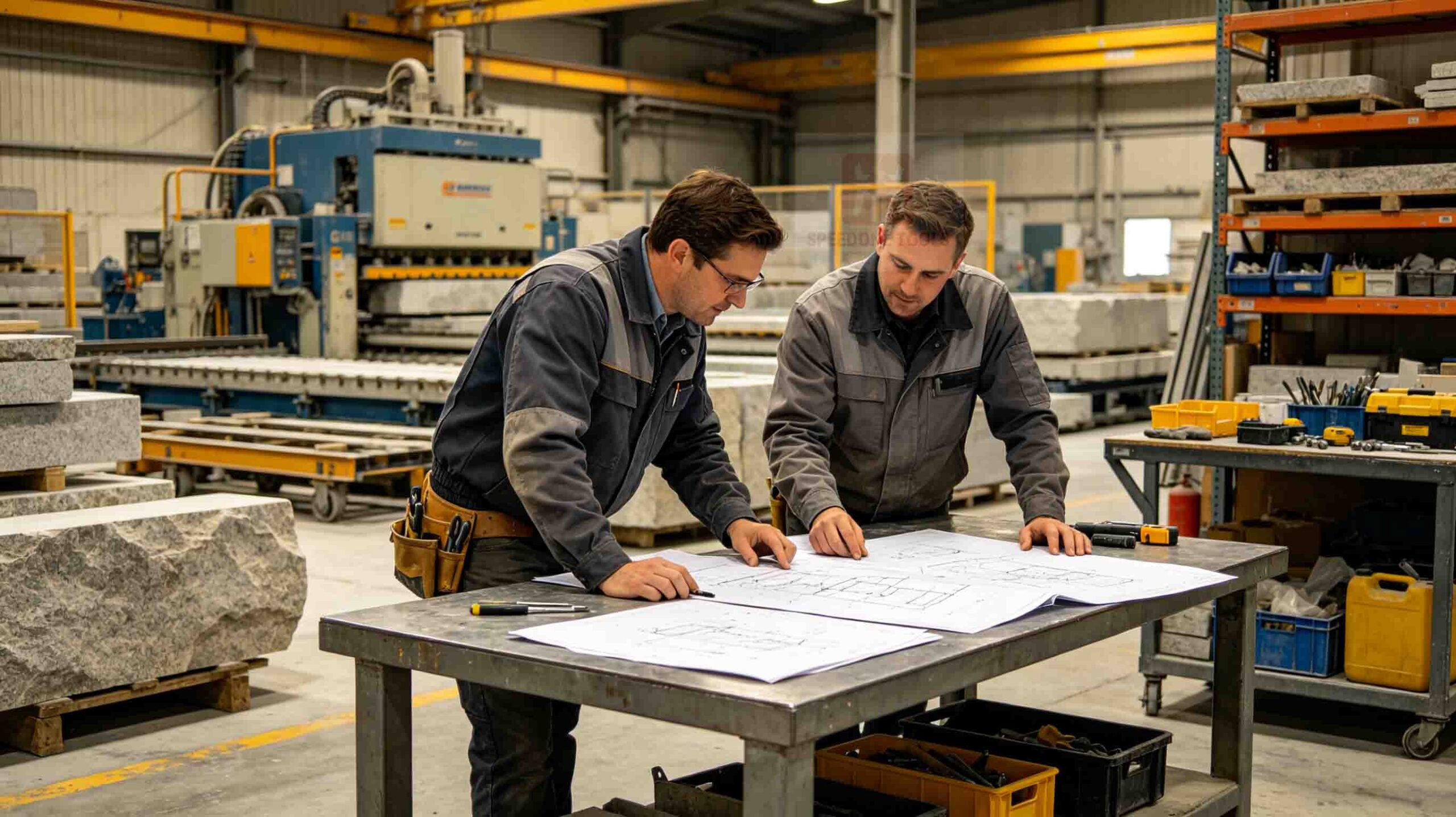
The global stone industry is becoming increasingly competitive. Stone processors are under constant pressure to reduce labor costs, improve production efficiency, increase safety standards, and minimize material damage. As a result, many companies are moving away from generic equipment and investing in OEM stone equipment designed specifically for their operational requirements.
Whether operating a granite factory, marble processing plant, quartz fabrication facility, or large-scale stone distribution center, every production environment has unique challenges. Standard equipment may solve basic transportation or storage requirements, but it often fails to maximize workflow efficiency. This is where custom machinery provides a significant competitive advantage.
From customized slab transport carts and A-frame storage racks to specialized lifting equipment and integrated logistics systems, OEM solutions allow businesses to build equipment around their workflow instead of forcing their workflow to adapt to standard equipment limitations.
What Is OEM Stone Equipment?
OEM (Original Equipment Manufacturer) stone equipment refers to machinery manufactured according to a customer’s specific requirements. Rather than selecting a standard model from a catalog, buyers work directly with the manufacturer to create equipment optimized for their factory layout, production volume, slab dimensions, and operational objectives.
Common OEM stone equipment categories include:
- Custom slab transport carts
- Modified A-frame storage racks
- Heavy-duty forklift attachments
- Specialized slab lifting systems
- Custom bundle transport carts
- Factory-specific logistics equipment
- Automated handling solutions
- OEM branded equipment for distributors
For many factories, OEM equipment becomes an important part of long-term productivity planning because it eliminates inefficiencies that standard equipment cannot address.
Why More Stone Factories Are Choosing Custom Machinery
No two stone factories operate exactly the same way. Differences in material type, slab size, warehouse layout, transportation routes, and production volume all affect equipment requirements.
| Standard Equipment | OEM Equipment |
|---|---|
| Fixed dimensions | Customized dimensions |
| Generic applications | Workflow-specific designs |
| Limited flexibility | Maximum adaptability |
| Basic functionality | Advanced customized features |
| Short-term solution | Long-term productivity improvement |
Although OEM equipment generally requires a higher initial investment, many factories discover that customized solutions provide significantly higher returns over the equipment lifecycle.
Popular OEM Equipment in the Stone Industry
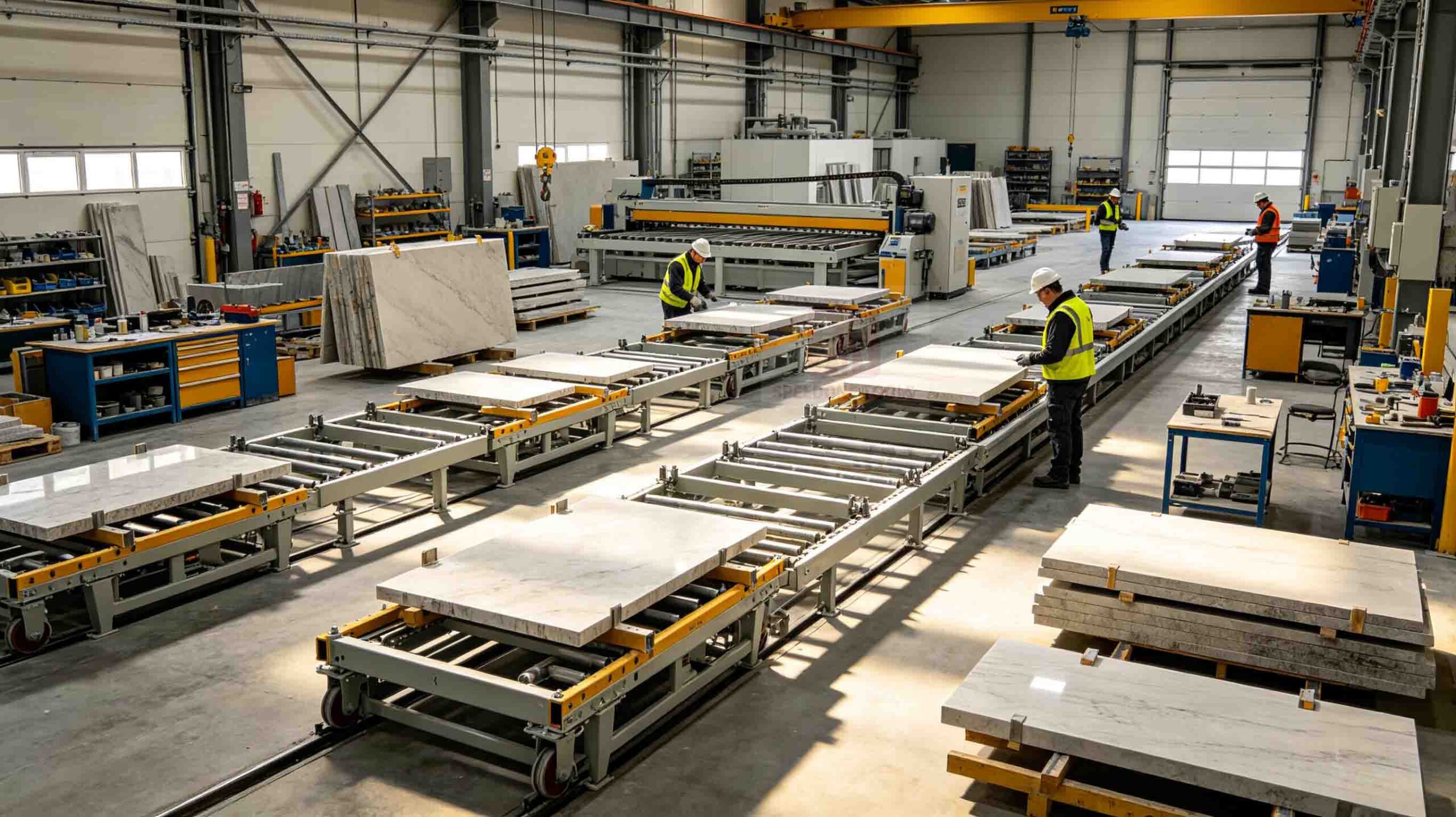
Transport and handling equipment represent the largest segment of OEM demand within the stone industry.
Stone slabs often weigh hundreds of kilograms, making safe transportation critical. Custom transport carts can be designed around:
- Slab dimensions
- Aisle width restrictions
- Forklift compatibility
- Production line requirements
- Load capacities
- Warehouse traffic patterns
Similarly, custom A-frame systems can be engineered to maximize storage density while maintaining slab safety.
For exporters, OEM modifications frequently focus on improving shipping efficiency, reducing loading time, and maximizing container utilization.
The OEM Development Process
Successful OEM projects follow a structured development process.
| Stage | Key Activities |
|---|---|
| Requirement Analysis | Identify operational challenges |
| Engineering Design | CAD drawings and technical review |
| Prototype Development | Testing and validation |
| Production | Manufacturing and quality control |
| משלוח | Packaging and export logistics |
| תמיכה לאחר המכירה | Technical assistance and spare parts |
Factories that actively participate during the design phase typically achieve better final outcomes because the equipment is tailored precisely to operational needs.
How OEM Equipment Improves Production Efficiency
The primary reason companies invest in OEM machinery is efficiency improvement.
Customized equipment reduces:
- Unnecessary material movement
- Worker travel distances
- Loading and unloading times
- Material handling risks
- Equipment bottlenecks
- Production downtime
Even small workflow improvements can create substantial gains when multiplied across thousands of production cycles each year.
OEM Equipment and Workplace Safety
Safety remains one of the most important factors in stone processing operations.
Stone slabs are heavy, brittle, and potentially dangerous when handled improperly. OEM equipment can incorporate safety features specifically designed for factory conditions.
- Enhanced load stability
- Improved ergonomic handling
- Anti-slip protection systems
- Reinforced structural supports
- Forklift safety integration
- Controlled slab positioning
Reducing workplace injuries not only protects employees but also minimizes insurance costs, downtime, and regulatory risks.
Why China Manufacturers Lead OEM Stone Equipment Production
Many international buyers choose China manufacturers for OEM stone equipment because of their combination of engineering expertise, production flexibility, and cost efficiency.
Leading China factories provide:
- Professional engineering teams
- Rapid prototype development
- Flexible customization capabilities
- Competitive manufacturing costs
- Global export experience
- Comprehensive after-sales support
China suppliers serving the stone industry have developed extensive experience with material handling equipment, making them strong partners for custom projects.
Key Questions Buyers Should Ask Before Ordering
1. Does the Supplier Understand Stone Handling?
Industry-specific experience is essential. Manufacturers familiar with slab transportation and storage systems can anticipate challenges that general equipment suppliers may overlook.
2. Can They Provide Engineering Drawings?
Professional OEM projects should include detailed CAD drawings and technical documentation.
3. What Testing Procedures Are Used?
Load testing, weld inspections, and structural verification should be part of the quality assurance process.
4. What Is the Lead Time?
Complex OEM projects often require longer production schedules than standard equipment.
5. Is Spare Parts Support Available?
Reliable suppliers provide long-term spare parts and technical support.
OEM Supplier Evaluation Checklist
| Evaluation Factor | Importance |
|---|---|
| Engineering Capability | Very High |
| Manufacturing Experience | Very High |
| Quality Control System | גבוה |
| Export Experience | גבוה |
| Customization Flexibility | גבוה |
| שירות לאחר מכירה | גבוה |
Calculating ROI for OEM Equipment
Many buyers initially focus on purchase price, but ROI provides a more accurate measure of value.
Typical ROI drivers include:
- Labor cost reduction
- Higher production throughput
- הפחתת נזק לחומרים
- Lower maintenance costs
- Improved storage efficiency
- Reduced workplace incidents
In many medium-sized stone factories, customized equipment pays for itself within 12 to 24 months through operational savings alone.
The Future of OEM Stone Equipment
The next generation of OEM equipment is expected to include greater automation, IoT monitoring capabilities, and advanced safety technologies.
Factories seeking long-term competitiveness are increasingly investing in customized systems capable of supporting future expansion and automation initiatives.
Rather than simply purchasing machinery, businesses are investing in engineered solutions designed to improve every stage of the production process.
הערה סופית / לקחים מעשיים
OEM stone equipment is no longer reserved for large industrial groups. Today, factories of all sizes are leveraging custom machinery to improve safety, productivity, and profitability. The most successful projects begin with a clear understanding of operational challenges and a partnership with an experienced manufacturer capable of delivering engineered solutions. By focusing on long-term ROI rather than initial purchase cost alone, buyers can achieve substantial competitive advantages through customized stone handling and logistics equipment.
שאלות נפוצות (FAQ)
1. What is OEM stone equipment?
OEM stone equipment is machinery designed and manufactured according to a buyer’s specific operational and production requirements.
2. Why choose OEM equipment instead of standard products?
OEM equipment is customized to match factory workflows, improve efficiency, and solve unique operational challenges.
3. What equipment can be customized?
Transport carts, A-frame racks, lifting equipment, forklift attachments, storage systems, and integrated logistics solutions can all be customized.
4. How do I evaluate an OEM supplier?
Review engineering capabilities, manufacturing experience, quality control systems, export experience, and after-sales support.
5. Is OEM equipment more expensive?
Initial costs may be higher, but customized equipment often delivers greater efficiency, lower labor costs, and better long-term ROI.
References
- ISO 9001 Quality Management Systems – Requirements.
- Occupational Safety and Health Administration (OSHA) Material Handling Guidelines.
- Natural Stone Institute – Stone Industry Technical Resources.
- MIA Stone Industry Safety Standards and Best Practices.
- International Material Handling Association (MHI) Equipment Design Guidelines.
- Lean Manufacturing Principles for Industrial Material Handling Systems.

הנרי
היי, אני מחבר הפוסט הזה, ואני עוסק בתחום זה כבר יותר מ-16 שנים. אם אתם זקוקים לשירות OEM&ODM עבור כלי אבן, אל תהססו לשאול אותי כל שאלה.