בצע את העבודה שלך ביעילות!








In a slab rack vs A-frame comparison, neither system is automatically better for every stone factory. Slab racks are often better suited to organized, higher-density main inventory storage, while A-frame racks provide accessible angled support for production staging, temporary storage, finished countertops and loading preparation. The right choice depends on slab dimensions, load requirements, inventory turnover, handling equipment, aisle space, floor conditions and how material moves through the factory. Many professional stone facilities benefit from using both systems for different stages of the workflow.
Slab Rack vs A-Frame Rack: Which One Is Better?
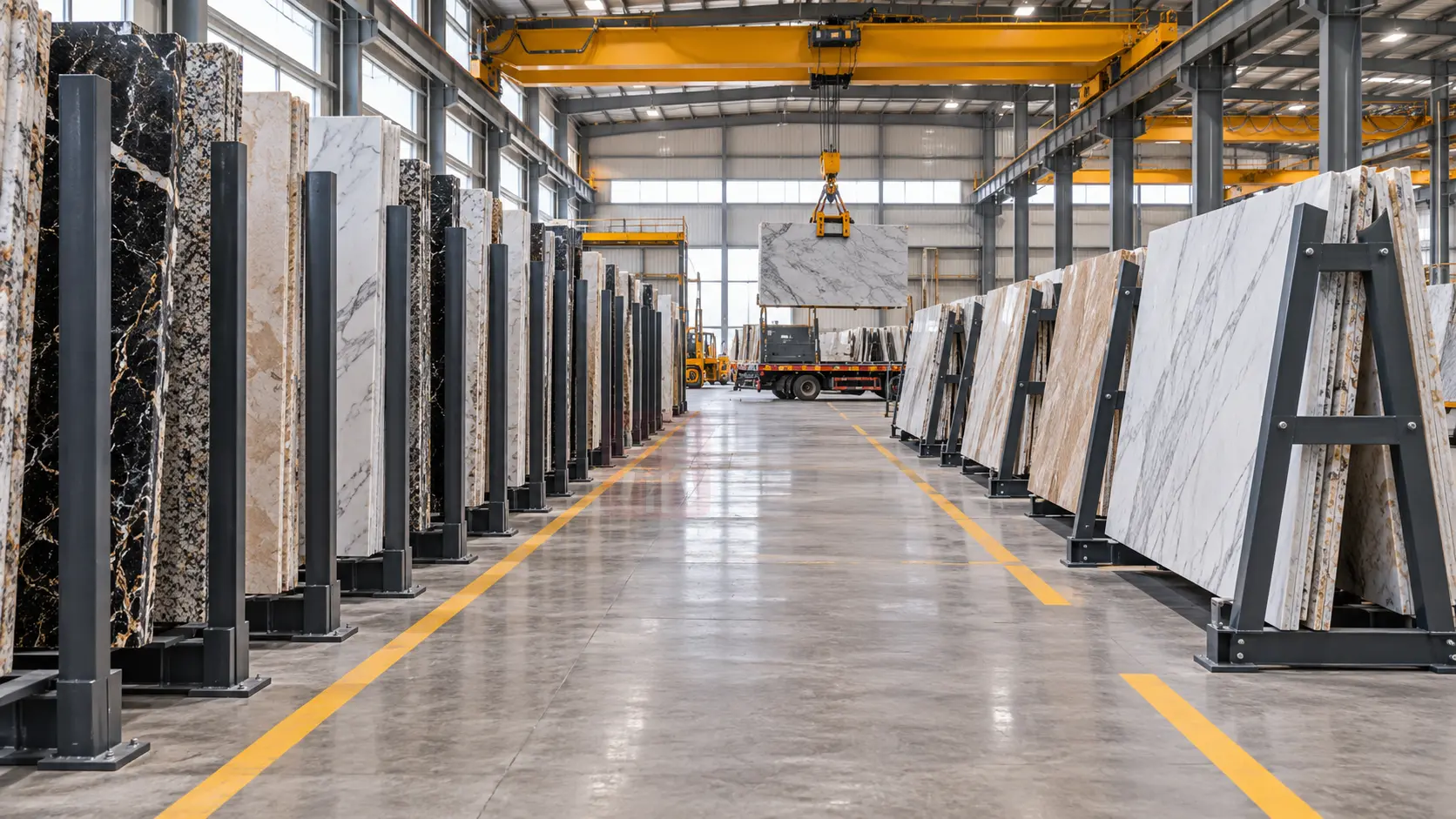
Slab rack vs A-frame comparison for stone slab storage in a professional warehouse
Choosing between a slab rack vs A-frame is an important decision for stone factories, warehouses, distributors and fabrication workshops.
Both systems can be used with granite, marble, quartz, porcelain, sintered stone and other large-format materials, but they solve different storage problems.
A slab rack is often selected when the main objective is organized inventory storage and efficient use of warehouse space.
An A-frame rack provides angled support and can be particularly useful for production staging, temporary storage, finished-piece storage and loading preparation.
The correct question is therefore not:
“Which rack is better?”
It is:
“Which rack is better for this particular stage of my stone-handling workflow?”
זה stone storage rack comparison examines the practical differences between the two systems so buyers can choose based on actual workflow, material access and operating requirements rather than appearance alone.
What Is a Slab Rack?
A slab rack is a steel storage system designed to support large stone slabs in defined warehouse positions.
Depending on the design, the system may use fixed or removable posts, uprights, rails or separated storage positions to organize slabs into groups.
Slab racks are commonly used for:
- Granite slab storage.
- Marble slab storage.
- Quartz slab storage.
- Stone warehouse inventory.
- Fabrication factory storage.
- Distributor slab yards.
- Project-specific inventory zones.
The main advantage is organization.
A factory can divide inventory according to:
- Material.
- Color.
- Thickness.
- Supplier.
- Batch.
- Customer project.
- Inventory turnover.
A professional storage rack should be evaluated as more than welded steel. Base stability, support geometry, load distribution, material quality, contact protection and loading method all affect performance.
For a deeper explanation, read למה מדפי סlabs הם יותר מסתם מסגרות מתכת.
Buyers comparing permanent storage systems can also review the Speedone slab rack range.
What Is an A-Frame Rack?
An A-frame rack uses an angled or triangular central structure that allows slabs or fabricated pieces to rest against one or both sides.
A-frame systems are commonly used for:
- Temporary slab storage.
- Production staging.
- Finished countertop storage.
- Loading preparation.
- Internal slab movement.
- Project-specific material staging.
- Warehouse organization.
The angled structure creates an accessible resting surface while allowing suitable cranes, clamps, vacuum lifters, forklifts or transport equipment to approach the material.
Some A-frame racks are fixed, while others are designed for mobile or transport applications.
Buyers can also review Speedone A-frame storage rack solutions when comparing available configurations.
Slab Rack vs A-Frame: Quick Comparison
| Factor | מדף משטחים | מתלה A-Frame |
|---|---|---|
| שימוש עיקרי | Main inventory storage | Storage, staging and loading preparation |
| Storage Density | Often well suited to organized high-density rows | Depends on one-sided or double-sided configuration |
| Slab Access | Depends on section layout and inventory grouping | Generally accessible from exposed sides |
| Layout Flexibility | Best for planned permanent storage areas | Useful for staging and flexible work zones |
| ניידות | Usually fixed | Fixed and mobile designs available |
| Typical Buyer | Factories and high-inventory warehouses | Factories, distributors and fabrication shops |
| Typical Role | Store inventory until required | Bridge storage, production and loading stages |
1. Which Rack Uses Warehouse Space Better?
For factories storing a large number of slabs, floor-space utilization is usually one of the first considerations.
Slab racks can perform well in high-density storage zones because multiple storage sections can be arranged in planned rows.
This makes it easier to create separate zones for different materials and projects.
A-frame racks require space for the central structure and angled slabs on one or both sides.
This may require more floor width per unit, although a double-sided A-frame can still provide substantial storage capacity.
The important point is that storage density should not be evaluated in isolation.
A rack that theoretically stores more slabs per meter is not necessarily more efficient if workers must move several slabs every time they need one specific material.
A more useful calculation is:
Practical Storage Efficiency = Storage Capacity + Material Accessibility + Handling Efficiency
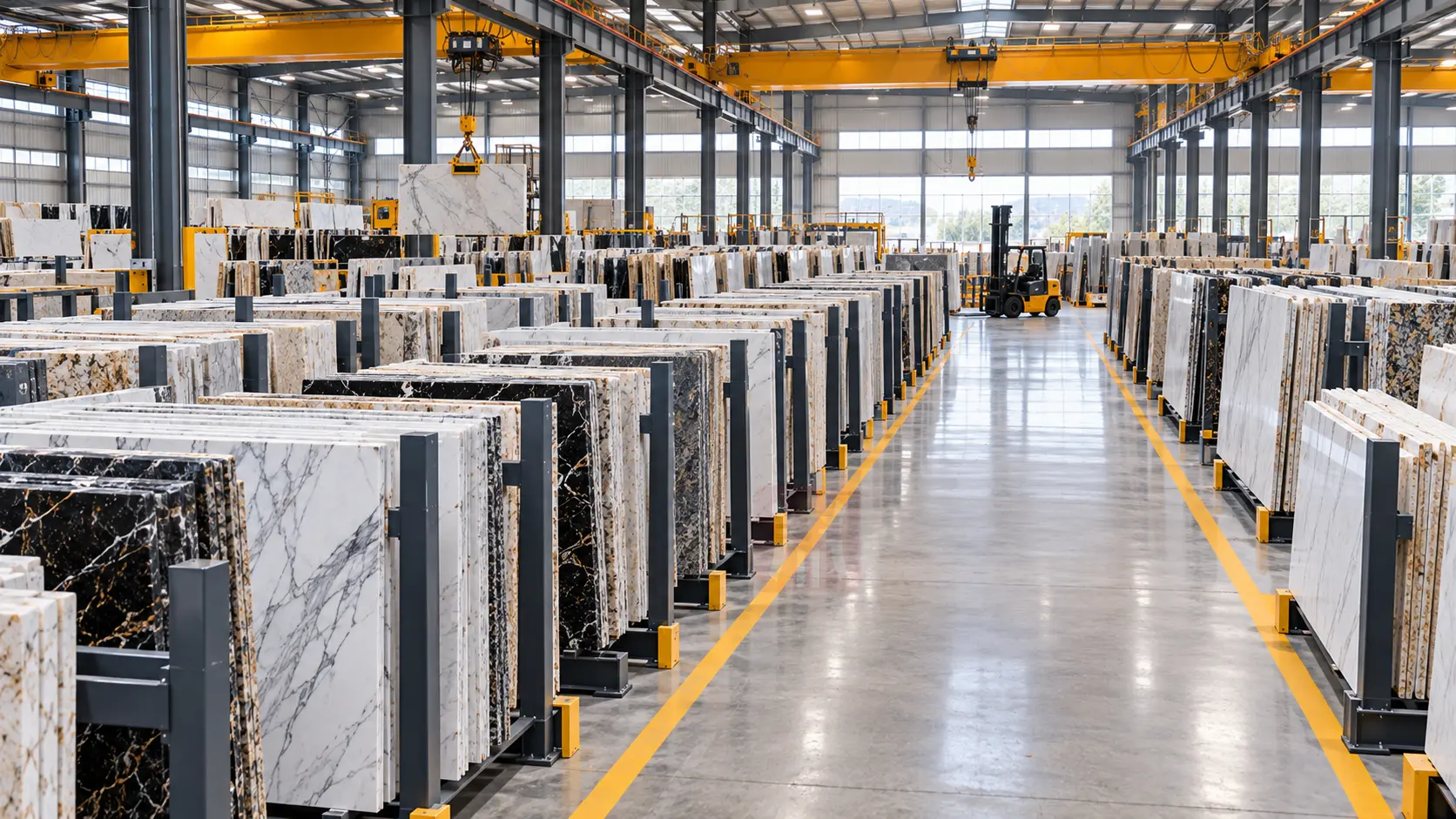
Heavy duty stone slab rack for organized granite marble and quartz storage
2. Which System Provides Easier Slab Access?
A-frame racks generally provide straightforward visual access because material is supported against exposed sides of the frame.
This can make them useful for:
- Frequently used materials.
- Production staging.
- Finished stone pieces.
- Short-term project storage.
- Loading preparation.
Fixed slab racks may provide more clearly separated inventory positions, but access depends heavily on how materials are organized.
If fast-moving materials are buried behind unrelated inventory, retrieval time can increase even if the storage density looks excellent on paper.
For this reason, warehouse managers should measure both:
- How many slabs can be stored.
- How long it takes to retrieve the required slab.
3. Which Rack Is Better for Long-Term Inventory?
For larger permanent inventories, slab racks are often the more practical direction.
A fixed rack system can create clearly identified warehouse positions for:
- White marble.
- Black granite.
- Quartz collections.
- Supplier batches.
- Reserved customer projects.
- Fast-moving materials.
- Slow-moving inventory.
Rack locations can also be connected to barcode, QR-code or warehouse-management systems.
A-frame racks can also hold material for longer periods when properly designed, but they are often especially valuable where access and staging flexibility are higher priorities than maximum organized storage density.
4. Which Rack Is Better for Production Staging?
This is one area where A-frames can be particularly useful.
For example, a fabrication shop may retrieve the slabs required for the next day’s jobs from the main inventory and move them to an A-frame close to the bridge saw or CNC area.
This creates a dedicated production buffer between storage and fabrication.
Potential operational benefits include:
- Less congestion around main inventory.
- Fewer last-minute slab searches.
- More predictable machine loading.
- Clear separation between inventory and active jobs.
- Reduced unnecessary handling.
Factories trying to improve the entire material path can also review how better slab handling organization can improve stone factory efficiency.
5. Which Rack Is Better When Inventory Changes Frequently?
Factories with stable product ranges can plan permanent storage zones relatively easily.
However, other businesses regularly change inventory because of:
- Seasonal demand.
- New quartz collections.
- Large project orders.
- Changing slab dimensions.
- Expansion into new materials.
Traditional fixed slab racks work well for permanent zones, while modular rack systems may provide greater adaptability.
A-frame racks can also provide flexibility, especially where material needs to move between inventory, production and loading.
Factories with changing warehouse requirements can learn more about how modular slab racks can improve warehouse space efficiency.
6. Slab Rack vs A-Frame for Marble Storage
Both systems can store marble when designed for the actual slab dimensions and loads.
Marble may contain natural veins and fissures, so controlled support and handling are important.
When selecting marble storage equipment, consider:
- Slab height.
- Slab width.
- Thickness.
- Individual slab weight.
- Total intended load.
- Frequency of retrieval.
- Lifting method.
- Stone contact protection.
- Floor condition.
A slab rack can work well for organized long-term marble inventory.
An A-frame can be particularly useful for selected slabs moving into inspection, fabrication or loading preparation.
7. Slab Rack vs A-Frame for Granite Storage
Granite slabs can be heavy, making rated load and structural suitability important regardless of rack type.
Factories with large permanent granite inventories may use slab racks to create multiple clearly identified storage sections.
A-frames may then be positioned near:
- Bridge saws.
- CNC machines.
- Inspection areas.
- Production staging areas.
- Loading stations.
For many granite fabrication plants, the most efficient solution may therefore be using both rack types at different stages.
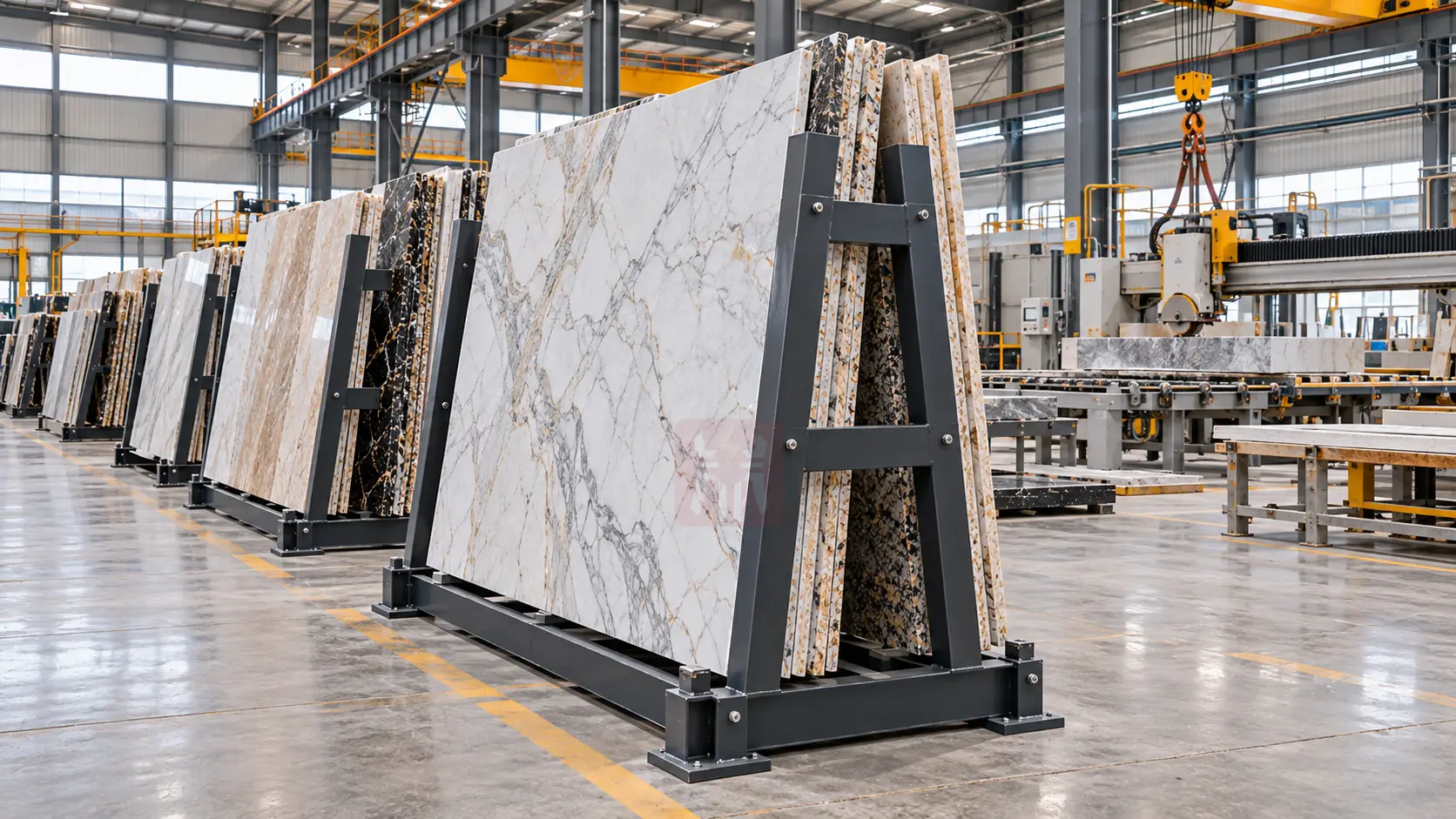
A-frame rack supporting large stone slabs for staging and storage in a fabrication factory
8. Slab Rack vs A-Frame for Quartz Slabs
Quartz countertop factories often require both organized inventory and short-term production staging.
Fixed slab racks can organize quartz slabs by:
- Color.
- Brand.
- Batch.
- Thickness.
- Customer project.
A-frames can then hold selected slabs near fabrication equipment before production begins.
This prevents main inventory aisles from becoming temporary staging zones.
9. Which Rack Works Better with Lifting Equipment?
The rack should be selected together with the handling equipment already used in the factory.
Stone slabs may be handled using:
- Overhead cranes.
- Slab lifting clamps.
- Vacuum lifters.
- Forklifts.
- Forklift attachments.
- Slab transport carts.
Before selecting the storage system, confirm whether the equipment can:
- Approach the rack.
- Reach the required slab.
- Lift the material without obstruction.
- Rotate where required.
- Exit the storage position safely.
A rack can have excellent capacity but still perform poorly if lifting equipment cannot access the stored material efficiently.
10. Compare the Complete Stone Storage Workflow
A useful stone storage rack comparison should examine the complete material route rather than only rack dimensions.
A typical stone factory workflow may include:
- Truck or container unloading.
- Incoming inspection.
- Main slab storage.
- Inventory selection.
- Production staging.
- Cutting.
- Fabrication.
- Finished-product storage.
- Packaging.
- Final loading.
If one rack configuration reduces unnecessary movements between these stages, it may provide more operational value than another system that simply holds a larger number of slabs.
11. Slab Rack vs A-Frame for Safety
Neither storage system is automatically safe simply because of its shape.
Storage performance depends on factors such as:
- Rated load capacity.
- Actual slab weight.
- Support geometry.
- Floor condition.
- Equipment condition.
- Aisle clearance.
- Handling method.
- Operator procedures.
Buyers should avoid choosing either system solely on appearance or price.
Storage equipment should be matched to the actual application and used according to the manufacturer’s instructions and applicable workplace requirements.
12. Fixed A-Frame vs Mobile A-Frame
Fixed A-Frame
A fixed A-frame is appropriate where the storage or staging location remains relatively stable.
Potential advantages include:
- Simple structure.
- Predictable loading position.
- No wheel or travel-system maintenance.
- Useful staging near production areas.
Mobile A-Frame
A mobile A-frame may help move suitable slabs or finished pieces between different work areas.
Additional considerations include:
- Wheel capacity.
- Floor quality.
- Travel distance.
- Turning space.
- Movement control.
- Load support during transport.
A mobile A-frame should therefore be evaluated as both storage equipment and transport equipment.
13. Which Rack Is Better for Finished Countertops?
Finished countertops often require a different storage approach from raw slabs.
A fabricated piece may contain:
- Polished edges.
- Sink cutouts.
- Cooktop openings.
- Thin rails.
- Drilled holes.
- Irregular shapes.
A-frame systems are often useful for staging finished pieces because the material remains accessible on the angled support surface.
However, the rack should still match the dimensions, weight and geometry of the finished components.
14. Which Storage System Is Better for Showrooms?
A showroom has different priorities from a high-density industrial warehouse.
Customer-facing storage may prioritize:
- Visibility.
- Material presentation.
- Controlled customer access.
- Easy slab identification.
- Convenient selection.
For this reason, a dedicated display system may be more appropriate than either a standard warehouse slab rack or a production A-frame.
Stone distributors can learn more about how a slab display rack can combine stone storage with customer presentation.
15. Maintenance: Slab Rack vs A-Frame
Both rack systems should be incorporated into the facility’s inspection and maintenance program.
Depending on the equipment design, check:
- Weld condition.
- Steel deformation.
- Corrosion.
- Loose components.
- Base condition.
- Stone contact surfaces.
- Forklift or equipment impacts.
Mobile A-frames may also require inspection of:
- Wheels.
- Casters.
- Axles.
- Bearings.
- Brakes.
- Locking mechanisms.
Equipment should also be evaluated following impacts, overloads or other abnormal events.
16. Purchase Price vs Long-Term Operating Value
The rack with the lowest quotation does not necessarily have the lowest long-term operating cost.
A better comparison includes:
- Purchase cost.
- Storage capacity.
- Material retrieval time.
- Number of handling movements.
- Floor-space utilization.
- Handling-equipment requirements.
- Maintenance cost.
- Expected service life.
- Future expansion.
If a storage configuration reduces several minutes of unnecessary handling every time a slab is retrieved, the accumulated operational value may eventually be more important than a small difference in purchase price.
How to Compare the Financial Value of Both Systems
Instead of assuming one system produces a specific percentage saving, use actual factory data.
| מטרית | What to Measure | Why It Matters |
|---|---|---|
| Storage Footprint | Total floor area used | Shows practical space efficiency |
| Retrieval Time | Minutes needed to retrieve one slab | Reveals labor and production impact |
| Slabs Moved per Retrieval | Number of unnecessary movements | Measures handling efficiency |
| Handling Equipment Time | Crane or forklift time required | Shows equipment utilization |
| Material Damage | Storage or retrieval-related incidents | Identifies potential rework or replacement cost |
A practical formula is:
Annual Operational Benefit = Labor Savings + Reduced Handling Cost + Avoided Damage/Rework + Space/Logistics Savings − Additional Maintenance/Training Cost
17. Compliance and Market Requirements
Storage-system requirements can differ by market, workplace and application.
Buyers should review:
- Manufacturer documentation.
- Rated load information.
- Installation instructions.
- Inspection procedures.
- Anchoring requirements where applicable.
- Applicable workplace requirements.
- Local requirements relevant to the installation.
Companies buying storage systems for different markets can review this overview of slab rack compliance considerations and global market trends.
18. Can Slab Racks and A-Frames Be Used Together?
Yes. In many factories, this is the most practical solution.
A combined storage strategy may use:
- Slab racks for main warehouse inventory.
- A-frames for production staging.
- Mobile A-frames for suitable internal transport applications.
- Display racks for customer-selection areas.
This allows each piece of equipment to perform the role for which it is best suited.
Factories wanting another product-selection perspective can also review this guide comparing slab racks and A-frame storage racks for different stone storage needs.
If X, Choose Y: Slab Rack vs A-Frame Decision Guide
- If you have a large permanent inventory: start by evaluating a slab rack system.
- If you need production staging near the bridge saw or CNC: consider an A-frame.
- If material changes frequently: consider modular racks or flexible A-frame staging.
- If finished countertops need accessible support: consider a suitable A-frame.
- If maximum inventory organization is the priority: slab racks are usually the stronger starting point.
- If the storage equipment also needs to move: evaluate a purpose-designed mobile A-frame.
- If customers need to view materials: use a dedicated slab display rack.
- If your factory needs both long-term inventory and active-job staging: use a combined slab rack + A-frame system.
Slab Rack vs A-Frame: Final Recommendation Table
| Your Requirement | Recommended Direction |
|---|---|
| Large permanent slab inventory | מדף משטחים |
| Production staging | A-Frame |
| Finished countertop staging | A-Frame |
| High-density organized warehouse | מדף משטחים |
| Flexible temporary storage | A-Frame or Mobile A-Frame |
| Changing inventory layout | Modular Slab Rack / Flexible A-Frame |
| Customer-facing showroom | Dedicated Slab Display Rack |
| Complete stone factory workflow | Combination of Slab Racks and A-Frames |
Common Buying Mistakes
| Mistake | Possible Result | Better Approach |
|---|---|---|
| Choosing by appearance | Poor workflow fit | Define the application first |
| Choosing only by capacity | Difficult slab retrieval | Evaluate capacity and accessibility together |
| Ignoring lifting equipment | Crane or forklift cannot access slabs efficiently | Design the rack around the handling method |
| Using main storage for staging | Warehouse congestion | Create a dedicated production staging zone |
| Buying only on price | Higher long-term handling cost | Compare lifecycle and workflow value |
How to Evaluate a Stone Storage Rack Supplier
A professional supplier should ask how the equipment will actually be used before recommending a rack.
Useful supplier evaluation points include:
- Rated load information.
- Product dimensions.
- Steel specifications where relevant.
- Support geometry.
- Surface treatment.
- Stone contact protection.
- Quality-control process.
- Replacement components.
- Export packaging.
- Customization capability.
- Application support.
A supplier should also request information about your slab dimensions, loads, handling equipment and warehouse layout.
China Slab Rack and A-Frame Manufacturer Considerations
Stone factories and distributors sourcing storage racks from China may choose between standard designs and OEM configurations.
Customization can include:
- Rack dimensions.
- Storage spacing.
- Support height.
- Intended load.
- Surface treatment.
- Indoor or outdoor configuration.
- Wheel configuration for mobile equipment.
- Color and branding.
- Export packaging.
However, customization should begin with application requirements rather than appearance.
Before requesting an OEM design, provide:
- Maximum slab dimensions.
- Maximum individual and total load.
- Number of slabs stored.
- Available floor dimensions.
- Aisle width.
- Forklift or crane information.
- Indoor or outdoor operating conditions.
- Whether the equipment must remain fixed or mobile.
Questions to Ask Before Buying
- What types of stone will be stored?
- What are the maximum slab dimensions?
- What is the heaviest individual slab?
- What is the maximum intended load?
- How many slabs must be stored?
- How frequently will each storage position be accessed?
- Will slabs be handled by crane, forklift, clamp, vacuum lifter or cart?
- How much aisle space is available?
- Is the system for permanent storage or temporary staging?
- Does the rack need to move?
- Will finished countertops also use the system?
- Will storage requirements expand in the future?
Soft CTA: Map the Workflow Before Choosing the Rack
Before requesting a quotation, map the path of a slab from unloading to final shipment.
Identify:
- Where inventory is stored.
- Where slabs are inspected.
- Where active jobs wait for production.
- How the crane or forklift accesses material.
- Where finished products are staged.
- Which movements currently create delays.
Then provide Speedone with slab dimensions, load requirements, available floor area, aisle width, handling equipment and photos or drawings of the proposed storage area.
This makes it easier to determine whether the project is best served by a slab rack, A-frame, mobile A-frame, modular system or a combination of several storage solutions.
References and Practical Safety Resources
- Storage-equipment manufacturer’s rated-capacity, installation, operating and maintenance instructions.
- Stone-handling equipment manufacturer’s operating requirements.
- Applicable workplace material-storage and handling requirements.
- Applicable local building, workplace and equipment requirements.
- Internal warehouse lifting, inspection and material-handling procedures.
הערה סופית / לקחים מעשיים
In a slab rack vs A-frame decision, the best option depends on the role the equipment must perform. Slab racks are generally well suited to organized main inventory and higher-density warehouse storage, while A-frame racks are especially useful for accessible production staging, temporary storage, finished products and loading preparation. For many stone factories, the strongest solution is not choosing one system exclusively. It is using slab racks for permanent inventory and A-frames for the stages where slabs need to remain accessible and move efficiently toward production.
Frequently Asked Questions About Slab Rack vs A-Frame
1. Is a slab rack better than an A-frame?
Not universally. Slab racks are often better suited to organized main inventory and high-density storage, while A-frames can be more practical for staging, flexible access, finished products and temporary storage. The correct choice depends on the application.
2. Which rack takes up less warehouse space?
Slab racks can provide efficient storage density when arranged in planned rows. A-frame racks require angled support space, although double-sided configurations can still use floor area effectively. Actual space efficiency depends on aisle requirements, handling equipment and material accessibility.
3. Can A-frame racks store marble and granite slabs?
Yes, when the A-frame is designed for the slab dimensions and intended loads and is used according to its rated application and manufacturer instructions.
4. Can a stone factory use slab racks and A-frames together?
Yes. A common approach is to use slab racks for main inventory and A-frames for production staging, finished products, loading preparation or suitable internal transport applications.
5. Which rack is better for production staging?
A-frames are often particularly useful for production staging because selected slabs can remain accessible near bridge saws, CNC machines or inspection areas without occupying main inventory storage positions.
6. Which rack is better for large permanent slab inventory?
A fixed slab rack is often the stronger starting point where the main goal is organizing a large permanent inventory into clearly identified storage sections.
7. Which rack is better for finished countertops?
A suitable A-frame can be useful for finished-countertop staging because it provides accessible angled support. However, the frame must be compatible with the dimensions, weight and geometry of the fabricated pieces.
8. What should I check before buying a stone storage rack?
Check slab dimensions, actual load requirements, rated rack capacity, inventory quantity, available floor space, aisle width, handling equipment, frequency of access, floor conditions, indoor or outdoor use and future storage requirements.

הנרי
היי, אני מחבר הפוסט הזה, ואני עוסק בתחום זה כבר יותר מ-16 שנים. אם אתם זקוקים לשירות OEM&ODM עבור כלי אבן, אל תהססו לשאול אותי כל שאלה.