効率的に仕事をこなす





Learn how stone fabricators should choose an A-Frame Storage Rack, including load capacity, steel structure, slab safety, shop layout, surface protection and supplier checks.
A countertop fabrication shop receives a container of granite, marble, quartz and quartzite slabs. Some slabs are polished and reserved for kitchen islands. Some are fragile bookmatched marble pieces for hotel walls. Some are remnants from previous projects. At first, the shop stores them against temporary stands because the team wants to save equipment cost. After several weeks, the warehouse becomes crowded, slabs are difficult to access, workers must move multiple pieces to reach one order, edges get chipped, and the production team realizes that slab storage is not only a warehouse issue. It is a safety, workflow and profit issue.
プロフェッショナル Aフレーム収納ラック is designed to support heavy slabs at a stable leaning angle while improving material organization and shop access. For stone fabricators, the right rack can reduce unnecessary slab movement, protect polished edges, improve forklift handling, make inventory easier to identify and create a safer production environment. The wrong rack, however, can create overload risk, slab tipping risk, surface scratches, poor workflow and long-term maintenance problems.
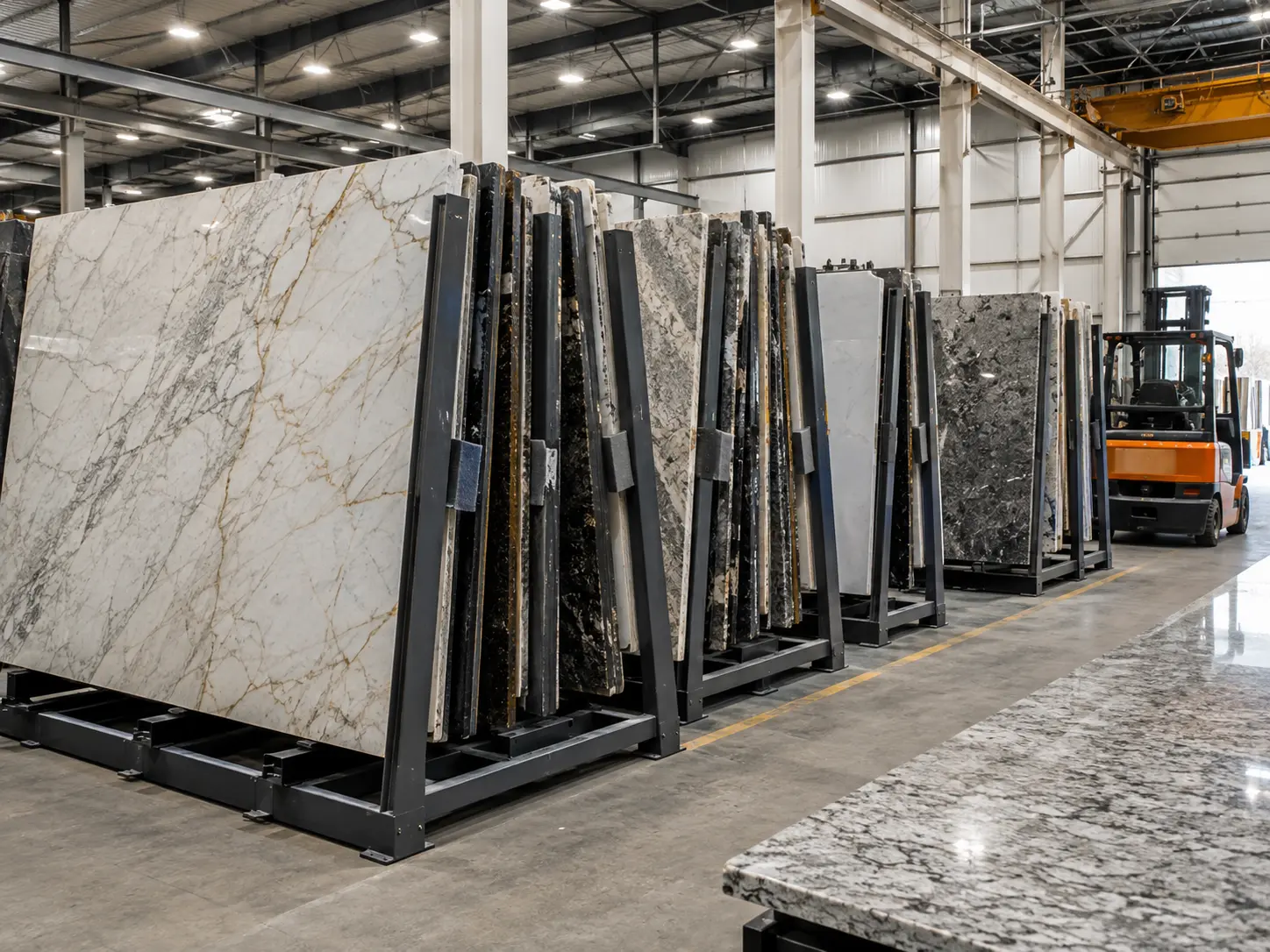
High Quality A-Frame Storage Rack
Quick Summary: A-Frame Storage Rack Buying Checklist
The best rack is not always the cheapest rack. A stone slab storage system should be selected by slab material, slab thickness, rack capacity, shop layout, handling method and safety process. Dense granite slabs, fragile marble slabs, engineered quartz, quartzite and large-format porcelain panels all place different demands on the rack structure and support surface.
Many buyers begin by searching for a heavy duty stone A frame rack, but “heavy duty” should be verified through rated capacity, steel tube size, base design, welding quality, anti-slip protection, coating and real shop use. A rack should be evaluated as a material-handling asset, not as a simple welded frame.
| Buying Factor | Why It Matters | Buyer Check | Risk if Missed |
|---|---|---|---|
| 負荷容量 | Prevents overloading | Confirm rated capacity per side and total rack | Rack deformation or collapse |
| Rack angle | Supports stable slab leaning | Check design angle and contact points | Slab tipping risk |
| Base width | Improves stability | Compare footprint with slab height | Unstable rack under load |
| Steel structure | Controls durability | Check tube size, plate thickness and welding | Short service life |
| Surface protection | Protects polished slabs | Rubber pads, wood pads or protective strips | Scratches and edge chips |
| Forklift aisle | Improves handling safety | Confirm aisle width and loading direction | Unsafe handling |
What Is an A-Frame Storage Rack for Stone Fabricators?
How an A-Frame Rack Works
An A-Frame Storage Rack uses an angled or triangular frame structure to support slabs leaning on one or both sides. The A-shaped frame distributes weight through the base and support rails, allowing slabs to stand vertically or near-vertically while using less floor space than flat storage. In stone fabrication shops, this type of rack is commonly used for granite slab storage, marble slab storage, quartz slab storage, quartzite slab storage, porcelain panel storage, sintered stone staging, countertop blank storage, cut-to-size panel organization and warehouse inventory management.
The design is simple in appearance but highly practical in use. Slabs remain visible, accessible and separated by project or material type. Workers can identify slabs faster, reduce unnecessary rehandling and move materials more efficiently toward cutting, polishing, CNC processing or loading zones.
Why Stone Fabricators Use A-Frame Storage Racks
Stone fabricators use A-frame racks because slab materials are heavy, valuable and easy to damage when poorly stored. A polished marble slab can be scratched by direct steel contact. A quartzite slab can be heavy enough to stress a weak frame. A thin porcelain panel can chip if support is uneven. A bookmatched slab pair can lose project value if labels or sequence are confused.
A well-selected storage rack improves shop organization, material access, slab protection, inventory control, workflow efficiency and professional presentation. It can also help reduce unsafe behavior by giving operators a designated storage system instead of improvised stands or crowded leaning areas.
Step 1: Identify the Slab Types You Need to Store
Granite Marble Quartz Quartzite and Porcelain Slabs
Different stone and engineered surfaces have different storage concerns. Granite is dense and heavy, so the rack must prioritize load capacity, base stability and strong welding. Marble may contain natural veins, fissures or softer edges, so protective contact pads and stable leaning support are important. Quartz slabs are consistent but heavy, making straight support and clean surface protection important. Quartzite is hard, dense and often expensive, so fabricators need both strength and careful handling. Porcelain and sintered stone panels can be thin, large and brittle when unsupported, requiring wider soft contact and controlled movement.
| 材質タイプ | Storage Concern | Recommended Rack Focus |
|---|---|---|
| Granite slabs | Heavy load | Strong steel frame and high capacity |
| Marble slabs | Edge chips and fissures | Protective contact pads and stable leaning |
| Quartz slabs | Consistent but heavy | Straight support and organized storage |
| Quartzite slabs | Premium value and heavy weight | Strong rack and careful handling |
| Porcelain slabs | Thin large-format fragility | Full support and anti-scratch protection |
| Cut-to-size panels | Mixed sizes | Adjustable or segmented storage zones |
Full Slabs vs Remnants vs Cut-to-Size Pieces
Full slabs need high-capacity support and clear access for forklifts, cranes, slab clamps or vacuum lifters. Remnants need smaller compartment-style organization so valuable offcuts do not become hidden waste. Cut-to-size pieces need labeling and edge protection because they may already be assigned to a customer, room number or installation drawing. Bookmatched slabs need sequence control so the left and right panels are not separated.
A shop that stores only full slabs may need larger double-sided A-frame racks. A shop that frequently handles remnants may need smaller racks or divided sections. A project-focused fabricator may need staging racks near the cutting area, finishing area and loading area.
Step 2: Calculate Load Capacity Before Comparing Prices
Why Rated Capacity Matters
Slab weight depends on length, width, thickness and material density. A rack should not be selected by appearance. Buyers should estimate the real load before confirming a purchase. A simple calculation is: slab weight equals length multiplied by width multiplied by thickness multiplied by material density. In practical terms, a 3200 × 1600 × 20mm slab may weigh roughly 225–295 kg depending on the material type.
A useful choose an A-Frame Storage Rack for stone slab storage process should always begin with load capacity, slab type, rack angle, base width, steel specification and shop layout. If the supplier cannot explain rated capacity clearly, the buyer should not approve the rack for heavy slab storage.
| Slab Example | Approximate Size | Thickness | Estimated Weight Range |
|---|---|---|---|
| Quartz slab | 3200 × 1600mm | 20mm | 225–260 kg |
| Granite slab | 3200 × 1600mm | 20mm | 265–290 kg |
| Marble slab | 3200 × 1600mm | 20mm | 255–280 kg |
| Quartzite slab | 3200 × 1600mm | 20mm | 265–295 kg |
| Large-format porcelain | 3200 × 1600mm | 12mm | 140–180 kg |
Capacity per Side vs Total Capacity
Buyers should confirm whether the rated load applies to one side or the total rack. This is a critical difference for double-sided storage. If a rack is rated for total capacity, loading both sides based on one-side assumptions can overload the frame. Buyers should also ask how many slabs can be stored safely per side, what maximum slab height is recommended, whether the rack is designed for indoor or outdoor use, and what safety margin was considered in the design.
Step 3: Compare Rack Structure and Steel Specification
Frame Shape Base Width and Support Angle
The structure of an A-frame rack should match daily loading conditions. Important design elements include support angle, base width, vertical support height, cross bracing, bottom rail, slab contact bar, feet plates, anchor holes, forklift pockets where required, rubber pads, welded joints, bolted connections and anti-rust coating.
A wider base improves stability but uses more space. A steeper rack may save floor area but can increase slab tipping risk if the support angle is not well designed. A rack that looks strong when empty may still deform under real slab load if the steel section, welds or base structure are weak. For example, a 20T A-Frame slab rack with a wide square tube base, rubber protection and detachable link design is the type of specification buyers can compare when evaluating high-capacity workshop storage.
Steel Thickness Welding and Surface Treatment
Stone storage racks should be evaluated by steel tube dimensions, wall thickness, base plate thickness, weld length, weld continuity, reinforcement points, coating quality and corrosion protection. Painted racks may be cost-effective for indoor use. Powder-coated racks can provide a cleaner finish and better scratch resistance. Galvanized racks may be better for high-humidity or outdoor storage areas, depending on the environment.
| Structure Item | Buyer Question | Why It Matters |
|---|---|---|
| Main steel tube | What size and wall thickness? | Controls load resistance |
| Base frame | How wide and reinforced? | Controls stability |
| 溶接 | Are welds continuous and clean? | Controls strength |
| Contact pads | Rubber, wood or plastic? | Protects slab surface |
| Coating | Painted, powder-coated or galvanized? | Controls corrosion |
| Anchor holes | Available or not? | Helps secure rack where needed |
Step 4: Match Rack Dimensions to Your Shop Layout
Floor Space and Storage Density
A-frame racks save floor space by storing slabs on angled supports, often on both sides. However, they still require aisle clearance. Buyers should plan rack location based on slab length, slab height, rack footprint, forklift turning radius, overhead crane access, container unloading path, saw loading area, polishing area, finished goods zone, employee walking routes and emergency access.
For shops trying to maximize warehouse efficiency with A-Frame Storage Rack systems, the key is not only buying more racks. The key is placing racks in the correct workflow sequence: receiving, inspection, storage, cutting, fabrication, finished goods and outbound loading. Poor placement creates extra handling even if the rack itself is strong.
Forklift Crane and Slab Clamp Access
Handling equipment affects rack placement. If the shop uses forklifts, buyers must plan approach direction and turning clearance. If the shop uses overhead cranes, vertical lifting clearance and hook travel must be reviewed. If operators use slab clamps, the rack should allow enough slab spacing and clamp access. If vacuum lifters are used, the slab face must be reachable and clean enough for safe contact.
A rack can fit the floor plan but still be unsafe if workers cannot access slabs correctly. Shop layout should be reviewed before purchasing the rack, not after delivery.
Step 5: Safety Considerations for Stone Slab Storage
Slab Tipping and Crush Hazards
Stone slabs are extremely heavy. Granite, marble, quartz and quartzite slabs can create serious hazards if stored, moved, unloaded or loaded incorrectly. Safety planning should include rated rack design, correct slab leaning angle, clear load limits, trained operators, proper lifting equipment, rack inspections and written working procedures.
Workers should not stand in danger zones during loading or unloading. Racks should not be overloaded. Shifted slabs should be handled only according to a safe procedure. Aisles should remain clear. Rack damage, bent supports, cracked welds, missing pads or unstable flooring should be addressed before normal use continues.
Shop Safety Checklist
| Safety Area | What to Check | Why It Matters |
|---|---|---|
| Rack capacity | Load rating and real slab weight | Prevents overload |
| Rack condition | Welds, frame, pads and base | Finds damage early |
| Slab position | Leaning angle and support contact | Reduces tipping risk |
| Handling equipment | Forklift, crane, clamp or vacuum lifter | Ensures proper movement |
| Operator training | Loading and unloading procedure | Reduces unsafe behavior |
| Aisle clearance | Forklift and worker access | Prevents collision |
| Floor condition | Level concrete and drainage | Prevents rack instability |
Step 6: Choose Between Standard and Custom A-Frame Storage Racks
When Standard Racks Are Enough
Standard A-frame racks can work when slab sizes are common, storage volume is moderate, the shop is indoors, the floor is level, loading methods are simple and no special labeling or footprint requirement exists. Standard racks may be suitable for small fabrication shops, distributor storage areas, showroom display areas or temporary staging zones.
When Custom Racks Are Better
Custom racks may be better when slabs are oversized, porcelain panels are thin and large, shop aisles are narrow, outdoor storage is required, capacity requirements are high, forklift pockets are needed, rack color must match company branding, multiple rack lengths are needed or the equipment must reduce export shipping volume.
A custom rack specification should include rack length, height, base width, load capacity, steel type, pad material, coating, detachable or welded design, forklift compatibility, installation location and storage volume. Customization should solve real workflow problems, not only create a different appearance.

卸売り Aフレーム収納ラック
Step 7: Evaluate Material Protection Features
Contact Pads and Edge Protection
Stone slabs can be scratched, chipped or marked during storage if they contact bare steel. Contact points should include rubber strips, wood pads, plastic spacers, bottom rail protection, anti-slip pads or replaceable cushions. The rack should avoid sharp steel contact with polished edges and finished faces. Weld edges should be smooth, and pads should be securely attached.
Protecting Polished and Bookmatched Slabs
Polished slabs need surface protection. Bookmatched slabs need sequence labels. High-value slabs should be stored in a location that reduces unnecessary rehandling. Fabricators should separate materials by project, customer, stone type, color, finish and urgency. A rack is most valuable when it supports both material protection and inventory logic.
Step 8: Compare A-Frame Racks with Other Slab Storage Systems
A-frame racks are not the only slab storage solution. Bundle racks, vertical racks, remnant racks and transport A-frames all serve different purposes. The best shop may use more than one storage system: A-frame racks for active slabs, bundle racks for large inventory, remnant racks for small offcuts and transport A-frames for delivery or temporary staging.
| Storage System | Advantage | Limitation | ベストユース |
|---|---|---|---|
| Aフレーム収納ラック | Stable two-side storage and easy access | Requires aisle space on both sides | Fabrication shops and warehouses |
| Bundle rack | High storage density | Harder to access individual slabs | Large slab inventory |
| Vertical rack | Good visibility | Requires strong structure | Display and organized inventory |
| Remnant rack | Stores small pieces | Not for full slabs | Remnant management |
| Transport A-frame | Supports truck or jobsite movement | Not always ideal for long-term storage | Delivery and temporary staging |
Step 9: Inspect the Rack Before Purchase or Delivery
Factory Inspection Checklist
Before purchase, buyers should request dimension drawings, load rating, steel specification, welding photos, coating photos, pad details, packaging method, assembly instructions, spare parts list, quality inspection report, export packing photos and loading photos. For international buyers, the rack should be packed so that coating, pads, bolts and detachable parts are protected during transport.
On-Site Acceptance Checklist
After delivery, the shop should check frame damage, paint scratches, weld cracks, missing pads, bent base sections, loose bolts, correct dimensions, correct quantity, installation surface, anchor points if used, level placement and safety labels if provided. A rack should be inspected before slabs are loaded onto it. Using a damaged rack because “it still stands” is poor risk control.
Step 10: Supplier Selection and RFQ Checklist
What a Reliable A-Frame Storage Rack Supplier Should Provide
A reliable supplier should provide product drawings, rated capacity, steel specification, rack dimensions, surface treatment details, pad material, customization options, MOQ, lead time, packing method, export experience, installation guidance, replacement parts and warranty or after-sales policy. A qualified A-Frame Storage Rack manufacturer should also understand stone shop realities: slab weight, forklift movement, polished surface protection, container loading, remnant management and warehouse workflow.
Buyer RFQ Checklist
| RFQ Item | Why It Matters | Buyer Requirement |
|---|---|---|
| Slab material | Defines weight and protection needs | Granite, marble, quartz, quartzite, porcelain or sintered stone |
| Slab size and thickness | Controls rack height and capacity | Provide maximum length, height and thickness |
| Maximum slab weight | Prevents overload | Estimate or calculate the heaviest slab |
| Storage environment | Controls coating choice | Indoor, outdoor, humid, coastal or warehouse use |
| Handling equipment | Controls access design | Forklift, crane, slab clamp or vacuum lifter |
| Pad material | Protects stone surface | Rubber, wood, plastic or custom contact strips |
| Packing and destination | Controls export protection | Quantity, destination port and packing requirements |
Common Buyer Mistakes
Mistake 1: Buying by Rack Price Only
Low price can hide weak steel, poor welding, thin base structure, poor coating, missing pads and short service life. Buyers should compare rated capacity, steel specification and supplier QC before comparing final price.
Mistake 2: Ignoring Slab Weight
Stone slabs are heavier than many new buyers expect. Without weight calculation, a rack may be overloaded quickly. Calculate slab weight by material, size and thickness before purchase.
Mistake 3: Poor Shop Layout Planning
A good rack can still create workflow problems if forklifts cannot access slabs safely. Plan aisle width, loading direction, crane access and emergency routes before placing racks.
Mistake 4: No Surface Protection
Polished slabs can be scratched or chipped if they contact bare steel. Choose racks with rubber, wood or protective pads at contact points.
Mistake 5: No Inspection Routine
Even a strong rack should be inspected. Create a monthly rack inspection checklist covering welds, base condition, pads, bolts, coating, frame deformation and floor condition.
Industry Trends in Stone Slab Storage Equipment
More Fabricators Upgrade from Temporary Stands to Engineered Racks
Stone shops are replacing improvised storage with rated equipment because safety, efficiency and material protection have become more important. Better racks help organize inventory and reduce unnecessary slab movement.
More Demand for Custom Rack Dimensions
Jumbo quartz slabs, large-format porcelain panels and premium bookmatched stone require racks that match real slab dimensions. Standard racks are useful, but many shops need custom length, base width, pad layout or coating.
More Focus on Shop Safety Documentation
Fabricators increasingly need written procedures, operator training, rack inspection records and clear loading rules. Storage equipment is now part of the shop’s safety system.
More Inventory Organization by Project
Stone shops are storing slabs by project, room number, finish, customer order and production stage. A-frame racks support this trend because slabs can be labeled, grouped and accessed more clearly.
More Export Buyers Request Factory QC Photos
International buyers want welding photos, dimensions, coating photos, pad details, packing photos and loading photos before shipment. This helps reduce disputes and confirms that the ordered rack matches the quotation.
Final Recommendation: Choose an A-Frame Storage Rack by Safety Workflow and Slab Value
An A-Frame Storage Rack is not only a place to put slabs. It is a safety tool, workflow tool and inventory protection tool for stone fabricators. The right rack helps protect polished materials, organize slabs, reduce rehandling, improve access, support forklift or crane movement and create a safer shop environment. The wrong rack can increase tipping risk, damage valuable slabs and slow production.
Before purchasing an A-Frame Storage Rack, prepare your slab materials, slab sizes, thickness range, estimated slab weight, storage volume, shop layout, handling equipment, floor condition, rack capacity requirement, surface protection needs and delivery destination. To clarify specifications, buyers can contact an A-Frame Storage Rack supplier with rack dimensions, loading requirements, coating preference, pad requirements, quantity and destination details.

Aフレーム収納ラック サプライヤー
Frequently Asked Questions About A-Frame Storage Rack Buying
1. What is an A-Frame Storage Rack used for?
An A-Frame Storage Rack is used to store stone slabs such as granite, marble, quartz, quartzite, porcelain and sintered stone in a stable angled position inside fabrication shops, slab warehouses, stone yards, showrooms and loading areas. It helps fabricators organize materials, reduce unnecessary slab movement, protect polished surfaces and improve access for forklifts, cranes, slab clamps or vacuum lifters. A good rack should be selected according to slab weight, slab size, shop layout and handling method.
2. How much weight can an A-Frame Storage Rack hold?
The weight capacity of an A-Frame Storage Rack depends on steel structure, rack size, base width, support angle, welding quality, material thickness and manufacturer rating. Buyers should confirm whether the rated load applies to one side or to the entire rack. They should also calculate the approximate slab weight based on material density, size and thickness before loading. A rack should never be approved only by appearance or price because heavy stone slabs can overload weak equipment quickly.
3. Is an A-Frame rack safe for stone slab storage?
An A-Frame rack can support safer slab storage when it is correctly designed, properly rated, loaded within capacity, placed on a suitable floor, inspected regularly and used by trained operators with proper slab handling equipment. Safety also depends on clear procedures, correct loading sequence, stable leaning angle, aisle clearance, rack condition and avoiding danger zones during loading or unloading. The rack is one part of a larger stone slab handling safety system.
4. What should I check before buying a stone slab storage rack?
Before buying a stone slab storage rack, check load capacity, steel tube size, base width, rack height, support angle, contact pads, welding quality, coating, corrosion resistance, forklift access, shop layout, floor condition, rack dimensions, supplier drawings, export packing and after-sales support. Buyers should also confirm what materials will be stored, including granite, marble, quartz, quartzite, porcelain, sintered stone, remnants or cut-to-size panels.
5. How do I choose an A-Frame Storage Rack supplier?
Choose an A-Frame Storage Rack supplier that can provide product drawings, rated capacity, steel specifications, rack dimensions, surface treatment details, pad material, customization options, QC photos, export packing, lead time, replacement parts and practical communication for stone fabrication needs. A strong supplier should understand slab weight, rack stability, forklift access, polished surface protection and warehouse workflow rather than quoting only a low price.
参考文献
- Hazards of Transporting, Unloading, Storing and Handling Granite, Marble and Stone Slabs, Author: OSHA Technical Contributors, Institution: Occupational Safety and Health Administration, Source: Safety and Health Information Bulletin.
- Hazards Associated with Transporting Granite and Marble Slabs, Author: OSHA Technical Contributors, Institution: Occupational Safety and Health Administration, Source: Stone Slab Handling Safety Bulletin.
- Safety in the Stone Business, Author: Natural Stone Institute Safety Contributors, Institution: Natural Stone Institute, Source: Stone Industry Safety Training Reference.
- Dimension Stone Design Manual, Author: Natural Stone Institute Technical Committee, Institution: Natural Stone Institute, Source: Stone Design and Handling Reference.
- Material Handling and Storage Guidance, Author: OSHA Technical Contributors, Institution: Occupational Safety and Health Administration, Source: Workplace Safety Reference.
- Warehouse Storage Equipment Safety Guidance, Author: Industrial Storage Equipment Contributors, Institution: Rack Manufacturers Institute and Material Handling Industry Publications, Source: Warehouse Equipment Reference.
- Granite and Marble Transport Rack Hazard Alert, Author: Washington State Labor and Industries Safety Team, Institution: Washington State Department of Labor and Industries, Source: Stone Slab Rack Safety Alert.
- Quality Management Systems Requirements, Author: ISO Technical Committee Contributors, Institution: International Organization for Standardization, Source: Quality Management Reference.
How Stone Fabricators Should Choose an A-Frame Storage Rack
How should a stone fabricator start choosing an A-Frame Storage Rack?
Start with the slabs, not the rack. Identify the material type, maximum slab size, thickness, estimated weight, number of slabs, handling equipment and shop layout. The rack should be selected only after the buyer knows the real storage load and movement process.
Why is load capacity the first decision point?
Load capacity determines whether the rack can safely support the stored slabs. Buyers should confirm whether the rating applies per side or to the total rack, then compare that rating with the actual slab weight and planned quantity. Unclear capacity data is a serious purchasing risk.
What option works best for granite and quartz slab storage?
Granite and quartz slabs usually require strong steel construction, reinforced base design, stable leaning angle, clear rated capacity and protective contact pads. Shops with high inventory should also consider rack placement, forklift aisle width and project-based slab organization.
What option works best for marble and porcelain slab protection?
Marble and porcelain slabs need careful support because edge chips, surface scratches and fragile thin panels can create high loss. Buyers should prioritize soft contact strips, stable support points, anti-slip protection, clear labels and reduced rehandling.
Consideration: What creates the highest rack purchasing risk?
The highest risks usually come from buying by price only, ignoring slab weight, failing to check steel specification, using weak surface protection, planning poor forklift access and operating without a routine rack inspection process.
Recommendation
Select a rack by capacity, structure, workflow and slab value. A good stone slab rack should improve safety, reduce material damage, save handling time and make the warehouse easier to manage.
Before ordering, send your supplier the slab dimensions, slab weight range, material types, rack quantity, indoor or outdoor use, floor condition, handling equipment and packing requirement. A professional A-Frame Storage Rack supplier can recommend a safer rack structure and more practical layout plan.

ヘンリー
こんにちは、私はこの記事の著者です。石工具のOEM&ODMサービスが必要な場合は、お気軽にご質問ください。