효율적으로 업무를 완료하세요!





Master warehouse logistics with our 2026 guide to the A-Frame Storage Rack. Discover heavy-duty steel specs, OSHA safety standards, and wholesale procurement tips.
The Complete 2026 Buyer’s Handbook for Storage Equipment Logistics
The evolution of warehouse logistics in 2026 demands unprecedented spatial optimization, rigorous material safety protocols, and advanced structural engineering. For modern fabrication facilities, managing massive, flat, and highly fragile materials—such as monolithic stone slabs, architectural glass panels, and industrial sheet metal—is a high-stakes operational challenge. A single mishandled slab can result in thousands of dollars of lost inventory, severe workflow bottlenecks, and catastrophic safety liabilities. At the absolute center of this complex logistical ecosystem is the A-프레임 스토리지 랙, widely recognized by industry professionals as a breakthrough in space-saving design and the undisputed champion for secure vertical material storage. By utilizing advanced principles of gravity, geometry, and metallurgy, these specialized structures allow facilities to maximize their vertical floor space while drastically minimizing the risk of progressive material failure.
This comprehensive manual serves as the definitive guide for procurement officers, warehouse managers, and facility engineers. It systematically breaks down the mechanical physics, metallurgical specifications, safety regulations, and compliance standards required to make highly informed B2B purchasing decisions in the modern industrial landscape.
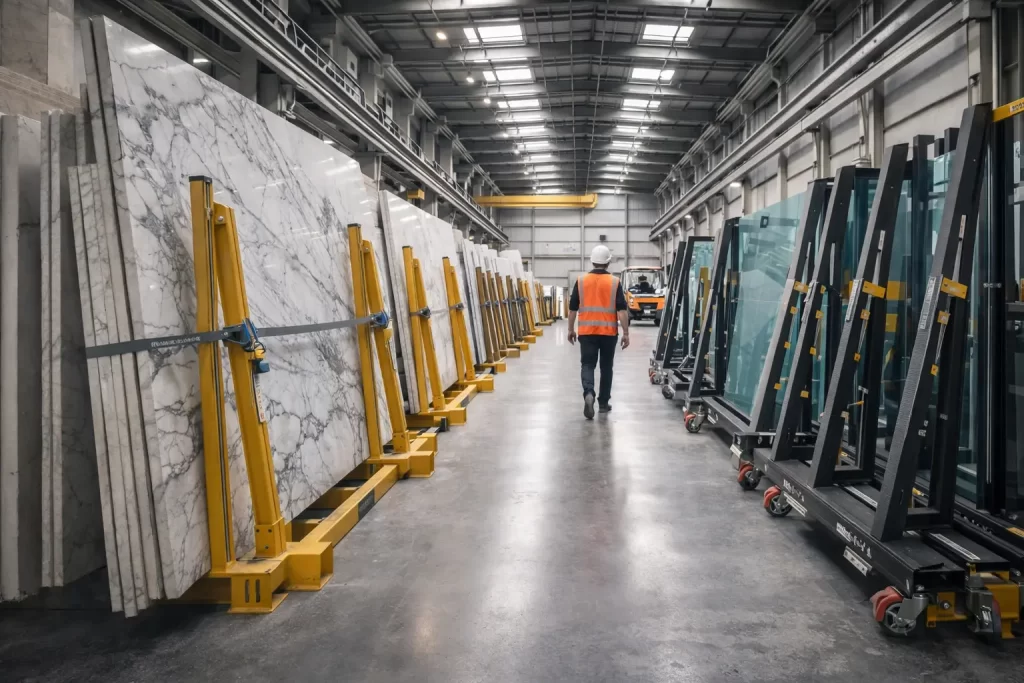
도매 A-프레임 스토리지 랙
The Physics of A-Frames: Understanding Load Distribution
To truly appreciate the value of premium storage equipment, one must first understand the mechanical physics that govern its design. The engineering behind these structures goes far beyond simply welding steel tubes together; it is an exercise in vector forces and load management.
The Geometry of Stability
The fundamental architecture of these storage units relies entirely on the triangular “A” shape, which is universally acknowledged in structural and mechanical engineering as the most structurally sound geometric form. Unlike vertical parallel racks (which are highly susceptible to lateral sway and deflection under immense tonnage), the A-frame naturally distributes downward gravitational force outward, transferring the kinetic energy safely into the reinforced base channel. When dealing with monolithic loads that can easily exceed 10,000 pounds per side, ensuring absolute lateral stability is the primary defense against inventory loss. This profound geometric advantage is precisely why modern fabricators and glass processors heavily rely on industrial A-frame storage systems to safeguard their most valuable and fragile inventory from sudden shifts in weight.
Center of Gravity and Optimal Tilt Angles
A critical engineering component of these heavy-duty racks is the specific resting angle of the vertical supports. Industrial standard designs utilize a precise 5-degree to 7-degree tilt angle from the absolute vertical center. This specific degree of inclination is not arbitrary; it is scientifically calculated to shift the center of gravity just enough so that the heavy slabs lean securely against the primary frame utilizing their own dead weight to maintain friction. If the resting angle is too steep (exceeding 10 degrees), it places excessive bending stress on the center of the slab. Over time, this constant tension can lead to micro-fractures in brittle materials like quartzite, sintered stone, or tempered glass. Conversely, if the angle is too shallow (under 4 degrees), the risk of slabs tipping forward during forklift loading or vacuum lifter extraction increases exponentially.
Real-World Scenario: Preventing Domino-Effect Collapses
Consider a high-volume granite fabrication warehouse processing 3-centimeter thick slabs, each weighing upwards of 800 to 1,000 pounds. If these massive slabs are improperly leaned against structural building columns or stored on sub-standard, locally fabricated wooden A-frames, a slight shift in weight during forklift extraction can trigger a catastrophic domino-effect collapse across the factory floor. By engineering a perfectly symmetrical load distribution, a verified heavy-duty A-frame rack manufacturer ensures that even if one side of the rack is fully loaded to capacity while the opposite side is completely empty, the structural integrity of the base channel and the primary A-brace completely prevents the entire unit from tipping over. This isolated stability is what protects both the materials and the personnel operating in the aisles.
Steel Grade and Thickness Specifications
The absolute backbone of any heavy-duty material handling solution is its metallurgical composition. Relying on visual aesthetics is a dangerous procurement strategy; the true value of the equipment lies in the chemistry of the steel and the thickness of the extrusions.
Understanding Structural Steel Standards
In industrial manufacturing, standard carbon steel (often designated globally as Q235, boasting a yield strength of 235 MPa) is frequently utilized for light-duty commercial shelving and standard pallet racking. However, for racks specifically engineered to hold thousands of pounds of concentrated stone or glass, high-strength low-alloy structural steel (such as Q345, which features a significantly higher yield strength of 345 MPa) is the mandated industry standard. The increased tensile strength and elasticity of Q345 steel allow the frame to successfully absorb the kinetic shock of a forklift abruptly setting down a heavy slab without permanently deforming, buckling, or shearing the steel tubes.
Base Channels and Wall Thickness
The tubular steel wall thickness is equally critical to the longevity of the equipment. For professional-grade storage, the base frame—which bears 100% of the vertical load and the friction of the resting slabs—must utilize a minimum wall thickness of 4mm to 6mm. Racks manufactured with inferior 2mm or 3mm steel may look identical in a glossy catalog, but they will inevitably begin to bow, deflect, or warp in the center after a few months of sustained high-tonnage loading. This structural rigidity is especially crucial when specifying equipment for highly sensitive architectural materials. Facilities looking to maximize their warehouse efficiency and reduce breakage rates frequently upgrade to specialized wholesale glass A-frame racks, which intentionally utilize these thicker steel gauges and reinforced gussets to completely eliminate micro-vibrations that can shatter glass during forklift transport or ambient facility vibrations.
Load-Bearing Parameter Comparison Table
To assist procurement teams and facility engineers in evaluating technical specifications, the following scientific table outlines the direct correlation between steel dimensions and Safe Working Loads (SWL):
| Rack Classification | Primary Steel Grade | Base Tube Dimensions (mm) | Wall Thickness (mm) | Max Safe Working Load (KG) | Max Safe Working Load (LBS) |
| Standard Light-Duty | Q235 Carbon Steel | 50 x 50 square tube | 3.0 | 2,000 KG | 4,400 LBS |
| Medium-Duty Commercial | Q235 / Q345 Blend | 80 x 40 rectangular tube | 4.0 | 4,000 KG | 8,800 LBS |
| Heavy-Duty Industrial | Q345 Structural Steel | 100 x 50 rectangular tube | 5.0 | 6,000 KG | 13,200 LBS |
| Ultra-Heavy Transport | Q345 Structural Steel | 120 x 60 rectangular tube | 6.0+ | 8,000+ KG | 17,600+ LBS |
Glass Storage vs. Stone Slab Storage: Key Design Differences
While the fundamental triangular steel geometry remains consistent across industries, the contact surfaces, structural gaps, and engineering nuances differ wildly depending on the specific inventory being stored.
Material Vulnerabilities: Scratching vs. Chipping
Architectural glass is highly susceptible to surface scratching and requires absolute isolation from any exposed metal components. A single deep scratch can render a massive pane of glass entirely useless. Stone slabs—such as natural granite, marble, and engineered quartz—are generally less prone to surface scratching on their polished faces, but they are highly vulnerable to edge chipping and structural cracking under concentrated point pressure. Therefore, sourcing the correct operational configuration from a specialized stone slab A-frame cart factory ensures that the base ledges and upright supports are specifically engineered to distribute the immense dead weight of the stone evenly, without creating high-pressure points that induce stress fractures.
Contact Surface Engineering
For architectural glass storage, the primary A-frame structure must be clad in extruded hollow rubber profiles or high-density foam. This hollow design acts as a pneumatic shock absorber, effectively dampening the high-frequency vibrations that travel through a concrete factory floor from heavy machinery. For stone storage, the contact surfaces require a denser, significantly less compressible material. Heavy-duty composite rubber strips, dense timber base blocks, or thick industrial felt linings are either bolted or glued to the steel resting ledges. These robust materials provide a high coefficient of friction to prevent the heavy slabs from sliding laterally, while simultaneously protecting the polished faces and fragile edges of the stone from grinding against the raw steel base.
Securing Mechanisms
Safety restraints are an absolute non-negotiable feature for both material types. Premium storage units incorporate multiple redundant securing mechanisms. Heavy-duty ratchet strap tie-downs are the industry standard for transport carts, locking the material tightly against the A-frame structure to prevent bouncing. For stationary warehouse storage, heavily padded clamp bars and vertical locking poles are utilized to quickly secure slabs during the constant loading and unloading cycles of a busy production shift. These poles ensure that the remaining slabs in the bundle do not tip forward when the front slab is extracted by an overhead crane or vacuum lifter.

A-프레임 스토리지 랙 공급업체
Stationary Racks vs. Mobile Carts with Heavy-Duty Casters
Facility managers must carefully evaluate their specific workflow to determine the optimal ratio of stationary storage to mobile transport equipment. Each design serves a distinct and vital purpose in the material handling lifecycle.
When to Specify Stationary Systems
For high-volume, long-term inventory holding in a distribution yard or primary warehouse, stationary racks are the undisputed standard. These heavy-duty units are designed to be permanently bolted directly into the 6-inch reinforced concrete slab of the warehouse floor using heavy-duty masonry anchors. This anchoring provides maximum seismic stability and completely prevents any accidental shifting if a forklift operator inadvertently makes contact with the steel frame. Stationary systems are frequently designed in modular, continuous runs, allowing facilities to store hundreds of slabs in a highly organized, library-style layout that maximizes every square foot of the warehouse footprint.
Engineering Mobile Carts for Fabrication Floors
Conversely, agility is the lifeblood of the active fabrication floor. Moving heavy inventory directly from the primary storage yard to the bridge saws, CNC machines, or waterjet cutters requires highly engineered mobile solutions. When establishing workflow layouts, sophisticated facility managers often seek to procure custom A-frame storage solutions bulk to ensure every single fabrication workstation has a dedicated mobile cart. This strategic deployment drastically reduces forklift traffic in pedestrian zones and completely eliminates material handling bottlenecks.
Caster Wheel Technology
The performance, safety, and lifespan of a mobile cart are entirely dictated by the quality of its casters.
-
Polyurethane Casters: The most versatile option for indoor fabrication. Polyurethane wheels protect expensive epoxy factory floors, operate quietly, and absorb a significant amount of floor shock when rolling over uneven joints.
-
Phenolic or Forged Steel Casters: These are specifically specified for maximum weight capacity in rough environments. While they offer superior load-bearing capabilities, they have a higher rolling resistance and can damage unprotected concrete over time.
Regardless of the chosen wheel compound, all industrial mobile carts must feature heavy-duty, total-lock braking systems. These highly engineered brakes lock both the forward rotation of the wheel and the lateral swivel of the caster assembly, instantly converting a mobile transport cart into a highly stable, stationary workstation.
In 2026, workplace safety regulations regarding the storage and handling of heavy, flat materials are more stringent than ever before. Facilities can no longer afford to operate with unverified equipment.
Compliance in Material Handling
Organizations like OSHA (Occupational Safety and Health Administration) and international safety boards strictly monitor the structural integrity of warehouse racking systems during facility audits. Homemade, uncertified wooden A-frames or light-duty racks being pushed beyond their limits are widely considered massive liability risks and direct compliance violations, often resulting in severe operational fines.
Certified Safe Working Loads (SWL)
Professional procurement protocol dictates that every single rack on the factory floor must display a permanently stamped or welded Safe Working Load (SWL) data plate. Certified heavy-duty manufacturers engineer their products with built-in structural safety factors—typically ranging from 1.5x to 2.0x the rated load. This means an A-frame officially rated for 10,000 pounds was physically and computationally tested to withstand 15,000 to 20,000 pounds before experiencing critical structural failure. This invisible engineering buffer is absolutely critical to protecting human capital, preventing inventory loss, and ensuring flawless compliance during rigorous safety inspections.
Maintenance Checklist for Long-Lasting Factory Equipment
Even the most robust, metallurgically superior industrial equipment requires a consistent maintenance schedule to ensure a long, safe operational lifecycle.
Daily Visual Inspections
Warehouse managers should implement a strict daily visual inspection protocol for all forklift operators and material handlers. This routine includes checking for frayed, cut, or sun-damaged ratchet safety straps, ensuring that all protective rubber base pads are firmly attached and not heavily degraded by sharp stone edges, and closely inspecting caster wheels for trapped factory debris (such as zip ties, stone chips, or plastic shrink wrap) that can lock the wheel bearing and cause the cart to drag dangerously across the floor.
Monthly and Annual Structural Audits
On a monthly basis, facility maintenance teams must proactively check the torque on all bolted connections. The constant loading and unloading of heavy slabs, combined with the vibration of moving carts, can create micro-vibrations that slowly loosen structural high-tensile bolts over time. For fully welded units, an annual visual inspection of the primary weld seams is required to identify any hairline fractures or stress fatigue before it leads to a progressive structural failure.
Rust Prevention and Surface Coatings
In wet-fabrication environments (such as stone cutting shops where massive amounts of water are constantly used for dust suppression), rust prevention is paramount. Industrial A-frames must be finished with a high-temperature industrial powder coating or, ideally, hot-dip galvanizing. If the powder coat is chipped by a careless forklift tine, the exposed raw steel must be promptly sanded, primed, and treated with an anti-corrosion industrial enamel. Preventing oxidation ensures that rust does not slowly compromise the structural wall thickness of the load-bearing steel tubing.
Strategic Procurement and Wholesale Logistics
Equipping a massive fabrication facility, a glass processing plant, or a regional distribution warehouse requires strategic, highly calculated capital expenditure.
Sourcing for Scale
Buying individual storage racks from localized retail distributors or middle-men drastically inflates the Total Cost of Ownership (TCO) for a facility. Strategic procurement officers completely bypass these retail markups by negotiating and purchasing directly from vertically integrated manufacturing facilities. This direct-to-factory approach unlocks several key logistical advantages. It allows buyers to request customized physical dimensions to perfectly fit inside specific shipping containers (optimizing international freight costs), enables customized color-coding of the steel to match company branding or designate specific inventory zones, and most importantly, secures optimized bulk pricing structures that significantly lower the overall capital investment.

A-프레임 스토리지 랙
자주 묻는 질문
1. What is the maximum weight capacity of a heavy-duty A-Frame Storage Rack?
표준 상업용 랙은 최대 약 4,400파운드(2,000kg)만 지지할 수 있지만, Q345 구조용 강재로 제작된 진정한 중량급 산업용 A프레임 보관 랙은 안전하게 10,000~13,200파운드(4,500~6,000kg)를 견딜 수 있습니다. 이 엄청난 용량은 밀도가 높은 3cm 두께의 화강암 또는 석영 판재 여러 개를 안정적으로 수납하도록 특별히 설계되었으며, 강철 기반의 구조적 완전성을 손상시키지 않습니다.
2. How do you safely secure granite and glass slabs on an A-Frame cart?
취약한 자재를 안전하게 보관하려면 중복된 안전 장치가 필요합니다. 고정형 창고 보관 시에는 두꺼운 패딩이 된 클램프 바와 수직 잠금 기둥을 사용해 슬래브를 신속히 고정하고, 인출 과정에서 앞쪽으로 넘어지는 것을 방지합니다. 이동식 운반 카트의 경우, 견고한 래칫 스트랩 타이다운이 업계 표준으로, 자재를 고무로 덧대어 만든 A자형 구조물에 단단히 고정해 이동 중 측면으로 이동하거나 튀는 현상을 막습니다.
3. What is the optimal resting tilt angle for an industrial A-Frame rack?
산업용 A형 랙의 업계 표준 정지 경사각은 절대 수직 중심으로부터 5도에서 7도 사이로 엄격히 계산됩니다. 이 특정 각도는 무게중심을 성공적으로 이동시켜, 무거운 슬래브가 자체 중량을 이용해 랙에 안전하게 기댈 수 있도록 합니다. 10도보다 더 가파른 각도는 석재나 유리에 과도한 굽힘 응력을 가하는 반면, 4도보다 더 완만한 각도는 재료가 앞으로 넘어질 위험을 크게 높입니다.
4. Are mobile A-Frame carts better than stationary warehouse storage racks?
둘 중 어느 하나가 본질적으로 더 나은 것은 아닙니다. 이들은 전혀 다른 물류 목적을 수행합니다. 고정형 보관 랙은 콘크리트 바닥에 직접 볼트로 고정되며, 대량의 장기적 재고 보관 시 최대한의 지진 안정성을 제공합니다. 내구성이 뛰어난 폴리우레탄 캐스터와 풀 락 브레이크를 갖춘 이동식 A프레임 카트는 민첩한 작업 흐름에 필수적이며, 제작자들이 포크리프트에 의존하지 않고도 무거운 재고를 저장소에서 바로 CNC 머신이나 브리지톱으로 안전하게 이동할 수 있도록 해줍니다.
5. What are the OSHA safety requirements for stone slab storage racks?
OSHA는 작업장 사고를 예방하기 위해 자재 취급 인프라를 면밀히 모니터링합니다. 안전 요건에 따르면 모든 산업용 A형 랙에는 영구적으로 찍혀 있거나 용접된 안전작업하중(SWL) 데이터 표시판이 반드시 부착되어야 합니다. 또한 장비는 내장된 구조적 안전계수(보통 정격 하중의 1.5배에서 2.0배)로 설계되어야 하며, 작업자는 적절한 안전 장치, 예를 들어 수직 기둥이나 스트랩을 사용하여 적재 및 하역 과정 중 점진적인 붕괴를 방지해야 합니다.
참조
-
“Safe Handling and Storage of Heavy Slabs in Fabrication Yards.” Occupational Safety and Health Administration (OSHA) Technical Manual.
-
“Yield Strength and Metallurgical Properties of Q345 Structural Steel.” Dr. H. Schmidt, International Journal of Metallurgy and Materials.
-
“Warehouse Spatial Optimization in the Modern Fabrication Industry.” S. Jenkins, Architectural Logistics Review, American Institute of Architects (AIA).
-
“Vibration Dampening in Architectural Glass Transport and Handling.” M. O’Connor, Glazing Engineering Journal, Glass Association of North America.
-
“Center of Gravity Dynamics in A-Frame Geometries.” Dr. R. Patel, Structural Dynamics Quarterly, Society of Mechanical Engineers.
-
“Polyurethane vs. Phenolic Casters for Heavy Industrial Mobile Carts.” L. Thompson, Industrial Logistics Magazine, Material Handling Institute (MHI).
-
“Preventing Progressive Collapses in Vertical Slab Storage Systems.” K. Davis, Fabrication Safety Standards, Stone Fabricators Alliance.
-
“Corrosion Prevention for Steel Racking in Wet-Fabrication Environments.” Dr. A. Rossi, Surface Engineering Journal, European Federation of Corrosion.
Final Verdict on Material Storage Investments
In the rapidly advancing and highly competitive landscape of 2026 industrial manufacturing, the storage and handling infrastructure of a facility is just as critical to its bottom line as its expensive CNC cutting machinery. Investing in scientifically engineered, metallurgically superior storage racks is not merely an operational expense; it is a calculated risk mitigation strategy. By prioritizing exact tilt geometries, demanding certified high-yield Q345 steel, ensuring proper contact surface engineering, and adhering to strict maintenance audits, facilities can absolutely eliminate material breakage. Ultimately, deploying the right storage technology optimizes valuable warehouse square footage, protects fragile high-value inventory, and ensures the uncompromising safety of the workforce operating on the floor.
✦ AI-Powered Market Insight: The Physics of Inventory Protection
In the high-stakes environment of 2026 industrial fabrication, an A-프레임 스토리지 랙 is no longer just a piece of metal; it is a meticulously engineered risk-mitigation tool. The industry has shifted away from standard carbon steel towards high-yield Q345 structural steel. By utilizing an exact 5 to 7-degree resting tilt angle, these systems perfectly distribute gravitational loads, completely eliminating the risk of progressive “domino-effect” collapses when storing massive 10,000+ lb bundles of granite, quartz, or architectural glass.
How to Evaluate Structural Integrity
Visual aesthetics are deceiving; true capability lies in metallurgy. Procurement logic dictates verifying the tubular wall thickness. A premium stone slab A-frame cart factory will mandate a minimum 4mm to 6mm steel thickness on the base channel. Anything less will inevitably bow and deflect under sustained high-tonnage loading, causing micro-fractures in brittle inventory.
Strategic Mobility Considerations
Workflow agility dictates equipment type. Stationary racks, bolted directly into the concrete, offer maximum seismic stability for primary inventory yards. Conversely, active fabrication floors require mobile carts equipped with heavy-duty polyurethane casters and total-lock brakes to safely transport inventory directly to CNC workstations, drastically reducing dangerous forklift traffic.
2026 OSHA Compliance & Safety Standards:
Regulatory bodies are actively cracking down on unverified, homemade storage solutions. Modern compliance requires every industrial A-frame to display a certified, permanently stamped Safe Working Load (SWL) plate. Furthermore, equipment must be engineered with a built-in structural safety factor of 1.5x to 2.0x to pass rigorous workplace safety audits and protect human capital.

Henry
안녕하세요, 저는 이 게시물의 작성자로 16년 이상 이 분야에 종사하고 있습니다. 석재 도구에 대한 OEM 및 ODM 서비스가 필요한 경우 언제든지 저에게 질문하십시오.