





Stone slabs create an unusual warehouse problem: they are thin compared with their height, extremely heavy, difficult to control once they begin to fall, and expensive enough that even a chipped corner can turn a premium slab into a lower-value remnant. A single natural stone slab can weigh several hundred kilograms, while several slabs stored together can place tonnes of load on one rack, one base frame and one section of floor.
For stone fabricators, countertop shops, slab distributors, showrooms and warehouses, storage is therefore both a safety issue and an inventory-quality issue. The purpose of an A-frame is not merely to save floor space. A properly selected стеллаж для каменных плит creates a defined support geometry, gives slabs a controlled resting position, protects polished faces from uncontrolled contact, improves access for cranes and forklifts, and helps workers identify individual slabs without dismantling a dangerous pile.
The correct buying process starts with a simple principle: treat the rack as load-bearing equipment. Do not assume that a frame is safe because the steel looks thick, because another stone company uses something similar, or because the rack has previously held several slabs without failure. Capacity depends on the complete structure, including steel sections, welds, connections, anchors, support geometry, floor condition and the way the slabs are distributed across the system.
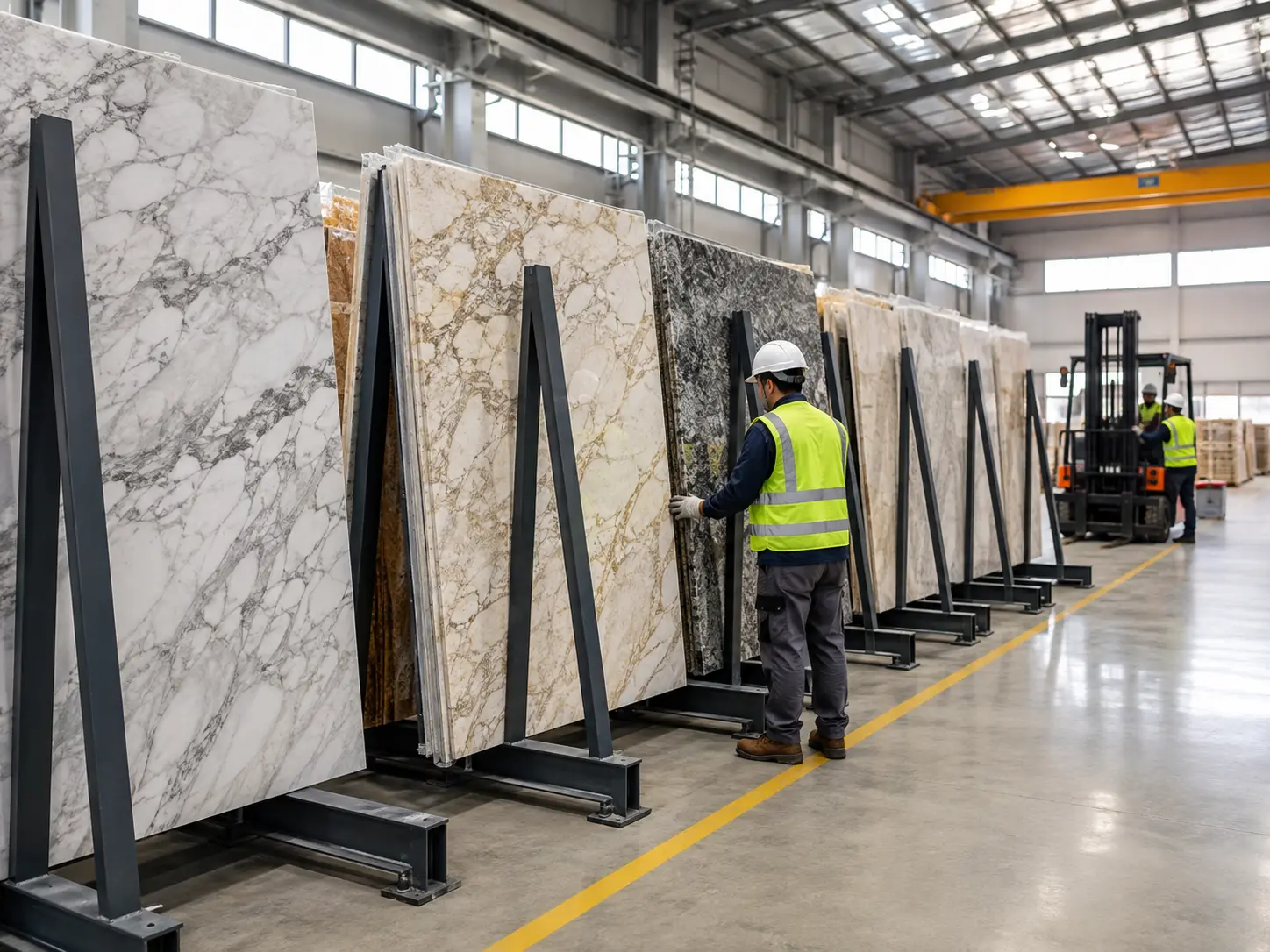
А-образная стойка для плит
Why Manufacturer Experience Matters in Stone Storage Equipment
Stone handling equipment operates in a more demanding environment than ordinary display shelving. Forklifts can strike bases, slabs can create concentrated loads, water and stone slurry may contribute to corrosion, and workers repeatedly remove one slab from a group while the remaining pieces must stay controlled.
Speedone describes its business as a specialist in metal racks, display racks, transport carts and related small mechanical equipment for the stone, glass and ceramic industries. Buyers evaluating Speedone stone handling equipment manufacturing should therefore focus on whether the supplier can match the rack structure to the actual operating environment rather than simply providing a standard steel frame.
For a commercial warehouse, useful supplier discussions should include the heaviest slab, tallest panel, number of slabs per side, forklift or overhead-crane approach, aisle width, concrete floor condition, desired rack length, protective contact material, separator method, indoor or outdoor exposure and any engineering documentation required by the buyer, insurer, contractor or local authority.
A Good Quote Starts With the Maximum Load, Not the Rack Length
Many buyers begin with a request such as “I need a six-metre A-frame.” Length matters, but it is rarely the most important design input. Two six-metre racks can face completely different structural demands if one stores thin porcelain panels and the other stores dense 30 mm granite slabs.
Before asking for pricing, buyers should prepare the slab type, largest dimensions, thickness range, maximum number of slabs, expected loading per side, lifting method and installation environment. The Speedone slab rack project inquiry can then be based on actual warehouse conditions instead of an undefined request for “heavy-duty” storage.
That distinction matters because “heavy duty” is a marketing description, not a complete capacity specification. A commercial buyer needs to know what the rated load applies to, whether the rating assumes balanced loading, how the system must be installed, what floor conditions are required and whether individual components have their own limits.
If the total stored load is unknown → calculate it before finalizing the rack.
If slab sizes vary widely → provide the maximum dimensions, not the average.
If loading will be strongly asymmetric → confirm that condition with the rack supplier or engineer.
Choosing a Supplier Is Part of the Safety Decision
A slab rack purchase should not be evaluated only by steel price per kilogram. A professional supplier should be able to discuss the intended material, structural configuration, protective surfaces, manufacturing process, load information, installation conditions and long-term inspection requirements.
Before issuing a purchase order, buyers can use a slab rack manufacturer selection guide to compare suppliers by technical support, customization ability, documented capacity, quality control, corrosion protection, delivery capability and after-sales support. This becomes particularly important when racks are repeated across a large warehouse because one design decision may be multiplied across dozens of bays.
A cheap rack that arrives without clear installation requirements or capacity information can become expensive when the buyer later needs additional engineering, replacement components, site modifications or a completely different layout. Commercial storage should be purchased on total installed value, not only factory price.
Why Stone Businesses Use Professional Slab Storage Systems
The strongest economic argument for slab racks is risk control. Stone inventory carries high unit value, occupies significant floor area and requires frequent mechanical handling. Random wall leaning or improvised timber supports may look inexpensive until one slab chips, an entire group shifts or an employee enters the fall zone to retrieve a panel.
Speedone’s guide on why slab racks matter for stone storage emphasizes the relationship between rack storage, warehouse efficiency, access, inventory organization, breakage control and safer mechanical handling. That is the correct way to evaluate an A-frame: as part of the operating system of the stone business.
The more frequently slabs are viewed, moved and replaced, the more important structured storage becomes. A showroom may prioritize visibility and easy customer selection, while a fabrication shop may prioritize crane access and rapid retrieval. A distributor storing hundreds of slabs may prioritize density, clear batch identification and repeatable forklift flow. The rack design should follow that workflow.
What Is an A-Frame Slab Rack?
An A-Frame Slab Rack uses an A-shaped or triangular support structure that allows large panels to rest against angled supports rather than standing unsupported at true vertical. Depending on the design, the rack may be fixed, single-sided, double-sided, mobile or integrated with transportation equipment.
The rack normally transfers slab weight through a lower support or base while the angled structure controls the upper portion of the panel. Protective strips, timber, rubber or polymer contact surfaces may be added where stone meets steel.
Common stored materials include:
- granite slabs;
- marble slabs;
- quartzite slabs;
- engineered quartz;
- limestone and travertine;
- sintered stone;
- large porcelain panels;
- glass and other sheet products where the rack is designed for them.
Single-Sided vs Double-Sided A-Frame
A single-sided rack supports slabs on one side and can fit certain perimeter or workflow locations. A double-sided rack provides storage on both sides of the central frame and can improve floor-space efficiency when access is available from both directions.
Double-sided storage, however, creates a critical design question: how does the system behave when one side is heavily loaded and the other side is almost empty? Buyers should not assume that a symmetrical-looking frame can be loaded asymmetrically without limit.
Why Stone Slabs Are Usually Stored Near Vertical
Reduced Unsupported Bending
Large slabs are thin relative to their length and height. Storing them horizontally without continuous engineered support can create bending stress and makes individual slab retrieval difficult.
Near-vertical storage allows the panel to transfer much of its weight downward while the rack controls lateral movement.
Better Visibility
Stone companies sell appearance. Vertical storage lets employees inspect colour, pattern, veins, repairs and slab numbers without lifting several heavy panels just to find one piece.
Faster Inventory Picking
When bundles are separated by rack location, project, thickness or colour, warehouse staff spend less time moving unrelated slabs.
Less Uncontrolled Handling
Every additional slab movement creates another chance for:
- edge chipping;
- surface scratching;
- lifting-device misplacement;
- worker exposure to the fall shadow;
- forklift contact;
- slab-to-slab impact.
Good storage reduces unnecessary movements rather than trying to make every movement faster.
A-Frame Slab Rack vs Slab Cart: What Is the Difference?
| Характеристика | Fixed A-Frame Slab Rack | Slab Cart / Transport A-Frame |
|---|---|---|
| Primary purpose | Storage | Internal or external movement |
| Мобильность | Normally stationary | Designed to move |
| Typical capacity logic | Long-term stored load | Transport load plus dynamic forces |
| Anchoring | May be required by engineered design or manufacturer instructions | Usually not floor anchored because mobility is required |
| Best use | Warehouse bays, fabrication shops, showrooms | Moving slabs between storage, saws, trucks or installation zones |
| Main mistake | Overloading or poor installation | Using mobile equipment as permanent high-capacity storage |
A transport cart and a storage rack may look similar, but their design loads are different. Mobile equipment must handle movement, braking, floor irregularities and other dynamic forces. A stationary rack is evaluated around stored load, stability, restraint and installation conditions.
Buyer mistake: Do not assume a wheeled A-frame is automatically an acceptable substitute for a fixed commercial stone slab storage rack.
What Size Should an A-Frame Slab Rack Be?
There is no universal rack size because slab formats and warehouse layouts vary widely.
| Design Parameter | What It Affects | Buyer Question |
|---|---|---|
| Rack height | Upper slab support | Will the tallest slab be supported at a suitable point? |
| Rack length | Total storage space | How many slabs or bundles must be stored? |
| Base spread | Footprint and stability | How much floor space is available? |
| Support spacing | Load distribution and panel contact | Are support points appropriate for the stored materials? |
| Lean geometry | Slab stability and footprint | What angle is specified by the rack manufacturer or engineer? |
| Bay spacing | Slab separation and handling access | Can clamps, lifters or forks reach the slab safely? |
| Aisle width | Forklift and crane workflow | Can handling equipment approach without striking adjacent racks? |
What Lean Angle Should an A-Frame Slab Rack Use?
Internet guides often provide one angle as if every slab rack should be built the same way. Commercial buyers should be more cautious.
A near-vertical slab needs enough controlled lean to remain supported against the rack. Too little lean can increase the chance that a slab moves away from the support. Excessive lean can increase floor footprint, change load geometry and make individual slab extraction more difficult.
The final geometry should come from:
- the rack manufacturer’s design;
- documented engineering;
- the intended slab dimensions;
- loading configuration;
- restraint system;
- installation conditions.
If a supplier cannot explain the intended loading geometry → do not invent an angle from a DIY drawing.

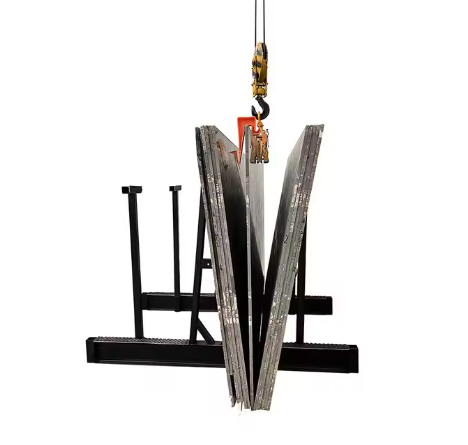
Очень прочный каменный А-образный стеллаж с подставкой для розничного хранения стекла и каменных плит
How Much Does a Stone Slab Weigh?
Slab weight can be estimated using a basic physical relationship:
Weight = Length × Width × Thickness × Material Density
For example, a 3200 × 1600 × 20 mm slab has a material volume of approximately 0.1024 cubic metre. Multiplying that volume by the material density provides an estimated slab mass.
| Материал | Illustrative Density Direction | Approx. Weight for 3200 × 1600 × 20 mm | Buyer Note |
|---|---|---|---|
| Гранит | Approx. 2,600–2,800 kg/m³ | Approx. 266–287 kg | Use actual quarry or supplier data for final calculations |
| Мрамор | Approx. 2,600–2,800 kg/m³ | Approx. 266–287 kg | Different stones vary |
| Quartzite | Approx. 2,600–2,900 kg/m³ | Approx. 266–297 kg | Dense varieties can be very heavy |
| Engineered quartz | Approx. 2,200–2,500 kg/m³ | Approx. 225–256 kg | Product-specific density should be confirmed |
These values are illustrative planning directions, not guaranteed material densities. Final rack loading should use the actual slab dimensions, thickness, quantity and product-specific density or verified weight.
Why Total Rack Load Is Easy to Underestimate
One slab weighing 280 kg may not sound extraordinary in an industrial warehouse. Thirty similar slabs represent approximately 8,400 kg of material before the rack itself is considered.
| Illustrative Slab Weight | Number of Slabs | Approx. Stored Material Weight |
|---|---|---|
| 250 кг | 5 | 1,250 kg |
| 250 кг | 10 | 2,500 kg |
| 250 кг | 20 | 5,000 kg |
| 250 кг | 30 | 7,500 kg |
| 300 кг | 30 | 9,000 kg |
This load is not experienced only by the visible A-frame. It is transferred through base members, welds, anchors or restraints, and ultimately into the supporting floor.
The design also needs to consider how slabs are distributed. Thirty slabs evenly divided on two sides create a different structural condition from thirty slabs on one side.
If a rack stores multiple tonnes of stone → require documented capacity or appropriate engineering rather than estimating capacity from appearance.
How Much Weight Can an A-Frame Slab Rack Hold?
There is no universal A-frame capacity.
Safe working capacity can depend on:
- steel grade;
- section size;
- member thickness;
- rack length;
- brace geometry;
- weld quality;
- bolted connections;
- base configuration;
- anchor design;
- concrete floor;
- slab lean;
- load position;
- balanced or unbalanced loading;
- indoor or outdoor environment.
Speedone’s current slab-rack product category includes different systems from lighter countertop-storage racks through heavy-duty galvanized A-frame products, demonstrating why model-specific capacity matters. One product family cannot be used to infer the capacity of another.
What Buyers Should Request
- rated capacity;
- the conditions attached to that rating;
- maximum slab dimensions;
- loading configuration;
- installation requirements;
- anchor recommendations where applicable;
- floor requirements;
- inspection instructions;
- engineering or test documentation when required.
Steel vs Wood Slab Rack
| Factor | Стальная стойка | Wood Support |
|---|---|---|
| Commercial load capability | Can be engineered for high loads | Highly dependent on timber design and connections |
| Долговечность | High with suitable protection | Can degrade with moisture and impact |
| Dimensional stability | Predictable when properly fabricated | Can split, warp or shrink |
| Inspection | Check welds, bends, corrosion and connections | Check splits, crushing, moisture damage and fasteners |
| Long-term commercial storage | Preferred direction | Requires careful engineering and risk review |
| Short-term small-load support | Possible but potentially unnecessary | May be used if properly designed for the load |
Wood should not be dismissed automatically, because properly engineered timber structures can carry significant loads. The problem is treating an improvised wooden frame as equivalent to a rated industrial storage system.
If full commercial slabs are stored daily around employees → an engineered steel storage system is usually the stronger procurement direction.
Should You Build or Buy an A-Frame Slab Rack?
Buy a Commercial Rack When:
- the system will hold many full slabs;
- employees work around the rack daily;
- documented capacity is required;
- insurance or project documentation matters;
- multiple identical racks are needed;
- rapid installation is important;
- replacement parts or supplier support are valuable.
Custom Fabrication Can Make Sense When:
- the warehouse has unusual slab formats;
- the company has qualified structural engineering support;
- the forklift or crane workflow requires special geometry;
- the site needs an unusual base or interface;
- custom manufacturing can still provide documented capacity and inspection requirements.
Avoid Unverified DIY Construction When:
- rack load is unknown;
- many employees or customers work nearby;
- the system will store multiple tonnes;
- weld quality cannot be verified;
- anchoring has not been designed;
- the rack will be used outdoors;
- the structure may be asymmetrically loaded.
What Safety Rules Apply to Stone Slab Storage?
OSHA 29 CFR 1910.176 states that stored materials must be stable and secure against sliding or collapse and that aisles used for material handling must remain clear and in good repair.
OSHA’s stone-slab handling bulletin goes further by discussing hazards specific to granite, marble and similar panels. It identifies crushing hazards associated with slabs shifting in storage racks and notes cases where A-frames were not designed to support the stored weight or failed to control remaining slabs when one slab was removed.
Historical OSHA data cited in that bulletin identified 46 fatalities associated with stone-slab handling and storage between 1984 and 2006. This is historical accident information rather than a current annual incident rate, but it demonstrates why slab storage should not be treated casually.
The Fall Shadow
The fall shadow is the area a slab can sweep through if it topples. Workers standing within this zone can suffer catastrophic crushing injuries.
OSHA’s guidance repeatedly emphasizes keeping employees outside this danger zone while slabs are moved or manipulated.
Critical rule: A worker should never rely on personal strength to control a falling slab. Mechanical handling, restraint and safe positioning must prevent workers from entering the fall shadow.
Should an A-Frame Slab Rack Be Anchored?
There is no responsible universal answer that every A-frame must use the same anchor layout.
The requirement depends on:
- rack design;
- manufacturer instructions;
- engineered stability;
- base footprint;
- stored load;
- asymmetric loading;
- concrete thickness and strength;
- site vibration;
- forklift impact risk;
- local requirements.
If Anchors Are Part of the Design, Ask For:
- anchor type;
- anchor diameter;
- embedment requirement;
- concrete specification;
- edge distance;
- installation torque where applicable;
- inspection procedure;
- replacement requirements after impact.
Do not substitute an arbitrary anchor because it “fits the hole.”
Why Uneven Loading Is Dangerous
Consider a double-sided A-frame that normally stores equal bundles on each side.
Now imagine that warehouse staff remove almost every slab from one side while the opposite side remains fully loaded.
The structure may experience:
- asymmetric overturning force;
- uneven base reactions;
- greater anchor loading;
- different stress in braces and welds;
- rack movement if the design does not allow for that condition.
If one side may routinely be loaded much more heavily than the other → tell the manufacturer before purchase and follow the approved loading instructions.
How Should Slabs Be Separated and Protected?
Polished stone should not rest directly against unprotected steel where scratching, edge chipping or contamination can occur.
Depending on the rack design, protective interfaces can include:
- rubber strips;
- polymer pads;
- timber contact rails;
- compatible plastic protection;
- post caps;
- corner wedges;
- separator pins or posts.
Why Padding Matters
The contact zone carries significant load. A small hard contact point can damage a fragile marble edge or leave marks on polished material.
Why Separators Matter
Separators can help organize slabs, create access for lifting devices and reduce the need to shift an entire group when one slab must be removed.
The separator system itself must be properly seated and designed for the expected forces.
How to Load an A-Frame Slab Rack Safely
Plan the Approach
Before lifting the slab, identify the complete route from the existing storage position to the rack.
Check:
- forklift clearance;
- overhead crane path;
- door height;
- rack position;
- personnel exclusion zone;
- floor condition;
- adjacent stored slabs.
Confirm Lifting Equipment Capacity
Use lifting equipment rated for the actual slab and surface condition.
Common systems may include:
- overhead cranes;
- slab clamps;
- vacuum lifters;
- forklift booms;
- approved lifting attachments.
A clamp should not be attached blindly over a weak fissure or open seam.
Approach the Rack Straight
Avoid swinging a slab into place. Side impact can damage the slab and transfer unexpected force to the rack.
Seat the Slab on the Intended Supports
Ensure the bottom edge is correctly positioned and the upper panel rests against the intended support surface.
Release the Lifting Device Only After Stability Is Confirmed
The lifting device should not be removed while the slab is still capable of shifting into an uncontrolled position.
How to Unload Slabs From the Rack Safely
Removal can be more dangerous than initial storage because the neighboring slabs may change position as one slab is separated.
Identify the Target Slab First
Know the slab number and intended handling method before anyone enters the storage zone.
Control Neighboring Slabs
The storage design should prevent the remaining group from shifting unexpectedly when the selected panel is removed.
Maintain an Exclusion Zone
Customers and unprotected personnel should remain away from active loading and unloading operations.
Use Wedges and Handling Tools From Safe Positions
Workers should not place themselves between slabs merely to create space for a clamp.
Most slab-rack risk is created while slabs are being handled, separated or moved—not while they are sitting untouched.
Slab Rack Safety Checklist
| Stage | Check | Reason |
|---|---|---|
| Before Loading | Rack frame condition | Cracks, bends or impact damage can reduce capacity |
| Before Loading | Anchors / base | Loose or damaged installation can affect stability |
| Before Loading | Padding | Prevents direct stone-to-steel damage |
| Before Loading | Floor condition | Rack depends on stable support |
| Before Loading | Slab weight | Total load must remain within approved capacity |
| During Loading | Lifting-device rating | Handling equipment must suit the slab |
| During Loading | Fall-shadow exclusion | Reduces crushing exposure |
| During Storage | Load distribution | Prevents unintended asymmetric loading |
| During Storage | Separator position | Maintains controlled slab arrangement |
| During Removal | Neighboring slab stability | Removal can cause remaining slabs to shift |
| Техническое обслуживание | Welds and structural members | Cracks or deformation require action |
| Техническое обслуживание | Corrosion | Section loss can reduce structural strength |
How Often Should a Slab Rack Be Inspected?
There is no universal inspection interval that replaces the rack manufacturer’s or site’s safety procedure.
Inspection frequency should consider:
- daily loading frequency;
- forklift traffic;
- previous impacts;
- outdoor exposure;
- corrosive moisture;
- stored weight;
- manufacturer instructions;
- workplace safety policy.
Items Worth Inspecting
- cracked welds;
- loose bolts;
- damaged anchors;
- bent supports;
- deformed bases;
- damaged separator pins;
- missing padding;
- corrosion;
- floor cracking around the base;
- evidence of forklift impact;
- rack leaning or movement.
If a rack has been struck by a forklift or visibly deformed → remove the affected storage position from service until it has been evaluated.
Indoor vs Outdoor A-Frame Slab Racks
Outdoor storage creates additional conditions that may not exist inside a fabrication shop.
Corrosion
Rain, humidity and stone-processing environments can attack unprotected steel. Galvanizing or another appropriate corrosion-protection system may be justified depending on exposure.
Wind
Large stone slabs have a large surface area. Natural Stone Institute safety materials warn that wind can contribute to instability in outdoor slab yards.
Drainage
Standing water around the rack can accelerate corrosion and contribute to poor floor or ground conditions.
Freeze/Thaw Conditions
Outdoor concrete and base conditions may change seasonally in cold climates.
Ground Support
A rack designed for reinforced indoor concrete should not automatically be placed on soft or uneven ground.
If the rack will be outdoors → specify outdoor exposure before ordering rather than applying paint to an indoor rack after delivery.
A-Frame Rack vs Other Stone Storage Methods
| Storage Method | Доступность | Мобильность | Capacity Direction | Main Risk | Лучшее применение |
|---|---|---|---|---|---|
| Fixed A-frame rack | Высокий | Нет | Commercial high-load potential | Overloading / poor installation | Fabrication shops and warehouses |
| Slab cart | Высокий | Высокий | Model specific | Movement and dynamic load | Internal transport |
| Horizontal stacking | Низкий | Низкий | Depends on full support | Difficult retrieval and handling | Special controlled applications |
| Wall leaning | Низкий | Нет | Undefined | Uncontrolled slab movement | Not recommended as routine commercial storage |
| Post / bundle rack | Высокий | Нет | Commercial high-load potential | Post seating and overload | Bulk warehouse storage |
Commercial A-Frame Rack Cost: Buy vs Custom Build
The steel cost is only one component of the final storage-system cost.
| Cost Component | Commercial Rack | Custom Fabrication |
|---|---|---|
| Steel / rack purchase | Included in quoted system | Purchased separately |
| Инженерия | May be included or available | Buyer must arrange if needed |
| Fabrication labor | Included | Internal or subcontracted |
| Coating / galvanizing | Specified with product | Buyer coordinates |
| Anchoring | Installation-dependent | Buyer must design and install |
| Inspection documentation | May be standardized | Must be created |
| Replacement components | Potential supplier support | Custom remake may be required |
| Engineering responsibility | Defined by supplier scope | Buyer/fabricator must define |
For a one-off rack in a facility with qualified engineers and fabricators, custom construction may make sense. For a multi-rack warehouse requiring repeatability, standardized systems can simplify procurement and inspection.
The right metric is Total Installed Storage Cost, not raw steel cost.
Eight Common A-Frame Slab Rack Mistakes
Mistake 1 — Guessing Load Capacity
Consequence: Structural overload may deform bases, supports or connections.
Better practice: Use documented capacity based on the actual rack model and loading condition.
Mistake 2 — Storing Slabs Too Upright
Consequence: Slabs may move away from the support and enter an unstable position.
Better practice: Follow the designed lean geometry.
Mistake 3 — Unevenly Loading a Double-Sided Rack
Consequence: Asymmetric forces can affect stability and anchors.
Better practice: Follow the manufacturer’s loading rules and design assumptions.
Mistake 4 — Using Bare Steel Contact
Consequence: Polished faces and vulnerable edges can scratch or chip.
Better practice: Use compatible protective contact materials.
Mistake 5 — Ignoring Anchor or Base Damage
Consequence: The rack can move or transfer load differently from the designed condition.
Better practice: Inspect the installation regularly and after impacts.
Mistake 6 — Using a Mobile Cart as Permanent Storage
Consequence: Equipment may be used outside its intended load or stability condition.
Better practice: Match equipment function to storage or transport.
Mistake 7 — Pulling One Slab Without Controlling Neighboring Slabs
Consequence: Adjacent slabs can shift into the fall shadow.
Better practice: Use the designed restraint and handling procedure.
Mistake 8 — Leaning Slabs Against a Wall
Consequence: Load, angle and restraint are uncontrolled.
Better practice: Use a properly designed vertical slab storage system.
Buyer Decision Guide: Which Slab Storage System Should You Choose?
| Situation | Recommended Direction |
|---|---|
| Large fabrication shop with full slabs | Rated fixed steel A-frame or suitable slab-rack system |
| Need frequent internal slab movement | Dedicated slab cart or transport A-frame |
| Short-term low-quantity project storage | Properly engineered temporary support |
| High-value marble or quartzite inventory | Rated commercial rack with protective contact surfaces |
| Outdoor stone yard | Corrosion-resistant engineered storage system |
| Very mixed slab sizes | Adjustable or modular rack designed for the size range |
| Unknown total load | Calculate weight and obtain engineering review before installation |
| Customer-facing showroom | Rack designed for both secure storage and controlled viewing access |
What Should Fabricators Ask a Slab Rack Supplier?
A serious RFQ should include the operating environment and ask for enough information to verify suitability.
Technical Questions
- What is the rated capacity?
- Is capacity per side, per bay or for the complete rack?
- What loading distribution is assumed?
- What slab sizes are supported?
- What is the rack height, length and base footprint?
- What steel grade and fabrication method are used?
- How are welds and structural components inspected?
- What corrosion-protection options are available?
- What protective padding is supplied?
- How are slabs separated or restrained?
Installation Questions
- Does the rack require anchoring?
- What floor condition is required?
- Is a minimum concrete thickness specified?
- How should the rack be leveled?
- What inspection is required after installation?
Operational Questions
- Can the rack be loaded asymmetrically?
- Is it compatible with overhead cranes?
- Is forklift access required from one or both sides?
- Can the rack be used outdoors?
- What regular inspection should the operator perform?
- Are replacement pads, posts or accessories available?
Commercial Questions
- What is the manufacturing lead time?
- What is the packaging method?
- Is engineering documentation available?
- What warranty applies?
- What replacement components can be supplied later?
- Can the system be expanded as inventory grows?’
Часто задаваемые вопросы
1. What is an A-Frame Slab Rack used for?
An A-Frame Slab Rack is used to store large stone and panel materials in a controlled near-vertical position. Typical materials include granite, marble, quartzite, engineered quartz, limestone, sintered stone, porcelain slabs and other sheet products when the rack is designed for them. The A-frame structure provides lower support for the slab weight and angled upper support that helps keep the panels in a stable resting position. Commercial racks are commonly used in fabrication shops, slab warehouses, distributors and showrooms because they improve material visibility, reduce unnecessary slab reshuffling and provide a defined interface for cranes, slab clamps and forklifts. Capacity and loading geometry must always be confirmed for the exact rack model.
2. How should granite and marble slabs be stored safely?
Granite and marble slabs should be stored on a system designed to withstand the actual slab loads and to prevent the materials from shifting, sliding or collapsing. OSHA stone-slab safety guidance recommends using properly designed racks, inspecting storage systems before loading, removing damaged racks from service and developing safe procedures for placing and removing slabs. Workers should remain outside the slab fall shadow during handling. Slabs should also be protected from uncontrolled stone-to-steel or stone-to-stone contact where scratching and chipping can occur. Randomly leaning full slabs against a wall is not a substitute for a rated commercial storage system.
3. How much weight can an A-Frame Slab Rack hold?
There is no universal A-Frame Slab Rack capacity. The safe load depends on the steel members, frame geometry, welds, connections, rack length, base design, anchors, floor conditions, slab angle and load distribution. Commercial racks can range from lighter countertop-storage systems to very heavy-duty stone-storage equipment, so capacity must be checked against the specific model rather than inferred from appearance. Buyers should request the rated capacity, understand whether it applies per side, bay or complete rack, and confirm any requirements for balanced loading, anchoring or floor conditions. For significant commercial loads, documented engineering or manufacturer capacity information should be available before the rack is put into service.
4. Should slab racks be anchored to concrete?
Some slab rack systems require anchoring while others may use a different engineered stability method, so the correct answer depends on the manufacturer, rack design, base geometry, stored load and site conditions. Where anchors are part of the approved design, buyers should follow the specified anchor type, embedment, concrete requirement, edge distance and installation procedure rather than substituting a convenient fastener. The supporting floor must also be capable of carrying the rack reactions. A rack should not be assumed safe merely because it is heavy. If anchoring or stability requirements are unclear, obtain confirmation from the manufacturer or qualified engineer before loading the system.
5. What is the difference between a slab rack and a slab cart?
A slab rack is primarily designed for storage, while a slab cart or transport A-frame is designed to move slabs from one location to another. A fixed A-frame rack may support stone for long periods and can be integrated into a warehouse storage layout. A mobile cart must also withstand dynamic forces created by rolling, stopping and uneven floors. Because their functions differ, a wheeled transport frame should not automatically be used as permanent high-capacity storage, and a fixed storage rack should not be moved unless it is specifically designed for transport. Buyers should choose equipment according to whether the main requirement is secure storage, internal handling, truck transport or customer display.
Ссылки
- Handling Materials — General, 29 CFR 1910.176 — Occupational Safety and Health Administration — U.S. Department of Labor — General Industry Materials Handling and Storage Standard.
- Hazards of Transporting, Unloading, Storing and Handling Granite, Marble and Stone Slabs — Occupational Safety and Health Administration — U.S. Department of Labor — Safety and Health Information Bulletin SHIB 08-12-2008.
- Hazards Associated with Transporting Granite and Marble Slabs — Occupational Safety and Health Administration — U.S. Department of Labor — Safety and Health Information Bulletin SHIB 09-08-2005.
- Safe Slab Handling: Overview — Natural Stone Institute Safety Committee — Natural Stone Institute — Silica & Slab Safety Certificate Program.
- Safe Slab Handling: Fall Shadow — Natural Stone Institute Safety Committee — Natural Stone Institute — Natural Stone University Safety Training.
- Safe Slab Handling: Forklifts — Natural Stone Institute Safety Committee — Natural Stone Institute — Natural Stone University Safety Training.
- Safe Slab Handling: Slings and Clamps — Natural Stone Institute Safety Committee — Natural Stone Institute — Natural Stone University Safety Training.
- Safety in the Stone Business — Natural Stone Institute Safety Committee — Natural Stone Institute — Stone Industry Safety Technical Module.
How to Choose a Slab Storage System That Remains Safe as the Business Grows
What Is the Real Purpose of an A-Frame Slab Rack?
The real purpose is controlled load management. An A-frame is useful because it supports large panels in a repeatable near-vertical geometry, defines where the bottom edge sits, creates a known support surface and allows handling equipment to approach the slabs in an organized storage zone. The rack also improves inventory visibility and can reduce the number of times unrelated slabs must be moved. Its value is therefore a combination of safety, material protection, space efficiency and handling productivity.
Why Should Capacity Be Calculated From the Slabs Instead of the Rack Appearance?
Stone inventory becomes heavy very quickly. A 20 mm slab around 3.2 × 1.6 metres can weigh roughly 225 to nearly 300 kg depending on the material. Thirty slabs can therefore create approximately 7–9 tonnes of stored material. The frame may look simple, but those forces must travel through the supports, welds, base, anchors and floor. Safe working capacity should be documented for the entire system and the expected loading condition rather than estimated from steel thickness alone.
Which Storage Option Fits Different Stone Businesses?
| Business Condition | Direction to Evaluate |
|---|---|
| High-volume stone fabrication | Rated fixed slab-storage rack with crane/forklift access |
| Showroom with frequent customer slab viewing | Secure rack designed for controlled visibility and slab selection |
| Distribution warehouse | High-capacity modular storage with clear bundle identification |
| Need to move slabs between machines | Dedicated slab transport cart or mobile A-frame |
| Outdoor stone yard | Engineered corrosion-resistant rack suitable for wind and environment |
| Short temporary project storage | Properly designed temporary support matched to actual load |
| Unknown rack load | Calculate slab weights and obtain capacity confirmation first |
What Considerations Matter Before the Purchase Order?
The buyer should confirm maximum slab size, maximum individual slab weight, total number of stored slabs, loading on each side, rack dimensions, steel construction, corrosion treatment, protective surfaces, separator design, forklift or crane access, aisle clearance, floor conditions, anchoring requirements, installation instructions, documented capacity and inspection procedures. If the rack is going outdoors, wind, drainage and corrosion must also be included in the specification. These questions make quotations comparable and reduce the chance of discovering missing requirements after delivery.
The Risk Buyers Most Often Underestimate
The greatest risk is often not a rack collapsing while nobody is near it. The dangerous moment occurs when employees are adding, separating or removing slabs and the remaining group changes position. OSHA accident investigations have repeatedly identified crushing hazards related to shifting slabs and people entering the fall shadow. A rack must therefore support safe handling procedures, not merely hold the stone while static.
How Is Professional Stone Storage Changing?
Stone warehouses are increasingly moving from improvised storage toward engineered systems that integrate rack capacity, forklift routes, overhead cranes, lifting clamps, slab identification, inspection schedules and dedicated exclusion zones. High-value quartzite, large-format porcelain and jumbo engineered slabs are also increasing the importance of rack dimensions and load planning. As slab formats become larger, storage equipment must be treated as part of material-handling engineering rather than a warehouse accessory.
Recommended Buying Logic
If the operation stores only a few lightweight remnants temporarily, a large commercial A-frame may be unnecessary. If full granite, marble, quartzite or engineered slabs are stored every day near employees, use a system with capacity and installation conditions appropriate to the real load. If the warehouse needs mobility, specify transport equipment rather than converting a fixed rack. If racks will be outdoors, purchase for outdoor exposure from the beginning. If any capacity, anchor or loading requirement is unclear, resolve it before the slabs are placed on the rack.
Soft Buying Recommendation
Before requesting a final slab-rack quotation, prepare the maximum slab length and height, thickness range, estimated weight per slab, maximum number of slabs, desired rack length, whether loading is single- or double-sided, indoor or outdoor location, floor condition, forklift or crane method and any documentation required by your safety team. That information allows a commercial slab rack supplier to recommend a configuration around the actual warehouse rather than quoting an arbitrary frame.
Safe Stone Storage Begins With Knowing the Load Before the First Slab Arrives
An A-Frame Slab Rack can improve storage density, slab visibility, inventory control and handling efficiency, but only when the system is treated as structural equipment. The rack must be matched to the stone, the loading method, the floor and the people who work around it.
Do not guess the capacity. Do not copy a lean angle because it appeared in a DIY drawing. Do not assume balanced loading will always exist. Do not ignore forklift damage, cracked welds or loose anchors. And do not enter the fall shadow simply because a slab appears stable.
For a professional stone operation, the strongest storage system is the one that still works safely when the warehouse is busy, one side of the rack is being unloaded, a crane is moving the next slab and employees are working nearby.
That is why the best A-Frame Slab Rack purchase is not necessarily the lowest-priced steel frame. It is the system whose capacity, geometry, protection, installation, handling method and inspection process are clear before the first tonne of stone is loaded onto it.
