Выполняйте свою работу эффективно!





To store marble slabs safely, warehouses need suitable slab racks or A-frame storage, clearly defined load capacity, stable slab support, adequate handling aisles, organized inventory, appropriate lifting equipment and regular rack inspections. Good marble storage safety is not only about the rack itself. The complete system should reduce unnecessary slab movement from unloading and inventory through staging, fabrication and final loading.
How to Store Marble Slabs Safely in Your Warehouse
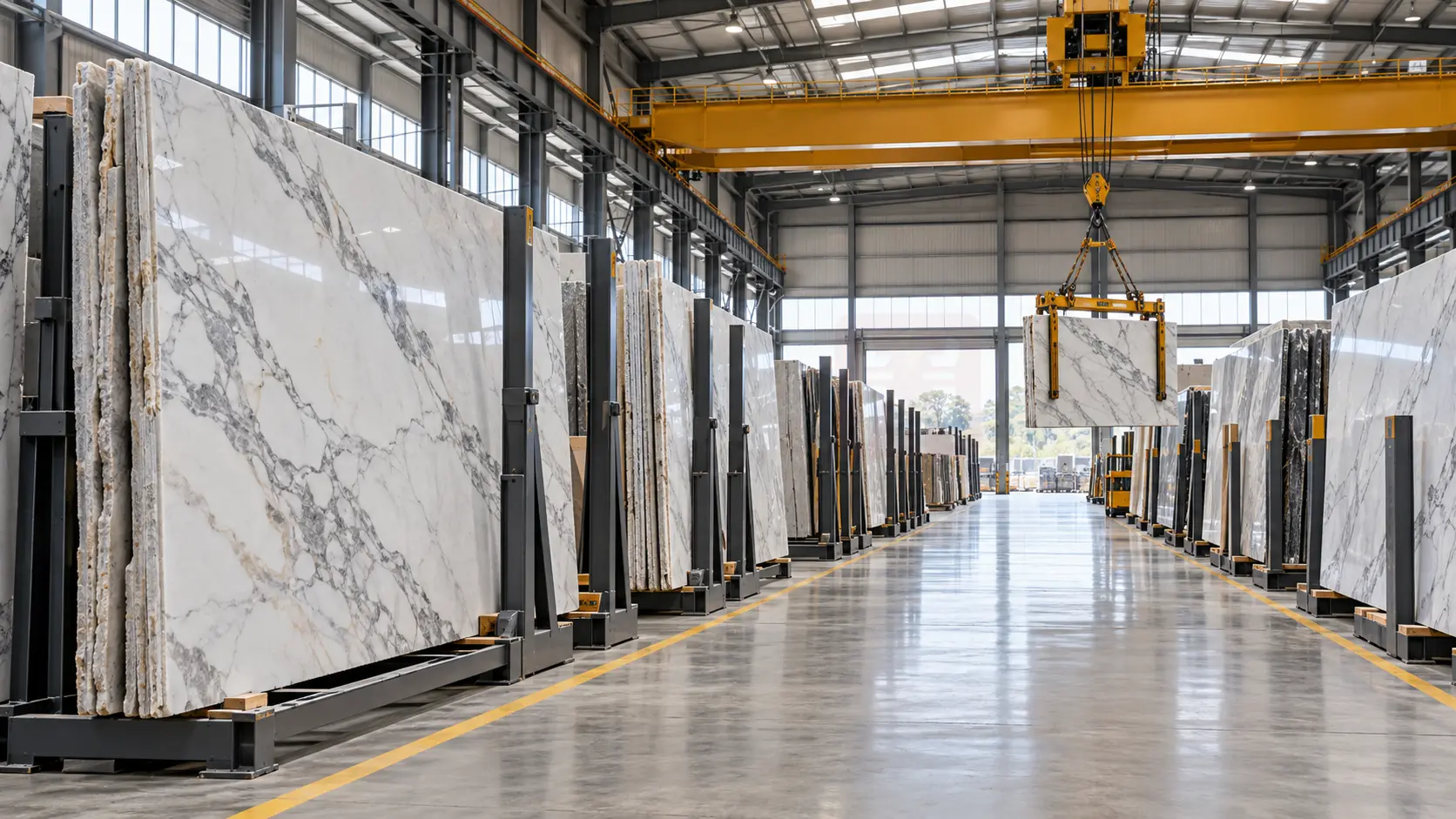
How to store marble slabs safely on steel slab racks in a stone warehouse
Knowing how to store marble slabs correctly is essential for stone factories, distributors, fabrication workshops and slab warehouses.
Marble slabs are large, heavy and valuable. Unlike uniform industrial sheet materials, natural marble may also contain veins, fissures, repaired areas and other characteristics that can influence how the material responds to impact and handling.
For this reason, good marble storage safety requires more than simply leaning slabs against a steel frame.
The complete storage process should consider:
- Rack type and rated capacity.
- Slab height, width, thickness and weight.
- Support configuration.
- Floor condition.
- Aisle width.
- Crane or forklift access.
- Slab identification.
- Inventory turnover.
- Production staging.
- Rack inspection.
- Lifting and transport equipment.
This guide explains practical slab storage tips for organizing marble inventory while reducing unnecessary material movement, warehouse congestion and avoidable damage.
Why Safe Marble Slab Storage Matters
Marble inventory can represent a significant investment for a stone business, particularly when the material is imported, project-specific, premium grade or difficult to replace.
Poor storage may contribute to:
- Broken slabs.
- Chipped edges.
- Surface scratches.
- Damage around weak or fissured areas.
- Repeated slab movement.
- Blocked aisles.
- Long material-search times.
- Production delays.
- Additional crane or forklift movements.
- Increased handling exposure.
A professional storage system therefore protects more than stone inventory. It also supports the production workflow.
Factories trying to reduce unnecessary material movement can review how better slab handling organization can improve stone factory efficiency.
The Safe Marble Storage System: More Than a Rack
A useful way to evaluate marble storage is to think of it as a system rather than a single piece of equipment.
| Storage Element | Main Purpose | What to Check |
|---|---|---|
| Стойка для плит | Support stored slabs | Capacity, geometry, dimensions, condition |
| Floor | Provide stable equipment foundation | Level, condition, drainage and suitability |
| Aisle | Allow controlled material access | Forklift, crane, cart and slab clearance |
| Inventory System | Locate the correct slab before handling | Rack numbers, labels, project identification |
| Подъемное оборудование | Remove and move slabs | Capacity, load compatibility and operating method |
1. Choose the Right Marble Storage Rack
The first step when planning how to store marble slabs is selecting equipment designed for the intended load and application.
Common options include:
- Fixed slab racks.
- A-frame storage racks.
- Double-sided A-frames.
- Mobile slab racks.
- Modular storage systems.
- Temporary production staging racks.
The best solution depends partly on how often the slabs will be accessed.
Main inventory storage and temporary production staging do not necessarily require the same rack configuration.
Factories comparing two popular systems can review this slab rack vs A-frame storage rack comparison.
Buyers can also review Speedone slab rack systems и А-образные стеллажи для хранения when planning different storage zones.
2. Confirm the Rack’s Rated Load Capacity
One of the most important marble storage safety principles is understanding how much load the rack is intended to support.
Do not estimate load capacity from the appearance of the steel structure.
When evaluating storage requirements, consider:
- Individual slab weight.
- Total intended load per rack or section.
- Number of slabs stored together.
- Slab thickness.
- Maximum slab dimensions.
- Rack configuration.
- Load distribution.
Different rack designs may distribute loads differently, so the manufacturer’s rated capacity and intended loading configuration should be followed.

Marble storage safety with organized slab racks and clear handling aisles
3. Understand That a Slab Rack Is More Than a Steel Frame
Two racks may look similar from a distance but behave differently under load.
A professional storage rack should be evaluated as a complete structure.
Important factors may include:
- Base stability.
- Support geometry.
- Steel construction.
- Weld quality.
- Connections.
- Stone contact surfaces.
- Surface protection.
- Load distribution.
- Interaction with the supporting floor.
This is why rack selection should focus on the intended application rather than appearance alone. Read more about Почему стеллажи для перекрытий - это больше, чем просто металлические рамы.
4. Store Marble with Stable Rack Support
Marble slabs are commonly stored in a near-vertical or inclined arrangement using purpose-designed slab racks or A-frame systems.
However, there is no single universal storage angle that should be applied to every rack.
The correct support configuration depends on:
- Rack design.
- Manufacturer instructions.
- Slab dimensions.
- Load configuration.
- Site conditions.
The objective is to keep each slab securely supported by the storage system rather than allowing it to balance in an unstable position.
Warehouses should also avoid improvising support using loose blocks or unrelated objects unless they are specifically designed and approved as part of the storage arrangement.
5. Check Floor Condition Before Installing Racks
A strong slab rack still depends on the surface beneath it.
Before installation, inspect the proposed storage area for:
- Uneven surfaces.
- Cracks.
- Damaged concrete.
- Poor drainage.
- Repeated forklift impacts.
- Areas where water or slurry accumulates.
Floor suitability is particularly important where large concentrated loads or mobile equipment are present.
For outdoor storage, environmental exposure, drainage and corrosion protection should also be considered.
6. Separate Slabs by Size, Material and Application
Randomly mixing very different materials can make warehouse access more complicated.
Useful inventory categories may include:
- Marble.
- Granite.
- Engineered quartz.
- Porcelain.
- Sintered stone.
- Thickness.
- Slab dimensions.
- Project assignment.
- Reserved inventory.
Organizing similar materials together can reduce the number of slabs that must be moved before workers reach the correct one.
7. Keep Fast-Moving Marble Easy to Access
Inventory turnover should influence rack position.
If one marble color is used every day while another is sold only occasionally, storing both in equally accessible locations may not be the most efficient layout.
Fast-moving materials can often be located closer to:
- Production staging.
- Cutting areas.
- Main crane coverage.
- Primary transport routes.
This can reduce crane cycles, travel distance and unnecessary slab handling.
8. Maintain Clear Handling Aisles
Aisles should be designed around the actual equipment used in the warehouse.
This may include:
- Overhead cranes.
- Forklifts.
- Slab transport carts.
- Vacuum lifting systems.
- Slab lifting clamps.
An aisle that is wide enough for employees to walk through may still be too narrow for a forklift carrying a slab.
Warehouse planners should consider:
- Vehicle width.
- Turning radius.
- Slab width.
- Load orientation.
- Operator visibility.
- Walls and columns.
- Nearby machines.
- Pedestrian routes.
The correct aisle width should therefore be determined from site conditions rather than copied from a generic warehouse dimension.
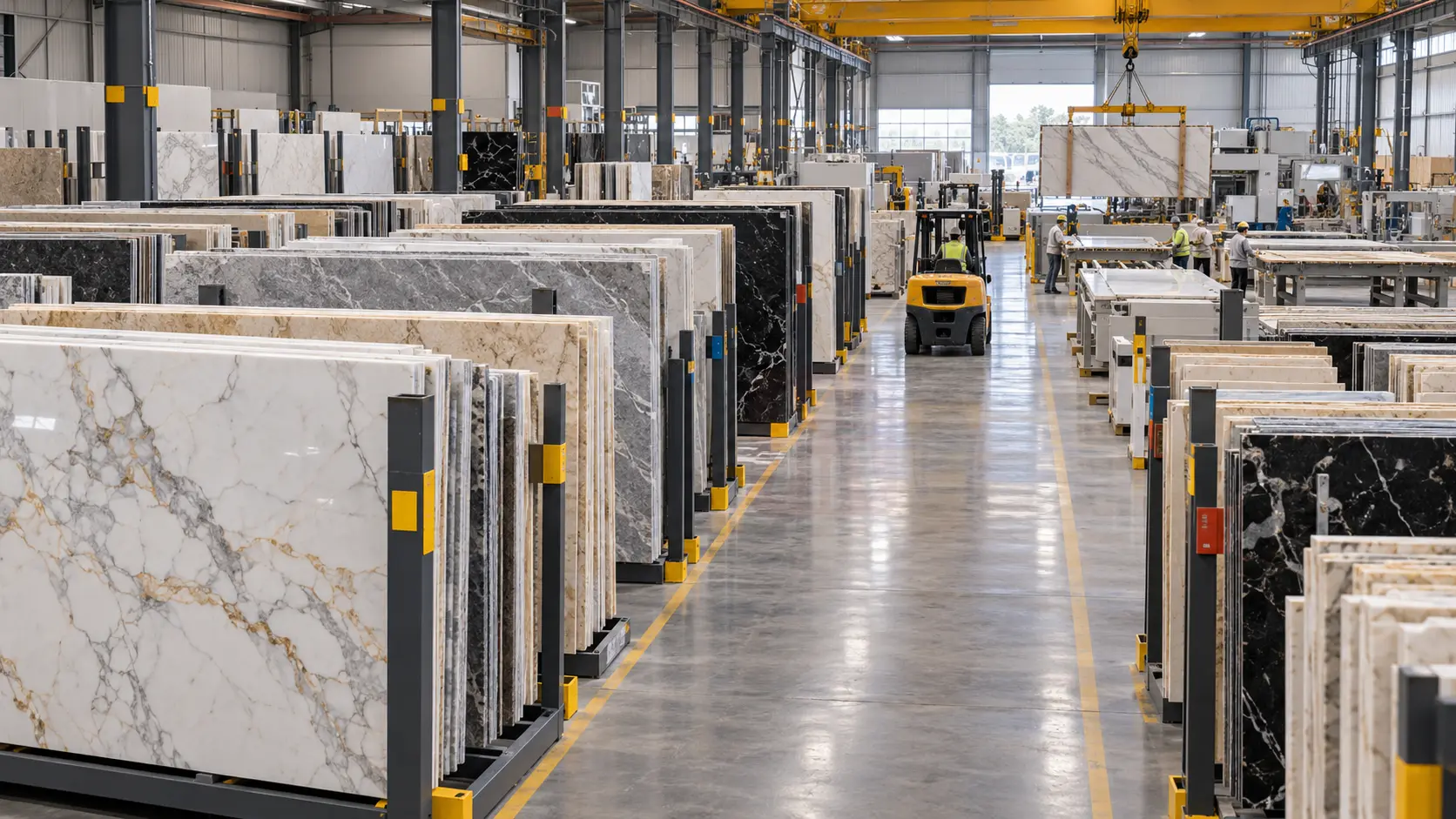
Marble slab storage tips for organized and efficient stone warehouse management
9. Minimize Unnecessary Slab Handling
Every additional movement creates another handling event.
If workers repeatedly move several slabs before reaching one required piece, the storage layout may need improvement.
Excessive slab movement increases:
- Lifting cycles.
- Handling labor.
- Equipment use.
- Surface and edge contact.
- Production waiting time.
A strong storage strategy aims to reduce how many times a slab must be handled from receiving through fabrication.
10. Protect Stone Contact Areas
Marble surfaces and edges can be vulnerable to damaging contact.
Where appropriate for the rack design, suitable protective materials can be used at designated stone-contact locations.
Protection should not create an unstable support surface or interfere with the intended loading configuration.
Pay particular attention to:
- Polished surfaces.
- Finished edges.
- Decorative marble.
- Fragile or fissured materials.
11. Do Not Depend on One Slab to Hold Another Safely
Stored slabs should be supported by the designed storage system.
If removing one slab causes surrounding slabs to move unpredictably, the storage arrangement deserves review.
The retrieval process should be controlled so that accessing one slab does not create uncontrolled movement among adjacent materials.
12. Create an Incoming Inspection Area
New marble should ideally be inspected before entering long-term inventory.
Check for:
- Transportation damage.
- Cracks.
- Visible fissures.
- Edge chips.
- Surface scratches.
- Quantity.
- Slab dimensions.
- Material identification.
This helps the warehouse distinguish pre-existing damage from damage that may occur later during storage or fabrication.
13. Label Every Rack and Storage Position
Workers should know where the required slab is located before the lifting operation begins.
Rack identification can include:
- Rack number.
- Storage-position number.
- Material name.
- Color.
- Supplier.
- Lot or batch.
- Thickness.
- Slab dimensions.
- Project.
- Inventory status.
Larger operations may connect these locations with barcode, QR or warehouse-management software.
14. Use Modular Storage When Inventory Changes Frequently
Stone inventory does not remain constant.
A warehouse may need additional marble capacity during one period and more quartz or project-specific storage during another.
A modular approach can make it easier to adapt storage configurations as inventory changes.
Possible advantages include:
- Adding storage positions.
- Reorganizing material categories.
- Adjusting warehouse zoning.
- Supporting future expansion.
Factories with changing inventory can review how modular slab racks can improve warehouse space efficiency.
15. Separate Display Storage from Industrial Storage
A warehouse and a showroom do not always have the same priorities.
Industrial inventory usually prioritizes capacity, handling access and production flow.
A customer-selection area may prioritize:
- Slab visibility.
- Presentation.
- Easy customer viewing.
- Controlled sample access.
For these applications, purpose-designed display equipment may be more suitable than high-density industrial storage.
Warehouses that combine sales and storage functions can read more about using slab display racks to organize and present stone slabs.
16. Review Applicable Requirements for Your Market
Stone-storage equipment is used in different countries, factory environments and operating conditions.
Buyers should review applicable:
- Workplace safety requirements.
- Equipment documentation.
- Rated-load information.
- Installation requirements.
- Anchoring requirements where applicable.
- Internal operating procedures.
Do not assume that one slab rack configuration automatically satisfies every market or installation condition.
International buyers can review this overview of global slab rack compliance considerations and market trends.
17. Inspect Marble Storage Racks Regularly
Rack inspection is particularly important in busy warehouses where forklifts, cranes and heavy stone operate nearby.
Look for:
- Bent components.
- Visible weld damage.
- Loose connections.
- Corrosion.
- Damaged contact areas.
- Forklift impact.
- Unexpected rack movement.
If a rack has experienced a significant impact, unusual loading event or visible deformation, it should be evaluated before returning to normal use.
18. Use Lifting Equipment Suitable for Marble Slabs
Correct storage does not solve the entire material-handling problem.
Slabs must also be removed from the rack and transferred to production.
Depending on the application, handling equipment may include:
- Slab lifting clamps.
- Vacuum lifters.
- Overhead cranes.
- Lifting beams.
- Forklift attachments.
- Slab transport carts.
Equipment selection should consider slab weight, dimensions, surface condition, lifting orientation, available crane or forklift capacity and operating environment.
Factories using mechanical gripping systems can review Speedone stone slab clamp lifters as part of the wider storage-to-production workflow.
19. Build a Clear Storage-to-Production Workflow
Safe storage and efficient production are closely connected.
A logical workflow may look like:
Truck Unloading → Incoming Inspection → Inventory Identification → Main Storage → Production Staging → Cutting → Fabrication → Finished-Product Storage → Packaging → Loading
If slabs repeatedly move backward across the warehouse, the layout may be creating unnecessary handling.
Adding a dedicated staging zone between main storage and cutting can help separate long-term inventory from active production material.
20. Separate Raw Marble from Finished Products
A finished countertop should not automatically be stored like a raw marble slab.
Finished products may contain:
- Polished edges.
- Sink openings.
- Cooktop cutouts.
- Thin rails.
- Fragile corners.
- Customer-specific labeling.
These parts can require different support and protection.
Where possible, create a dedicated finished-product area away from heavy raw-slab inventory.
Slab Rack vs A-Frame for Marble Storage
| Factor | Fixed Slab Rack | A-Frame Storage |
|---|---|---|
| Typical Role | Main inventory storage | Storage, staging and project preparation |
| Layout | Works well in organized permanent rows | Can provide accessible angled support |
| Доступность | Depends on rack spacing and inventory order | Often useful for smaller active groups of slabs |
| Selection Priority | Capacity, spacing and handling access | Load, frame geometry and operating space |
Many professional stone facilities use both systems because they perform different functions.
If X, Choose Y: Marble Storage Decision Guide
- If you need organized long-term inventory storage: consider fixed slab racks.
- If you need accessible storage for active jobs: consider suitable A-frame storage.
- If inventory categories change frequently: evaluate modular storage.
- If workers move several slabs to reach one material: improve zoning and rack accessibility before simply adding more capacity.
- If slabs regularly wait beside cutting machines: create a dedicated staging area.
- If customers need to browse slabs: use dedicated display storage rather than treating industrial racks as showroom displays.
- If finished pieces are being chipped or scratched: separate finished-product storage from raw slabs.
- If forklifts cannot maneuver easily: redesign aisle spacing around actual equipment operating requirements.
Marble Slab Storage Safety Checklist
| Check | Recommended Action |
|---|---|
| Rack capacity | Confirm the rack is rated and configured for the intended load. |
| Slab dimensions | Confirm the rack geometry suits the material size. |
| Floor condition | Check that the storage surface is suitable for the equipment and load. |
| Slab support | Ensure slabs remain supported by the intended rack structure. |
| Aisles | Keep handling routes clear and suitable for the equipment used. |
| Inventory labels | Identify slabs before the handling operation begins. |
| Rack condition | Check for deformation, corrosion, loose components and impacts. |
| Lifting equipment | Use equipment suitable for the slab dimensions, weight and handling method. |
Common Marble Slab Storage Mistakes
| Storage Mistake | Potential Problem | Better Practice |
|---|---|---|
| Overloading storage racks | Excessive structural stress | Follow rated load and intended configuration |
| Random slab placement | Repeated searching and handling | Organize by material, size, project and turnover |
| Blocked aisles | Difficult lifting and transport access | Maintain dedicated operating routes |
| Unclear rack labels | Wrong slab selection or additional movement | Use clear physical and digital inventory identification |
| Ignoring rack damage | Reduced equipment reliability | Inspect and evaluate damaged equipment |
| Mixing raw and finished material | Greater edge and surface exposure | Create separate storage zones |
Marble Storage Risk and Control Guide
| Risk | Possible Cause | Control Consideration |
|---|---|---|
| Unstable slab | Unsuitable support arrangement | Use the rack according to its intended design and manufacturer instructions |
| Rack deformation | Overload or impact | Confirm loads and inspect after abnormal events |
| Slab damage | Repeated movement or hard contact | Improve inventory access and suitable contact protection |
| Handling congestion | Insufficient aisle or staging space | Design layout around actual handling equipment |
| Wrong slab moved | Poor identification | Use rack numbers, labels and inventory records |
How to Improve an Existing Marble Storage Warehouse
Start with an Inventory Audit
Identify what materials are stored, how many slabs are in each area and which materials move most frequently.
Measure Slab Retrieval
Observe how many slabs operators move before reaching the target slab.
If multiple unnecessary movements are common, inventory zoning or rack configuration may need improvement.
Move High-Turnover Materials
Place frequently used slabs closer to production where practical.
Create a Staging Area
Prepare slabs for upcoming jobs without blocking main storage aisles.
Improve Identification
Number racks and storage positions so employees can identify the correct location before starting the lifting process.
Remove Aisle Obstructions
Do not allow pallets, remnants, packaging materials or unused equipment to gradually consume the designated handling route.
How to Choose a Marble Storage Rack Supplier
The lowest rack quotation does not necessarily provide the lowest long-term storage cost.
A professional supplier should ask about the application before recommending equipment.
Useful information includes:
- Maximum slab dimensions.
- Maximum intended load.
- Number of slabs stored.
- Indoor or outdoor environment.
- Available floor area.
- Crane or forklift access.
- Aisle width.
- Inventory turnover.
- Required surface treatment.
Buyers should also review manufacturing quality, load information, documentation, replacement components, surface finish and export packaging where relevant.
China Marble Storage Rack Manufacturer and OEM Considerations
Stone factories and distributors sourcing marble storage equipment from China may choose between standard products and customized rack configurations.
OEM requirements may involve:
- Rack dimensions.
- Intended load.
- Storage position spacing.
- Steel configuration.
- Surface treatment.
- Indoor or outdoor use.
- Color or branding.
- Export-packing requirements.
Country of origin alone does not determine rack suitability.
Buyers should evaluate the individual manufacturer based on engineering communication, manufacturing quality, approved drawings, load information, inspection procedures and consistency between the agreed specification and delivered equipment.
Maintenance and Lifecycle Management
Storage racks should remain part of the warehouse maintenance and inspection program after installation.
Depending on operating conditions, inspection may include:
- Structural deformation.
- Impact marks.
- Corrosion.
- Loose connections.
- Damaged contact protection.
- Floor deterioration.
- Changes in the way the rack is being loaded.
A rack originally purchased for one type of slab should not automatically be assumed suitable if the factory later begins storing much larger or heavier material.
Questions to Ask Before Buying a Marble Slab Storage System
- What are the largest slab dimensions?
- What is the maximum slab weight?
- How many slabs will be stored in each area?
- How frequently will the inventory be accessed?
- Is the storage indoors or outdoors?
- What handling equipment will be used?
- What aisle width is available?
- What is the floor condition?
- Do fast-moving materials need separate storage?
- Is a production staging area required?
- Will raw slabs and finished products be stored separately?
- Is future expansion expected?
Soft CTA: Plan the Marble Storage Workflow Before Ordering Racks
Before requesting a quotation, prepare a simple storage brief.
Record the largest slab dimensions, heaviest expected load, inventory quantity, available floor area, aisle width, handling equipment and whether the rack will be installed indoors or outdoors.
It is also useful to provide photos or a basic layout drawing of the warehouse.
This allows Speedone to evaluate the storage application as a complete workflow instead of simply quoting a standard steel rack.
References and Safety Resources
- Occupational Safety and Health Administration, 29 CFR 1910.176 — Handling Materials, General.
- Occupational Safety and Health Administration — Hazards of Transporting, Unloading, Storing and Handling Granite, Marble and Stone Slabs.
- Natural Stone Institute — stone handling, fabrication and workplace safety resources.
- Rack manufacturers’ rated-capacity, installation, operating and inspection instructions.
- Applicable local workplace, material-handling and building requirements.
Заключительное замечание / Практические выводы
The safest way to store marble slabs is to treat storage as one part of the complete material-handling system. Suitable racks, clearly defined load capacity, stable support, suitable floors, clear aisles, organized inventory, appropriate lifting equipment and regular inspections all contribute to stronger marble storage safety. A well-planned warehouse should also minimize unnecessary slab movement. Reducing repeated handling can help protect materials, shorten retrieval time and create a more efficient path from receiving and inventory to fabrication and final loading.
Frequently Asked Questions About Marble Slab Storage
1. What is the best way to store marble slabs?
Marble slabs should be stored on purpose-designed slab racks or A-frame systems suitable for the intended slab dimensions and loads. The slabs should remain securely supported, accessible to appropriate handling equipment and organized to reduce unnecessary movement.
2. Can marble slabs be stored vertically?
Marble slabs are commonly stored in near-vertical or inclined arrangements using purpose-designed racks or A-frames. The exact support configuration should follow the rack design, manufacturer instructions, slab characteristics and site procedures rather than a generic angle.
3. How can I prevent marble slabs from being damaged in storage?
Use suitable storage equipment, avoid overloading, protect appropriate stone-contact areas, inspect incoming slabs, organize inventory, reduce unnecessary handling and use lifting and transport equipment suited to the material.
4. Is an A-frame good for storing marble slabs?
An A-frame can be suitable for marble storage, staging or finished-product handling when it is designed for the intended load and used according to its instructions. The best choice depends on slab dimensions, storage capacity, access requirements and warehouse layout.
5. How much space should be left between marble storage racks?
There is no universal aisle width. The required space depends on slab dimensions, forklift turning radius, crane operation, transport-cart size, loading direction, operator visibility and site-specific requirements.
6. How often should marble storage racks be inspected?
Inspection frequency should reflect use, traffic, environment, manufacturer recommendations and company procedures. Racks should also be checked after impacts, unusual loading events or whenever visible deformation, corrosion or damage is discovered.
7. What should I check before buying a marble storage rack?
Confirm maximum slab dimensions, intended load, rack configuration, floor conditions, aisle space, handling equipment, indoor or outdoor environment, inventory quantity and required access frequency.
8. Should raw marble slabs and finished countertops be stored together?
Where practical, they should have separate storage zones. Finished countertops can contain polished edges, cutouts, thin rails and fragile corners that may require different support and protection from full raw slabs.

Генри
Привет, я автор этого поста, и я работаю в этой области уже более 16 лет. Если вам нужны OEM&ODM услуги для каменных инструментов, не стесняйтесь задавать мне любые вопросы.