





Quick Summary: Why Every Stone Warehouse Needs a Slab Rack
Stone Storage Is Not Just About Space — It Is About Risk Control
In the stone business, slabs are beautiful, expensive, heavy, and slightly terrifying when stored incorrectly. A single marble or granite slab may weigh several hundred kilograms, and large-format stone, quartz, or sintered slabs can create serious safety risks if they are leaned against walls, stacked randomly, or stored on weak supports. For a stone warehouse manager, storage is not a background task. It directly affects worker safety, inventory accuracy, slab breakage, customer delivery, and daily handling efficiency.
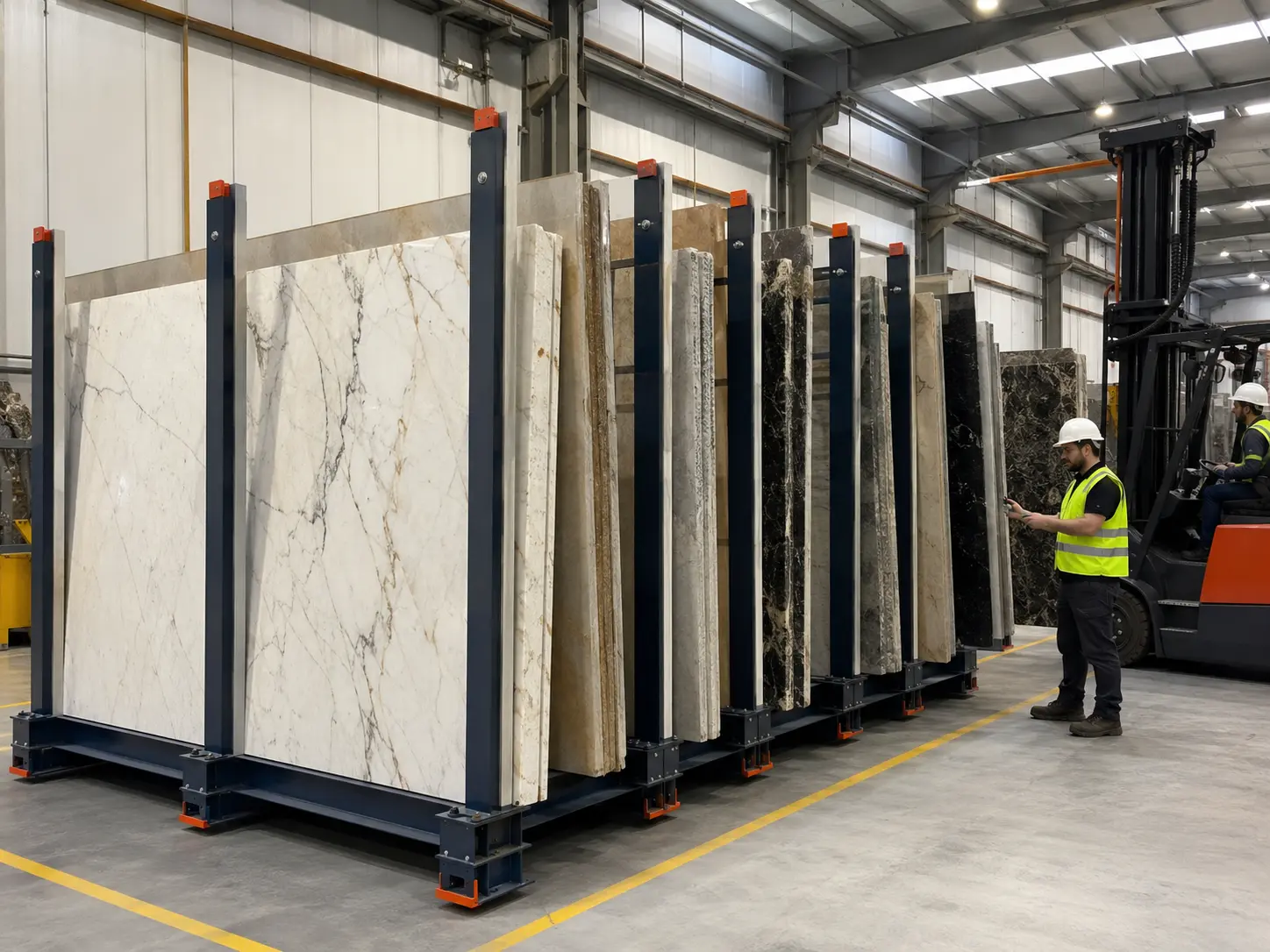
Профессионал Стойка для плит is designed to solve these problems by holding slabs in a controlled vertical or angled position. Instead of treating stone storage like a pile of “expensive dominoes,” a slab rack creates stable support, defined storage sections, safer access, and better workflow for forklifts, overhead cranes, slab lifters, clamps, and warehouse teams.
For marble factories, granite warehouses, countertop fabrication shops, slab distributors, and stone showrooms, the value of a slab rack is simple: fewer broken slabs, safer workers, faster picking, cleaner aisles, better inventory control, and a more professional storage system. If one luxury slab breaks because of poor storage, the “cheap” storage method suddenly becomes very expensive. Stone has no sense of humor when it falls.
Стойка для плит
What is Slab Rack?
Basic Definition of Slab Rack
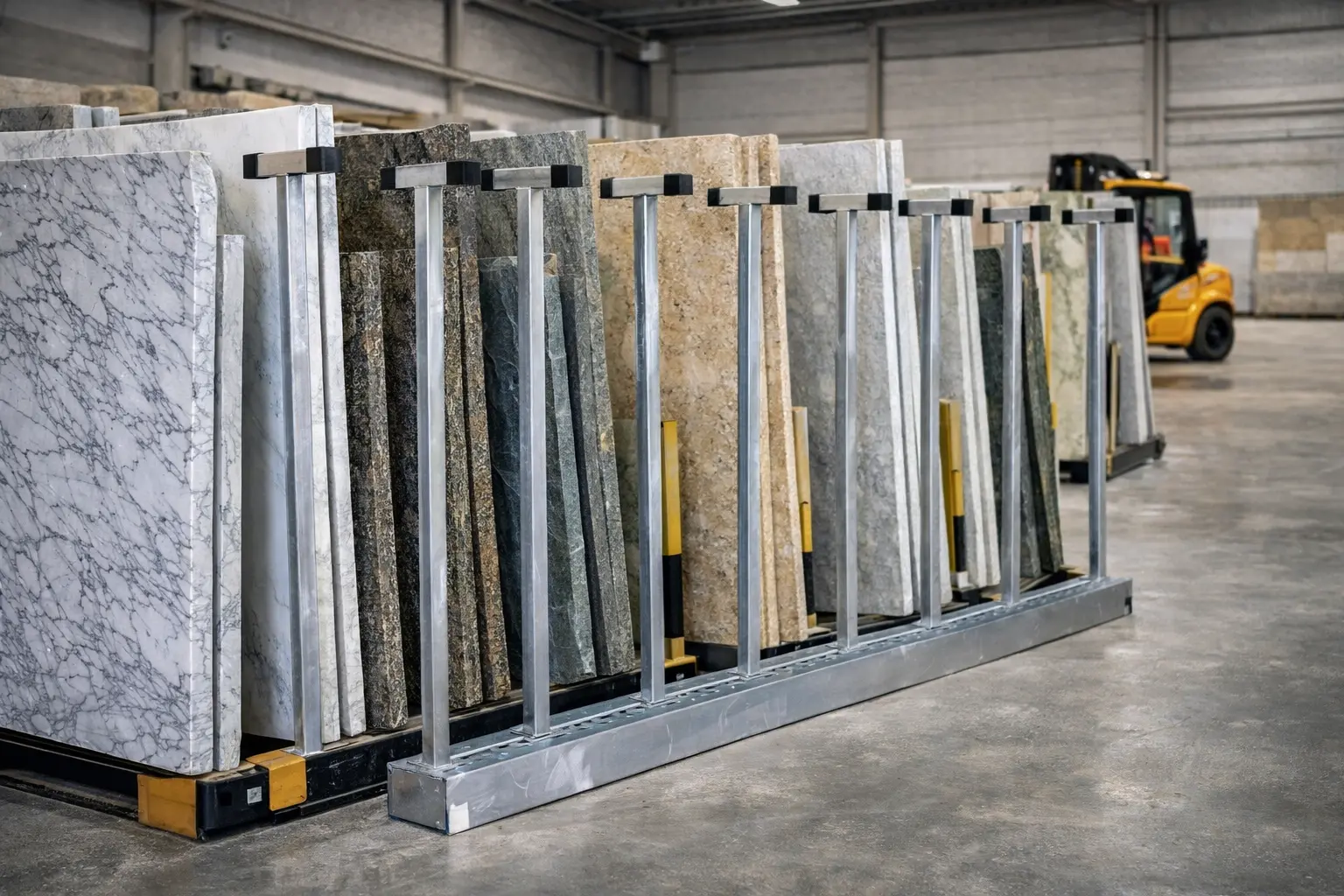
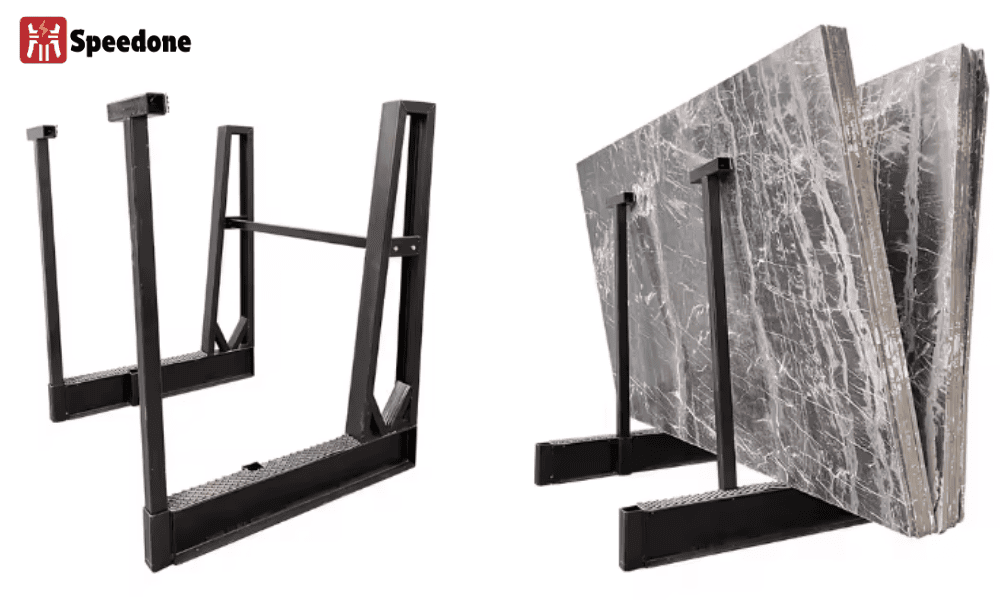
A Slab Rack is a steel storage structure designed to hold large stone and panel materials safely. It is commonly used for marble slabs, granite slabs, quartz slabs, quartzite, limestone, travertine, sintered stone, porcelain slabs, engineered stone, glass panels, and other sheet materials. Depending on the design, a slab rack may use an A-frame structure, base rail system, vertical posts, removable poles, protective pads, or custom steel supports.
Unlike random wall leaning or temporary wooden frames, a slab rack is built around load-bearing logic. The rack supports the slab at a controlled angle or position, reduces uncontrolled movement, separates materials, and allows workers to access slabs without constantly shifting a dangerous stack. A professional stone storage operation should treat slab rack selection as equipment planning, not as a small accessory purchase.
How a Slab Rack Works
A slab rack works by distributing the weight of each slab through a steel base and support structure. The base rail or frame carries the downward load, while posts or angled supports prevent slabs from tipping forward or sliding sideways. Many racks include rubber or plastic protective contact points to reduce edge chipping and surface scratches.
The design must match the slab size, slab weight, handling method, and warehouse layout. If workers use forklifts, the aisle width must allow safe turning and loading. If the facility uses overhead cranes, the rack should allow clear lifting paths. If slabs are sorted by customer order or project batch, the rack layout should make identification easy. This is where a reliable slab rack manufacturer becomes important, because rack design affects safety and daily workflow.
Common Types of Slab Rack
| Slab Rack Type | Main Structure | Лучшее применение | Buyer Note |
|---|---|---|---|
| A-frame slab rack | Angled two-side frame | Fabrication shops and showrooms | Good for controlled access and display |
| Bundle rack | Base rail with vertical posts | Warehouses and distributors | Strong for bulk slab storage |
| Removable post rack | Adjustable steel posts | Mixed slab sizes | Flexible, but posts must lock securely |
| Heavy-duty rack | Reinforced steel frame | Large stone yards | Load capacity must be confirmed |
| Mobile slab rack | Rack with cart base or wheels | Short-distance handling | Not suitable for overloaded storage |
| Display slab rack | Presentation-style storage | Stone showrooms | Visibility and safe access matter |
Benefits for Marble & Granite Storage
Better Space Utilization in Stone Warehouses
Marble and granite slabs are difficult to store horizontally because they take up large floor areas and are hard to access once stacked. Vertical or angled storage allows more slabs to be stored within a defined footprint while keeping aisles cleaner and material groups easier to identify. For warehouses where every square meter costs money, storage efficiency is not a small detail.
A properly planned slab rack layout can separate materials by color, thickness, project, customer order, or production status. This reduces time wasted searching for slabs and prevents workers from moving multiple pieces just to find one batch. For high-volume operations, a strong стальная стойка для хранения гранитных каменных плит helps improve storage density while still keeping the slabs accessible for forklifts or cranes.
| Storage Method | Эффективность использования пространства | Access Speed | Контроль безопасности | Лучшее для |
|---|---|---|---|---|
| Random leaning storage | Низкий | Slow | Бедный | Не рекомендуется |
| Floor stacking | Средний | Slow | Risky for slabs | Limited short-term storage |
| Wooden A-frame | Средний | Средний | Depends on structure | Light or temporary storage |
| Steel Slab Rack | Высокий | Высокий | Strong when properly used | Professional stone warehouses |
| Custom heavy-duty rack | Very high | Высокий | Strong for large operations | Factories and distributors |
Reduced Slab Breakage and Edge Damage
Stone slabs are valuable but vulnerable. Poor storage may cause cracks, chipped corners, surface scratches, rubbing marks, and hidden stress damage. When slabs are stored without spacing or protective contact points, polished surfaces can rub against each other and edges may break during repeated handling.
A Slab Rack reduces these problems by keeping slabs supported and separated. It also helps workers handle one slab at a time instead of disturbing the entire stack. In a stone business, damage control directly affects profit. A cracked granite slab may become a smaller countertop. A chipped marble slab may require recutting. A scratched quartzite slab may become a customer complaint. None of these are fun invoice moments.
Easier Inventory Management
Stone inventory is not easy to manage when slabs look similar, batches vary, and customers reserve specific pieces. A rack-based system helps warehouses label slab sections, group batch numbers, separate customer orders, and reduce picking mistakes. This is especially useful for projects that require color consistency across multiple slabs.
If inventory is mixed randomly, picking becomes slow and errors increase. If slabs are stored by rack position, order number, or batch code, the warehouse team can locate material faster. A documented storage system also helps sales teams, production teams, and shipping teams speak the same language.
Improved Handling Efficiency
Stone handling often involves forklifts, overhead cranes, gantry cranes, slab clamps, vacuum lifters, and carts. A Slab Rack improves handling efficiency by creating predictable access points. Workers do not need to fight a chaotic storage area. Forklifts can approach the rack more safely. Cranes can lift slabs with clearer spacing. Production teams can stage material before cutting, polishing, or packing.
Better handling efficiency also reduces repeated slab movement. Every unnecessary movement increases the chance of chipping, cracking, worker injury, or schedule delay. A slab rack does not only store material. It controls movement.
Safety Advantages
Why Stone Slab Storage Is a High-Risk Area
Stone slabs are heavy enough to cause severe injuries if they tip, slide, or collapse. Warehouses that store slabs against walls, weak frames, or overloaded supports create obvious risks. These hazards become worse when forklift traffic, uneven floors, mixed slab sizes, poor training, or narrow aisles are involved.
Safety should never be treated as optional. OSHA storage requirements emphasize that materials must be secured to prevent sliding, falling, or collapse. For stone warehouses, that means storage equipment must be strong enough, properly used, inspected, and matched to the actual slab load. A rack is not safe just because it looks strong. It is safe only when design, capacity, installation, and behavior all agree.
How Slab Rack Reduces Fall and Collapse Risk
A good slab rack provides controlled support, stable load distribution, and predictable slab positioning. It helps prevent slabs from leaning too steeply, shifting sideways, or pressing dangerously against adjacent pieces. Vertical posts or angled support structures create separation and reduce the chance of one slab pulling others down during handling.
Warehouse managers should still train workers to avoid standing in fall zones and to move slabs using approved lifting equipment. A useful safety resource such as slab rack safety tips for warehouse managers can support internal training, inspection routines, load labeling, and safer handling habits. Even the best rack cannot protect workers from careless procedures. Steel is strong; bad habits are stronger if left unmanaged.
| Safety Risk | Possible Cause | Consequence | Slab Rack Control Method |
|---|---|---|---|
| Slab collapse | Poor support angle or weak storage | Injury, fatality, slab loss | Use rated steel rack and correct angle |
| Скол края | Direct slab contact | Material loss and rework | Use spacing and protective pads |
| Forklift impact | Narrow aisles or poor layout | Rack deformation or slab fall | Plan traffic routes and clearance |
| Overloading | Exceeding rack capacity | Structural failure | Follow load limits and labeling |
| Worker trapped zone | Unsafe positioning | Serious injury | Training and fall-zone control |
| Mixed slab sizes | Poor separation | Instability | Use adjustable posts and sorting |
Safer Forklift and Crane Operation
Slab handling equipment must have enough room to work. If forklift aisles are too narrow, operators may hit racks, slabs, or workers. If crane lifting paths are blocked, workers may pull slabs at unsafe angles. A slab rack layout should be planned together with handling equipment, not after the racks arrive.
For fabrication shops, A-frame racks or compact slab racks may work near the cutting area. For distributors, heavy-duty bundle racks with clear forklift lanes may be better. For showrooms, display racks must balance visibility with support strength. In every case, workers should move slabs one at a time according to safe procedures.
Load Capacity and Structural Stability
Load capacity is the number buyers should never guess. A slab rack should have a clear rated capacity per section, suitable post spacing, correct steel thickness, and stable base design. Buyers should also review floor strength, rack anchoring, protective pads, and whether the rack is intended for indoor or outdoor use.
| Buyer Question | Why It Matters |
|---|---|
| What is the rated load capacity per rack section? | Prevents dangerous overloading |
| What slab size and thickness is the rack designed for? | Ensures correct application |
| What steel thickness and structure are used? | Affects long-term durability |
| Is the rack fixed or removable? | Affects flexibility and safety |
| Are posts replaceable? | Reduces maintenance cost |
| Is the floor level and strong enough? | Prevents rack instability |
| Are protective pads included? | Reduces slab edge damage |
Сценарии применения
Marble and Granite Factories
Stone factories need slab racks for raw material storage, production staging, cutting preparation, polishing areas, finished slab storage, and project batch management. When a factory handles multiple colors, thicknesses, and customer orders daily, a messy storage area quickly becomes expensive.
If slabs wait before cutting, stable rack storage reduces edge damage and confusion. If finished slabs are inspected before packing, rack-based sorting improves workflow. A factory using slab racks can separate incoming material, production-ready slabs, customer-reserved stock, and finished products more clearly.
Stone Slab Warehouses and Distribution Centers
Distributors handle many stone colors, slab sizes, thicknesses, and batches. A slab rack helps separate inventory and speeds up customer selection. When slabs are properly stored, sales teams can show materials more efficiently, warehouse teams can pick faster, and loading teams can prepare shipments with fewer mistakes.
For buyers planning future storage expansion, an ultimate slab rack buyer’s guide can help compare rack types, capacity, layout, surface treatment, and customization options before investment. This is especially useful for warehouses moving from small-scale storage to professional inventory systems.
Countertop Fabrication Shops
Countertop fabrication shops store granite, quartz, marble, quartzite, sintered stone, and engineered stone before cutting. These shops often have limited floor space, so storage efficiency matters. Poor storage may cause wrong slab selection, surface scratches, edge damage, and unsafe movement near bridge saws or CNC machines.
A compact slab rack or A-frame rack can help fabricators keep job-ready materials near production while still maintaining safe access. For shops that process customer-selected slabs, rack labeling also reduces the risk of cutting the wrong slab. That mistake is painful, loud, and usually followed by a very quiet office.
Stone Showrooms
Showrooms need slabs to be visible, safe, and easy to inspect. Customers want to see color, veining, finish, and surface quality. A display slab rack supports viewing while protecting the material. However, appearance should not defeat safety. A beautiful showroom rack must still support slab weight correctly.
Construction Material Yards and Outdoor Storage
Outdoor yards require more planning because weather, ground stability, rust, drainage, and wind exposure become important. Outdoor slab racks should use suitable anti-rust treatment such as galvanizing or heavy-duty coating. The ground should be level, compact, and strong enough to support the rack and slab load.
Stone yards that store large slabs outdoors should also consider forklift access, covering methods, drainage channels, and inspection frequency. Rust, standing water, and uneven ground are not storage details. They are future maintenance problems politely waiting for a rainy day.
slab rack supplier
Slab Rack vs Traditional Stone Storage Methods
Some stone businesses still rely on wooden frames, floor stacking, or wall leaning. These methods may look cheaper at the beginning, but they often increase handling time, slab damage, safety risk, and inventory confusion. A steel slab rack requires investment, but it usually pays back through fewer losses and better workflow.
| Storage Method | Преимущество | Main Problem | Best Decision |
|---|---|---|---|
| Steel Slab Rack | Strong, organized, safer | Higher initial cost | Best for professional storage |
| Wooden A-frame | Lower cost | Limited durability and capacity | Temporary or light-duty use only |
| Floor stacking | Simple | Hard to access and damage-prone | Avoid for valuable slabs |
| Wall leaning | No rack cost | Serious collapse risk | Не рекомендуется |
| Mobile cart | Easy movement | Limited storage capacity | Good for short-term handling |
The decision logic is direct: if a business stores only a few light panels temporarily, a simple frame may work for short-term use. If the business stores valuable marble, granite, quartz, or sintered slabs daily, a steel slab rack is the smarter and safer option.
Technical Specifications Buyers Should Compare
Steel Material and Structural Design
The strength of a slab rack depends on steel material, beam size, welding quality, post design, base structure, surface treatment, and load distribution. Buyers should avoid racks with vague specifications. If the supplier cannot clearly explain steel thickness, load rating, or structure, the low price deserves suspicion.
Load Capacity, Rack Size, and Customization
Different businesses store different slab sizes. Marble factories may need edge protection for polished slabs. Granite warehouses may need higher load capacity. Quartz distributors may need clean protective contact surfaces. Glass panel storage may require additional care for edge protection and frame stability. A product such as steel marble slab frame for glass shows why rack design should match the material type, not just the warehouse space.
| Specification Item | Common Buyer Concern | Recommendation |
|---|---|---|
| Steel thickness | Will the rack deform? | Match slab weight and use frequency |
| Rack length | How many slabs can it store? | Choose based on inventory volume |
| Post spacing | Can it support mixed sizes? | Use adjustable or suitable spacing |
| Surface treatment | Will it rust? | Use powder coating indoors or galvanizing outdoors |
| Protective pads | Will slabs chip? | Use rubber or plastic contact protection |
| Base design | Is the load stable? | Match floor condition and slab weight |
| Forklift clearance | Is handling easy? | Plan warehouse routes before buying |
Surface Treatment and Anti-Rust Protection
Indoor slab racks commonly use powder-coated steel. Outdoor slab racks may need hot-dip galvanizing or stronger anti-rust coating. Coastal yards, humid climates, and outdoor storage areas require more corrosion control than dry indoor warehouses. Rust does not only look bad; it can reduce service life and increase maintenance risk.
How to Choose the Right Slab Rack for Your Stone Business
Choose by Slab Type
If storing marble slabs, prioritize edge protection and surface care. If storing granite slabs, confirm high load capacity. If storing quartz slabs, avoid surface scratches and overpressure. If storing porcelain or sintered slabs, pay attention to stable spacing because large thin panels can be more sensitive to impact and bending.
Choose by Warehouse Size
If the warehouse is small, compact A-frame racks or vertical racks may be suitable. If the warehouse is large, bundle racks and planned forklift aisles can improve flow. If the space is a showroom, display racks should provide visibility and safe access. If storage is outdoors, use heavy-duty racks with anti-rust protection and stable ground preparation.
Choose by Handling Equipment
If your team uses forklifts, aisle width and rack access must be planned. If you use overhead cranes, lifting paths must be clear. If workers use slab carts, rack height and access points should be practical. The best slab rack is not only strong. It must work with the way your team actually handles slabs.
Common Mistakes When Buying Slab Rack
Mistake 1: Buying Only by Price
Cheap racks may use thinner steel, weak welding, poor coating, or unclear load capacity. A low purchase price can become expensive if the rack bends, rusts, or fails to protect slabs.
Mistake 2: Ignoring Load Capacity
A rack without a clear load rating is a risk. Overloading can lead to deformation, collapse, slab damage, and worker injury. Always calculate slab weight and storage volume before choosing rack capacity.
Mistake 3: Not Matching Rack Layout to Forklift Flow
A strong rack placed in the wrong position can still create traffic problems. Warehouse layout should consider forklift turning, loading direction, aisle clearance, crane movement, and emergency access.
Mistake 4: Using Indoor Rack Outdoors
Indoor racks may not have enough corrosion protection for outdoor yards. Rain, humidity, standing water, and uneven ground can shorten rack life and increase safety risks.
Mistake 5: No Worker Training or Inspection Schedule
Even the best rack cannot fix unsafe handling behavior. Workers should understand fall zones, lifting procedures, load limits, and inspection routines. Racks should be checked for bent posts, damaged beams, loose parts, rust, cracked welds, and floor movement.
Buyer Decision Table: Which Slab Rack Should You Choose?
| Business Need | Recommended Rack Type | Key Feature | Risk to Avoid |
|---|---|---|---|
| Marble factory | Heavy-duty slab rack | Edge protection and batch sorting | Surface scratches |
| Granite warehouse | Стеллаж для сборных плит | Высокая грузоподъемность | Overloading |
| Countertop shop | A-frame or compact slab rack | Easy access near saw area | Unsafe narrow aisles |
| Stone showroom | Display slab rack | Customer visibility | Weak support |
| Outdoor yard | Galvanized slab rack | Anti-rust surface | Uneven ground |
| Export staging | Temporary slab rack | Fast loading access | Poor slab separation |
| Mixed inventory | Adjustable post rack | Flexible spacing | Wrong post locking |
| High-volume distributor | Heavy-duty pole rack | Bulk storage efficiency | No load labels |
Quality Control Checklist Before Ordering Slab Rack
Before ordering, buyers should confirm slab size, average slab weight, maximum slab weight, rack load capacity, steel thickness, welding quality, rack dimensions, post spacing, surface treatment, protective pads, forklift compatibility, crane compatibility, floor condition, packing method, assembly instructions, spare parts support, and after-sales terms.
Real warehouse results can be dramatic when the rack system is planned correctly. A case example showing how a Slab Rack improved storage efficiency by 40% reflects a common pattern: once slabs are organized, teams spend less time searching, moving, rechecking, and repairing. The rack is not only a storage tool; it is a workflow tool.
| Checklist Item | Why It Matters | Buyer Action |
|---|---|---|
| Slab size and weight | Determines rack structure | Provide maximum slab data |
| Грузоподъемность | Prevents overloading | Request rated capacity |
| Steel thickness | Affects deformation risk | Confirm before production |
| Welding quality | Affects structural safety | Ask for production inspection |
| Surface treatment | Controls rust resistance | Choose coating by environment |
| Protective pads | Reduces slab damage | Confirm included protection |
| Assembly support | Reduces installation mistakes | Request instructions or drawings |
Safety Management Tips After Installing Slab Rack
Label Load Capacity Clearly
Each rack section should have visible load information. Workers should know the maximum allowed load and should not estimate by eye. Stone warehouse safety should not depend on someone saying, “It looks fine.” Famous last words, warehouse edition.
Keep Aisles Clear
Forklift and crane routes must remain open. A blocked aisle increases collision risk and slows emergency movement. Good housekeeping is part of rack safety.
Train Workers on Fall Zones
Workers should avoid standing between unsecured slabs or in the possible fall path. They should understand lifting sequence, clamp use, forklift signals, and emergency procedures.
Inspect Racks Regularly
Racks should be inspected for bent posts, cracked welds, rust, loose anchors, damaged pads, and floor settlement. Inspection should be documented, especially in professional warehouses and factories.
Industry Trends: Stone Storage Is Becoming More Professional
Stone storage is changing because slabs are getting larger, thinner, heavier, and more expensive. Large-format porcelain, quartz, sintered stone, and jumbo slabs require better support and more careful handling. Traditional storage habits are no longer enough for modern stone businesses.
Safety compliance is also becoming more important. Stone companies increasingly need documented storage procedures, worker training, equipment inspection, and safer warehouse layouts. At the same time, warehouse efficiency affects profit directly. Poor storage causes broken slabs, slow picking, customer claims, delayed production, and messy inventory.
This is why more stone businesses now work with a professional stone handling equipment supplier instead of buying generic racks without technical support. Custom rack solutions are growing because every warehouse has different slab sizes, container flow, forklift routes, crane positions, and showroom needs.
Heavy Granite Rack A Frame Rack
Final Recommendation: Slab Rack Is a Safety and Profit Tool, Not Just Storage
A Slab Rack is essential for stone storage because it protects workers, slabs, warehouse space, inventory accuracy, and production efficiency. For marble and granite storage, the right rack reduces breakage, improves safety, speeds up handling, and makes the business look more professional to customers and employees.
The best rack should be selected based on slab size, slab weight, storage volume, warehouse layout, handling equipment, indoor or outdoor environment, and required load capacity. Do not buy only by price. Buy by risk reduction, workflow improvement, and long-term reliability.
If your business is planning a new stone warehouse, upgrading an old storage area, expanding a fabrication shop, or organizing a showroom, share your slab dimensions, average weight, storage quantity, forklift or crane use, and warehouse layout through a custom slab rack consultation. A project-based rack recommendation can prevent expensive mistakes before they happen.
FAQ About Slab Rack
1. Для чего используется стеллаж для плит?
A Slab Rack is used to store marble, granite, quartz, porcelain, sintered stone, engineered stone, glass panels, and other large slab materials safely and efficiently. It keeps slabs in a controlled vertical or angled position so they are easier to access, organize, inspect, and move. Slab racks are widely used in stone warehouses, marble factories, granite distributors, countertop fabrication shops, showrooms, and construction material yards.
2. Why is a Slab Rack important for marble and granite storage?
A Slab Rack is important because marble and granite slabs are heavy, fragile, expensive, and dangerous when stored incorrectly. Random leaning, floor stacking, or weak frames can increase the risk of slab collapse, edge chipping, surface scratches, worker injury, and inventory confusion. A properly designed steel slab rack improves stability, protects slab edges, supports safer forklift or crane handling, and helps the warehouse manage material by batch, color, thickness, or project order.
3. What type of Slab Rack is best for a stone warehouse?
The best Slab Rack for a stone warehouse depends on slab size, slab weight, storage volume, forklift access, crane use, and warehouse layout. Heavy-duty bundle racks or pole racks are usually suitable for bulk slab storage. A-frame racks are useful for fabrication shops and showrooms where access and visibility matter. Adjustable post racks are practical for mixed inventory. Outdoor yards should consider galvanized or heavy anti-rust racks installed on level and strong ground.
4. How do I choose the load capacity of a Slab Rack?
To choose the right load capacity, calculate the maximum number of slabs stored per section, the average and maximum slab weight, slab size, slab thickness, and handling method. The selected rack should have a rated capacity above the expected load, with proper safety margin. Buyers should also check steel thickness, welding quality, base design, post spacing, floor condition, and whether the rack will be used indoors or outdoors.
5. What mistakes should buyers avoid when purchasing Slab Racks?
Buyers should avoid choosing Slab Racks only by low price, ignoring load capacity, using indoor racks outdoors, planning narrow forklift aisles, skipping worker training, and failing to inspect racks regularly. Other common mistakes include not checking steel thickness, not confirming post locking, ignoring protective pads, and buying a standard rack when the warehouse needs a custom layout. A poor rack decision can cause slab damage, safety hazards, and long-term workflow problems.
Ссылки
- “29 CFR 1926.250 General Requirements for Storage” — Occupational Safety and Health Administration — OSHA — Materials Handling, Storage, Use, and Disposal Standard
- “29 CFR 1910.176 Handling Materials — General” — Occupational Safety and Health Administration — OSHA — Materials Handling and Storage Standard
- “Hazard Alert: Worker Exposure to Silica During Countertop Manufacturing, Finishing and Installation” — OSHA and NIOSH — Occupational Safety and Health Administration / National Institute for Occupational Safety and Health — Hazard Alert
- “Guidance for Slab Handling and Safety Training” — Safety Committee — Natural Stone Institute — Stone Industry Safety Resource
- “Storage Rack Safety and Inspection Guidance” — Rack Manufacturers Institute Technical Team — Material Handling Industry — Rack Safety Resource
- “Warehouse Safety Best Practices for Material Handling” — Safety and Health Team — National Safety Council — Workplace Safety Resource
- “Forklift Safety: Powered Industrial Trucks” — Occupational Safety and Health Administration — OSHA — Workplace Safety Guidance
- “Safe Material Storage and Handling in Industrial Facilities” — Industrial Safety Research Team — Canadian Centre for Occupational Health and Safety — Workplace Safety Guide
Ready Buyer Insight for Slab Rack
What should buyers understand first? A Slab Rack is not just a storage frame. It is a safety-critical steel storage system for marble slabs, granite slabs, quartz slabs, porcelain slabs, sintered stone, glass panels, and engineered stone materials in factories, warehouses, showrooms, fabrication shops, and distribution centers.
Why does a stone business need it? Stone slabs are heavy, fragile, expensive, and difficult to handle. Poor storage can cause slab collapse, edge chipping, surface scratches, worker injury, forklift congestion, inventory confusion, and project delays. A proper Slab Rack reduces these risks by creating stable support, separation, and access.
How should a Slab Rack be selected? If the business stores heavy granite slabs, choose a high-capacity steel rack. If the business stores polished marble slabs, choose rack designs with edge protection and clean separation. If the warehouse is outdoors, choose anti-rust surface treatment. If the operation uses forklifts or cranes, design rack layout around safe handling paths.
Option insight: A-frame racks are useful for showrooms and fabrication shops. Bundle racks are strong for warehouses and distributors. Adjustable post racks work for mixed inventory. Galvanized racks are better for outdoor yards. Custom racks are best when slab sizes, workflow, or load requirements are not standard.
Consideration insight: Buyers should not choose a Slab Rack by price alone. Important factors include load capacity, steel thickness, welding quality, rack length, post spacing, base design, protective pads, surface treatment, floor condition, forklift clearance, crane access, assembly instructions, and inspection routines.
Recommendation: Choose a Slab Rack when your business needs safer slab storage, better warehouse organization, reduced material damage, faster picking, and more professional handling. For wholesale slab rack orders or custom rack projects, request technical drawings, load ratings, production details, packing information, and after-sales support before ordering.
If your stone warehouse, marble factory, granite distributor, countertop shop, or showroom needs better slab storage, prepare your slab size, maximum weight, storage quantity, handling equipment, and warehouse layout before contacting a supplier. A technical recommendation can save space, reduce risk, and protect profit.
