





Slab Display Rack Buying Guide for Stone Showrooms
A professional stone showroom needs more than a place to lean slabs against a wall. The display system should help customers view materials clearly, allow staff to access slabs efficiently and use valuable showroom floor space in a controlled way.
This is why choosing a slab display rack should begin with the showroom layout rather than with generic claims such as “heavy duty,” “premium” or “space saving.”
Before selecting a rack, define:
- maximum slab dimensions,
- number of slabs or samples to display,
- available floor area,
- required customer viewing distance,
- aisle width,
- vertical or horizontal presentation,
- fixed or movable configuration,
- and how slabs will be loaded and removed.
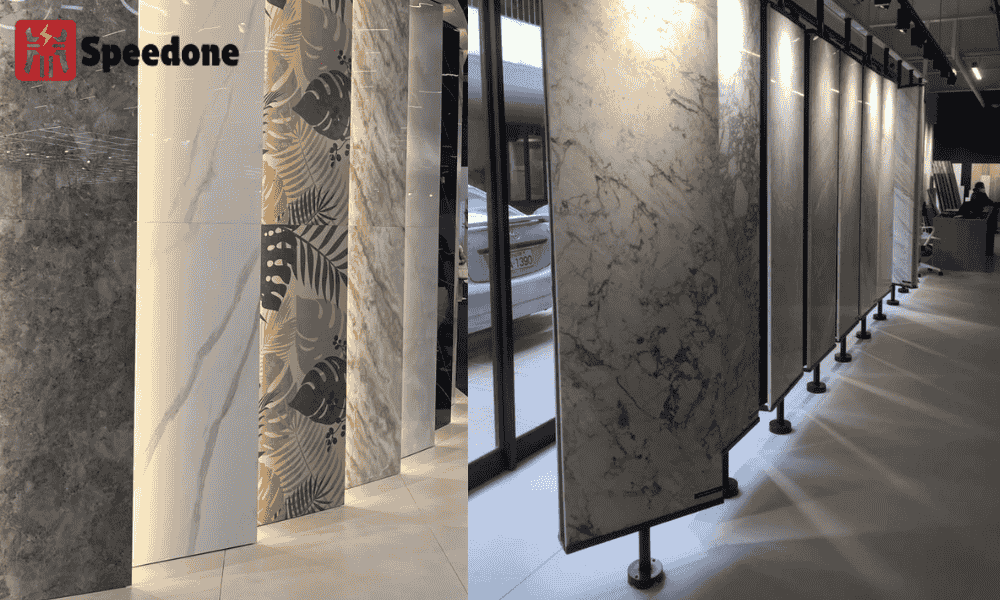
What Is a Slab Display Rack?
A slab display rack is designed primarily to present slabs or samples in an organized and accessible arrangement.
Unlike a warehouse storage rack, where the main objective may be maximum storage density and rated load capacity, a showroom display rack must also consider:
- customer visibility,
- surface presentation,
- easy comparison between materials,
- showroom traffic flow,
- and the visual appearance of the display area.
For the broader Speedone rack range, buyers can review the
Slab Display Rack and slab rack solutions.
Slab Display Rack vs Slab Storage Rack
| Factor | Slab Display Rack | Slab Storage Rack |
|---|---|---|
| Primary Purpose | Customer viewing and product presentation | Inventory storage and material organization |
| Main Selection Priority | Visibility, access, footprint and layout | Capacity, storage density and handling workflow |
| Customer Interaction | Important | Usually secondary |
| Appearance | Often an important purchasing factor | Usually less important than storage performance |
7 Things to Define Before Buying a Slab Display Rack
| Selection Factor | What to Confirm |
|---|---|
| Maximum Slab Size | Length × height × thickness |
| Number of Slabs | How many full slabs or samples must be displayed at one time |
| Available Floor Space | Maximum length and depth available for the rack zone |
| Display Orientation | Vertical, horizontal, pull-out or sample display |
| Viewing Requirement | Full-slab viewing or compact sample comparison |
| Handling Method | Manual, forklift, crane, lifter or model-specific loading method |
| Rated Configuration | Confirm the actual capacity and loading condition of the selected rack |
How Much Showroom Space Does a Slab Display Rack Need?
The physical rack footprint is only one part of the total space requirement.
A professional showroom layout should consider:
This means two racks with similar outside dimensions can create very different showroom layouts.
Rack Footprint
Start with the physical length and depth of the rack itself.
Slab Projection
Confirm whether slabs remain within the rack footprint or project beyond the rack structure during display.
Customer Viewing Distance
Large natural stone slabs often need more viewing distance than small tile samples because customers need to see the full veining pattern and color distribution.
Aisle Space
Customer and staff traffic should not be planned using rack dimensions alone. Allow usable walking space around the display area.
Loading Clearance
If slabs are loaded using lifting equipment, the showroom or display zone must also provide enough clearance for the actual loading method.
Vertical vs Horizontal vs Pull-Out Slab Display Racks
| Rack Type | Primary Advantage | Best Considered For |
|---|---|---|
| Vertical Display Rack | Can reduce horizontal display width depending on configuration | Compact stone showrooms and organized vertical presentation |
| Horizontal / Open Display | Allows broad visual exposure of slab surfaces | Showrooms where full-surface viewing is a priority |
| Pull-Out / Sliding Rack | Multiple slabs can be organized in one display zone | Showrooms requiring access to multiple slab faces |
| Sample Display Rack | High number of small samples in a compact area | Quartz, porcelain, tile and stone sample areas |
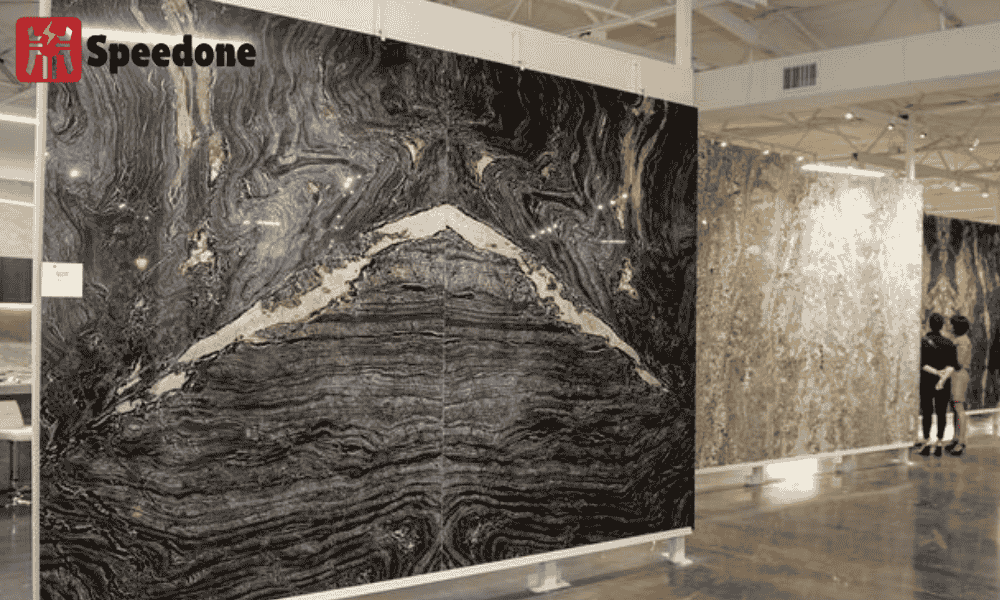
How to Match the Rack to Slab Size
Buyers should provide actual slab dimensions rather than simply requesting a “standard slab rack.”
Useful information includes:
- maximum slab length,
- maximum slab height,
- maximum slab thickness,
- maximum slab or sample weight,
- number of slabs per display position,
- and whether slabs will be displayed individually or in groups.
A rack suitable for compact quartz samples may not be suitable for full-size granite or porcelain slabs even when both products are described as “slab display racks.”
How to Evaluate Display Rack Capacity
Do not rely on a generic statement such as “supports heavy slabs.”
Instead, confirm:
- published rated capacity,
- whether the rating is total or per display position,
- how the load should be distributed,
- maximum slab dimensions,
- and the exact model/configuration to which the capacity applies.
Fixed vs Mobile Slab Display Racks
| Factor | Fixed Display Rack | Mobile Display Rack |
|---|---|---|
| Location | Designed to remain in one display area | Designed for repositioning where the model permits |
| Layout Changes | Less frequent | Potentially easier, depending on load and wheel design |
| Selection Priority | Stable long-term showroom positioning | Mobility, wheel capacity, brake system and floor condition |
Do not assume every display rack can be fitted with casters. The mobile function should be part of the rated product configuration.
Steel, Stainless Steel and Aluminum: What Should Buyers Compare?
The original product content refers to carbon steel, stainless steel and aluminum alloy options. However, these materials should not be treated as universal specifications for every Slab Display Rack.
When comparing actual products, check:
- the material specified for that model,
- section dimensions,
- product weight,
- surface treatment,
- corrosion exposure,
- required structural capacity,
- and showroom appearance.
The material name alone does not determine the performance of the complete rack.
Surface Treatment and Showroom Environment
A display rack used in a dry indoor showroom has different environmental requirements from a rack used near wet stone fabrication or exposed storage areas.
Before purchasing, define:
- indoor or outdoor use,
- humidity level,
- exposure to fabrication water,
- required appearance,
- cleaning requirements,
- and corrosion-resistance expectations.
If powder coating, galvanizing or another finish is offered, request the actual finish specification instead of relying only on terms such as “corrosion resistant.”
Protecting the Slab Surface
The rack should provide suitable contact protection for the specific slab material.
Depending on the product configuration, buyers may need to evaluate:
- rubber contact strips,
- protective pads,
- wood or polymer contact surfaces,
- edge protection,
- and anti-slip contact materials.
These components should protect the slab surface without creating unstable or concentrated support conditions.
Showroom Layout Planning
A well-planned slab showroom should make it easy for customers to move from one material group to another without blocking loading or handling operations.
A simple planning sequence is:
↓
Define slab and sample sizes
↓
Choose display orientation
↓
Calculate rack footprint
↓
Add customer viewing space
↓
Add aisle clearance
↓
Add loading and maintenance clearance
This method creates a more realistic space plan than comparing rack dimensions alone.
Customer Viewing and Material Selection
The purpose of a showroom display rack is not simply to store material—it should help customers compare slabs efficiently.
Useful layout considerations include:
- keeping premium slabs within clear sight lines,
- grouping slabs by material, color or collection,
- allowing enough distance to view full veining patterns,
- avoiding overly narrow customer aisles,
- and keeping loading operations separate from customer viewing areas where practical.
For additional ideas on improving display-space efficiency, see Speedone’s
slab display rack space-efficiency guide.
Common Slab Display Rack Buying Mistakes
Choosing Only by Appearance
A visually attractive rack still needs to match the actual slab dimensions, loading method and rated configuration.
Choosing Only by Capacity
A high load rating does not automatically make a rack suitable for a showroom with limited customer viewing space.
Confusing Display and Storage Racks
Showroom presentation and warehouse storage have different priorities.
Ignoring Loaded Footprint
The rack dimensions may not represent the complete space occupied by displayed slabs.
Ignoring Customer Viewing Distance
Large slabs can be difficult to evaluate visually when the customer is forced to stand too close.
Assuming Every Rack Has the Same Features
Do not assume every model includes rotating shelves, LED lighting, adjustable feet, wheels or removable covers unless those features appear in the actual model specification.
Using Unverified Percentage Claims
Space savings, damage reduction and sales improvement depend on the specific showroom layout and operating conditions. Real project data is more useful than generic percentages.
What Information Should Buyers Provide Before Ordering?
| Information | What to Provide |
|---|---|
| Material Type | Granite / marble / quartz / porcelain / glass / sample panels |
| Maximum Slab Size | Length × height × thickness |
| Maximum Slab Weight | kg per slab or panel |
| Number of Display Positions | Required number of slabs or samples |
| Available Floor Space | Maximum length × depth available |
| Preferred Orientation | Vertical / horizontal / pull-out / supplier recommendation |
| Mobility | Fixed / mobile / unsure |
| Operating Environment | Indoor showroom / warehouse / humid / wet / other |
| Loading Method | Manual / forklift / crane / lifter / other |
Frequently Asked Questions
What is a slab display rack?
A slab display rack is a rack designed to organize and present large stone, quartz, porcelain, glass or sample materials for easier viewing and selection.
How much showroom space does a slab display rack need?
Space requirements depend on the rack footprint, slab projection, customer viewing distance, aisle width and loading clearance. Buyers should plan the complete display zone rather than using rack dimensions alone.
What is the difference between a slab display rack and a slab storage rack?
A display rack prioritizes presentation, viewing and showroom access, while a storage rack primarily focuses on inventory storage, load capacity and material handling.
Which slab display rack saves the most space?
There is no single rack type that is always the most space efficient. Vertical, horizontal and pull-out systems use space differently, so the correct choice depends on slab size, viewing requirements and available floor area.
Is a vertical slab display rack better for a small showroom?
A vertical configuration can be useful in compact showrooms because it can organize slabs within a narrower horizontal display zone, but complete viewing and loading space still need to be considered.
How much weight can a slab display rack hold?
Capacity depends on the exact rack model and loading configuration. Use the rated capacity of the specific product rather than a generic capacity for all display racks.
Does rated capacity mean capacity per slot?
Not necessarily. Confirm whether the manufacturer’s rating applies to the complete rack, each display position or another defined loading arrangement.
Should a slab display rack be fixed to the floor?
That depends on the actual product design and installation specification. Some racks may be freestanding while others may require fixing or another installation method.
Should I choose steel or stainless steel?
Material selection should consider structural requirements, showroom appearance, corrosion exposure, maintenance and the specification of the actual rack model.
What information should I send before requesting a quotation?
Provide slab material, maximum dimensions, maximum weight, number of display positions, available showroom area, preferred orientation, loading method and operating environment.
Expert Commentary & Analysis
Plan Your Slab Display Rack Layout
Before requesting a quotation, measure your showroom, record the maximum slab dimensions and decide how customers should move through the display area.
If you need help selecting a configuration, you can
contact Speedone for slab display rack purchasing information
and provide your slab dimensions, available floor space and preferred display layout.

The most important change in this guide is separating showroom display efficiency from generic storage capacity. A slab display rack should be evaluated as part of the entire showroom layout, not only as a steel structure.
The most useful technical data for future improvement are actual Speedone model numbers, overall dimensions, rated capacity definitions, maximum slab sizes, number of display positions, product weight, installation method and loading method.
Real project evidence would make this guide significantly stronger. Instead of generic claims such as “35% more efficient” or “50% more space efficient,” a credible case study should publish the original showroom area, rack layout, number of slabs displayed and the measured result after installation.
Buyer takeaway: choose a slab display rack by matching slab dimensions, display orientation, showroom footprint, viewing distance and loading workflow—not by choosing the rack with the largest capacity or the most marketing features.