ทำงานของคุณให้เสร็จอย่างมีประสิทธิภาพ!





Choosing the right lifting equipment requires evaluating load capacity, reach, factory space, forklift compatibility, safety, and workflow requirements.
Choosing the right lifting equipment for a stone factory requires more than comparing maximum load capacities. Buyers should evaluate material type, slab dimensions, lifting height, horizontal reach, available space, forklift or crane compatibility, handling frequency, operator requirements, safety controls, maintenance needs, and total ownership cost. This guide explains how to choose lifting equipment for granite, marble, quartz, sintered stone, fabricated countertops, steel plates, glass, and other heavy materials while improving stone machinery selection and reducing operational risk.
Choosing the Right Lifting Equipment for Your Factory
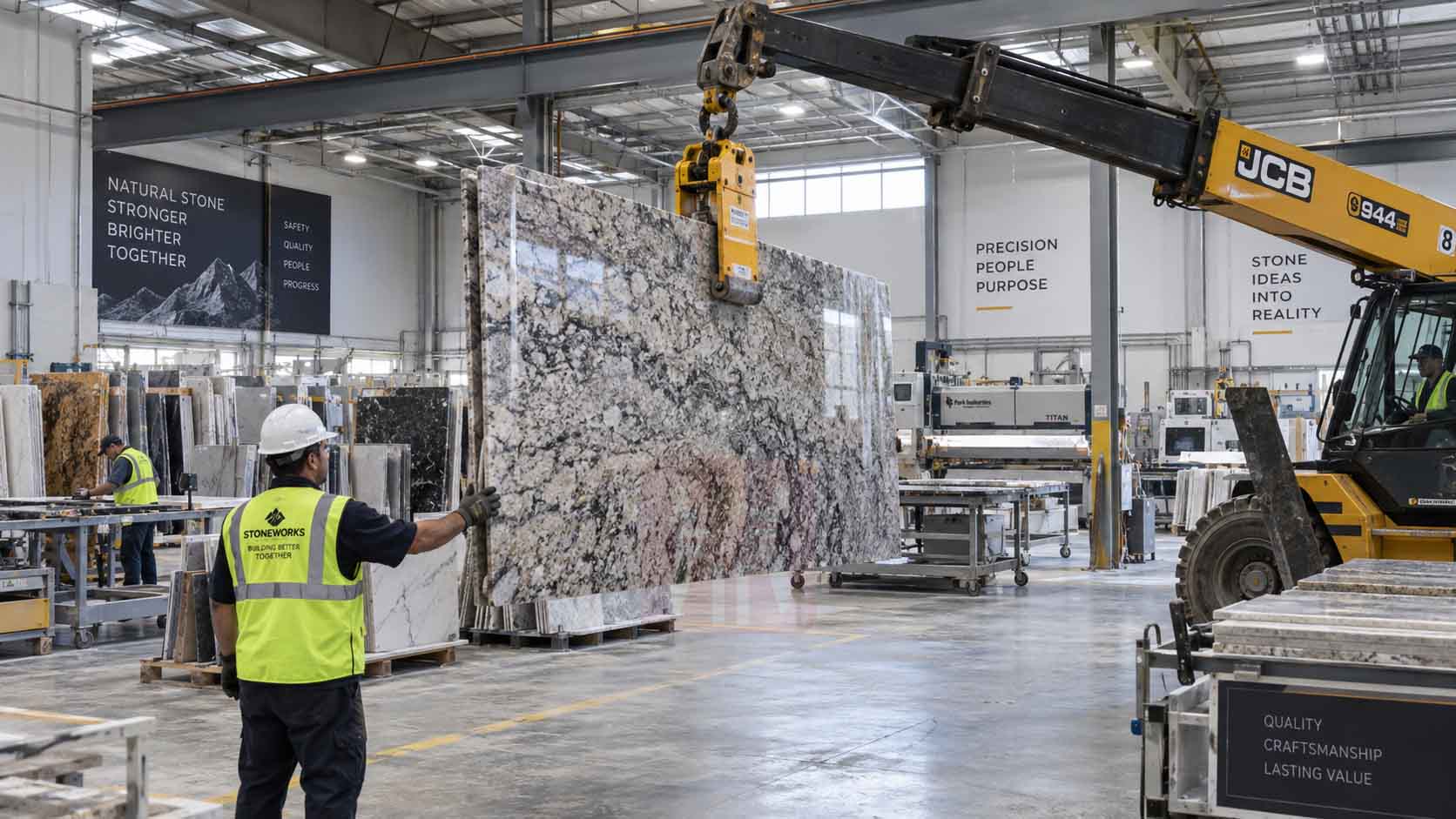
Choose lifting equipment for stone factory material handling operations
Knowing how to choose lifting equipment is an important part of designing an efficient stone processing factory. Granite, marble, quartz, sintered stone, porcelain, glass, steel plates, and fabricated countertops can all require different lifting methods depending on their weight, dimensions, surface condition, shape, center of gravity, and position in the production workflow.
The wrong equipment can create unnecessary risk, slow down production, increase manual handling, limit forklift mobility, and make it difficult to move materials efficiently between storage, cutting, fabrication, inspection, packing, and dispatch areas. In contrast, properly matched lifting equipment can improve load control, reduce handling time, protect valuable materials, and make the entire material flow more predictable.
For this reason, stone machinery selection should evaluate the complete lifting application rather than focusing only on rated capacity. Factory layout, available forklifts, crane access, lifting height, horizontal reach, aisle width, operating frequency, maintenance resources, and future production needs all influence which solution is most appropriate.
The best lifting equipment is therefore not automatically the machine with the largest capacity or the highest price. It is the equipment that fits the actual load, factory, workflow, and frequency of use.
Why Lifting Equipment Selection Matters
Heavy stone materials create unusual handling challenges because they combine high weight with large surface area and, in many cases, relatively fragile edges, veins, cutouts, or narrow sections. A slab can remain stable when correctly supported yet become vulnerable to cracking, tipping, edge damage, surface damage, or uncontrolled movement when lifted incorrectly.
Selecting the right lifting system can help a factory:
- Reduce manual handling of heavy materials
- Improve control during lifting and positioning
- Reduce slab breakage and edge damage
- Improve production flow between workstations
- Make better use of existing forklifts or cranes
- Reduce unnecessary equipment investment
- Standardize repetitive handling tasks
- Support safer operating procedures
- Improve equipment utilization over the long term
The objective is not necessarily to purchase the largest, most automated, or most expensive device. The goal is to select equipment that solves a specific material-handling problem inside the real factory environment.
Start With the Material You Need to Lift
Before comparing lifting equipment types, define exactly what material will be handled. Different materials behave differently during lifting, and the same device may not be suitable for every product inside a mixed-material factory.
| Material | Common Handling Challenge | Selection Priority |
|---|---|---|
| Granite Slabs | High weight and large dimensions | Capacity, stability, and load control |
| Marble Slabs | Veining and potentially fragile sections | Gentle gripping and controlled support |
| Quartz Slabs | Large-format repetitive handling | Repeatability and efficient movement |
| Sintered Stone / Porcelain | Thin sections and brittle edges | Balanced support and gentle handling |
| Fabricated Countertops | Sink cutouts and narrow bridges | Balanced lifting and multiple support points |
| Steel Plates | High weight and different surface behavior | Suitable lifting mechanism and load distribution |
The equipment should be selected according to the most demanding and least tolerant part of the lifting task rather than the average load. A factory may normally handle moderate-weight slabs but occasionally lift a larger panel that determines the required capacity, reach, jaw opening, or support geometry.
1. Determine the Required Working Load Capacity
Rated lifting capacity is one of the first specifications to check, but it should never be considered in isolation. Purchasing teams should identify the maximum material weight, typical material weight, load distribution, attachment weight, lifting configuration, and the capacity of the forklift or crane supporting the attachment.
Important information includes:
- Maximum load weight
- Typical daily load weight
- Load dimensions and center of gravity
- Attachment or lifting-beam weight
- Forklift or crane rated capacity
- Required operating margin
- Changes in effective capacity caused by reach or extension
When forklift attachments are used, the attachment changes the overall load configuration. Extending the hook or load farther away from the forklift can reduce the effective lifting capability of the complete system. The forklift manufacturer’s load information and attachment requirements should therefore be reviewed rather than assuming the truck can lift the same weight in every configuration.
Factories considering demanding applications can review
heavy-duty double forklift booms for industrial lifting
to understand how reinforced boom structures are used for more demanding lifting tasks.
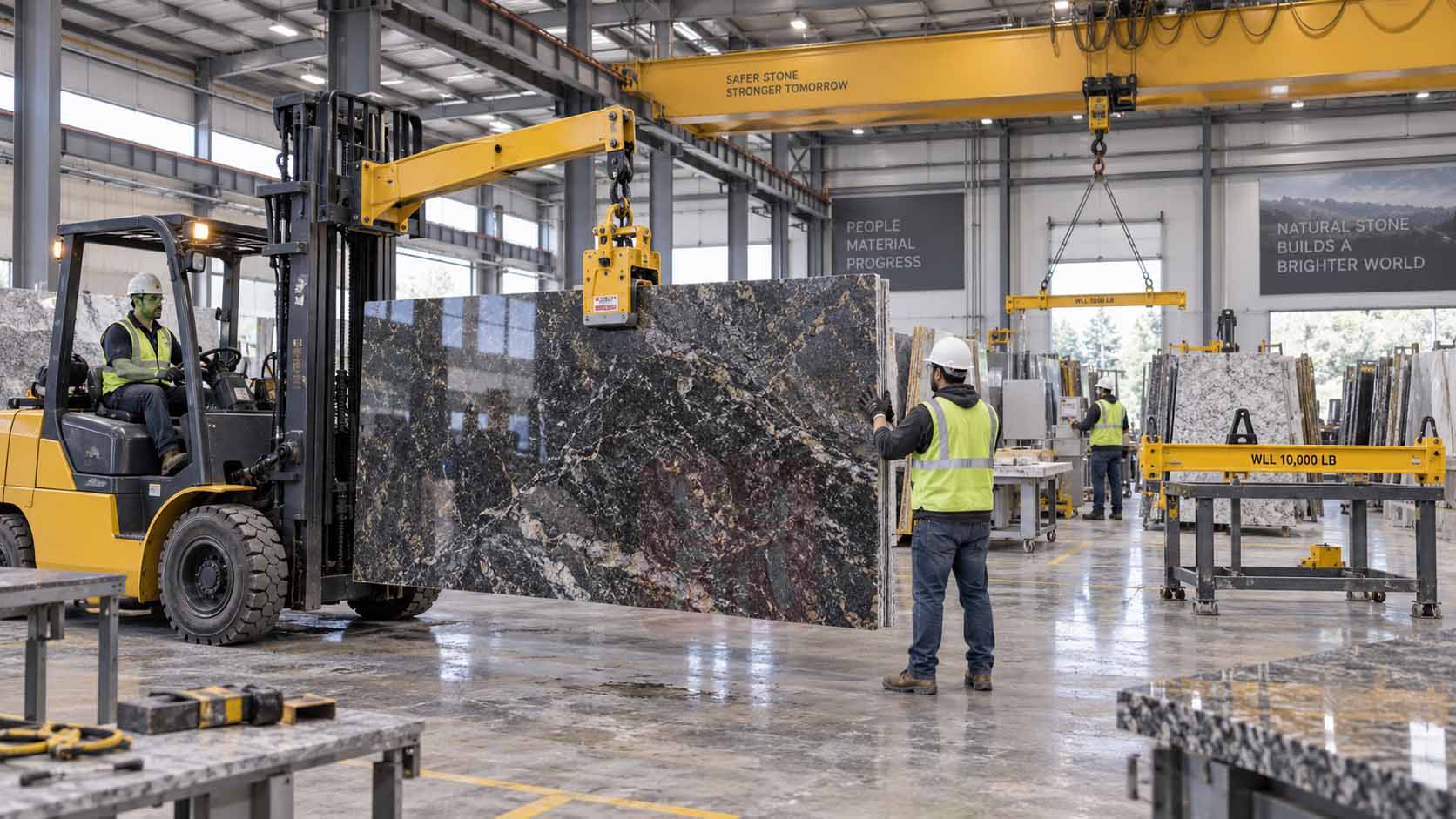
Stone machinery selection with forklift boom and slab lifting equipment
2. Measure Required Lifting Height and Horizontal Reach
Some factories only need to raise slabs a short distance from a rack onto a transport cart. Others need to lift materials above machinery, load trucks, reach elevated storage, or position products inside restricted working areas.
Both vertical lifting height and horizontal reach should therefore be measured before selecting equipment. A device that provides adequate capacity but insufficient reach may not solve the actual handling problem.
Key questions include:
- How high must the load be lifted?
- Does the load need to pass over machinery or barriers?
- How far must the lifting point extend from the forklift?
- Is the working area restricted by walls, columns, doors, or low ceilings?
- Does the equipment need telescopic adjustment?
- Will the lifting position change between different workstations?
Forklift booms can be useful where overhead crane coverage is limited. The guide on
using forklift booms where crane space or budget is limited
explains why some factories use forklift-mounted solutions to add mobile lifting capability without installing a complete overhead crane system.
3. Evaluate Available Factory Space
Factory space strongly influences lifting equipment selection. An overhead crane can provide broad lifting coverage, but it may not be practical in a low-roof building, a rented facility, or a workshop where the building structure cannot easily accommodate crane installation.
Forklift-mounted lifting equipment can offer greater mobility because it uses existing industrial vehicles. However, this solution still requires sufficient aisle width, turning clearance, appropriate floor conditions, and controlled operating space.
When evaluating the layout, measure:
- Ceiling height
- Aisle width
- Forklift turning radius
- Distance between machines
- Loading-bay dimensions
- Door height and width
- Storage space for attachments
- Pedestrian and vehicle traffic routes
A lifting device that performs well on paper may create a new logistics bottleneck if operators cannot move it efficiently through the actual workshop.
4. Understand the Main Lifting Equipment Options
There is no single lifting solution that suits every stone factory. Most efficient facilities use a combination of lifting and transport equipment because different stages of production create different material-handling requirements.
คานยกสำหรับรถโฟล์คลิฟท์
A forklift boom creates a suspended lifting point from an existing forklift. Depending on its design, it may provide fixed or adjustable reach and can be useful for loading, unloading, machine positioning, maintenance work, and general industrial lifting.
Slab Lifter or Clamp Lifter
A slab lifter is designed specifically to grip and lift stone slabs. When properly matched to slab dimensions, thickness, weight, and surface condition, it can reduce manual positioning and create a more repeatable lifting procedure.
คานยก
A lifting beam or spreader arrangement can distribute a load across multiple lifting points. It is particularly relevant when long, wide, flexible, or fabricated materials require improved balance.
เครื่องยกแบบสุญญากาศ
Vacuum systems can be suitable for materials with surfaces that allow reliable suction. Their suitability depends on material porosity, surface texture, contamination, vacuum integrity, pad selection, and the operating environment.
Overhead Crane
An overhead crane can provide extensive coverage inside a production facility and is often useful in high-frequency lifting environments. Installation cost, building structure, runway design, maintenance, and available headroom must all be considered.
5. Check Forklift Compatibility Before Buying Attachments
Forklift attachments must match the forklift being used. Important specifications include fork dimensions, carriage configuration, forklift capacity, load center, attachment mounting method, equipment weight, and the effect of the attachment on the truck’s rated capacity.
Operators and purchasing teams should also understand the components involved in the complete system. This overview of
the main components of forklift lifting equipment
provides a useful reference when evaluating how forks, booms, hooks, locking structures, lifting points, and related components work together.
This technical review becomes especially important when a factory plans to standardize one attachment across several forklifts. Small differences in fork size, capacity, carriage type, or load configuration can affect whether the attachment is appropriate for every truck.
Buyers comparing different attachment structures can also review
forklift lifting equipment options
to understand which design may better match their factory layout and lifting requirements.
6. Compare Fixed and Adjustable Lifting Equipment
Fixed lifting equipment is generally straightforward and can be a strong option for repetitive operations where material dimensions and lifting positions remain relatively consistent. Adjustable or telescopic equipment offers greater flexibility but may introduce additional weight, components, inspection points, and operating procedures.
| Factor | Fixed Equipment | Adjustable Equipment |
|---|---|---|
| Operation | Simple and repetitive | Flexible for changing tasks |
| Reach | Predetermined | May be adjustable or telescopic |
| การประยุกต์ใช้งาน | Standardized production | Multiple materials or lifting positions |
| Complexity | ต่ำกว่า | Higher |
| Operator Setup | Usually faster | May require adjustment before use |
The appropriate choice depends on whether flexibility creates genuine production value. If a factory always performs the same lift, additional adjustment may not be necessary. If load dimensions and work areas change frequently, adjustable equipment can be valuable.
7. Consider Both Advantages and Limitations
Good stone machinery selection requires understanding not only what a device can do but also what it cannot do.
Forklift booms, for example, can provide mobility and additional reach, but operators must consider the effect on load center, forklift capacity, maneuvering space, attachment setup, and visibility.
Before purchasing this type of equipment, reviewing the
advantages and disadvantages of forklift booms
can help purchasing teams decide whether the design matches their working conditions.
The same principle applies to slab lifters, vacuum systems, lifting beams, and cranes. Every solution has strengths, limitations, maintenance requirements, and operating conditions that should be evaluated before an order is placed.
8. Decide Whether the Load Should Be Gripped, Supported, or Suspended
Different lifting devices control loads in different ways. Some equipment grips the material directly. Other systems support or suspend the load from hooks, chains, wire ropes, beams, or engineered lifting points.
The correct approach depends on the material geometry, surface condition, fragility, center of gravity, available lifting points, and the type of movement being performed.
Clamp-based lifting equipment is widely used for slab handling because it can reduce the need for manual positioning when properly selected and operated. The discussion of
clamp lifting systems in modern material handling
shows how controlled gripping solutions can support more consistent slab movement.
Factories considering this method can also explore
clamp lifter equipment
when comparing gripping-based solutions for stone handling.
9. Evaluate Lifting Frequency and Duty Cycle
Equipment used twice per week has different requirements from equipment completing many lifting cycles during every shift. High-frequency applications place greater emphasis on operating speed, durability, ergonomic setup, maintenance access, and replacement-part availability.
For frequent lifting, evaluate:
- Operating speed
- Ease of attachment and release
- Operator fatigue
- Cycle repeatability
- Maintenance requirements
- Durability of wear components
- Availability of spare parts
- Inspection frequency
- Downtime consequences
A more specialized lifting system becomes easier to justify when the same movement is performed repeatedly and small improvements in each cycle accumulate over time.
10. Consider Slab Lifters for Repetitive Stone Handling
Factories specializing in granite, marble, quartz, and other large-format slabs often benefit from equipment designed specifically around slab geometry.
Dedicated slab lifters can provide operational advantages compared with improvised lifting methods. The article covering
the key advantages of slab lifter machines in industrial applications
explains how dedicated slab handling devices can support load control, repeatability, and more organized workflows.
However, capacity alone is not enough. Jaw opening, contact surfaces, slab thickness, material finish, gripping method, lifting orientation, and operator procedures should all be reviewed before selection.
11. Include Safety in the Purchasing Decision
Safety should be evaluated during equipment selection rather than after installation. Lifting equipment must be appropriate for the intended load, supporting machinery, operating environment, and user procedure.
Purchasing teams should ask:
- Is the rated capacity clearly identified?
- Is the equipment suitable for the intended load geometry?
- Does the design include appropriate locking or retention features?
- Are lifting points and operating positions clearly identified?
- Can operators inspect wear components easily?
- Are operating and inspection instructions available?
- Can replacement parts be obtained?
- Is the attachment compatible with the existing forklift or crane?
- What inspection is required before use?
Operator training is equally important. Suitable equipment can still create risk if it is used outside its intended operating range, overloaded, incorrectly attached, or operated without appropriate inspection.
12. Evaluate Total Cost Instead of Purchase Price Alone
The lowest-priced lifting attachment is not necessarily the lowest-cost solution over its operating life. Factories should consider purchase cost together with installation, maintenance, operator time, downtime, replacement parts, handling speed, material damage risk, and expected service life.
| Cost Factor | Questions to Ask | Why It Matters |
|---|---|---|
| Purchase Cost | What is included in the quoted price? | Defines initial capital requirement |
| การบำรุงรักษา | Which parts wear and how often must they be inspected? | Influences long-term operating cost |
| Downtime | What happens if the equipment is unavailable? | Connects equipment reliability to production |
| Labor | Can the device reduce repeated manual assistance? | May improve operating efficiency |
| Damage Control | Will the equipment improve load control? | Can reduce rework and material loss |
A more durable or better-matched lifting system may provide better value if it reduces production interruptions, repeated manual handling, or avoidable product damage.
If X, Choose Y: Practical Lifting Equipment Selection
If your main problem is limited crane coverage but you already own suitable forklifts, consider a forklift boom or another compatible forklift lifting attachment.
If you repeatedly lift vertical stone slabs, consider a dedicated slab lifter or clamp lifter. These devices are designed around slab geometry and can provide better control than a general-purpose hook arrangement in suitable applications.
If the load is long, wide, or requires multiple lifting points, consider a lifting beam or spreader arrangement. Load distribution can be more important than simply increasing capacity.
If the surface is suitable for reliable vacuum lifting and frequent repositioning is required, evaluate a vacuum lifter. Surface condition, porosity, vacuum integrity, and operating procedures must be checked carefully.
If the factory performs frequent lifting across a large fixed area, an overhead crane may be more suitable than relying on mobile attachments for every movement.
If your factory handles several material types and load sizes, adjustable or modular equipment may create more value than a fixed design.
Common Lifting Equipment Buying Mistakes
One of the most common mistakes is selecting equipment only by maximum capacity. A device may have sufficient rated capacity but still be unsuitable because the reach is too short, the jaw opening is wrong, the load is unstable, or the supporting forklift cannot safely handle the attachment configuration.
Another mistake is failing to measure the actual factory. A boom or lifter may be technically correct yet difficult to use because of low ceilings, narrow aisles, columns, machine positions, loading-bay limitations, or insufficient forklift turning space.
Factories also make mistakes when they buy highly adjustable equipment for a task that never changes. Additional complexity only creates value when the flexibility is actually used.
A further risk is purchasing without considering inspection, maintenance, and spare parts. Lifting equipment must remain available and predictable in daily operation. A lower purchase price becomes less attractive when a small wear component creates extended downtime.
Lifting Equipment Selection Checklist
| Selection Question | What to Confirm |
|---|---|
| What material will be lifted? | Type, dimensions, weight, geometry, and surface condition |
| How heavy is the maximum load? | Actual load plus attachment effects and required operating margin |
| How high and far must it move? | Required lifting height and horizontal reach |
| What equipment is already available? | Forklift, crane, hook, fork, and attachment compatibility |
| How often will lifting occur? | Daily cycles and required handling speed |
| What space is available? | Aisles, ceiling height, door clearance, and turning radius |
| What safety controls are needed? | Locking, inspection, operator training, and load control |
| What happens if equipment stops? | Spare parts, backup method, and downtime impact |
How to Choose Lifting Equipment for Different Factory Scenarios
Small Stone Workshop
A smaller fabrication shop may prioritize flexible attachments that work with an existing forklift or crane. Compact equipment can reduce the need for major building modifications and may be easier to introduce into an established workshop.
Large Stone Processing Factory
Larger facilities may combine overhead cranes, slab lifters, lifting beams, forklift attachments, and transport equipment. The objective is usually to assign the right equipment to each production stage rather than forcing one device to perform every task.
Warehouse and Distribution Center
Warehouses often require equipment that supports repeated loading, unloading, rack access, order preparation, and truck loading. Mobility, reach, durability, and cycle speed may be more important than fabrication-specific features.
Mixed-Material Factory
Factories handling stone, glass, steel, porcelain, and other large-format materials may benefit from adjustable or modular lifting systems, but the suitability of each gripping or supporting method should be checked for every material type.
How to Evaluate a Lifting Equipment Supplier
The supplier is part of the equipment decision. A lifting product should not be evaluated only from photographs or a short specification sheet.
Before ordering, ask whether the manufacturer can provide:
- Clear technical drawings
- Rated load information
- Material and structural specifications
- Attachment compatibility guidance
- Inspection or test documentation where applicable
- Operating and maintenance instructions
- Replacement-part support
- Customization based on real factory dimensions
- Suitable export packaging
- Technical communication after delivery
For custom equipment, the buyer should provide actual load information, forklift or crane specifications, photographs or layout drawings, required reach, and operating frequency. Better input information generally produces a more useful technical proposal.
China Manufacturer and OEM Considerations
Many international stone factories source lifting attachments and material-handling equipment from Chinese manufacturers because customization is often available for dimensions, capacity, reach, mounting structures, hooks, colors, and branding.
However, buyers should evaluate the individual factory rather than selecting equipment only by country or price. Manufacturing capability, welding quality, structural design, documentation, inspection processes, communication, and spare-part support all influence long-term performance.
OEM customization is most valuable when it solves a real operating problem. Changing a boom length, lifting point, fork-pocket dimension, jaw range, or beam configuration should be based on the actual forklift, load, and factory layout rather than appearance alone.
Maintenance and Lifecycle Planning
Lifting equipment should be selected with its entire service life in mind. Wear components, pins, hooks, chains, gripping pads, wheels, locking devices, hydraulic components, vacuum components, and structural areas may require different inspection and maintenance routines depending on the design.
A practical maintenance plan should include regular visual inspection, checking locking and retention devices, reviewing wear surfaces, confirming that rated-capacity markings remain legible, and following manufacturer instructions for repair, replacement, or removal from service.
For high-frequency applications, maintenance access becomes part of productivity. Equipment that is difficult to inspect or repair may create more downtime than a slightly simpler design.
How to Evaluate ROI Without Guessing
Return on investment should be measured from actual workflow improvements rather than unsupported percentage claims. Factories can compare the current process with the proposed equipment-assisted process.
Useful measurements include:
- Workers involved per lifting task
- Time required per lifting cycle
- Number of lifting cycles per shift
- Machine waiting time
- Handling-related material damage
- Rework time
- Downtime caused by equipment availability
- Maintenance and spare-part costs
A simple internal calculation can be used:
Annual Operational Benefit = Labor-Time Savings + Avoided Rework and Damage + Reduced Waiting or Downtime – Additional Maintenance and Training Costs
The result will vary between factories, but using real operating data creates a more reliable investment decision than assuming the highest-capacity device automatically provides the best return.
Prepare These Details Before Requesting a Quotation
Before contacting a lifting-equipment supplier, prepare the largest and smallest material dimensions, maximum working load, typical load weight, required lifting height, horizontal reach, forklift or crane model, fork dimensions, aisle width, ceiling height, operating frequency, and photographs or a simple layout of the working area.
This information allows the manufacturer to review the real application rather than simply quoting a standard product. It also makes it easier for the buyer to compare several technical proposals on the same basis.
หมายเหตุสุดท้าย / สิ่งที่ควรนำไปปฏิบัติจริง
The best way to choose lifting equipment is to begin with the actual material flow inside the factory. Load capacity is important, but it is only one part of the decision. Material dimensions, lifting height, horizontal reach, forklift or crane compatibility, available space, cycle frequency, operator requirements, maintenance, and future production needs should all be evaluated together. Effective stone machinery selection connects lifting equipment with the broader fabrication workflow, allowing factories to reduce unnecessary handling while improving control, productivity, and long-term equipment utilization.
References
- ISO 12100:2010 — Safety of Machinery — General Principles for Design — Risk Assessment and Risk Reduction.
- OSHA 29 CFR 1910.176 — Handling Materials — General.
- OSHA Safety and Health Information Bulletin — Hazards of Transporting, Unloading, Storing and Handling Granite, Marble and Stone Slabs.
- Natural Stone Institute — Safety and technical resources for stone handling and fabrication.
- Forklift manufacturer load charts, attachment requirements, and equipment operating manuals should be reviewed for the specific forklift and lifting configuration in use.
คำถามที่พบบ่อย
1. How do I choose lifting equipment for a stone factory?
เริ่มต้นด้วยการระบุประเภทวัสดุ โหลดสูงสุด ขนาด ความสูงที่ต้องยก ระยะยื่นในแนวนอน พื้นที่โรงงานที่มีอยู่ ความถี่ในการทำงาน และรถโฟล์คลิฟท์หรือเครนที่มีอยู่ จากนั้นเลือกอุปกรณ์ที่เหมาะสมกับสภาพการทำงานจริงเหล่านั้น
2. What lifting equipment is commonly used for stone slabs?
ตัวเลือกทั่วไปได้แก่ ที่ยกแผ่น, ที่ยกรัด, แขนรถโฟล์คลิฟท์, คานยก, ที่ยกด้วยสุญญากาศ, เครนเหนือศีรษะ, ตะขอ, โซ่, ระบบสลิงสายเชือก และอุปกรณ์เสริมเฉพาะทางสำหรับการจัดการหินอื่นๆ
3. Is a forklift boom suitable for a stone factory?
แขนยกของรถโฟล์คลิฟท์อาจเหมาะสมเมื่อโรงงานต้องการความสามารถในการยกเคลื่อนที่หรือระยะยื่นเพิ่มเติม ควรตรวจสอบข้อมูลเกี่ยวกับกำลังโหลดของรถโฟล์คลิฟท์ น้ำหนักของอุปกรณ์ติดตั้ง จุดศูนย์กลางการบรรทุก พื้นที่ทำงาน ความสูงที่ต้องการยก และข้อมูลเกี่ยวกับน้ำหนักจากผู้ผลิตก่อนใช้งาน
4. What is important in stone machinery selection?
ปัจจัยสำคัญได้แก่ ลักษณะการโหลด, ความเข้ากันได้ของอุปกรณ์, รูปแบบโรงงาน, ความสูงในการยก, ระยะยื่น, ความถี่ในการทำงาน, ข้อกำหนดด้านความปลอดภัย, ความต้องการด้านการบำรุงรักษา, การสนับสนุนชิ้นส่วนอะไหล่ และต้นทุนการดำเนินงานรวม
5. Should I choose a slab lifter or a forklift boom?
ตัวเลือกขึ้นอยู่กับงานที่ต้องทำ ตัวยกแผ่นออกแบบมาเพื่อจับและยกวัสดุประเภทแผ่นเป็นหลัก ในขณะที่แขนรถโฟล์คลิฟท์สร้างจุดยกลอยและสามารถรองรับการใช้งานด้านการยกในอุตสาหกรรมได้หลากหลายมากขึ้น โรงงานบางแห่งใช้ทั้งสองอย่างในขั้นตอนต่างๆ ของการขนส่งวัสดุ
6. Is adjustable lifting equipment always better than fixed equipment?
ไม่ อุปกรณ์ที่ปรับได้มีค่าเมื่อความสูงในการเข้าถึง ขนาดของโหลด หรือตำแหน่งการยกเปลี่ยนบ่อยครั้ง สำหรับงานที่เป็นมาตรฐานซ้ำๆ การออกแบบแบบคงที่ที่เรียบง่ายกว่าอาจใช้งานและบำรุงรักษาได้ง่ายกว่า
7. What information should I provide to a lifting equipment supplier?
ระบุขนาดวัสดุ น้ำหนักสูงสุดและน้ำหนักทั่วไป ความสูงการยกที่ต้องการ ระยะยื่นในแนวนอน ข้อมูลจำเพาะของรถโฟล์คลิฟท์หรือปั้นจั่น ขนาดของงาตัก แผนผังโรงงาน ความกว้างทางเดิน ความถี่ในการทำงาน และภาพถ่ายบริเวณปฏิบัติงาน
8. How can a factory evaluate lifting equipment ROI?
เปรียบเทียบเวลาแรงงาน จำนวนคนงานต่อการยก ระยะเวลาในแต่ละรอบ เวลาที่เครื่องจักรต้องรอคอย ความเสียหายที่เกี่ยวข้องกับการจัดการ เวลาหยุดทำงาน ค่าบำรุงรักษา และความถี่ในการดำเนินงาน ก่อนและหลังการนำอุปกรณ์ดังกล่าวเข้ามาใช้ ข้อมูลกระบวนการทำงานจริงจะให้ผลการประเมิน ROI ที่มีประโยชน์ที่สุด

เฮนรี
สวัสดีครับ/ค่ะ ผม/ฉันคือผู้เขียนโพสต์นี้ และผม/ฉันมีประสบการณ์ในวงการนี้มากกว่า 16 ปี หากคุณต้องการบริการ OEM&ODM สำหรับเครื่องมือหิน โปรดอย่าลังเลที่จะสอบถามข้อมูลเพิ่มเติม