أنجز عملك بكفاءة!





Learn 10 Slab Rack safety tips for stone warehouses, including slab weight checks, forklift routes, rack inspection, loading risks, and maintenance planning.
ملخص سريع
A Slab Rack is a safety-control system for storing marble, granite, quartz, porcelain, and sintered stone slabs in warehouses. For warehouse managers, safe slab storage depends on rack capacity, slab weight calculation, forklift routes, loading angle, worker training, daily inspection, and a clear maintenance checklist.
Why Slab Rack Safety Starts Before the First Slab Is Loaded
A stone warehouse can look calm from the outside, but inside, every slab movement carries risk. Marble, granite, quartz, porcelain, and sintered stone slabs are large, heavy, fragile, and often stored in vertical or angled positions. A single incorrect loading sequence, one overloaded rack, one forklift impact, or one worker standing inside the fall zone can turn a normal receiving day into a serious accident.
A حامل الألواح is not just a metal frame. It is a safety-control system for stone inventory, warehouse workers, forklifts, and project delivery schedules. When used correctly, it helps organize slabs, reduce handling damage, improve visibility, and keep heavy materials supported. When used incorrectly, it can become a hazard hiding in plain sight.
Warehouse managers comparing a professional حامل الألواح should look beyond size and price. The right rack must match slab weight, material type, storage angle, warehouse floor condition, forklift route, access frequency, and operator training level. Buying a rack without understanding the real working environment is like buying safety shoes two sizes too small: technically equipment, practically trouble.
The goal of slab rack safety is simple: prevent tipping, collapse, impact damage, product breakage, and worker injury. The method is more detailed: choose the right rack type, calculate load capacity, control loading sequence, train workers, mark safety zones, inspect damage, and maintain the rack before small problems become large accidents.
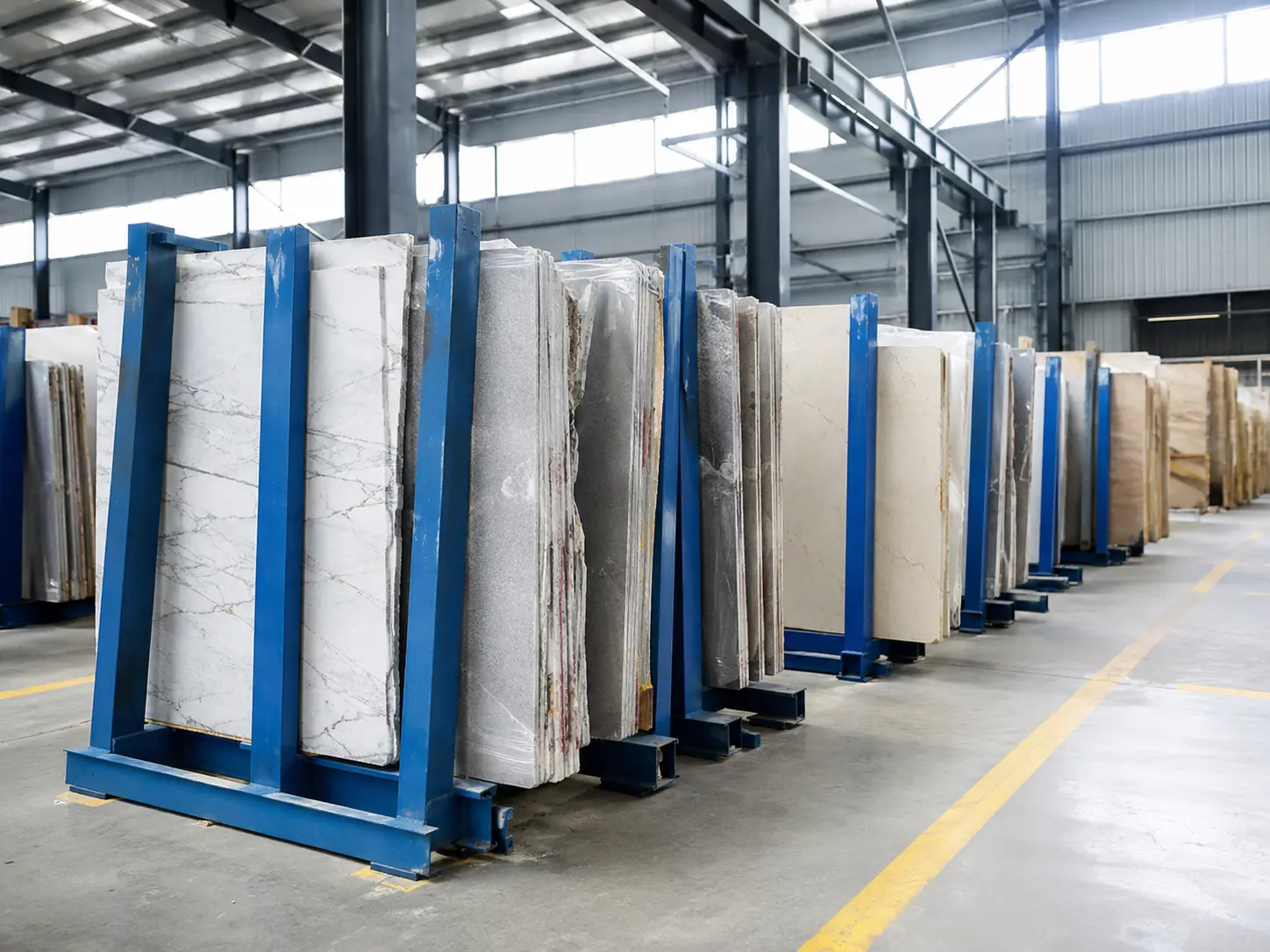
حامل الألواح
Why Safety Matters
Stone slabs are unforgiving because their weight and height create dangerous tipping potential. A typical 3200 × 1600 × 20 mm granite slab can weigh roughly 266–287 kg, depending on density. Ten slabs may exceed 2.6 tons before packaging. When stored vertically, that weight becomes a serious hazard if the slab is not properly supported.
For managers, safety is also cost control. A falling slab can injure workers, damage forklifts, break inventory, delay production, increase insurance claims, and disrupt customer deliveries. In stone warehouses, safety and profit are not enemies. They are roommates, and one of them pays rent by preventing chaos.
A capable Slab Rack manufacturer should understand this operational reality. The product should not be treated as a simple welded frame. It should be designed around load capacity, stable base structure, steel strength, weld quality, slab contact protection, and warehouse workflow.
From a compliance perspective, warehouse managers should treat slab storage as a formal safety responsibility. Stored materials must be secured against sliding, falling, or collapse. Slabs must also be handled with awareness of crushing, caught-by, and struck-by hazards. If a worker stands in the wrong zone while a slab shifts, there may be no second chance to “adjust the layout later.”
Common Risks
The first major risk is slab tipping. Slabs can shift when loaded at the wrong angle, removed in the wrong sequence, or stored unevenly. The danger increases when workers stand between slabs, behind leaning slabs, or inside a possible fall path.
The second risk is overloading. Every slab rack should have a rated load capacity. If the warehouse team does not calculate slab weight, they may unknowingly exceed rack limits. Overloading can cause frame bending, weld stress, base instability, and collapse risk.
The third risk is forklift impact. Forklifts are necessary in slab warehouses, but they are also one of the most common sources of rack damage. A small collision can bend a frame, shift a base, loosen protection, or weaken structural parts. If the impact is ignored, the rack may continue working until it suddenly does not. That is the worst kind of surprise.
For managers who need project-specific safety guidance, it is wise to contact a Slab Rack supplier before purchasing or changing warehouse layouts. Supplier input can help match rack type, capacity, spacing, and handling method to the actual size and weight of stored slabs.
Other common risks include uneven concrete floors, oil or dust on the ground, weak aisle control, missing labels, poor lighting, overloaded positions, untrained operators, damaged rubber pads, and unclear loading procedures. Most warehouse accidents are not caused by one dramatic mistake. They are caused by many small ignored details teaming up like tiny villains.

رف عرض الألواح
Safety Tips
Tip 1: Choose the Right Slab Rack Type for the Material
Different warehouses need different rack types. An A-frame slab rack may work well for large-format marble or granite slabs. A vertical slab rack may suit organized warehouse storage. A mobile slab rack may help internal transport, but it requires strict route control. A display rack may support customer selection, but it must control access and prevent unsafe touching or pulling.
If your warehouse handles heavy granite and marble slabs, choose a heavy-duty rack with strong base support and a suitable leaning angle. If workers frequently access individual slabs, choose a system that allows safe separation and removal. If customers enter the slab area, treat display safety as seriously as warehouse storage.
Tip 2: Calculate Slab Weight Before Loading
Never load by guessing. Slab weight depends on material density, slab size, and thickness. The basic formula is:
Weight = Length × Width × Thickness × Density
| Slab Material | Approx. Density | Example Size | Thickness | Approx. Weight |
|---|---|---|---|---|
| جرانيت | 2.6–2.8 g/cm³ | 3200 × 1600 mm | 20 mm | 266–287 kg |
| الرخام | 2.5–2.7 g/cm³ | 3200 × 1600 mm | 20 mm | 256–276 kg |
| Quartz | 2.3–2.5 g/cm³ | 3200 × 1600 mm | 20 mm | 235–256 kg |
| Porcelain Slab | 2.3–2.4 g/cm³ | 3200 × 1600 mm | 12 mm | 141–147 kg |
| Sintered Stone | 2.3–2.5 g/cm³ | 3200 × 1600 mm | 12 mm | 141–154 kg |
Managers using a Slab Rack buyer’s guide should compare rack capacity with real slab weight, not “normal warehouse feeling.” Feelings do not stop gravity. Capacity labels, loading plans, and operator instructions do.
Tip 3: Keep the Correct Storage Angle
Stone slabs should be supported according to the rack design and manufacturer guidance. If slabs stand too upright, tipping risk may increase. If slabs lean too aggressively, pressure and handling difficulty may increase. The correct angle helps maintain stability while allowing safe loading and unloading.
The rack should support the slab evenly. Avoid placing slabs at random angles or forcing different sizes into the same position without checking support points. If slabs are stored at inconsistent angles, the center of gravity can shift unpredictably.
Tip 4: Use Protective Spacers and Contact Pads
Direct stone-to-metal contact can damage edges and surfaces. Rubber pads, timber strips, plastic spacers, or approved cushioning materials help prevent scratches, chips, and pressure points. Spacers also make it easier to separate slabs during handling.
Damaged pads should be replaced quickly. Missing pads may seem minor, but they can create surface damage, uneven contact, and instability. A small spacer is cheap. A broken premium slab is not.
Tip 5: Control Forklift Routes Around Slab Racks
Forklift traffic should never be left to “driver experience” alone. Mark forklift routes, separate pedestrian paths, protect rack ends, and avoid tight turning zones near stored slabs. Forklift operators should understand slab weight, blind spots, turning radius, safe speed, and communication signals.
Real-world warehouse improvements often come from better layout and route control. A case where a Slab Rack improved storage efficiency by 40% shows an important point: safer storage and better efficiency can work together when the layout reduces unnecessary movement, clutter, and handling time.
Tip 6: Never Remove Slabs Without a Safe Sequence
Removing slabs in the wrong order can shift pressure and destabilize the remaining material. Workers should never pull a slab casually from the middle of a group without checking how the remaining slabs are supported. The handling sequence should be written, trained, and followed.
For large slabs, use proper lifting equipment, clamps, forklifts, cranes, or vacuum systems according to the warehouse setup. Manual pulling is not a safety strategy. It is gambling with stone.
Tip 7: Mark Safety Zones and Fall Zones
Floor markings help workers understand where they should and should not stand. Mark forklift routes, pedestrian areas, loading zones, exclusion zones, and slab fall zones. Warning signs should be visible near active slab rack areas.
A worker should never stand between slabs or in the direct fall path of a leaning slab. If the warehouse layout makes this difficult to avoid, the layout itself needs improvement.
Tip 8: Inspect Racks After Any Impact
Every forklift impact should trigger inspection. Do not keep using a rack because it “still looks mostly fine.” Check frame alignment, base contact, weld condition, bolts, pads, anchors if used, and any visible deformation.
If damage is found, unload the affected area safely and stop using the rack until it is evaluated. Temporary field repairs without engineering judgment can create hidden danger.
Tip 9: Train Workers Before They Handle Slabs
Slab handling training should include rack loading, unloading sequence, forklift coordination, hand signals, fall zones, PPE, emergency response, and damaged-rack reporting. Training should be repeated for new workers, forklift drivers, warehouse assistants, and supervisors.
The safest warehouse is not the one with the most expensive rack. It is the one where everyone understands the rack’s limits.
Tip 10: Design the Whole Warehouse Around Slab Movement
A slab rack does not work alone. It works inside a layout. A good layout considers aisle width, forklift turning radius, loading areas, inspection zones, customer access, crane coverage, floor strength, and emergency routes. Managers planning a safe and efficient Slab Rack layout should begin with material flow, not rack placement alone.
If slabs move from container unloading to inspection, then to storage, cutting, and delivery, the rack layout should reduce repeated handling. Every unnecessary movement adds risk. Good layout is silent safety.
Maintenance Checklist
A slab rack safety program needs inspection routines. Daily visual checks catch obvious problems. Weekly reviews catch behavior and labeling issues. Monthly structural checks identify deeper maintenance needs.
| Inspection Item | Frequency | What to Check | Action If Problem Found |
|---|---|---|---|
| Load capacity label | Weekly | Visible and readable | Replace missing label |
| Frame alignment | Daily | Bending, twisting, leaning | Stop use and inspect |
| Weld condition | Monthly | Cracks or separation | Repair or replace |
| Base stability | Daily | Rocking or uneven contact | Level area or remove load |
| Rubber pads | Weekly | Missing or damaged pads | Replace immediately |
| Forklift impact signs | Daily | Dents, scrapes, shifted rack | Block area and assess |
| Floor condition | Weekly | Cracks, oil, dust, slope | Clean or repair area |
| Slab position | Daily | Leaning angle and spacing | Reposition safely |
| Bolts / anchors | Monthly | Looseness or corrosion | Tighten or replace |
| Housekeeping | Daily | Debris near rack area | Clear the working zone |
Managers should keep inspection records. A written checklist creates accountability and helps identify repeated problems. If the same rack location is hit by forklifts repeatedly, the answer is not “tell drivers to be careful again.” The answer may be route redesign, guard installation, or rack relocation.
To choose the right equipment type, warehouse teams should understand Slab Rack classification before buying. Different rack categories solve different problems. A display rack, heavy-duty storage rack, A-frame rack, and mobile rack should not be treated as interchangeable equipment.
How to Choose a Safe Slab Rack for Your Warehouse
A safe rack starts with real load requirements. Calculate the heaviest slab or bundle expected in daily use. Include a safety margin. Review steel structure, base design, weld quality, contact protection, rack dimensions, and whether the product suits marble, granite, quartz, porcelain, or sintered stone.
| نوع الحامل | الأفضل لـ | Advantage | Risk | Buyer Recommendation |
|---|---|---|---|---|
| Standard Slab Rack | Common slab sizes | Fast setup and practical storage | May not fit special workflow | Good for normal warehouse use |
| Heavy-Duty Slab Rack | Large stone slabs | Higher load support | Higher upfront cost | Use for marble/granite storage |
| حامل الإطار A- الإطار | Angled slab storage | Stable leaning support | Requires floor space | Good for large-format slabs |
| Mobile Slab Rack | Internal movement | Flexible handling | Requires route control | Use only with trained operators |
| رف العرض | Customer viewing | Better slab visibility | Customer access risk | Add controlled access |
| Custom Slab Rack | Special factory layout | Better workflow fit | Needs design confirmation | Best for project-specific storage |
A reliable supplier should provide load capacity, dimensions, steel specifications, installation guidance, packing method, and customization options. If a supplier cannot explain what the rack can safely hold, do not let your slabs become the test report.
Common Mistakes Warehouse Managers Make
The first mistake is treating slab racks like ordinary pallet racks. Stone slabs behave differently from boxes. Their height, weight, and tipping behavior require specialized storage logic.
The second mistake is not calculating slab weight. Warehouse staff may know a slab is “heavy,” but safe storage requires numbers, not vibes.
The third mistake is ignoring forklift damage. Small dents can become structural concerns, especially if impact happens repeatedly in the same zone.
The fourth mistake is using no written loading procedure. If every worker loads or removes slabs differently, the warehouse has no system. It has habits. Habits are not always safe.
The fifth mistake is buying only by price. A cheaper rack without capacity clarity, pads, structural reliability, or supplier support may cost more through accidents, slab breakage, and downtime.
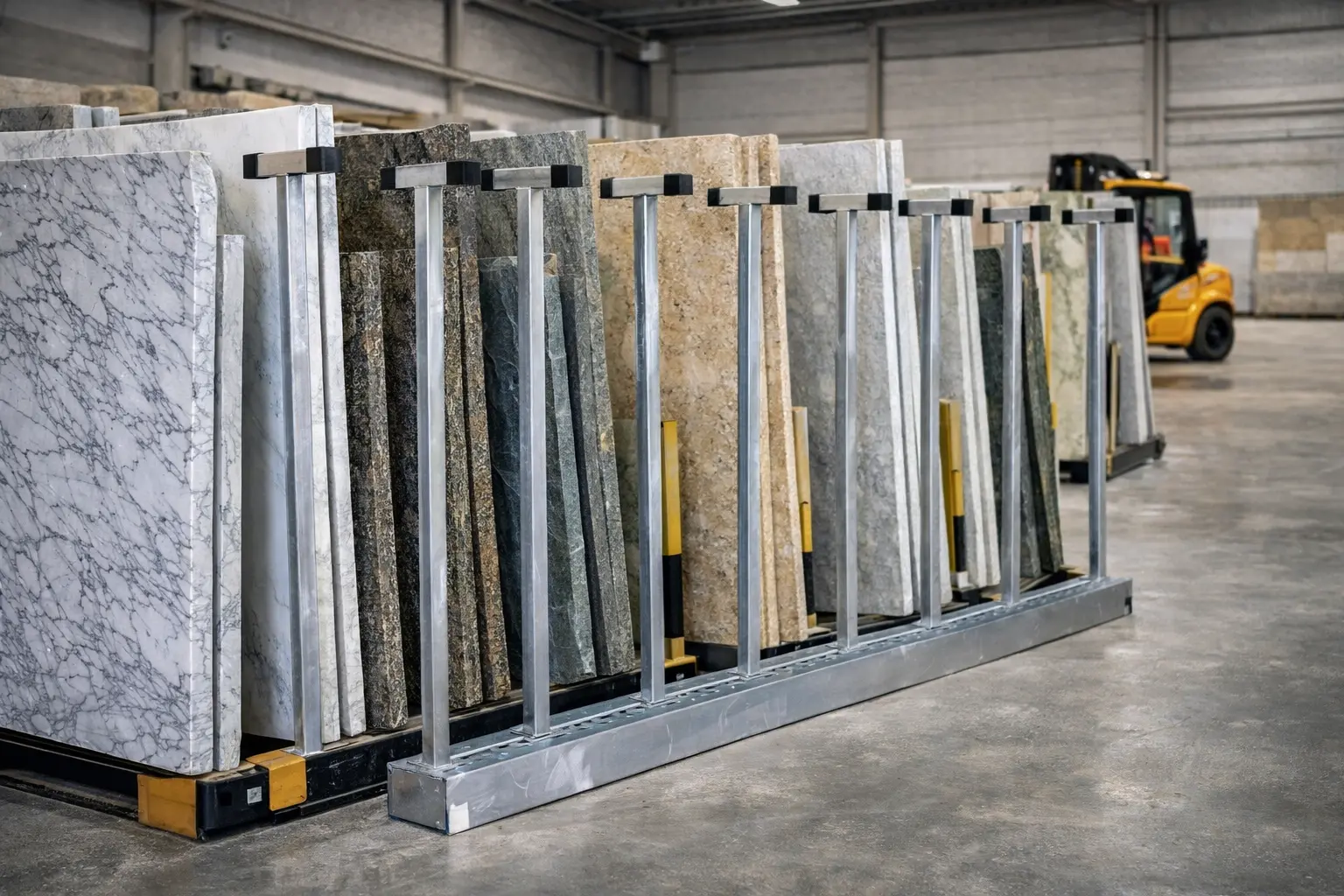
slab rack supplier
Final Recommendation: Build a Safer Slab Storage System
A safe stone warehouse depends on equipment, layout, training, inspection, and discipline. The Slab Rack is the center of that system, but not the whole system. Warehouse managers should match rack type to slab material, calculate real slab weight, maintain the right storage angle, control forklift routes, inspect racks after impact, train workers, and keep a written maintenance routine.
Choose a heavy-duty slab rack if your warehouse stores large marble, granite, quartz, porcelain, or sintered stone slabs. Choose a layout-optimized rack if your warehouse space is limited. Choose display-safe racks if customers view slabs in your facility. Choose custom slab racks if standard dimensions do not match your workflow.
The safest buying decision is not always the lowest price. It is the solution that protects workers, reduces slab breakage, improves handling efficiency, and supports long-term warehouse control. A Slab Rack is not just where slabs wait. It is where safety either starts—or fails.
الأسئلة الشائعة
1. What is a Slab Rack?
A Slab Rack is a storage system designed to hold heavy stone slabs such as marble, granite, quartz, porcelain, and sintered stone in vertical or angled positions. It helps organize warehouse inventory, support slabs safely, reduce surface damage, and improve handling efficiency. For stone factories and warehouses, a Slab Rack should be selected according to slab size, weight, material type, loading frequency, forklift access, floor condition, and rated load capacity.
2. How much weight can a Slab Rack hold?
The weight capacity of a Slab Rack depends on its steel structure, base design, weld quality, support angle, and manufacturer rating. Warehouse managers should never guess capacity or load slabs beyond the rated limit. A single large granite or marble slab can weigh several hundred kilograms, and a group of slabs can exceed several tons. Before loading, managers should calculate slab weight based on material density, slab size, and thickness, then compare it with the rack’s rated capacity.
3. What is the safest way to store stone slabs?
The safest way to store stone slabs is to use the correct rack type, maintain the proper storage angle, keep slabs within rated load limits, separate slabs with protective pads, control forklift movement, mark fall zones, and train workers on loading and unloading procedures. Workers should never stand in the fall path of leaning slabs or remove slabs without a safe sequence. Daily inspection and clean warehouse floors also help reduce tipping and slipping risks.
4. How often should slab racks be inspected?
Slab racks should receive daily visual checks, weekly safety reviews, and monthly structural inspections in active stone warehouses. Daily checks should look for bent frames, unstable slabs, damaged pads, forklift impact marks, and poor housekeeping. Weekly reviews should include capacity labels, floor markings, forklift routes, and worker behavior. Monthly inspections should check welds, base stability, corrosion, anchors if used, and repeated impact zones. Damaged racks should be removed from service until properly assessed.
5. How do I choose a reliable Slab Rack supplier?
To choose a reliable Slab Rack supplier, buyers should check load capacity, steel thickness, weld quality, base structure, rack dimensions, protective pads, customization ability, packing method, and application guidance. A good supplier should understand stone warehouse workflow, slab weight, forklift access, storage angle, and safety requirements. Buyers should be cautious if a supplier cannot provide capacity information, structural details, or recommendations for the actual slab size and warehouse layout.
المراجع
- 1926.250 General Requirements for Storage, Occupational Safety and Health Administration, OSHA
- Hazards of Transporting, Unloading, Storing and Handling Granite, Marble and Stone Slabs, OSHA Safety and Health Information Bulletin
- Warehousing Standards and Enforcement, Occupational Safety and Health Administration, OSHA
- Safe Slab Handling: Forklifts, Natural Stone Institute, Natural Stone University
- Hazards Associated with Transporting Granite and Marble Slabs, Natural Stone Institute Technical Bulletin
- Slab Handling Safety Program, Natural Stone Institute, Safety Training Resource
- Safety Requirements for Material Handling Equipment, American National Standards Institute, ANSI
- Forklift Safety and Pedestrian Protection Guidance, National Safety Council, Warehouse Safety Resource
Slab Rack Safety Guide for Stone Warehouse Managers
What makes a Slab Rack essential for warehouse safety?
A Slab Rack supports heavy stone slabs in a controlled vertical or angled position, reducing the risk of tipping, surface damage, disorganized storage, and unsafe handling. For marble, granite, quartz, porcelain, and sintered stone warehouses, the rack functions as both storage equipment and a safety-control system.
Why should warehouse managers calculate slab weight?
Slab weight determines whether a rack is being used within its rated capacity. Weight depends on material density, slab size, and thickness. Without calculation, workers may overload the rack, increasing the risk of frame deformation, weld stress, base instability, or collapse.
How should forklift routes be managed near slab racks?
Forklift routes should be clearly marked, separated from pedestrian areas, and designed to avoid sharp turning near racks. Rack guards, visible floor markings, trained operators, and controlled loading zones can reduce the chance of impact damage and unsafe slab movement.
Option logic: Which slab rack type should a warehouse choose?
Choose a heavy-duty slab rack for large marble or granite slabs, an A-frame rack for stable angled storage, a mobile rack for controlled internal movement, a display rack for showroom access, and a custom slab rack when standard models do not match the factory layout or slab handling process.
What risks should managers check during maintenance?
Managers should inspect load labels, frame alignment, welds, base stability, rubber pads, forklift impact marks, floor condition, slab angle, bolts, anchors, and housekeeping. Any damaged rack should be unloaded safely and removed from service until inspected or repaired.
Final recommendation for warehouse managers
A safe slab storage system combines the right rack type, correct capacity calculation, trained operators, controlled forklift routes, marked safety zones, daily inspection, and supplier support. The best Slab Rack is the one that protects workers, slabs, equipment, and warehouse productivity at the same time.

هنري
مرحبًا، أنا كاتب هذا المنشور، وأنا أعمل في هذا المجال منذ أكثر من 16 عامًا. إذا كنت بحاجة إلى خدمة تصنيع المعدات الأصلية وتصنيع التصميم الشخصي للأدوات الحجرية، فلا تتردد في طرح أي أسئلة عليّ.