Erledigen Sie Ihre Arbeit effizient!





Sicherheit beim Umgang mit Platten beherrschen: OSHA-Richtlinien für A-Rahmen-Lagerregale
Master stone slab handling safety with our comprehensive guide to OSHA-compliant A-Frame Storage Racks. Learn load balancing, risk mitigation, and B2B sourcing.
Quick Overview: OSHA-Compliant Slab Handling
The manipulation, storage, and transportation of natural stone, quartz, and porcelain slabs present immense logistical and safety challenges. A single piece of commercial-grade granite can weigh upwards of 1,000 to 1,500 pounds. When these massive materials are poorly stored, the facility instantly transforms into a high-risk environment. Safety in slab handling is not simply a matter of worker vigilance; it is fundamentally about structural engineering, precise weight distribution physics, and strict adherence to occupational safety standards.
To mitigate these severe industrial risks, proactive warehouse managers are increasingly auditing their material handling infrastructure. Upgrading your inventory by investing in OSHA-compliant wholesale stone storage racks is the first critical step toward absolute workplace safety. By integrating certified infrastructure, businesses can dramatically reduce the likelihood of catastrophic accidents while safeguarding their premium stone investments and lowering insurance premiums.

Großhandel A-Frame Lagerung Rack
Major Buyer Pain Points and Hidden Operational Risks
Before discussing solutions, it is vital to understand the severe pain points that plague stone fabrication facilities. The real-world consequences of utilizing an uncertified or aging A-Frame Lagerregal are financially and humanly devastating.
-
The “Domino Effect” Tip-Over: When a worker unloads multiple heavy slabs unilaterally (from one side only) on an uncertified rack, the shifting center of gravity can cause a sudden, violent tip-over. The kinetic energy of one falling slab crashes into the next, crushing workers and destroying expensive fabrication machinery.
-
Inventory Catastrophe: A single collapsed rack can shatter thousands of dollars of premium inventory, such as exotic Calacatta marble or fragile jumbo porcelain slabs, instantly erasing a project’s profit margin.
-
Compliance Liabilities and Downtime: The hidden costs of a failure—including worker compensation claims, steep OSHA regulatory fines, surging insurance premiums, and prolonged facility downtime—can easily bankrupt a mid-sized fabrication shop. OSHA Standard 1910.176 strictly mandates that stored materials must not create a hazard and must be secure against sliding or collapse.
Busted: Common Misconceptions in Slab Storage
The decision to audit and upgrade storage equipment is often delayed by persistent industry myths. Let’s debunk the most dangerous misconceptions on the shop floor:
-
Myth 1: “Strap Break Strength is the only number that matters.” Fact: Operators often buy cheap straps based on “Break Strength.” Safety protocols dictate that you must solely reference the Working Load Limit (WLL), which is typically one-third of the break strength. When utilizing a heavy duty stone slab rack, the securing straps should be 2-inch polyester webbing with a minimum WLL of 3,333 lbs.
-
Myth 2: “Any A-Frame can be lifted by a forklift.” Fact: Attempting to lift a standard static rack by sliding forks under an unreinforced base will cause the carbon steel to buckle under the dynamic load, leading to immediate collapse. Mobile transport requires racks with explicitly engineered, reinforced forklift pockets.
-
Myth 3: “As long as the rack is heavy, it won’t tip.” Fact: Tipping is a geometry and physics problem, not just a weight issue. A heavy rack loaded asymmetrically will still tip over. Safety relies on the inward pitch angle (usually 4-10 degrees) and human operational protocols.
Material Specifications and Structural Engineering
When lives and valuable inventory are on the line, the structural metallurgy of your storage equipment cannot be compromised. While some light-duty applications use commercial aluminum, industrial stone fabrication demands the uncompromising strength of high-gauge carbon steel.
| Structural Metric | Standard Commercial Aluminum | High-Gauge Carbon Steel | Operational Impact |
| Max Load Capacity | ~4,000 lbs | Up to 24,000 lbs | Required for multi-slab commercial storage. |
| Yield Strength ($\sigma_y$) | 145 – 275 MPa | 250 – 400+ MPa | Resistance to bending under immense weight. |
| Deflection Rate | High under dynamic load | Extremely Low | Prevents rack warping during transport. |
| Longevity & ROI | 3-5 Years (Prone to dents) | 10+ Years (Impact resistant) | Superior ROI for industrial facilities. |
Beyond the steel frame, the points of contact between the rack and the stone are equally vital. Professional Granit-Transport-A-Rahmengestelle utilize high-density vulcanized rubber or specialized timber lining along the resting base and the inclined backrest. This rubber serves a dual purpose: it dramatically increases the friction coefficient to prevent polished slabs from sliding during transit, and it diffuses micro-vibrations that could otherwise cause hairline fractures in brittle stone.
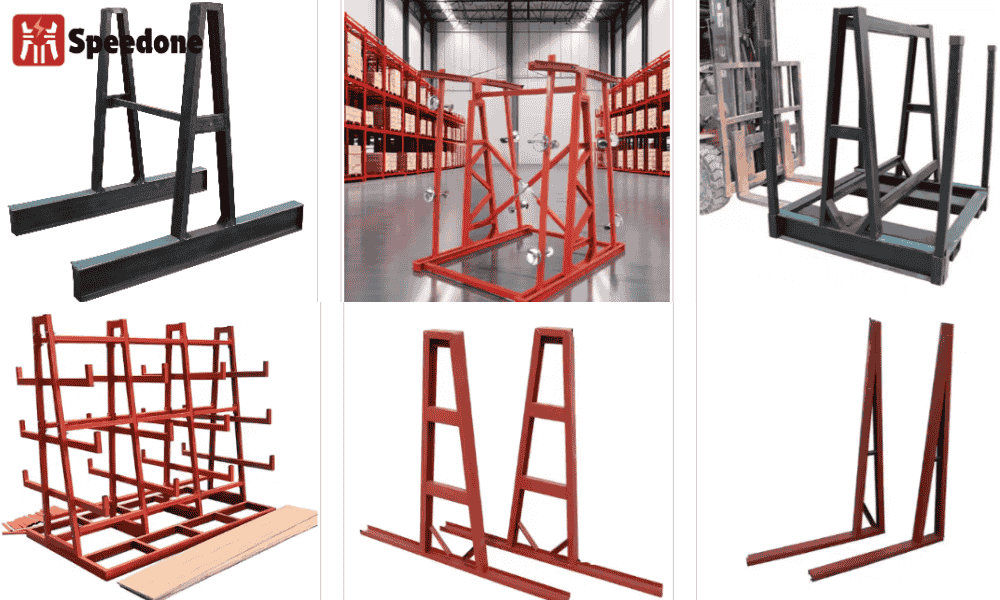
A-Frame Lagerregal
The Strategic Decision Matrix: Choosing the Right Rack
To maximize safety and operational efficiency, your equipment must perfectly align with its functional demands. Use this decision logic framework:
-
If your facility focuses on high-volume, static warehouse storage of standard 2cm/3cm slabs $\rightarrow$ Choose a heavy-duty, boltable carbon steel A-Frame. Bolting the rack to the concrete floor eliminates the risk of base-shifting during heavy forklift loading operations.
-
If you are dealing with extra-large “Jumbo” porcelain or sintered stone slabs $\rightarrow$ Choose a specialized 90 degree A-frame slab rack with height extensions. Standard racks are often too short for modern 12-foot slabs, leading to dangerous bowing and edge cracking.
-
If your operations require frequent movement across the shop floor or loading onto flatbed trucks $\rightarrow$ Choose a mobile A-frame to transport granite equipped with high-load polyurethane casters, deadlock braking systems, and reinforced forklift channels.
Calculating Symmetrical Weight Distribution
Even the strongest carbon steel will fail if the load is wildly asymmetrical. The structural brilliance of the A-Frame design relies on its inward pitch, which forces the resting stone to lean its weight directly toward the central spine of the rack, maintaining a secure centroid.
However, operators must master the symmetrical load-balancing formula. The golden rule is maintaining a weight variance of less than 20% between the left and right sides. For example, if the left side holds three 800 lb slabs (2,400 lbs total), the right side must hold a roughly equivalent weight. Warehouse protocols must strictly prohibit the unilateral unloading of a fully stocked rack, as the sudden absence of counterweight will cause the remaining 2,400 lbs to forcefully pull the rack over.
Daily Visual Inspection Protocols
A rack is only as safe as its foundation and joints. Warehouse supervisors should implement a mandatory daily and weekly inspection protocol:
-
Caster Integrity: Check high-load polyurethane casters for debris entrapment, flat spots, or bearing damage. Ensure the dead-lock braking mechanisms engage fully before loading.
-
Identifying Micro-Fractures: Carbon steel is robust, but dynamic daily use causes metal fatigue. Inspect the primary load-bearing welds—specifically where the inclined vertical posts meet the horizontal base. Look for flaking paint, rust lines forming at joints, or visible hairline cracks.
-
Rubber Lining Degradation: Ensure the vulcanized rubber has not worn down to the bare steel, which poses an immediate scratching risk to polished faces.
Final Recommendations and Your Next Strategic Step
Safety in the stone fabrication industry is an investment, not an expense. The cost of a single workplace accident or a shattered Calacatta slab far exceeds the price of outfitting your entire facility with certified, OSHA-compliant storage solutions. By enforcing symmetrical loading protocols, conducting daily visual inspections, and upgrading to purpose-built carbon steel frames, you create a culture of safety that protects your workforce and your bottom line.
Do not leave your facility’s safety to chance or rely on degrading, uncertified equipment. We encourage warehouse directors and procurement officers to audit their current storage infrastructure. Reach out to a certified A-Frame Storage Rack manufacturer today to discuss custom dimensions for jumbo slabs, request load-capacity certifications, and receive a wholesale quote tailored to your facility’s unique operational demands.

Extra starkes A-Rahmen-Gestell aus Stein mit Ständer für die Lagerung von Glas- und Steinplatten im Einzelhandel
FAQ
1. What is the maximum weight capacity of a standard A-Frame rack?
Obwohl die Tragfähigkeit je nach Hersteller und Konstruktion variiert, verfügt ein hochwertiges, robustes A-Rahmen-Gestell aus Kohlenstoffstahl in gewerblicher Ausführung in der Regel über eine maximale Tragfähigkeit von 10.000 bis 24.000 Pfund (ungefähr 5.000 bis 12.000 Pfund pro Seite). Es ist äußerst wichtig, die vom Hersteller ausdrücklich angegebene zulässige Arbeitslast niemals zu überschreiten und das Gewicht gleichmäßig auf die gesamte Struktur zu verteilen.
2. How do you safely remove a single slab without tipping the rack?
Safety requires symmetrical balance. When removing a slab, you must assess the weight remaining on the opposite side. If removing a heavy slab creates a severe weight imbalance (exceeding a 20% difference between sides), you must use an overhead crane or forklift to temporarily reposition slabs from the heavier side to restore the rack’s center of gravity before completing the removal.
3. Does OSHA require A-Frame racks to be bolted to the floor?
OSHA standard 1910.176 requires that stored materials not create a hazard and be secure against sliding or collapse. While OSHA does not explicitly state that A-frames must be bolted, if a stationary rack is located in a high-traffic forklift zone or lacks a sufficiently wide footprint to prevent tipping under asymmetrical loads, bolting it to the concrete floor is considered a mandatory industry best practice to ensure total compliance.
4. Can I transport an A-Frame rack fully loaded on a forklift?
Ja, aber nur, wenn das Regal ausdrücklich für den mobilen Transport konzipiert ist. Es muss an der Basis spezielle, verstärkte Gabelstapleraufnahmen aufweisen. Der Versuch, ein normales statisches Regal zu heben, indem man Gabeln unter eine nicht verstärkte Basis schiebt, kann dazu führen, dass der Stahl unter dynamischer Belastung nachgibt und sofort zusammenbricht. Zudem müssen die Platten vor dem Heben mit Ratschenbändern festgesichert werden.
5. How often should heavy-duty casters be replaced?
Hochbelastbare Polyurethanrollen sollten täglich visuell auf das Einklemmen von Fremdkörpern, flache Stellen oder Lagerbeschädigungen überprüft werden. Bei normalem industriellen Einsatz sollten schwerlastige Rollen in der Regel alle 18 bis 24 Monate ausgetauscht werden. Sollten jedoch die Bremsen nicht mehr vollständig arretieren oder sollte das Gestell mit übermäßiger menschlicher Kraft geschoben werden müssen (was auf einen Lagerausfall hindeutet), müssen die Rollen unverzüglich ausgetauscht werden, um entgleisende Unfälle zu verhindern.
Referenzen
-
“Materials Handling and Storage – OSHA 3220-10N,” Occupational Safety and Health Administration (OSHA), 2025.
-
“Standard Practice for the Safe Handling of Heavy Stone Slabs,” Natural Stone Institute, 2024.
-
“Yield Strength and Load Capacities in High-Gauge Carbon Steel Structures,” Journal of Industrial Metallurgy, 2025.
-
“Dynamic Load Testing for Forklift Accessible Storage Racks,” Warehouse Engineering Quarterly, 2024.
-
“Working Load Limits (WLL) and Synthetic Web Tie-Down Safety,” Web Sling & Tie Down Association (WSTDA).
-
“Ergonomics and Hazard Prevention in Granite Fabrication Shops,” National Institute for Occupational Safety and Health (NIOSH), 2025.
-
“Polyurethane Caster Degradation in Heavy Industrial Environments,” Material Handling Equipment Distributors Association, 2026.
-
“The Future of Smart Warehousing: Load Balancing Matrix,” Global Supply Chain & Logistics Review, 2026.
Strategic Material Handling & Rack Procurement
Structural Risk Mitigation (Why it Matters): The storage of 1,000+ lb stone slabs represents a critical fall hazard in industrial facilities. Standardizing your warehouse with engineered A-Frame solutions—featuring a specific 4 to 10-degree inward pitch—safely shifts the slab’s center of gravity toward the central spine. This structural engineering dramatically reduces lateral sheer force, ensuring compliance with OSHA 1910.176 standards and preventing the fatal “domino effect” of slab tip-overs.
For industrial heavy-duty applications, High-Gauge Carbon Steel is non-negotiable. It provides a yield strength exceeding 250 MPa, effectively absorbing dynamic vibrations during forklift transport without bending, a critical failure point common in lighter commercial aluminum racks.
A premium rack still requires human compliance. How to load safely: Operators must enforce a symmetrical load-balancing protocol. The weight variance between the left and right resting bases must never exceed 20%. Unilateral unloading causes immediate centroid shifts and high tipping risks.
*For custom load-capacity certifications or wholesale B2B inquiries, consult with our fabrication engineering team.

Henry
Hallo, ich bin der Autor dieses Beitrags, und ich habe in diesem Bereich für mehr als 16 Jahre gewesen. Wenn Sie OEM & ODM-Service für Steinwerkzeuge benötigen, zögern Sie nicht, mir irgendwelche Fragen zu stellen.