





A Brammentransport A-Frame is not just a steel rack; it is a load-control structure designed to keep heavy stone slabs stable, supported, and protected during factory handling, warehouse movement, truck loading, and jobsite delivery. In stone logistics, the challenge is not only the weight of the slab. It is the combination of weight, height, brittleness, edge exposure, vibration, turning force, forklift handling, and center of gravity movement.
Marble, granite, quartz, quartzite, sintered stone, and porcelain slabs are large, heavy, and fragile at the same time. A slab may be strong under compression but still crack if unsupported, tipped, impacted, or placed under uneven stress. For this reason, professional stone factories and logistics teams use A-frame systems to keep slabs leaning at a controlled angle instead of standing dangerously vertical or lying flat in unstable stacks.
For stone factories, warehouses, countertop fabricators, exporters, and project contractors, selecting the right Brammentransport A-Frame can reduce breakage, improve loading speed, protect polished surfaces, control warehouse workflow, and reduce transport risk from factory to jobsite.
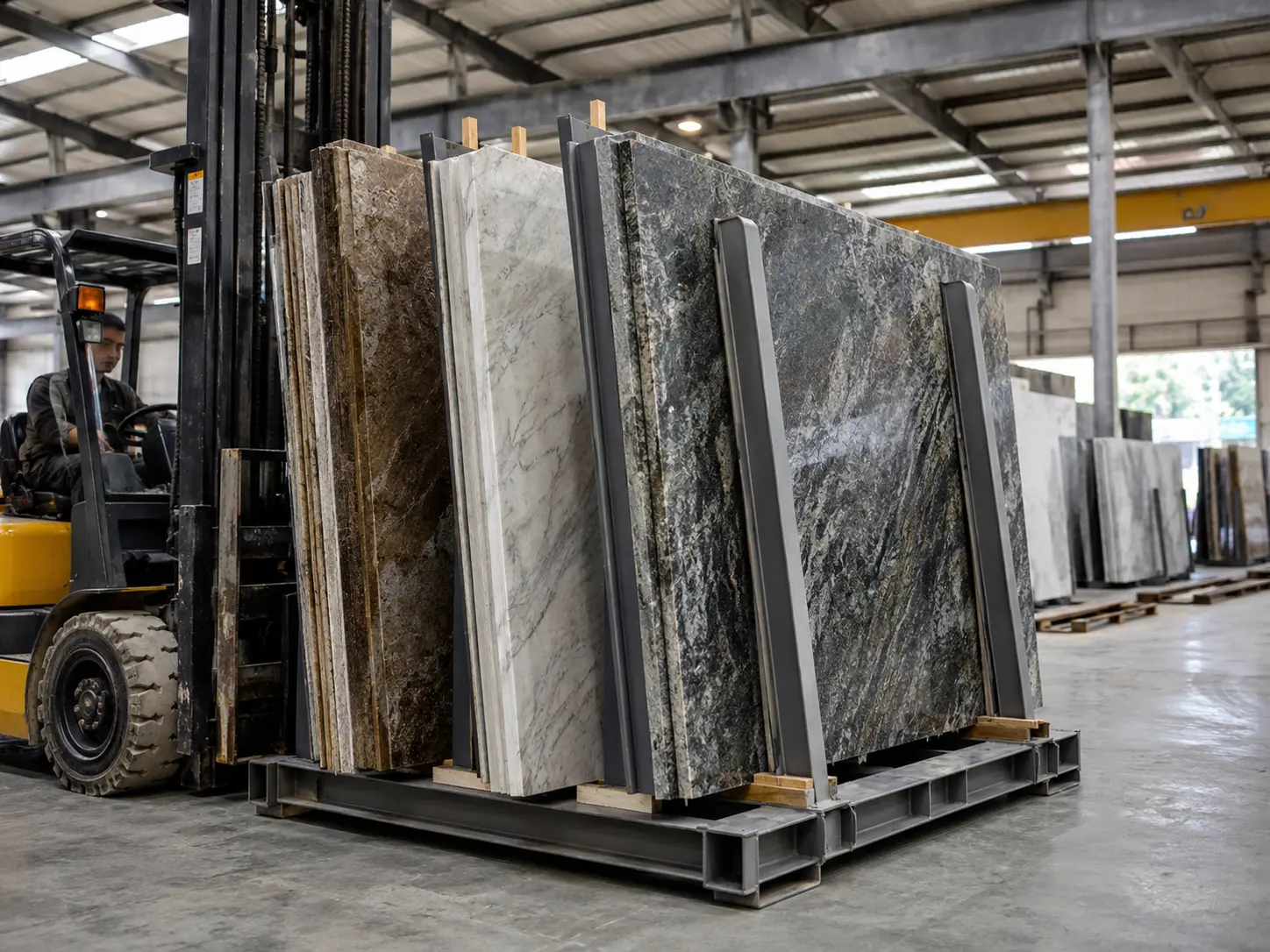
Brammentransport A-Frame
Was ist ein Brammentransport-A-Rahmen?
A Slab Transport A-Frame is a steel support frame shaped like the letter “A” and used to transport or temporarily store large stone slabs. The angled structure allows stone slabs to lean safely against padded support rails while the base carries the load footprint. This design is commonly used for marble slabs, granite slabs, quartz slabs, quartzite slabs, porcelain slabs, sintered stone panels, and engineered stone surfaces.
The main purpose is to improve stability. Tall slabs standing nearly vertical can tip if the center of gravity moves outside the support footprint. Flat stacking may create cracks, surface scratches, uneven pressure, and handling difficulty. A-frame support gives the slab a controlled leaning angle, helping workers load, move, inspect, and unload slabs more safely.
In real stone logistics, A-Frames are used in factory workshops, stone warehouses, forklift handling zones, truck loading areas, export packing lines, countertop fabrication shops, and construction sites. Some designs are fixed for storage, some are forklift-compatible, and some are built into mobile carts for short-distance movement.
| Funktion | What It Does | Buyer Value |
|---|---|---|
| Angled support | Allows slabs to lean safely | Reduces tipping risk |
| Steel frame structure | Carries heavy slab weight | Improves logistics safety |
| Base platform | Supports load footprint | Increases stability |
| Rubber or wood padding | Protects slab surface and edges | Reduces breakage and scratches |
| Restraint points | Secures slabs during movement | Improves transport control |
| Forklift access | Allows easier handling | Saves loading and unloading time |
Defining the Slab Transport A-Frame Structure
The structure of a Slab Transport A-Frame usually includes the main steel frame, base beams, angled support rails, cross bracing, padding, tie-down points, forklift pockets, and surface coating. Each component has a safety function. If one part is weak, the whole system becomes less reliable under heavy stone loads.
The main steel frame carries the slab weight. It is usually made from welded steel tubes, structural steel sections, or reinforced beams. It must resist bending, twisting, side load, and vibration. The base beam controls the footprint. A wider and longer base generally improves stability, especially when the frame holds large slabs or moves over uneven workshop floors.
Angled support rails hold the slabs at a controlled leaning position. Padding protects the slab surface and edges from direct metal contact. Tie-down points, straps, chains, or locking systems help secure slabs during truck movement. Forklift pockets or lifting points allow the frame to be moved safely without damaging the base or shifting the load.
For factories that need mobile stone movement rather than fixed staging, equipment such as a High-Bottom Trolley for Marble and Rock Plate Transport can support internal handling workflows where slab height, wheel clearance, and factory route planning affect daily efficiency.
| Structural Part | Main Purpose | Buyer Check |
|---|---|---|
| Main frame | Supports slab load | Steel thickness and weld quality |
| Base beam | Controls footprint stability | Width, length, and anti-tip design |
| Angled rails | Holds slab leaning position | Angle and contact area |
| Cross bracing | Prevents twisting | Reinforcement design |
| Padding | Protects stone surfaces | Rubber or wood quality |
| Tie-down points | Secures slabs | Position and strength |
| Forklift pockets | Supports movement | Fork entry size and location |
| Surface coating | Prevents corrosion | Powder coating, paint, or galvanizing |
Double-Sided vs. Single-Sided A-Frame Mechanics
A double-sided Slab Transport A-Frame allows slabs to be loaded on both sides. When both sides are loaded properly, the weight can be more balanced around the central frame. This design is common in factories and warehouses because it can carry more slabs, improve space use, and support balanced staging. However, buyers should not assume double-sided means automatically safe. Uneven loading on one side can still shift the center of gravity and increase tipping risk.
A single-sided Slab Transport A-Frame allows slabs to lean on one side only. It is useful when the rack must be placed beside a wall, in a narrow loading bay, or in a controlled one-side access zone. The risk is that all slab weight is concentrated on one side, so the base must be wider, heavier, or specially designed to resist overturning.
The mechanical difference is simple: double-sided A-Frames can balance loads better when used correctly, while single-sided A-Frames require stronger anti-tip design because the load is asymmetrical. Buyers should choose based on workflow, space, slab size, loading method, and whether the rack is used for storage, truck transport, or jobsite staging.
| A-Frame Type | Beste Verwendung | Main Advantage | Key Risk |
|---|---|---|---|
| Double-sided A-Frame | Factory, warehouse, truck loading | Better balanced loading | Uneven side loading can still create risk |
| Single-sided A-Frame | Wall-side storage, narrow spaces | Easier access from one side | Higher tipping risk if base is weak |
| Heavy-duty transport A-Frame | Large slabs and long-distance movement | Strong structure and tie-down options | Higher cost and weight |
| Lightweight A-Frame | Small slabs or temporary use | Easier movement | Not suitable for heavy loads |
| Custom A-Frame | Special slab size or workflow | Better project fit | Requires accurate load data |
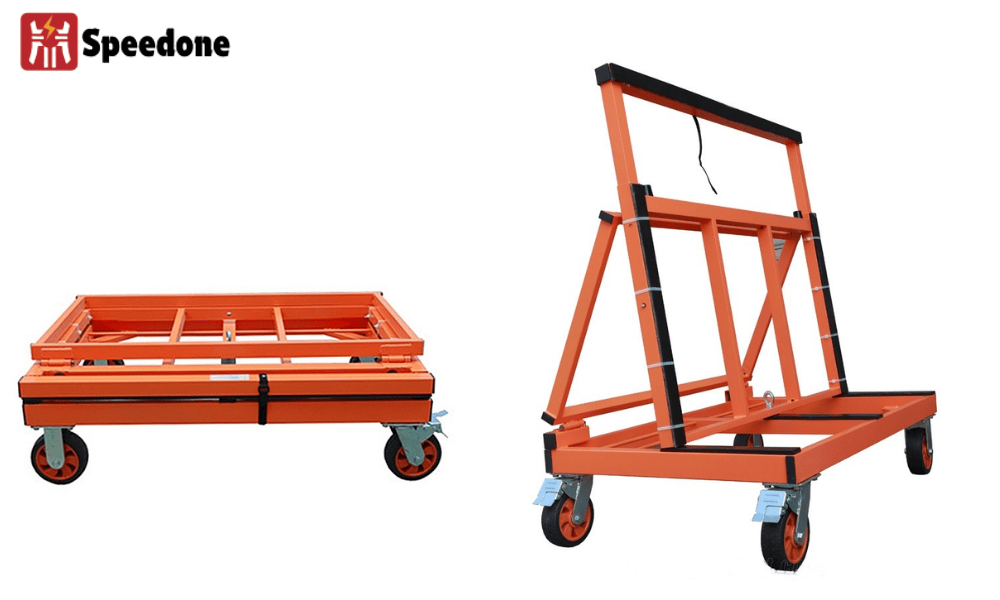
Großhandel Brammentransport A-Frame
Load Distribution and Center of Gravity Control
Center of gravity is the most important safety concept in slab logistics. A stone slab is tall, heavy, and narrow. If the center of gravity moves outside the support footprint, the frame can tip. This may happen during uneven loading, sudden forklift movement, sharp turning, sloped flooring, truck braking, or one-sided loading.
Slabs should lean evenly against the support rails. Heavy slabs should be loaded first and placed in a balanced sequence. The load should stay centered within the base footprint. Workers should avoid loading one side heavily while the opposite side is empty unless the frame is specifically designed for single-sided use. During truck transport, the frame must also control vibration and lateral load shift.
Loading angle also affects stability. A very small leaning angle may not provide enough confidence against tipping. Too much angle may increase footprint and make loading harder. Practical lean angles may often fall around 5°–10° from vertical, but actual design should follow the frame type, slab size, support height, and supplier engineering guidance.
For internal movement in processing plants, a Granite Marble Slab Buggy A-Frame Cart can be useful where workers need to move heavy slabs between cutting, polishing, inspection, fabrication, and loading zones without repeatedly shifting the slabs by unsafe manual methods.
| Slab Material | Approx. Density Range | Example 3200×1600×20mm Slab Weight | Logistics Meaning |
|---|---|---|---|
| Marmor | 2,600–2,800 kg/m³ | Approx. 266–287 kg | Needs edge protection and stable support |
| Granit | 2,650–2,900 kg/m³ | Approx. 271–297 kg | Heavy and strong, but can chip |
| Quartz | 2,300–2,500 kg/m³ | Approx. 236–256 kg | Common for countertop logistics |
| Quartzite | 2,650–2,900 kg/m³ | Approx. 271–297 kg | Heavy and brittle in handling |
| Porcelain slab | 2,300–2,500 kg/m³ | Depends on thickness | Large thin panels need careful support |
| Sintered stone | 2,300–2,600 kg/m³ | Depends on thickness | Requires even backing support |
Key Performance Parameters Buyers Should Check
The first parameter is rated load capacity. Buyers should calculate total slab weight based on material density, slab size, thickness, and quantity per load. A single 3200×1600×20mm stone slab can weigh more than 250 kg depending on material. A load of 30 slabs may exceed 7,500–8,500 kg. The A-Frame must be rated above the expected load with a suitable safety allowance.
Frame dimensions are also critical. The rack must match slab length, slab height, base footprint, support rail height, forklift pocket position, and loading method. If the slab overhangs too much or contacts the frame incorrectly, breakage risk increases. If the base is too narrow, tipping risk increases.
Steel thickness and welding quality determine long-term service life. Thin steel may deform under repeated heavy loading. Poor welding can create structural risk. Padding protects slab edges and polished surfaces. Tie-down points are essential for truck movement. Surface coating, such as powder coating, paint, or galvanizing, helps reduce corrosion in factory, warehouse, and outdoor loading environments.
| Parameter | Why It Matters | Buyer Question |
|---|---|---|
| Tragfähigkeit | Prevents overload failure | What is the rated capacity? |
| Frame size | Matches slab dimensions | What slab size does it support? |
| Steel thickness | Affects strength | What tube or beam thickness is used? |
| Weld quality | Controls structural safety | Are welds inspected? |
| Base width | Controls stability | Is the footprint wide enough? |
| Padding | Protects slab surface | Is rubber or wood padding included? |
| Tie-down points | Secures moving load | Are restraint points available? |
| Coating | Prevents rust | What finish is applied? |
Real-World Heavy Stone Logistics Scenarios
In factory internal movement, the A-Frame may move slabs from cutting to polishing, inspection, packing, or loading zones. The key requirements are forklift access, fast handling, stable angle, and soft contact surfaces. Poor padding can chip edges before the slab even reaches the customer.
In warehouse storage and picking, a double-sided A-Frame can organize slabs by material, order batch, project, or production status. Balanced loading is critical. If one side is heavily loaded and the other side is empty, the frame may become unstable. In truck transport, the frame needs tie-down points, base stability, vibration control, and load balance. Sudden braking, road vibration, and sharp turns can shift poorly secured slabs.
For export container loading, the A-Frame must match container dimensions, load weight, slab restraint, packing protection, and corrosion requirements. For jobsite delivery, compact footprint and safe unloading become more important because space is often limited and ground conditions may be uneven. Buyers planning cross-border or long-distance shipping can review A-Frame slab transport solutions for safe stone shipping to better understand how shipping safety, storage efficiency, and export handling connect.
| Scenario | Recommended A-Frame Type | Key Requirement | Risk If Ignored |
|---|---|---|---|
| Factory movement | Forklift-compatible A-Frame | Quick handling and padding | Edge chips |
| Warehouse storage | Double-sided A-Frame | Balanced loading | Tipping risk |
| Truck transport | Heavy-duty transport A-Frame | Tie-down and base stability | Load shift |
| Export container | Reinforced transport frame | Container fit and restraint | Breakage in transit |
| Jobsite delivery | Compact transport A-Frame | Safe unloading | Slab fall |
| Fabrication shop | Single or double-sided rack | Easy slab access | Workflow delays |
Slab Transport A-Frame vs Other Stone Handling Equipment
A Slab Transport A-Frame is often used for transport, staging, and temporary storage. A fixed slab storage rack is usually used for warehouse organization and long-term slab storage. A slab cart is smaller and more mobile, but it may have lower capacity. A bundle rack can handle grouped slab storage, while a crane system supports heavy lifting in large factories. A wooden crate is useful for export packing but not suitable for frequent internal handling.
The right equipment depends on workflow. A factory that moves slabs frequently may need forklift-compatible A-Frames and slab carts. A warehouse may need fixed racks and double-sided A-Frames. A countertop fabrication shop may need smaller carts for short-distance movement. An exporter may need reinforced A-Frames, wood packing, container-compatible dimensions, and tiedown systems.
As global stone logistics becomes more structured, buyers are paying more attention to equipment safety, workflow speed, and damage control. A guide about evolving stone logistics and Slab Transport A-Frame trends can help procurement teams understand why A-Frame systems are becoming more important in international slab handling.
| Equipment | Beste Verwendung | Strength | Limitation |
|---|---|---|---|
| Brammentransport A-Frame | Moving and staging heavy slabs | Stable angled support | Needs correct load balance |
| Fixed slab rack | Warehouse storage | Organized long-term storage | Less mobile |
| Slab cart | Short-distance movement | Easy mobility | Lower capacity |
| Bundle rack | Grouped slab storage | Bulk handling | Less flexible for single slabs |
| Crane system | Large factory handling | Efficient for heavy lifting | Higher investment |
| Wooden crate | Export packing | Container shipment support | Not for frequent handling |
Safety and Regulatory Considerations for Stone Slab Transport
Stone slab handling carries serious safety risks. Slabs may tip, shift, crack, or fall if the frame is overloaded, improperly restrained, or loaded in the wrong sequence. Workers should stay outside fall zones. Only trained operators should handle heavy slabs. Forklifts, cranes, straps, chains, and clamps should be rated for the load.
Before using a Slab Transport A-Frame, teams should inspect the frame, check welds, confirm padding, verify tie-down points, review floor conditions, and confirm the loading sequence. During truck transport, the load must be secured, weight must be distributed properly, and drivers should avoid sudden braking and sharp turning where possible.
Buyers should request load rating, material information, welding inspection if available, QC photos, user guidance, and packing or loading suggestions. Safety is not only a legal concern; it is also a cost-control issue. One slab fall can cause product loss, worker injury, equipment damage, delayed delivery, and customer claims.
| Risk | Cause | Prevention |
|---|---|---|
| Rack tipping | Unbalanced load | Load both sides or use suitable base |
| Slab breakage | Poor padding | Add rubber or wood contact protection |
| Load shift | Weak restraint | Use straps, chains, or tie-down points |
| Forklift instability | Wrong lifting point | Use correct forklift pockets |
| Kantenabsplitterung | Hard metal contact | Use replaceable pads |
| Overload failure | Exceeding rated capacity | Confirm total slab weight |
| Worker injury | Standing in fall zone | Train operators and mark danger area |
Common Mistakes When Buying a Slab Transport A-Frame
The first mistake is buying without calculating total slab weight. If buyers only estimate by slab count, they may overload the frame. Different stone types and thicknesses create different loads. The second mistake is choosing too small a base footprint, which increases overturning risk. The third mistake is ignoring slab size compatibility, causing dangerous overhang or incorrect contact points.
The fourth mistake is buying a frame with no padding or poor padding. Bare metal contact can scratch polished slabs, damage edges, or create hidden cracks. The fifth mistake is using a frame with no tie-down points for truck transport. During braking or road vibration, slabs can shift. The sixth mistake is buying the lowest price only. Thin steel, weak welds, poor coating, and poor design may cost more through damage, downtime, and safety risk.
How to Choose a Reliable Slab Transport A-Frame Supplier
A reliable supplier should answer engineering and workflow questions, not only provide a price. Buyers should ask about rated load capacity, supported slab size, single-sided or double-sided structure, steel thickness, frame dimensions, forklift pockets, tie-down points, padding material, surface coating, customization options, factory photos, production videos, packing method, and wholesale supply support.
Supplier capability should include steel fabrication, welding quality control, custom design, load capacity planning, surface coating, padding systems, packing, export experience, project communication, and after-sales support. Reviewing an experienced Slab Transport A-Frame manufacturer background can help buyers judge whether the supplier has the production experience and stone-handling knowledge needed for heavy slab logistics.
| Supplier Check | Good Signal | Risk Signal |
|---|---|---|
| Load rating | Clear capacity data | Vague “heavy duty” claim |
| Steel specification | Tube or beam size provided | No material detail |
| Welding quality | Clean continuous welds | Rough or incomplete welds |
| Base design | Wide stable footprint | Narrow unstable base |
| Padding system | Replaceable rubber or wood pads | Bare metal contact |
| Tie-down points | Transport restraint included | No secure points |
| Custom support | Size and capacity customization | One-size-only offer |
| Export packing | Strong packing method | No shipping protection |
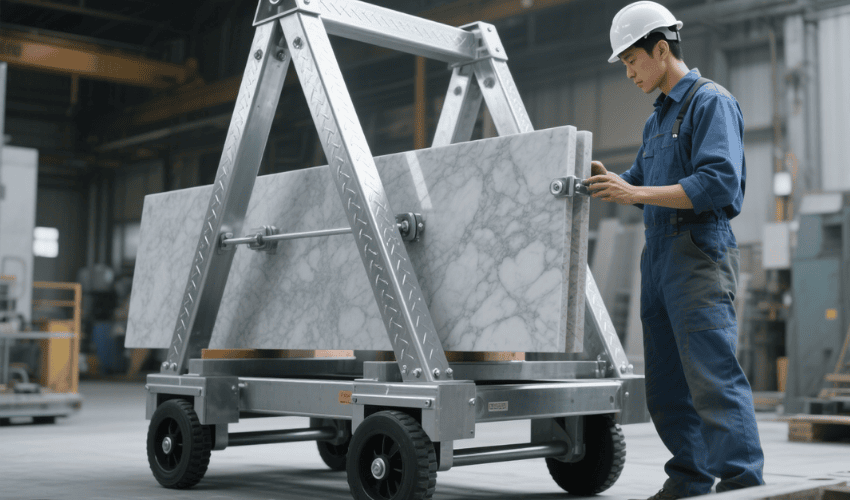
Langlebiger Brammentransport-A-Rahmen
If This Is Your Project, Choose This Slab Transport A-Frame Strategy
If the project needs balanced warehouse storage, choose a double-sided A-Frame and load both sides properly. If the project needs wall-side slab placement, choose a single-sided A-Frame with a strong base. If the project involves truck transport, choose a heavy-duty A-Frame with tie-down points and strong base stability. If the project is export logistics, choose a reinforced frame with a container-compatible packing plan.
If the slabs are large marble, granite, or quartzite, choose a high-capacity padded frame. If the material is fragile porcelain or sintered stone, choose full support and soft contact padding. If the workflow requires fast forklift handling, choose forklift-pocket A-Frames. Buyers can send slab size, material type, thickness, quantity per load, transport method, warehouse layout, and loading equipment through the Slab Transport A-Frame project consultation page to request frame selection support.
| If Your Project Needs | Choose | Avoid |
|---|---|---|
| Balanced warehouse storage | Double-sided A-Frame | Single-sided overloaded rack |
| Wall-side slab placement | Single-sided A-Frame with strong base | Narrow unstable frame |
| Truck transport | Heavy-duty A-Frame with tie-downs | Storage-only rack |
| Export logistics | Reinforced frame with packing plan | Light workshop rack |
| Large marble slabs | High-capacity padded frame | Thin steel frame |
| Fragile porcelain slabs | Full support and soft padding | Point contact support |
| Fast forklift handling | Forklift-pocket A-Frame | Frame without lifting access |
| Custom slab size | Custom-engineered frame | Standard frame too small |
Häufig gestellte Fragen
1. What is a Slab Transport A-Frame?
A Slab Transport A-Frame is a steel support frame used to transport and temporarily store large stone slabs at a stable leaning angle. It is commonly used for marble, granite, quartz, quartzite, porcelain, sintered stone, and engineered stone panels. The A-shaped structure supports slabs on angled rails, keeps the load inside a controlled footprint, and helps reduce tipping, edge damage, and handling risk during factory movement, truck loading, warehouse staging, and jobsite delivery.
2. Why are stone slabs transported on an A-Frame?
Stone slabs are transported on an A-Frame because they are tall, heavy, rigid, and fragile. If slabs stand too vertically, they can tip. If they are stacked flat without proper support, they may crack, scratch, or become difficult to handle. An A-Frame allows slabs to lean at a controlled angle, improves load distribution, protects slab edges, and helps operators manage center of gravity during forklift handling, truck transport, and temporary storage.
3. Is a double-sided A-Frame better than a single-sided A-Frame?
A double-sided A-Frame is often better for balanced warehouse storage and higher-capacity loading because slabs can be placed on both sides of the frame. However, it must still be loaded evenly. A single-sided A-Frame is useful for wall-side placement, narrow spaces, or one-side access zones, but it needs a strong base and anti-tip design because the load is concentrated on one side. The better option depends on space, slab size, transport method, and workflow.
4. What load capacity should a Slab Transport A-Frame have?
The required load capacity depends on slab material, slab size, thickness, and the number of slabs per load. For example, a 3200×1600×20mm marble or granite slab can weigh roughly 260–300 kg depending on density. A full load of multiple slabs can quickly exceed several tons. Buyers should calculate total slab weight and choose a Slab Transport A-Frame with a suitable safety allowance instead of relying only on a general “heavy-duty” claim.
5. What should buyers check before ordering a Slab Transport A-Frame?
Before ordering a Slab Transport A-Frame, buyers should check rated load capacity, frame dimensions, supported slab size, steel thickness, weld quality, base width, angled rail design, padding material, tie-down points, forklift pockets, surface coating, and supplier experience. Buyers should also confirm whether the frame is designed for warehouse storage, forklift movement, truck transport, export container loading, or jobsite delivery because each use requires different structural details.
Referenzen
- “Material Handling and Storage Safety Guidelines” — Occupational Safety and Health Administration — Industrial Safety Reference
- “Forklift Operator Safety and Load Stability Guidance” — Occupational Safety and Health Administration — Powered Industrial Truck Resource
- “Dimension Stone Design Manual” — Natural Stone Institute — Stone Handling and Installation Reference
- “Safe Slab Handling Practices in Stone Fabrication” — Natural Stone Institute — Fabrication Safety Resource
- “Load Securement Requirements for Road Transport” — Federal Motor Carrier Safety Administration — Cargo Securement Reference
- “Steel Structures and Welding Quality Control” — American Welding Society — Welding Inspection Resource
- “Warehouse Storage Rack Safety and Inspection Guidance” — Rack Manufacturers Institute — Industrial Rack Safety Resource
- “Manual Handling and Mechanical Handling of Heavy Materials” — Health and Safety Executive — Workplace Safety Resource
Final Buyer Insight: A Slab Transport A-Frame Is a Load-Control System, Not Just a Metal Rack
What should buyers understand first?
A Slab Transport A-Frame should be treated as part of the heavy stone logistics system. Its value comes from load distribution, center of gravity control, slab protection, handling efficiency, and transport safety.
How should buyers choose?
Double-sided frames support balanced loading in factories and warehouses. Single-sided frames solve wall-side or narrow-space access needs. Truck transport needs tie-down points and vibration control. Export logistics needs reinforced structure and packing support.
Why do logistics problems happen?
The main risks are overload, narrow base footprint, weak welds, poor padding, no restraints, incorrect slab loading sequence, unsafe forklift movement, and choosing a storage rack for a transport job.
Option logic: If slabs must move by truck, choose a transport-rated A-Frame. If slabs stay in a warehouse, choose a stable storage structure. If the material is fragile, choose wider contact support and soft padding. If the load is heavy, calculate total slab weight before ordering.
Recommendation: Before purchasing, prepare slab size, material type, thickness, quantity per load, loading method, transport distance, truck/container requirements, warehouse layout, and forklift specifications. This allows the supplier to recommend a safer frame structure.
The safest Slab Transport A-Frame is not the one that only carries weight on paper, but the one that controls balance, protects slabs, and fits the real logistics workflow.
