





Stone slabs are valuable, heavy, and often vulnerable to edge damage, surface scratches, and breakage when they are stored or moved incorrectly. For granite distributors, marble warehouses, quartz fabricators, and countertop manufacturers, storage is therefore more than a question of finding enough floor space. It is an important part of material protection, inventory control, and production planning.
A warehouse may have sufficient square footage and still experience daily inefficiencies. Workers may spend too much time identifying the correct slab, forklifts may have difficulty reaching storage positions, and frequently requested materials may be blocked by slower-moving inventory. Poorly matched racks can also create avoidable handling risks or prevent a warehouse from using its available space effectively.
A well-planned Slab Rack System addresses these issues by connecting storage configuration with material dimensions, handling methods, load requirements, and order flow. Instead of selecting racks based on price or appearance alone, buyers should evaluate how each system will perform within the actual warehouse environment.
This guide explains how to assess storage requirements, compare rack configurations, estimate slab weight, plan warehouse layouts, manage safety risks, and evaluate suppliers. The objective is to help stone businesses develop a practical Almacén de losas de piedra strategy that supports efficient daily operations without compromising stability or material protection.

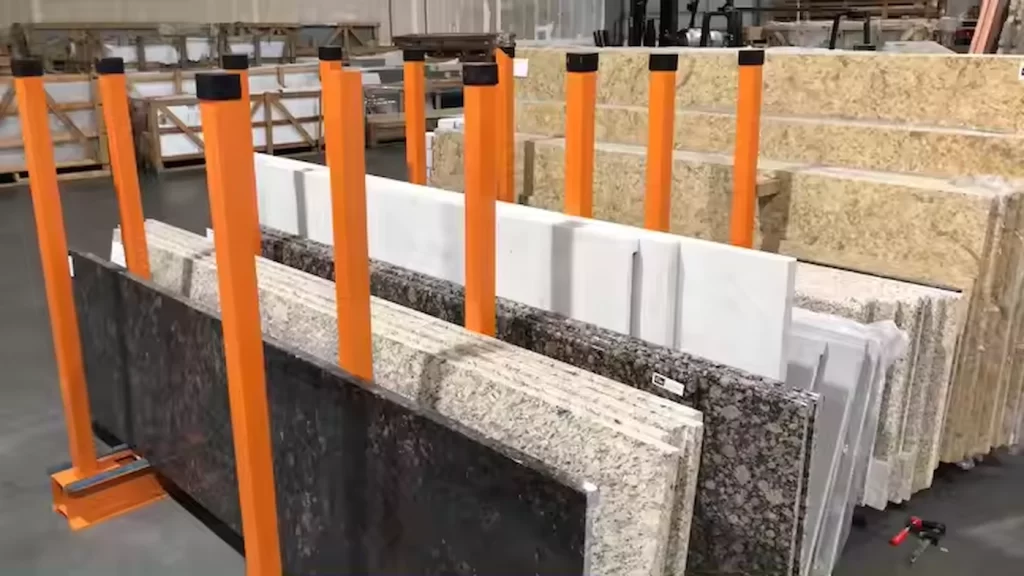
speedone heavy duty stone slab rack storage system
1. What Is a Slab Rack System and Why Does It Matter?
A Slab Rack System is a purpose-designed storage structure for organizing large, flat materials such as natural stone slabs, engineered quartz surfaces, and certain other sheet or panel products. Depending on the design, it may support slabs in an A-frame arrangement, a vertical or inclined configuration, an adjustable modular structure, or a transport-oriented rack.
The system should be selected according to the material, storage environment, and handling process. A rack intended for stationary warehouse storage should not automatically be treated as suitable for road transportation. Similarly, a rack designed for one slab thickness or loading pattern may not be appropriate for another without confirmation from the manufacturer.
Key Components of a Stone Slab Storage Rack
Common design elements include a structural base, support frames, slab-contact surfaces, stabilizing components, and designated loading positions. Depending on the application, additional features may include adjustable supports, protective pads, identification areas, or provisions for securing materials.
Each component serves a practical purpose. The base transfers loads to the floor, the frame maintains the intended support geometry, and contact surfaces help protect slab edges and faces. Stabilizing elements reduce the risk of unintended movement when they are correctly designed and used.
Buyers evaluating estanterías para losas de piedra should ask for clear technical documentation covering intended use, rated capacity, permitted loading arrangements, installation requirements, and inspection procedures. A product photograph alone cannot establish structural suitability.
Which Materials Can These Racks Store?
Typical applications include granite, marble, quartzite, engineered quartz, and other large-format stone products. Some rack configurations may also be adapted for glass, ceramic panels, or similar materials, but compatibility must be confirmed for the specific product and its support requirements.
Natural stone and engineered materials vary in density, thickness, dimensions, surface finish, and susceptibility to damage. A configuration suitable for one product family should not be assumed to work equally well for every material. Glass and finished panels, for example, may require different contact protection and handling controls from rough or unfinished stone.
For a first review of available configurations, buyers can examine the Slab Rack product range and compare the listed designs with their intended storage and handling tasks.
2. Assess Your Stone Slab Storage Requirements Before Buying
The most effective rack selection process begins with measurable operating requirements. Purchasing equipment before understanding the slab inventory can result in insufficient capacity, unused storage positions, restricted access, or a layout that conflicts with existing material-handling equipment.
Measure Slab Length, Width, and Thickness
Start by recording the dimensions of the slabs that the warehouse expects to store. Include the largest pieces, the most common sizes, and any unusually thick or heavy products. If dimensions vary substantially, separate the inventory into practical groups instead of designing around a single average slab.
For each group, record:
- Maximum slab length and width.
- Typical and maximum thickness.
- Material type and approximate density.
- Number of slabs expected in each storage position.
- Frequency of access and order-picking requirements.
- Any special requirements for polished, fragile, or finished surfaces.
These details help determine the rack dimensions, usable storage positions, support arrangement, and clearances required for handling. They also provide a more useful basis for requesting quotations from equipment suppliers.
Calculate the Approximate Weight of Each Slab
Slab weight is a critical input when selecting storage equipment. A slab that appears manageable by its dimensions alone may impose a substantial load because stone is relatively dense. The following equation provides an initial estimate for a rectangular slab:
Slab weight (kg) = length (m) × width (m) × thickness (m) × material density (kg/m³)
The table below uses illustrative dimensions and assumed density values to demonstrate how the calculation works. The density figures are examples for preliminary estimation, not certified material specifications. Actual values vary by stone type, composition, porosity, and product construction.
| Illustrative Material | Length × Width | Thickness | Assumed Density | Estimated Weight |
|---|---|---|---|---|
| Granito | 3.00 × 1.80 m | 20 mm | 2,700 kg/m³ | 291.6 kg |
| Mármol | 3.00 × 1.80 m | 20 mm | 2,700 kg/m³ | 291.6 kg |
| Engineered stone | 3.20 × 1.60 m | 30 mm | 2,400 kg/m³ | 368.6 kg |
Calculation note: Estimated weight equals volume multiplied by assumed density. The engineered-stone density in this example is illustrative and must be replaced with the relevant product specification. The granite and marble examples use the same assumed density solely to demonstrate the calculation.
For example, a slab measuring 3.00 m long, 1.80 m wide, and 0.020 m thick has a volume of 0.108 cubic meters. At an assumed density of 2,700 kilograms per cubic meter, its estimated mass is 291.6 kilograms.
Use verified product data whenever possible. Do not use the example values as the basis for final rack engineering, lifting decisions, or capacity approval.
Determine the Required Rack Capacity
Once slab weights and inventory quantities are known, establish the maximum load expected in each storage position. The required capacity depends on the rack’s rated configuration and the way the slabs are supported and distributed.
Buyers should distinguish between the capacity of an individual support, a rack side, a complete rack assembly, and a larger connected installation. These ratings are not interchangeable. The rack manufacturer should confirm the permitted load arrangement and any restrictions on uneven loading, slab thickness, support location, or configuration.
Do not select equipment by adding up nominal component ratings unless the supplier’s engineering documentation explicitly permits that method. The complete assembly, floor interface, and intended loading pattern must be suitable for the actual application.
3. Optimize Warehouse Space with a Better Rack Layout
Warehouse efficiency depends on more than the number of slabs that fit inside a building. Storage positions must also remain accessible, loading activities must be coordinated with picking, and handling equipment must be able to approach and withdraw slabs safely.
Plan Storage Zones Around Material Flow
Divide the warehouse into logical areas based on material type, slab dimensions, inventory turnover, customer orders, or production destination. For example, frequently requested countertop materials may need to be positioned closer to the relevant processing or dispatch area, provided that the location remains compatible with load limits and safe handling.
Slow-moving inventory can be placed in less frequently accessed positions when the rack design and operating procedure allow it. However, high-turnover materials should not be placed where retrieving one slab requires moving several unrelated slabs first.
A practical zone plan can include receiving, inspection, main storage, high-turnover inventory, order staging, and dispatch. Clearly separating these functions reduces unnecessary movement and helps workers understand where each material group belongs.
Design Aisles for the Actual Handling Equipment
Aisle width should be determined from the dimensions and operating requirements of the equipment that will use it. Forklift turning radius, load length, mast movement, attachment geometry, approach direction, and pedestrian access can all affect the required clearance.
There is no single aisle width that is appropriate for every stone warehouse. A value suitable for one forklift and rack arrangement may be unsuitable for another. Follow the equipment manufacturer’s guidance, the rack layout drawings, the site risk assessment, and applicable local requirements.
Do not improve nominal storage density by reducing an aisle below the clearance needed for safe maneuvering. A layout that holds more slabs but prevents controlled loading or unloading may increase operational risk rather than improve efficiency.
Use Vertical or Inclined Storage Only When the Design Supports It
Vertical and inclined storage arrangements can use floor space differently from horizontal storage. Their suitability depends on the rack geometry, slab dimensions, support design, loading method, and building layout. A-frame configurations can provide organized access to selected slab groups, while vertical arrangements may suit particular inventory and handling workflows.
However, vertical storage is not automatically safer or more space-efficient in every warehouse. The support arrangement, slab stability, loading sequence, and handling equipment must all be considered. Follow the rack’s intended orientation and do not improvise a new configuration without approval from the manufacturer.
Plan for Inventory Growth and Maintenance Access
Leave appropriate room for receiving new slabs, inspecting racks, carrying out maintenance, and handling changing product dimensions. A system designed only for current inventory can become restrictive when the warehouse begins stocking larger formats or more material varieties.
Modular systems may provide flexibility where future inventory is likely to change, but modules must be compatible and installed according to the approved design. Expansion should not be assumed to preserve the original rated capacity without confirmation.
For a broader planning framework, the article on Slab Rack Layouts for Stone Warehouse Efficiency is a relevant next step for connecting storage positions, aisle planning, and material flow.
Estante para losas
4. Compare Slab Rack Configurations for Different Workflows
Different rack types solve different storage problems. Rather than searching for a universally best rack, compare the options against your slab inventory, handling process, building constraints, and safety requirements.
Material Fit by Product Direction
The following matrix is a qualitative compatibility guide, not statistical data, a load certification, or a guarantee of product suitability. It indicates general areas to investigate when choosing a configuration. Final compatibility depends on the specific rack design, slab dimensions, load ratings, support arrangement, and intended use.
Legend:
- ●●● = Primary
- ●●○ = Strong Option
- ●○○ = Depends on Workflow
- — = Usually Not First Choice
| Product Direction | Bastidor en A | Vertical Rack | Adjustable Modular Rack | Transport Rack |
|---|---|---|---|---|
| Natural stone slab warehouse storage | ●●● | ●●○ | ●●○ | ●○○ |
| Mixed slab sizes and changing inventory | ●●○ | ●○○ | ●●● | ●○○ |
| Frequent material transfers | ●○○ | ●○○ | ●○○ | ●●● |
| Specialized finished or fragile panels | ●○○ | ●○○ | ●○○ | ●○○ |
Interpretation: These symbols express general application fit only. They are not measured performance scores. Fragile panels, glass, unusually large slabs, or materials with special support requirements need a product-specific assessment before any rack type is selected.
A-Frame Racks for Organized Slab Storage
A-frame racks support slabs on inclined sides arranged around a central structure. They may suit warehouses that store groups of slabs and require access from one or both sides, depending on the design. Buyers should examine the permitted slab arrangement, support contact points, loading direction, and rated capacity.
The main decision is not simply whether an A-frame rack fits the floor plan. It is whether the rack enables the intended slabs to be loaded, secured, identified, and retrieved using the available equipment.
Vertical Racks for Specific Storage Requirements
Vertical racks can be useful where the system is designed to support slabs in a defined upright orientation. Their footprint and access pattern may differ from those of A-frame systems. Nevertheless, the rack must provide suitable support and restraint, and the loading procedure must prevent slabs from shifting or being handled in an uncontrolled manner.
Do not assume that any flat slab can be stored vertically merely because the available floor area is limited. Consult the rack manufacturer and the slab supplier when material characteristics or storage orientation create uncertainty.
Modular and Transport-Oriented Solutions
Adjustable modular racks can be worth considering when slab dimensions and inventory change frequently. Their practical value depends on the adjustment range, approved configurations, component compatibility, and the ease of reconfiguring the system without compromising capacity.
Transport racks serve a different operational purpose. A rack designed for stationary storage may not be suitable for loading onto a vehicle or moving across a site. Transport use introduces additional considerations such as restraint, vibration, movement, and vehicle-specific requirements. Buyers should confirm that the product is expressly designed and rated for the intended transport conditions.
5. Technical Factors That Influence Rack Performance
Rack selection should be based on the complete operating system, not a single specification. Material properties, steel construction, support geometry, floor conditions, and environmental exposure all influence whether a rack is appropriate for a particular warehouse.
Steel Construction and Structural Geometry
Steel grade, member dimensions, base geometry, connection design, weld quality, and manufacturing consistency contribute to the performance of a storage rack. However, a thicker steel member does not automatically prove that the complete rack has a higher safe working capacity. Structural behavior depends on the design and interaction of the entire assembly.
Request the rated capacity and the conditions under which it applies. Ask whether the rating assumes a particular slab size, loading pattern, support spacing, or installation arrangement. If the intended configuration differs from the documented one, obtain written confirmation before use.
Surface Protection and Corrosion Resistance
Surface treatment should reflect the warehouse environment. Powder coating, galvanizing, or other protective finishes may be suitable in different circumstances, depending on moisture, exposure, cleaning practices, and expected wear. Contact surfaces may also require protective materials to reduce the risk of scratching or chipping.
Evaluate coating coverage, repair procedures, compatibility with slab finishes, and the consequences of damaged protective layers. A finish that looks attractive when new may still require maintenance if the rack is frequently exposed to impact, moisture, or abrasive materials.
Floor Capacity and Load Distribution
The floor is part of the storage system. Concentrated loads from rack feet or base supports may create different demands from evenly distributed loads across a larger area. Floor condition, slab thickness, reinforcement, joints, and the building’s structural design may affect suitability.
Do not assume that a floor can support a fully loaded rack simply because it carries forklifts or other equipment. Where rack loads are substantial or floor conditions are uncertain, obtain an assessment from a qualified structural professional. Installation details, anchoring, and any required restraints should follow the approved engineering design and local requirements.
6. Improve Safety and Reduce Avoidable Material Damage
Stone slabs can create serious hazards because of their weight, size, and potential to tip or shift. Effective storage management combines suitable equipment with documented procedures, trained operators, regular inspection, and controlled access.
Prevent Slab Tipping, Sliding, and Edge Damage
Store slabs only in the orientation and configuration approved for the rack. Ensure that support surfaces are appropriate for the material and that any required restraints or stabilizing components are used correctly. Avoid improvised spacers or modifications that could change the slab’s support points or create uneven loading.
Edge protection and compatible contact materials can help reduce cosmetic damage, but they do not replace structural support. Workers should follow the approved loading and unloading sequence and use lifting equipment rated for the load and the intended lift.
Establish a Consistent Inspection Routine
Inspection procedures should reflect the rack design, usage frequency, operating environment, and manufacturer instructions. Workers can be trained to report visible damage such as bent members, cracked welds, missing components, loose connections, corrosion, or damaged contact pads.
Potentially unsafe equipment should be taken out of service or isolated according to the site’s safety procedure until it has been assessed by an appropriately qualified person. Repairs and modifications should not be improvised on load-bearing components.
Understand Applicable Safety Requirements
For warehouses in the United States, employers should review relevant Occupational Safety and Health Administration requirements, including applicable rules for material storage, powered industrial trucks, walking-working surfaces, and workplace training. Other jurisdictions may impose different or additional obligations.
Requirements depend on the location, workplace activities, equipment, and specific circumstances. A general article cannot establish legal compliance for an individual installation. Consult the applicable regulations, competent safety professionals, and equipment documentation before putting a new storage layout into operation.
7. A Practical Example: Reorganizing a Stone Warehouse
Consider an illustrative stone distributor that stores granite, marble, and engineered surfaces in a warehouse with mixed slab sizes. Staff regularly search for specific colors and thicknesses, and incoming materials sometimes occupy the same areas used for customer-order staging.
The business could begin by recording inventory dimensions, estimating slab weights, and classifying materials by product family and order frequency. It could then map receiving, storage, picking, and dispatch activities before deciding whether the existing racks are suitable or a different configuration is needed.
After confirming the rack ratings and handling-equipment clearances, the warehouse team could assign defined storage zones, improve slab identification, and establish a consistent inspection routine. The outcome should be assessed through measurements rather than assumed in advance.
| Performance Measure | What to Record Before Changes | What to Measure After Changes |
|---|---|---|
| Slab retrieval time | Time from order identification to retrieval | The same task under comparable conditions |
| Material handling | Number of handling steps per order | Handling steps after route and zone changes |
| Storage utilization | Occupied and usable storage positions | Usable capacity with required access and safety clearances |
| Material damage | Recorded chips, scratches, or breakage | Comparable damage records over a defined period |
This example is a planning scenario, not a verified customer case or a claim of guaranteed savings. For a fair comparison, use consistent measurement methods, similar order types, and a defined observation period. Changes in workforce, inventory volume, or product mix should also be considered when interpreting results.
The goal is to determine whether the revised layout improves access, reduces unnecessary handling, and maintains safe storage conditions. A warehouse should not claim greater efficiency solely because it holds more slabs per square meter if retrieval becomes harder or safety clearances are compromised.
8. How to Select a Reliable Slab Rack Manufacturer
The supplier’s engineering and support capabilities matter as much as the quoted price. A low-cost rack may become an expensive choice if its dimensions do not match the inventory, its capacity documentation is incomplete, or the warehouse needs modifications after delivery.
Verify Technical Documentation and Intended Use
Ask for drawings, dimensions, rated load information, installation instructions, and guidance on permitted slab arrangements. Confirm whether the quoted capacity applies to the full rack assembly and whether any anchoring, floor preparation, or configuration restrictions apply.
For customized systems, provide the supplier with actual slab dimensions, maximum slab weight, inventory mix, handling equipment, warehouse drawings, and the intended operating environment. This allows the manufacturer to assess the application instead of relying on a generic product description.
Evaluate Manufacturing Quality and Customization
When comparing a Slab Rack Manufacturer o Slab Rack Factory, consider material traceability where relevant, welding and coating quality controls, inspection documentation, packaging, replacement components, and the supplier’s ability to explain technical limitations.
Customization may involve rack dimensions, support arrangements, protective surfaces, modular features, or finishes. Any change that affects structural performance should be reviewed and approved by the responsible engineering team. A custom rack should not be assumed to retain the original capacity after an unapproved modification.
Buyers should also check how the supplier handles questions, specification changes, delivery planning, and after-sales support. The supplier’s company background and service capabilities can be reviewed through its company profile and manufacturing information, alongside the technical documentation for the specific product under consideration.
Compare Wholesale Orders on Total Operating Value
For a wholesale slab rack order, evaluate the total project rather than unit price alone. Relevant factors include usable storage capacity, installation requirements, transport and packaging, expected maintenance, compatibility with existing equipment, and the cost of changing the warehouse layout.
A slightly more expensive system may be worth considering if it is better matched to the inventory and reduces avoidable handling steps. Conversely, additional features provide little value when the warehouse does not need them or when the product lacks adequate technical documentation.
Before requesting a quotation, prepare a concise specification sheet that includes the maximum slab dimensions and weight, the expected number of slabs, rack orientation, required storage zones, handling equipment, site constraints, and delivery destination.
For additional supplier-evaluation criteria, review cómo elegir un fabricante confiable de estanterías para baldosas para su almacén. Use the guidance to prepare questions and compare suppliers against the same documented requirements.
Use a Structured RFQ Checklist
- What slab dimensions and maximum weights must the rack accommodate?
- What is the rated capacity of the complete assembly?
- Which loading orientations and support arrangements are permitted?
- Are installation, anchoring, or floor assessments required?
- Is the rack designed for stationary storage, transport, or both?
- What protective finish and contact materials are included?
- What inspections, maintenance, and replacement parts are recommended?
- What drawings, manuals, and capacity documentation will be supplied?
- Can the configuration accommodate future inventory changes?
- What are the quotation scope, lead time, packaging, and delivery terms?
Clear answers help reduce purchasing uncertainty and make supplier comparisons more objective. If key information is missing, request clarification before approving the order.
9. Industry Trends in Stone Slab Storage
Stone warehouses are increasingly interested in storage systems that can adapt to changing product ranges, improve inventory visibility, and integrate more effectively with material handling. These are practical development directions rather than guarantees that every facility will benefit from the same technology.
Modular Storage and Adaptable Layouts
Modular configurations may help businesses manage changes in slab sizes and inventory categories, provided the components are designed to work together. Buyers should verify the approved configurations and rated capacities before making changes.
Digital Inventory Identification
Barcodes, QR codes, and inventory-management software can help link slab identification to material type, dimensions, location, and order status. These tools can improve traceability when the underlying records are maintained accurately and the physical labels remain readable.
Data-Driven Warehouse Planning
Recording retrieval time, handling steps, storage occupancy, and damage incidents can help managers identify operational bottlenecks. The most useful measurements are those that reflect the warehouse’s actual work and can be compared consistently over time.
Technology does not replace sound rack engineering, appropriate handling equipment, or workplace safety controls. Digital tools are most useful when they support a clearly designed storage process and reliable operating procedures.

Estantería para desbastes de alta calidad
10. Frequently Asked Questions About Slab Rack Systems
1. What is the best slab rack system for a stone warehouse?
The best slab rack system depends on slab dimensions, material weight, inventory turnover, available floor space, and the handling equipment used in the warehouse. A-frame racks may suit organized groups of slabs, while vertical or adjustable modular systems may fit other storage requirements. Buyers should compare the permitted loading arrangement, complete rack capacity, access requirements, and safety documentation before choosing a configuration.
2. How do I calculate the load capacity required for stone slab storage?
Begin by calculating the approximate weight of each slab from its length, width, thickness, and verified material density. Then establish the maximum number of slabs stored in each position and follow the rack manufacturer’s documented loading arrangement. Do not simply multiply a component rating to estimate the capacity of the complete assembly. Confirm the rated load, support configuration, floor conditions, and any installation restrictions before loading the rack.
3. Are A-frame slab racks better than vertical slab racks?
Neither configuration is universally better. A-frame racks can be suitable for certain grouped storage and access patterns, while vertical racks may fit specific space and handling requirements. The correct choice depends on the rack’s engineering, slab characteristics, available aisle space, and how workers retrieve materials. Compare the complete workflow and safety requirements rather than judging a rack solely by its footprint or advertised storage capacity.
4. How can I improve stone slab storage without expanding my warehouse?
Start by mapping the current storage layout, identifying frequently accessed slabs, and measuring the time and handling steps required to retrieve typical orders. Organize inventory by material, size, or order status, improve identification, and review whether the existing racks match the slab dimensions. Reconfigure storage only within approved rack specifications, preserve necessary equipment clearances, and assess the results using consistent measurements of retrieval time, usable capacity, and material damage.
5. What should I look for when buying from a slab rack manufacturer?
Look for clear capacity documentation, application-specific drawings, installation guidance, consistent manufacturing quality, appropriate surface protection, and responsive technical support. Ask whether the rack is intended for stationary storage or transport, and confirm the permitted loading configuration. For custom or wholesale orders, provide the slab dimensions, maximum weights, inventory quantities, handling equipment, and site constraints. Compare suppliers using the same specification and consider maintenance and compatibility in addition to the initial purchase price.
Referencias
- Occupational Safety and Health Administration. 29 CFR 1910.176 — Handling Materials: General. United States Department of Labor.
- Occupational Safety and Health Administration. 29 CFR 1910.178 — Powered Industrial Trucks. United States Department of Labor.
- Occupational Safety and Health Administration. 29 CFR 1910.22 — General Requirements for Walking-Working Surfaces. United States Department of Labor.
- National Institute of Standards and Technology. International System of Units (SI): The International System of Units (SI), NIST Special Publication 330. U.S. Department of Commerce.
- Callister, William D., Jr., and David G. Rethwisch. Materials Science and Engineering: An Introduction. Wiley.
- ASHRAE. ASHRAE Handbook—Fundamentals. American Society of Heating, Refrigerating and Air-Conditioning Engineers. Relevant background for environmental considerations in building operations.
- International Organization for Standardization. ISO 9001:2015 — Quality Management Systems—Requirements. ISO.
- International Organization for Standardization. ISO 45001:2018 — Occupational Health and Safety Management Systems—Requirements with Guidance for Use. ISO.
Build a More Efficient Stone Slab Storage Strategy
How Can a Slab Rack System Improve Warehouse Operations?
A properly selected Slab Rack System connects storage capacity with the actual movement of stone slabs. Organized positions, clear identification, suitable equipment access, and documented loading procedures can make retrieval more consistent and reduce unnecessary handling. The results should be evaluated using site measurements rather than assumed from rack design alone.
Why Does the Right Storage Configuration Matter?
Stone slabs are heavy, occupy substantial space, and may be damaged by unsuitable support or handling. A configuration that is convenient for one material range may be unsuitable for another. Dimensions, slab weight, support geometry, floor capacity, and the intended loading method must be assessed together.
What Should Buyers Compare Before Purchasing?
Compare complete-assembly capacity, permitted loading arrangements, rack dimensions, protective finishes, installation requirements, maintenance guidance, and the supplier’s technical documentation. For wholesale or custom projects, compare quotations against a consistent specification rather than focusing exclusively on unit price.
Which Storage Option Should a Warehouse Consider?
A-frame, vertical, adjustable modular, and transport-oriented racks serve different purposes. The preferred option depends on inventory characteristics and operating workflow. If the application involves unusually large slabs, fragile panels, uncertain floor conditions, or nonstandard loading arrangements, obtain a product-specific assessment before making a decision.
What Are the Most Important Considerations for Long-Term Performance?
Long-term performance depends on using the rack within its approved configuration, maintaining the equipment, training operators, preserving required clearances, and reviewing changing inventory needs. Digital identification and operational measurements can support continuous improvement, but they cannot replace suitable engineering and safety controls.
What Is the Next Step for a Stone Warehouse Buyer?
Begin with a simple inventory and site assessment. Record slab sizes and weights, identify the handling equipment, map the main movement routes, and document current retrieval or storage problems. Use this information to request a technically specific quotation and verify the proposed solution against the warehouse’s real conditions. This process helps buyers assess whether a rack system is appropriate before committing to a purchase.
Practical takeaway: The most useful storage solution is not necessarily the one with the smallest footprint or lowest initial price. It is the system that safely accommodates the intended slabs, supports an efficient handling process, fits the warehouse environment, and can be maintained over its service life. Discussing documented requirements with a qualified supplier is a sensible next step toward a more organized stone storage operation.
