Travaillez efficacement !





Guide de sélection des chariots de transport de dalles : sécurité, capacité et manutention
Choose a Slab Transport Cart by capacity, stability, wheels, safety features and workflow needs. Compare handling options for marble, granite, quartz and porcelain slabs.
Résumé rapide : A Chariot de transport de dalles is a dedicated material-handling solution for moving marble, granite, quartz, porcelain and other large stone panels through workshops, warehouses and fabrication facilities. The right chariot de transport de dalles de pierre should be selected according to load capacity, slab dimensions, stability, wheel configuration, floor conditions and workflow requirements. For buyers comparing a Chariot de manutention pour dalles, the most important decision is not simply maximum capacity, but whether the complete cart configuration matches the actual material, route and operating environment.
Moving a large stone slab is not simply a matter of adding wheels underneath a heavy material. Marble, granite, quartz, porcelain and other large-format panels combine significant weight with a large surface area, rigid structure and varying sensitivity to impact. In a professional fabrication environment, the transport method therefore becomes part of the production system itself.
A properly selected Chariot de transport de dalles can help create a more controlled path between storage, cutting, fabrication, inspection and loading areas. However, not every cart is appropriate for every slab, floor or workflow. A useful purchasing decision has to consider the entire handling process: what is being moved, how heavy it is, how far it travels, how frequently it moves, how narrow the route is and what happens during starting, stopping and turning.
This guide explains how to evaluate a chariot de transport de dalles de pierre from an engineering and operational perspective. Instead of focusing on one universal specification, it provides a practical framework for comparing capacity, frame stability, wheel selection, slab support, safety features and factory compatibility.
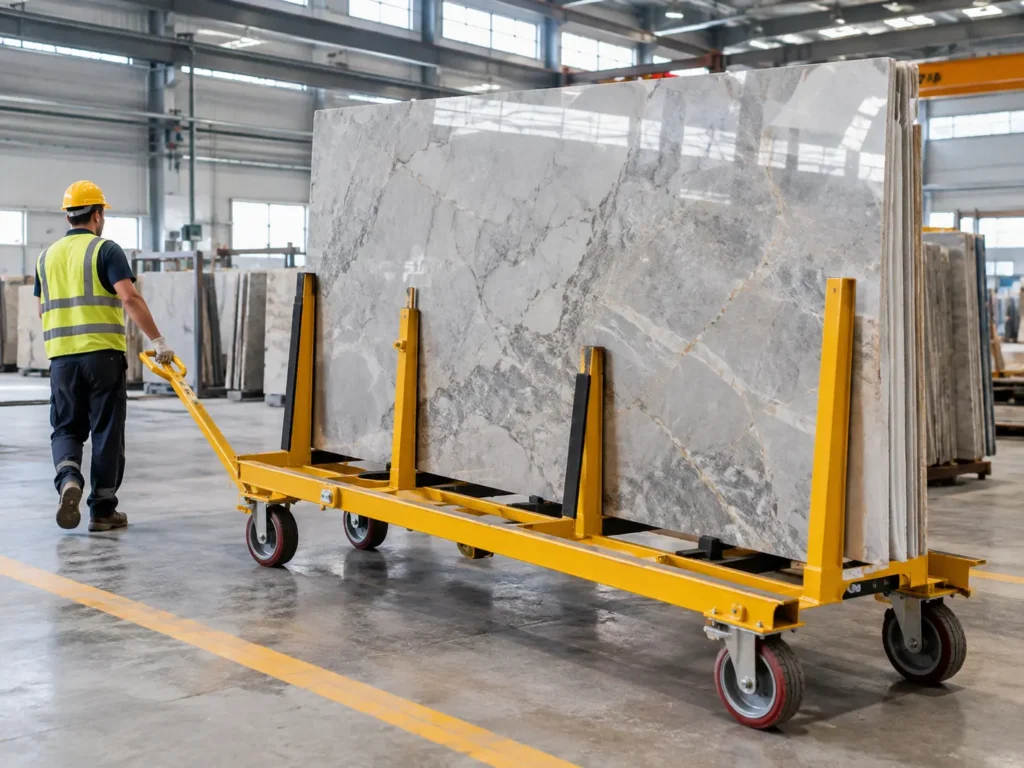
Chariot de transport de dalles
What Is a Slab Transport Cart?
A Slab Transport Cart is a purpose-designed handling platform used to move large stone panels inside controlled working environments. Depending on the design, it may support slabs in a vertical, inclined or horizontal position and may use fixed wheels, swivel casters, pneumatic tires, polyurethane wheels or powered drive systems.
The basic concept is straightforward: transfer the load from direct manual carrying to a mechanically supported platform that can be pushed, pulled or powered along a planned route. The engineering challenge is much more complex because the cart has to maintain stability while supporting a wide, heavy and sometimes fragile panel.
How a Slab Transport Cart Works
A typical cart combines a structural frame, slab-contact area, wheels or casters and operator-control components. Some designs include rubber-lined supports to reduce direct contact between stone and steel. Others incorporate adjustable supports, locking systems, tilting mechanisms or powered movement.
The cart should be considered as a complete load-handling system rather than as a frame plus wheels. The frame carries the primary structural load, while the support surface controls how the slab contacts the cart. The wheel system determines how the load responds to floor conditions, turning forces and obstacles.
Where Slab Transport Carts Are Used
Common applications include stone fabrication shops, countertop production facilities, slab warehouses, distribution centers, stone showrooms and installation operations. A cart may be used to move a slab from an Châssis de stockage en A to a cutting station, between fabrication machines, from a finishing area to an inspection point or toward a loading area.
The ideal cart is therefore closely connected to the facility layout. A model that works well in a spacious warehouse may be inconvenient in a compact fabrication shop. Similarly, a cart designed for smooth indoor concrete may not be appropriate for an outdoor yard with thresholds, ramps or uneven pavement.
Slab Transport Cart vs. General Material Carts
General industrial carts are usually designed around boxes, containers, components or relatively compact loads. Stone slabs are different. Their center of gravity can be high, their dimensions can exceed the footprint of conventional carts, and their edges can be vulnerable to impact.
For this reason, specialized slab-handling equipment typically focuses more heavily on load support, stability, controlled movement and surface protection. The correct choice depends on the actual material and operating environment rather than the label used in a product catalog.
What Types of Stone Slabs Can a Transport Cart Handle?
The material being transported is one of the first variables a purchasing team should define. Marble, granite, quartz, engineered stone and porcelain may all appear similar from a distance, but their thickness, weight, surface finish and handling requirements can vary significantly.
Marble Slabs
Marble is often selected for architectural and interior applications where appearance is critical. During movement, polished or honed surfaces should be protected from unnecessary contact, while edges and corners need controlled support. A cart with suitable padding and stable slab positioning can help reduce accidental surface contact during internal transfers.
Granite Slabs
Granite is dense and heavy, so capacity becomes particularly important. A chariot à dalles de granit should be evaluated according to the actual dimensions and mass of the slabs being moved rather than an assumed average. Wheel capacity, frame stiffness and maneuverability become increasingly important as the load grows.
Quartz and Engineered Stone
Engineered quartz is widely used for countertops and interior surfaces. Its handling requirements depend on slab thickness, dimensions and construction. Large panels should be supported adequately across their working span, and the movement route should minimize unnecessary impact and sudden changes in direction.
Large-Format and Heavy Stone Slabs
Large-format panels introduce another variable: overhang. A cart may have sufficient nominal weight capacity but still be poorly matched to a very long panel if the support area is too short. Procurement teams should therefore evaluate both load capacity and physical support dimensions.
Comment choisir le bon chariot de transport de dalles
The strongest purchasing decision begins with the application rather than the product name. Before requesting a quotation, document the largest slab, the heaviest typical slab, the route length, the narrowest passage, floor conditions and the number of transfers expected during a normal production cycle.
For buyers who want a more detailed factory-oriented selection framework, this guide to choosing a slab transport cart for stone factories provides another useful reference point for evaluating wheel types, structural parameters and operating conditions.
Load Capacity and Maximum Working Weight
Capacity should never be treated as a single number without context. A manufacturer may specify a maximum load, but the actual application also depends on how the load is distributed, how high the center of gravity sits and whether the cart is stationary or moving.
A buyer should ask for the rated working capacity, not simply the largest theoretical weight the frame can support under static conditions. The wheel or caster rating must also be considered because a cart is only as reliable as its weakest load-bearing component.
Cart Dimensions and Slab Size
Measure the maximum slab length, width and thickness before selecting a cart. Then compare these measurements with the effective support area of the equipment. A large panel that extends far beyond the support structure may behave differently from a smaller slab of the same weight.
Also measure aisle width, door openings, turning areas and workstation clearances. OSHA’s material-handling requirements emphasize sufficient safe clearances where mechanical handling equipment is used, including aisles, loading docks and turning areas. :chatgpt-content-reference{index=”2″}
Wheel Configuration and Floor Conditions
Wheel selection should reflect the floor rather than simply the load. Smooth indoor concrete, rough outdoor pavement, gravel, thresholds and ramps create different rolling requirements.
Large pneumatic wheels can be useful where impact absorption and uneven-surface mobility are priorities. Polyurethane or other industrial casters may be more suitable for smooth factory floors where rolling resistance and maneuverability are important. The exact choice should be based on the cart manufacturer’s load rating and the actual floor environment.
Frame Construction and Load Stability
The frame should maintain its geometry under the intended working load. Inspect the construction method, weld quality, reinforcement points and support arrangement. For B2B buyers, technical drawings and load documentation are often more valuable than marketing descriptions because they reveal whether the equipment was designed around the actual application.
Handles, Supports and Slab Protection
Operator control is another important part of the design. Handles should allow the user to steer without adopting awkward positions, while slab-contact areas should provide suitable protection. Depending on the application, non-marking rubber, protective pads or replaceable contact surfaces may be considered.
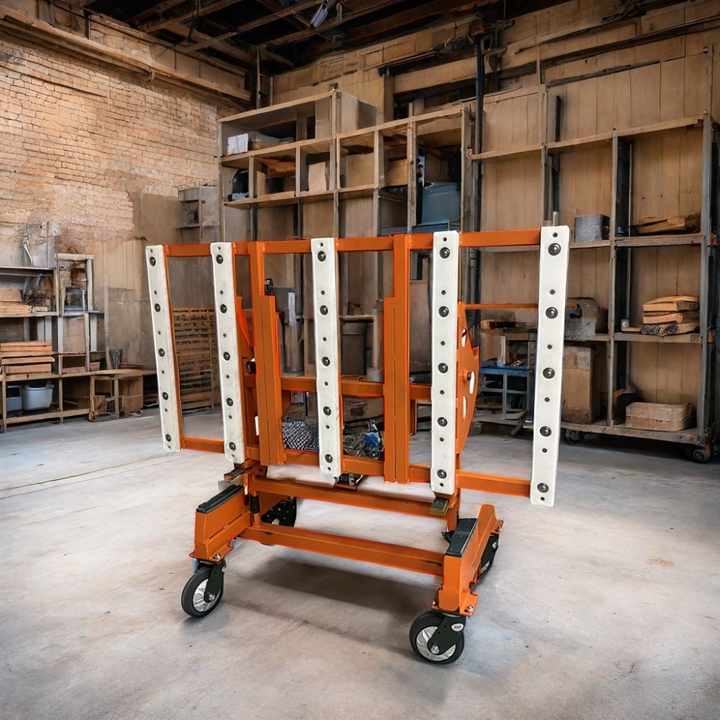
chariot de transport de dalles pour pierre verre
Slab Transport Cart Capacity Explained
Capacity is one of the most frequently searched topics when buyers compare transport equipment, but it is also one of the most misunderstood. A cart’s capacity should be interpreted together with its geometry, wheels, center of gravity, floor conditions and operating speed.
Understanding Rated Load Capacity
The rated capacity is the manufacturer’s stated limit for the intended operating conditions. It should be treated as a specification, not a target that operators should routinely approach without considering the complete handling situation.
For example, a cart that appears adequate for a particular slab by weight may still be unsuitable if the slab is exceptionally long, poorly balanced or difficult to secure. Capacity therefore needs to be matched to both weight and geometry.
Why Maximum Capacity Is Not the Same as Recommended Working Load
Static and dynamic conditions are different. When a cart starts, stops, turns or crosses a floor transition, forces are introduced into the frame, wheels and load-support system. That means procurement teams should ask whether the manufacturer’s rating applies to the intended moving condition and whether any restrictions apply.
This distinction is particularly important for B2B buyers because a cart used several times per day in a production line experiences a very different duty cycle from equipment used occasionally in a showroom.
How Slab Weight Affects Cart Selection
Stone weight can be estimated from material density, slab dimensions and thickness, but purchasing decisions should ultimately use the manufacturer’s verified specifications and the actual material being handled. The goal is to identify the heaviest realistic working load, not merely an average slab.
The NIOSH approach to material-handling risk similarly emphasizes factors such as object weight, horizontal and vertical position, movement frequency, duration and coupling when evaluating manual lifting tasks. While a transport cart changes the task, the same principle remains useful: handling risk depends on the complete task rather than weight alone. :chatgpt-content-reference{index=”3″}
Balancing Large Slabs During Movement
A slab’s center of gravity should remain within the stable support zone of the cart. A wide base, suitable support angle and correct load positioning can help improve stability. Operators should avoid sudden steering movements and should follow the manufacturer’s loading sequence.
How to Move Stone Slabs Safely With a Transport Cart
Safe movement begins before the wheels start rolling. The operator should understand the route, confirm that the cart is suitable for the load and make sure the travel path is clear. The slab should be positioned according to the manufacturer’s instructions rather than adjusted casually after movement begins.
Preparing the Slab Before Movement
Inspect the slab for visible cracks, unstable sections, loose packaging or other conditions that could affect movement. Confirm that the cart’s support surfaces are clean and correctly positioned.
If the slab requires additional restraints or protective materials, these should be prepared before loading. A rushed securing process after the cart is already moving increases unnecessary risk.
Positioning the Slab on the Cart
The slab should be supported in the intended load zone and should not be allowed to rest on a small number of unintended contact points. Large-format panels may require additional support because an unsupported edge can be vulnerable to bending and impact.
Maintaining a Stable Center of Gravity
The operator should keep the load balanced and avoid asymmetric placement unless the cart is specifically designed for that arrangement. Sudden turns, abrupt braking and uneven floor transitions can all influence the stability of a tall slab.
Moving Through Narrow Workshop Areas
A narrow aisle requires more than a compact cart. The route should provide enough space for the cart, slab and operator to pass without striking machines, racks or other workers. Corners should be assessed before the load is moved.
Loading and Unloading Procedures
Loading and unloading are often the moments when the center of gravity changes most rapidly. Brakes or locking systems should be used where provided, and workers should remain outside hazardous positions identified by the site’s risk assessment and operating procedures.
NIOSH identifies lifting, pushing, pulling, carrying, awkward postures and vibration among workplace factors that can contribute to musculoskeletal risk. Using mechanical assistance where appropriate can reduce the amount of physical exertion required from workers. :chatgpt-content-reference{index=”4″}
Slab Transport Cart Safety Features to Look For
Safety should be treated as a system rather than a single feature. A brake cannot compensate for an undersized frame, and a strong frame cannot compensate for wheels that are inappropriate for the floor. The most useful safety evaluation therefore looks at the interaction between structure, load, operator and environment.
Non-Slip Contact Surfaces
Protective contact surfaces can help keep the slab positioned while reducing direct contact with the metal frame. Material selection should also consider whether the surface can leave marks on light-colored stone.
Protective Padding and Supports
Padding should be durable enough for repeated industrial use. Replaceable wear components can make maintenance easier because high-contact areas can be renewed without rebuilding the entire cart.
Locking and Braking Systems
A locking or braking function can help stabilize the cart during loading, unloading or temporary positioning. The exact brake configuration should be selected according to the cart design and operating environment.
Reinforced Frames and Welded Joints
Inspect critical load-bearing connections, welds, brackets and wheel attachments. Buyers should request relevant quality-control documentation when purchasing equipment for demanding industrial use.
Ergonomic Handles and Operator Control
The operator should be able to control the cart without excessive force or awkward twisting. Ergonomics is especially important in repetitive workflows because even a task that feels manageable once can become physically demanding when repeated throughout a shift.
Using Slab Transport Carts in Stone Fabrication Shops
The best cart is one that improves the entire material flow rather than solving only one movement. In a well-designed workflow, the cart becomes a bridge between storage, processing and loading.
Moving Slabs Between Storage and Cutting Areas
The first transfer may be from an A-frame rack to a preparation or cutting station. The route should be planned so the slab does not need to be transferred repeatedly between different temporary supports.
Transporting Slabs to CNC and Edge Processing Equipment
After cutting, the slab or component may need to travel to polishing, edge processing, inspection or assembly. A dedicated cart can create a consistent handling method and reduce unnecessary manual repositioning.
Improving Material Flow Inside the Workshop
Workflow efficiency is not only about moving faster. It is about reducing unnecessary stops, waiting time and repeated handling. A cart that fits the facility layout can help connect individual workstations into a more predictable sequence.
This is particularly valuable when a facility handles multiple slab formats. Instead of designing every movement around a forklift, the workshop can use specialized carts for short-distance internal transfers while reserving lifting equipment for tasks that genuinely require it.
Reducing Unnecessary Manual Handling
The purpose of mechanical handling equipment is not to remove every human decision. It is to move physical effort into a controlled mechanical system where possible. NIOSH’s ergonomics guidance emphasizes designing work tasks around worker capabilities and using assistive lifting devices to reduce injury risk. :chatgpt-content-reference{index=”5″}
Slab Transport Cart vs. Other Stone Handling Equipment
A transport cart is not a universal replacement for every handling system. Stone facilities normally use a combination of racks, carts, forklifts, lifting clamps, vacuum equipment and other tools. The right question is therefore not “Which machine is best?” but “Which handling device fits this movement?”
| Equipment | Best-Suited Task | Main Strength | Key Consideration |
|---|---|---|---|
| Chariot de transport de dalles | Internal movement of individual slabs or panels | Dedicated mobility and maneuverability | Capacity, floor and route compatibility |
| Rack de stockage à cadre en A | Organized slab storage | Vertical storage and accessibility | Not automatically a transport solution |
| Forklift | Heavy loads, bundles and yard operations | High lifting capacity | Requires adequate clearance and trained operation |
| Équipement de levage sous vide | Controlled lifting and positioning | Precise slab handling | Requires suitable surface and equipment configuration |
Transport Carts vs. A-Frame Racks
An A-frame rack is primarily associated with storage and support. A transport cart is primarily associated with movement. Some equipment combines both functions, but buyers should confirm the intended use rather than assuming that a storage frame is automatically safe for mobile transport.
Transport Carts vs. Slab Dollies
A basic dolly can be useful for certain smaller or shorter-distance movements, but its suitability decreases when slab size, weight or stability requirements increase. Specialized carts generally provide more deliberate support for large panels.
Transport Carts vs. Forklift Handling
Forklifts are highly useful for moving heavy bundles and loads that require vertical lifting. However, they also require operating space, suitable attachments and trained operators. A cart may be more efficient for repeated horizontal movement inside a fabrication area.
When a Transport Cart Is the Better Choice
A cart is particularly attractive when the same type of slab movement occurs repeatedly along a defined route. In this situation, a dedicated transport solution can reduce unnecessary equipment changes and make the workflow easier to standardize.
Common Slab Transport Cart Selection Mistakes
Many purchasing problems come from choosing equipment based on one specification while ignoring the complete application. The following mistakes are especially important for B2B buyers.
Choosing Capacity Without Considering Actual Slab Weight
A cart should be specified around the heaviest realistic working load. Buyers should also verify whether the stated capacity refers to static or dynamic operation and whether any conditions apply.
Ignoring Cart Width and Turning Space
A cart can be structurally excellent but operationally useless if it cannot turn inside the factory. Measure the narrowest aisle, doorway and workstation entrance before ordering.
Using Inadequate Wheel Systems
Wheels should match the floor. Smooth concrete, wet areas, outdoor pavement and uneven thresholds each create different demands. Choosing wheels only because they have a high nominal load rating can lead to poor maneuverability.
Forgetting Surface Protection
The cart is supposed to protect valuable stone, not create new damage. Contact surfaces should be inspected for sharp edges, exposed steel, worn rubber and contamination.
Choosing Storage Equipment for Transport Applications
Storage and transport are different engineering functions. A fixed storage rack may be designed to hold slabs in a stationary position but may not have wheels, brakes, tie-down points or structural characteristics required for movement.
How to Maintain a Slab Transport Cart
Maintenance is part of capacity management and safety. A cart that was correctly specified when new can become unsuitable if wheels wear, welds deteriorate, protective surfaces fail or brakes stop working correctly.
Inspecting Wheels and Bearings
Check wheels for cracks, abnormal wear, embedded debris and uneven rotation. Pneumatic tires should be maintained according to the manufacturer’s recommended pressure and inspection schedule.
Checking Welds and Frame Alignment
Look for visible cracks, deformation, corrosion or unusual movement at welded joints and structural connections. If the frame no longer maintains its intended geometry, the equipment should be removed from service until evaluated.
Inspecting Padding and Contact Surfaces
Replace worn padding before the metal frame becomes exposed. Contact surfaces should remain clean and free from sharp debris that could scratch polished stone.
Routine Cleaning and Preventive Maintenance
Stone fabrication creates dust, slurry, chips and debris that can affect wheels and moving components. A regular cleaning and inspection routine can reduce avoidable wear and make equipment defects easier to identify.
Slab Transport Cart Buying Checklist
Before requesting a quotation, procurement teams should confirm:
- Maximum slab weight and typical working load
- Maximum slab length, width and thickness
- Required support orientation
- Cart overall dimensions
- Narrowest aisle and turning radius available
- Indoor or outdoor operating environment
- Floor material and surface condition
- Wheel or caster type and rating
- Frame construction and load-bearing components
- Protective slab-contact materials
- Braking or locking requirements
- Manual, electric or hybrid movement requirements
- Maintenance and replacement-part availability
- Inspection and quality documentation
- Customization requirements for unusual slab formats
For buyers who are ready to compare actual equipment configurations, the Slab Transport Cart product range provides a useful starting point for reviewing different cart formats and material-handling applications.
Practical Workflow for Safer Stone Slab Transportation
A good cart cannot compensate for a poorly planned workflow. The most effective approach is to create a repeatable sequence that operators can follow for every movement.
Plan the Route
Identify the destination, obstacles, floor transitions, ramps, doors and areas where other workers may be present. Clear the route before moving the slab.
Prepare the Cart
Check the wheels, frame, support surfaces, brakes and restraints. Confirm that the cart is rated for the planned load.
Secure and Position the Slab
Load the slab according to the manufacturer’s instructions. Confirm that it is supported at the intended contact points and that the center of gravity remains within the stable area of the cart.
Move at Controlled Speed
Avoid abrupt acceleration, sudden turns and unnecessary impacts. Controlled movement gives the operator more time to respond to floor conditions and obstacles.
Complete the Final Placement
When the destination is reached, stabilize the cart before transferring the slab. The unloading stage should receive the same level of attention as the initial loading stage.
How Modern Slab Transport Cart Systems Solve Factory Problems
The value of modern handling equipment becomes clearer when viewed through the problems it solves. A fabrication shop may be dealing with worker fatigue, repeated forklift requests, narrow aisles, damaged edges, inconsistent workflow or difficult floor conditions at the same time.
A well-designed system addresses these issues through better load support, more appropriate wheel configurations, improved maneuverability and a more predictable movement process. The goal is not simply to make one operator push a cart more easily. The larger objective is to create a safer and more repeatable material-flow system.
For a deeper problem-oriented analysis, this resource on the problems solved by modern slab transport cart systems covers worker injury risk, product damage, maneuverability, workflow efficiency, floor conditions and the move toward smarter handling systems.
Worker Injury Risk
Mechanical assistance can reduce the need for workers to repeatedly push, pull, carry or manually reposition heavy and awkward materials. This is consistent with the broader ergonomics principle that work should be designed around worker capabilities.
Slab Damage
A controlled support system can reduce uncontrolled movement and direct impact. This is particularly important when moving polished marble, large-format porcelain or other materials where visible damage can create rework.
Poor Maneuverability
Swivel casters, suitable wheel sizes and appropriate cart dimensions can make internal movement easier where forklifts are difficult to maneuver. However, the final choice must always match the actual factory route.
Workflow Delays
If workers regularly wait for a forklift to move a single slab a short distance, a dedicated cart may improve workflow continuity. The business case becomes stronger when the same movement occurs many times each day.
Choosing Between Manual, Powered and Specialized Cart Configurations
Not every facility needs powered movement. Manual carts may be appropriate for short internal routes, moderate handling frequency and controlled floor conditions. Powered configurations become more relevant when loads are heavier, routes are longer or movement frequency is high.
When a Manual Cart Makes Sense
A manual configuration can be practical when the route is short, the floor is relatively smooth and the load remains within the manufacturer’s recommended operating range. Simplicity can also make inspection and maintenance easier.
When Powered Movement Should Be Considered
Powered equipment may be worth evaluating when repeated pushing creates excessive physical demand or when the workflow requires frequent movement of heavy loads over longer distances. The facility should consider charging, controls, maintenance, operator training and emergency procedures as part of the total system.
When Customization Becomes Important
Standard dimensions do not fit every stone operation. Large-format panels, unusual slab thicknesses, narrow production lines or specialized workstations may require customized support dimensions, wheel arrangements or handling interfaces.
This is where direct communication with an experienced equipment manufacturer can be useful. Instead of selecting from a generic catalog, buyers can provide slab dimensions, weight, floor conditions, route information and production requirements so the equipment configuration can be reviewed against the actual application.
What Should B2B Buyers Ask a Slab Transport Cart Manufacturer?
A professional quotation should answer more than “How much does the cart cost?” For industrial procurement, the buyer should be able to understand what is included in the design and how the equipment is intended to operate.
Ask About Engineering Specifications
Request dimensions, rated load capacity, wheel specifications, support configuration, frame construction and any applicable drawings. If the cart is customized, confirm which dimensions are fixed and which can be adjusted.
Ask About Quality Control
Clarify how frames, welds, wheels and moving components are inspected. For larger orders, ask whether pre-shipment inspection documentation, photographs or test records can be provided.
Ask About Customization
If your facility handles oversized or unusual slabs, provide actual measurements rather than simply describing the material as “large.” Length, width, thickness, weight and route constraints allow the manufacturer to evaluate the application more accurately.
Ask About After-Sales Support
Replacement wheels, pads, brakes and other wear components may matter over the service life of the cart. Buyers should understand how spare parts and technical support are handled before finalizing a purchase.
For manufacturer background, production capabilities and company information, buyers can review the stone equipment manufacturer’s company profile before moving to detailed technical discussions.
Material Fit by Product Direction
The following matrix is an adaptability guide, not statistical data. It is intended to help procurement teams think through which transport-cart configuration may fit different stone-handling directions. Final selection should be confirmed against the actual slab dimensions, weight, floor conditions and manufacturer specifications.
●●● = Primary
●●○ = Strong Option
●○○ = Depends on Workflow
— = Usually Not First Choice
| Product / Handling Direction | Manual Slab Cart | Heavy-Duty Slab Cart | Powered Cart | Key Selection Consideration |
|---|---|---|---|---|
| Standard Marble Slabs | ●●● | ●●○ | ●○○ | Surface protection, stability and route control |
| Granite Slabs | ●●○ | ●●● | ●○○ | Higher load demand and wheel capacity |
| Quartz Slabs | ●●○ | ●●● | ●○○ | Weight, dimensions and support arrangement |
| Large-Format Porcelain | ●○○ | ●●○ | ●●○ | Full support and controlled movement |
| Long Internal Factory Routes | ●○○ | ●●○ | ●●● | Movement frequency and operator effort |
| Outdoor / Uneven Surfaces | ●○○ | ●●● | ●●○ | Wheel design, shock absorption and terrain |
This material-fit framework should not be interpreted as a universal ranking. A lighter marble slab on a smooth factory floor may be easier to move manually than a large granite panel, while a large porcelain sheet may require greater attention to support and impact control even when its absolute weight is lower.
The strongest purchasing decision therefore comes from matching the cart to the actual movement task. In other words, capacity, geometry, stability and workflow should be evaluated together.
 transport de plaques de marbre CARTBDC-A |
 chariot de transport de paquets pour dalle |
Why Direct Manufacturer Communication Matters in B2B Procurement
A transport cart is a relatively simple-looking piece of equipment, but its performance depends on details that may not be visible in a standard product photograph. Frame dimensions, weld design, wheel selection, support materials and customization capability can all influence suitability.
Direct communication is particularly useful when the buyer needs multiple units, unusual dimensions or a coordinated equipment package. It also makes it easier to communicate the actual working environment rather than relying on generic catalog categories.
When a buyer has already defined the slab size, load, floor type and workflow, the next step is usually a technical discussion rather than a simple product search. Procurement teams can use the equipment manufacturer’s contact and quotation channel to submit application details and confirm the appropriate configuration.
Frequently Asked Questions About Slab Transport Carts
1. What is a Slab Transport Cart used for?
A Chariot de transport de dalles is designed to move large and heavy stone panels through fabrication shops, warehouses, showrooms, installation areas and other controlled workspaces. It provides a dedicated support platform that helps operators position slabs more consistently than improvised carts or unsupported manual handling. The right configuration can improve maneuverability, reduce unnecessary lifting and help protect slab edges and finished surfaces. Selection should always consider slab weight, dimensions, center of gravity, floor conditions and the cart’s rated working capacity.
2. How do I choose the right Slab Transport Cart capacity?
Choose cart capacity according to the heaviest slab and the actual working conditions, rather than relying only on an average slab weight. Review the manufacturer’s rated capacity, load distribution, wheel capacity, frame strength and dynamic operating conditions. Large-format marble, granite, quartz and porcelain panels can behave differently during movement, so the cart should provide adequate support for the complete slab and remain stable during starting, stopping and turning. The final specification should be confirmed against the manufacturer’s technical documentation.
3. What features should I look for in a stone slab transport cart?
Les caractéristiques importantes comprennent un châssis conçu de manière appropriée, une capacité de charge suffisante, des supports stables pour les dalles, des roues ou des roulettes adaptées, des surfaces de contact protégées, des fonctions de freinage ou de verrouillage lorsque cela est nécessaire, des poignées pratiques ainsi que des dimensions correspondant à l'environnement de travail. Les acheteurs devraient également tenir compte des conditions du sol, de la largeur des allées, de l'espace de rotation, des dimensions des dalles, des besoins d'entretien et du fait que le chariot sera utilisé à l'intérieur, à l'extérieur ou entre différentes zones de travail. Une configuration bien adaptée est plus importante que le simple choix du plus grand chariot disponible.
4. Can a Slab Transport Cart move marble, granite, quartz and porcelain slabs?
Yes, a properly specified Slab Transport Cart can be used for different stone and engineered slab materials, including marble, granite, quartz and porcelain panels, provided the cart is designed for their dimensions, weight and handling characteristics. Thin or large-format panels may require additional support and careful control because unsupported overhang, sudden impacts or unstable loading can increase breakage risk. Always verify the cart’s working capacity and support configuration before handling a specific material.
5. How can a Slab Transport Cart improve stone fabrication workflow?
Un chariot de transport de dalles peut créer un flux de matériaux plus prévisible entre les zones de stockage, de découpe, de fabrication, d'inspection et de chargement. En réduisant les transferts inutiles et en fournissant une plateforme de manutention dédiée, il peut contribuer à améliorer la maniabilité et à diminuer la dépendance aux levages manuels répétés. Le plus grand avantage se manifeste généralement lorsque le chariot est adapté à la disposition de l'usine, aux dimensions des dalles, aux conditions du sol et à la séquence de production. Pour les installations à fort volume, des configurations motorisées ou spécialisées peuvent également être envisagées lorsque le flux de travail et l'environnement d'exploitation le justifient.
Références
- Materials Handling and Storage: General Industry Standards
Author: Occupational Safety and Health Administration
Institution: U.S. Department of Labor
Source: OSHA 29 CFR 1910.176 - Revised NIOSH Lifting Equation
Author: National Institute for Occupational Safety and Health
Institution: Centers for Disease Control and Prevention
Source: CDC / NIOSH Ergonomics - Materials Handling: Lifting and Carrying Toolbox Talk
Author: Pfirman D., Cunningham T. R., Bunting J.
Institution: National Institute for Occupational Safety and Health / CPWR
Source: DHHS NIOSH Publication No. 2026-119 - Ergonomic Guidelines for Manual Material Handling
Author: National Institute for Occupational Safety and Health
Institution: Centers for Disease Control and Prevention
Source: DHHS NIOSH Publication No. 2007-131 - Elements of Ergonomics Programs
Author: National Institute for Occupational Safety and Health
Institution: Centers for Disease Control and Prevention
Source: NIOSH Ergonomics Program Guidance - About Ergonomics and Work-Related Musculoskeletal Disorders
Author: National Institute for Occupational Safety and Health
Institution: Centers for Disease Control and Prevention
Source: CDC / NIOSH Ergonomics - Engineering Controls Database: Material Handling
Author: National Institute for Occupational Safety and Health
Institution: Centers for Disease Control and Prevention
Source: NIOSH Engineering Controls Database - Materials Handling and Workplace Safety Principles
Author: Occupational Safety and Health Administration
Institution: U.S. Department of Labor
Source: OSHA Materials Handling and Storage Guidance
Final Perspective: Building a More Efficient Stone Handling Workflow
Start With the Workflow, Not the Equipment:
Le droit Chariot de transport de dalles should be selected after the actual material-flow process has been mapped. Consider the heaviest slab, maximum dimensions, travel distance, aisle width, turning points, floor conditions and frequency of movement before comparing individual cart specifications. This approach helps buyers avoid choosing equipment based only on nominal load capacity.
Match the Cart to the Load:
Stone slabs behave differently according to material, thickness, dimensions and support conditions. Marble, granite, quartz and large-format porcelain may require different combinations of frame strength, support geometry, wheel configuration and protective contact surfaces. Capacity should therefore be evaluated together with load distribution and stability rather than treated as an isolated specification.
Design Around the Factory:
A technically strong cart may still perform poorly if it does not fit the working environment. Door openings, aisle widths, floor transitions, ramps, workstation locations and storage areas all influence maneuverability. For repetitive internal transportation, the best equipment is usually the configuration that integrates naturally into the existing production route.
Balance Safety With Productivity:
Effective stone handling is not simply about moving heavier slabs with less effort. It is about creating a controlled and repeatable movement process. Suitable wheels, stable supports, protective surfaces, braking or locking systems and operator-friendly controls can contribute to a more predictable workflow while reducing unnecessary manual handling.
Choose the Right Handling Level:
Manual carts can be practical for short-distance movement in controlled environments, while heavy-duty or powered configurations may become more appropriate for larger loads, longer routes or repetitive production cycles. Specialized designs can also be considered when slab dimensions, factory layout or handling requirements fall outside standard configurations.
Think Beyond the Initial Purchase:
For B2B buyers, equipment selection should also consider inspection, maintenance, replacement wheels or contact materials, customization capability and technical support. A cart is part of a long-term handling workflow, so serviceability and application compatibility can be as important as the initial specification.
The Strategic Takeaway:
A high-performing stone handling system is built around the relationship between the slab, the cart, the operator and the factory environment. The strongest Chariot de transport de dalles choice is therefore not necessarily the largest or most heavily specified model, but the one that provides an appropriate balance of capacity, stability, maneuverability, protection and workflow efficiency for the intended application.

Henri
Bonjour, je suis l'auteur de cet article et je travaille dans ce domaine depuis plus de 16 ans. Si vous avez besoin d'un service OEM&ODM pour les outils en pierre, n'hésitez pas à me poser des questions.