





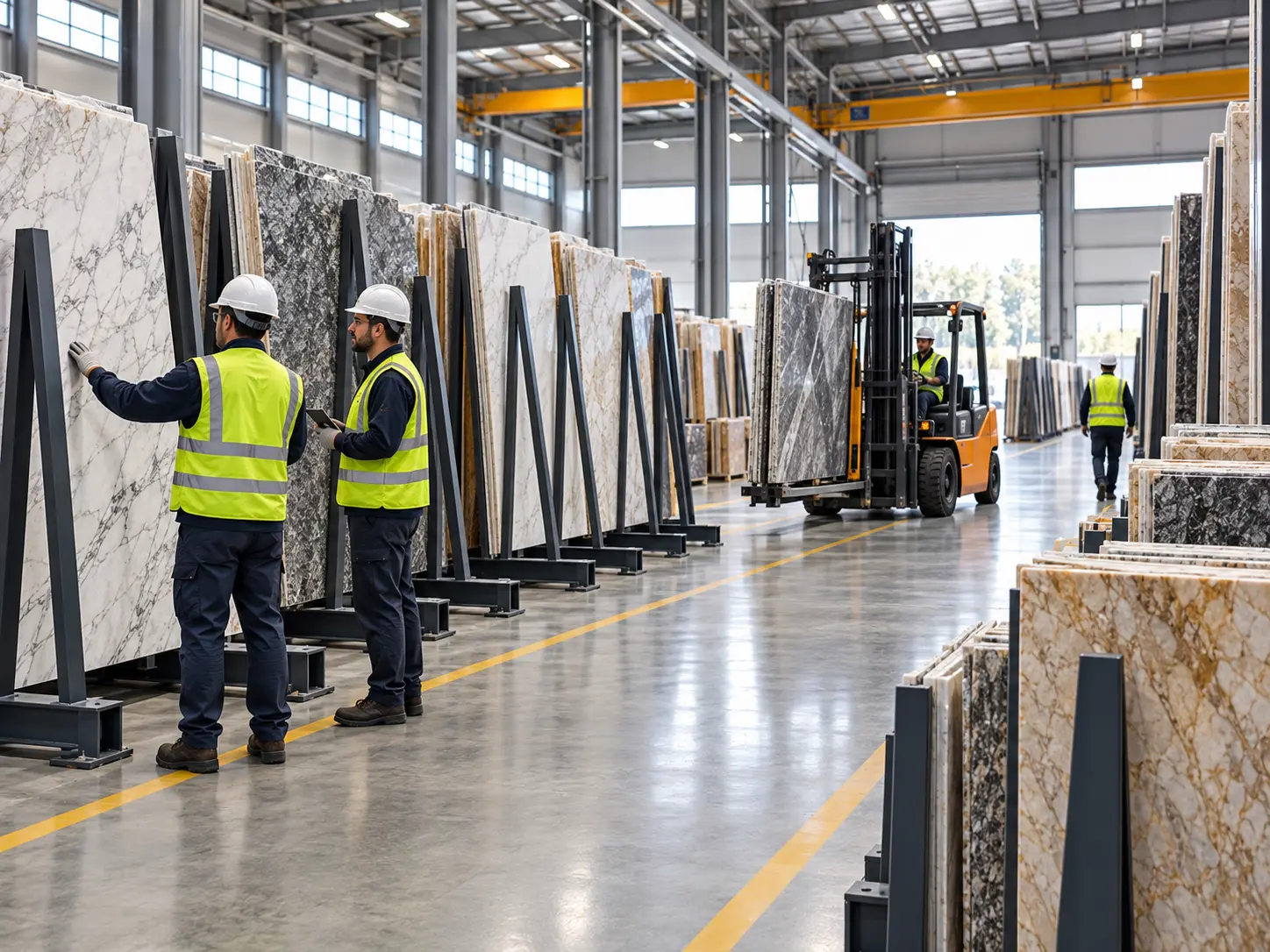
A stone warehouse may contain several hundred marble, granite, quartzite, engineered quartz or sintered-stone slabs, yet one of the most important pieces of equipment is often treated as a simple welded frame. That is a mistake. A storage rack must resist the actual loads imposed by leaning slabs, remain stable as material is added and removed, work with forklifts or cranes, protect polished edges and keep workers away from the potential fall path of unsecured stone. Before asking “How much does the rack cost?”, the warehouse should first define the slab size, approximate density, maximum stored quantity, loading method and floor condition. SPEEDONE offers several Slab Racks for stone storage, including heavy-duty, galvanized and lighter-duty configurations, but the correct model should be selected only after the storage requirement is quantified.
This specification-first approach is especially important because the stored material can weigh far more than it appears to. A single large 20 mm slab may weigh several hundred kilograms, while a rack holding dozens of slabs can carry many tonnes. Rack loading also changes every time one slab is removed, so the storage system needs to remain stable under realistic partial-load conditions—not merely at one ideal full-load condition. A competent manufacturer should therefore be able to explain how the load rating was established, what configuration it applies to, whether the rating is per side or total, how the rack should be installed and what restrictions apply to slab height, lean angle or material handling. Buyers evaluating a stone equipment and Slab Rack manufacturer should look for engineering information, manufacturing control and application support rather than comparing only steel weight or paint finish.
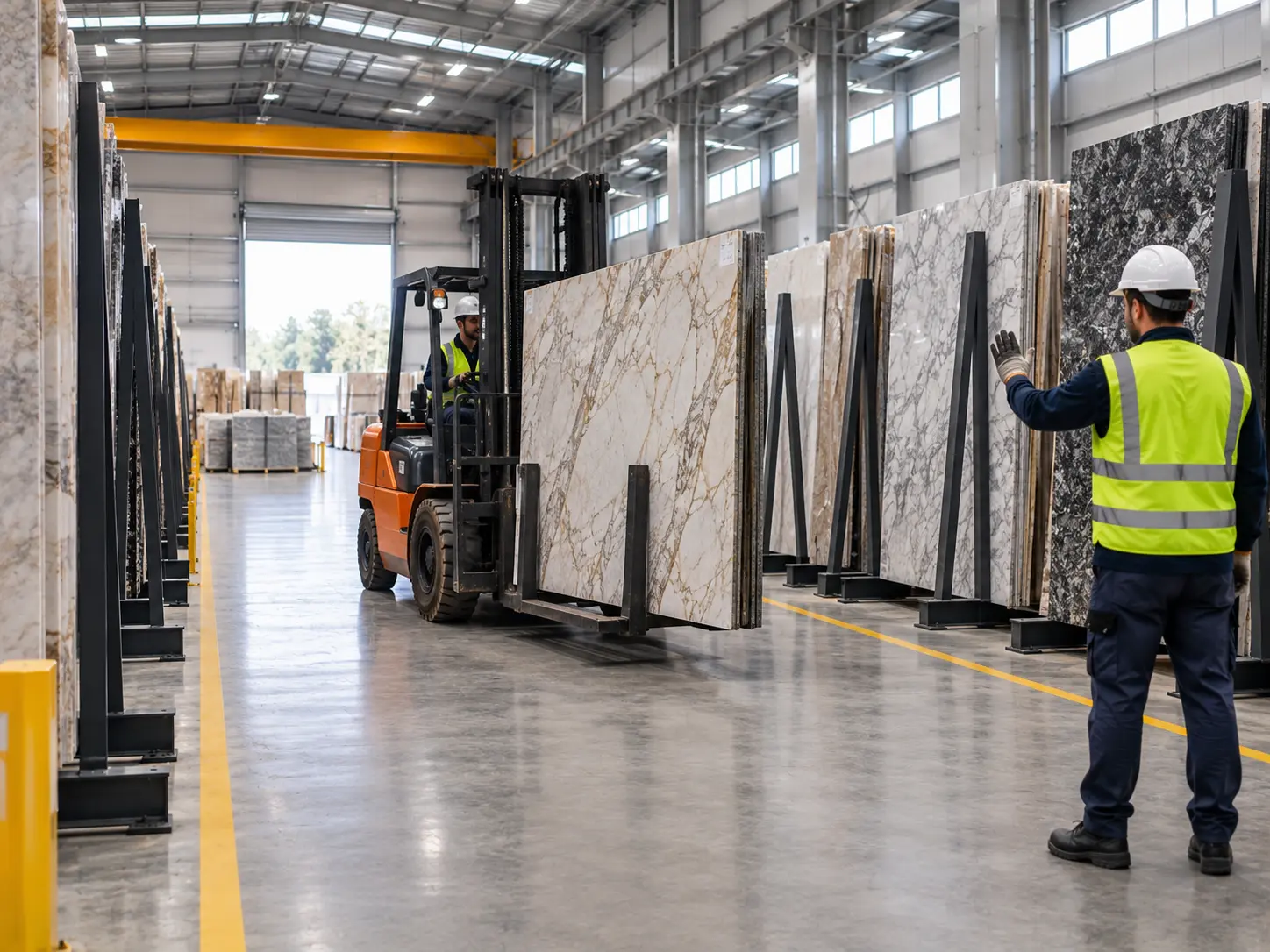
The next step is to match the rack to the warehouse rather than forcing the warehouse to adapt to a standard catalog model. A countertop shop using a forklift may need wide, predictable approach paths. A large slab importer using an overhead crane may prioritize clear lifting zones and sequential access. A facility combining slab carts, clamps and forklifts may need a rack system that supports several transfer methods without forcing employees into the dangerous fall zone beside leaning slabs. Floor strength, drainage, seismic conditions, corrosion exposure and emergency access can also affect the final specification. Buyers planning a new slab yard or replacing an old system can request a Slab Rack layout and quotation after preparing the actual slab dimensions, estimated weights, equipment details and floor plan. That information is more valuable than asking suppliers for “the strongest rack available.”
Storage efficiency should also be measured in operational terms. A rack that stores the most slabs per square meter can still perform poorly if employees must move five other slabs to retrieve one target slab. Conversely, a slightly larger indexed system can reduce handling cycles, edge damage and forklift travel. SPEEDONE’s discussion of why Slab Rack is essential for stone storage highlights benefits such as better space utilization, reduced slab damage, easier inventory control and improved handling efficiency. Those benefits are real only when the rack is integrated into the complete material flow—from container unloading to inspection, storage, fabrication and final shipping.
Safety is the final filter through which every efficiency decision should pass. OSHA has documented fatal crushing incidents associated with stone slabs shifting or falling from storage systems, and its stone-slab handling bulletin specifically recommends racks designed for imposed loads, restraint against shifting or collapse, proper installation and inspection before use. Rack users also need procedures for loading, removal, forklift traffic and employee positioning. SPEEDONE’s Slab Rack safety tips for warehouse managers similarly emphasize load calculation, forklift routes, fall zones, inspection and worker training. The practical lesson is straightforward: safe storage is not one rack feature. It is a system connecting the rack, slabs, floor, handling equipment and people.
ספק מדפי לוחות
Quick Answer: How Do You Choose the Right Slab Rack?
A practical buying process can be reduced to six decisions:
- Measure the largest and heaviest slab you expect to store.
- Calculate the maximum credible stored mass.
- Select a rack type and geometry suited to the storage method.
- Verify that the rack load rating applies to the intended configuration.
- Check floor, anchoring and handling-equipment compatibility.
- Define inspection, restraint and safe operating procedures before loading begins.
| Selection Question | What to Confirm |
|---|---|
| What stone will be stored? | Material, dimensions, thickness and density |
| How many slabs? | Maximum credible quantity per rack or side |
| What capacity is required? | Stored mass plus engineering design basis |
| How will slabs be handled? | Forklift, crane, clamp, cart, vacuum lifter or combination |
| Where will the rack sit? | Floor condition, foundation, indoor/outdoor environment |
| How will workers stay safe? | Restraints, exclusion zones, training and inspection |
Important: load factors, rack angles, anchoring, structural sections and test requirements should be defined by the rack manufacturer, qualified engineer and applicable local regulations. Do not copy one numerical recommendation from another warehouse and treat it as a universal legal requirement.
Step 1: Design Around the Largest and Heaviest Slab
The storage rack should be specified from the most demanding credible slab condition, not the average slab in inventory.
Record the Following
- maximum slab length;
- maximum slab height;
- minimum and maximum thickness;
- material type;
- actual or estimated density;
- maximum slabs stored together;
- whether slabs are individual or bundled;
- whether oversized pieces or finished countertops will also be stored.
A warehouse handling 20 mm marble one week and 30 mm granite the next should not calculate rack requirements from the lighter material simply because it is the most common stock.
How to Calculate Stone Slab Weight
For preliminary planning, slab mass can be estimated from geometry and material density:
Use meters for dimensions and kilograms per cubic meter for density.
Example
For a 3.2 × 1.6 m slab, 20 mm thick, using an illustrative density of 2,700 kg/m³:
At 30 mm thickness:
The 30 mm slab contains 50% more material volume and theoretical mass than the 20 mm slab of the same length, height and density.
Scientific Slab-Weight Comparison
The table below uses three density scenarios to show how material density and thickness influence slab weight. These are illustrative density scenarios, not certified values for any particular marble, granite, quartzite or engineered stone.
| גודל הלוח | Density Scenario | 20 mm | 30 mm | 50 mm |
|---|---|---|---|---|
| 3.2 × 1.6 m | 2,400 kg/m³ | 245.8 kg | 368.6 kg | 614.4 kg |
| 3.2 × 1.6 m | 2,700 kg/m³ | 276.5 kg | 414.7 kg | 691.2 kg |
| 3.2 × 1.6 m | 2,900 kg/m³ | 297.0 kg | 445.4 kg | 742.4 kg |
Use actual supplier material data, verified slab weight or a calibrated weighing method when final structural decisions depend on the value.
Step 2: Calculate the Maximum Stored Mass
The first useful capacity calculation is simple:
If the rack may hold 40 slabs and the heaviest slab is 415 kg:
That is 16.6 tonnes of stone before the rack manufacturer applies the structural design criteria, load combinations, allowable stresses and any required design or test factors.
Do not simply multiply by a universal “safety factor” from an online article. The structural design basis should come from the engineered rack system, applicable standards and site requirements.
Why a “30-Ton” or “40-Ton” Label Is Not Enough
A load number is useful only when the conditions behind it are clear.
Ask the Supplier
- Is the rating per side or total?
- What slab height and lean condition were assumed?
- Is the rack free-standing or anchored in the rated configuration?
- Is the load uniformly distributed?
- Does the rating apply to static storage only?
- Was the capacity derived by engineering calculation, physical test or both?
- What deflection or deformation criteria were used?
- Are there restrictions for partial loading?
The phrase “heavy duty” has no useful engineering meaning unless the manufacturer can explain what the rack is actually designed to carry.
Rack Capacity Is Not the Same as Slab Capacity
A rack rated for a certain total load is not automatically suitable for every arrangement totaling that same mass.
Load distribution changes with:
- slab height;
- lean angle;
- center of gravity;
- loading on one or both sides;
- restraint;
- partial unloading;
- position of spacers or posts.
The intended slab arrangement should be included in the engineering review.
Step 3: Choose the Rack Type
A-Frame Slab Racks
A-frame storage systems lean slabs against a central supporting structure and can store material on one or both sides depending on the design.
They can be effective for:
- fabrication shops;
- warehouse rows;
- granite and marble storage;
- organized bundle storage.
Their actual capacity and stability depend on frame geometry, base width, steel sections, slab height, restraints and installation.
Vertical Pole or Post Racks
Pole-based systems create separated slab positions between uprights. These can provide organized, indexed access but require correct pole engagement, structural capacity and safe restraint.
OSHA has documented failures in slab-rack systems where poles were not fully inserted or rack bases deformed under load, illustrating why installation and inspection are critical.
Cantilever or Segmented Racks
Segmented storage can separate stone groups by customer, material or project and may reduce unnecessary slab movement.
Mobile Slab Racks
Mobile systems can support internal workflow where the product is specifically designed for movement.
Never assume a storage rack can be moved while loaded. Loaded movement should occur only when the rack or transport frame is specifically engineered and rated for that operating condition.
Fixed vs Mobile Slab Storage
| Factor | Fixed Rack | Mobile / Transfer System |
|---|---|---|
| Storage position | Stable defined location | Can move material between operations |
| Anchoring | Can be integrated where design requires | Usually requires a different stability strategy |
| Workflow | Best for organized permanent storage | Can reduce repeated slab transfers |
| Main concern | Impact and static stability | Dynamic stability and restraint |
How Slab Rest Angle Affects Storage
The slab lean or rest angle influences footprint, slab pressure, center of gravity and sliding tendency.
A more upright arrangement can reduce floor footprint but may increase sensitivity to restraint, base geometry and movement. A shallower lean can occupy more floor area while changing how the slab load transfers into the support structure.
| Rest-Angle Direction | Storage Effect | Engineering Consideration |
|---|---|---|
| More shallow lean | Larger footprint | Lower verticality but greater space use |
| Moderate lean | Balanced footprint | Must match rack geometry and restraint |
| More upright | Smaller footprint | Restraint and tip stability become increasingly important |
There is no one universal “best” slab angle. Use the angle specified by the engineered rack manufacturer for the actual storage configuration.
Why Slab Restraint Matters
A storage rack needs to control more than gravity under perfect conditions. Slabs can shift when material is loaded, removed, bumped or temporarily separated for lifting.
Depending on the system, restraint may involve:
- posts;
- stop bars;
- straps;
- clamps;
- wedges;
- secondary bracing;
- purpose-designed bundle restraints.
The correct restraint method must be compatible with the stone and the handling procedure.
The Fall Shadow: One of the Most Important Slab-Safety Concepts
OSHA uses the term “fall shadow” to describe the area on either side of a slab where the slab could land if it tips or falls.
Workers should not position themselves inside that potential fall path while slabs are being moved, separated or left unsecured.
Why This Matters
A large slab can weigh several hundred kilograms. Multiple slabs can weigh several tonnes. Once a tall slab begins to fall, a person does not have the physical ability to stop it safely.
Storage design should make the safe position easy and the dangerous position unnecessary. If workers routinely need to step into the fall shadow to retrieve slabs, the workflow itself should be redesigned.
Why Partially Loaded Racks Need Attention
A rack that is stable when evenly filled can experience different forces as slabs are removed.
Potential issues include:
- unbalanced side loading;
- loss of support between slabs;
- changes in slab lean;
- remaining slabs shifting;
- workers entering the rack zone to reach inner slabs.
The loading and unloading sequence should be part of the operating procedure.
Single Slabs vs Bundled Slabs
An individual slab may be easier to access but more exposed to tipping. A bundle has greater total mass and may behave differently under restraints.
The storage system should be designed around the actual operating method:
- single-slab retrieval;
- small groups;
- full bundles;
- customer-order segregation.
Step 4: Check the Floor and Foundation
Even a perfectly engineered rack transfers its load into the building floor or foundation.
The site review should consider:
- concrete thickness;
- reinforcement where known;
- floor condition;
- cracks;
- flatness;
- footplate size;
- concentrated reactions;
- anchor requirements;
- local structural design criteria.
A high-capacity rack on an unsuitable floor is not a high-capacity storage system.
Floor Load vs Rack Load
Rack capacity describes the storage structure. Floor capacity describes the surface supporting it.
A rough average load over the rack footprint may be useful for early planning:
But actual footplate reactions can be much higher than the average because the load is transferred through discrete support points.
Final floor adequacy should be checked by the appropriate structural professional where the loads are significant.
מדף לוחות באיכות גבוהה
Should Slab Racks Be Anchored?
Some rack systems are designed to be anchored, while others may use different structural configurations.
Anchoring decisions depend on:
- rack design;
- rack height;
- stored load;
- floor construction;
- impact exposure;
- seismic requirements;
- manufacturer instructions;
- local regulations.
There is no universal anchor diameter or embedment depth that applies to every Slab Rack. Anchor design must match the rack, concrete and applied loads.
Seismic Considerations
Facilities in earthquake-prone regions should include seismic loading and anchorage in the structural evaluation.
Potential considerations include:
- rack overturning;
- slab restraint;
- anchor forces;
- floor capacity;
- clearance between storage systems;
- local building or seismic requirements.
A rack designed for a low-seismic indoor warehouse should not automatically be assumed suitable for every U.S., Japanese or other seismic-region project.
Indoor vs Outdoor Slab Racks
Indoor Storage
Indoor racks generally operate in a more controlled environment but still face forklift impact, dust, wet floors and handling damage.
Outdoor Storage
Outdoor racks may also face:
- rain;
- corrosion;
- standing water;
- wind;
- freeze-thaw conditions;
- foundation movement;
- UV exposure to pads or coatings.
Outdoor storage should therefore be specified as an outdoor structural and corrosion environment, not simply an indoor rack placed outside.
Painted vs Galvanized Slab Racks
| Finish Direction | Potential Advantage | Main Consideration |
|---|---|---|
| Powder coat / paint | Cost-effective finish, easy visual customization | Damage can expose steel and require touch-up |
| Hot-dip galvanized | Stronger corrosion-protection direction | Higher initial cost and process-specific finish characteristics |
| Custom corrosion system | Can match aggressive site environment | Should be specified from real exposure conditions |
Do not assume a fixed service-life multiplier between painted and galvanized racks. Actual life depends on coating quality, exposure, damage and maintenance.
Step 5: Match the Rack to the Handling Equipment
A safe rack is one that can be serviced without improvisation.
Common Handling Methods
- forklift with approved slab-handling attachment;
- overhead crane;
- gantry crane;
- slab clamp;
- vacuum lifter;
- slab cart;
- purpose-built transfer frame.
Forklift Compatibility
The warehouse should check:
- forklift turning radius;
- mast clearance;
- rack approach angle;
- slab length;
- operator visibility;
- pedestrian separation;
- end-of-rack protection;
- attachment capacity.
A tight aisle can increase rack damage even if it appears to improve storage density.
Overhead Crane and Gantry Compatibility
Crane-serviced racks should provide:
- clear lifting path;
- adequate overhead clearance;
- room for clamps or spreaders;
- safe employee positioning;
- controlled slab swing;
- defined exclusion zones.
OSHA recommends using appropriate mechanical equipment and keeping workers away from the slab fall shadow during handling.
Slab Cart Compatibility
Where carts move slabs between storage and fabrication, evaluate:
- cart rated capacity;
- deck width;
- rack approach;
- floor slope;
- transfer height;
- slab restraint;
- center-of-gravity change during transfer.
How Wide Should the Aisle Be?
There is no universal aisle width for Slab Racks.
Aisle design depends on:
- forklift model;
- turning radius;
- slab length;
- attachment geometry;
- rack orientation;
- pedestrian zones;
- traffic direction;
- emergency access.
Use the real equipment envelope and material flow to design the aisle, not a copied warehouse dimension.
Storage Density vs Retrieval Efficiency
Storage efficiency should not be reduced to “slabs per square meter.”
A stronger set of KPIs includes:
- average retrieval time;
- number of slab moves per retrieval;
- forklift travel distance;
- damage incidents;
- number of re-handled slabs;
- labor time per customer order.
Why Digital Rack Indexing Matters
A large slab yard becomes easier to manage when every storage position has an identity.
Example
This can be connected to:
- barcode;
- QR code;
- warehouse inventory software;
- customer project;
- bundle number;
- slab photography.
How to Measure Retrieval Efficiency
One useful internal metric is:
Another is:
A rack layout that reduces unnecessary slab moves can improve both productivity and safety because every extra slab movement creates another handling event.
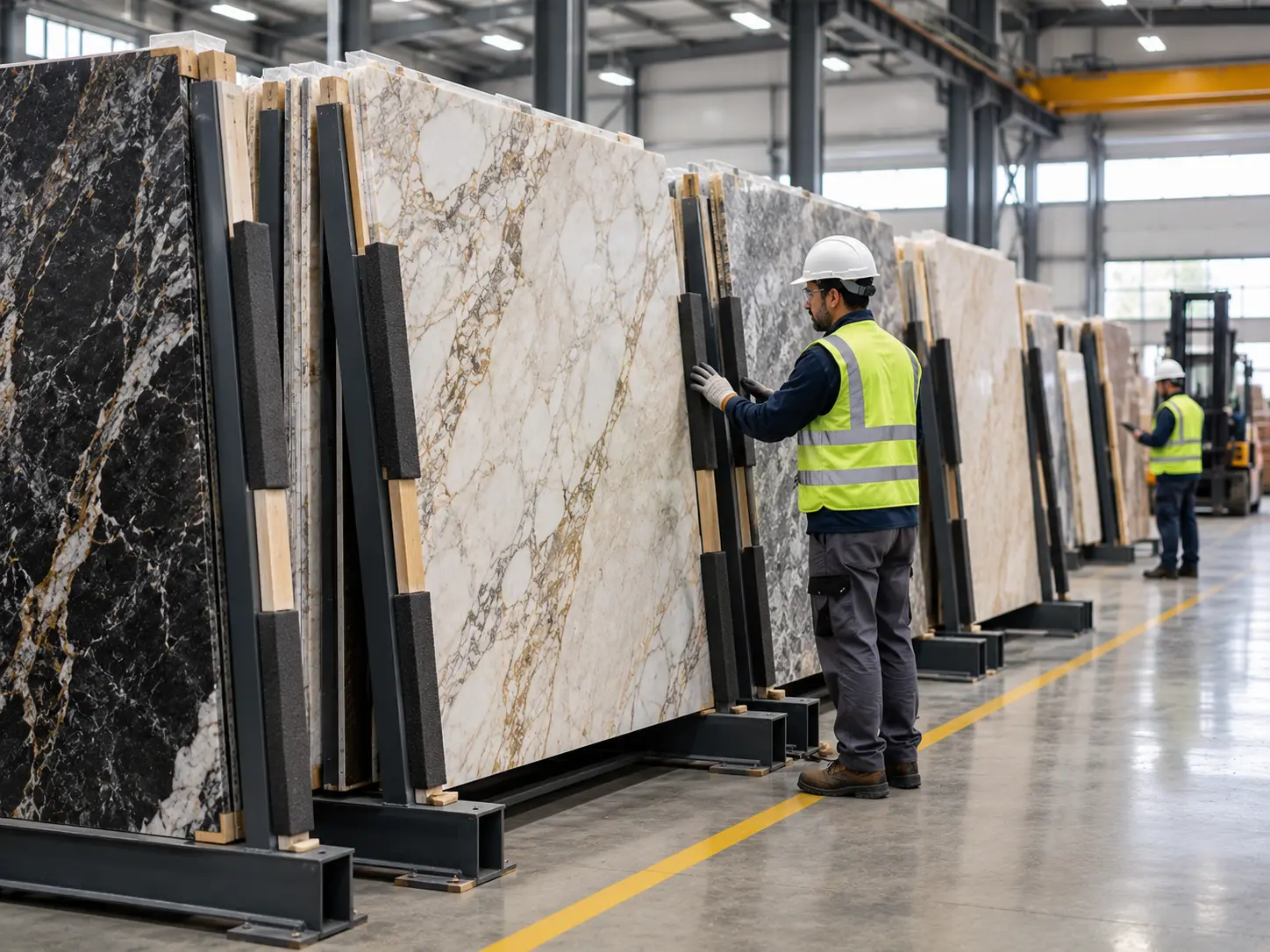
Protecting the Stone at Rack Contact Points
Bare steel contact can create localized pressure or edge damage, particularly on polished marble or fragile materials.
Depending on the design, contact protection may use:
- rubber;
- PVC;
- polyurethane;
- timber or engineered protective strips;
- replaceable pads.
Pads should be inspected as consumable components rather than treated as permanent.
Step 6: Build an Inspection System
OSHA recommends inspecting racks before loading and removing damaged storage racks from service. A practical warehouse can expand this into a documented inspection system.
Routine Visual Checks
- leaning or misaligned frame;
- slab restraint;
- base condition;
- obvious weld cracks;
- forklift impact marks;
- missing pads;
- blocked aisles;
- debris around rack bases.
Periodic Documented Inspection
- welds;
- anchors where used;
- corrosion;
- bent structural members;
- base plates;
- uprights or posts;
- load labels;
- restraint devices.
The frequency should reflect use intensity, impact exposure, environment and manufacturer guidance rather than one universal schedule.
What If a Forklift Hits the Rack?
A rack that appears “mostly fine” after impact can still contain hidden deformation.
Potential damage includes:
- bent base members;
- shifted rack position;
- cracked welds;
- loosened anchors;
- damaged pads;
- changed slab rest angle.
Do not continue using an impacted rack simply because it has not yet collapsed.
When Should a Slab Rack Be Removed From Service?
Examples of conditions requiring evaluation include:
- cracked welds;
- bent primary members;
- deformed rack base;
- damaged or missing posts;
- failed anchors;
- significant corrosion;
- unstable floor contact;
- damaged restraint system;
- overload evidence.
The exact rejection criteria should come from the manufacturer or qualified engineer.
Supplier Load Testing: What Buyers Should Ask
A serious rack supplier should be able to explain how capacity is verified.
Ask for
- design basis;
- engineering calculations where appropriate;
- test method;
- applied test load;
- load duration;
- measured deflection;
- residual deformation;
- photographs or test report;
- rated configuration.
Do not specify one universal “125% for 24 hours” test unless that method is supported by the applicable engineering requirement for the rack.
Design Verification vs Physical Load Testing
| Method | מטרה | Limitation |
|---|---|---|
| Engineering calculation | Predict structural response across defined load cases | Depends on correct assumptions and design model |
| Physical test | Verifies actual prototype or production behavior | Represents tested configuration and conditions |
| Production QC | Maintains consistency with approved design | Does not replace engineering |
The strongest capacity claim is one where the supplier can explain both the design assumptions and the evidence supporting the rating.
Steel Grade Is Not the Whole Structure
Buyers often compare Q235, Q355 or similar steel designations as if steel grade alone defines rack capacity.
Actual strength depends on:
- section geometry;
- wall thickness;
- member length;
- bracing;
- weld design;
- connection design;
- base width;
- anchoring;
- load distribution.
A rack built from higher-strength steel can still be poorly designed.
Weld Quality
Load-bearing welds should be produced and inspected to the applicable fabrication specification.
Visible Concerns Can Include
- cracks;
- lack of continuity where continuity is required;
- undercut;
- porosity;
- poor fit-up;
- distortion.
Visual inspection is useful, but critical structural weld acceptance should follow the relevant drawing, welding procedure and code.
Total Cost of Ownership Matters More Than Rack Price
A low-cost rack can become expensive if it creates slow retrieval, frequent slab contact damage or constant forklift repositioning.
Illustrative Cost Comparison
| Cost Factor | Rack A | Rack B |
|---|---|---|
| Initial price index | 100 | 120 |
| Rack indexing | Basic | Structured |
| Slab protection | Limited | Replaceable contact pads |
| Handling compatibility | Requires extra repositioning | Designed around existing workflow |
| Retrieval labor | Potentially higher | Potentially lower |
Illustrative purchasing logic only. This is not a financial-return guarantee.
Real Scenario 1: Small Countertop Fabrication Shop
A local countertop shop stores 20–30 slabs per rack and retrieves material with a forklift and clamp.
Priority Direction
- simple fixed A-frame or engineered slab-rack system;
- clear rack IDs;
- protected stone contact;
- adequate forklift aisle;
- easy daily visual inspection.
The shop should prioritize predictable safe access rather than maximum storage density.
Real Scenario 2: High-Volume Granite and Quartz Warehouse
A distribution center stores hundreds of slabs and needs rapid customer-order retrieval.
Priority Direction
- indexed rack zones;
- barcode or QR inventory;
- heavy-duty rated systems;
- planned forklift / crane flow;
- clear pedestrian separation;
- replacement pads and restraints;
- damage-reporting process.
Here, retrieval efficiency can be as important as raw storage density.
Real Scenario 3: Coastal Stone Factory
A coastal factory faces frequent humidity and occasional salt exposure.
Priority Direction
- corrosion-resistant finish;
- drainage;
- regular coating inspection;
- protected anchors and fasteners where applicable;
- outdoor foundation review.
Galvanizing may provide a stronger corrosion-protection direction than ordinary paint, but the exact system should match the environment.
Real Scenario 4: Mixed-Material Stone Warehouse
The warehouse stores marble, granite, quartzite, engineered quartz and thick finished pieces.
Main Risk
If capacity is calculated from the average marble slab but the rack later receives denser, thicker or larger material, actual stored mass can exceed the original assumption.
Better Approach
Design from the heaviest credible combination and verify unusually heavy stock separately.
Common Slab Rack Buying Mistakes
Mistake 1 — Comparing Price Before Capacity
Risk: suppliers quote different structural assumptions.
Better decision: issue one consistent RFQ.
Mistake 2 — Using Average Slab Weight
Risk: heavier stock overloads the system.
Better decision: design around the heaviest credible slab.
Mistake 3 — Ignoring Floor Capacity
Risk: the rack is stronger than the supporting slab or foundation.
Better decision: review floor reactions.
Mistake 4 — Treating the Load Rating as Self-Explanatory
Risk: the rated configuration differs from actual use.
Better decision: ask how the rating was established.
Mistake 5 — No Slab Restraint
Risk: slabs can shift, slide or collapse.
Better decision: use the restraint system designed for the rack.
Mistake 6 — No Fall-Zone Procedure
Risk: workers stand where a slab can fall.
Better decision: design and train around exclusion zones.
Mistake 7 — Aisles Too Tight
Risk: forklift impacts increase.
Better decision: use real turning-radius data.
Mistake 8 — Rack Does Not Match Handling Equipment
Risk: workers improvise during slab transfer.
Better decision: design rack and handling flow together.
Mistake 9 — No Inspection Program
Risk: small deformation becomes structural damage.
Better decision: document routine and periodic inspection.
Mistake 10 — No Impact Quarantine
Risk: damaged rack stays in service.
Better decision: isolate and evaluate before reuse.
Mistake 11 — Ignoring Corrosion Environment
Risk: steel deterioration reduces long-term reliability.
Better decision: select finish for actual exposure.
Mistake 12 — No Inventory Indexing
Risk: excessive slab movements increase time and hazard exposure.
Better decision: link rack, slot and slab IDs.
Stone Slab Rack Buyer Decision Matrix
| Storage Situation | Starting Direction |
|---|---|
| Small fabrication shop | Fixed engineered A-frame or slab rack |
| High-volume slab warehouse | Indexed high-capacity rack system |
| Frequent individual-slab retrieval | Slot-based system with controlled access |
| Internal mobile workflow | Purpose-designed mobile / cart-compatible system |
| Outdoor yard | Corrosion-resistant rack + foundation engineering |
| Seismic area | Engineered rack and anchorage for local seismic conditions |
| Mixed slab thicknesses | Capacity based on heaviest credible stock |
| Showroom storage | Access and display visibility balanced with restraint |
What Should Buyers Ask a Slab Rack Manufacturer?
Load Rating
- What is the rated capacity?
- Is that per side or total?
- How was the rating established?
- What slab height and configuration were assumed?
- What load distribution is permitted?
מבנה
- What steel grade is used?
- What are the main member dimensions and thicknesses?
- What weld standard or process applies?
- How is the rack braced?
- What rest angle does the design require?
בטיחות
- What restraint devices are included?
- Is anchoring required?
- What is the loading / unloading procedure?
- What inspection instructions are provided?
- What damage requires the rack to be removed from service?
Warehouse Layout
- What aisle clearance is needed?
- What forklift / crane access is required?
- What floor loads are generated?
- Can the rack be used outdoors?
- Can rack ends be protected from vehicle impact?
Documentation
- General arrangement drawing?
- Load-rating label?
- Engineering or test information?
- Installation manual?
- Inspection checklist?
- Maintenance guidance?
- Warranty?
Slab Rack Factory
Quote-Ready RFQ Checklist
| RFQ Item | Information to Provide |
|---|---|
| Slab material | Granite, marble, quartzite, engineered quartz, porcelain, etc. |
| Maximum slab size | Length × height |
| Thickness range | Minimum and maximum |
| Heaviest slab | Measured or calculated mass |
| Max stored quantity | Slabs per rack / side / bay |
| Handling system | Forklift, crane, clamp, cart, vacuum lifter |
| Warehouse layout | Available footprint and aisle |
| Floor | Concrete condition and structural information where available |
| סביבה | Indoor, outdoor, coastal, humid, seismic |
| Corrosion finish | Painted, galvanized or project-specific |
| Restraint | Required slab-control system |
| Documentation | Drawings, load data, installation and inspection guidance |
שאלות נפוצות
1. כיצד אני מחשב את קיבולת רצפת הסלע הדרושה?
Start by identifying the largest and heaviest slab that can realistically be stored on the rack, then multiply that mass by the maximum number of slabs that may be stored at one time. For preliminary slab-weight calculation, use slab length × height × thickness × material density. This produces the maximum stored stone mass, but it is not automatically the rack’s final design rating. The rack manufacturer or structural engineer must then account for the actual storage geometry, load distribution, rack configuration, material lean, connections, structural design criteria and any applicable load combinations or regulatory requirements. Buyers should therefore avoid applying one universal safety factor copied from another warehouse and should ask the supplier exactly how the stated rack rating was established.
2. באיזה זווית על רכיבת A-מסגרת או רכיבת לוחות אבן להשתמש?
אין זווית אחסון אחת נכונה באופן גורף עבור כל מתלה של מסגרת A או לוח אבן. זווית ההטיה המתאימה תלויה בגיאומטריית המותקן, במידות הלוח, במרכז הכובד, ברוחב הבסיס, במערכת ההגבלה, בשיטת העמסה ובמגזר הנדסי של היצרן. סידור לוחות זקוף יותר יכול לצמצם את שטח הרצפה אך עלול להפוך את הגבלת התנועה והתנהגות ההתהפכות לחשובה יותר, בעוד שהטיה רדודה יותר תشغل יותר שטח רצפה ותעביר את העומסים בצורה שונה אל המותקן. על הקונים להשתמש בזווית שצוינה עבור המותקן המהונדס, ולא לבחור זווית רק כדי למקסם את צפיפות האחסון. אם המחסן משנה את מידות הלוחות, את קונfigורציית המותקן או את שיטת הטיפול, יש לבדוק מחדש את הגיאומטריה של האחסון לפני שכופים על הזווית המקורית להמשיך להיות מתאימה.
3. האם יש לקשור את מדפי הלוחות האבן לרצפה?
Some Stone Slab Racks are designed to be anchored, while other systems use different structural configurations, so anchoring should follow the manufacturer’s engineered design and the site’s structural requirements. Factors include rack height, stored load, floor construction, base geometry, forklift impact exposure, seismic conditions and local codes. If anchors are required, their diameter, embedment depth, spacing and concrete requirements must be designed for the actual forces and substrate rather than chosen from one generic specification. The floor itself also needs adequate capacity because a strong anchor cannot compensate for unsuitable concrete. Warehouses should confirm installation requirements before loading the rack and inspect anchors periodically where they form part of the storage system.
4. מהי הדרך הבטוחה ביותר לאחסן לוחות כבדים ממרמור, גראניט וקוורץ?
Safe slab storage combines a rack designed for the imposed loads with slab restraint, stable installation, suitable handling equipment, trained employees and procedures that keep workers out of the potential slab fall path. OSHA’s stone-slab handling guidance specifically warns about caught-by, crushed-by and struck-by hazards and recommends storage racks designed for the loads and forces imposed on them, systems that prevent slabs from shifting or collapsing, correct rack installation and inspection before loading. The warehouse should also control forklift routes, loading and unloading sequence, damaged-rack reporting and slab-handling equipment. A rack should be treated as one part of a complete safety system rather than as a substitute for safe operating procedures.
5. באיזו תדירות יש לבדוק את מדפי הסלבים?
מדפי הסלעים צריכים להיבדק בתדירות מספקת כדי לזהות נזק לפני שהוא משפיע על הפעלה בטוחה, אך אין פרק זמן בדיקה אחד שמתאים לכל מחסן. OSHA ממליצה לבדוק את מדפי האחסון לפני העמסה ולא להשתמש במדפים פגומים. במחסנים בעלי תנועה גבוהה ניתן גם לבצע בדיקות ויזואליות שגרתיות לאיתור деformציה גלויה, מיקום הסלעים, רפידות פגומות, פסולת ופגיעה על ידי מלגזות, לצד סקירות מבניות תקופתיות מתועדות של חיבורים ניטרים, עוגנים במידת הצורך, קורוזיה, בסיסים, עמודים ואמצעי קיבוע. תדירות הבדיקה צריכה לשקף את עצימות הטיפול, תנועת כלי הרכב, החשיפה לסביבה, היסטוריית הנזקים הקודמים והנחיות היצרן. כל מדף שנפגע על ידי מלגזה או שמראה חלקים מבניים כפופים, חיבורים ניטרים מפוצלים או תמיכה לא יציבה, צריך להיות מבודד ונבדק לפני שהוחזר לשימוש.
References
- Hazards of Transporting, Unloading, Storing and Handling Granite, Marble and Stone Slabs — Occupational Safety and Health Administration — U.S. Department of Labor — Safety and Health Information Bulletin SHIB 08-12-2008.
- 29 CFR 1910.176 — Handling Materials: General — Occupational Safety and Health Administration — U.S. Department of Labor — General Industry Material Handling and Storage Requirements.
- 29 CFR 1926.250 — General Requirements for Storage — Occupational Safety and Health Administration — U.S. Department of Labor — Construction Material Storage Requirements.
- Safety in the Stone Business — Natural Stone Institute Safety Committee — Natural Stone Institute — Stone Industry Safety and Slab Handling Training Resource.
- Safe Slab Handling Training Bundle — Natural Stone Institute Safety Committee — Natural Stone Institute / Natural Stone University — Slab Handling and Storage Safety Training.
- ANSI MH16.1 — Specification for the Design, Testing and Utilization of Industrial Steel Storage Racks — Rack Manufacturers Institute / ANSI — Industrial Steel Storage Rack Engineering Reference.
- ANSI/AISC 360 — Specification for Structural Steel Buildings — American Institute of Steel Construction — Structural Steel Design Specification.
- AWS D1.1/D1.1M — Structural Welding Code — Steel — American Welding Society — Structural Steel Welding Requirements and Inspection Framework.
How to Specify Slab Racks as a Complete Stone Storage System
At a Glance
Slab Racks are structural storage systems for large, heavy and fragile panels. The safest buying decision starts with the stone rather than the rack catalog. Determine slab size, mass and quantity first; then select rack geometry, floor support, restraint, handling equipment and inspection procedures that work together. A rack with a high advertised tonnage is not automatically safe if the load distribution, foundation or operating method does not match its engineered configuration.
| Question | Best Evidence |
|---|---|
| How heavy are the slabs? | Dimensions × thickness × verified density or measured weight |
| How much load will the rack carry? | Maximum credible slab count and engineering review |
| Will the rack remain stable? | Engineered geometry, restraints and installation |
| Can the floor support it? | Footplate reactions and structural floor review |
| Can operators retrieve slabs safely? | Real forklift / crane / cart workflow |
| How is damage controlled? | Inspection, impact quarantine and maintenance procedures |
What Is the Most Important Calculation?
Start with slab weight. Without a realistic mass estimate, rack capacity cannot be compared meaningfully. Length, height and thickness are easy to measure, but density varies by material. The safest planning method uses the heaviest credible stone in the warehouse or an actual measured weight. If the operation stores unusually thick countertops or oversized quartzite, those conditions should be included even if they represent only a small percentage of inventory.
Why Is a Big Tonnage Number Not Enough?
Capacity depends on configuration. A 30-ton rating may refer to the complete rack, one side, a uniformly distributed load or a particular slab height. It may assume anchoring, a defined rest angle or a specific load pattern. Buyers should require enough documentation to understand those conditions. If the supplier cannot explain what “30 tons” means, the number is not yet a usable engineering specification.
How Does Storage Geometry Affect Safety?
Slabs are not low, compact loads. They are tall panels with substantial mass and a center of gravity located far above the floor. Their angle and restraint therefore influence tipping and sliding behavior. A warehouse should not change slab angle simply to create more storage positions without confirming that the rack was designed for the new geometry.
Why Does the Fall Shadow Matter?
The fall shadow is the zone into which a slab can fall or topple. Worker positioning is therefore part of rack design. A safe layout provides enough space and the right mechanical handling method so that clamps, wedges or other devices can be applied from safer positions. If a worker must stand in front of an unsecured slab to complete every retrieval, the storage system is creating a recurring hazard.
What Is the Best Rack Type?
There is no universal winner. A fixed A-frame can be efficient for stable warehouse rows. A pole or slot-based system can improve indexing. Mobile or transfer frames can reduce slab rehandling when they are purpose-designed for movement. Outdoor racks need greater corrosion and foundation consideration. Seismic locations need structural and anchorage review. The best rack is the one whose operating mode matches the warehouse.
Why Must the Floor Be Treated as Part of the Rack?
Every kilogram stored on the rack eventually reaches the floor. The rack may concentrate thousands of kilograms through relatively small base plates. Average load over the total rack footprint can underestimate local reactions at those points. Concrete condition, slab thickness, reinforcement and anchorage therefore matter. For large loads, structural review is a normal part of responsible storage planning.
How Should Handling Equipment Change the Layout?
A forklift requires turning room, operator visibility and protected rack ends. An overhead crane requires clear lifting paths and worker exclusion zones. A slab cart requires compatible transfer height and floor condition. Designing the racks first and squeezing equipment through afterward can create repeated impact and unsafe improvisation. Start with the material flow, then place the racks around it.
How Should a Warehouse Measure Efficiency?
Use operational metrics, not only storage density. Track retrieval time, slab movements, forklift travel and damage. If one layout stores five percent more material but doubles the number of slab moves needed to reach customer orders, it may be less efficient overall. Digital rack and slot IDs can help large warehouses find the correct slab without unnecessary rehandling.
What Does Good Inspection Look Like?
Inspection should have two levels. Operators can perform frequent visual checks for obvious deformation, impact, slab position, damaged pads or debris. A documented structural review can examine welds, bases, corrosion, posts and anchors where applicable. After any meaningful forklift impact or overload event, the rack should be isolated and assessed before normal loading resumes.
How Should Buyers Compare Suppliers?
Give every supplier the same RFQ. Include maximum slab dimensions, mass, quantity, handling method, floor information, indoor or outdoor environment and documentation requirements. Then compare what each supplier is actually engineering. A slightly more expensive proposal may provide clearer load data, better restraints, replaceable protection, corrosion treatment or a layout that reduces labor and slab damage. Those differences are more meaningful than steel weight alone.
What Is the Strongest Safety Principle?
The rack should reduce the need for employees to physically stabilize slabs. Heavy stone should be controlled with engineered storage, suitable mechanical handling, safe restraint and trained operating procedures. OSHA’s historical incident data demonstrates why relying on people to catch, hold or manually stabilize tall slabs is not an acceptable control strategy.
Recommended Buyer Workflow
- List every stone material stored in the facility.
- Measure the largest credible slab dimensions.
- Identify the maximum slab thickness.
- Calculate or measure the heaviest credible slab.
- Define maximum slabs stored per rack or side.
- Document forklift, crane, clamp and cart equipment.
- Map existing and proposed material flow.
- Measure available rack footprints and aisle space.
- Review floor condition and structural capacity.
- Define indoor, outdoor, corrosion and seismic conditions.
- Select the appropriate rack type.
- Request the manufacturer’s rated configuration and engineering basis.
- Confirm slab-rest angle and restraint system.
- Confirm anchoring requirements where applicable.
- Verify handling-equipment compatibility.
- Define slab-contact protection.
- Approve drawings and installation instructions.
- Establish rack IDs and inventory locations.
- Create loading and unloading procedures.
- Mark fall zones, forklift routes and pedestrian areas.
- Train employees before use.
- Implement routine and documented rack inspection.
- Quarantine any rack damaged by impact or overload.
Soft Buying Recommendation
Before requesting a Slab Rack quotation, prepare the maximum slab length, height, thickness and weight, the maximum number of slabs per storage position, the warehouse floor plan, handling equipment, available aisle width, floor condition and environmental exposure. Ask the supplier to return a drawing, rated-load explanation, rack dimensions, restraint system, installation requirements, corrosion finish, slab-contact protection and inspection guidance. A supplier who can explain how the storage system fits the real slab yard provides far more purchasing value than one who can only quote a rack price and tonnage number.
The Best Slab Rack Is the One Designed Around the Real Slab Yard
A stone slab rack is not simply a place to lean heavy material.
It is part of a structural and operational system.
The slabs determine the load. The rack controls the load. The floor carries the rack. The forklift or crane moves the slabs. Restraints control shifting. The layout determines whether workers can remain outside the fall zone. Inspection determines whether damaged equipment stays in service or is removed before a failure occurs.
That is why the strongest buying question is not:
“Which Slab Rack has the biggest capacity?”
It is:
“Which storage system safely supports our heaviest slabs while fitting our floor, handling equipment and daily retrieval workflow?”
When that question is answered first, capacity, safety and storage efficiency stop competing with one another.
They become parts of the same warehouse design.
