Lavorate in modo efficiente!





Attrezzature per il sollevamento di pietre: Guida completa per le fabbriche (2026)
Stone lifting equipment is essential for modern stone factories because it improves safety, reduces slab damage, lowers labor pressure, and speeds up handling efficiency. This guide explains different slab lifting tools such as clamp lifters, vacuum lifters, forklift attachments, and crane systems, helping buyers choose the right solution based on slab type, factory layout, and workflow needs while avoiding common purchasing mistakes.
Complete Guide to Stone Lifting Equipment for Modern Factories
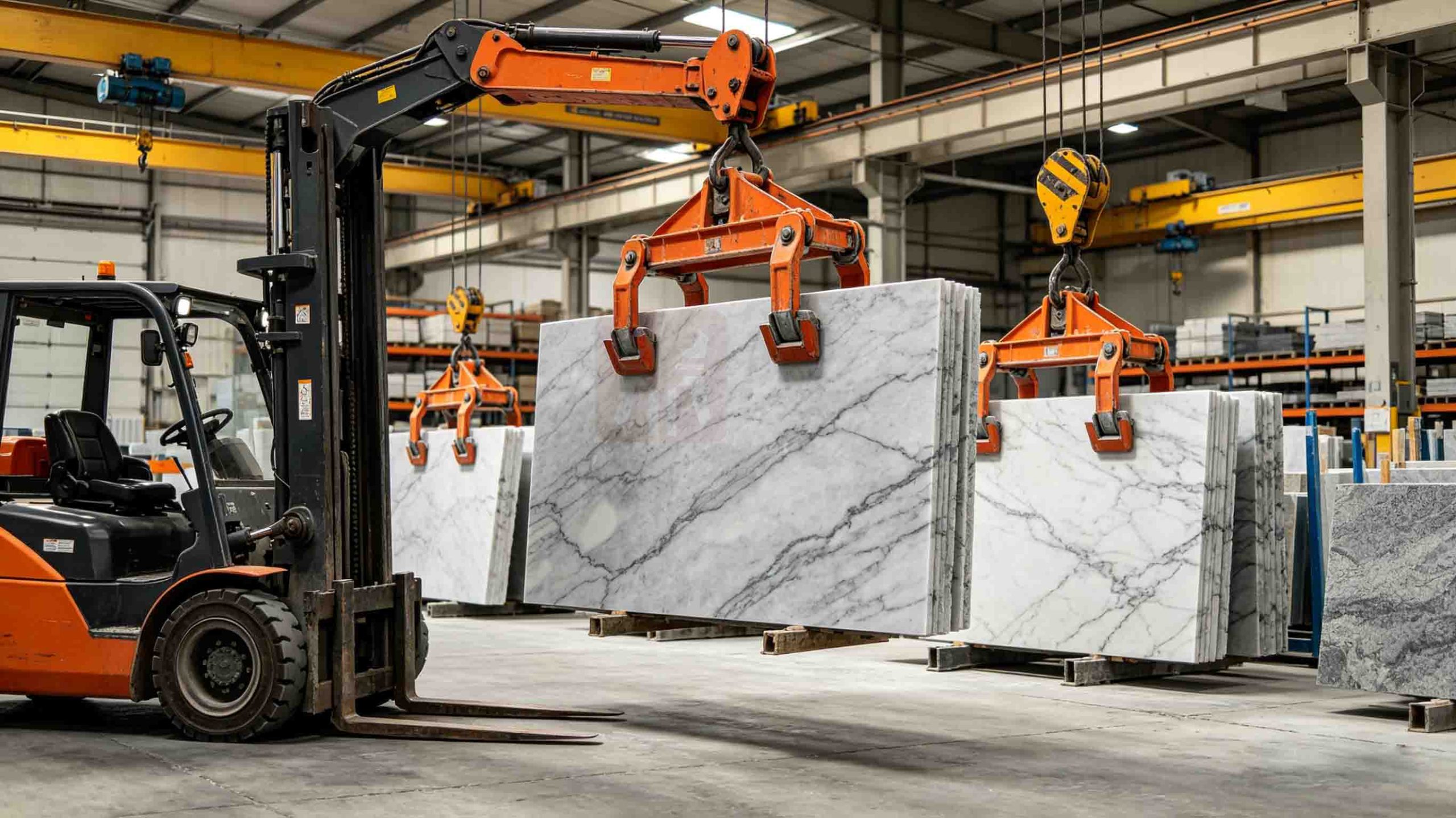
Attrezzatura per il sollevamento della pietra utilizzata in fabbrica per la movimentazione di lastre pesanti di marmo
Handling heavy slabs is one of the most underestimated risk points in a stone factory. A wrong lifting method does not just slow down movement; it can cause slab breakage, edge chipping, worker injury, shipping delay, and unnecessary labor pressure. That is why investing in the right attrezzatura per il sollevamento della pietra is not a simple equipment purchase. It is a production decision.
Con l'evoluzione dei sistemi di movimentazione industriale, gli attrezzi per il sollevamento delle lastre have become more advanced, allowing factories to lift, move, and position marble, granite, quartz, and engineered stone with higher precision and lower risk. As explained in perché i sollevatori per lastre stanno trasformando la movimentazione dei materiali, modern lifting solutions are reshaping factory efficiency and safety standards.
Buyers often focus on load capacity alone, but that is only part of the story. The better question is this: which lifting system best matches your slab type, workshop layout, handling frequency, and production goals? That is where smart procurement begins.
Why Stone Lifting Equipment Matters More Than Many Buyers Realize
Stone handling affects almost every stage of a factory workflow, from unloading and storage to machine loading, fabrication transfer, packaging, and container dispatch. If lifting is inefficient, the entire line becomes inefficient. If lifting is unsafe, the entire factory carries hidden cost and liability.
Moderno attrezzatura per il sollevamento della pietra improves more than movement. It helps factories reduce reliance on manual labor, standardize handling quality across shifts, lower material damage rates, and improve throughput. In export-oriented workshops, these gains directly affect margin, delivery reliability, and customer satisfaction.
Many factories only notice lifting problems after repeated slab breakage, labor fatigue, or congestion between workstations. By then, the equipment is not just a problem area. It has become a bottleneck.
What Is Stone Lifting Equipment?
L'attrezzatura per il sollevamento della pietra refers to specialized machines, attachments, and tools used to grip, lift, move, rotate, or position heavy slabs such as marble, granite, quartz, porcelain, and sintered stone. These systems are designed to reduce manual handling, improve safety, and support stable transport across the production cycle.
Different types of lifting equipment are designed for different tasks, from vertical slab transfer to precision machine loading and heavy-duty industrial logistics. Understanding these categories helps factories choose the most efficient and lowest-risk solution.
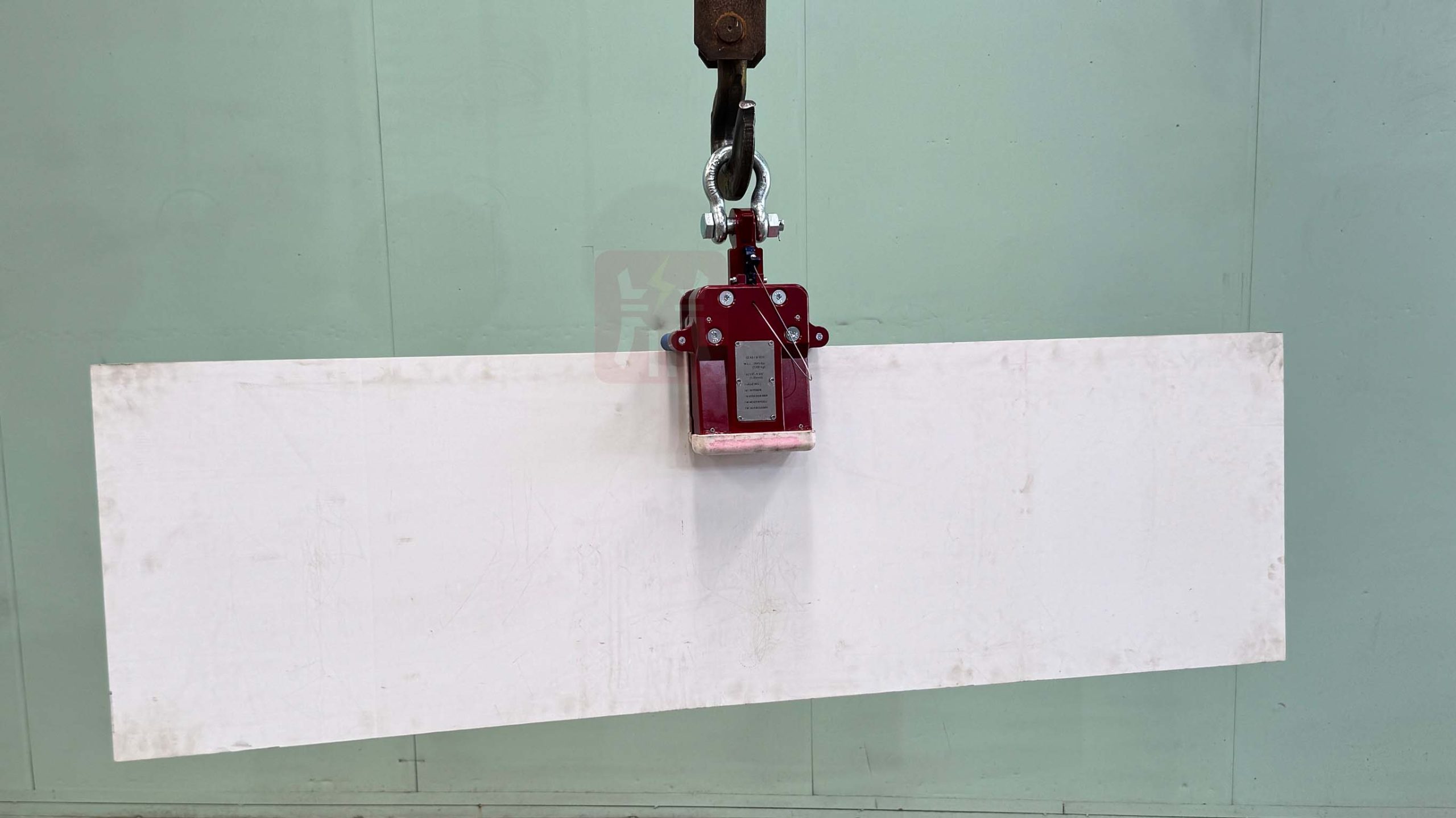
Fissaggio per lastre di pietra
The Physics Behind Safe Slab Handling
Stone is strong in compression but weak in tension. That single fact explains why improper lifting can ruin an otherwise perfect slab. If force is applied unevenly, at the wrong angle, or through a poor gripping point, micro-cracks can develop long before visible failure appears.
A practical weight formula used in factories is:
Weight = Length × Width × Thickness × Density
For example, a granite slab measuring 3 m × 2 m × 0.03 m with a density of around 2700 kg/m³ weighs about 486 kg. Quartz slabs are often heavier, while thin porcelain or sintered slabs may be lighter but more vulnerable during unsupported movement. This is why professional manufacturers recommend working safety margins rather than selecting equipment based on “just enough” capacity.
A lifter that barely matches slab weight may look economical, but in real production it leaves too little buffer for movement, tilt, acceleration, operator error, and repeated daily use. That is not saving money. That is borrowing trouble.
Tipi di attrezzi per il sollevamento delle lastre
- Sollevatori a morsetto
- Sollevatori a vuoto
- Accessori per carrelli elevatori
- Sistemi di sollevamento con gru
- Sollevatori meccanici per lastre
Among these, clamp-based systems are widely used because of their reliability, low maintenance, and simple operation. For example, sistemi di sollevamento a morsetto offer strong gripping force and are suitable for various slab sizes in yard storage and upright transfer applications.
Inoltre, le moderne tecnologie di sollevamento orientate alla sicurezza sono evidenziate in questa guida sui sistemi di sollevamento a morsetto, showing how innovation is improving workplace safety and reducing operational risk.
Confronto tra le attrezzature comuni per il sollevamento della pietra
| Tipo di apparecchiatura | Miglior utilizzo | Vantaggi | Limitazioni |
|---|---|---|---|
| Sollevatori a morsetto | Sollevamento verticale delle lastre | Strong grip, simple design, low maintenance | Requires correct positioning and proper pad condition |
| Sollevatori a vuoto | Smooth surface slabs, CNC and bridge saw loading | No surface damage, high precision, ideal for polished materials | Needs power supply, monitoring, and regular maintenance |
| Braccio per carrello elevatore | Heavy industrial lifting, container access, flexible in-plant transport | High capacity, flexible reach, cost-efficient if forklifts already exist | Requires forklift and skilled operation |
| Sistemi con gru | Large-scale operations and repetitive lifting zones | Wide movement range, stable lifting path, suitable for high-volume workflow | Higher installation cost and less mobility |
| Mechanical Slab Lifters | General workshop handling | Reliable, economical, easy to integrate into daily use | May not suit high-precision or fragile slab operations |
Soluzioni avanzate di sollevamento per le fabbriche moderne
Le fabbriche moderne si stanno orientando verso sistemi integrati di sollevamento che combinano sicurezza, efficienza e flessibilità. Ad esempio, sistemi di gru a forma di U per container are widely used for loading heavy slabs into shipping containers more safely and with less operator strain.
Allo stesso modo, accessori per sollevamento pesante come sistemi a doppia benna per carrelli elevatori provide high-capacity lifting for industrial applications where standard forklift reach is not enough.
Le macchine avanzate per il sollevamento delle lastre portano anche significativi vantaggi operativi, come discusso in questa panoramica sui vantaggi dei sollevatori per lastre. These systems are especially valuable in workshops that need to combine speed with repeatable positioning accuracy.
If X, Choose Y: Decision Logic for Buyers
If you mainly move slabs vertically from A-frames to transfer points, choose clamp lifters. They are efficient, durable, and well suited to yard handling and upright slab movement.
If you load slabs onto bridge saws, CNC machines, or polishing lines, choose vacuum lifters. They reduce edge contact, improve placement precision, and better protect polished or fragile materials.
If your workshop already uses forklifts and you need flexible long-distance movement, choose forklift boom systems. This often gives the best balance of investment control and operational flexibility.
If your factory has repetitive high-frequency handling in one fixed zone, choose a jib or crane-based lifting solution. Repetition rewards infrastructure. Improvised movement usually punishes productivity.
If you work with fragile, high-value slabs, choose control and surface protection over lower purchase cost. A cheaper lifter that causes even occasional slab damage is not cheaper in any meaningful sense.
Come scegliere l'attrezzatura giusta per il sollevamento della pietra
- Valutare dimensioni e peso delle lastre
- Considerare la disposizione e il flusso di lavoro della fabbrica
- Verificare la compatibilità con le attrezzature già presenti
- Dare priorità alle caratteristiche di sicurezza
- Analizzare l'efficienza dei costi a lungo termine
Choosing the right lifting system is not just about capacity. It is about optimizing the whole workflow while controlling damage, downtime, and labor intensity. The right combination of equipment can dramatically reduce labor costs and improve productivity.
Buyers should also ask practical questions before purchase. What slab materials are being handled most often? Are slabs mostly upright or flat? Is the floor layout open or narrow? Will the equipment be used occasionally or continuously? Can spare parts be supplied quickly? A supplier that cannot answer these questions with clarity is not helping you buy well.
Common Buying Mistakes and Their Consequences
Mistake 1: Buying only by maximum load rating. Capacity matters, but so do lifting angle, pad quality, slab fragility, and real workflow conditions. The result of ignoring this is equipment that technically lifts, but performs poorly in daily production.
Mistake 2: Assuming one tool can do every job. A clamp lifter may be excellent for upright transfer but poor for face-up machine loading. A vacuum lifter may be ideal for polished slabs but unnecessary for rough yard movement.
Mistake 3: Ignoring contact surface materials. Low-quality pads may wear fast, slip, stain, or damage resin-finished surfaces. This is especially risky for engineered quartz and polished materials.
Mistake 4: Copying another factory’s setup without checking layout differences. Another workshop’s solution may become your bottleneck if your aisle width, slab size, or process order is different.
Mistake 5: Neglecting maintenance planning. Even strong equipment becomes unreliable if clamps, joints, pads, alarms, or vacuum systems are not checked regularly.
Risk Table: What Happens When the Equipment Choice Is Wrong?
| Wrong Decision | Immediate Problem | Long-Term Consequence |
|---|---|---|
| Capacity too close to slab weight | Unsafe lifting margin | Higher accident and failure risk |
| Wrong gripping method | Slab instability or edge damage | Breakage losses and customer complaints |
| Poor fit with layout | Slow transfer and operator congestion | Bottlenecks and reduced throughput |
| Low-quality pads or components | Fast wear or surface marking | Higher service cost and reputational damage |
| No maintenance routine | Unexpected downtime | Shorter equipment life and more safety issues |
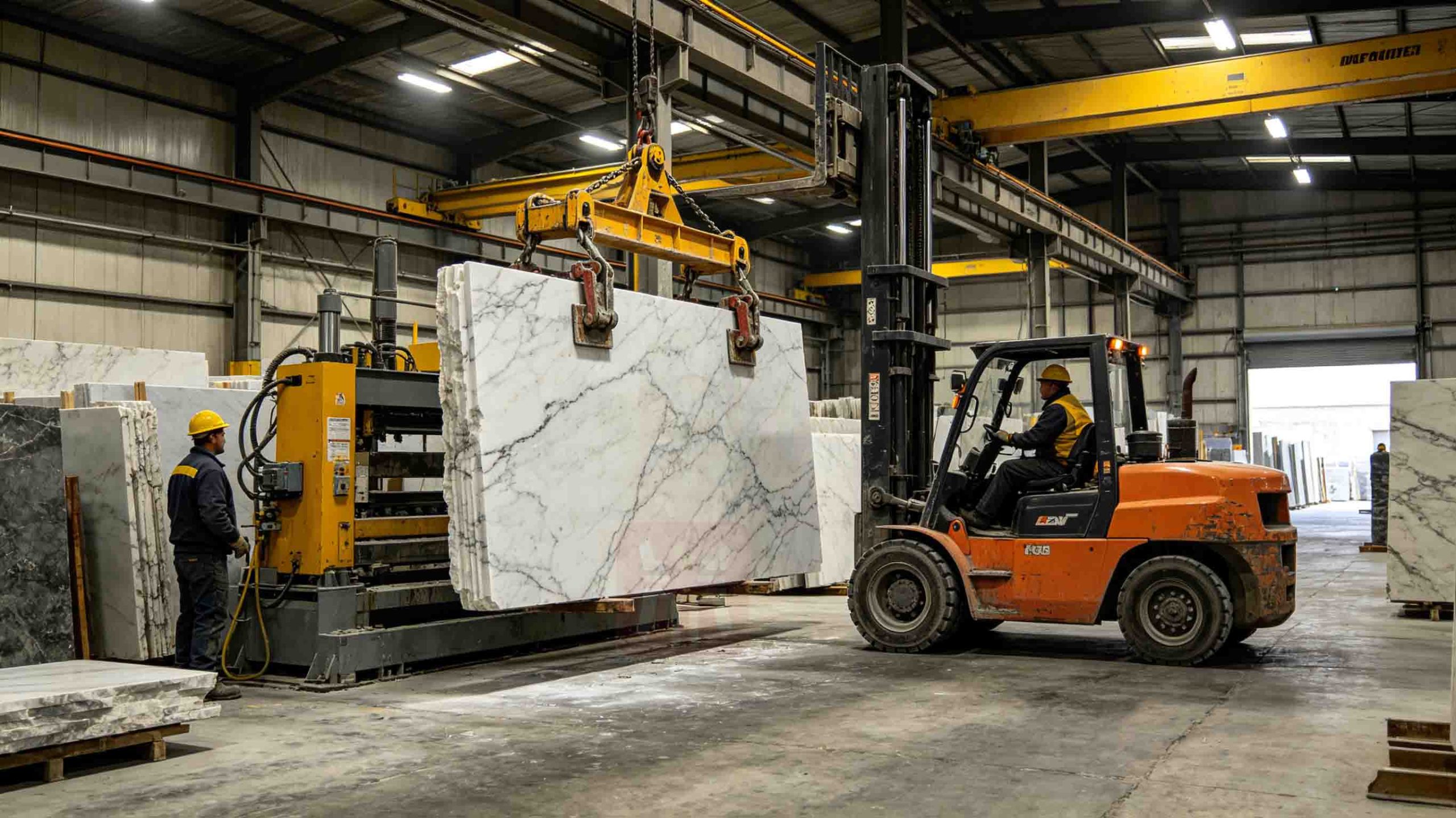
Strumenti per il sollevamento di lastre, inclusi sollevatori a pinza e bracci per carrelli elevatori nelle fabbriche di pietra
Vantaggi dell'utilizzo di attrezzi moderni per il sollevamento delle lastre
- Miglioramento della sicurezza dei lavoratori
- Riduzione dei danni ai materiali
- Movimentazione e trasporto più rapidi
- Minore dipendenza dalla manodopera
- Migliore efficienza operativa
Le fabbriche che adottano tecnologie avanzate attrezzatura per il sollevamento della pietra often see immediate improvements in both productivity and safety performance. In many cases, labor dependency can be reduced significantly, especially where manual slab transfer was previously handled by multiple workers.
The gains are not only operational. Better lifting systems also improve consistency. When slabs are handled with repeatable precision, downstream fabrication becomes smoother, fewer materials are rejected, and customer confidence increases.
Why Many Global Buyers Source from China Manufacturers
Many China suppliers have become strong partners in the stone handling sector because they combine cost efficiency with real application experience. Reliable China manufacturers often understand the daily realities of stone factories very well: narrow aisles, mixed slab sizes, container loading challenges, fragile surfaces, and pressure to reduce labor dependency.
Leading suppliers are no longer just selling tools. They are providing workflow-oriented solutions, offering custom boom lengths, different pad materials, load testing support, spare parts, and handling recommendations based on slab type and factory layout. That is a much stronger value proposition than selling a generic catalog item and waving goodbye.
Maintenance and Lifecycle Management
High-quality gli attrezzi per il sollevamento delle lastre are an investment. Neglect is one of the main causes of equipment failure in a factory setting. Weekly inspection of rubber pads, moving joints, hinges, safety locks, and vacuum pressure stability helps ensure reliable long-term performance.
Regular maintenance can extend service life, reduce unexpected downtime, and protect the very ROI the equipment was bought to create. In most mid-sized facilities, the return on properly selected and maintained lifting systems appears within 8 to 14 months through lower labor cost, reduced material breakage, and smoother production flow.
Recommendation Framework for Buyers
If your workshop already runs forklifts and needs flexible transport across multiple stations, start with clamp lifters and forklift boom attachments. This often delivers the best entry point in terms of affordability and operational reach.
If your main pain point is polished slab protection or precise loading onto fabrication machines, invest in vacuum lifting systems with proper alarms, monitoring, and stable suction control.
If your production is growing and daily slab movement is becoming repetitive in one zone, fixed crane infrastructure may outperform adding more labor. Repetition rewards systems. Chaos rewards invoices from your repair department.
If you export high-value countertops, vanity tops, or custom stone products, handling quality should be treated as part of product quality. Damage during lifting is still damage the customer will remember.
Soft CTA
The smartest next step is not asking for the lowest price first. It is matching your slab dimensions, materials, daily handling frequency, and current layout to the right lifting method. Once that is clear, comparing models and suppliers becomes much easier, and much less risky.
Nota finale / Conseguenze pratiche
Stone lifting equipment is a critical investment for any factory handling heavy slabs. By selecting the right slab lifting tools, businesses can improve efficiency, reduce damage, and ensure workplace safety. Modern lifting solutions are no longer optional. They are essential for staying competitive in today’s stone industry. Buyers should evaluate lifting systems as part of a full material-handling strategy, not as isolated products. The right choice protects margin, stabilizes workflow, lowers hidden costs, and supports future production growth.
Riferimenti
- ISO 12100: Safety of Machinery – General Principles for Design
- OSHA Materials Handling and Storage Guidelines
- EN 13155: Cranes – Safety – Non-fixed Load Lifting Attachments
- Natural Stone Institute – Stone Industry Technical Resources
- China Machinery Industry Federation – Industrial Equipment Manufacturing Reports
- HSE Guidance on Safe Use of Lifting Equipment and Lifting Operations
Domande frequenti
1. Che cos'è l'attrezzatura per il sollevamento della pietra?
L'attrezzatura per il sollevamento di pietra comprende macchine e strumenti progettati per afferrare, sollevare, spostare e posizionare in modo sicuro lastre pesanti come marmo, granito, quarzo e porcellanato in fabbriche, officine e depositi.
2. Quali sono gli attrezzi più comuni per il sollevamento delle lastre?
Gli strumenti più comuni includono sollevatori a morsetto, sollevatori a vuoto, sistemi di gru, attacchi per bracci di carrelli elevatori e sollevatori meccanici per lastre.
3. Come faccio a scegliere l'attrezzatura giusta per il sollevamento?
Dovresti prendere in considerazione dimensione della lastra, peso, tipo di materiale, condizione della superficie, disposizione dell'officina, direzione di movimentazione e requisiti di sicurezza prima di scegliere l'attrezzatura.
4. I sollevatori per lastre sono migliori della movimentazione manuale?
Sì. I sollevatori per lastre migliorano notevolmente la sicurezza, riducono la dipendenza dalla manodopera, diminuiscono la probabilità di rottura delle lastre e aumentano l'efficienza operativa rispetto alla movimentazione manuale.
5. L'attrezzatura per il sollevamento può ridurre i danni alle lastre?
Sì. I sistemi di sollevamento adeguati riducono al minimo gli errori di movimentazione, migliorano la stabilità del carico, diminuiscono il contatto con i bordi quando necessario e abbassano il rischio di crepe, scheggiature e danni alla superficie.
6. What is the difference between a clamp lifter and a vacuum lifter?
Un sollevatore a morsetto afferra i bordi della lastra ed è ideale per il trasferimento verticale, mentre un sollevatore a vuoto utilizza la suzione sulla superficie della lastra ed è più adatto per il sollevamento orizzontale, le superfici lucide e il carico su macchine.
7. Why do many buyers choose China manufacturers for stone lifting equipment?
Molti produttori cinesi offrono prezzi competitivi, capacità di personalizzazione, esperienza nell'esportazione e design pratici studiati su misura per i flussi di lavoro delle fabbriche di pietra vera.
8. Can modern lifting systems improve ROI in a stone factory?
Sì. I moderni sistemi di sollevamento possono ridurre i costi del lavoro, migliorare la capacità produttiva e abbassare i tassi di danneggiamento delle lastre, il che spesso consente alle fabbriche di recuperare l'investimento entro un periodo ragionevole.

Enrico
Salve, sono l'autore di questo post e lavoro in questo settore da più di 16 anni. Se avete bisogno di un servizio OEM&ODM per gli utensili in pietra, sentitevi liberi di farmi qualsiasi domanda.