





Factory floor space is expensive, and poor material storage quietly drains profit every day. When large slabs, glass panels, stone sheets, metal plates, or cabinet boards are placed randomly on the floor, the workshop becomes slower, less safe, and harder to manage. Operators waste time searching for material. Forklift aisles become blocked. Edges get chipped. Finished surfaces get scratched. In worse cases, unstable materials can slide, fall, or create serious workplace hazards.
アン Aフレーム収納ラック solves this problem by storing large flat materials at an angled position on a stable A-shaped structure. Instead of laying slabs flat or leaning them against walls, the rack supports materials on one or both sides, keeping them visible, accessible, and better protected. This makes it especially valuable in stone yards, countertop factories, glass workshops, metal sheet warehouses, cabinet factories, tile showrooms, and industrial storage facilities.
For factories handling marble slabs, granite slabs, quartz slabs, sintered stone, glass panels, or sheet materials, a professional Aフレーム収納ラック is not just a metal frame. It is part of the factory’s layout, safety, and material handling system. The right rack helps recover valuable floor space, reduce material damage, improve picking efficiency, and support safer daily operation.
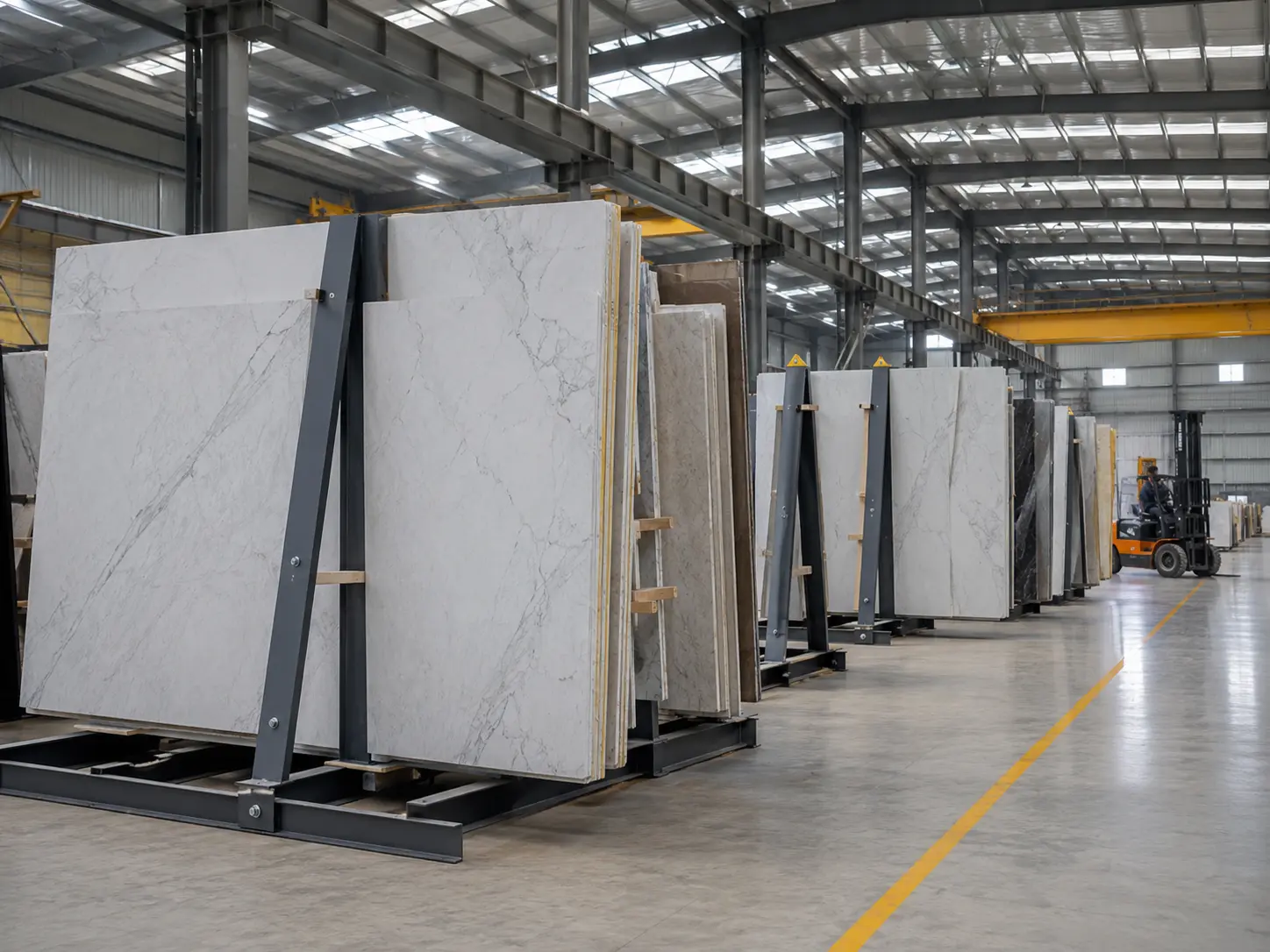
A-Frame Storage Rack Provider
Aフレーム収納ラックとは?
An A-Frame Storage Rack is an industrial storage structure shaped like the letter “A.” It is designed to support large flat materials at an angle instead of standing them fully vertical or stacking them horizontally. This angled position helps materials lean toward the frame and transfer part of their weight toward the rack base. When designed and loaded correctly, this improves stability and reduces the risk of uncontrolled tipping.
The A-frame shape is common in industries that handle heavy, fragile, or oversized materials. Stone fabrication shops use it for marble, granite, quartz, and porcelain slabs. Glass factories use it for tempered glass, laminated glass, mirrors, and shower panels. Metal suppliers use it for sheet metal and decorative panels. Cabinet and door factories use it for plywood, MDF boards, door panels, and wall panels.
The basic design usually includes a strong base, inclined support posts, cross bracing, protective padding, stopper pins or safety blocks, and sometimes forklift pockets or lifting points. Some models are stationary, while others are movable by forklift or mounted on wheels. The best design depends on material weight, material size, handling method, floor condition, and workflow frequency.
| 特徴 | 機能 | Buyer Benefit |
|---|---|---|
| A-shaped structure | Supports materials at an angle | Improves stability for slabs and panels |
| Wide base | Spreads load across the floor | Reduces tipping and floor pressure risk |
| Double-sided loading | Stores materials on both rack sides | Improves storage density per footprint |
| Rubber or wood padding | Protects material contact points | Reduces scratches, chips, and edge damage |
| Stopper pins or safety posts | Prevents materials from sliding | Improves handling safety |
| Forklift pockets | Allows rack movement by forklift | Improves layout flexibility |
Why A-Frame Storage Racks Are Used in Factories and Warehouses
The first reason factories use A-Frame Storage Racks is floor space efficiency. Large slabs and panels occupy a lot of space when laid flat. Horizontal stacking also makes lower materials difficult to access, increasing handling time and damage risk. A-frame storage uses vertical and angled space more effectively, allowing more materials to be stored within a smaller footprint.
The second reason is stability. Large flat materials are difficult to store safely when they are placed upright without proper support. An A-frame structure creates a controlled leaning angle and helps distribute weight toward the frame and base. This is especially useful for stone slabs, glass sheets, and oversized panels, where one sliding piece can damage both the material and the surrounding equipment.
In export stone yards and slab warehouses, heavy-duty A-frame racks are often preferred because they help combine high storage density with safer slab access. The article on why export stone yards prefer heavy-duty A-Frame Storage Rack reflects a common reality: export businesses need racks that can handle heavy material, repeated forklift movement, loading preparation, and long-term yard organization.
Core Mechanics: How an A-Frame Storage Rack Supports Heavy Materials
The stability of an A-Frame Storage Rack comes from geometry. When a slab or panel leans against an inclined support, part of the load is transferred downward into the base and inward toward the frame. A wider base, stronger steel structure, proper frame angle, cross-bracing, and balanced loading all help improve stability.
Buyers should not look only at the total capacity number. They should ask how the rack supports load on each side, what steel tube size is used, whether the rack has proper bracing, how the base is designed, and whether stopper pins or anti-slip blocks are included. A rack that claims a high load capacity but has a narrow base, weak welds, or no safety stops may create more risk than value.
| Design Parameter | Why It Matters | Buyer Check |
|---|---|---|
| Frame angle | Controls leaning stability | Match angle to slab or panel type |
| Base width | Affects anti-tipping performance | Confirm base design with load capacity |
| Support height | Supports tall slabs and panels | Match largest material height |
| Steel thickness | Affects structural strength | Ask for tube specification |
| Cross-bracing | Improves frame rigidity | Check weld and bolt design |
| Safety stopper | Prevents material sliding | Required for heavy slabs and glass panels |
| Floor contact area | Distributes load to the floor | Check factory floor strength |
A-Frame Storage Rack Applications by Industry
In stone fabrication shops, A-frame racks are used to store marble, granite, quartz, sintered stone, porcelain slabs, and artificial stone near bridge saws, CNC machines, polishing lines, and inspection areas. The rack must support heavy loads while protecting polished surfaces and slab edges. Rubber pads, wood base systems, and safety stops are especially important in this environment.
Glass workshops use A-frame racks for tempered glass, laminated glass, mirrors, architectural glass, shower panels, and partition glass. In this case, contact protection becomes critical. Bare metal contact can chip or scratch glass edges, so rubber padding, smooth contact surfaces, and careful angle control are required. Sheet metal warehouses may use A-frame racks to sort steel sheets, aluminum panels, stainless plates, and composite panels by thickness, size, or order batch.
For buyers comparing suppliers and rack configurations, a direct sourcing guide such as sourcing industrial A-Frame Storage Rack direct from the manufacturer is useful because rack performance depends on factory design capability, steel selection, welding quality, coating, customization, packing, and export experience—not only the product photo.
| Industry | Stored Material | Rack Design Priority |
|---|---|---|
| Stone fabrication | Marble, granite, quartz, porcelain slabs | High load capacity and edge protection |
| Glass workshop | Tempered glass, laminated glass, mirrors | Rubber padding and anti-slip support |
| Metal warehouse | Steel, aluminum, stainless sheets | Rigid frame and corrosion resistance |
| Cabinet factory | MDF, plywood, door panels | Surface protection and easy sorting |
| Tile and slab showroom | Large-format slabs and panels | Appearance, access, and safety |
A-Frame Storage Rack vs Other Storage Methods
Many factories still use floor stacking, horizontal piles, wall leaning, or improvised supports. These methods may look cheap at first, but they often create hidden costs. Horizontal stacking makes lower materials hard to access. Wall leaning can be unstable. Random floor storage blocks aisles and slows down handling. Improvised racks may not have tested load capacity or proper safety stops.
A-Frame Storage Racks offer better visibility, faster access, and safer angled support for large flat materials. Compared with horizontal stacking, operators can identify and retrieve slabs more easily. Compared with vertical racks, angled storage provides better leaning support. Compared with cantilever racks, A-frame racks are more suitable for large flat panels and slabs. Compared with mobile carts, stationary or heavy-duty A-frame racks usually provide higher storage stability.
| Storage Method | 最適 | Advantage | Limitation |
|---|---|---|---|
| Aフレーム収納ラック | Slabs, panels, glass, stone | Stable angled support | Requires correct loading balance |
| Horizontal stacking | Flat boards with low access frequency | Simple layout | Difficult lower-layer access |
| Vertical rack | Smaller panels | Good visibility | Needs strong anti-tip control |
| Cantilever rack | Pipes, bars, lumber | Good for long materials | Not ideal for large fragile slabs |
| Mobile rack or cart | Short-distance movement | Flexible handling | Lower storage density and stability |
Key Performance Parameters Buyers Should Compare
The first technical parameter is load capacity. Buyers should ask for total capacity, per-side capacity, per-slot capacity, and recommended loading rules. If the rack is double-sided, both sides must be considered. Loading one side heavily while leaving the other side empty may create unbalanced force if the rack is not designed for that condition.
The second parameter is size. Rack length, height, base width, support height, and usable loading depth must match the material size. The third parameter is steel structure. Tube thickness, steel grade, cross-bracing, welding quality, base reinforcement, and surface coating all affect long-term durability. The fourth parameter is mobility. A stationary rack may be best for long-term storage, while a forklift-movable rack may improve layout flexibility.
For buyers wanting a structured purchasing approach, the comprehensive buyer’s manual for A-Frame Storage Rack can support specification planning, especially when comparing load capacity, customization, application type, and export packing. The goal is not to buy the heaviest rack on paper. The goal is to buy the rack that fits the material, floor, handling equipment, and daily workflow.
| パラメータ | Typical Buyer Question | Why It Matters |
|---|---|---|
| Total capacity | How many tons can the rack hold? | Prevents overload |
| Per-side capacity | Can both sides be loaded fully? | Controls load balance |
| Rack length | How many slabs fit per rack? | Affects storage density |
| Base width | Is the rack stable with heavy slabs? | Reduces tipping risk |
| Tube thickness | What steel structure is used? | Affects durability |
| Surface coating | Is it painted, powder coated, or galvanized? | Controls corrosion resistance |
| Padding | Does it protect slab edges? | Reduces material damage |
| Fork pockets | Can a forklift move the rack? | Improves layout flexibility |
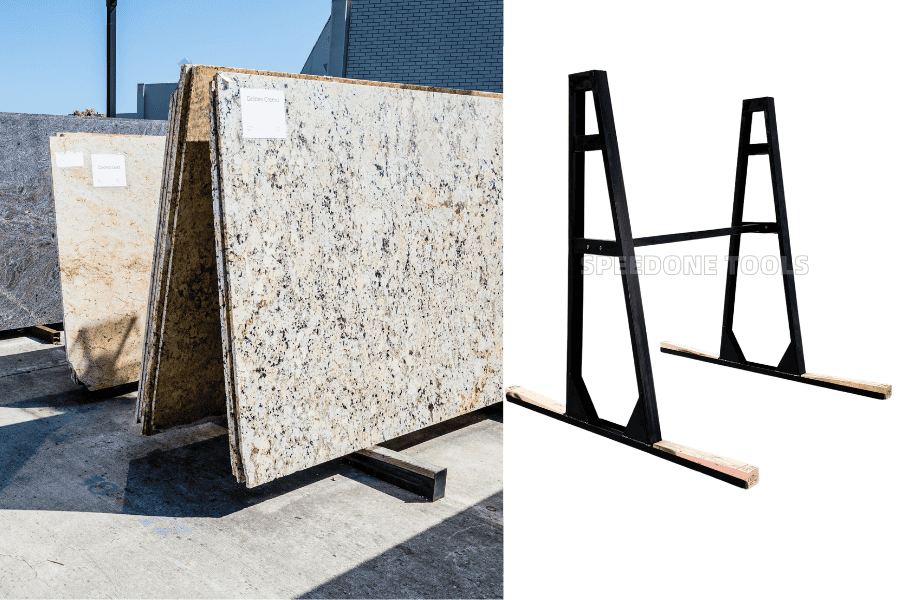
Aフレーム収納ラック
Space Efficiency Metrics: How A-Frame Racks Save Factory Floor Area
Factory floor space is not only about square meters; it is also about how quickly workers can access materials. A rack that stores more slabs but blocks forklift movement is not efficient. A good A-frame layout should balance storage density with access, inspection, picking, and loading flow.
Double-sided A-frame storage can improve usable storage positions within a compact footprint. Instead of spreading slabs across the floor or stacking materials in deep piles, a rack can store them in angled rows with better visibility. This helps operators identify materials faster, reduce unnecessary handling, and keep production aisles clearer.
Actual storage improvement depends on rack length, material thickness, aisle width, slab size, handling method, and whether the rack is one-side or two-side loaded. A factory using bridge cranes will plan differently from a factory using forklifts or vacuum lifters. The rack layout should be designed around the way materials actually move, not around a perfect drawing nobody follows after Monday morning.
| Layout Factor | What to Measure | Why It Matters |
|---|---|---|
| Aisle width | Forklift, crane, or vacuum lifter movement space | Prevents congestion and collisions |
| Rack spacing | Distance between rack rows | Improves access safety |
| Loading direction | One-side or two-side access | Affects workflow speed |
| Material length | Largest slab or panel size | Determines rack size |
| Handling method | Forklift, crane, clamp, or vacuum lifter | Changes rack placement needs |
| Floor capacity | Load per rack footprint | Prevents floor damage and settlement |
Safety and Stability Standards Buyers Should Consider
Industrial storage must be stable, organized, and compatible with material handling equipment. A-Frame Storage Racks should not create blocked aisles, sliding materials, falling hazards, or overload conditions. In many factories, the rack is close to forklifts, cranes, workers, machines, and finished goods. That means rack stability is not optional; it is part of basic workplace safety.
Buyers should consider capacity labels, material stops, padding, balanced loading, floor condition, aisle marking, and inspection routines. OSHA material handling logic emphasizes stable storage and clear aisles, while powered industrial truck rules affect forklift handling around storage areas. For stone shops and slab warehouses, slab handling safety and OSHA guidelines for A-Frame Storage Rack are especially relevant because heavy slabs can create severe hazards if stored or moved incorrectly.
| Inspection Item | What to Check | Risk If Ignored |
|---|---|---|
| Welds | Cracks, deformation, rust | 構造的破損 |
| Base frame | Bending or uneven floor contact | Tipping risk |
| Stopper pins | Missing, loose, or damaged parts | Sliding materials |
| Padding | Worn rubber or wood contact points | Edge damage and slipping |
| Floor condition | Cracks, slope, debris, oil | Instability and handling risk |
| Load balance | Uneven side loading | Rack tipping or stress concentration |
| Capacity labels | Visible load marking | Operator overload errors |
Common Mistakes When Buying A-Frame Storage Racks
The first mistake is buying by price only. A cheap rack with weak steel, poor welding, thin coating, or narrow base may look acceptable at delivery but fail under real factory use. The second mistake is ignoring per-side capacity. Double-sided racks must be designed to handle real loading conditions, including unbalanced use during daily picking.
The third mistake is forgetting floor load capacity. Heavy slabs stored in a compact footprint can create high pressure on the floor. The fourth mistake is no edge protection. Stone, glass, and finished panels can chip, scratch, or crack when they contact bare steel. The fifth mistake is poor aisle planning. If the forklift cannot approach safely, the rack slows the factory instead of improving it. The sixth mistake is no capacity labeling. Operators cannot follow limits they cannot see.
How to Choose an A-Frame Storage Rack Supplier or Manufacturer
A reliable supplier should ask about material type, slab size, total weight, loading method, factory layout, floor condition, and whether the rack needs to be stationary, forklift-movable, or wheeled. If the supplier only asks “how many racks do you want?” and immediately quotes the lowest price, that is not a technical buying process.
Buyers should ask for drawings, load capacity details, steel tube specifications, coating options, protective padding, stopper design, packing method, and customization options. An experienced factory should understand slab weight, material fragility, export packing, forklift handling, and container loading. For company background and manufacturing capability, buyers can review Speedone industrial storage rack manufacturer information before discussing custom rack requirements.
Custom options may include longer rack length, higher support frame, wider base, forklift pockets, wheel sets, rubber pads, wood base systems, stopper pins, galvanized finish, powder coating, custom color, capacity label plates, and export-optimized packaging. Customization is not just for appearance. In heavy-duty storage, customization often determines whether the rack actually fits the factory process.
Heavy-Duty and Custom A-Frame Rack Options
Some factories need standard A-frame storage for light panels. Others need heavy-duty systems for stone slabs, large-format porcelain, quartz, and thick panels. When the material weight is high, the rack design must pay more attention to base width, steel section, bracing, contact pads, stopper systems, and floor load distribution.
For buyers handling export stone slabs or heavy materials, a model such as the 20T capacity double-link A-Frame Rack with customizable wood base system shows how heavy-duty rack design can combine load support, slab protection, and export-oriented configuration. Wood bases can help protect stone edges and reduce direct hard contact, while heavy-duty structural design supports high-load storage requirements.
Buyers should still confirm whether the stated capacity is total capacity, per-side capacity, or application-specific capacity. They should also confirm whether capacity assumes balanced loading, indoor use, level concrete floor, and correct material placement. A specification without assumptions is like a map without roads; it may look useful, but it will not guide the trip.
If This Is Your Factory, Choose This Rack Strategy
| If Your Factory Needs | Choose | Avoid |
|---|---|---|
| Heavy stone slab storage | Heavy-duty A-Frame Storage Rack | Light-duty panel rack |
| Glass panel protection | Rack with rubber padding | Bare metal contact |
| Flexible factory layout | Forklift-movable A-frame rack | Fixed rack only |
| Long-term outdoor use | Powder-coated or galvanized rack | Thin paint coating |
| High loading safety | Wide base and stopper pins | Narrow base with no stops |
| Small factory space | Double-sided A-frame rack | Flat floor stacking |
| Frequent material selection | Open-access A-frame rack | Deep horizontal pile |
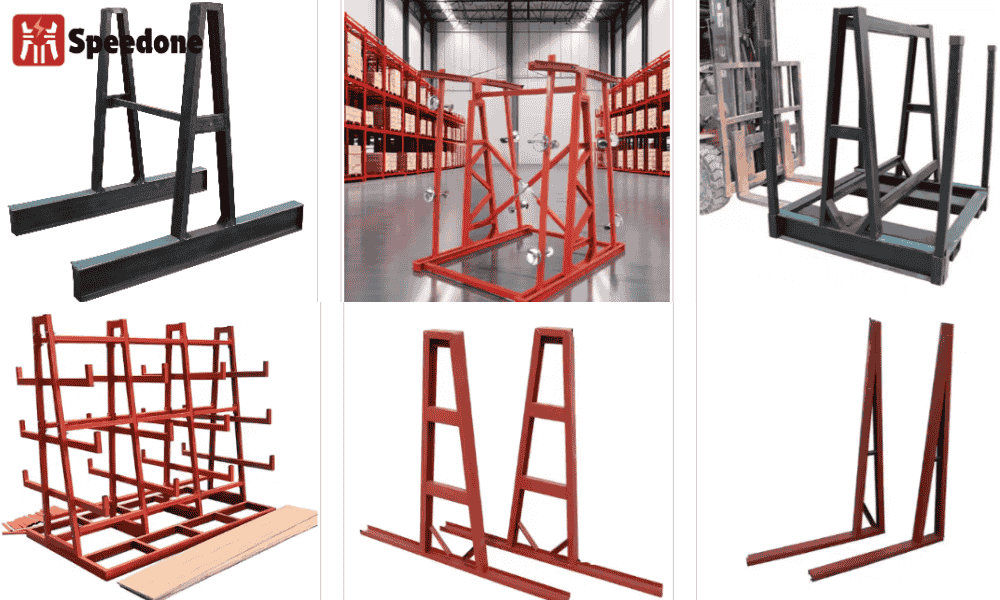
Aフレーム収納ラック
Real Factory Scenarios for A-Frame Storage Racks
In a stone countertop fabrication plant, A-frame racks can be placed near bridge saws, CNC machines, polishing areas, and inspection zones. Slabs can be organized by material type, order batch, thickness, or project. This reduces unnecessary slab movement and helps operators find the correct material faster.
In a glass processing factory, A-frame racks store tempered glass, laminated glass, and mirror panels at a safe angle with soft contact support. In a metal sheet warehouse, they help sort sheet metal by size and thickness. In a cabinet panel workshop, they keep MDF, plywood, door panels, and decorative boards organized while reducing surface damage and warping risk.
The main principle is the same across industries: large flat materials should be stable, visible, accessible, and protected. A rack that improves only storage but slows handling is incomplete. A rack that improves access but damages edges is also incomplete. The best A-frame system improves space, safety, and material protection at the same time.
よくある質問
1. Aフレーム収納ラックはどのような用途で使われますか?
Aフレーム収納ラックは、石板、大理石、花崗岩、クォーツ、ガラスパネル、金属板、木材板、ドアパネル、複合パネルなど、大型の平らな材料を斜めに配置して保管するために使用されます。A字型の構造が材料を安全に支えながら、視認性を保ち、アクセスしやすくします。床面積、材料保護、安定性が重要な、石材加工店、ガラス加工工場、板金倉庫、キャビネット工房、産業用倉庫などで広く利用されています。
2. Aフレーム収納ラックは、どのくらいの重量を支えられますか?
[QWEN_MT_ITEM_1]Aフレーム収納ラックの耐荷重は、その鋼構造、ラックの長さ、ベース幅、支柱の高さ、溶接品質、補強設計、床の状態、および耐荷重が総荷重、片側ごとの荷重、またはスロットごとの荷重を指すかによって異なります。重量級モデルでは数トン以上を支えることもありますが、購入者はマーケティング上の耐荷重値だけを頼りにしてはなりません。供給者に総耐荷重、片側ごとの耐荷重、推奨される積載方法、および床の水平性やバランスのとれた積載に関する前提条件について必ず確認してください。[/QWEN_MT_ITEM_1]
3. Aフレーム収納ラックは、平らに積み重ねるよりも優れているでしょうか?
大型のスラブやパネルの場合、Aフレーム式収納ラックは通常、平積みよりも優れています。なぜなら、アクセス性が向上し、表面との接触が減少し、床面積を節約でき、材料の識別も容易になるからです。平積みでは、下層の材料を取り出すのが難しくなり、傷や欠け、取り扱い時間の増加を招く可能性があります。Aフレーム式収納では、材料を制御された角度で立てることができるので、仕分けや取り扱いがより簡単になります。ただし、安定性を保つためには、ラックを適切に設計・荷重管理・点検する必要があります。
4. Aフレーム収納ラックはカスタマイズ可能ですか?
はい、Aフレーム収納ラックは、材料のサイズ、重量、取り扱い方法、工場のレイアウト、用途に応じてカスタマイズできることがよくあります。一般的なカスタムオプションには、ラックの長さ、支柱の高さ、ベースの幅、鋼材の厚さ、フォークリフト用ポケット、ホイールシステム、ゴムパッド、木製ベースシステム、ストッパーピン、色、コーティングタイプ、容量ラベル、輸出梱包などが含まれます。特に石板、ガラスパネル、重いシート材の場合、業種ごとに保護や積載に関する要件が異なるため、カスタマイズが非常に重要です。
5. バイヤーはAフレーム収納ラックを注文する前に何を確認すべきですか?
Aフレーム収納ラックを注文する前に、購入者は材料の寸法、材料の重量、必要総容量、片側あたりの容量、ラックの角度、ベース幅、鋼管の仕様、溶接品質、表面塗装、クッション材、ストッパーの設計、床面の強度、通路幅、フォークリフトまたはクレーンのアクセス、およびサプライヤーの図面を確認する必要があります。また、ラックが固定式か、フォークリフトで移動可能か、あるいは車輪付きか、さらに屋内、屋外、または輸出ヤードでの使用に適しているかも確認する必要があります。優れたラックを選ぶ際には、単に材料サイズだけでなく、工場のワークフローにも合致することが重要です。
参考文献
- “29 CFR 1910.176 Handling Materials — General” — Occupational Safety and Health Administration — Material Storage Safety Standard
- “29 CFR 1910.178 Powered Industrial Trucks” — Occupational Safety and Health Administration — Forklift Operation Safety Standard
- “Material Handling and Storage Safety Guidance” — Occupational Safety and Health Administration — Workplace Safety Resource
- “Overhead and Gantry Crane Safety Guidance” — Occupational Safety and Health Administration — Industrial Lifting Reference
- “Warehouse Storage and Racking Safety Principles” — MHI — Material Handling Industry Resource
- “Slab Handling and Storage Best Practices” — Natural Stone Institute — Stone Fabrication Safety Resource
- “Industrial Steel Rack Design Considerations” — Rack Manufacturers Institute — Storage Equipment Reference
- “Factory Layout and Material Flow Optimization” — Warehousing Education and Research Council — Logistics Planning Resource
Factory Storage Insight: When an A-Frame Storage Rack Is the Right Choice
What problem does an A-Frame Storage Rack solve?
It solves the factory problem of storing large, heavy, flat, or fragile materials in a safer and more space-efficient way. Instead of spreading slabs across the floor or stacking panels in deep piles, the rack creates angled support, better visibility, and easier access.
How should buyers choose the right rack?
Start with the material, not the rack photo. Confirm slab size, panel weight, total load, per-side load, handling method, floor capacity, aisle width, and whether the rack must be stationary, forklift-movable, or wheeled.
Why do rack projects fail?
Most failures come from buying by price only, ignoring load balance, using weak steel, skipping edge protection, placing racks on poor floors, or failing to plan forklift aisles. A rack is not safe just because it is painted nicely.
Option logic: If your factory handles heavy stone slabs, choose a heavy-duty A-frame rack. If you handle glass panels, choose rubber-protected contact surfaces. If space is tight, choose a double-sided design. If your layout changes often, choose forklift-movable racks. If the rack will be used outdoors, confirm coating and corrosion resistance.
Recommendation: Before placing an order, prepare material dimensions, material weight, expected quantity per rack, handling method, factory layout, aisle width, and target load capacity. Buyers can send these details through the Speedone contact page to discuss a storage rack configuration that fits real factory conditions instead of guessing from a standard model.
Choose an A-Frame Storage Rack when your factory needs to store heavy slabs or panels safely, access them faster, and recover valuable floor space without turning the workshop into a risky material maze.
