効率的に仕事をこなす





Master A-Frame Racks procurement. Navigate structural steel limits, corrosion risks, and PU padding benefits. Lower TCO and ensure OSHA safety for heavy slabs.
Quick Overview: Sourcing Durable A-Frame Racks
In the precision-driven world of industrial logistics and warehousing, the integrity of your storage infrastructure is the thin line between operational excellence and catastrophic financial loss. For warehouse managers, plant directors, and distribution executives handling high-value, fragile, or immense materials—such as architectural glass, jumbo quartz slabs, or exotic natural marble—the choice of storage equipment is a critical risk-management decision, not a mere purchasing task.
When a 2,000kg granite slab or a $5,000 architectural glass pane is compromised due to structural failure or poor design, the costs extend far beyond the raw material. They encompass crippling labor downtime, severe safety liabilities, delayed project timelines, and irreparably damaged reputations. This comprehensive guide moves beyond basic product descriptions to provide the technical insights, material science, and strategic decision-making logic necessary to ensure your warehouse operations remain safe, efficient, and profitable.
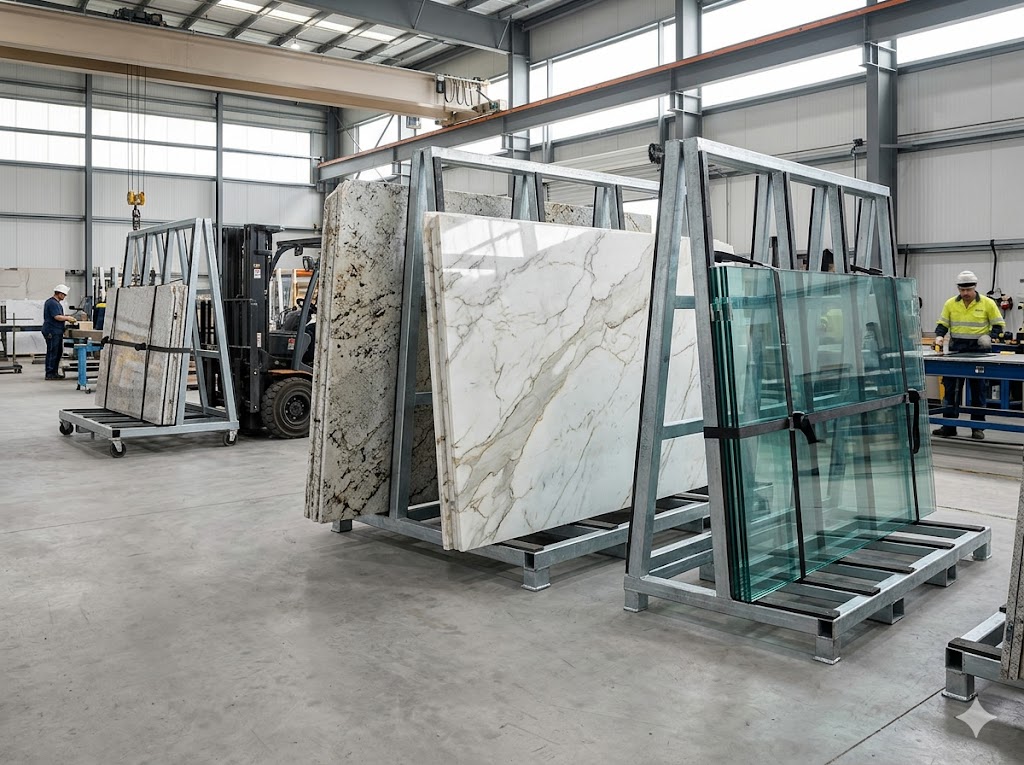
卸売 Aフレームラック
The High Stakes: Buyer Pain Points and Hidden Risks
Before exploring steel grades and tilt angles, procurement teams must face the brutal reality of substandard storage solutions. A cheap A-frame rack is a volatile liability waiting to detonate on your warehouse floor.
The Catastrophic Tipping Hazard
The most severe risk in slab storage is a rack tipping over. This occurs when an A-frame is poorly engineered with a narrow base or an incorrect tilt angle, or when operators unevenly load a rack that lacks sufficient counter-balance outriggers. The result is a terrifying “domino effect” that can crush inventory and, tragically, endanger human lives. Understanding what is an a-frame storage rack in the context of safety engineering is the first step in risk mitigation.
The “Silent Killer”: Material Staining and Edge Chipping
You invested heavily in pristine White Carrara marble or Calacatta quartz. However, after weeks on the rack, you discover deep, dark stains on the face of the slabs, or devastating chips along the bottom edges. The culprit? Inferior, oil-leaching recycled rubber padding and the lack of a proper timber base. These “small” design flaws render luxury materials unsellable.
Structural Fatigue and Rust Bleeding
Using racks made from mild steel with cheap spray paint in a wet stone-cutting environment guarantees rapid oxidation. Over time, the structural integrity weakens, and “rust bleeding” drips onto your expensive inventory, causing irreversible damage.
Busted: 3 Common Sourcing Myths
Many buyers attempt to scale their operations using outdated conventional wisdom. Let’s debunk the most expensive myths in the industrial storage sector:
-
Myth 1: “Steel is steel; the cheapest option is fine.”
-
Reality: All steel is not created equal. High-capacity storage requires steel with a high yield strength—the ability to flex under pressure and return to its original shape without permanent deformation. Mild steel will permanently bend under heavy loads, compromising safety.
-
-
Myth 2: “Rubber padding is all the same.”
-
Reality: Cheap, recycled black rubber contains volatile oils that leach into porous stone. It also cracks and degrades under UV light. Premium Polyurethane (PU) padding is non-marking, chemically stable, and far superior for shock absorption.
-
-
Myth 3: “A steeper angle saves more warehouse space.”
-
Reality: Pushing the angle too close to vertical (e.g., 2-3 degrees) to save floor space creates a massive tipping hazard. The laws of physics cannot be cheated; an optimal angle must balance density with gravitational stability.
-
The Core Foundation: Steel Grades and Structural Integrity
The skeletal strength of any industrial rack depends entirely on the grade of steel utilized in its fabrication.
Why Q235 and Q345 Yield Steel Matter
Industry leaders and any reputable industrial A-frame racks manufacturer will specify Q235 or Q345 (comparable to ASTM A36) carbon structural steel for the vertical uprights and base channels. Q345 offers a higher yield strength (345 MPa), making it ideal for dynamic environments. This ensures the rack can sustain its maximum rated capacity without permanent bending. For large-scale operations, the wall thickness of the structural tubing should never drop below 3.0mm; thinner sections are highly prone to buckling under concentrated weight.
Tube Thickness and Gusset Reinforcement
Beyond the raw material, the geometry of construction is paramount. Square and rectangular structural tubing provide superior resistance to torsion compared to open C-channels. High-stress intersection points must be reinforced with heavy-duty triangular gussets to distribute load across a larger surface area, preventing weld fatigue.
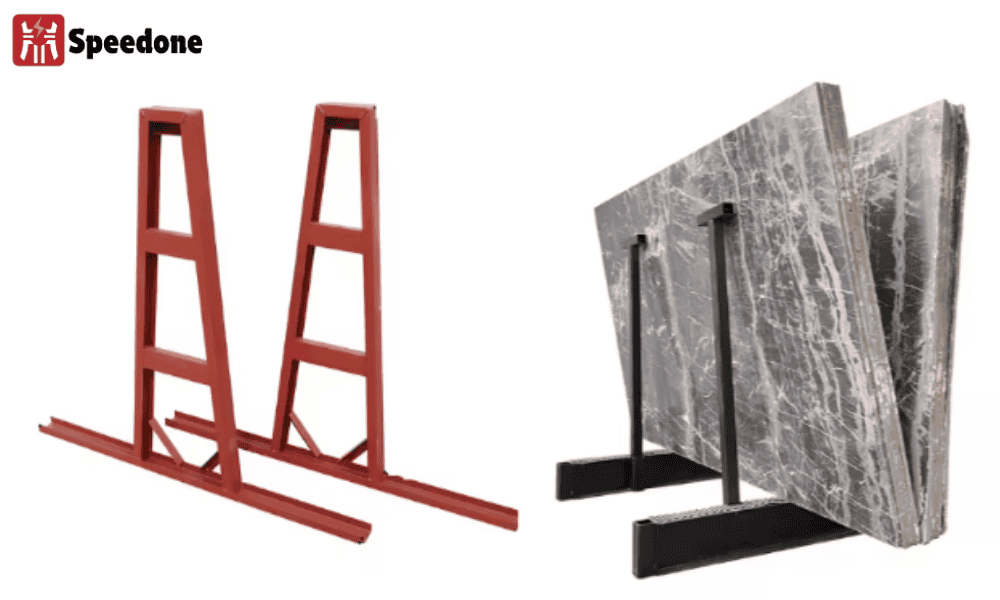
Aフレーム収納ラック サプライヤー
Comparative Analysis: Painted vs. Powder-Coated vs. Galvanized
Industrial environments are harsh. Without the proper surface treatment, even the strongest steel will succumb to oxidation.
Combating Corrosion in Harsh Environments
Standard spray painting is insufficient for B2B applications as it chips easily during loading. Electrostatic powder coating offers a much harder, impact-resistant finish. However, for the ultimate durability—especially for outdoor stone yards—hot-dip galvanizing is the industry gold standard.
Data Table: Surface Finish Lifespan and ROI
| 表面処理 | Coating Thickness (μm) | Salt Spray Resistance (Hrs) | Estimated Lifespan (Indoor) | Estimated Lifespan (Outdoor) |
| Industrial Paint | 30 – 50 | 48 – 96 | 3 – 5 Years | 1 – 2 Years |
| パウダーコーティング | 60 – 100 | 250 – 500 | 10 – 15 Years | 3 – 5 Years |
| 溶融亜鉛メッキ | 80 – 150+ | 1,000+ | 50+ Years | 25+ Years |
When evaluating the comprehensive buyers manual for a-frame storage rack, buyers must calculate the Return on Investment (ROI). While galvanizing costs more initially, it eliminates replacement and maintenance costs over decades.
The Critical Contact Zones: Padding and Protection
While the steel provides the strength, the padding provides the safety for your inventory.
Polyurethane (PU) vs. Recycled Rubber Backing
As previously discussed, avoiding cheap recycled rubber is crucial. Polyurethane (PU), specifically with a Shore A hardness of 80-90, is the superior choice. PU is non-marking and offers exceptional shock absorption, making it the primary choice for any high-quality heavy duty A-frame storage system designed to protect valuable slabs.
Timber Base Configurations for Stone Slabs
In the stone industry, the bottom edge of a slab is highly vulnerable. High-end A-frames feature a wooden base insert (hardwood or pressure-treated timber) within the bottom steel channel. This provides a “soft” landing, preventing catastrophic edge cracking that occurs when heavy stone meets bare steel.
Engineering the Perfect Angle and Load Distribution
The physics of an A-frame rack is centered on the center of gravity and the angle of repose.
The 5 to 7-Degree Tilt: Balancing Stability and Capacity
Extensive engineering and field testing dictate that a tilt angle of 5 to 7 degrees is optimal for most warehouse applications. This precise angle ensures that the material leans securely against the back support while minimizing the horizontal footprint.
Calculating Working Load Limits (WLL)
Safety managers must demand clear Working Load Limit (WLL) documentation. A rack rated for 2,000kg static weight may only be safe for 1,000kg when being moved dynamically on casters. Never exceed these limits.
Specialized Configurations for Glass and Stone Logistics
Different materials demand nuanced engineering approaches.
Glass Transport A-frames: Avoiding Edge Stress
Architectural glass requires absolute structural flatness and superior vibration dampening. Specialized glass transport A-frames must integrate heavy-duty ratchet tie-downs and vertical locking bars to prevent any lateral shifting during transit, which can cause micro-fractures in tempered glass.
Jumbo Slabs and Custom Solutions
With the rising popularity of 3.2m x 1.6m Jumbo quartz and sintered stone slabs, standard racks are often insufficient. Buyers need solutions from an engineering team that understands how to widen the wheelbase and heighten the uprights safely. To learn more about our engineering capabilities, please review details について our manufacturing processes and custom fabrication expertise.
Safety Regulations and OSHA Compliance
In high-liability environments, compliance with workplace safety standards is non-negotiable.
Forklift Pockets and Crane Lifting Eyes
To move large racks safely, they must be equipped with standardized forklift pockets integrated into the base frame. For facilities utilizing overhead cranes, reinforced lifting eyes (lugs) that have undergone non-destructive testing (NDT) are mandatory to handle the vertical lift of the rack and its cargo.
The Strategic Decision Matrix: “If X → Choose Y”
To maximize your procurement ROI, utilize this decision logic framework:
-
IF you operate a wet stone-cutting facility or store slabs outdoors…
-
→ CHOOSE Hot-Dip Galvanized A-frames. The upfront cost prevents rapid rusting and structural failure in highly corrosive environments.
-
-
IF you handle high-value, light-colored natural marble or engineered quartz…
-
→ CHOOSE Racks exclusively fitted with White Polyurethane (PU) padding and timber bases to eliminate the risk of oil staining and edge chipping.
-
-
IF your facility requires frequent movement of slabs between cutting stations…
-
→ CHOOSE Heavy-duty Transport Carts equipped with high-load, non-marking polyurethane casters (with dual locking brakes) rather than static storage racks.
-
Clear Recommendations and Next Steps
Stop accepting the hidden costs of damaged inventory and unsafe working conditions. Protect your assets and your workforce by elevating your storage infrastructure.
-
Demand Material Certifications: Request mill test certificates for the steel (verifying Q235/Q345 yield strength) and technical data sheets for the padding materials.
-
Audit for Safety Features: Ensure every rack incorporates forklift pockets, crane lifting eyes, and a scientifically validated 5-7 degree tilt.
-
Prioritize TCO (Total Cost of Ownership): Do not buy the cheapest rack. Calculate the cost of one shattered slab or one workplace injury against the premium of a properly engineered rack.
Take Action: If your current storage solutions are rusting, damaging your slabs, or creating safety hazards, it is time for an upgrade. Please お問い合わせ today to consult with our engineering team, request load-capacity documentation, or design a custom A-frame solution tailored to your specific warehouse layout.
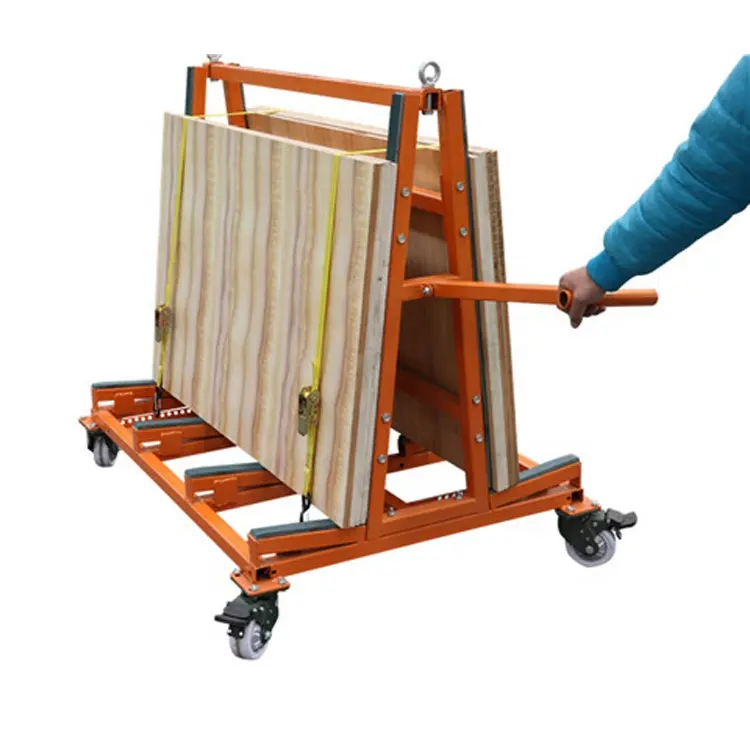
Aフレーム収納ラック
FAQ: Expert Answers on Sourcing A-Frame Racks
1. What is the maximum load capacity of a standard steel A-frame rack?
The capacity varies significantly based on engineering, but industrial-grade steel A-frames constructed with Q235/Q345 steel typically offer a Working Load Limit (WLL) between 1,000kg and 5,000kg per side. Always check the manufacturer’s data sheet for specific static versus dynamic load ratings.
2. Why are hot-dip galvanized A-frames recommended for outdoor stone yards?
溶融亜鉛メッキは、亜鉛と鋼の間に厚い冶金的結合を形成し、標準的な塗装よりもはるかに耐久性のある被膜を提供します。この被膜は陰極防食効果を発揮するため、たとえ被膜が激しく傷ついたとしても、周囲の亜鉛が自ら犠牲となって下地の鋼が錆びるのを防ぎ、数十年にわたる屋外使用を保証します。
3. Can I customize the dimensions of an A-frame cart from a manufacturer?
はい、プロフェッショナルなB2Bメーカーは、高さ、幅、傾斜角度を幅広くカスタマイズし、焼結石や特大の建築用ガラスなどジャンボサイズの材料を安全に取り扱うことができます。カスタマイズには、パッド材や頑丈なキャスターの構成を特定の産業用床タイプに合わせて調整することも含まれます。
4. What is the difference between an A-frame rack and an A-frame transport cart?
収納ラックは主に静的な倉庫用途を想定しており、平らなベースを備えています(ただし、時折の位置変更のためにフォークリフト用ポケットを設ける必要があります)。運搬カートは、多忙な作業場や生産ライン内で頻繁かつ安全に材料を移動させるため、耐荷重性の高いキャスターと人間工学に基づいたハンドルを特別に設計されています。
5. How do I prevent glass sheets from shifting on an A-frame during transit?
ラックに内蔵されたラチェット式タイダウンストラップや、荷物をフレームにしっかりと固定する垂直ロックバーを装備することで、積載物のずれを防ぎます。さらに、高摩擦・衝撃吸収性に優れたパッド、例えばプレミアムポリウレタン(PU)を使用することで、動的な動きの中でも素材の絶対的な安定性を維持できます。
参考文献
-
“Structural Steel Yield Strength and Load Distribution in Industrial Racking,” Journal of Material Engineering, 2024.
-
“Surface Treatment Performance: Hot-Dip Galvanizing vs. Powder Coating,” American Galvanizers Association.
-
“Polyurethane Hardness and Material Protection for Fragile Surfaces,” Polymer Science Quarterly.
-
“Warehouse Safety Standards for Heavy Slab Storage,” OSHA Occupational Safety Guidelines.
-
“The Physics of Center of Gravity in A-Frame Storage Systems,” Industrial Logistics Review.
-
“Corrosion Rates of Steel in High-Moisture Stone Cutting Environments,” International Journal of Corrosion.
-
“Safe Material Handling of Architectural Glass and Stone Slabs,” Global Glass & Stone Association.
-
“Total Cost of Ownership in Industrial Storage Infrastructure,” Procurement Management Journal.
Deep Synthesis of Industrial A-Frame Engineering
Structural Integrity Protocol: The strategic value of Aフレームラック is dictated by the intersection of material science and gravitational physics. Unlike generic shelving, heavy-duty slab storage requires steel with high yield strength (e.g., Q345) to resist permanent plastic deformation under concentrated loads. The optimal 5-7 degree tilt is a calculated safety threshold that balances storage density with a stable center of gravity, effectively mitigating the catastrophic tipping hazards associated with more vertical or improperly braced frames.
For high-moisture stone yards, Hot-Dip Galvanizing is the standard to prevent rust-bleeding onto inventory. In contrast, indoor facilities prioritize Electrostatic Powder Coating for impact resistance. Protection zones must utilize Polyurethane (PU) rather than recycled rubber to prevent the leaching of volatile oils that stain porous natural stone surfaces like Carrara marble.
Procurement directors must audit for OSHA-compliant features such as integrated forklift pockets and NDT-tested crane lifting eyes. A critical misunderstanding often occurs regarding Dynamic vs. Static Load; racks engineered for storage may not support the same weight limits when converted into transport carts with casters, making safety-factor verification (1.5x to 2x) a mandatory B2B procurement step.
📈 2026 Industry Outlook: As the global market shifts toward Jumbo-sized sintered stone and oversized architectural glass, A-frame construction is evolving toward modular, expandable chassis and lightweight, ultra-high-strength alloys. The integration of Smart Tracking (IoT) on transport racks is becoming the new benchmark for preventing logistics bottlenecks and ensuring the zero-damage flow of fragile materials in automated warehouse environments.

ヘンリー
こんにちは、私はこの記事の著者です。石工具のOEM&ODMサービスが必要な場合は、お気軽にご質問ください。