効率的に仕事をこなす





“`html
Moving large slabs safely and efficiently is one of the most important material-handling tasks in stone factories, fabrication shops, warehouses, and distribution centers. Granite, marble, quartz, porcelain, and sintered stone slabs are heavy, fragile, and difficult to reposition manually. A properly selected スラブ運搬台車 helps move these materials between storage racks, cutting areas, fabrication stations, loading zones, and other working areas while reducing unnecessary handling.
The value of a slab cart is not simply its ability to carry weight. Its real performance depends on how well the cart matches the material, workshop layout, floor condition, slab dimensions, handling frequency, and loading method. This guide explains what a slab transport cart is, how it works, its main structures and power options, where it is used, how it compares with other slab-handling equipment, and what buyers should evaluate before selecting a model.
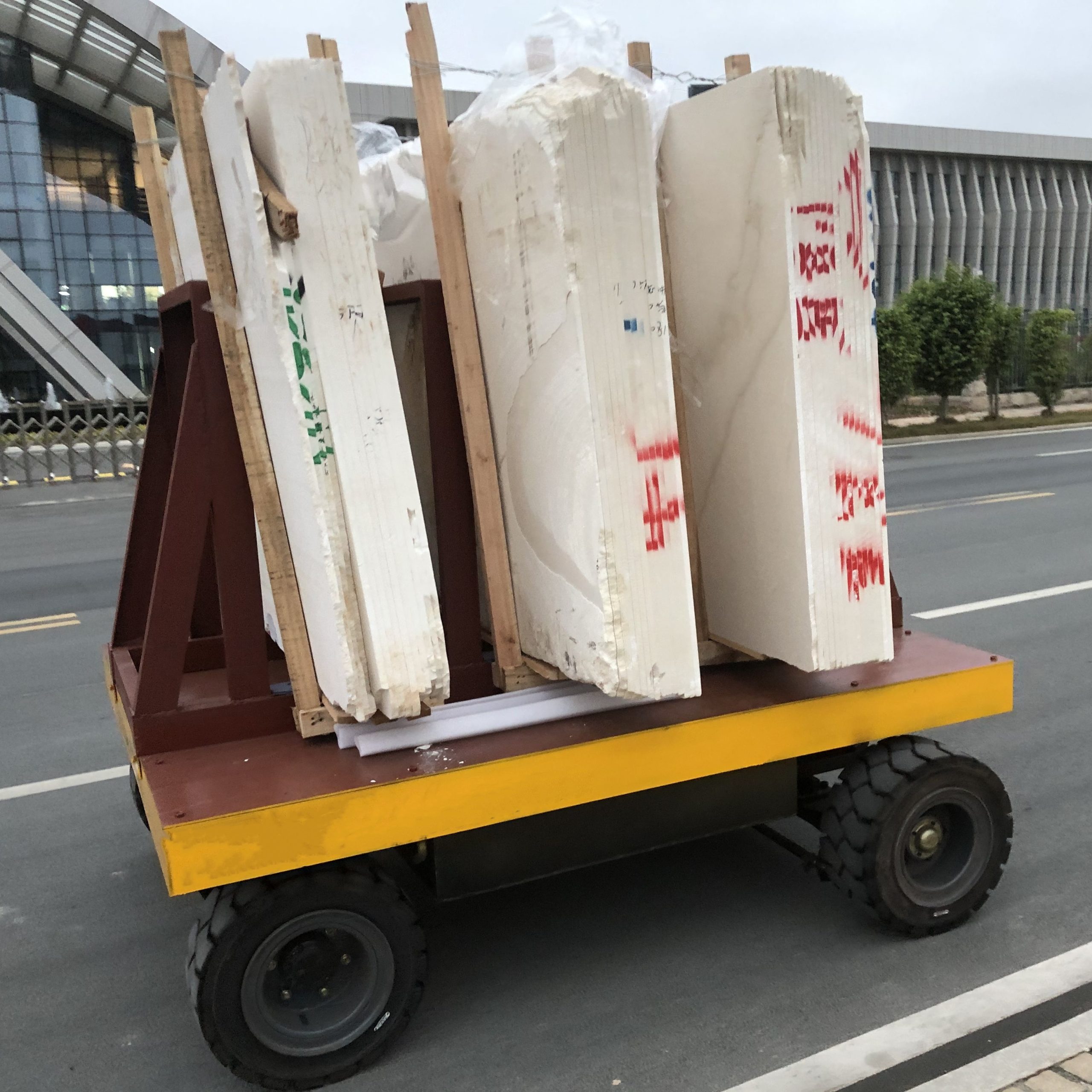
スラブ運搬台車
What Is a Slab Transport Cart?
A slab transport cart is a wheeled material-handling device designed to move large, flat, and heavy materials over short or medium distances. In the stone industry, it is commonly used for granite slabs, marble slabs, quartz slabs, porcelain panels, sintered stone, countertops, and similar materials.
Unlike a fixed slab rack, which is mainly intended for storage, a transport cart is designed around movement. Depending on the application, the cart may use a flat platform, an A-frame support structure, a bundle-supporting frame, protective contact surfaces, heavy-duty casters, steering wheels, or a powered drive system.
Structure and Design of a Slab Transport Cart
Load-Bearing Frame and Platform
The frame is the main structural component of the cart. Heavy-duty models are commonly manufactured from steel or other high-strength materials so that loads can be distributed through the chassis rather than concentrated in one small area.
Depending on the cart design, slabs may be supported on a flat platform, leaning frame, A-frame structure, bundle-supporting structure, or other dedicated support system. Contact areas may also use rubber, protective pads, textured surfaces, or retaining components to help reduce unwanted slab movement and surface contact damage.
Wheel and Caster Configuration
Wheel design has a major influence on maneuverability. Smaller manual carts may use a relatively simple four-wheel configuration, while larger industrial designs can use additional wheels to distribute heavier loads and improve stability.
Common wheel materials in industrial handling equipment include solid rubber, rubber-coated wheels, polyurethane, nylon, and metal wheels. The correct option depends on floor quality, load, turning requirements, noise restrictions, and the amount of rolling resistance the operator can accept.
| Design Factor | What It Affects | Buyer Consideration |
|---|---|---|
| Frame Structure | Load support and stability | Match rated capacity to actual slab load |
| ホイールタイプ | Rolling resistance and floor compatibility | Consider floor material and surface condition |
| Steering Arrangement | Turning radius and maneuverability | Measure workshop aisle width first |
| Contact Protection | Slab surface protection | Important for polished and finished slabs |
Main Power and Propulsion Options
Slab transport carts and related industrial material-handling carts can use different propulsion methods. Not every system is suitable for every stone-handling environment, so power type should be selected according to load, transport distance, floor conditions, frequency of use, and available working space.
Manual Slab Transport Carts
Manual carts are practical for short-distance transport and applications where loads and rolling resistance remain manageable. They generally have fewer drive components, require relatively simple maintenance, and can be suitable for fabrication shops or work areas where slabs only need to move between nearby stations.
The main limitation is operator effort. As slab weight, movement frequency, distance, or floor resistance increases, powered movement may become more appropriate.
Electric-Powered Transport Carts
Electric-powered carts use an electric motor and rechargeable battery to reduce the physical effort required from operators. They can be useful in indoor environments where controlled movement, lower operating noise, and frequent material transfer are important.
Actual battery capacity, operating time, charging requirements, speed, control system, and load rating vary by model and manufacturer and should therefore be checked individually.
Diesel and Other Powered Industrial Carts
Across the broader material-handling industry, diesel-powered transport equipment can be used for outdoor, long-distance, or high-load applications where battery operation may not be the preferred solution. Such systems may offer high torque and extended operating ranges.
However, diesel propulsion is not the default requirement for stone slab transport. Indoor stone workshops usually need to consider emissions, noise, turning space, maintenance, and actual transport distance before choosing any powered system.
How Does a Slab Transport Cart Work?
The operating method depends on the cart design. In a basic system, slabs are loaded or transferred onto the supporting frame, secured or stabilized as required, moved to the destination, and then unloaded using the appropriate handling method.
Some specialized carts or industrial transport systems may incorporate mechanical, hydraulic, pneumatic, or electric lifting functions. Others are designed only for transport and depend on separate forklifts, cranes, lifters, or manual loading equipment.
Powered carts may use buttons, levers, handles, remote controls, or other control arrangements depending on the model. Manual carts rely primarily on operator pushing or pulling force.
Typical Workflow
| ステップ | Main Task | Key Consideration |
|---|---|---|
| 1 | Inspect cart and route | Check wheels, frame, aisle, and floor |
| 2 | Load the slab or bundle | Keep load within rated capacity |
| 3 | Stabilize the load | Use provided restraints or supports correctly |
| 4 | Transport the load | Move smoothly and avoid sudden turns |
| 5 | Unload | Use the correct lifting or transfer equipment |
Key Advantages of Slab Transport Carts
Heavy Material Handling
Industrial slab carts can be designed for loads ranging from relatively light individual slabs to multi-ton bundles. The actual rated capacity should always be confirmed from the specific product specification rather than assumed from appearance or frame size.
Improved Workshop Mobility
Compared with repeatedly repositioning large slabs using fixed equipment, a mobile cart can simplify transport between nearby work areas. A suitable steering and caster arrangement can also make movement easier in narrow fabrication spaces.
Reduced Unnecessary Handling
Every additional slab transfer requires time and introduces another handling step. A transport cart can help create a more direct workflow between storage, fabrication, inspection, packing, and loading zones.
Potential Labor Savings
A suitable cart can reduce the amount of manual carrying, repositioning, and repeated equipment setup involved in slab movement. Actual labor savings depend on travel distance, load size, production volume, floor layout, and existing workflow.
What Materials Can a Slab Transport Cart Handle?
Although the term “slab transport cart” can apply broadly to industrial sheet or panel movement, stone-processing applications are especially important because slabs are both heavy and vulnerable to impact damage.
| 素材 | Typical Handling Concern | Cart Requirement |
|---|---|---|
| 御影石 | High weight | Strong frame and suitable capacity |
| 大理石 | Surface and edge damage | Protected contact areas |
| Quartz | Large slab dimensions | Stable support geometry |
| Porcelain / Sintered Stone | Thin, large-format panels | Controlled support and careful movement |
| Large Industrial Panels | Size and movement control | Application-specific cart design |
Where Are Slab Transport Carts Used?
Stone Fabrication Workshops
Fabrication shops can use carts to move slabs between storage racks, cutting machines, CNC equipment, polishing areas, inspection stations, and packing areas. Reducing repeated forklift access can also help simplify internal workflow in some layouts.
Granite and Marble Warehouses
Stone distributors frequently need to retrieve slabs from storage and move them to viewing, staging, loading, or processing areas. A cart can act as the transport link between fixed storage and the next handling operation.
Quartz and Countertop Production
Quartz slabs and fabricated countertops often need to move between multiple production stages. The cart should be selected according to the size, weight, finished surface, and required positioning accuracy of the material.
Construction and Industrial Material Handling
Across the wider material-handling sector, transport carts can also move concrete elements, metal sheets, large wooden panels, composite materials, and prefabricated components. However, the support structure must be designed for the specific material rather than assuming that one slab cart is suitable for every application.
Slab Transport Cart vs Other Handling Equipment
| Equipment | Primary Purpose | モビリティ | ベストユース |
|---|---|---|---|
| スラブ運搬台車 | Moving slabs | 高い | Workshop and warehouse transport |
| Forklift | Lifting and general material handling | 高い | Heavy lifting and longer-distance movement |
| スラブラック | Storage | Normally fixed | Warehouse inventory storage |
| Aフレーム収納ラック | Supporting slabs in a leaning position | Depends on design | Storage, staging, or transport support |
| スラブ・ディスプレイ・ラック | Presentation | Usually limited | Showroom and customer selection |
A forklift is highly versatile and can lift substantial loads, but it requires sufficient operating space and the correct attachment or handling method. A slab transport cart is more specialized for moving slabs along predetermined workshop routes and may require less turning space depending on its wheel arrangement.
Slab racks and A-frame racks mainly solve storage problems, whereas transport carts solve movement problems. In a well-organized stone facility, these equipment categories usually work together rather than replace one another.
スラブ運搬台車の正しい選び方
1. Confirm the Required Load Capacity
Start with the heaviest slab or bundle the cart will actually transport. The rated capacity of the cart should be verified against the real working load rather than choosing only by appearance, frame thickness, or product name.
2. Measure the Slab Dimensions
Length, height, thickness, bundle width, and center of gravity can influence the required support structure. Large-format porcelain and sintered stone may need a different support approach from a compact granite bundle.
3. Measure Workshop Aisle Width
The cart must be able to move through the real facility. Check straight aisle width, corners, door openings, loading zones, and the space required for workers or forklifts around the cart.
4. Match the Wheels to the Floor
A smooth indoor concrete floor has different requirements from uneven outdoor paving. Wheel material, diameter, bearing design, and steering arrangement all affect movement effort and stability.
5. Check the Loading and Unloading Method
Determine whether slabs will be loaded using a crane, forklift, vacuum lifter, clamp, manual transfer method, or built-in lifting system. The cart must fit the existing material-handling process.
6. Consider Transport Frequency and Distance
A manually pushed cart may work well for occasional short trips, while frequent long-distance transport of heavier loads may justify powered movement.
Which Slab Transport Cart Should You Choose?
| Requirement | Suitable Cart Direction |
|---|---|
| Short-distance workshop movement | Manual slab cart |
| High-frequency heavy movement | Powered or heavy-duty transport cart |
| Large slab bundle transport | Heavy-duty bundle transport cart |
| Narrow fabrication area | Compact cart with suitable steering arrangement |
| Stone staging and mobile support | A-frame style transport cart |
Slab Transport Cart Safety Checklist
Slab transport involves large and heavy materials, so equipment selection and operating procedures should be based on the specific cart, load, and workplace conditions.
- Confirm the cart’s rated capacity before loading.
- Inspect wheels, frame, handles, restraints, and contact surfaces before use.
- Keep the slab or bundle positioned according to the cart manufacturer’s instructions.
- Use restraints, locking devices, or support components where provided.
- Do not exceed the rated load.
- Keep the transport route clear of obstacles.
- Avoid sudden acceleration, braking, or sharp turns.
- Check floor conditions before moving a heavy load.
- Use appropriate lifting equipment during loading and unloading.
- Follow the equipment manufacturer’s operating instructions and site safety procedures.
How Can a Slab Transport Cart Improve Workflow?
The benefit of a transport cart can be estimated by comparing the current slab-moving process with the proposed process. The exact result will vary by factory, so the following is only an example calculation.
Current slab movement time: 12 minutes per trip
Cart-assisted movement time: 8 minutes per trip
Time saved: 4 minutes per trip
20 slab movements per day × 4 minutes = 80 minutes saved per day
80 minutes × 22 working days = 1,760 minutes
= approximately 29.3 labor hours per month
This example does not represent a guaranteed performance figure. Actual savings depend on distance, load size, operator skill, workshop layout, production volume, and the equipment currently used.
Common Mistakes When Buying a Slab Transport Cart
Choosing Only by Maximum Capacity
A higher load rating does not automatically mean the cart is suitable. Buyers also need to check dimensions, maneuverability, wheel configuration, loading method, and floor conditions.
Ignoring the Real Workshop Layout
A cart can have excellent specifications and still be inconvenient if it cannot turn through the available aisles or pass through workshop doors.
Using the Wrong Wheel Type
Wheel material and diameter affect rolling effort, vibration, noise, floor protection, and durability. They should be matched to the working environment.
Failing to Consider Slab Surface Protection
Polished granite, marble, quartz, and porcelain surfaces may require rubber or other protective contact materials between the slab and cart structure.
Confusing Storage Equipment With Transport Equipment
A slab rack is primarily intended to store materials. A transport cart is primarily intended to move them. Selecting the correct equipment starts with identifying whether the main problem is storage, movement, lifting, staging, or presentation.
Future Development of Slab Transport Carts
Material-handling technology continues to develop, particularly in electric drive systems, battery performance, sensors, remote control, automation, and lighter high-strength materials. In some industrial environments, these technologies may gradually increase the level of powered or automated slab movement.
For most stone factories, however, practical buyer priorities remain straightforward: suitable load capacity, stable support, reliable wheels, manageable dimensions, easier steering, surface protection, serviceability, and compatibility with the existing workflow.
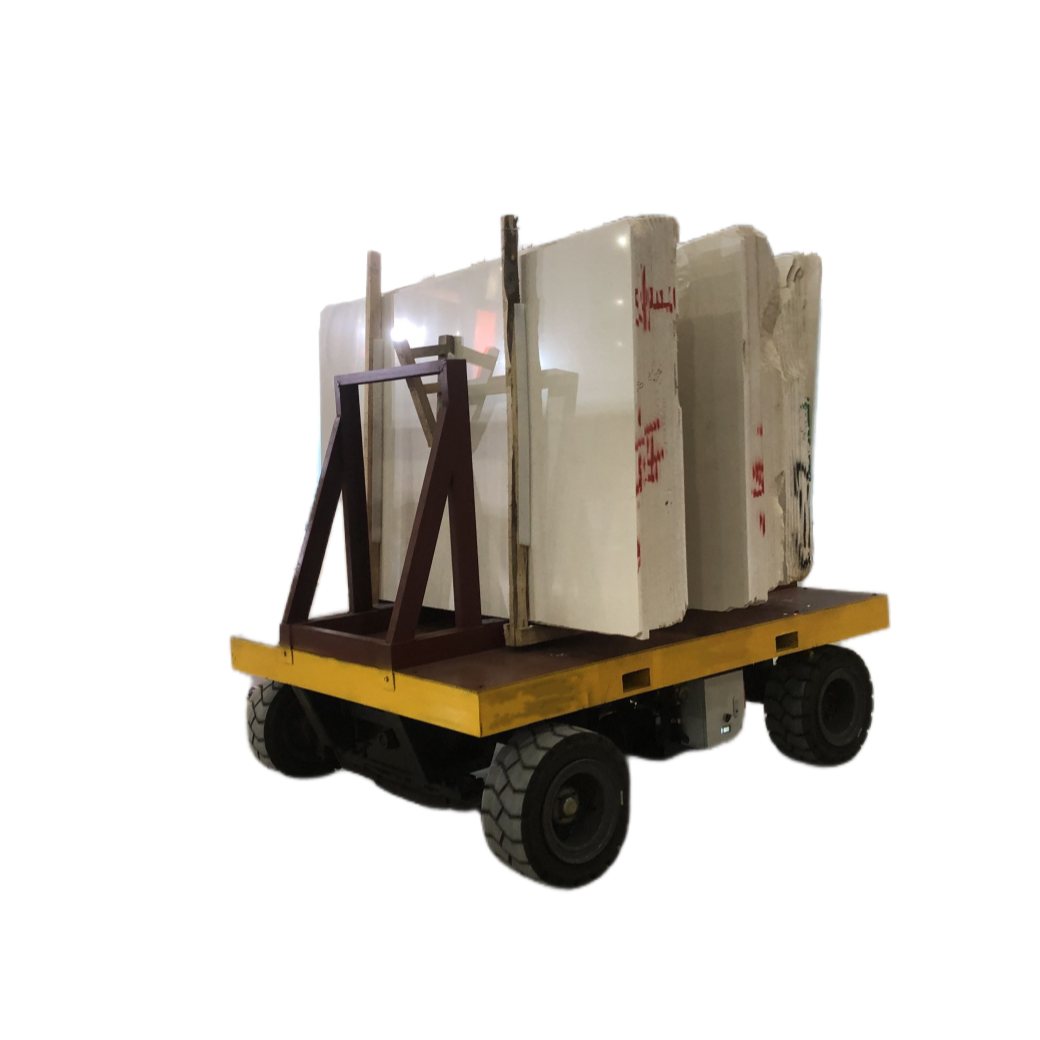
大理石スラブ運搬 CARTBDC-A
よくある質問
スラブ搬送台車は何に使うのですか?
A slab transport cart is used to move granite, marble, quartz, porcelain, sintered stone, countertops, and other large slab materials between storage, fabrication, inspection, loading, and installation areas.
How much weight can a slab transport cart carry?
Capacity varies significantly by model. Some carts are designed for individual slabs or lighter workshop work, while heavy-duty industrial models can handle multi-ton loads. Buyers should always use the rated capacity of the specific cart as the reference.
What is the difference between a slab transport cart and a slab rack?
A slab transport cart is primarily designed for movement, while a slab rack is primarily designed for storage. Stone factories commonly use both as parts of the same material-handling workflow.
Which slab transport cart is suitable for granite?
The correct cart depends on granite slab weight, slab dimensions, bundle size, floor conditions, aisle width, required travel distance, and loading method. Heavy granite bundles normally require a stronger structure and higher rated load than lighter individual slabs.
Are manual slab carts suitable for heavy slabs?
A manual cart can be suitable when the load is within its rated capacity and the floor, distance, and rolling resistance allow the operator to move it safely. Heavier or more frequent transport may require powered assistance.
What wheel type is best for a slab transport cart?
There is no single best wheel for every application. Rubber and polyurethane may be suitable for many indoor floors, while nylon, metal, or other industrial wheels may suit different loads and surfaces. Wheel diameter, bearing type, load rating, and floor condition should all be considered.
What should I measure before ordering a slab cart?
Measure the maximum slab or bundle dimensions, working load, aisle width, doorway width, turning area, travel distance, floor condition, and available loading and unloading space.
結論
A slab transport cart is not simply a wheeled platform. In stone fabrication and slab distribution, it is part of the workflow connecting storage, production, inspection, packing, and loading. The best cart is therefore the one that matches the actual slab weight, dimensions, workshop layout, wheel requirements, loading method, and frequency of movement.
For granite, marble, quartz, porcelain, and sintered stone operations, careful cart selection can reduce unnecessary material handling, improve slab movement between workstations, and make the overall handling process more organized. Buyers should focus on real operating conditions rather than choosing only by maximum load capacity or price.
“`

ヘンリー
こんにちは、私はこの記事の著者です。石工具のOEM&ODMサービスが必要な場合は、お気軽にご質問ください。
Expert Commentary & Analysis
In practical stone-handling projects, the most common mistake is treating load capacity as the only specification that matters. A cart rated for a heavy load may still perform poorly if its wheel configuration does not suit the floor, its turning radius does not suit the aisle, or its support structure does not match the dimensions of the slab.
For this reason, slab transport cart selection should begin with the workflow rather than the cart itself. Buyers should identify where the slab starts, where it needs to go, how it will be loaded, what obstacles exist along the route, and how frequently the movement occurs.
Buyer takeaway: select the transport system around the real slab size, working load, floor condition, aisle width, handling frequency, and loading method. A correctly matched cart can provide more operational value than simply choosing the largest or highest-capacity model available.