효율적으로 업무를 완료하세요!





If you need crane-like lifting capability but are constrained by limited floor space, infrastructure or budget, a forklift boom may provide a practical alternative for certain applications. Steel mills, construction sites, warehouses, fabrication shops and manufacturing facilities often need to lift or position bulky materials without installing a permanent overhead crane or operating a larger mobile crane.
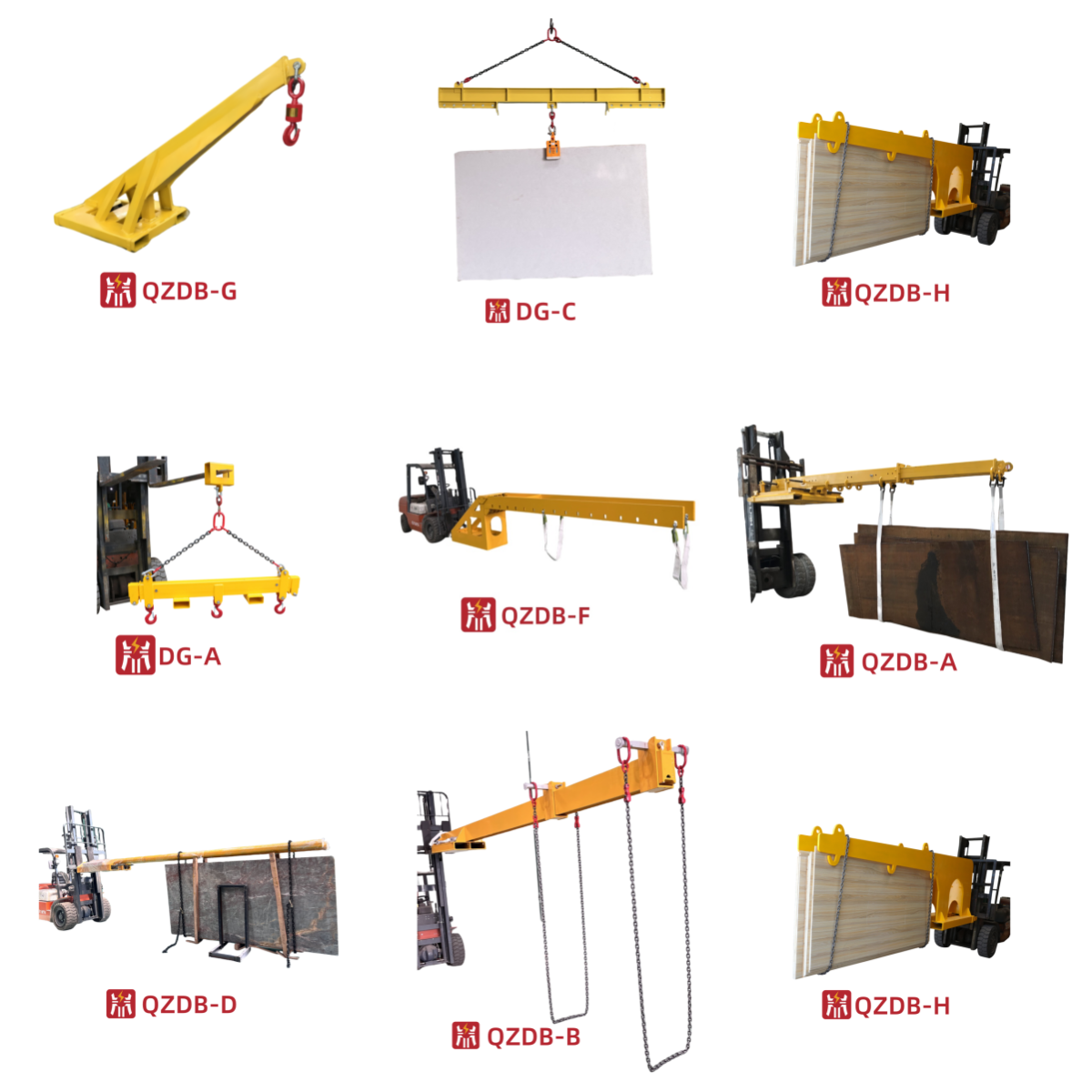
지게차 붐, also called forklift jib booms or fork-mounted lifting booms, are attachments designed to extend the lifting reach and functionality of a compatible forklift. They can help position suspended, long or awkward loads that may be difficult to handle using standard forks alone.
The key question, however, is not simply whether a forklift boom is cheaper or smaller than a crane. The more important question is whether the complete forklift-and-boom combination provides the required capacity, reach, stability and operating clearance for the intended task.

What Is a Forklift Boom?
A forklift boom is a lifting attachment that fits onto or integrates with a compatible forklift to create an extended lifting point in front of the truck. Depending on the design, the boom may be fixed, adjustable or telescopic and may provide one or more hook positions for different lifting requirements.
Instead of supporting a load directly on the forks, the boom allows suitable loads to be suspended from a hook or lifting point. This can make it useful for loads that are difficult to position with forks alone, including machinery, fabricated components, stone-handling equipment, structural materials and other awkward industrial loads.
Can a Forklift Boom Replace a Crane?
In some applications, yes. In others, no.
A forklift boom can make sense when lifting is intermittent, a suitable forklift is already available, the required reach is moderate, loads remain within the rated capacity of the complete system, and the working environment does not justify installing a permanent crane.
A crane may still be the better solution when the application requires very high capacity, long reach, frequent repetitive lifting, large vertical lift heights or specialized load control.
| Factor | 지게차 붐 | Dedicated Crane |
|---|---|---|
| Initial Investment | Can be lower when a compatible forklift already exists | Often requires larger equipment or installation investment |
| Space Requirement | Compact and mobile | Depends on crane type and infrastructure |
| 모빌리티 | High when mounted on a mobile forklift | Varies by crane type |
| Reach | Limited by boom design and forklift stability | Typically better for larger lifting envelopes |
| 용량 | Limited by the complete forklift-and-attachment system | Often more suitable for higher-capacity lifting |
| 베스트 애플리케이션 | Intermittent lifting and positioning | Frequent, high-capacity or high-reach lifting |
Why Businesses Consider Forklift Booms
Lower Infrastructure Requirements
A forklift boom can use an existing compatible forklift as the mobile lifting platform. This may avoid some of the infrastructure associated with permanent overhead crane systems and can be useful in facilities where installing a fixed lifting system is difficult.
Better Use of Limited Space
A major reason companies consider forklift booms is space. Warehouses, fabrication shops and manufacturing areas may not have enough room for larger lifting systems or may need lifting equipment that can move between different work zones.
Because the boom travels with the forklift, one attachment can potentially serve several areas rather than remaining fixed in one location.
Flexible Lifting Positions
Depending on the design, adjustable or telescopic forklift booms can offer several hook or boom positions. This allows operators to select a lifting point that better matches the required reach and load position.
However, increasing reach generally moves the load farther from the forklift and can reduce the allowable working capacity. Reach should therefore never be evaluated independently from load weight and forklift stability.
Reduced Need for Separate Lifting Equipment
For businesses that already operate suitable forklifts, a boom attachment may allow the same truck to perform additional lifting and positioning tasks. This can improve equipment utilization where a crane would otherwise only be used occasionally.
How a Forklift Boom Affects Forklift Capacity
This is one of the most important factors buyers should understand before purchasing a forklift boom.
Adding a boom changes how the load acts on the forklift. The boom itself adds weight, and extending the load farther forward increases the effective load center. As the load moves farther away from the forklift, the leverage acting on the truck increases.
Longer boom extension
↓
Load positioned farther forward
↓
Greater effective load center
↓
Higher overturning moment
↓
Potentially lower allowable lifting capacity
For this reason, buyers should never choose a forklift boom based only on the maximum capacity printed on the attachment.
Check the Complete Lifting System
Before use, evaluate:
- Forklift rated capacity
- Forklift model and configuration
- Boom attachment weight
- Boom length and extension position
- Hook position
- Load weight
- Effective load center
- Fork dimensions and attachment fit
- Required lift height
- Floor and operating conditions
- Forklift manufacturer requirements
지게차 붐은 어디에 사용되나요?
Stone Fabrication and Material Handling
Forklift booms can be useful in stone-processing environments for positioning lifting equipment, handling awkward components and supporting certain lifting operations involving granite, marble, quartz and other heavy materials.
건설 현장
Construction operations may use forklift booms to position structural components, beams, prefabricated elements or equipment when the load and work area are compatible with the forklift-and-boom system.
Warehouses and Distribution Centers
Forklift booms can assist with long, bulky or difficult-to-position loads that cannot be handled efficiently using standard forks alone.
Steel Mills and Metal Fabrication
Fabrication shops may use boom attachments when positioning fabricated components, equipment, structural sections or other industrial loads during production or maintenance.
Manufacturing Facilities
Manufacturers may use forklift booms for machinery installation, maintenance work, equipment positioning and other intermittent lifting operations.
Container Loading and Unloading
Extended boom designs can also be useful where the forklift must reach toward loads during container handling or similar loading and unloading operations. The required reach must always be evaluated together with capacity and stability.
Agricultural and General Industrial Applications
Forklift booms can also support selected lifting tasks involving pipes, equipment and other awkward materials in agricultural or general industrial environments.
Main Advantages of a Forklift Boom
| Advantage | Why It Matters |
|---|---|
| Potential Cost Saving | May require less investment than purchasing or installing a dedicated crane when a compatible forklift already exists |
| 공간 효율성 | Useful where permanent lifting infrastructure is difficult to install |
| 모빌리티 | The lifting system can move with the forklift between different work areas |
| 다용도성 | Can support different lifting and positioning tasks depending on boom design |
| Existing Equipment Utilization | Extends the range of tasks that a compatible forklift can perform |
Limitations and Disadvantages
Lower Capacity Than Some Cranes
Forklift booms are not intended to replace every crane. Heavy, high-reach or continuous lifting applications may require dedicated crane equipment with greater capacity and a larger operating envelope.
Reduced Capacity at Extended Reach
Moving the lifting point farther forward changes the load center and can reduce the safe capacity of the forklift-and-boom combination.
Stability Must Be Evaluated Carefully
A suspended or extended load affects forklift stability differently from a load carried directly on the forks. Sudden movement, turning, uneven floors or unsuitable load positioning can increase risk.
Operator Training Is Still Required
A forklift boom can integrate with existing forklift operations, but it should not be treated as an attachment that requires no additional knowledge. Operators need to understand the boom’s operating method, capacity limits, altered load center, stability characteristics and site-specific procedures.
Inspection and Maintenance
Hooks, locking components, boom sections, welds, fork pockets, structural members and other load-bearing parts should be inspected according to the manufacturer’s instructions and workplace maintenance procedures.
Forklift Boom Safety and Compliance Considerations
Forklift booms operate as part of a powered industrial truck system. Workplace requirements can differ by country, forklift type, attachment design and application, so buyers should confirm the applicable regulations, forklift manufacturer requirements and site procedures before use.
Important considerations include:
- Forklift and attachment compatibility
- Updated or applicable capacity information
- Attachment identification and ratings
- Operator training
- Load stability
- Correct hook and lifting accessory selection
- Inspection of structural and locking components
- Safe operating routes
- Personnel separation from suspended loads
Industry guidance from organizations such as OSHA, ANSI and ITSDF may apply depending on the market, equipment and workplace. Buyers should use the requirements applicable to their location and application rather than relying only on the boom manufacturer’s nominal attachment capacity.
Pre-Use Forklift Boom Safety Checklist
- Confirm that the boom is compatible with the forklift.
- Confirm the required working capacity for the selected boom position.
- Check the boom structure for visible damage or deformation.
- Inspect welds and load-bearing components.
- Check fork pockets and attachment locking devices.
- Confirm locking pins are correctly installed.
- Inspect the lifting hook and safety latch where fitted.
- Confirm the actual load weight before lifting.
- Confirm chains, slings or other lifting accessories are appropriate for the load.
- Check floor conditions and the intended travel route.
- Keep personnel clear of suspended loads.
- Avoid sudden acceleration, braking or turning.
- Follow the forklift, boom and workplace operating procedures.
How to Compare Forklift Boom and Crane Costs
It is tempting to compare only the purchase prices, but the correct decision should consider the total operating requirement.
| Forklift Boom Option | Crane Option |
|---|---|
| Boom attachment purchase | Crane purchase or rental |
| Compatible forklift availability | Installation or mobilization cost |
| Compatibility and capacity review | Possible structural or foundation requirements |
| Operator training | Operator and lifting requirements |
| Inspection and maintenance | Inspection and maintenance |
If a compatible forklift already exists and lifting is occasional, a boom attachment may offer a lower-cost solution. If the facility performs high-capacity lifting continuously, a dedicated crane may deliver better long-term productivity.
How to Evaluate Forklift Boom Space Requirements
A forklift boom may require less permanent infrastructure than a crane, but buyers still need to consider the complete operating envelope.
Before choosing a boom, check:
- Forklift overall dimensions
- Forklift turning radius
- Retracted boom length
- Extended boom length
- Required hook position
- Aisle width
- Door and gate clearance
- Ceiling height
- Overhead obstructions
- Load swing clearance
- Pedestrian routes
- Available space for turning with the load
The shortest boom is not automatically the best choice, and the longest boom is not automatically the most versatile. The correct reach should solve the lifting problem while keeping the load as close to the forklift as practical.
How to Choose a Forklift Boom
1. Define the Maximum Load
Start with the heaviest load you expect to lift and confirm whether this refers to the actual suspended load or includes additional lifting accessories.
2. Define the Required Reach
Measure how far the hook needs to extend from the forklift. Excessive boom length can reduce usable capacity and increase the required operating space.
3. Match the Boom to the Forklift
Check forklift capacity, fork dimensions, attachment method and compatibility requirements before ordering.
4. Check Hook Positions
Multiple hook or extension positions can increase versatility, but each position may affect capacity differently.
5. Evaluate Lift Height and Space
Consider ceiling height, doors, aisles, turning areas and the total working envelope of the forklift with the boom installed.
6. Confirm the Intended Application
Stone handling, machinery positioning, container work, construction and warehouse lifting can have very different load and reach requirements. The boom should be selected for the actual workflow rather than purchased only by maximum stated capacity.
When Does a Forklift Boom Make the Most Sense?
| Operating Situation | Forklift Boom Suitability |
|---|---|
| Compatible forklift already available | Potentially strong fit |
| Intermittent lifting rather than continuous crane work | Potentially strong fit |
| Limited permanent installation space | Potential advantage |
| Moderate reach requirement | Often suitable if capacity is confirmed |
| Extremely high-capacity or long-reach lifting | Dedicated crane may be more appropriate |
| Continuous repetitive lifting | Crane or dedicated lifting system may offer better productivity |
포크리프트 붐에 투자해야 할까요?
A forklift boom can be a strong investment when your business already operates a suitable forklift and needs occasional or moderate lifting capability without installing a dedicated crane system.
It is especially worth evaluating when:
- Floor or installation space is limited
- The forklift must serve multiple work areas
- Lifting tasks are intermittent
- Loads are awkward rather than extremely heavy
- Moderate horizontal reach is required
- A compatible forklift is already available
However, the purchasing decision should not be based only on lower cost. Capacity, reach, load center, forklift compatibility, operator training, stability and working environment are equally important.
지게차 지브 붐
자주 묻는 질문
지게차의 붐이 크레인을 대체할 수 있나요?
포크리프트 붐은 필요한 하중, 도달 범위 및 작동 조건이 전체 포크리프트-붐 시스템의 용량 내에 있는 경우, 일부 간헐적인 리프팅 및 위치 조정 작업에서 크레인을 대체할 수 있습니다. 이는 고용량, 고도달 또는 연속적인 크레인 리프팅을 대체할 수 있는 만능 솔루션은 아닙니다.
지게차 브룸을 추가하면 지게차의 적재량이 줄어들나요?
그럴 수 있습니다. 부착장치는 무게를 추가하고 리프팅 포인트를 더 앞으로 이동시킵니다. 하중 중심이 증가하면 전체 지게차와 부착장치 조합의 허용 작업 용량을 줄일 수 있습니다.
Can I use the boom’s maximum capacity as the forklift lifting capacity?
No. The boom rating alone does not determine the safe working capacity. Forklift capacity, attachment weight, boom position, hook position, load center and actual load must all be considered.
지게차 붐 운영자에게 교육이 필요합니까?
Operators should understand the attachment’s operation, capacity limits, effect on forklift stability, load positioning and site-specific procedures. A boom should not be treated as an attachment that requires no additional operating knowledge.
지게차 봉과 지게차 지브의 차이점은 무엇인가요?
이 용어들은 종종 서로 교환하여 사용됩니다. 둘 다 일반적으로 지게차에 장착되는 부속장치를 가리키며, 이는 매달린 상태이거나 불편한 하중에 대해 더 긴 지지점을 제공합니다.
Why does boom extension affect lifting capacity?
Extending the boom moves the load farther from the forklift. This increases the effective load center and the overturning force acting on the truck, which can reduce the allowable working load.
지게차 붐을 구매하기 전에 무엇을 확인해야 하나요?
필요한 하중, 도달 범위, 붐 위치, 지게차 용량, 포크 치수, 부착 장치 호환성, 하중 중심, 리프팅 높이, 후크 구성, 통로 폭, 바닥 상태 및 적용 가능한 작동 요건을 확인하십시오.
When should I choose a crane instead?
A crane may be more appropriate when the application requires substantially higher loads, longer reach, frequent repetitive lifting, greater vertical height or a dedicated lifting system for continuous production.
결론
A forklift boom can be a practical solution for companies that need additional lifting capability but cannot justify the cost, space or infrastructure required for a dedicated crane. Its main advantages are mobility, flexibility and the ability to extend the usefulness of an existing compatible forklift.
However, the safest and most productive solution is not simply the longest boom or the highest attachment capacity. Buyers should evaluate the complete lifting system, including forklift capacity, boom weight, reach, load center, hook position, actual load, operating space and operator requirements.
For intermittent lifting, awkward loads and facilities with limited space, a properly matched forklift boom can provide excellent operational flexibility. For continuous, very heavy or high-reach lifting, a dedicated crane may still be the more appropriate solution.

Henry
안녕하세요, 저는 이 게시물의 작성자로 16년 이상 이 분야에 종사하고 있습니다. 석재 도구에 대한 OEM 및 ODM 서비스가 필요한 경우 언제든지 저에게 질문하십시오.
Expert Commentary & Analysis
The most common mistake when selecting a forklift boom is focusing only on the attachment’s maximum load rating. In practice, the real question is how the load rating changes as the lifting point moves farther from the forklift.
For many projects, a shorter boom position with a higher usable capacity can be more valuable than maximum extension. Buyers should therefore define the required lifting point first and then select the shortest practical reach that solves the task.
Space planning is equally important. A forklift boom may eliminate the need for permanent crane infrastructure, but the forklift still needs enough room to approach, turn, lift and travel safely with the load.
Buyer takeaway: choose a forklift boom as part of a complete lifting system—not as an isolated attachment. Forklift capacity, boom position, load center, working space and actual lifting task should all be evaluated together.