





A-Frame Storage Rack Buying Guide 2026: Capacity, Safety & Selection
Choosing an A-Frame Storage Rack is not simply a matter of selecting the rack with the highest published tonnage. Stone slabs, glass panels, quartz, porcelain and other large sheet materials combine substantial weight with large dimensions and potentially unstable geometry.
A professional buyer therefore needs to answer several questions before comparing quotations:
- What materials will be stored?
- What is the maximum slab size?
- What is the maximum total stored weight?
- Is the equipment for stationary storage or loaded transport?
- Is loading single-sided or double-sided?
- What restraint system will prevent slabs from shifting?
- How will forklifts, cranes, clamps or vacuum lifters approach the rack?
- Will the rack operate indoors, outdoors or in a wet fabrication environment?
- What engineering and test documentation can the supplier provide?
This guide focuses on those purchasing decisions rather than treating one material grade, wall thickness, rack angle or capacity as a universal specification.
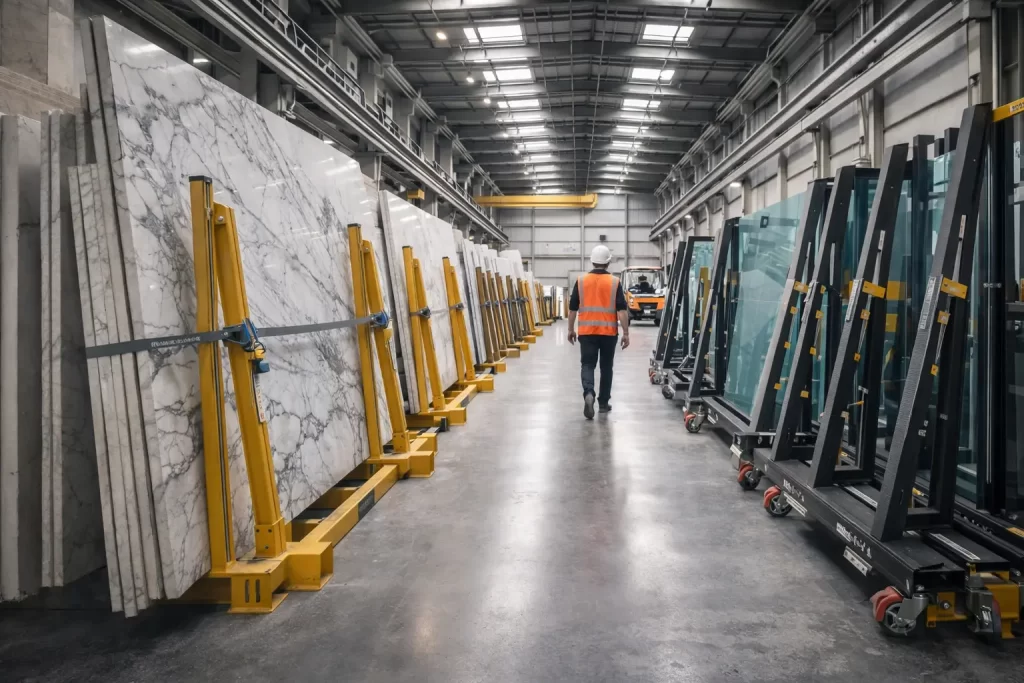
What Is an A-Frame Storage Rack?
An A-frame storage rack uses an A-shaped or inclined support structure to hold large slabs or panels in a controlled position. The structural geometry transfers load through the supporting members and base into the floor or supporting surface.
For a practical introduction to the product category, buyers can also review Speedone’s
A-Frame Storage Rack overview
and the complete
A-Frame Storage Rack product range.
The important point is that the A-shape alone does not establish load capacity. Actual performance depends on the complete system, including:
- base structure,
- uprights and cross members,
- steel grade,
- tube section and wall thickness,
- welded or bolted joints,
- gussets and reinforcement,
- load distribution,
- contact surfaces,
- restraint devices,
- and floor or installation conditions.
7 Specifications Buyers Should Define First
| Specification | What the Buyer Should Define |
|---|---|
| Material | Granite, marble, quartz, glass, porcelain, sintered stone or other panel material. |
| Maximum Slab Size | Length × height × thickness. |
| Maximum Total Load | Total weight expected on the complete rack or on each loading side. |
| Storage Type | Stationary storage or loaded transport. |
| Loading Arrangement | Single-sided, double-sided or model-specific configuration. |
| Restraint System | Safety poles, straps, bars or another engineered restraint method. |
| Operating Environment | Indoor, outdoor, humid, wet fabrication, coastal or other exposure. |
How to Calculate Stone Slab Weight
Before selecting rack capacity, estimate or verify the actual weight of the slabs that will be stored.
The density should come from the actual material supplier or another verified technical source because granite, marble, engineered quartz, glass and porcelain do not all have the same density.
For multiple slabs:
The rated capacity should then be compared with the complete loaded condition rather than the weight of only one slab.
What Does Rated Capacity Actually Mean?
A published capacity such as 10T, 20T or 30T only becomes useful when the buyer understands how the manufacturer defines it.
Before ordering, ask:
- Is the rating for the complete rack or each side?
- Is it a static storage rating?
- Does another rating apply during transport?
- What load distribution is assumed?
- What slab position or placement width is assumed?
- Was the rating established by engineering calculation, physical testing or both?
- Does the rating apply only to one specific rack configuration?
10T vs 20T vs 30T A-Frame Storage Racks
A larger nominal capacity is not automatically the better purchasing choice.
| Selection Question | Why It Matters |
|---|---|
| What is the verified maximum stored weight? | Capacity should match the real load rather than an arbitrary higher number. |
| How tall are the slabs? | A high-capacity rack can still be unsuitable if support geometry does not match slab height. |
| How wide is the loaded bundle? | Placement width affects rack geometry and warehouse footprint. |
| How will slabs be restrained? | Load capacity alone does not prevent shifting or collapse. |
| Is the rack stationary or mobile? | Transport introduces different operating forces and requirements. |
Real Speedone A-Frame Product Examples
Published Speedone models illustrate why buyers should compare configurations rather than using only one generic capacity number.
| Model | Published Capacity | Published Positioning |
|---|---|---|
| AJ-R | 20T | Heavy-duty A-frame slab rack with anti-slip positioning. |
| AJ-P | 20T | Safety poles, detachable design and rubber protection. |
| AJ-O | 30T | Adjustable safety poles and higher published loading capacity. |
| AJ-N | 20T | Adjustable safety poles, detachable structure and rubber protection. |
| AJ-L | 20T | Square-tube base, detachable link design and rubber protection. |
These published values are useful for initial comparison, but the final purchase should still use the current technical drawing and specification for the exact model and order configuration.
Steel Grade: Q235 vs Q345 vs Structural Design
Steel grade matters, but it is only one part of rack performance.
Different structural steels, including Q235, Q345 or other grades, may be appropriate depending on:
- section dimensions,
- wall thickness,
- rack geometry,
- joint design,
- weld quality,
- reinforcement,
- load distribution,
- and engineering calculations.
A buyer should therefore request the actual material specification rather than assuming that Q345 automatically makes one rack safer, or that Q235 is automatically unsuitable for every heavy-duty application.
Steel Thickness: Why There Is No Universal Minimum
Tube wall thickness is also important, but a statement such as “every heavy-duty rack must use 4–6 mm steel” is too simplistic.
A thicker tube changes structural performance, but capacity also depends on:
- tube width and height,
- steel grade,
- unsupported length,
- connection details,
- brace geometry,
- weld design,
- and where the actual load enters the structure.
Compare the complete technical drawing and rated configuration instead of purchasing from wall thickness alone.
What Is the Correct A-Frame Resting Angle?
There is no single universal “5–7 degree rule” that should automatically be applied to every A-frame storage rack.
The correct geometry depends on:
- rack design,
- slab height,
- slab thickness,
- placement width,
- contact surfaces,
- restraint system,
- and the manufacturer’s engineered loading condition.
Buyers should therefore ask for the designed rack geometry and technical drawing rather than changing the angle according to a generic internet recommendation.
Stone vs Glass: Contact Protection Matters
Different stored materials can require different contact protection.
| Material | Common Purchasing Considerations |
|---|---|
| Granite / Marble / Quartz | Edge protection, pressure distribution, friction, surface contact and slab restraint. |
| Glass | Surface protection, contact material, edge protection and restraint against shifting. |
| Porcelain / Sintered Stone | Panel size, edge sensitivity, support geometry and contact protection. |
Rubber, timber, felt or other interfaces should be selected according to the material and actual rack configuration rather than assuming one protection system is best for every application.

Storage A-Frame vs Transport A-Frame
One of the most important purchasing distinctions is whether the equipment remains stationary or carries slabs while being moved.
| Factor | Storage A-Frame | Transport A-Frame |
|---|---|---|
| Main Purpose | Stationary slab storage | Moving loaded slabs between locations |
| Primary Load Condition | Static/model-specific | Includes movement-related forces and model-specific dynamic conditions |
| Wheels | Model-specific | Common on mobile versions but model-specific |
| Restraints | Important to prevent shifting or collapse | Especially important while the loaded unit is moving |
| Selection Priority | Storage density, slab access, rated capacity and footprint | Movement path, floor condition, wheel system, restraint and dynamic rating |
For transport-oriented solutions, review Speedone’s
granite transport A-frame racks.
Restraints, Safety Poles and Slab Stability
A heavy slab leaning against an A-frame should not be treated as secure simply because gravity holds it against the support.
Depending on the rack and workflow, restraint solutions may include:
- adjustable safety poles,
- retaining bars,
- straps or tie-downs,
- secondary bracing,
- or another manufacturer-specified restraint arrangement.
The restraint system should prevent remaining slabs from shifting, sliding or collapsing when slabs are loaded, removed or repositioned.
OSHA-Based Slab Storage Safety Principles
For U.S. workplaces, buyers should distinguish between OSHA regulations and OSHA guidance. OSHA’s stone slab handling bulletin provides practical recommendations but is not itself a new product-certification standard.
Key principles include:
- Storage racks should be designed to withstand the actual loads and forces imposed on them.
- Slabs should be protected against shifting, sliding and collapse through suitable rack design, bracing or restraint systems.
- Rack components should be correctly installed.
- Storage racks should be inspected before loading.
- Cracked welds, bent members, structural damage and overload damage should be treated seriously.
- Damaged racks should not remain in service until properly addressed.
- Workers should remain outside areas where slabs could fall or topple.
For the underlying guidance, see the
OSHA Safety and Health Information Bulletin on granite, marble and stone slab handling.
Pre-Loading Inspection Checklist
- Confirm the rack model and rated configuration.
- Confirm the actual slab or bundle weight.
- Inspect the base for bending, impact damage or deformation.
- Inspect uprights and structural members.
- Inspect load-bearing welds and bolted joints.
- Confirm removable parts are fully installed and secured.
- Inspect safety poles, straps, bars or other restraints.
- Check rubber, timber or other contact protection where fitted.
- Check for evidence of previous overload or collision.
- Confirm the floor and installation area remain suitable.
- Keep personnel out of potential slab fall areas during handling.
Inspection frequency should follow the manufacturer’s instructions, site risk assessment, usage frequency and applicable workplace requirements rather than relying on one universal daily/monthly/annual schedule.
Powder Coating vs Galvanizing
Surface treatment should be selected according to the real operating environment.
| Factor | Powder Coating | Galvanizing |
|---|---|---|
| Protection Method | Polymer coating over prepared steel | Zinc-based protective layer |
| Appearance | Available in different colors depending on specification | Typical galvanized metallic finish |
| Selection Basis | Humidity, outdoor exposure, corrosion requirement, coating specification, maintenance, appearance and cost. | |
Do not assume that all powder coatings or all galvanized surfaces provide identical corrosion performance. Where corrosion resistance is important, request the actual coating process and measurable specification.
What Documents Should an A-Frame Supplier Provide?
Strong B2B purchasing decisions depend more on verifiable documentation than on marketing terms such as “heavy duty” or “premium steel.”
| Document / Evidence | Why It Matters |
|---|---|
| Technical Drawing | Confirms dimensions, geometry and structural configuration. |
| Rated Capacity Definition | Clarifies what the published tonnage actually represents. |
| Load-Test Evidence | Supports capacity claims where available. |
| Material Specification | Identifies the actual structural steel used. |
| Weld / Joint Information | Helps evaluate structural manufacturing quality. |
| Surface-Treatment Specification | Supports corrosion-resistance decisions. |
| Assembly Instructions | Important for detachable or knock-down structures. |
| Inspection / Maintenance Guidance | Supports long-term use and site inspection planning. |
Welded vs Knock-Down A-Frame Designs
Both welded and knock-down designs can be appropriate when correctly engineered.
A welded structure may reduce on-site assembly, while a knock-down design can reduce packing volume and simplify international transportation. However, a knock-down design should not automatically be assumed to have the same capacity as a welded rack unless the exact bolted structure has been designed and rated accordingly.
For a deeper discussion of factory capability, shipping and supplier evaluation, see Speedone’s
B2B guide to sourcing industrial A-frame storage racks.
Supplier Comparison Scorecard
| Evaluation Area | Score |
|---|---|
| Clear rated-capacity definition | 20 |
| Technical drawing and dimensions | 15 |
| Material and structural specification | 15 |
| Load-test / engineering evidence | 15 |
| Restraint and slab-protection design | 10 |
| Surface treatment appropriate to environment | 10 |
| Assembly / inspection documentation | 10 |
| Packaging and export planning | 5 |
| Total | 100 |
Common A-Frame Buying Mistakes
Buying by Tonnage Alone
Capacity is only meaningful when its exact loading condition is known.
Assuming Higher Steel Grade Automatically Means a Better Rack
Steel grade must be evaluated together with geometry, tube section, joints, welds and reinforcement.
Using a Universal Wall-Thickness Rule
Tube thickness alone does not establish rack capacity.
Copying a Universal Rack Angle
The correct geometry should come from the engineered product configuration rather than a generic 5–7° rule.
Confusing Storage Capacity with Transport Capacity
Loaded movement introduces different forces and should use a transport-rated configuration where applicable.
Ignoring Restraints
Slabs still require protection against shifting, sliding or collapse even when the rack itself has adequate structural capacity.
Assuming “OSHA Compliant” Is a Product Certification
OSHA guidance and applicable workplace requirements should be reviewed separately from manufacturer product claims.
Buying Without Technical Documentation
A quotation without dimensions, capacity definition, material information and a technical drawing makes meaningful supplier comparison difficult.

What Information Should You Send in an RFQ?
| Information | What to Provide |
|---|---|
| Material | Granite / marble / quartz / glass / porcelain / other |
| Maximum Slab Size | Length × height × thickness |
| Maximum Total Load | kg or tons |
| Placement Width | Required slab/bundle space on each side |
| Application | Stationary storage / transport |
| Handling Equipment | Forklift / crane / clamp / vacuum lifter / other |
| Environment | Indoor / outdoor / wet / humid / coastal |
| Restraint Requirement | Safety poles / straps / bars / supplier recommendation |
Frequently Asked Questions
What load capacity A-Frame Storage Rack do I need?
Calculate the maximum total stored load first, then choose a rack whose verified rated configuration is appropriate for that load, slab dimensions, placement width and storage arrangement.
How do I calculate slab weight?
Multiply slab length, height, thickness and verified material density using consistent units. Add the individual slab weights to calculate the total stored load.
Does a 20T rack mean 20T per side?
Not automatically. Ask whether the published rating applies to the complete rack, each side or another defined loading condition.
Is Q345 required for a heavy-duty A-frame?
No single steel grade should be treated as universally mandatory. Capacity depends on the complete structural design, including material grade, tube section, thickness, geometry, joints and reinforcement.
What is the best A-frame storage angle?
There is no universal angle that should be copied across every design. Use the geometry specified for the exact rack, slab dimensions and restraint system.
What is the difference between a storage A-frame and a transport A-frame?
A storage A-frame is primarily selected for stationary slab storage, while a transport A-frame must also account for forces created while the loaded equipment is moved.
Should I choose powder coating or galvanizing?
Choose according to environmental exposure, corrosion requirements, maintenance, appearance and the actual coating specification.
Does an A-frame need safety poles or straps?
The appropriate restraint depends on the product and workflow, but slabs should be protected against shifting, sliding and collapse using the rack design or suitable secondary restraints.
Is an A-frame storage rack OSHA certified?
OSHA does not provide a generic product certification for A-frame storage racks. U.S. workplaces should follow applicable regulations and relevant OSHA guidance for slab handling and storage.
What should I inspect before loading an A-frame?
Check structural members, welds, joints, restraints, removable components, contact surfaces, signs of deformation or overload, and the installation area before loading.
What documents should I request from a supplier?
Request the current technical drawing, rated-capacity definition, material specification, assembly guidance, restraint information and available engineering or load-test evidence.
How should I compare two A-frame suppliers?
Compare verified technical information and evidence—not only price, steel weight or marketing claims. Capacity definition, drawings, materials, structural design, restraints, surface treatment and documentation are particularly important.
References & Further Reading
- OSHA – Hazards of Transporting, Unloading, Storing and Handling Granite, Marble and Stone Slabs
- Speedone A-Frame Storage Rack Product Range
- Speedone B2B Guide to Sourcing Industrial A-Frame Storage Racks

Expert Commentary & Analysis
The most important purchasing mistake in A-frame storage is treating one specification—capacity, steel grade, tube thickness or angle—as proof of overall quality. These values only become meaningful when they are connected to the complete engineered configuration.
For professional B2B purchasing, the strongest evidence is a combination of a clearly defined rated load, technical drawing, material specification, restraint design, appropriate surface treatment and available test or engineering documentation.
A 30T rack is not automatically better than a 20T rack, Q345 is not automatically better for every structure than Q235, and a thicker tube does not automatically prove greater usable capacity. The correct product is the one whose complete specification matches the real slabs, warehouse workflow and loading condition.
Buyer takeaway: define the load and workflow first, then select the rack. Do not select the rack first and attempt to make the slabs fit afterward.