Get Your Work Done Efficiently !





Check seven A-Frame Storage Rack specifications before buying, including capacity, steel structure, base stability, rubber protection, coating and supplier QC.
A stone fabrication shop receives premium marble, granite, quartz and sintered stone slabs every week. The slabs are heavy, expensive and often fragile along edges and corners. At first, the warehouse uses simple welded frames to save equipment cost. After several months, problems appear: some racks bend slightly, rubber strips are missing, forklift operators struggle to access slabs, polished marble edges get chipped, and workers feel unsafe when moving large panels near crowded aisles.
This is why an A-Frame Storage Rack manufacturer should not be evaluated by price alone. A slab storage rack is not just a metal frame. It is a safety-critical storage system for heavy materials. Before buying, procurement teams should check capacity, steel structure, base design, support angle, rubber protection, movement design, surface coating, welding quality, warehouse layout and supplier documentation. One cracked marble slab or one unstable storage incident can cost more than the price difference between a cheap rack and a professional heavy-duty rack.
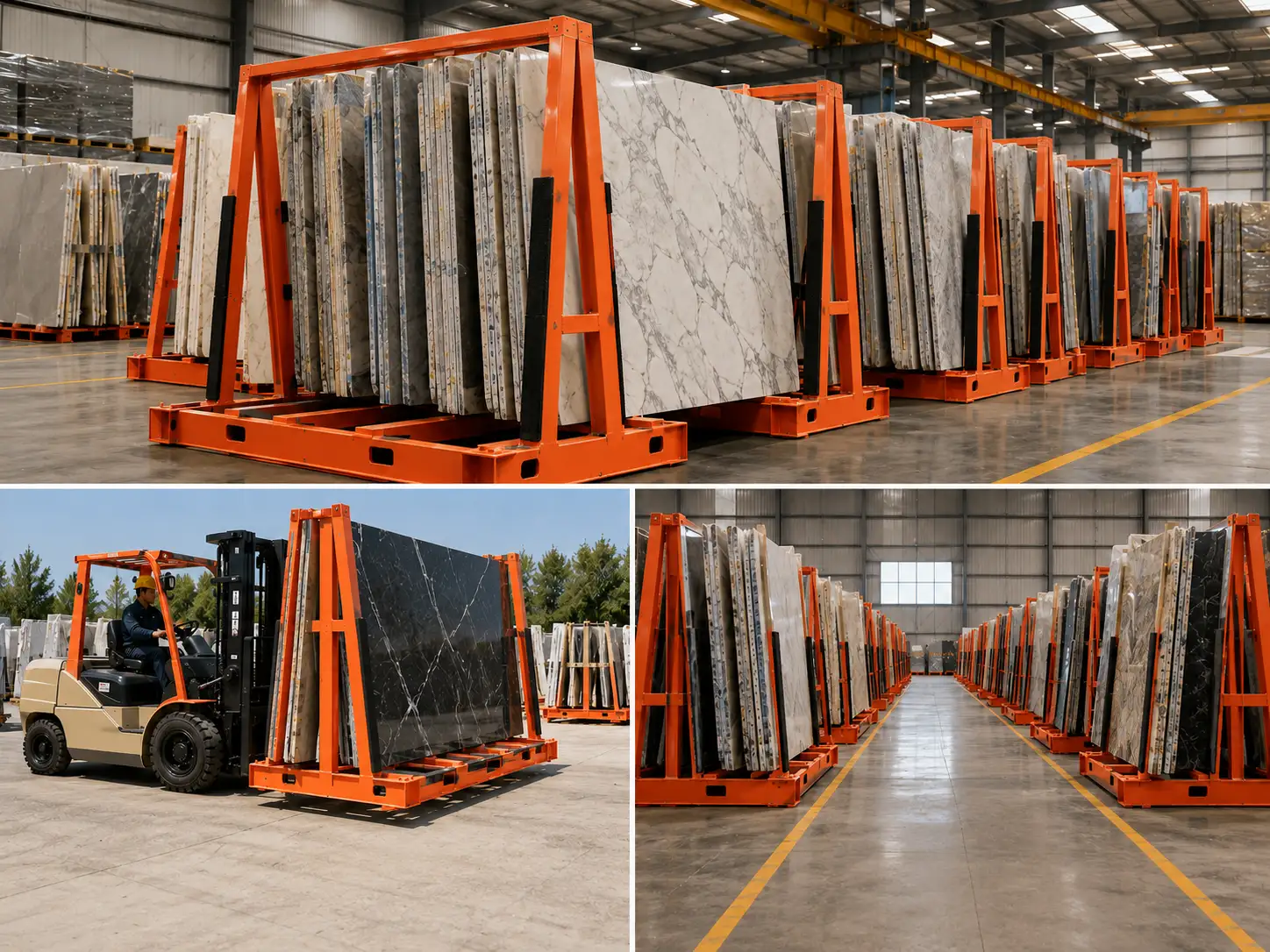
High-quality A-Frame Storage Rack
Why A-Frame Storage Rack Specifications Matter Before Purchase
Stone slabs are not easy warehouse goods. A single full-size marble, granite or quartz slab can weigh hundreds of kilograms depending on size, thickness and material density. When multiple slabs lean on one rack, the total load may reach several tons. If the rack has weak steel, poor welds, a narrow base or missing rubber contact points, the warehouse may face rack deformation, slab sliding, scratches, edge chips, forklift collision risk or unsafe operator behavior.
Before approving a rack order, buyers should prepare slab material, slab size, slab thickness, maximum slab weight, storage quantity per rack, indoor or outdoor use, forklift access, rack spacing and surface treatment requirements. For projects that need drawings, capacity clarification or export packing information, buyers can contact an A-Frame Storage Rack supplier with warehouse layout and slab data before confirming specifications.
| Specification | Why It Matters | Buyer Risk | What to Confirm |
|---|---|---|---|
| Load capacity | Prevents rack overload | Rack deformation or collapse | Rated load and real slab weight |
| Steel structure | Controls frame strength | Bending and unstable storage | Tube size and wall thickness |
| Base design | Controls stability | Rack tipping or floor pressure | Base width and support points |
| Support angleSupport angle | Controls slab leaning safety | Slab sliding or edge stress | Rack angle and slab contact |
| Prevents slab scratches | Marble or quartz edge damage | Rubber thickness and placement | |
| Detachable or movable design | Controls warehouse efficiency | Difficult handling | Forklift pockets and assembly |
| Surface treatment | Prevents corrosion | Short service life | Powder coating or galvanizing |
What Is an A-Frame Storage Rack?
How A-Frame Racks Store Heavy Stone Slabs
An A-Frame Storage Rack is a steel storage frame designed to hold stone slabs in a leaning position. The A-shaped structure supports slabs on one or both sides while the base carries vertical load and controls stability. It is commonly used for marble, granite, quartz, quartzite, sintered stone, porcelain panels and other large sheet materials.
The principle looks simple, but the engineering matters. The rack must balance slab weight, leaning angle, support height, base width, floor contact, forklift access and slab surface protection. A professional stone slab A-Frame Storage Rack should help warehouses store materials in an organized way while reducing unnecessary slab movement, edge damage and unsafe temporary leaning.
Common Applications in Stone Fabrication and Warehousing
A-frame racks are used in stone slab warehouses, granite processing factories, marble import yards, quartz countertop fabrication shops, showroom slab display areas, container loading preparation zones, project material staging areas, distribution centers and outdoor stone yards. The best rack design depends on slab type, warehouse workflow, loading method and daily handling frequency.
| Application Area | Rack Requirement | Buyer Priority |
|---|---|---|
| Stone factory | Heavy daily use | Capacity and welding quality |
| Marble warehouse | Surface protection | Rubber pads and stable angle |
| Quartz slab shop | Edge protection | Rack spacing and base stability |
| Outdoor slab yard | Weather resistance | Galvanizing or strong coating |
| Showroom | Clean appearance | Finish and layout |
| Export staging | Forklift access | Base and handling design |
Specification 1: Rated Load Capacity
Why Load Capacity Is the First Specification
Load capacity is the first specification buyers should check because slab weight is the direct force acting on the rack. A rack should not be selected by appearance or general product photos. It should be selected by actual slab weight, maximum slab count, rack design and safety margin.
Buyers should confirm rated capacity per rack, capacity per side, maximum slab count, slab thickness, average slab weight, maximum slab weight, load label and supplier engineering basis. A rack used for lightweight showroom display should not be treated the same as a rack storing multiple 30 mm granite slabs. For stone fabricators who need a complete purchasing framework, an A-Frame Storage Rack buying guide for stone fabricators is useful because it links slab type, load capacity, rack structure, shop layout and supplier checks into one decision process.
Slab Weight Estimation Table
Exact slab weight depends on density, slab length, width and thickness. Buyers should calculate real weight whenever possible. The following table gives a practical risk direction for procurement teams.
| Slab Material | Typical Thickness | Approx. Weight Concern | Buyer Check |
|---|---|---|---|
| Marble slab | 18–20 mm | Medium-heavy | Confirm slab size and density |
| Granite slab | 20–30 mm | Heavy | Add capacity margin |
| Quartz slab | 20–30 mm | Heavy and dense | Confirm storage quantity |
| Sintered stone | 12–20 mm | Large and fragile | Check edge support |
| Porcelain slab | 6–12 mm | Lighter but brittle | Improve protection |
| Mixed slabs | Varies | Hard to estimate | Use maximum load case |
Specification 2: Steel Tube Size and Wall Thickness
Why Frame Structure Determines Service Life
The steel structure carries repeated heavy loads, forklift impact risk and long-term warehouse stress. A low-cost rack may look acceptable when empty, but the weakness appears after months of daily use. Thin wall tubes can bend. Poorly reinforced bases can twist. Weak connection plates can loosen. Bad welding can crack under repeated slab loading.
Buyers should check main tube size, wall thickness, steel grade, base tube design, cross bracing, connection plates, load-bearing direction, reinforcement points and welding areas. A heavy-duty rack should feel stable when loaded and should remain aligned after repeated use.
Steel Structure Comparison Table
| Structure Item | Low-Cost Risk | Better Specification Direction |
|---|---|---|
| Main tube | Bending under load | Larger square tube or reinforced frame |
| Wall thickness | Deformation | Adequate thickness for rated load |
| Base tube | Poor stability | Wider and stronger base |
| Cross brace | Frame shaking | Reinforced connection |
| Connection plate | Weak joint | Thick plate and full weld |
| Welding area | Crack risk | Continuous and clean welds |
Specification 3: Base Width Footprint and Stability
Why Base Design Prevents Tipping
The base carries slab weight and controls the rack’s stability. A narrow or weak base increases tipping risk, especially when slabs are loaded unevenly or when forklifts move nearby. The base must support the leaning force of multiple slabs while maintaining floor contact and preventing rack shift.
Buyers should check base width, base length, floor contact area, anti-slip feet, anchor holes where needed, cross-base connection, load distribution, left-right balance, warehouse floor strength and forklift traffic clearance. A rack used in a busy fabrication shop needs a stronger base than a light display rack.
Warehouse Layout and Rack Spacing
Even a strong rack can become risky if the warehouse layout is poor. Buyers should plan forklift aisle width, crane access, emergency walkways, slab picking direction, rack spacing, loading sequence, material category zones, heavy slab positions, operator visibility and floor flatness before placing the rack order.
| Layout Factor | Why It Matters | Buyer Action |
|---|---|---|
| Aisle width | Forklift safety | Match forklift turning radius |
| Floor flatness | Rack stability | Inspect warehouse floor |
| Rack spacing | Slab access | Avoid narrow picking zones |
| Load balance | Prevents leaning risk | Distribute slabs evenly |
| Traffic path | Prevents impact | Separate forklift lanes |
| Emergency access | Workplace safety | Keep walkways clear |
Specification 4: Slab Support Angle and Contact Design
Why Leaning Angle Matters
Stone slabs are stored leaning against the A-frame. If the angle is too steep, slabs may stand too upright and feel unstable. If the angle is too shallow, the rack footprint becomes large and warehouse density decreases. The correct angle helps support slabs safely while keeping the warehouse efficient.
Buyers should check support angle, slab contact height, back support position, base stop design, bottom contact protection, slab leaning direction, edge clearance, support symmetry and compatibility with different slab sizes. The rack should support slabs consistently rather than creating point pressure on fragile edges or polished surfaces.
Support Angle and Slab Risk Table
| Rack Design Issue | Possible Risk | Buyer Decision |
|---|---|---|
| Too narrow leaning angle | Slabs may stand too upright | Check stability |
| Too wide footprint | Wastes warehouse space | Review layout |
| No bottom stop | Slab sliding risk | Add base protection |
| Poor contact height | Uneven slab pressure | Confirm slab size fit |
| Uneven support | Point stress | Use continuous protection |
| No angle consistency | Difficult loading | Check manufacturing accuracy |
Specification 5: Rubber Protection and Slab Contact Surfaces
Why Rubber Protection Is Critical for Marble Granite and Quartz
Stone slabs may be strong under compression but vulnerable at edges, corners and polished faces. Direct metal contact can scratch, chip or mark marble, quartz, granite, porcelain and sintered stone. Rubber strips, bottom pads and protective contact points are not cosmetic details. They protect expensive material value.
When buyers study how to choose an A-Frame Storage Rack for stone slab storage, rubber protection should be checked together with load capacity and base stability. A high-capacity rack without proper contact protection may still damage premium slabs during daily loading and unloading.
Material Protection Table
| Stone Type | Main Damage Risk | Rack Protection Needed |
|---|---|---|
| Polished marble | Scratches and edge chips | Soft rubber contact |
| Granite slabs | Corner damage | Strong base rubber |
| Quartz slabs | Edge chipping | Continuous support strip |
| Sintered stone | Brittle edge | Wider contact protection |
| Porcelain panels | Crack risk | Even support and padding |
| Mixed slabs | Different thicknesses | Adjustable or generous support |
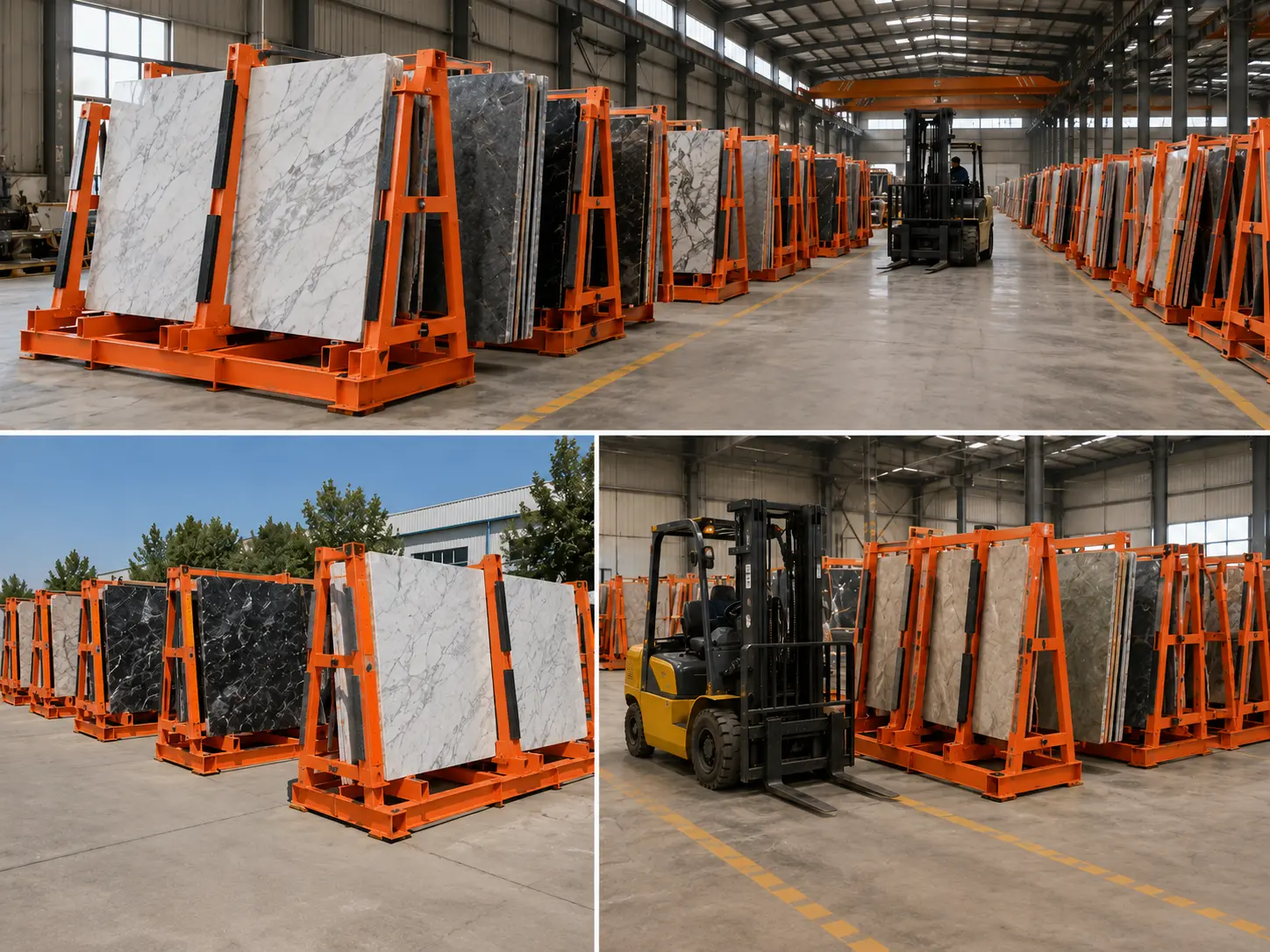
A-Frame Storage Rack Provider
Specification 6: Detachable Movable or Fixed Design
How Rack Design Affects Warehouse Efficiency
A-frame racks can be fixed, detachable or movable depending on warehouse workflow. Fixed racks are stable and suitable for permanent slab storage. Detachable racks can reduce shipping volume and improve layout flexibility. Movable or forkliftable racks are useful when material needs to move between cutting, polishing, staging and packing zones.
Buyers should check detachable link design, bolt strength, assembly time, forklift pockets, lifting points, wheel option if applicable, transport efficiency, spare parts, replacement bolts and structural stability after assembly. A rack that saves freight but becomes weak after repeated assembly is not a good investment.
Fixed vs Detachable vs Movable Rack Comparison
| Rack Type | Best Use | Advantages | Buyer Risk |
|---|---|---|---|
| Fixed A-frame rack | Permanent warehouse storage | Strong and stable | Less flexible |
| Detachable A-frame rack | Shipping and flexible layout | Saves freight and space | Assembly quality needed |
| Movable A-frame rack | Factory workflow | Easier transfer | Must control floor and load |
| Forkliftable rack | Warehouse handling | Faster movement | Base strength required |
| Custom rack | Special slabs | Application-specific | Needs accurate drawings |
Specification 7: Surface Treatment Welding Quality and Supplier Documentation
Surface Treatment for Indoor and Outdoor Use
Surface treatment affects service life. Indoor racks may use paint or powder coating. Outdoor yards, humid warehouses or coastal environments may need stronger anti-corrosion treatment. Buyers should check coating thickness, paint adhesion, galvanized option, anti-rust primer, surface smoothness, color coding, coating damage after shipping, outdoor weather exposure and maintenance plan.
Surface finish should also protect workers and slabs. Sharp edges, weld spatter and rough contact surfaces should be avoided. If the rack is used around premium marble or polished quartz, clean and controlled finishing becomes more important.
Welding Quality and Inspection Documents
Welding quality is critical because the rack carries heavy angled loads. Poor welding can crack, deform or fail under repeated use. Buyers should review continuous welds, visible cracks, undercut, weld spatter, reinforced corners, weld penetration, inspection photos, load rating labels, production drawings, packing photos, user guidance and warranty terms.
| QC Item | Buyer Risk | Inspection Method |
|---|---|---|
| Weld continuity | Joint failure | Visual inspection |
| Tube thickness | Frame bending | Measurement |
| Coating coverage | Rust | Surface check |
| Rubber placement | Slab damage | Contact inspection |
| Base flatness | Rack instability | Floor contact check |
| Load label | Misuse | Capacity marking |
| Packing quality | Shipping damage | Crate and photo review |
How to Choose A-Frame Storage Rack by Stone Type
Marble Slabs
Marble slabs need surface and edge protection. Buyers should prioritize rubber contact, stable leaning angle, clean support surfaces and careful loading access. Premium marble may contain natural veins and fissures, so point pressure and direct metal contact should be avoided.
Granite Slabs
Granite slabs are dense and heavy. Buyers should prioritize high load capacity, reinforced steel structure, strong base design and clean welding. A heavy duty stone A-Frame Rack for granite slab storage should be reviewed by real slab weight, rack capacity, steel frame design, base stability and transport method.
Quartz Slabs
Quartz slabs are often consistent but heavy. They need stable support, organized spacing and continuous contact protection. Because quartz is frequently used for countertop fabrication, slab edge condition affects finished product value.
Sintered Stone and Porcelain Panels
Sintered stone and porcelain panels can be large and brittle. Buyers should prioritize wider contact surfaces, gentle handling, even support and rack spacing that allows operators to remove panels without twisting or impact.
| Material | Storage Priority | Best Rack Feature |
|---|---|---|
| Marble | Scratch and edge protection | Rubber protected frame |
| Granite | Heavy load capacity | Reinforced steel base |
| Quartz | Edge safety | Continuous contact support |
| Sintered stone | Brittle panel handling | Wide support angle |
| Porcelain panel | Crack prevention | Soft pads and even support |
Safety and Compliance Considerations
Workplace Safety in Slab Storage Areas
Stone slab storage involves heavy materials and serious handling hazards. Buyers should follow local workplace safety rules, warehouse safety policies, operator training requirements and equipment usage instructions. The rack should support safe behavior through clear load labels, stable structure, accessible layout and routine inspection.
Safety topics include no overloading, balanced loading, personal protective equipment, forklift operation rules, no standing in pinch zones, clear aisles, floor inspection, rack inspection schedule, damaged rack removal, operator training and emergency procedures. The goal is not only to buy a rack but to build a safer slab storage process.
Rack Inspection Schedule
| Inspection Frequency | What to Check | Action |
|---|---|---|
| Daily | Visible damage, loose slabs, blocked aisles | Correct before work |
| Weekly | Rubber pads, bolts, rack balance | Replace or tighten |
| Monthly | Welds, corrosion, base condition | Maintenance review |
| After impact | Forklift collision damage | Remove from service if unsafe |
| Before heavy loading | Capacity and slab count | Confirm load limit |
Cost Analysis: Cheap Rack vs Heavy-Duty Rack
Why Lowest Price Can Be Expensive
Low rack price can hide weak steel, thin tube walls, poor welding, unstable base design, missing rubber protection, weak coating and poor packing. The hidden cost may appear later through slab breakage, edge chipping, scratched surfaces, rack deformation, forklift damage, production delay, warehouse accidents, replacement rack cost and customer complaints.
A better rack may cost more at the beginning, but it can protect high-value materials and support safer daily operation. For stone fabricators, the rack should be evaluated as a material-handling asset, not a simple welded commodity.
Total Cost of Ownership Table
| Cost Area | Cheap Rack Risk | Heavy-Duty Rack Value |
|---|---|---|
| Initial purchase | Lower price | Higher upfront cost |
| Slab protection | Higher damage risk | Better rubber and support |
| Service life | Shorter | Longer |
| Safety | Lower confidence | Better stability |
| Maintenance | More repair | Lower replacement frequency |
| Warehouse efficiency | Unstable workflow | Better handling |
Supplier Selection Checklist for A-Frame Storage Rack Buyers
What a Reliable Supplier Should Provide
A reliable supplier should provide rated capacity, rack drawings, steel tube specification, wall thickness, base size, rack dimensions, rubber strip details, surface treatment details, welding photos, inspection photos, packing photos, user guidance, load label, customization options, detachable design options, MOQ information, lead time, warranty and after-sales support.
RFQ Checklist for Buyers
Before requesting pricing, buyers should provide stone type, slab size, slab thickness, maximum slab weight, number of slabs per rack, indoor or outdoor use, warehouse floor condition, forklift access requirement, fixed or detachable preference, color preference, surface treatment requirement, rubber protection requirement, rack dimension limit, quantity, destination port, packing requirement, inspection requirement, budget and delivery timeline.
| RFQ Item | Why It Matters | Buyer Requirement |
|---|---|---|
| Slab material | Controls load and protection | Marble, granite, quartz, porcelain or mixed slabs |
| Slab size and thickness | Controls rack dimensions | Length, height, thickness and weight |
| Storage quantity | Controls total load | Number of slabs per rack or per side |
| Warehouse condition | Controls coating and base design | Indoor, outdoor, humid or forklift-heavy site |
| Handling method | Controls access and structure | Forklift, crane, clamp or vacuum lifter |
| Rack type | Controls efficiency | Fixed, detachable, movable or custom |
Common Buyer Mistakes
Mistake 1: Buying by Rack Price Only
Cheap racks may use weaker steel, thinner wall thickness, poor welds, unstable base design or insufficient slab protection. Buyers should compare capacity, tube size, welding, rubber contact, coating and documentation before comparing price.
Mistake 2: Ignoring Real Slab Weight
Rack overload can happen when buyers estimate slab weight casually. Calculate slab weight by material, size and thickness, then check rated load per side and total rack capacity.
Mistake 3: Ignoring Rubber Protection
Missing rubber protection can cause scratches, edge chips and customer complaints. Buyers should confirm rubber thickness, contact location, replaceability and bottom support protection.
Mistake 4: Choosing the Wrong Rack Type
A fixed rack may be stable but inflexible. A detachable rack may save freight but needs correct assembly. A movable rack may improve workflow but requires strong base design and good floor condition. Choose rack type by workflow, not by appearance.
Mistake 5: Skipping Welding and Packing Inspection
Poor welds can create structural risk, while weak packing can damage racks during transport. Buyers should request production photos, welding inspection photos and packing photos before shipment.
Industry Trends in A-Frame Storage Rack Sourcing
Stone Warehouses Prefer Heavy-Duty Safety-Oriented Racks
More buyers are moving away from thin, low-cost racks toward stronger systems with clearer load ratings, stronger bases and better safety features.
Detachable A-Frame Racks Are Growing for Export Buyers
Detachable designs can reduce shipping volume and improve warehouse flexibility. However, buyers must confirm connection strength, bolt quality and assembly accuracy.
Rubber Protection Is Becoming a Standard Requirement
More buyers demand rubber pads and slab-contact protection for premium marble, quartz, sintered stone and polished stone slabs.
Warehouse Layout Planning Is Becoming Part of Rack Purchasing
Buyers increasingly consider forklift aisle width, slab picking direction, rack spacing, loading sequence and operator safety before ordering racks.
Documentation and Inspection Photos Matter More
International buyers want drawings, load ratings, production photos, welding inspection and packing photos before shipment. This reduces disputes and improves purchasing confidence.
Final Recommendation: Buy the Rack That Protects the Slab and the Worker
An A-Frame Storage Rack should be selected by rated load capacity, steel tube structure, base stability, support angle, rubber protection, detachable or movable design, surface treatment, welding quality and supplier documentation. The safest rack is not simply the heaviest-looking rack. It is the rack that matches real slab weight, slab value, warehouse layout and daily handling method.
Before requesting A-Frame Storage Rack pricing, prepare your slab material, slab size, slab thickness, maximum slab weight, number of slabs per rack, indoor or outdoor use, warehouse layout, forklift handling requirement, rack type preference, surface treatment requirement and destination. A professional A-Frame Storage Rack supplier can recommend a safer rack specification that protects slabs and improves warehouse efficiency.
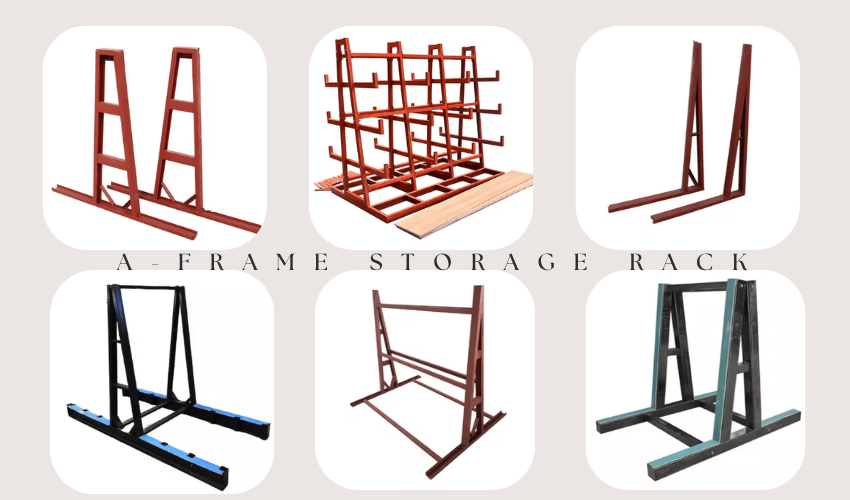
Wholesale A-Frame Storage Rack
Frequently Asked Questions About A-Frame Storage Rack Specifications
1. What is an A-Frame Storage Rack used for?
An A-Frame Storage Rack is used to store marble, granite, quartz, quartzite, sintered stone, porcelain panels and other large slabs in a safer and more organized leaning position. It is commonly used in stone factories, slab warehouses, countertop fabrication shops, showrooms, project staging areas and outdoor stone yards. The rack helps reduce floor clutter, improve slab visibility, protect slab edges and support safer forklift or crane handling.
2. How much weight can an A-Frame Storage Rack hold?
The weight capacity of an A-Frame Storage Rack depends on steel structure, tube size, wall thickness, base design, welding quality, rack dimensions and supplier rating. Some heavy-duty racks may be designed for multi-ton slab loads, but buyers should never assume capacity without confirmation. Before buying, calculate real slab weight by material, size and thickness, then confirm rated load per side and total load with the supplier.
3. What specifications should I check before buying a slab storage rack?
Before buying a slab storage rack, check rated load capacity, steel tube size, wall thickness, base width, support angle, rubber protection, bottom stop design, forklift access, detachable or fixed structure, surface treatment, welding quality, inspection photos, packing method and supplier documentation. These specifications affect slab safety, warehouse efficiency, service life and total ownership cost.
4. Is rubber protection necessary for an A-Frame Storage Rack?
Yes, rubber protection is necessary for most stone slab storage applications because direct metal contact can scratch polished marble, chip quartz edges, mark granite surfaces or damage fragile porcelain and sintered stone panels. Buyers should confirm rubber strip thickness, rubber placement, bottom pad protection, replaceability and contact coverage. Proper rubber protection can reduce customer complaints and material loss.
5. How do I choose an A-Frame Storage Rack supplier?
Choose an A-Frame Storage Rack supplier that can provide clear drawings, rated load information, steel tube specifications, wall thickness details, rubber protection design, welding quality control, surface treatment options, inspection photos, export packing photos, customization support, lead time, warranty and after-sales communication. A reliable supplier should ask about slab type, slab size, slab thickness, storage quantity, warehouse layout and handling method before recommending a rack.
References
- Slab Handling and Storage Safety Guidelines, Author: Stone Industry Safety Contributors, Institution: Natural Stone Institute, Source: Stone Safety Reference.
- Dimension Stone Design Manual, Author: Natural Stone Institute Technical Contributors, Institution: Natural Stone Institute, Source: Natural Stone Handling and Installation Reference.
- Occupational Safety Guidance for Material Handling, Author: OSHA Technical Contributors, Institution: Occupational Safety and Health Administration, Source: Workplace Safety Reference.
- Steel Structure Fabrication and Welding Quality Guidance, Author: Structural Fabrication Contributors, Institution: Steel Construction Technical Publications, Source: Welded Steel Frame Reference.
- Warehouse Material Handling Equipment Planning Guide, Author: Industrial Logistics Contributors, Institution: Material Handling Industry Publications, Source: Warehouse Equipment Reference.
- Forklift Operation and Load Handling Guidance, Author: Industrial Truck Safety Contributors, Institution: Material Handling Safety Publications, Source: Forklift Handling Reference.
- Corrosion Protection for Steel Equipment, Author: Coating Technology Contributors, Institution: Industrial Coating Technical Publications, Source: Surface Treatment Reference.
- Quality Management Systems Requirements, Author: ISO Technical Committee Contributors, Institution: International Organization for Standardization, Source: Quality Management Reference.
How Buyers Should Evaluate A-Frame Storage Rack Specifications
How should buyers start choosing an A-Frame Storage Rack?
Buyers should start with slab material, slab dimensions, slab thickness, maximum slab weight, number of slabs per rack, warehouse layout, forklift access and indoor or outdoor use. These details determine capacity, base size, steel structure and protective contact requirements.
Why is rated load capacity the first decision point?
Rated capacity prevents overload. Stone slabs can weigh hundreds of kilograms each, and multiple slabs can create several tons of load. Buyers should confirm whether the rating applies to one side or the total rack.
What option works best for granite and quartz slab storage?
For granite and quartz slabs, prioritize heavy-duty steel structure, reinforced base design, strong welding, stable leaning support and verified load rating. These materials are dense and require more capacity margin.
For marble, porcelain and sintered stone, prioritize rubber strips, bottom pads, wider contact surfaces, smooth weld finishing and stable angle design. These materials require protection against scratches, chips and point stress.
Consideration: What creates the highest rack purchasing risk?
The highest risks come from buying by price only, ignoring real slab weight, accepting weak welding, skipping rubber protection, choosing the wrong rack type and placing racks in unsafe warehouse layouts.
Recommendation
Select the rack by safety, slab protection and workflow efficiency. Confirm drawings, steel specifications, load rating, rubber contact, surface treatment, inspection photos and packing before shipment.
Send your supplier the slab type, size, thickness, storage quantity, layout plan, forklift method and destination. A qualified A-Frame Storage Rack supplier can recommend a safer specification for your stone warehouse.

Henry
Hi, I’m the author of this post, and I have been in this field for more than 16 years. If you need OEM&ODM service for stone tools, feel free to ask me any questions.