Get Your Work Done Efficiently !





Inefficient slab transport can become a hidden production bottleneck in stone factories. Workers may spend valuable time moving full slabs, repositioning cut pieces, waiting for lifting equipment, or manually carrying finished countertops between workstations. A professional transport system uses different equipment for different stages, such as A-frame carts, self-locking trolleys, slab transport carts, transfer tables and countertop installation carts. The correct solution should be selected according to slab dimensions, load weight, travel distance, factory layout, floor conditions and production workflow.
The Slab Transport Bottleneck: How to Reduce Hidden Handling Costs
Stone fabrication factories invest heavily in cutting machines, CNC equipment, polishing systems, tooling and skilled employees.
But one of the most important parts of the production process often receives much less attention:
How does the stone actually move between each production stage?
A slab may arrive at the factory by truck or container, move into storage, travel to inspection, continue to cutting, move again for edge processing or polishing, and finally travel to packaging, loading and installation.
Every one of these movements takes time.
If the factory relies too heavily on improvised manual movement, poorly matched carts or repeated lifting operations, slab transport can quietly become one of the largest hidden bottlenecks in the workshop.
The problem is not simply that stone is heavy.
The real issue is that granite, marble, quartz, porcelain and sintered stone often combine substantial weight with large dimensions, vulnerable finished edges and limited safe gripping points.
This guide explains how to identify slab transport bottlenecks, compare different transport equipment and build a more logical material-flow system throughout the stone factory.
 |
 |
| Speedone slab transport equipment for stone factories and fabrication workshops | |
Why Slab Transport Becomes a Hidden Factory Cost
Material movement does not directly cut, polish or finish stone, but production cannot continue without it.
This creates a simple operational problem:
The more time skilled employees spend moving material, the less time they spend producing finished products.
Transport inefficiency may appear in several forms:
- Several employees are required for one movement.
- Workers wait for a forklift or crane.
- Slabs travel through the same aisle several times.
- Finished pieces are repeatedly lifted and repositioned.
- The wrong cart is used for the load.
- Production areas become congested with temporary material.
- Large pieces are moved manually because suitable equipment is unavailable.
- Finished countertops are handled like raw slabs even though they require different support.
Each event may appear small, but repeated across dozens of jobs every week, the cumulative effect can be significant.
The Four Main Costs of Inefficient Slab Transport
| Hidden Cost | How It Appears | What to Measure |
|---|---|---|
| Labor | Multiple employees repeatedly moving slabs and pieces | Labor minutes per transport task |
| Production Delay | Machines wait for material to arrive or leave | Machine waiting time |
| Material Damage | Chips, scratches, cracks or finished-edge damage | Transport-related damage incidents |
| Workflow Congestion | Carts, slabs and finished pieces block aisles or machines | Travel routes and staging delays |
1. Labor Cost: When Skilled Fabricators Become Material Movers
Skilled stone workers are valuable because they understand fabrication, finishing, measurement, installation and quality control.
When several experienced employees must stop production every time a large stone piece needs to move, part of that valuable labor is being redirected to internal logistics.
A simple way to calculate this hidden cost is:
Monthly Transport Labor Cost = Average Transport Time × Number of Workers × Number of Moves × Hourly Labor Cost
This formula can reveal whether buying a purpose-designed transport cart has a realistic operational justification.
Do not estimate from memory. Track the actual movements for several days.
2. Material Damage During Transport
A slab can be fabricated correctly and still become unusable after an uncontrolled handling event.
Transport-related damage may include:
- Chipped corners.
- Scratched polished surfaces.
- Cracks around sink openings.
- Broken narrow rails.
- Edge impact.
- Contact damage between two finished pieces.
The risk changes throughout production.
A full raw slab and a finished countertop are not the same handling problem.
The finished component may have polished edges, holes, cutouts and thin sections that make the transport method even more important.
3. Production Machines Waiting for Material
A high-speed bridge saw or CNC machine cannot create value when it is waiting for the next slab.
Factories often evaluate cutting speed but overlook the time between jobs.
For example:
Job finished → operator waits → slab located → crane becomes available → slab moves through aisle → slab positioned → next job begins.
If this sequence regularly creates delays, increasing cutting-machine speed may not solve the real bottleneck.
The transport workflow should therefore be evaluated together with machine utilization.
4. Excessive Slab Movement
The shortest material-handling route is not always possible, but repeated backtracking usually indicates a layout problem.
A slab should ideally move through a logical sequence:
Receiving → Storage → Staging → Cutting → Fabrication → Inspection → Packaging → Loading
If a slab repeatedly crosses the same aisle or returns to the same storage area, the layout may need improvement.
Manual Handling vs Purpose-Designed Slab Transport Equipment
Manual handling remains part of stone fabrication, particularly for smaller pieces and final positioning.
However, larger materials should not automatically be moved manually simply because “this is how the shop has always done it.”
| Factor | Manual Movement | Purpose-Designed Transport Equipment |
|---|---|---|
| Labor Requirement | May require multiple workers | May reduce unnecessary manual carrying when properly selected |
| Load Support | Depends heavily on worker positioning | Designed around a defined support structure |
| Repeatability | Varies by team and technique | Creates a more repeatable handling method |
| Best Use | Small adjustments and light components | Repeated internal transport of suitable stone loads |
The SPEEDONE Approach: Use the Right Tool for Each Transport Stage
There is no single slab transport cart that is ideal for every part of the stone-processing workflow.
A full raw slab, a cut countertop, a piece being positioned on a worktable and a finished countertop entering a customer’s home all have different handling requirements.
For this reason, a more professional approach is to build a slab transport system rather than purchase one cart and expect it to solve every movement problem.
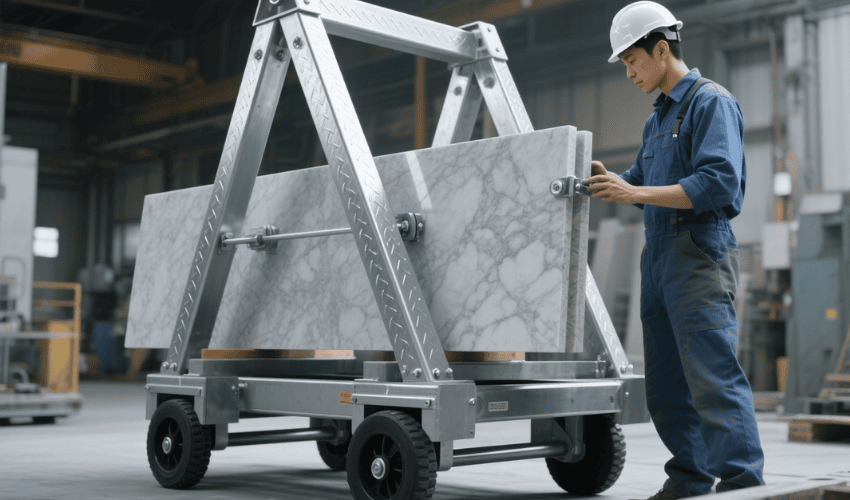
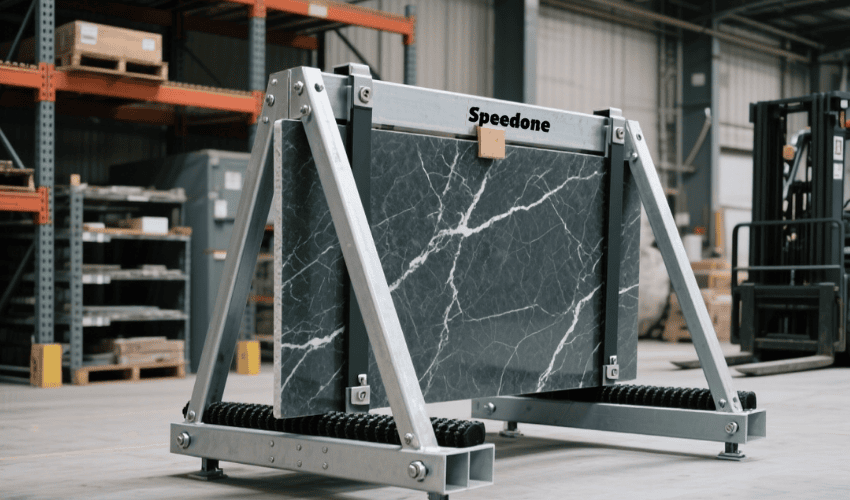
Speedone offers multiple categories of equipment for different stages of stone handling. Buyers can review the broader range of slab transport carts when planning the complete workflow.
 |
 |
Stage 1: Moving Full Slabs
The first major transport challenge is moving full slabs between receiving, storage and production.
Full slabs combine high weight with large surface area, so stability, load support and travel path should be considered before movement begins.
An A-frame style cart can be useful where slabs need vertical or inclined support during internal transport.
The Speedone A-Frame Metal Cart is designed for applications where stone or panel materials require mobile A-frame support.
Before using any transport cart, verify:
- Rated capacity.
- Maximum load dimensions.
- Load orientation.
- Wheel capacity.
- Floor condition.
- Travel distance.
- Door and aisle clearance.
- Method used to load and unload the cart.
Stage 2: Moving and Positioning Slabs Inside the Workshop
Once a slab reaches fabrication, the movement problem changes.
Operators may need to transfer material between:
- Bridge saws.
- CNC machines.
- Fabrication tables.
- Polishing stations.
- Inspection areas.
At this stage, maneuverability may become as important as capacity.
The Speedone Self-Locking Trolley can be considered for suitable panel and stone transport applications where controlled support and mobile positioning are required.
Self-locking or clamping-style equipment should always be matched to the load dimensions, weight and intended orientation.
Stage 3: Workstation Movement and Positioning
Not every transport problem involves moving material across the whole factory.
Sometimes the challenge is repositioning a large countertop or stone piece on the fabrication table.
Dragging heavy material across the work surface can create unnecessary effort and may risk surface contact.
A transfer surface can help operators reposition suitable pieces with less direct sliding resistance.
The Universal Ball Transfer Table is designed for this type of workstation movement.
It can be useful during fabrication processes where stone components need to be rotated, repositioned or transferred across a work area.
Stage 4: Moving Cut Pieces Around the Factory
After primary cutting, factories may have several pieces instead of one full slab.
The individual components may be lighter than the original slab but still large enough to require purpose-designed transport equipment.
The 500kg–1500kg Foldable Stone Slab Trolley is intended for suitable stone, glass and sheet-material transport applications.
A foldable design can also help workshops where equipment-storage space is limited when the trolley is not in use.
Stage 5: Finished Countertop Transport
Finished countertops require a different handling approach from raw slabs.
A fabricated piece may contain:
- Polished edges.
- Sink cutouts.
- Cooktop openings.
- Faucet holes.
- Narrow stone rails.
- Finished surfaces.
These features can make the component more vulnerable during movement.
The transport path may also include:
- Loading areas.
- Truck ramps.
- Driveways.
- Doorways.
- Hallways.
- Installation areas.
The Stone Slab Countertop Install Cart is designed specifically for moving suitable finished stone pieces during the final transport and installation stage.
Slab Transport Equipment Comparison
| Equipment | Primary Role | Best Stage |
|---|---|---|
| A-Frame Cart | Support and transport larger slabs or panels | Storage to fabrication |
| Self-Locking Trolley | Controlled transport of suitable slab or panel materials | Internal production movement |
| Ball Transfer Table | Reposition pieces across a work surface | Fabrication workstation |
| Foldable Slab Trolley | General transport of suitable cut stone or panels | Fabrication and warehouse |
| Countertop Install Cart | Finished countertop movement | Loading and installation |
If X, Choose Y: Slab Transport Decision Guide
- If you need to move full slabs between storage and production: evaluate an A-frame transport cart or other heavy-duty slab transport cart.
- If material needs controlled support during internal workshop movement: consider a self-locking trolley suitable for the load.
- If the main problem is repositioning stone on a fabrication table: consider a ball-transfer work surface.
- If you regularly move cut pieces through narrow workshop areas: evaluate a compact or foldable slab trolley.
- If you transport finished countertops to installation areas: use equipment specifically designed for finished stone components.
- If the load must be lifted vertically: a cart alone is not enough; use suitable lifting equipment.
- If long-distance transport is required: powered material-handling equipment may be more appropriate.
Slab Transport Cart vs Slab Lifter
A transport cart and a lifting device solve different problems.
| Function | Slab Transport Cart | Slab Lifting Equipment |
|---|---|---|
| Primary Purpose | Horizontal transport | Raise, lower or suspend material |
| Typical Equipment | A-frame cart, trolley, install cart | Clamp lifter, vacuum lifter, lifting beam |
| Common Factory Role | Move material between work areas | Transfer material onto or off carts and machines |
In many stone factories, the two systems work together.
A slab may be lifted from a rack using suitable lifting equipment, placed onto a transport cart, moved to production and then lifted or transferred again at the destination.
Factory Layout Can Be More Important Than Cart Speed
Buying a better cart does not automatically fix an inefficient transport route.
A useful factory layout should minimize unnecessary travel between:
- Raw slab storage.
- Production staging.
- Bridge saw.
- CNC equipment.
- Edge fabrication.
- Polishing.
- Quality control.
- Packaging.
- Finished-product loading.
A cart that moves smoothly still wastes time if the slab must cross the factory several unnecessary times.
How to Audit Your Slab Transport Workflow
Before purchasing equipment, spend several days observing the current workflow.
Step 1: Count Every Material Movement
Track how many times a slab or countertop is moved from receiving to shipment.
Step 2: Record the Employees Involved
Identify which movements regularly require several skilled employees.
Step 3: Measure Travel Time
Record the time from the beginning of the transport task until the material is correctly positioned at the next production stage.
Step 4: Identify Waiting Time
Determine whether workers regularly wait for cranes, forklifts, carts or open aisles.
Step 5: Record Damage
Separate transport-related damage from cutting and fabrication defects.
Step 6: Identify the Worst Bottleneck
Do not try to replace every transport method at once. Start with the movement that consumes the most labor, causes the most waiting or creates the highest operational risk.
Illustrative Slab Transport ROI Example
The following is a hypothetical example to demonstrate how a stone factory can evaluate transport equipment. It is not a claim about a specific Speedone customer’s results.
| Metric | Current Workflow | Improved Workflow | Financial Effect to Calculate |
|---|---|---|---|
| Workers per transport task | Measure current requirement | Measure after equipment change | Labor-hour difference |
| Time per movement | Record actual minutes | Record new process | Time saved per month |
| Waiting time | Measure delays for shared equipment | Measure after dedicated cart introduction | Recovered production time |
| Transport-related damage | Historical incidents | Track new incidents | Avoided replacement or rework cost |
A simple ROI framework is:
Annual Operational Benefit = Labor Savings + Reduced Waiting Cost + Avoided Damage + Productivity Value − Additional Maintenance Cost
Then:
Estimated Payback Period = Equipment Investment ÷ Monthly Net Operational Benefit
This is more reliable than using a generic statement such as “this cart increases productivity by 50%” because the result is based on the buyer’s own workflow.
Common Slab Transport Mistakes
| Mistake | Possible Result | Better Approach |
|---|---|---|
| Choosing a cart only by capacity | Load may not fit the support geometry | Check weight and dimensions together |
| Ignoring floor conditions | Poor rolling or control | Evaluate floor joints, slopes and debris |
| Using one cart for every stage | Poor fit for raw slabs or finished countertops | Match equipment to the production stage |
| Ignoring aisle width | Cart cannot maneuver efficiently | Verify turning and travel space before purchasing |
| Transporting finished pieces like raw slabs | Edge or cutout damage | Use suitable finished-product support |
Slab Transport Risk and Control Guide
| Risk | Common Cause | Control Consideration |
|---|---|---|
| Unstable load | Wrong support geometry or loading method | Use equipment intended for the load dimensions and orientation |
| Poor steering control | Heavy load, floor debris or unsuitable wheels | Inspect travel path and cart condition |
| Finished-edge damage | Hard contact surfaces or unsuitable support | Use appropriate protective contact surfaces |
| Worker exposure around moving stone | Poor route planning or uncontrolled movement | Establish controlled travel and handling procedures |
| Cart overload | Load exceeds rated capacity | Verify actual load weight before use |
How to Choose the Right Slab Transport Cart
Before comparing product prices, define the application.
Important selection factors include:
- Maximum material weight.
- Maximum slab height and width.
- Finished or unfinished material.
- Vertical or horizontal orientation.
- Required support surface.
- Travel distance.
- Floor quality.
- Aisle width.
- Door width.
- Ramp or slope conditions.
- Required turning radius.
- Frequency of use.
- How the load will be placed onto the cart.
- How the load will be removed.
A cart can have sufficient weight capacity and still be unsuitable if the slab is too wide, too tall or poorly supported.
Wheel Selection Matters
Wheels are one of the most important but frequently overlooked components of slab transport equipment.
The correct wheel system depends on:
- Load weight.
- Floor hardness.
- Floor cleanliness.
- Joints and gaps.
- Required maneuverability.
- Indoor or outdoor use.
- Travel distance.
Stone factories should keep transport routes clear of stone chips and debris because small fragments can interfere with heavily loaded wheels.
Maintenance of Slab Transport Equipment
Transport carts generally have relatively simple mechanical structures, but regular inspection is still important.
Check:
- Wheels and casters.
- Axles.
- Bearings.
- Frame deformation.
- Welded areas.
- Fasteners.
- Locking mechanisms.
- Protective rubber or padding.
- Handles.
- Braking systems where fitted.
Equipment should also be inspected after a collision, overload event or unusual operating condition.
China Slab Transport Cart Manufacturer and OEM Considerations
Stone factories, distributors and equipment dealers sourcing slab transport carts from China may choose between standard products and OEM configurations.
Customization may involve:
- Load capacity.
- Cart length.
- Support height.
- Wheel configuration.
- Contact padding.
- Frame structure.
- Surface treatment.
- Product color.
The buyer should provide application information before requesting customization.
A reliable supplier discussion should begin with the load, not the paint color.
How to Evaluate a Slab Transport Equipment Supplier
When comparing suppliers, ask for more than price.
Evaluate:
- Rated capacity information.
- Product dimensions.
- Material specifications where relevant.
- Wheel and caster details.
- Welding and fabrication quality.
- Quality-control process.
- Replacement-part availability.
- Export packaging.
- OEM capabilities.
- Application support.
A professional supplier should ask how the equipment will actually be used before recommending a model.
Questions to Ask Before Buying Slab Transport Equipment
- What is the heaviest load?
- What are the largest slab dimensions?
- Is the material raw or finished?
- How far must it travel?
- What floor surface will the cart use?
- Are there slopes or ramps?
- How narrow are the aisles and doors?
- Will the cart be used indoors or outdoors?
- How frequently will it operate?
- How will the slab be loaded onto the cart?
- Will lifting equipment be used together with the cart?
- Does the finished product contain cutouts or fragile sections?
Soft CTA: Find the Bottleneck Before Buying the Cart
Before requesting a quotation, track your current material movement for one working week.
Record:
- How many slab movements occur each day.
- How many employees participate.
- Average time per movement.
- Where workers wait.
- Which aisles create difficulty.
- Where material damage occurs.
- Which movement causes the greatest interruption to production.
Then provide Speedone with your material dimensions, maximum load, transport distance, floor condition, aisle width and photos of the current handling process.
This makes it easier to determine whether the application is best served by an A-frame cart, self-locking trolley, foldable slab trolley, transfer table, countertop installation cart or another handling solution.
References and Safety Resources
- Occupational Safety and Health Administration, 29 CFR 1910.176 — Handling Materials, General.
- Occupational Safety and Health Administration — Hazards of Transporting, Unloading, Storing and Handling Granite, Marble and Stone Slabs.
- Natural Stone Institute — stone fabrication, slab handling and workplace safety resources.
- Equipment manufacturers’ rated-capacity, inspection, maintenance and operating instructions.
- Applicable local workplace and material-handling requirements.
Final Note / Practical Takeaway
The biggest slab transport problem is often not the weight of the stone itself, but an inefficient workflow that requires too many people, too many movements and too much waiting. A professional transport system assigns the right equipment to each stage: full-slab movement, production positioning, cut-piece transport, workstation handling and finished-countertop installation. Before investing, measure the current workflow and identify the single movement creating the highest labor cost, production delay or handling risk. Solving that bottleneck first usually creates more value than simply buying more equipment.
Frequently Asked Questions About Slab Transport
1. What is a slab transport cart?
A slab transport cart is material-handling equipment designed to support and move suitable stone slabs, panels or fabricated pieces between locations. Different designs are used for full slabs, cut pieces, finished countertops and other applications.
2. What is the best cart for transporting full stone slabs?
The best option depends on slab dimensions, weight, travel distance, floor conditions and loading method. A heavy-duty A-frame transport cart may be suitable where full slabs require inclined or vertical support during internal factory movement.
3. Can one slab transport cart be used for every stage of fabrication?
Usually not. Full raw slabs, cut stone components and finished countertops have different support and maneuverability requirements. Many factories benefit from using different transport equipment for different production stages.
4. How do I calculate whether a slab transport cart will save money?
Measure current labor time, workers involved, movements per month, machine waiting time and transport-related damage. Compare these costs with the expected workflow after introducing suitable equipment and then calculate the payback period based on your own operating data.
5. Can slab transport carts replace lifting equipment?
No. Transport carts are mainly intended for horizontal movement, while lifting clamps, vacuum lifters, cranes and lifting beams are used to raise or lower stone. Many factories use lifting and transport equipment together.
6. What should I check before buying a stone slab trolley?
Confirm rated capacity, load dimensions, frame design, support surface, wheel configuration, travel distance, aisle width, floor condition and the method used to load and unload the material.
7. How often should a slab transport cart be inspected?
Inspection frequency depends on use, load conditions, environment and manufacturer recommendations. Wheels, axles, frame structure, fasteners, padding and locking mechanisms should also be checked after impacts or unusual loading events.
8. What information should I send a slab transport cart manufacturer?
Provide maximum load weight, slab dimensions, material type, transport orientation, travel distance, floor conditions, aisle and door widths, frequency of use and photos or drawings of the intended application.

Henry
Hi, I’m the author of this post, and I have been in this field for more than 16 years. If you need OEM&ODM service for stone tools, feel free to ask me any questions.