Get Your Work Done Efficiently !





Top Safety Risks in Stone Lifting and How to Avoid Them | Stone Lifting Safety Guide
Learn how to improve stone lifting safety by identifying the most common lifting accidents in stone factories. Explore best practices for slab lifters, forklift boom attachments, inspections, and operator training.
Stone slab lifting is one of the highest-risk operations in every fabrication shop. This guide explains the most common stone lifting safety hazards, why lifting accidents occur, and the practical methods factories can use to create a safer and more efficient material handling process.
Top Safety Risks in Stone Lifting and How to Avoid Them
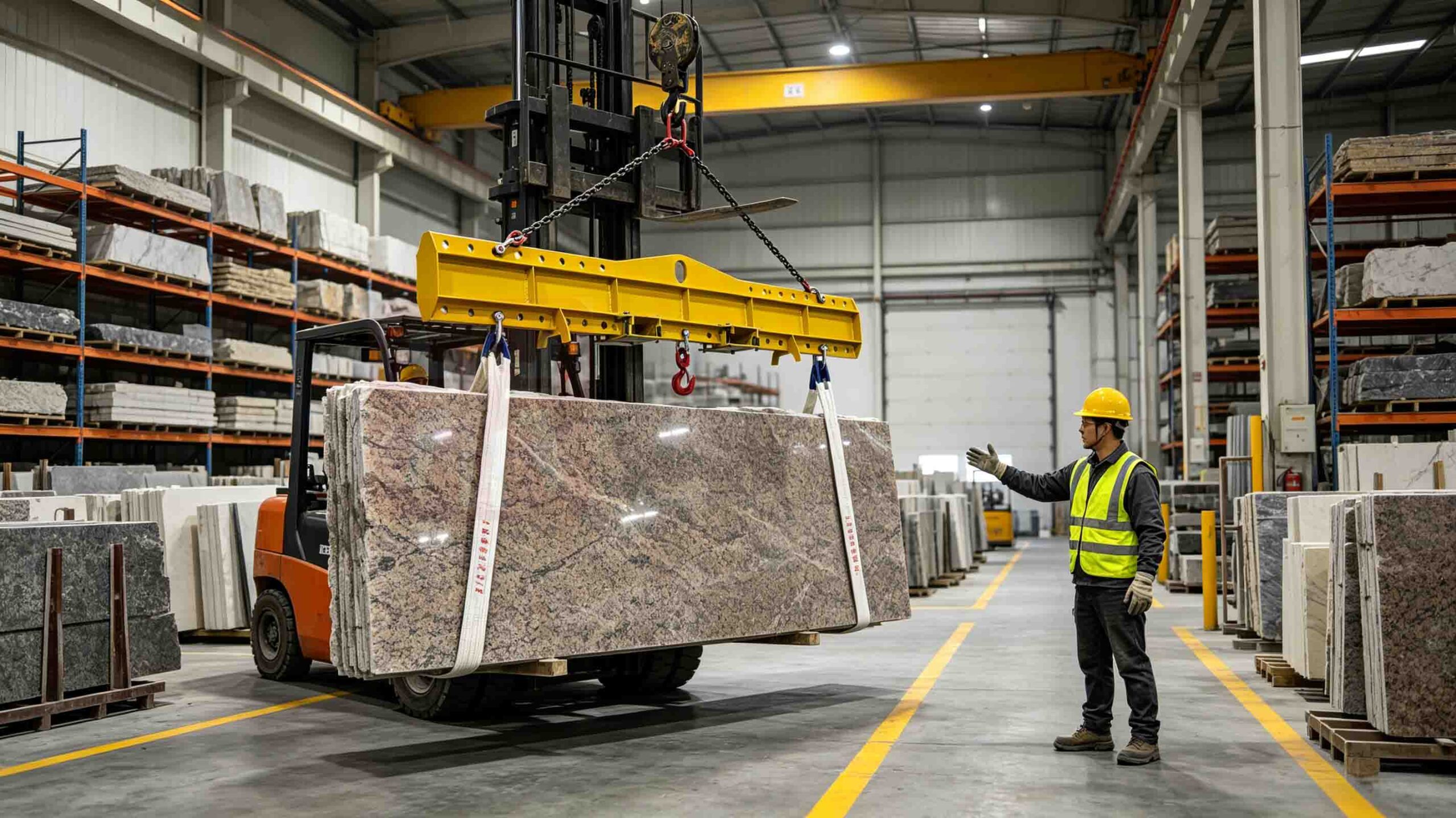
Lifting of the beam
Every year, stone fabrication facilities experience equipment damage, product loss, and workplace injuries caused by improper slab handling. Because granite, marble, quartz, and sintered stone slabs can weigh hundreds or even thousands of kilograms, maintaining stone lifting safety should be a top priority for every factory manager.
Most lifting accidents are preventable. They usually result from incorrect equipment selection, poor operator training, overloaded lifting devices, or unsafe work procedures. By understanding these risks and implementing the right handling solutions, stone factories can greatly improve safety while increasing productivity.
Why Stone Lifting Requires Special Attention
Unlike many industrial materials, stone slabs are extremely heavy yet surprisingly fragile. A slab may survive years of storage but crack instantly if lifted incorrectly. At the same time, a falling slab poses a serious danger to nearby workers.
Professional lifting equipment minimizes these risks by distributing loads evenly and providing better control throughout transportation and installation.
Common Causes of Lifting Accidents
| Risk Factor | Potential Consequences | Prevention |
|---|---|---|
| Incorrect lifting equipment | Slab dropping | Choose equipment with correct capacity |
| Equipment overload | Structural failure | Never exceed rated load |
| Poor operator training | Handling errors | Provide regular safety training |
| Damaged lifting tools | Equipment failure | Routine inspection |
| Poor communication | Worker injuries | Use standardized signals |
Risk 1: Using the Wrong Lifting Equipment
One of the biggest causes of lifting accidents is selecting equipment that does not match the size, thickness, or weight of the stone slab. Small lifting clamps used on oversized slabs can easily lose grip, while under-rated lifting devices may suffer structural failure.
Modern factories increasingly rely on
professional slab lifters
to improve stability while reducing manual handling.
Risk 2: Ignoring Equipment Capacity
Every lifting device has a maximum working load. Unfortunately, some operators estimate slab weight visually instead of checking specifications. Even small overloads place unnecessary stress on lifting equipment and dramatically increase failure risks.
Factories should maintain accurate records of slab dimensions, material density, and lifting capacity to ensure equipment always operates within safe limits.
Risk 3: Inadequate Operator Training
Even the most advanced lifting equipment cannot compensate for poor operating practices. Workers must understand lifting procedures, balance points, emergency stop methods, and communication signals before handling heavy materials.
Companies introducing new equipment should provide both classroom instruction and practical training sessions to ensure safe operation.
Risk 4: Selecting the Wrong Slab Lifter
Different lifting tasks require different equipment. Vacuum lifters, clamp lifters, forklift attachments, and overhead lifting systems each have specific applications.
Understanding
how to choose a suitable slab lifter
helps reduce equipment misuse while improving operational efficiency.
Risk 5: Poor Equipment Maintenance
Regular inspection is essential for every lifting device. Worn hydraulic components, damaged clamps, loose bolts, cracked welds, and worn lifting chains can all lead to unexpected equipment failures.
Preventive maintenance schedules should include daily visual inspections, monthly mechanical checks, and annual load testing where appropriate.
Modern Slab Lifters Improve Safety
Today’s lifting technologies provide better control than traditional manual handling methods. Advanced lifting systems reduce worker fatigue while protecting expensive stone materials from accidental damage.
Many factories have experienced significant productivity improvements after adopting
modern slab lifting equipment
designed specifically for heavy stone handling.
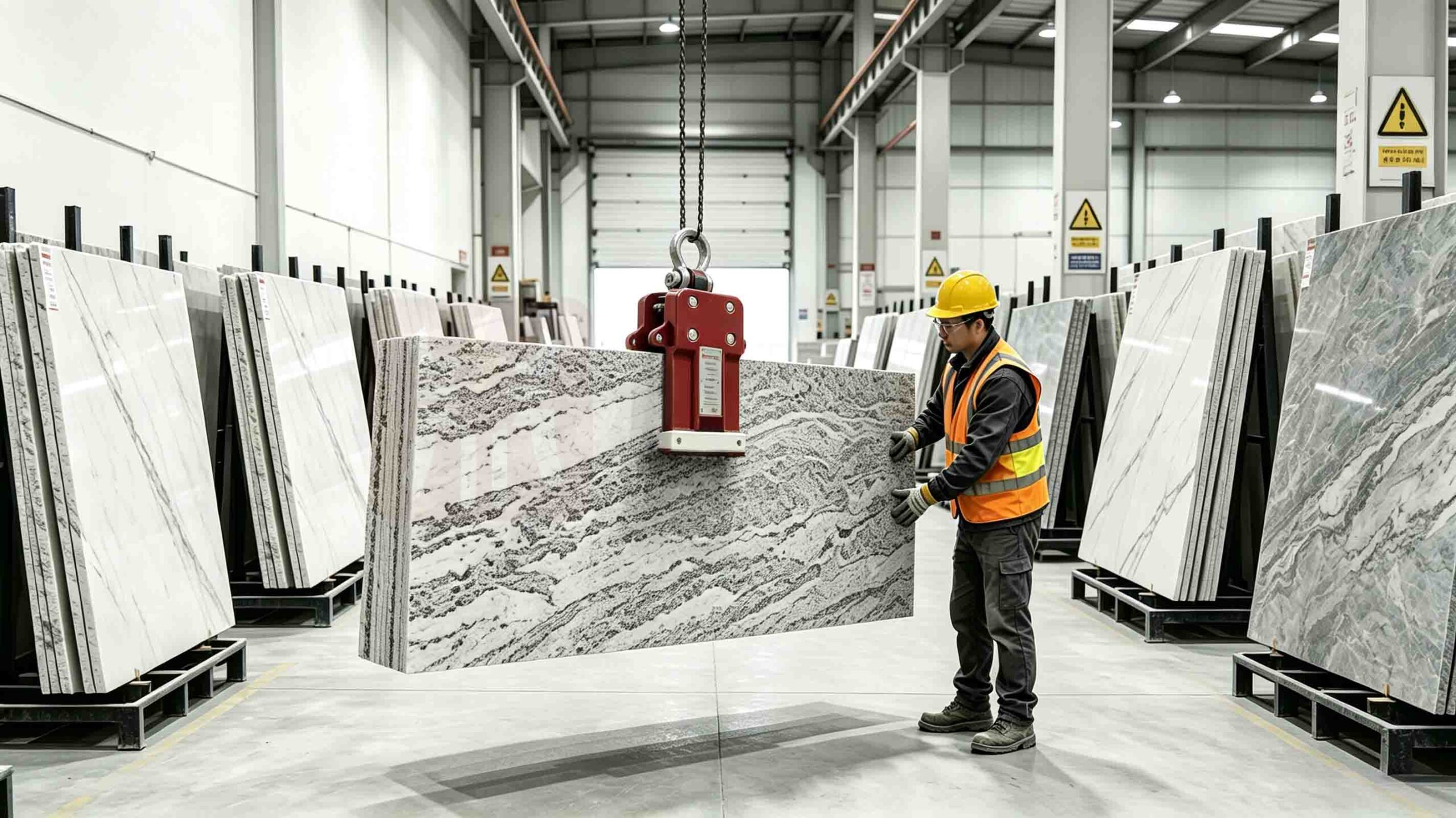
Clamp lifting
Forklift Attachments Require Proper Training
Forklift boom attachments have become increasingly popular because they convert standard forklifts into versatile lifting machines. However, operators must understand attachment limitations, lifting geometry, and safe operating procedures.
Choosing a properly engineered
heavy-duty double forklift boom
can improve lifting performance while maintaining excellent load stability.
Risk 6: Unsafe Work Areas
A safe lifting operation depends not only on the equipment but also on the surrounding environment. Wet floors, uneven surfaces, poor lighting, cluttered aisles, and unmarked lifting zones increase the likelihood of accidents. Workers should always ensure the lifting path is clear before moving any slab.
Dedicated lifting areas with floor markings, warning signs, and restricted pedestrian access help minimize unnecessary exposure to moving loads.
Risk 7: Poor Communication Between Operators
Stone slabs are often transported by multiple workers using forklifts, overhead cranes, or slab lifters. Without clear communication, sudden movements or incorrect positioning may cause slabs to swing, tilt, or collide with nearby objects.
Factories should establish standardized hand signals or radio communication protocols so every operator clearly understands each lifting instruction.
Forklift Boom Safety Best Practices
Forklift boom attachments offer flexible lifting solutions, but operators should always remember that the attachment changes the forklift’s load center and lifting capacity. Before using any boom attachment, confirm that both the forklift and attachment are rated for the intended load.
Many stone factories reduce infrastructure costs after learning
how forklift booms can solve crane space and budget problems
while still maintaining safe lifting practices.
Operators should also understand
the major components of forklift lifting equipment
to recognize signs of wear and perform routine inspections before each shift.
Daily Safety Inspection Checklist
Every lifting operation should begin with a simple inspection routine.
- Verify lifting capacity.
- Inspect clamps, chains, hooks, and hydraulic systems.
- Check for damaged welds or structural deformation.
- Confirm the slab is securely positioned.
- Ensure the travel path is free of obstacles.
- Verify all workers wear appropriate PPE.
- Test emergency stop functions where applicable.
- Assign one person to coordinate lifting operations.
Building a Strong Safety Culture
Technology alone cannot eliminate lifting accidents. The safest stone factories develop a workplace culture where employees actively report hazards, follow operating procedures, and participate in regular safety training.
Routine equipment inspections, documented maintenance schedules, operator certification, and continuous improvement programs all contribute to safer lifting operations.
Conclusion
Improving stone lifting safety requires more than purchasing better equipment. Successful factories combine professional slab lifters, properly engineered forklift attachments, preventive maintenance, operator training, and standardized lifting procedures to minimize lifting accidents while improving productivity. A proactive safety culture protects both employees and valuable stone materials.
FAQs
1. What is the biggest cause of lifting accidents in stone factories?
The most common causes include using incorrect lifting equipment, exceeding load limits, poor operator training, inadequate maintenance, and unsafe work environments.
2. How can stone lifting safety be improved?
Use certified lifting equipment, train operators regularly, inspect equipment before use, follow load ratings, and establish standardized lifting procedures.
3. Are slab lifters safer than manual lifting?
Yes. Professional slab lifters provide better load control, reduce manual handling, minimize worker fatigue, and significantly lower the risk of slab damage and injuries.
4. Can forklift boom attachments be used safely for lifting stone slabs?
Yes. When properly matched to the forklift, correctly installed, and operated within their rated capacity, forklift boom attachments provide a safe and efficient lifting solution.
5. How often should lifting equipment be inspected?
Visual inspections should be performed before every shift, while detailed maintenance and load testing should follow the manufacturer’s recommendations and local safety regulations.

Henry
Hi, I’m the author of this post, and I have been in this field for more than 16 years. If you need OEM&ODM service for stone tools, feel free to ask me any questions.