Get Your Work Done Efficiently !





Wasting Space, Wasting Time? How a Professional Slab Rack System Can Reclaim 2,000 Sq Ft & 50+ Hours/Month
Slab rack ROI should not be calculated from purchase price alone. An inefficient stone storage area can consume labor, floor space and production time while increasing unnecessary slab movement and exposure to damage. A professional slab storage system can create measurable value by improving storage density, accessibility, inventory organization and material flow. The most reliable ROI calculation uses your own factory data, including slab retrieval time, labor cost, usable floor space, handling frequency, storage-related damage and production delays.
Slab Rack ROI: How the Right Storage System Pays for Itself
Walk into the slab-storage area of almost any stone factory and you can quickly tell whether storage is helping production or slowing it down.
Are granite, marble and quartz slabs organized by material and project? Can operators identify the correct slab before beginning the lifting process? Can cranes, forklifts and transport carts approach the racks without repeatedly moving unrelated material?
Or does retrieving one slab require moving several others first?
These questions matter because a slab rack is not simply a place to put stone. It is part of the factory’s inventory system, internal logistics network and production workflow.
When slab storage is poorly organized, the cost does not appear on a single invoice. Instead, it appears gradually through extra labor, repeated crane movements, lost production time, damaged material, inefficient floor-space use and congestion around fabrication equipment.
This is why professional stone factories should think about slab rack ROI rather than only rack purchase price.
The goal of this guide is not to promise a universal payback period. Every factory has different labor rates, property costs, slab values and production volumes. Instead, it explains how to identify hidden storage costs and calculate the potential financial value of improving your own slab storage system.
 |
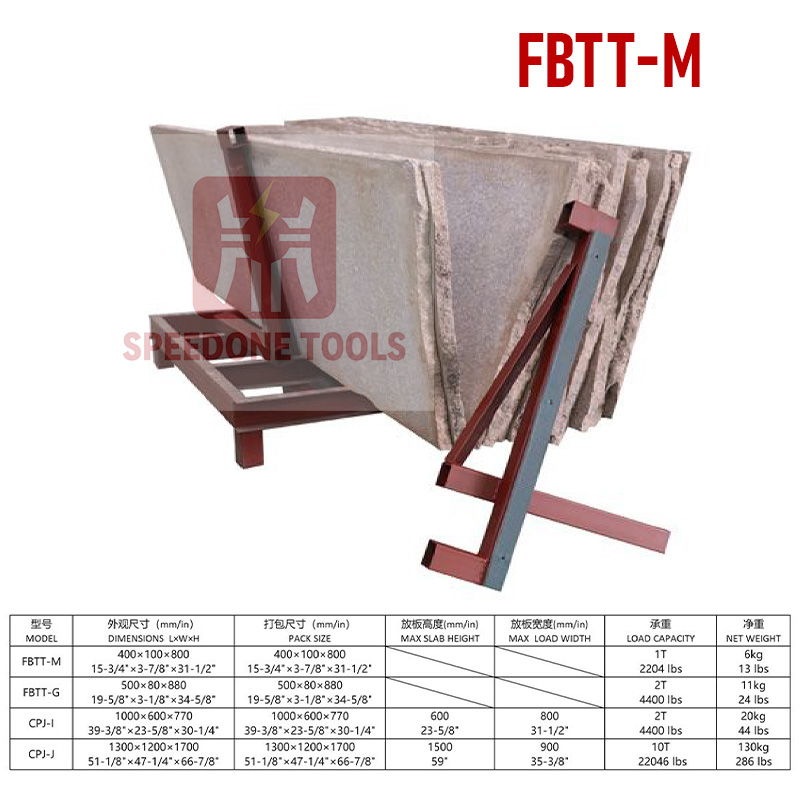 |
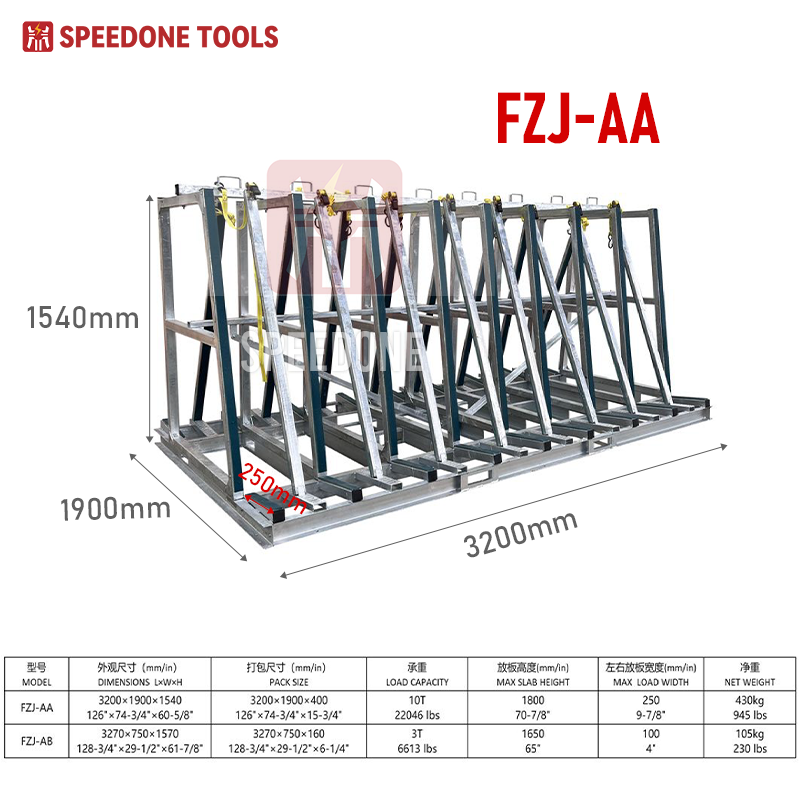
| Speedone stone slab storage rack solutions | |
Why Slab Rack ROI Matters More Than Purchase Price
When a buyer compares slab racks, the first number they usually see is the quotation price.
That number is easy to compare, but it does not show the complete economic impact of the storage system.
A less expensive rack layout that causes employees to repeatedly move slabs may cost more over time than a better-organized system with a higher initial purchase price.
A useful ROI analysis should therefore examine several cost categories together:
- Labor spent locating and retrieving slabs.
- Repeated crane or forklift movements.
- Material damage during storage and retrieval.
- Floor space occupied by inefficient storage.
- Production waiting time.
- Time spent reorganizing inventory.
- Handling congestion.
- Maintenance and inspection requirements.
The Hidden Cost of an Inefficient Slab Storage System
| Hidden Cost | How It Appears | What to Measure |
|---|---|---|
| Labor Cost | Workers search for slabs or move other slabs to gain access | Minutes per retrieval × retrievals per month |
| Handling Cost | Extra crane, forklift or cart movements | Average moves required per selected slab |
| Damage Cost | Chips, scratches, edge damage or breakage | Storage-related damage incidents and replacement value |
| Space Cost | Poor rack layout occupies more usable floor area than necessary | Square meters or square feet used per stored slab |
| Production Delay | Cutting equipment waits for incoming material | Machine waiting time caused by storage or retrieval |
1. The Labor Cost of Slab Retrieval
One of the easiest storage costs to measure is labor.
Imagine that a production operator needs a specific quartz slab for the next cutting job.
If that slab is clearly labeled and accessible, the handling team can identify it and prepare the lifting process immediately.
If it is stored behind several unrelated slabs, workers may need to:
- Identify the rack.
- Locate the required slab.
- Move surrounding materials.
- Temporarily stage those materials elsewhere.
- Retrieve the required slab.
- Return the other materials.
None of these extra movements adds value to the finished countertop.
They are internal handling costs created by storage design.
Simple Labor Cost Formula
Monthly Retrieval Labor Cost = Average Retrieval Time × Number of Retrievals × Hourly Labor Cost
If two employees are normally involved, include both workers in the calculation.
The advantage of this formula is that it uses your own operating information instead of relying on industry averages.
2. Slab Damage Is Part of Storage ROI
A slab can be damaged before it ever reaches the bridge saw.
Repeated handling can expose materials to edge contact, surface scratches or impact. Natural stone may also contain veins and fissures that make controlled support particularly important.
A professional stone slab rack should therefore help keep materials organized while allowing predictable access.
When calculating ROI, record storage-related incidents separately from cutting or fabrication defects.
This helps management determine whether the real problem is:
- Storage equipment.
- Rack layout.
- Slab identification.
- Lifting procedures.
- Transport equipment.
- Operator training.
3. Floor Space Has Economic Value
Factory floor space should not be treated as free simply because the building is already owned or leased.
Every square meter used for inefficient storage is space that cannot be used for:
- Additional fabrication machinery.
- Production staging.
- Finished-goods storage.
- Packaging operations.
- Wider handling aisles.
- Future factory expansion.
A better rack system does not necessarily mean squeezing the maximum number of slabs into the smallest possible footprint.
The goal is to improve the ratio between storage density and accessibility.
If storage density becomes so high that operators repeatedly move slabs to access inventory, the factory may lose more in labor and handling than it gains in floor space.
For a more detailed look at this tradeoff, see how professional slab rack planning can reduce wasted space and handling time.
4. Retrieval Speed Affects Production Throughput
A slab storage area may appear separate from the fabrication department, but the two are operationally connected.
If the bridge saw or CNC machine is ready but the correct slab has not reached the production area, expensive processing equipment may sit idle.
For this reason, slab retrieval time should be measured as part of production flow.
Factories can track:
- Time from material request to slab identification.
- Time from identification to rack removal.
- Number of slabs moved before accessing the target slab.
- Time required to deliver the slab to staging.
This information can reveal whether the bottleneck is storage, inventory organization, lifting equipment or factory layout.
SPEEDONE Slab Storage as a System
Speedone provides different equipment types for different stages of stone handling rather than treating every application as the same storage problem.
The appropriate configuration may include fixed slab racks, A-frame storage, mobile transport equipment or temporary staging solutions.
Factories reviewing permanent storage can explore Speedone’s slab rack solutions and A-frame storage rack systems.
The key is matching the equipment to how the material actually moves through the factory.
 |
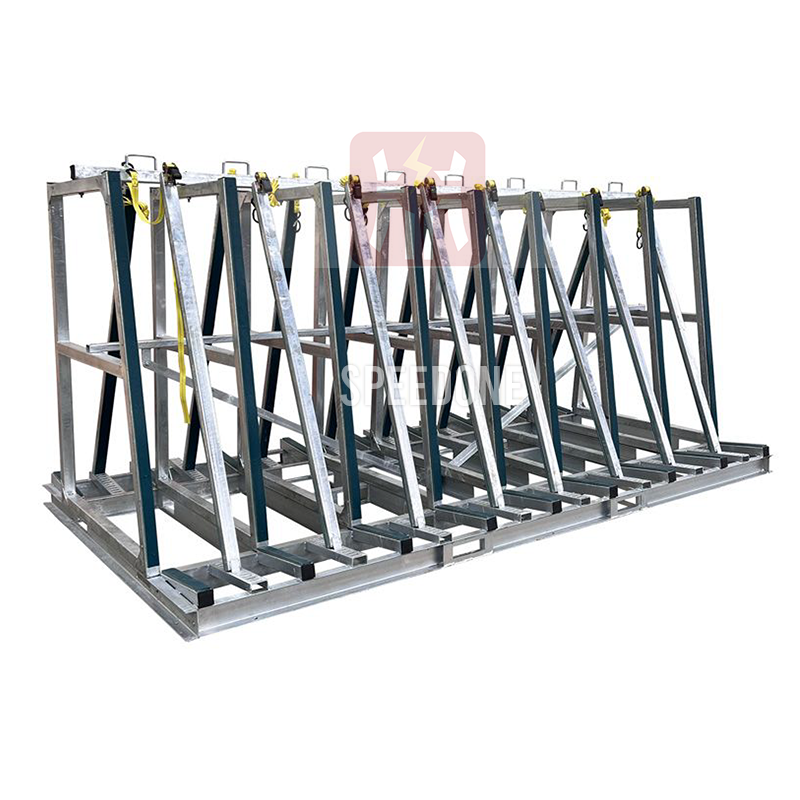 |
| Slab storage and material-handling equipment | |
Building a Tiered Slab Storage Strategy
One storage system does not need to perform every function.
Professional factories can divide storage into different operational tiers according to where the material is in the production process.
| Storage Tier | Primary Purpose | Typical Equipment |
|---|---|---|
| Tier 1 | Main raw-slab inventory | Fixed slab racks or A-frame storage |
| Tier 2 | Active production staging | Mobile A-frames, staging racks or transport carts |
| Tier 3 | Work-in-progress and reusable offcuts | Dedicated smaller storage zones |
| Tier 4 | Finished products and shipping preparation | Padded racks, A-frames and installation carts |
Tier 1: Primary Bulk Slab Storage
This area contains the main stone inventory.
The priorities are typically capacity, organization, predictable access and stable support.
Materials may be divided according to:
- Granite.
- Marble.
- Quartz.
- Porcelain or sintered stone.
- Color.
- Thickness.
- Supplier.
- Project assignment.
Fast-moving materials can be placed where they require less travel and handling.
For movement between storage areas, an A-Frame Metal Cart may form part of the internal material-handling process where the application is suitable.
Tier 2: Workshop Buffer and Active Job Storage
Production should not always need to retrieve every slab directly from the main warehouse at the exact moment it is required.
A controlled buffer area near fabrication can hold materials scheduled for upcoming jobs.
This can help reduce interruptions around the cutting area.
Depending on the material and workflow, a Self-Locking Trolley can provide mobile support during selected internal transport and staging applications.
Tier 3: Work-in-Progress and Offcut Storage
Usable remnants often have financial value, but only if employees can identify and retrieve them.
When offcuts are stacked randomly, the factory may eventually purchase new material even though a suitable remnant already exists somewhere in storage.
A useful remnant system should record:
- Material.
- Color.
- Thickness.
- Approximate dimensions.
- Rack location.
Tier 4: Finished Goods and Loading Staging
Finished countertops have different storage requirements from raw slabs.
They may contain polished edges, sink openings, narrow rails or irregular shapes that require careful support.
Dedicated finished-goods storage helps separate completed customer orders from raw inventory.
For final movement and installation preparation, Speedone offers equipment such as the Stone Slab Countertop Install Cart.
For suitable lighter panel, sheet or stone-handling applications, the Foldable Stone Slab Trolley can also form part of the wider handling system.
A-Frame Slab Rack vs Slot-Style Storage
| Factor | A-Frame Slab Rack | Slot / Post-Style Rack |
|---|---|---|
| Structure | Slabs rest against angled central support | Slabs are organized between defined support positions |
| Accessibility | Useful for grouped slab storage and staging | Can provide more defined individual storage positions |
| Typical Use | Storage, staging and finished goods | Organized main inventory |
| Selection Priority | Load, access method and available space | Slab size, spacing, support design and retrieval method |
Neither system is universally better. Many factories use both because they solve different storage problems.
How to Calculate Slab Rack ROI
A useful ROI calculation begins with the current storage system.
Step 1: Measure Current Retrieval Time
Record how long it takes to locate, access and deliver slabs to production.
Step 2: Calculate Handling Labor
Multiply the retrieval time by the number of employees involved and the number of retrievals completed per month.
Step 3: Record Storage-Related Damage
Separate slab damage caused during storage and retrieval from defects created during cutting or fabrication.
Step 4: Measure Storage Footprint
Calculate the total floor area used by racks, temporary storage and access aisles.
Step 5: Measure Production Waiting Time
Track whether fabrication equipment regularly waits for slabs to arrive.
Step 6: Compare the Proposed System
Estimate how the new layout changes retrieval movements, storage footprint and handling workflow.
Step 7: Calculate Financial Benefit
A simple model is:
Annual Operational Benefit = Labor Savings + Avoided Damage Cost + Space Value + Reduced Production Delay − Additional Annual Operating Cost
Then:
Estimated Payback Period = Total Storage-System Investment ÷ Monthly Net Operational Benefit
This provides a much more useful purchasing framework than asking whether one slab rack is cheaper than another.
Illustrative Slab Rack ROI Example
The following example is a hypothetical calculation designed to show how an ROI model can be built. It is not a claim about a specific Speedone customer’s results.
| Metric | Current System | Proposed System | Value to Calculate |
|---|---|---|---|
| Average Retrieval Time | Measure current time | Estimate after layout improvement | Labor hours saved per month |
| Storage Capacity | Current usable capacity | Planned usable capacity | Value of added inventory space |
| Storage Footprint | Current occupied floor area | Proposed occupied area | Production space potentially reclaimed |
| Handling Moves | Moves required per selected slab | Expected moves after reorganization | Handling time reduction |
| Damage Incidents | Historical storage-related incidents | Target improvement | Potential avoided material cost |
The important point is not the specific numbers. The important point is that every variable can be measured using factory data.
What Usually Creates the Highest Slab Rack ROI?
The greatest return generally comes from solving a real operational bottleneck.
- If workers spend too much time searching for slabs: improve rack identification and inventory zoning.
- If several slabs must be moved before retrieving one: improve accessibility and storage grouping.
- If production machines frequently wait for material: introduce a staging area closer to fabrication.
- If the warehouse is full but poorly organized: review storage density and rack layout.
- If finished countertops are being damaged: create separate protected finished-goods storage.
- If forklift and crane movements are excessive: redesign the storage-to-production travel path.
Common Slab Storage Investment Mistakes
| Mistake | Potential Result | Better Approach |
|---|---|---|
| Buying by price alone | Poor application fit | Compare total operating value |
| Maximizing storage density | Poor slab accessibility | Balance density with retrieval speed |
| Ignoring handling equipment | Forklift or crane cannot access racks efficiently | Design rack layout around actual equipment |
| No staging area | Production congestion | Separate main inventory from active-job storage |
| Ignoring future growth | Storage becomes inadequate quickly | Include realistic expansion requirements |
Safety Should Be Part of the ROI Discussion
Stone slabs are heavy materials and should be stored and handled using equipment suitable for the intended load and application.
Storage-system planning should consider:
- Equipment rated capacity.
- Slab dimensions and weight.
- Rack condition.
- Floor condition.
- Handling equipment.
- Aisle access.
- Operator procedures.
- Inspection frequency.
Safety benefits should not be reduced to an invented dollar figure. Instead, buyers should treat safe, controlled storage as a fundamental design requirement and calculate ROI primarily from measurable operating factors such as labor, space, damage and throughput.
How Much Aisle Space Does a Slab Rack Need?
There is no universal aisle-width number that applies to every stone factory.
The correct dimension depends on:
- Slab width and height.
- Crane operating method.
- Forklift model and turning radius.
- Transport cart dimensions.
- Rack loading direction.
- Pedestrian routes.
- Site-specific safety requirements.
The aisle should therefore be designed around the actual equipment and workflow rather than copied from a generic warehouse example.
How to Improve an Existing Slab Storage Area
A factory does not necessarily need to replace every rack immediately.
Start by measuring the current operation.
Perform an Inventory Audit
Identify fast-moving, slow-moving and project-reserved slabs.
Record Retrieval Time
Measure how long employees actually spend finding and accessing material.
Count Unnecessary Movements
Record how many slabs must be repositioned before retrieving the target material.
Review Storage Locations
Place high-turnover materials closer to production where practical.
Create an Active Job Buffer
Prepare slabs for upcoming jobs without blocking main warehouse aisles.
Separate Finished Products
Finished countertops should not be treated exactly like raw slab inventory.
Inspect Existing Racks
Look for impact damage, corrosion, deformation, loose components or other visible problems that may require inspection or corrective action.
How to Choose a Slab Rack Supplier
A supplier should understand more than the required rack length.
Before recommending equipment, the manufacturer should ask about:
- Maximum slab dimensions.
- Maximum intended load.
- Number of slabs or bundles.
- Indoor or outdoor use.
- Crane or forklift access.
- Aisle width.
- Storage footprint.
- Inventory turnover.
- Required customization.
Buyers should also evaluate manufacturing quality, load documentation, surface treatment, export packaging, replacement parts and communication during the engineering process.
China Slab Rack Manufacturer and OEM Considerations
Stone factories and distributors sourcing slab racks from China may have access to standard products as well as OEM configurations.
Customization can be useful when the buyer has specific:
- Slab dimensions.
- Load requirements.
- Rack length restrictions.
- Floor-space limitations.
- Surface-treatment requirements.
- Transport or container-packing requirements.
However, customization should begin with application information rather than appearance alone.
A professional OEM discussion should confirm intended use, load requirements, drawings, materials, manufacturing details and inspection requirements before production.
Maintenance and Lifecycle Value
The ROI of a storage system continues after installation.
Racks should remain part of the factory’s inspection program.
Depending on the design and environment, inspection may include:
- Structural deformation.
- Impact damage.
- Corrosion.
- Loose fasteners.
- Worn protective surfaces.
- Changes in floor condition.
- Evidence of unintended loading practices.
Maintenance and inspection requirements should follow the equipment manufacturer’s instructions and applicable workplace procedures.
Questions to Ask Before Buying a Slab Rack System
- How many slabs do we currently store?
- What is our peak inventory?
- What are our largest slab dimensions?
- What is the maximum intended rack load?
- How many times per day are slabs retrieved?
- Which materials move most frequently?
- How many slabs are normally moved before accessing the correct one?
- What handling equipment will access the rack?
- How much floor area does the current system use?
- Does production require a separate staging area?
- Do we need indoor or outdoor storage?
- How much future growth should the system accommodate?
Soft CTA: Calculate Your Storage Cost Before Requesting a Quote
Before requesting a slab rack quotation, spend several days measuring your current storage process.
Record:
- Average slab retrieval time.
- Number of retrievals per day.
- Number of employees involved.
- Average unnecessary slab movements.
- Storage footprint.
- Storage-related damage.
- Handling equipment currently used.
Then provide Speedone with your slab dimensions, load requirements, available floor space, inventory quantity, crane or forklift information and photos or drawings of the storage area.
This allows the discussion to focus on improving the complete storage workflow rather than simply quoting another metal rack.
References and Safety Resources
- Occupational Safety and Health Administration, 29 CFR 1910.176 — Handling Materials, General.
- Occupational Safety and Health Administration — Hazards of Transporting, Unloading, Storing and Handling Granite, Marble and Stone Slabs.
- Natural Stone Institute — stone slab handling, fabrication and safety resources.
- Equipment manufacturers’ rated-capacity, installation, inspection and operating instructions.
- Applicable local workplace and material-handling requirements.
Final Note / Practical Takeaway
A professional slab rack system should be evaluated as part of the factory’s material-flow strategy rather than as a standalone storage purchase. The strongest slab rack ROI usually comes from reducing unnecessary slab movements, shortening retrieval time, improving usable floor space and creating more predictable material access. Instead of relying on generic payback claims, stone factories should measure their own labor, storage footprint, handling movements, damage incidents and production delays. Those numbers provide a much more reliable basis for deciding whether a new slab storage system can justify its investment.
Frequently Asked Questions About Slab Rack ROI
1. How do I calculate the ROI of a slab rack?
Calculate the current cost of slab retrieval labor, storage-related material damage, floor-space use and production delays. Estimate how a new slab storage system could change these costs, then compare the expected monthly or annual operational benefit with the total investment.
2. How can a slab rack reduce labor cost?
An organized rack layout can reduce the time workers spend locating slabs, moving unrelated material and reorganizing inventory. The actual savings depend on retrieval frequency, labor cost, inventory organization and the existing storage layout.
3. Can a slab rack increase storage capacity?
It can improve usable storage density when the rack layout is matched to slab dimensions and factory space. However, maximum storage density should not come at the expense of safe access and efficient slab retrieval.
4. What is the difference between an A-frame slab rack and a slot-style rack?
An A-frame supports slabs against an angled central structure and is often useful for grouped storage or staging. Slot or post-style systems divide the storage area into more defined positions and may provide different access characteristics. The correct choice depends on slab size, inventory type and handling method.
5. How much aisle space is required between slab racks?
There is no single aisle width suitable for every factory. The required space depends on slab dimensions, forklift turning radius, crane operation, transport-cart dimensions, rack orientation, pedestrian routes and site-specific requirements.
6. Can slab racks be used outdoors?
Some slab rack designs can be suitable for outdoor applications when the materials, surface treatment, foundation and design are appropriate for the environment. Buyers should confirm outdoor suitability with the manufacturer for the exact model and site conditions.
7. How often should slab racks be inspected?
Inspection frequency should reflect usage, environment, equipment-manufacturer recommendations and company procedures. Racks should also be checked after impacts, unusual loading events or when visible deformation, corrosion or damage is discovered.
8. What information should I provide before requesting a slab rack quotation?
Provide maximum slab dimensions, intended load, number of slabs or bundles, available floor area, handling equipment, aisle requirements, indoor or outdoor environment, inventory turnover and any future expansion requirements.

Henry
Hi, I’m the author of this post, and I have been in this field for more than 16 years. If you need OEM&ODM service for stone tools, feel free to ask me any questions.