Faça o seu trabalho de forma eficiente!





A-frame shipping systems improve slab transport safety, reduce breakage risks, and optimize international stone shipping and export logistics.
A-frame shipping systems have become a critical part of modern international stone logistics. As global demand for granite, marble, quartz, and engineered stone continues to increase, exporters face growing challenges related to slab breakage, container efficiency, loading safety, and transportation reliability. This comprehensive guide explains how A-frame shipping systems improve slab transport safety, optimize warehouse operations, reduce operational losses, and support large-scale stone export operations in 2026 and beyond.
Why A-Frame Is Essential for International Stone Shipping
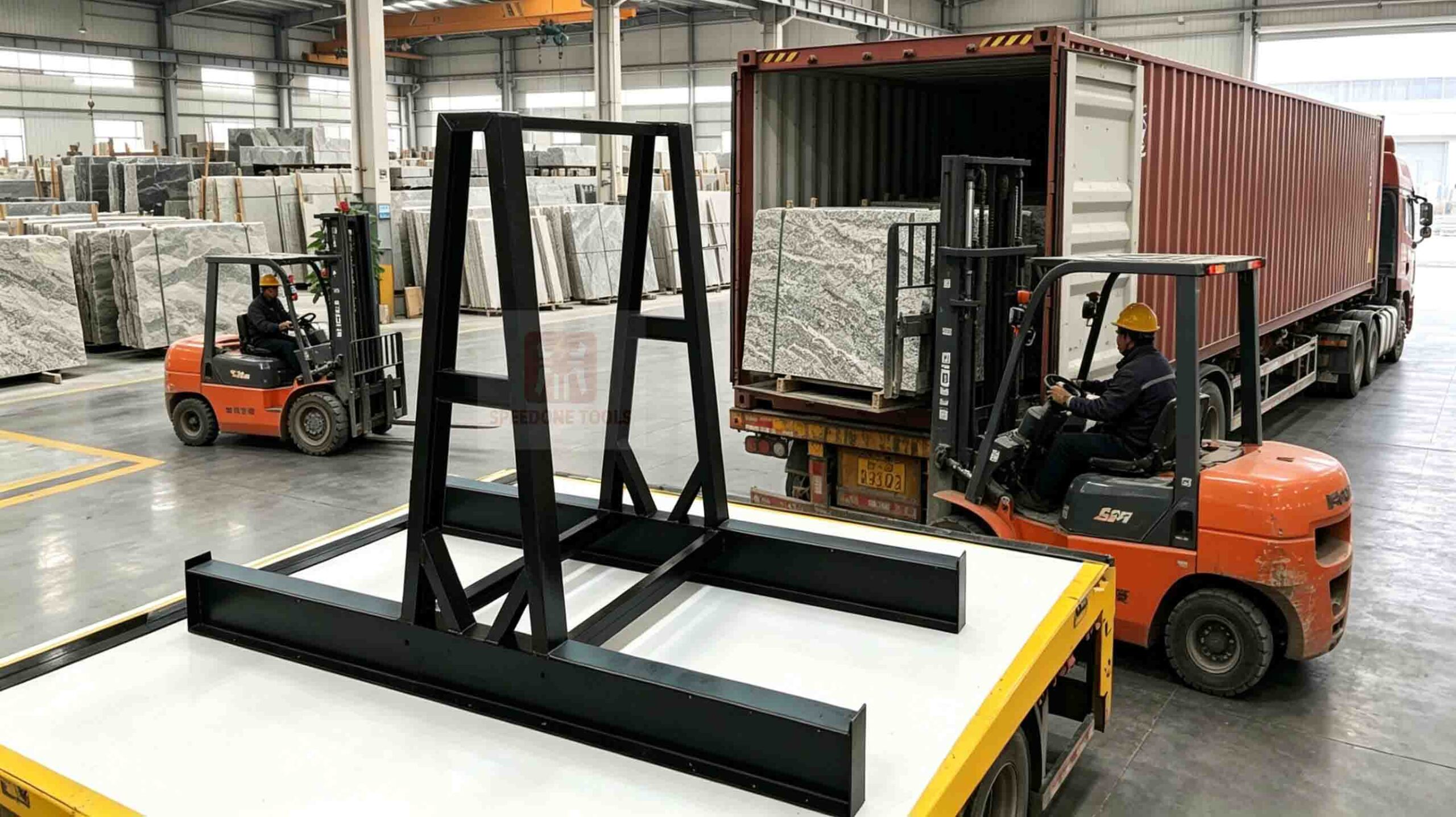
A-frame shipping system used for safe international stone slab export
International stone transportation is one of the most challenging sectors in industrial logistics. Stone slabs are extremely heavy, highly fragile under tension, and expensive to replace if damaged during transportation. A single broken slab can result in thousands of dollars in direct losses, delayed project timelines, insurance disputes, and dissatisfied customers.
For this reason, modern exporters increasingly depend on A-frame shipping systems to improve stability during transportation and ensure reliable slab protection across the global supply chain.
In today’s competitive export market, improving slab transport safety is no longer optional. Factories are under constant pressure to reduce shipping risks, maximize container efficiency, and improve overall operational reliability.
| Industry Challenge | Impact on Export Operations | A-Frame Solution |
|---|---|---|
| Slab breakage | High replacement costs | Vertical support stability |
| Poor container organization | Reduced shipping efficiency | Optimized slab arrangement |
| Manual handling risks | Worker injuries | Forklift-compatible transport |
| Distribuição desigual da carga | Transportation instability | Balanced structural support |
What Is an A-Frame Shipping System?
An A-frame shipping system is a heavy-duty steel structure specifically engineered for vertical slab storage and transportation. The triangular frame design creates balanced load distribution while minimizing slab movement during transport.
Unlike traditional flat stacking methods, A-frame systems keep slabs upright and properly separated. This significantly reduces stress concentration points that often cause cracks or fractures during vibration and movement.
Modern A-frame systems are widely used in:
- Stone export logistics
- Container loading operations
- Warehouse slab storage
- Internal factory transportation
- Outdoor slab handling
- Granite and marble distribution centers
- Quartz slab transportation
- Construction material logistics
The growing popularity of A-frame systems reflects the broader modernization of stone handling infrastructure across the international market.
Why Traditional Shipping Methods Create Serious Risks
Many factories previously relied on wooden supports, horizontal stacking, or improvised transport structures for international shipping. While these methods initially appear cost-effective, they often create substantial operational risks.
During ocean freight transportation, containers experience continuous vibration, shifting weight distribution, humidity changes, and sudden movement during loading and unloading. Without stable slab support, even minor vibrations can lead to edge chipping, internal fractures, or catastrophic slab failure.
Common Problems With Traditional Slab Shipping
- Slab breakage during transportation vibration
- Excessive slab-to-slab contact pressure
- Difficult forklift accessibility
- Longer loading and unloading times
- Higher labor requirements
- Wasted shipping container space
- Reduced operational efficiency
- Inconsistent load stability
Many exporters underestimate how significantly storage and transport systems affect profitability. As explained in
this guide to slab rack classifications and storage systems
, optimized rack engineering dramatically improves both operational safety and logistics efficiency.

Slab transport safety system using industrial A-frame transport racks
The Engineering Principle Behind A-Frame Stability
The effectiveness of an A-frame system comes from basic structural engineering principles. The triangular shape is naturally one of the strongest load-bearing geometries in industrial design.
When slabs lean against the angled supports, gravitational force is distributed evenly across the structure instead of concentrating pressure on a single point. This improves:
- Load stability
- Shock resistance
- Transport balance
- Structural rigidity
- Forklift maneuverability
Modern A-frame systems also incorporate reinforced steel tubing, anti-slip rubber contact surfaces, forklift channels, and corrosion-resistant coatings to improve long-term durability.
How A-Frame Shipping Improves Slab Transport Safety
| Safety Feature | Operational Benefit | Business Impact |
|---|---|---|
| Vertical slab positioning | Reduces slab collision | Lower breakage rates |
| Steel structural support | Improves transport stability | Safer international shipping |
| Forklift compatibility | Faster loading operations | Reduced labor costs |
| Balanced weight distribution | Minimizes pressure points | Protects expensive slabs |
| Modular transport design | Optimizes container space | Improved export efficiency |
Durability Is Critical for Export Operations
International logistics environments are extremely demanding. Equipment is constantly exposed to:
- Heavy slab weight pressure
- Forklift impact stress
- Ocean freight vibration
- Rain and moisture exposure
- Outdoor temperature fluctuations
- Repeated loading cycles
This is why exporters require highly durable A-frame systems capable of supporting continuous industrial operations.
Industrial users often rely on
heavy-duty A-frame storage racks
specifically engineered for long-term reliability in harsh environments.
A-Frame Systems Improve Container Loading Efficiency
Container utilization directly affects export profitability. Poorly organized slab loading wastes valuable shipping space and increases transportation costs per square meter of stone.
A-frame systems improve loading efficiency by creating organized slab positioning that maximizes container capacity while maintaining safe weight distribution.
Container Loading Advantages
- Higher slab density per container
- Improved weight balance
- Faster forklift access
- Reduced manual repositioning
- Lower unloading times
- Improved logistics planning
Large exporters handling hundreds of containers annually often achieve substantial operational savings after implementing professional A-frame shipping systems.
A-Frame Systems Improve Warehouse Efficiency
Beyond transportation, A-frame systems also improve warehouse organization and production workflow.
Vertical slab storage allows factories to:
- Increase storage density
- Improve slab identification
- Reduce warehouse congestion
- Enhance inventory management
- Improve worker accessibility
- Simplify slab retrieval
Modern factories increasingly integrate A-frame systems into broader warehouse optimization strategies. For example,
space-saving A-frame rack systems
help maximize efficiency in high-volume production facilities.
The Role of Forklifts in Modern A-Frame Logistics
One major reason for the rapid adoption of A-frame systems is their compatibility with forklift handling equipment.
Forklift integration allows factories to:
- Reduce manual labor dependency
- Improve loading speed
- Enhance workplace safety
- Reduce handling damage
- Increase operational throughput
Modern A-frame systems are often designed with reinforced forklift channels that improve lifting stability and reduce frame stress during movement.
The Versatility of Modern A-Frame Systems
Another reason A-frame shipping systems continue to gain popularity is their exceptional operational flexibility.
Today’s systems can support:
- Indoor slab storage
- Outdoor transportation
- Export container loading
- Showroom slab organization
- Factory logistics integration
- Stone fabrication workshops
- Distribution center operations
This operational flexibility is further explored in
this analysis of A-frame versatility and efficiency
.
Why Slab Transport A-Frames Are Becoming Industry Standard
As slab dimensions continue increasing, traditional transportation methods are becoming increasingly impractical.
Modern logistics operations now depend heavily on advanced systems such as
specialized slab transport A-frames
that improve transport precision while reducing operational risk.
The stone industry widely recognizes A-frame systems as essential logistics infrastructure. This trend is clearly demonstrated in
the growing adoption of A-frame granite transport systems
.
Cost Reduction and Long-Term ROI
Although high-quality A-frame systems require an initial investment, the long-term financial benefits are substantial.
| Operational Area | Without A-Frame | With A-Frame |
|---|---|---|
| Slab breakage risk | Elevado | Baixa |
| Container efficiency | Moderado | Elevado |
| Labor requirements | Higher | Mais baixo |
| Loading speed | Slower | Faster |
| Operational safety | Mais baixo | Higher |
For many exporters, the reduction in slab damage alone justifies the investment within a relatively short operational period.
How to Choose the Right A-Frame Shipping Solution
- Evaluate slab dimensions and weight
- Consider export container specifications
- Review steel frame thickness
- Check forklift compatibility
- Analyze warehouse workflow
- Confirm weather resistance requirements
- Evaluate long-term maintenance needs
- Consider transport frequency and volume
Choosing the correct system requires balancing operational efficiency, transport safety, durability, and long-term cost performance.
Future Trends in Stone Shipping Logistics
The future of international stone logistics is moving toward fully integrated handling systems combining A-frame transport, automated slab lifting, smart warehouse management, and digital tracking technologies.
Factories that modernize their transport infrastructure today will be better positioned to handle increasing global demand, rising labor costs, and stricter safety regulations in the years ahead.
Nota final / Conclusões práticas
A-frame shipping systems have become essential for modern stone export operations because they dramatically improve slab transport safety, loading efficiency, warehouse organization, and long-term operational reliability. As international logistics requirements continue evolving, professionally engineered A-frame systems are no longer optional equipment—they are strategic infrastructure investments that help exporters reduce losses, improve efficiency, and remain competitive in the global stone industry.
Referências
- International Organization for Standardization (ISO) — Industrial material handling safety standards.
- Occupational Safety and Health Administration (OSHA) — Guidelines for heavy material transport and storage.
- Natural Stone Institute — Stone transportation and slab handling best practices.
- Industrial logistics engineering publications related to structural load distribution systems.
- Global stone export operational studies regarding container efficiency and slab damage reduction.
FAQs
1. What is A-frame shipping?
A-frame shipping is a transportation method that uses triangular steel support structures to safely transport stone slabs.
2. Why are A-frame systems important for slab transport safety?
They improve slab stability, reduce collision risks, and prevent slab breakage during transportation.
3. Are A-frame systems suitable for international shipping?
Yes. They are widely used for export container loading and international stone logistics operations.
4. Can A-frame systems improve warehouse efficiency?
Yes. Vertical slab storage improves space utilization and material accessibility.
5. What materials can be transported using A-frame systems?
A-frame systems are commonly used for granite, marble, quartz, engineered stone, and glass slabs.

Henrique
Olá, sou o autor deste post, e estou neste sector há mais de 16 anos. Se precisar de um serviço OEM&ODM para ferramentas de pedra, não hesite em colocar-me quaisquer questões.