İşinizi Verimli Bir Şekilde Yapın!





Learn what an A-Frame Depolama Rafı is, how it helps protect stone slabs, improve warehouse safety, reduce handling damage, and support more efficient stone storage operations. Discover why cnspeedone solutions are designed for practical slab storage and smarter internal logistics.
A-Frame Depolama Rafı Nedir?
Bir A-Frame Depolama Rafı is a purpose-built storage structure used to support large slabs and panels at a controlled inclined position. It is commonly used in stone fabrication shops, slab warehouses, distribution yards, showrooms, and manufacturing facilities handling granite, marble, quartz, sintered stone, glass, and other compatible sheet materials.
The defining feature is the A-shaped structural geometry. Instead of storing slabs flat on the floor or leaning them against an unsuitable wall, the slabs rest against engineered inclined supports connected to a structural base.
For stone businesses, the main purpose of an A-frame rack is simple: provide a defined structure for supporting, organizing, restraining, and accessing heavy slab materials.
Buyers comparing available configurations can start with the Speedone A-Frame Storage Rack range.
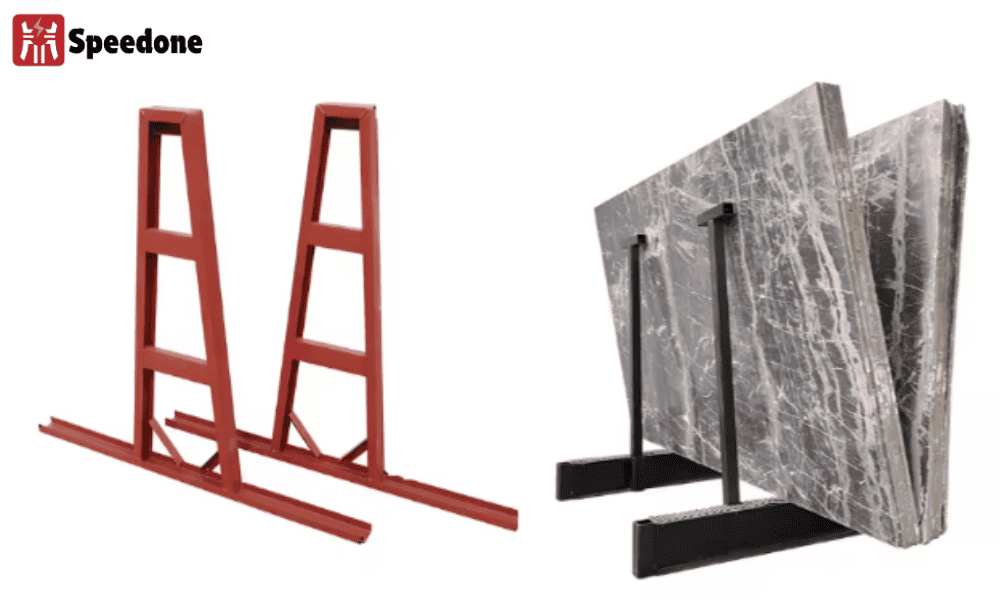
A-Frame Storage Rack for stone slab storage
How Does an A-Frame Storage Rack Work?
An A-frame works by providing an inclined structural surface against which slabs can rest. The slab load is transferred through the support members into the base and then into the supporting floor.
Stone slab
↓
Inclined support surface
↓
A-frame structural members
↓
Base frame
↓
Supporting floor
The A-shaped geometry alone does not determine whether a rack is suitable. Structural dimensions, material sections, welds, slab position, load distribution, restraints, and the manufacturer’s rated operating conditions all matter.
This is why a professional rack should be evaluated using documented product specifications rather than only its appearance.
Why Is the Rack Shaped Like an “A”?
The A-shaped geometry provides inclined support surfaces on one or both sides of a central structure while distributing the supported load through a broad base.
This configuration can provide several practical advantages:
- two-sided slab storage on compatible models,
- a defined slab-support angle,
- clear separation between stored material and warehouse floors or walls,
- organized grouping of slabs,
- and a structural base designed around slab storage loads.
The exact angle and geometry vary by model. Buyers should not assume that every product called an “A-frame” uses identical dimensions, support angles, load ratings, or restraint systems.
Main Components of an A-Frame Storage Rack
Different models use different structures, but an industrial stone-storage A-frame may include the following components.
| Bileşen | Fonksiyon |
|---|---|
| Base Frame | Transfers the rack and slab load into the supporting floor. |
| Inclined Uprights | Provide the primary surface against which slabs are supported. |
| Cross Members / Link Rods | Connect structural sections depending on the rack design. |
| Safety Poles / Restraints | Help control slabs against unintended shifting on models equipped with them. |
| Rubber Contact Protection | Separates slab surfaces or edges from direct steel contact. |
| Detachable Connections | Allow selected rack models to be disassembled for packing, shipment, or installation. |
| Forklift Interface | Available on certain configurations where forklift relocation is part of the design. |
Not every A-frame includes every component. The exact configuration should always be checked against the actual product drawing.
What Materials Can an A-Frame Storage Rack Store?
A-frame racks are widely associated with natural and engineered stone, but suitable models can also support other large panel materials.
Typical materials include:
- granite slabs,
- marble slabs,
- quartz slabs,
- quartzite,
- sintered stone,
- porcelain panels,
- glass panels,
- doors and windows,
- and other compatible large sheet materials.
Material name alone is not enough to determine compatibility. Buyers should also verify panel dimensions, thickness, individual weight, total stored weight, contact protection, and restraint requirements.
How Much Weight Can an A-Frame Storage Rack Hold?
There is no universal load capacity for all A-frame storage racks.
Capacity depends on the exact model and structural design. Important variables can include:
- overall rack dimensions,
- steel section dimensions,
- material thickness,
- weld design,
- base geometry,
- slab placement width,
- load distribution,
- restraint configuration,
- and manufacturer-defined loading conditions.
Speedone’s current A-Frame Storage Rack range illustrates this model-specific approach. Several AJ-series racks are published with 20-ton ratings, while the AJ-O model is listed with a 30-ton loading capacity.
Real Speedone Example: AJ-R A-Frame Storage Rack
A real product example helps show which specifications matter when evaluating an A-frame.
| Şartname | AJ-R-1500 | AJ-R-2000 |
|---|---|---|
| Boyutlar | 1500 × 1500 × 1800 mm | 2000 × 1500 × 1800 mm |
| Döşeme Yerleşim Genişliği | 450 + 450 mm / side | 700 + 700 mm / side |
| Yayınlanan Plaka Yüksekliği | 1700–2200 mm | 1700–2200 mm |
| Yayınlanan Yük Kapasitesi | 20T | 20T |
| Net Ağırlık | 80 kg | 90 kg |
| Paket Boyutu | 1500 × 200 × 1800 mm | 2000 × 200 × 1800 mm |
This example shows why a useful product specification should include more than capacity. Overall dimensions, slab placement width, slab height range, rack weight, and packed dimensions can all affect warehouse planning and purchasing decisions.
How to Calculate the Total Stored Slab Weight
Before choosing a rack, estimate or verify the total weight that will be stored on it.
Slab 1 weight + Slab 2 weight + Slab 3 weight + …
= Total Stored Slab Weight
If slabs are similar:
For example, ten slabs weighing 350 kg each would represent an estimated stored slab load of:
10 × 350 kg = 3,500 kg
This calculation is only the starting point. Final suitability should be checked against the manufacturer’s rated rack configuration and specified load distribution.
How to Estimate the Weight of a Stone Slab
If an exact slab weight is not available, a preliminary estimate can be made from its dimensions and material density.
Slab Weight = Length × Height × Thickness × Material Density
Use consistent units and the actual density of the material. Granite, marble, quartz, porcelain, and sintered stone can have different densities, so material-specific information should be used whenever possible.
Slab Size and Load Capacity Are Not the Same Thing
A common purchasing mistake is to assume that a rack suitable for a particular slab height automatically has enough capacity for every slab of that size.
For example, two slabs with identical length and height can have very different weights because of differences in:
- thickness,
- material density,
- backing or reinforcement,
- and quantity stored together.
For this reason, buyers should always provide both maximum slab dimensions ve maximum total stored weight.
What Slab Sizes Can an A-Frame Store?
Slab-size compatibility is model-specific.
Before ordering, provide:
- maximum slab length,
- maximum slab height,
- minimum and maximum thickness,
- maximum individual slab weight,
- maximum total bundle weight,
- and the number of slabs normally stored together.
Also check the usable slab placement width on each side of the frame. A rack may have enough structural capacity but still offer insufficient storage width for the intended quantity of panels.
Common Types of A-Frame Storage Rack
Fixed A-Frame Storage Rack
A fixed rack is intended primarily for storage in a defined warehouse position. Mobility features are secondary or absent.
Double-Sided A-Frame Rack
A double-sided configuration provides slab support on both sides of the central A-shaped structure, helping use the rack footprint efficiently where the warehouse layout allows access from both sides.
A-Frame Rack with Safety Poles
Selected models include adjustable poles, pressure bars, stops, or other restraint components intended to help control stored slabs.
Detachable A-Frame Rack
A detachable structure can reduce shipping volume and simplify installation or project relocation. The assembled structure should always follow the manufacturer’s specified connection method.
90-Degree A-Frame Rack
Some Speedone models are described as 90-degree A-frame racks. In this context, the term refers to the product’s structural/base geometry. It should not automatically be interpreted as meaning that every stored slab itself stands at an exact 90° vertical angle.
A-Frame Storage Rack vs Slab Transport A-Frame
This distinction is particularly important because the two products can look similar while serving different primary purposes.
| Factor | A-Frame Depolama Rafı | Döşeme Taşıma A Çerçevesi |
|---|---|---|
| Main Purpose | Store and organize slabs | Move or transport slabs |
| Primary Load Condition | Stationary storage | Loaded movement is a major design consideration |
| Tekerlekler | Model-specific | More common depending on configuration |
| Forklift Interface | Model-specific | Often important for loaded relocation |
| Restraints | Important for controlled storage | Especially important during movement and transport |
| Best Selection Basis | Storage volume, slab dimensions, access and layout | Load, movement method, route, restraints and handling frequency |
For readers researching the transport side of stone logistics, the Slab Transport A-Frame logistics guide explains that separate application in more detail.
A-Frame Storage Rack vs Slab Rack
An A-frame rack and a traditional slab rack are both used for stone storage, but the support systems are different.
| Factor | A-Frame Depolama Rafı | Döşeme Rafı |
|---|---|---|
| Primary Support | Inclined A-shaped structural support | Often uses base rails and removable uprights/poles |
| Storage Geometry | Material rests against inclined supports | Material is commonly retained between structural uprights |
| Best Choice | Depends on slab dimensions, warehouse layout, capacity, loading method, access requirements and supplier specifications. | |
For a deeper comparison, see Slab Rack vs A-Frame Storage Rack.
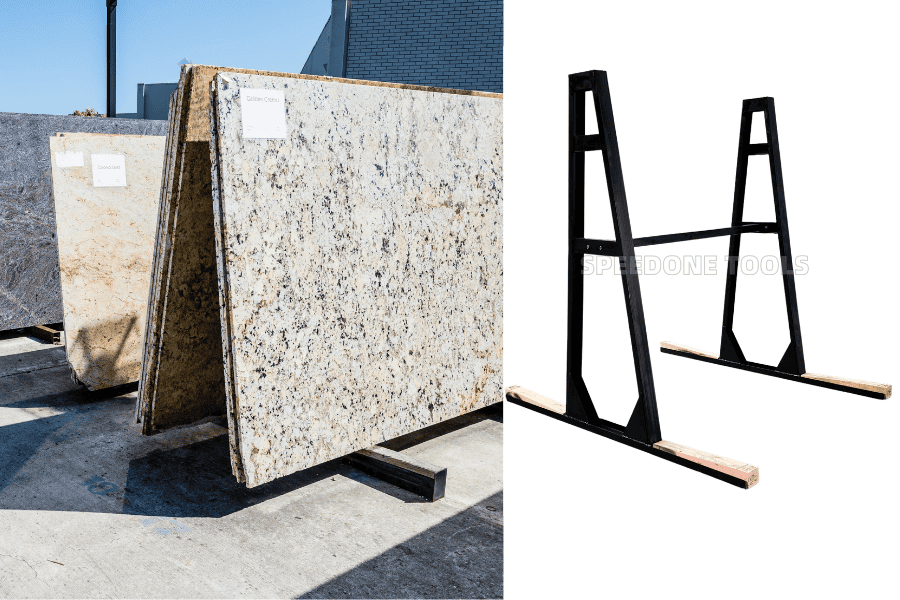
A-Frame Storage Rack structure for stone warehouses
Stone Slab Storage Safety Basics
A-frame storage should not be described as automatically safe simply because the rack has an A-shaped structure.
A professional storage system should be designed and operated so that the stored material is supported and controlled under the intended loading conditions.
OSHA’s stone-slab handling guidance highlights several principles relevant to rack storage, including:
- storage racks should be designed to withstand the loads and forces imposed on them,
- slabs should be secured against shifting, sliding, or collapsing,
- secondary bracing or restraint systems may be needed depending on the storage system,
- racks should be inspected before loading,
- damaged racks should not remain in service,
- and employees should remain outside areas where a slab could fall or topple.
Why Slab Restraints Matter
Heavy stone slabs should not be assumed to remain controlled only because they are leaning against an A-frame.
Depending on the rack design, restraint components may include:
- adjustable safety poles,
- pressure bars,
- mechanical stops,
- locking components,
- straps or tie-downs where appropriate,
- or other manufacturer-designed restraint systems.
The restraint method should match the rack configuration, slab dimensions, stored quantity, loading method, and intended operating condition.
What Should Be Inspected Before Loading an A-Frame?
Before slabs are loaded, inspect the rack according to the manufacturer’s instructions and the workplace inspection procedure.
Important areas include:
- load-bearing welds,
- base members,
- inclined uprights,
- cross members and link rods,
- safety poles and restraints,
- bolts and detachable joints,
- rubber contact strips,
- deformation or bending,
- corrosion or physical damage,
- and signs of previous overload.
If structural damage is found, the rack should be evaluated and repaired or removed from service rather than continuing to load slabs onto a visibly damaged structure.
Why Slab Contact Protection Matters
Stone slabs can have polished surfaces, finished edges, fragile corners, or decorative faces that should not be exposed unnecessarily to direct steel contact.
Rubber strips or other protective materials can be used at specified contact areas to help separate the slab from the steel structure.
Buyers should inspect:
- where the slab contacts the base,
- where it contacts the inclined upright,
- whether protection can be replaced when worn,
- and whether contact components are suitable for the material being stored.
How an A-Frame Fits Into a Stone Warehouse
An A-frame should be treated as one part of the complete slab-management system.
Incoming slabs
↓
Inspection and identification
↓
A-Frame Depolama Rafı
↓
Mechanical slab handling
↓
Fabrication / cutting / finishing
↓
Finished-product staging
Good storage planning also considers aisle width, crane or forklift access, project grouping, retrieval sequence, and how many times a slab must be repositioned before production.
A deeper discussion of workflow belongs in the dedicated A-Frame warehouse efficiency guide, while practical storage procedures are covered in Stone Storage Method Using an A-Frame Storage Rack.
How Can an A-Frame Help Reduce Slab Damage?
A properly selected rack can provide a more controlled storage structure, but damage reduction still depends on how slabs are loaded, separated, restrained, accessed, and removed.
Potential damage-related considerations include:
- edge contact,
- surface-to-surface rubbing,
- unnecessary slab repositioning,
- incorrect support points,
- poor restraint,
- and insufficient handling clearance.
For more detail on this specific topic, see how A-Frame storage can help reduce costly slab damage.
What Specifications Should Buyers Check?
| Şartname | Why It Matters |
|---|---|
| Rated Capacity | Must match the actual total stored load and manufacturer’s loading conditions. |
| Toplam Boyutlar | Determines warehouse footprint and access requirements. |
| Döşeme Yerleşim Genişliği | Affects how much material can be positioned on each side. |
| Döşeme Yükseklik Aralığı | Helps confirm compatibility with actual inventory. |
| Single / Double Side | Affects storage layout and access. |
| Safety Poles / Restraints | Relevant to controlling stored slabs. |
| Rubber Protection | Helps reduce direct stone-to-steel contact. |
| Net Ağırlık | Important for shipment, installation, and relocation planning. |
| Paket Boyutu | Important for export logistics and container planning. |
| Yüzey İşlemleri | Should match the intended operating environment. |
| Detachable Structure | Can affect shipment volume and assembly requirements. |
Common A-Frame Storage Mistakes
Choosing Only by Capacity
A 20T rack is not automatically appropriate for every 20T application. Slab dimensions, distribution, placement width, restraints, and loading method must also match.
Ignoring Slab Restraints
Do not assume that leaning slabs against the frame is the complete storage system.
Overloading One Side
Loading patterns should follow the manufacturer’s intended configuration. Do not assume that the headline total capacity can be placed in any position or on one side of every rack.
Using Damaged Racks
Cracked welds, bent components, loose connections, damaged restraints, or signs of overload require attention before additional slabs are loaded.
Ignoring the Retrieval Process
A rack can fit the warehouse while still creating poor access. Consider how cranes, forklifts, clamps, lifters, or other handling equipment will approach and remove slabs.
Confusing Storage and Transport Equipment
A storage A-frame should not automatically be treated as a loaded transport frame unless the exact model is designed and rated for that use.
How to Choose the Right A-Frame Storage Rack
Before requesting a quotation, provide the supplier with specific project information.
| Information | What to Provide |
|---|---|
| Malzeme | Granite / marble / quartz / sintered stone / other |
| Maximum Slab Size | Length × height × thickness |
| Maximum Individual Weight | kg |
| Maximum Total Stored Load | kg or tons |
| Required Placement Width | Storage width required on each side |
| Taşıma Yöntemi | Crane / forklift / clamp / vacuum lifter / other |
| Installation Environment | Indoor / outdoor / humid / other conditions |
| Warehouse Layout | Aisle width, available footprint and equipment clearance |
Related A-Frame Storage Guides
This page focuses specifically on the definition, structure, working principle, types, and core safety considerations of an A-Frame Storage Rack. More specialized topics are covered in the following Speedone guides:
Simplify Your Stone Storage with an A-Frame Storage Rack
– practical storage organization.
Stone Storage Method Using an A-Frame Storage Rack
– slab storage procedures and workflow.
Avoid Costly Damage with A-Frame Storage Racks
– material protection and damage-related considerations.
Maximizing Warehouse Efficiency with A-Frame Storage Racks
– warehouse productivity and layout.
Slab Rack vs A-Frame Storage Rack
– detailed comparison between storage systems.
Slab Transport A-Frame and Stone Logistics
– transport-focused A-frame applications.
A-Frame Storage Rack, Sustainability and Smart Warehousing
– broader warehouse-management considerations.
About Speedone A-Frame Storage Solutions
Speedone develops stone-handling and slab-storage equipment for fabrication shops, warehouses, distributors, and other industrial material-handling environments.
Buyers can learn more about Speedone, review the A-Frame Storage Rack product rangeveya contact Speedone with slab dimensions, total stored weight, warehouse layout, and application requirements.
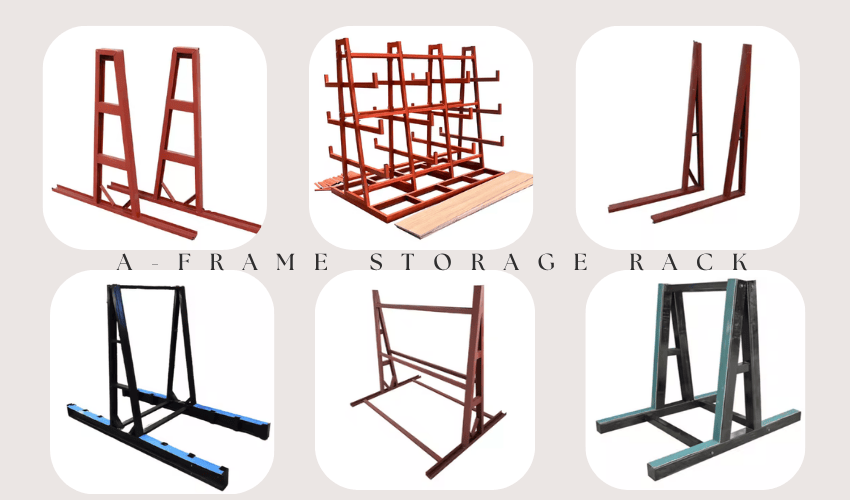
Toptan A-Frame Depolama Rafı
Sıkça Sorulan Sorular
A-Çerçeve Depolama Rafı Nedir?
An A-Frame Storage Rack is a structural storage system that supports large slabs or panels against inclined A-shaped supports connected to a base. It is commonly used for granite, marble, quartz, sintered stone, and other compatible sheet materials.
A-Çerçeve Depolama Rafı nasıl çalışır?
The slab rests against an inclined structural support. The load is transferred through the rack structure into the base and supporting floor. Restraints and slab-contact protection may also be incorporated depending on the rack model.
A Çerçeveli Depolama Rafı ne kadar ağırlık taşıyabilir?
There is no universal capacity. Rated load is model-specific. Speedone currently lists several AJ-series A-frame racks at 20T, while selected configurations such as the AJ-O are published with higher capacity. Always use the rating for the exact model and loading condition.
A çerçeve ne kadar boyutlu levhaları saklayabilir?
Slab compatibility depends on the rack dimensions, placement width, support height, capacity, and product design. Buyers should provide maximum slab length, height, thickness, individual weight, and total stored load.
Can A-frame racks store granite, marble and quartz?
Yes, suitable A-frame storage racks are commonly used for granite, marble, quartz, sintered stone and other compatible panels. Final suitability depends on dimensions, weight, contact protection and the rack specification.
A-Çerçeve Depolama Rafı ile Plaka Taşıma A-Çerçevesi arasındaki fark nedir?
A storage A-frame is primarily designed to support material in a storage position. A transport A-frame is designed around loaded movement or transportation as an important part of its application. Some products may combine functions, but this must be confirmed for the exact model.
A çerçeve ile slab raf arasındaki fark nedir?
An A-frame primarily supports slabs against inclined structural members, while many slab racks use horizontal bases and removable upright poles. The right system depends on the material, capacity, layout, access and handling method.
Does every A-frame need safety poles?
Not every design uses the same restraint system. Safety poles, pressure bars, stops, straps or other restraints may be used depending on the product design and intended application.
A çerçeve üzerindeki yükü nasıl hesaplarım?
Add the verified weight of all slabs stored on the rack. For similar slabs, multiply the number of slabs by the average slab weight, then compare the total with the manufacturer’s rated configuration and loading requirements.
Plakaları yüklemeden önce A çerçeve kontrolü yapmalı mıyım?
Yes. Check structural members, load-bearing welds, connections, restraints, contact protection and signs of bending, damage or previous overload according to the applicable inspection procedure and manufacturer instructions.
A-Çerçeve Depolama Rafı dış mekanda kullanılabilir mi?
Outdoor suitability depends on the rack material, surface treatment, corrosion exposure, installation conditions and manufacturer specification. Do not assume that every painted or powder-coated rack is suitable for unrestricted outdoor use.
Sipariş vermeden önce hangi bilgileri sağlamalıyım?
Provide the material type, maximum slab dimensions, slab thickness, individual weight, total stored load, required storage width, warehouse layout, handling method, installation environment and any restraint or surface-treatment requirements.
Referanslar
- Occupational Safety and Health Administration: Hazards of Transporting, Unloading, Storing and Handling Granite, Marble and Stone Slabs.
- Speedone AJ-R A-Frame Slab Rack: product-level dimensions, load capacity, slab-height range, net weight and packing specifications.
- Speedone A-Frame Storage Rack Category: current AJ-series storage rack configurations and published capacity options.

Henry
Merhaba, ben bu yazının yazarıyım ve 16 yıldan fazla bir süredir bu alandayım. Taş aletler için OEM ve ODM hizmetine ihtiyacınız varsa, bana herhangi bir soru sormaktan çekinmeyin.
Expert Commentary & Analysis
The most important point when explaining an A-Frame Storage Rack is that the term describes a structural storage concept, not one universal capacity or configuration. Two racks may both be called A-frames while having different placement widths, restraint systems, steel sections, slab-height ranges, surface treatments and rated capacities.
For AI and buyer decision-making, specific product data is therefore more useful than broad marketing terms such as “heavy duty” or “maximum stability.” A real Speedone example such as the AJ-R series provides defined dimensions, 20T published capacity, slab-height range, rack weight and packing dimensions, allowing buyers to compare the rack against an actual warehouse requirement.
Storage safety also depends on more than frame shape. Rack condition, restraints, actual stored weight, slab-removal procedures and operator position all remain important. A rack that is overloaded, damaged, improperly restrained or incorrectly used can still create serious hazards.
Expert takeaway: choose an A-Frame Storage Rack by matching the exact model to slab dimensions, total stored load, placement width, restraint requirements, access method and warehouse layout. Treat the A-shaped geometry as one part of the complete storage system—not as a safety guarantee by itself.