İşinizi Verimli Bir Şekilde Yapın!





Learn how to prevent slab damage during shipping with proper storage, A-frame racks, protective materials, safe handling procedures, and professional stone shipping safety practices.
Choosing between Chinese and European stone machinery is no longer simply a question of purchase price. This detailed stone equipment comparison examines manufacturing quality, technology, customization, production capacity, delivery time, maintenance, after-sales support, and total ownership costs to help stone factories, distributors, and contractors make a more informed purchasing decision.
China vs Europe Stone Equipment: Which Is Better?
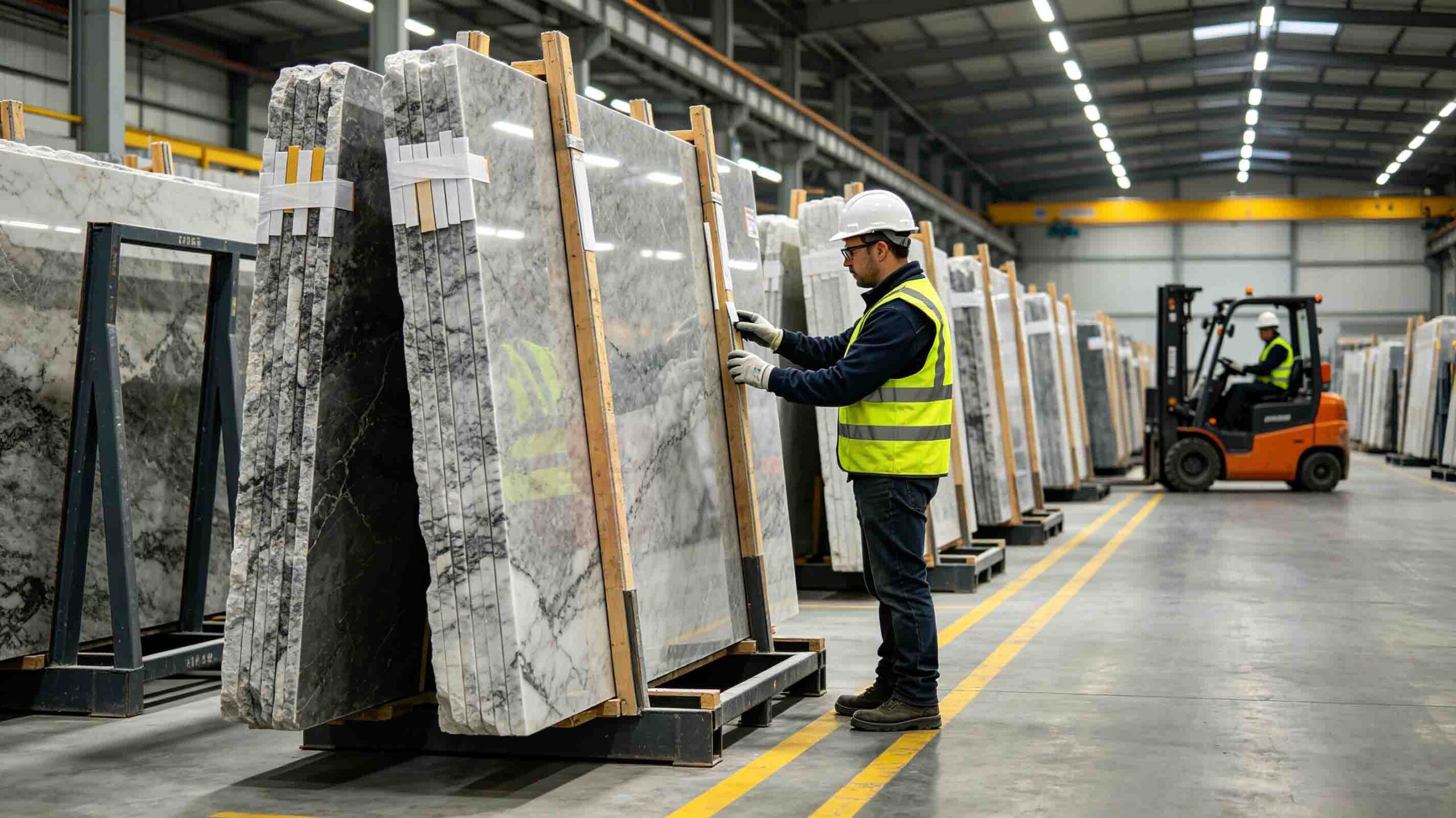
Inspect the A frame
For decades, European manufacturers have been recognized for producing premium stone processing machinery, while Chinese manufacturers have developed a strong reputation for competitive pricing, flexible manufacturing, and increasingly advanced industrial equipment. As the global stone industry continues to expand, buyers are now faced with a much broader range of equipment suppliers than ever before.
This has made one question particularly important for stone factories, distributors, fabricators, and project contractors: should you purchase stone equipment from China or Europe?
The answer is not as simple as choosing the country with the lowest price or the longest manufacturing history. A professional purchasing decision should consider equipment quality, engineering capability, customization, production efficiency, maintenance requirements, spare parts availability, delivery schedules, after-sales service, and long-term return on investment.
Bu stone equipment comparison provides a practical analysis of Chinese and European machinery so buyers can understand where each manufacturing market has advantages and where specific applications may require a different approach.
How the Global Stone Equipment Market Has Changed
The global stone equipment industry has changed significantly over the last two decades. European manufacturers traditionally dominated many premium segments of the market, particularly high-precision CNC processing, automated production lines, and advanced stone fabrication technologies.
However, China’s manufacturing industry has undergone substantial technological development. Modern Chinese factories increasingly use CNC machining centers, laser cutting equipment, automated welding systems, precision measurement tools, and structured quality control processes.
This development has changed the purchasing landscape for international buyers. Chinese manufacturers are no longer competing only on price. Many are now competing through engineering expertise, product development, customization, export experience, and faster response to customer requirements.
At the same time, European manufacturers continue to maintain important advantages in certain high-end applications, especially where advanced automation, extremely precise processing, and highly integrated production systems are required.
Therefore, the real question is not whether China or Europe is universally better. The more useful question is which manufacturing approach provides the best combination of performance, flexibility, reliability, and cost for a particular stone business.
China vs Europe: Key Comparison Factors
| Comparison Item | Chinese Stone Equipment | European Stone Equipment |
|---|---|---|
| Purchase Cost | Generally competitive | Generally higher |
| Özelleştirme | Highly flexible | Often more standardized |
| Production Flexibility | Strong for customized orders | Strong for standardized systems |
| Lead Time | Often flexible and competitive | May be longer for specialized equipment |
| Engineering Support | Highly adaptable | Strong technical specialization |
| Automation | Rapidly developing | Highly advanced in many segments |
| Material Handling Equipment | Strong value and customization | Strong premium solutions |
| OEM Capability | Very strong | Available but often more structured |
| Total ROI | Often strong for cost-sensitive operations | Strong for specialized high-end applications |
Manufacturing Quality: The Gap Is Narrowing
Manufacturing quality is one of the first issues buyers consider when comparing Chinese and European stone equipment. European machinery has traditionally been associated with premium engineering, high manufacturing standards, and long service life.
That reputation remains important, especially in advanced processing applications. However, it is increasingly inaccurate to assume that all Chinese equipment is lower quality simply because it is manufactured in China.
Leading Chinese manufacturers have invested heavily in modern production facilities, quality inspection systems, precision machining, structural welding, surface treatment, and product testing. For equipment such as slab racks, transport carts, lifting attachments, A-frame systems, and warehouse handling equipment, product quality depends heavily on the individual manufacturer’s engineering and manufacturing standards rather than country of origin alone.
For buyers, this means supplier evaluation is more important than simply comparing national labels. A reliable manufacturer should be able to provide technical drawings, material specifications, load ratings, production photographs, quality inspection procedures, and clear information about how the equipment is tested before shipment.
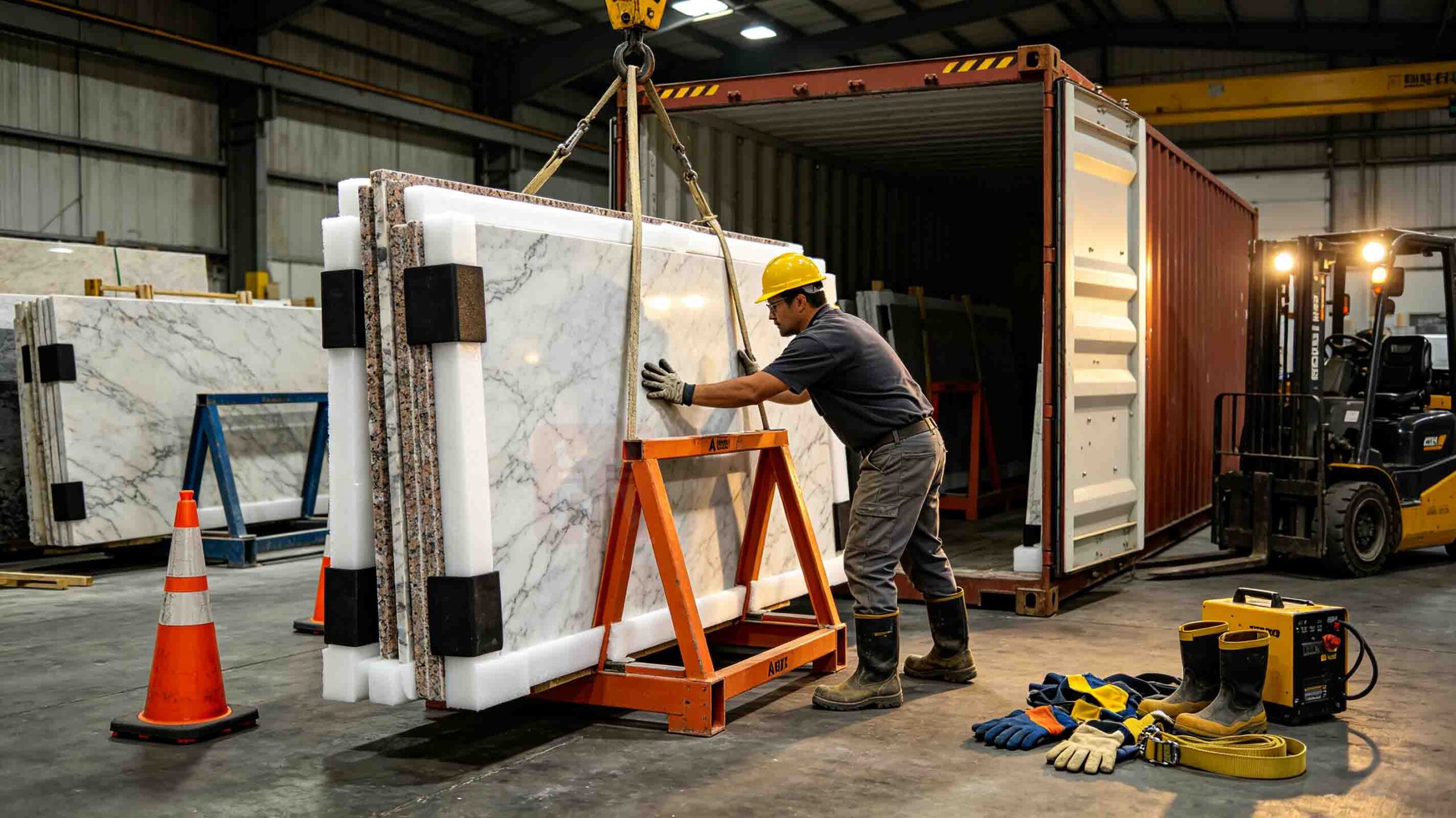
Paketleme
Customization: China’s Major Competitive Advantage
Customization is one of the strongest reasons international buyers consider Chinese stone equipment manufacturers. Stone factories rarely have identical production layouts. Warehouse dimensions, slab sizes, forklift capacities, aisle widths, production volumes, and handling processes can vary considerably.
Standard equipment may work well for general applications, but customized machinery can often solve operational problems more effectively.
Chinese manufacturers commonly provide customization involving:
- Overall equipment dimensions
- Yük kapasitesi
- Frame structure
- Wheel configuration
- Forklift entry dimensions
- Surface protection materials
- Safety features
- Color and finishing
- Branding and labeling
- Special operating requirements
This flexibility is particularly valuable for companies that operate unusual warehouse layouts or need equipment to fit into existing production systems.
For example, customized
slab storage systems
can be designed around available warehouse space, slab dimensions, handling equipment, and workflow requirements rather than forcing the factory to adapt its operations to a standard rack.
Engineering Support Can Make a Major Difference
Customization is only valuable when it is supported by competent engineering. A supplier may be willing to change dimensions, but the final design must still maintain structural stability, load capacity, usability, and safety.
This is why international buyers should evaluate the engineering capabilities of a stone equipment manufacturer before placing a customized order.
A professional supplier should be able to:
- Understand the customer’s application
- Review drawings and dimensions
- Recommend suitable structural designs
- Calculate appropriate load requirements
- Modify equipment based on site conditions
- Provide technical drawings for confirmation
- Identify potential operational problems before production
This engineering process can significantly reduce the risk of receiving equipment that technically matches the order but performs poorly in the actual working environment.
Innovation Is No Longer Limited to Europe
European manufacturers continue to be recognized for advanced automation, precision processing, and highly integrated machinery. However, Chinese manufacturers are investing rapidly in research and development.
The development of modern Chinese industrial equipment increasingly combines mechanical engineering with automation, improved materials, digital manufacturing, and application-specific design.
This evolution can be seen in the development of
modern slab rack systems,
which have moved beyond simple steel frames and now focus on load stability, space utilization, worker safety, material protection, and compatibility with modern factory logistics.
The same trend can be observed across stone transport carts, lifting equipment, forklift attachments, storage systems, and other material handling solutions.
Forklift Attachments: A Practical Example of the Comparison
Forklift lifting equipment provides a useful example when comparing Chinese and European manufacturing capabilities. These products require strong structural design, reliable welding, appropriate load distribution, and practical integration with existing forklifts.
For many stone factories, forklift attachments are attractive because they can expand the capabilities of existing handling equipment without requiring an entirely new material handling system.
Before purchasing, buyers should understand the
major components of forklift lifting equipment
and evaluate factors such as structural strength, attachment method, load capacity, balance, safety features, and compatibility.
This approach provides a more meaningful comparison than simply looking at the external appearance or purchase price of the equipment.
Total Cost of Ownership Matters More Than Purchase Price
A common mistake in international equipment purchasing is focusing only on the initial purchase price. The actual cost of machinery extends far beyond the invoice.
Buyers should consider the total cost of ownership, including:
- Initial equipment cost
- International shipping expenses
- Installation costs
- Operator training
- Routine maintenance
- Replacement parts
- Downtime costs
- Energy consumption where applicable
- Equipment lifespan
- Future modification requirements
A more expensive machine may be justified when its advanced capabilities significantly improve production. However, for simpler applications such as stone storage, slab transportation, or forklift-based material handling, a competitively priced customized solution may provide a much stronger return on investment.
This is why buyers should compare the expected operational value of equipment rather than simply comparing quotations from different countries.
Delivery Time and Production Flexibility
Lead time is another important factor in any stone equipment comparison. Equipment delays can affect factory expansion plans, project schedules, warehouse operations, and customer deliveries.
Many Chinese manufacturers operate flexible production systems that allow them to accommodate customized equipment orders. This can be particularly useful for distributors and contractors who need application-specific machinery within a defined project schedule.
European manufacturers can also provide excellent delivery performance, particularly for established standard product lines. However, specialized or highly customized machinery may involve longer engineering and production cycles depending on the manufacturer and project requirements.
Buyers should therefore ask suppliers for a clear production schedule that includes engineering confirmation, manufacturing, inspection, packaging, and shipping preparation rather than evaluating lead time based only on an estimated factory production period.
After-Sales Service and Spare Parts
After-sales service is another factor that should not be overlooked. Even a well-designed piece of equipment may eventually require maintenance, replacement components, or technical assistance.
Before purchasing, international buyers should ask:
- Are replacement parts readily available?
- Can the supplier provide technical documentation?
- Is remote technical support available?
- How are warranty claims handled?
- Can the supplier provide replacement components internationally?
- Does the supplier maintain long-term customer support?
For relatively simple equipment such as racks, carts, clamps, and forklift attachments, maintenance requirements are usually straightforward. However, service responsiveness can still have a major impact when equipment is used continuously in high-volume production environments.
Compliance With Global Standards
International buyers also need to consider compliance requirements. Depending on the product type and destination market, equipment may need to meet specific safety, electrical, structural, or documentation requirements.
Export-oriented Chinese manufacturers increasingly design equipment for international markets and can provide documentation and certifications required for different applications.
The continuing development of
global compliance and market trends
shows how international stone equipment suppliers are adapting their products to increasingly demanding safety and export requirements.
Buyers should always confirm the exact compliance requirements applicable to their country and equipment category before placing an order.
Which Buyers Benefit Most From Chinese Stone Equipment?
Chinese stone equipment can be particularly attractive for companies that prioritize flexibility, customization, and cost efficiency.
Typical buyers include:
- Stone fabricators expanding production capacity
- Stone distributors purchasing equipment for multiple facilities
- Growing factories with controlled capital budgets
- OEM customers requiring customized equipment
- Importers and equipment distributors
- Construction contractors handling stone materials
- Factories upgrading warehouse logistics
For these buyers, the combination of competitive manufacturing costs and flexible engineering can provide significant advantages.
When European Equipment May Be the Better Choice
European machinery remains an excellent choice for certain specialized applications. Buyers may prefer European manufacturers when they require:
- Ultra-high precision processing equipment
- Advanced automated production lines
- Highly integrated CNC systems
- Specialized stone processing technologies
- Premium automation platforms
- Long-established technology ecosystems
For these applications, the higher initial investment may be justified if the machinery provides significant productivity improvements, automation benefits, or specialized processing capabilities.
The key is to match the equipment technology to the actual production requirements instead of paying for capabilities that the factory does not need.
Forklift Booms and Material Handling Flexibility
Material handling is another area where buyers can achieve significant savings by selecting application-specific equipment instead of replacing an entire handling system.
For example,
forklift boom attachments
can extend the handling capabilities of an existing forklift and provide additional reach for certain lifting and transportation tasks.
Before investing, however, operators should understand the advantages, limitations, rated capacity, load center, and operating conditions of the attachment.
In applications where overhead cranes are difficult to install, properly selected
forklift boom solutions
can help address space and budget limitations while improving material handling flexibility.
How to Evaluate a Chinese Stone Equipment Manufacturer
If a buyer decides to source equipment from China, choosing the manufacturer is arguably more important than simply choosing a product.
A professional supplier evaluation should include:
- Manufacturing facility and production capacity
- Engineering and R&D capabilities
- Quality control procedures
- Material and component quality
- Welding and structural standards
- Customization experience
- Export experience
- Customer references
- Packaging and shipping procedures
- Satış sonrası destek
Buyers should also ask for product drawings, specifications, load capacities, inspection information, and photographs or videos of comparable projects whenever possible.
A manufacturer that can clearly explain how its equipment is designed, tested, produced, and inspected is generally easier to evaluate than a supplier that focuses only on price quotations.
How to Make the Right Purchasing Decision
Instead of asking whether Chinese or European equipment is universally better, buyers should first define their own operational requirements.
Consider the following questions before making a final decision:
- What materials will the equipment handle?
- What are the maximum load and working dimensions?
- How frequently will the equipment be used?
- Is customization necessary?
- How important is delivery time?
- What level of automation is actually required?
- What maintenance resources are available locally?
- What are the expected equipment lifespan and ROI?
- Does the supplier provide adequate after-sales support?
- What safety and compliance standards must be met?
Once these questions have been answered, the purchasing decision becomes much clearer. In many cases, the best solution may not be the most technologically advanced or the cheapest option, but the equipment that provides the best balance between performance, reliability, flexibility, and total operating cost.
China vs Europe: Which One Offers Better Value?
For many stone material handling applications, Chinese manufacturers can provide an attractive combination of competitive pricing, customization, flexible production, and improving manufacturing quality.
European manufacturers remain highly competitive in advanced processing machinery, automation, precision engineering, and specialized production technologies.
Therefore, the best choice depends heavily on the type of equipment being purchased. A factory looking for a customized slab rack, transport cart, A-frame system, forklift attachment, or other material handling product may place greater value on customization and cost efficiency.
In contrast, a factory investing in a highly automated CNC processing line may prioritize advanced automation technology, integrated software, and specialized engineering capabilities.
Bir profesyonel stone equipment comparison should therefore evaluate the complete purchasing equation rather than treating China and Europe as two simple categories.
Son Not / Pratik Çıkarımlar
Modern stone equipment comparison is no longer a simple debate between China and Europe. European manufacturers continue to excel in high-end automation, precision processing, and specialized technologies, while leading Chinese manufacturers offer strong value through competitive pricing, flexible customization, rapid product development, export experience, and increasingly advanced manufacturing capabilities. For stone factories and distributors, the most effective purchasing strategy is to evaluate equipment according to application, quality, engineering support, total cost of ownership, delivery requirements, and after-sales service rather than country of origin alone.
SSS
1. Is Chinese stone equipment reliable?
Yes. Many leading Chinese manufacturers produce reliable stone equipment using modern manufacturing technologies, structured quality control, and international export standards. However, buyers should evaluate the individual manufacturer’s production capabilities rather than judging equipment quality solely by country of origin.
2. Why is Chinese stone machinery usually less expensive?
Competitive manufacturing costs, efficient supply chains, large-scale industrial production, and strong domestic component supply networks allow many Chinese manufacturers to offer competitive pricing. Lower purchase prices do not automatically mean lower quality, but buyers should still verify materials, manufacturing processes, testing procedures, and specifications.
3. When should buyers choose European stone equipment?
European equipment can be a strong choice for highly specialized applications requiring advanced automation, ultra-high precision processing, sophisticated CNC systems, or integrated production technologies. The higher investment may be justified when these capabilities directly improve production performance.
4. Does Chinese stone equipment support OEM customization?
Yes. OEM customization is one of the major advantages offered by many Chinese manufacturers. Buyers can often request customized dimensions, load capacities, wheel configurations, structural designs, surface protection, branding, and other application-specific modifications.
5. Which offers better value, China or Europe?
There is no universal answer. For many stone material handling and logistics applications, Chinese equipment can provide excellent value through competitive pricing, customization, flexible production, and shorter or more adaptable lead times. European equipment may provide better value for highly specialized processing and automation applications.
6. Is Chinese equipment suitable for international stone factories?
Yes. Export-oriented Chinese manufacturers supply stone equipment to international markets and can design products according to different operational, safety, packaging, and documentation requirements. Buyers should confirm destination-market requirements before ordering.
7. What should I compare when buying stone equipment from China or Europe?
Buyers should compare manufacturing quality, engineering capability, customization, load capacity, production technology, lead time, spare parts, maintenance, warranty, after-sales service, compliance, shipping costs, and total cost of ownership.
8. Is customization more important than brand reputation?
For many material handling applications, customization can be extremely important because equipment must fit the factory’s actual workflow, slab dimensions, warehouse layout, and handling methods. Brand reputation is still valuable, but buyers should evaluate the actual technical solution and supplier capabilities as well.

Henry
Merhaba, ben bu yazının yazarıyım ve 16 yıldan fazla bir süredir bu alandayım. Taş aletler için OEM ve ODM hizmetine ihtiyacınız varsa, bana herhangi bir soru sormaktan çekinmeyin.