







Why Capacity, Wheels and Frame Design Determine Cart Performance
Moving granite, marble, quartz, porcelain, and other large-format materials through a stone fabrication facility requires equipment designed for both load support and controlled movement. A suitable Slab Taşıma Arabası is more than a wheeled platform. Its frame must support the workpiece, its wheels must suit the factory floor, and its overall structure must maintain stability during loading, transportation, and positioning.
For stone fabricators, warehouse operators, and equipment distributors, choosing an unsuitable cart can create several operational problems. An undersized frame may deform under repeated loading, unsuitable wheels can make a loaded cart difficult to control, and poorly positioned support points may increase the risk of slab movement or edge damage. These issues can affect production efficiency, equipment maintenance, and workplace safety.
When evaluating a Slab Transport Cart Manufacturer, buyers should look beyond product appearance and advertised capacity. Manufacturing experience, structural design, customization capability, and technical communication all influence whether a proposed solution can meet actual factory requirements. A supplier with experience in stone storage, transportation, and lifting equipment may be better positioned to understand how a cart fits into a complete material handling workflow. Buyers can learn more about the company’s background and manufacturing focus through its stone handling equipment manufacturer profile.
This guide explains how to calculate slab weight, evaluate rated payload, compare wheel materials, understand frame construction, and identify the specifications that matter before purchasing. It also includes practical application examples, technical comparison tables, safety considerations, and a supplier evaluation checklist.
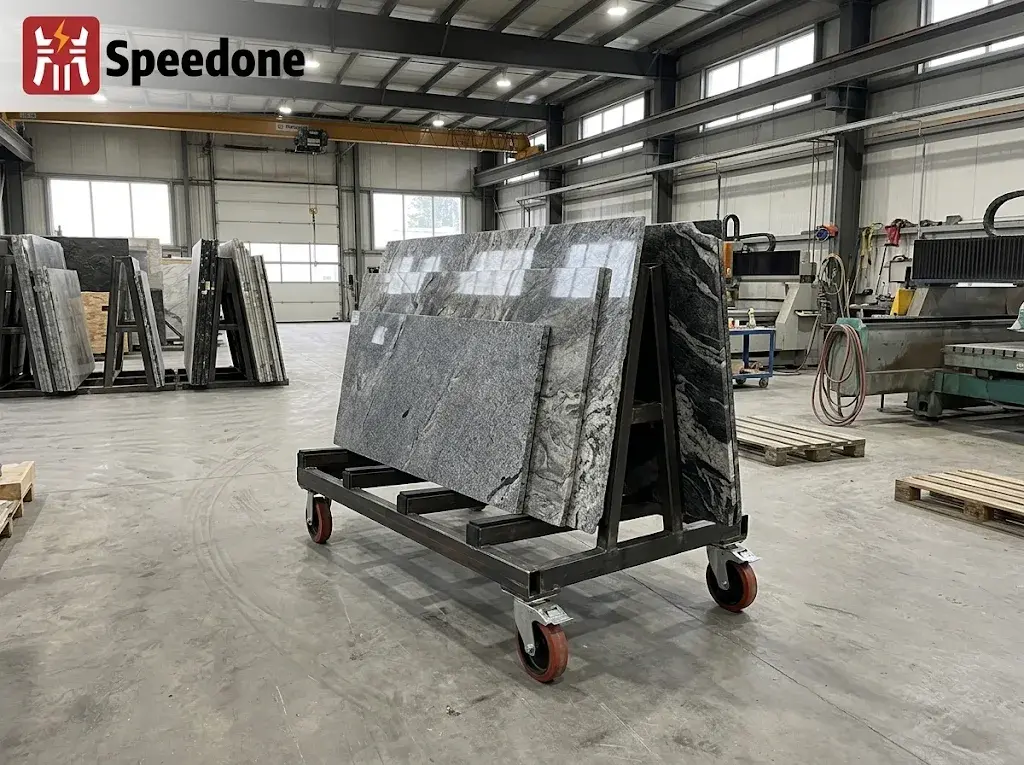
heavy-duty-slab-transport-cart-stone-workshop
Understanding Slab Transport Cart Load Capacity
What Does Rated Load Capacity Actually Mean?
Rated load capacity is the maximum payload that a cart is designed and approved to carry under the operating conditions specified by its manufacturer. It should not be confused with the cart’s own weight or the combined weight of the cart and its cargo.
When evaluating a Heavy Duty Slab Transport Cart, buyers should distinguish between four important values:
- Cart self-weight: The weight of the unloaded equipment.
- Rated payload: The permitted weight of the material being transported.
- Total loaded weight: The combined weight of the cart and transported material.
- Maximum individual slab weight: The heaviest workpiece the cart must support under the intended loading arrangement.
These values affect different aspects of equipment selection. The payload rating determines whether the cart is suitable for the material weight, while the total loaded weight is relevant to floor loading, maneuvering, and the effort required to move the equipment.
Buyers should also confirm whether the manufacturer’s rating applies to evenly distributed loads, a particular slab orientation, or a defined support arrangement. A cart suitable for a uniformly distributed load may not automatically be appropriate for an off-center workpiece or an unusual slab configuration.
How to Calculate the Weight of a Stone Slab
One practical way to estimate the required payload is to calculate the slab’s volume and multiply it by the material density.
Slab Weight = Length × Width × Thickness × Material Density
When dimensions are expressed in meters and density is expressed in kilograms per cubic meter, the result is calculated in kilograms.
Consider a hypothetical stone slab with the following dimensions:
- Length: 3.20 m
- Width: 1.60 m
- Thickness: 0.020 m
- Illustrative density: 2,700 kg/m³
The estimated volume is 3.20 × 1.60 × 0.020 = 0.1024 m³. Multiplying this volume by the illustrative density gives an estimated slab weight of 276.48 kg.
| Parametre | Illustrative Value | Amaç |
|---|---|---|
| Slab length | 3.20 m | Defines support length |
| Slab width | 1.60 m | Affects material volume |
| Slab thickness | 0.020 m | Directly affects weight |
| Illustrative density | 2,700 kg/m³ | Calculation input |
| Calculated weight | 276.48 kg | Estimated payload requirement |
This example demonstrates the calculation method rather than establishing a universal density value for granite or another stone. Actual density varies by material composition and product. Buyers should obtain the relevant material data from the slab supplier whenever possible.
Why the Heaviest Slab Is Not the Only Consideration
A stone factory may transport individual slabs, multiple supported pieces, or finished countertops with different dimensions. The maximum expected working load should therefore be identified before selecting equipment. Buyers should also consider slab positioning, weight concentration, and whether the cart will travel over floor joints, thresholds, or ramps.
Another common mistake is selecting a cart by adding together the individual wheel ratings. Component ratings cannot simply be added to establish the safe payload of the complete cart. Uneven floors, load distribution, caster geometry, mounting conditions, and frame stiffness can affect how forces are transferred through the assembly.
For this reason, buyers comparing Slab Cart Load Capacity should request the complete product’s rated payload and permitted operating configuration. A general description such as heavy-duty or industrial-grade is not a substitute for a clear technical specification.
Slab Transport Cart Wheels: Materials, Configurations and Floor Compatibility
Common Wheel Materials Used on Stone Transport Carts
Wheels influence rolling resistance, maneuverability, vibration, floor protection, and operator control. The best choice depends on the cart’s load, the factory floor, and the route between workstations.
| Tekerlek Malzemesi | General Characteristics | Potential Application | Buyer Considerations |
|---|---|---|---|
| Solid rubber | No inflation requirement; cushioning depends on compound and construction | General workshop movement | Load rating, hardness, wear, and floor marking |
| Polyurethane | Can provide abrasion resistance and controlled rolling behavior | Compatible industrial floors | Tread formulation, hardness, floor compatibility |
| Naylon | Hard rolling surface on suitable floors | Smooth, compatible surfaces | Noise, impact behavior, floor damage risk |
| Pneumatic | Air-filled construction can absorb some surface irregularities | Rougher or uneven routes | Pressure, puncture risk, rated load |
Wheel material should not be evaluated in isolation. Two wheels made from the same general material can have different load ratings, tread designs, diameters, and operating characteristics. The manufacturer’s technical specification is more useful than the material name alone.
How Wheel Diameter and Width Affect Cart Performance
Wheel diameter influences how a cart travels over small floor joints and surface irregularities. Larger wheels can generally negotiate certain obstacles more easily, although the result also depends on wheel material, load, and obstacle geometry. Wheel width affects the contact area and can influence floor pressure and rolling behavior.
In a stone workshop, a route may include smooth concrete, expansion joints, drainage channels, ramps, and narrow turning points. A wheel that performs well on a smooth production floor may not be the best choice for a route containing frequent surface transitions.
Buyers should measure the actual route and identify the most difficult section rather than selecting wheels based only on the main production area. They should also check whether the loaded cart can turn without colliding with machinery, storage racks, or other equipment.
Fixed Casters, Swivel Casters and Braking Arrangements
Fixed casters help maintain a predictable travel direction, while swivel casters allow the cart to turn more easily in confined spaces. Some configurations combine fixed and swivel wheels to balance directional control with maneuverability. The appropriate arrangement depends on cart length, wheelbase, expected load, and the operator’s route.
Brakes or parking locks are important when the cart must remain stationary during loading, unloading, or positioning. On sloped surfaces, buyers should verify that the braking arrangement is suitable for the intended operating conditions. A parking brake should not be treated as a substitute for a safe loading procedure or appropriate slab restraint.
Matching Wheels to Factory Floor Conditions
| Floor Condition | Selection Consideration | Main Risk |
|---|---|---|
| Smooth concrete | Rolling resistance and wheel rating | Excessive pushing effort |
| Epoxy-coated floor | Non-marking tread compatibility | Surface marking or damage |
| Rough concrete | Wheel diameter and impact behavior | Vibration and difficult movement |
| Floor joints | Obstacle clearance and wheel construction | Sudden impact and load movement |
| Sloped areas | Brakes, control, and operating procedure | Unintended movement |
For buyers comparing Stone Transport Cart Wheels, a practical approach is to describe the floor material, route length, floor transitions, maximum load, and turning requirements to the manufacturer. This gives the supplier a clearer basis for recommending a suitable wheel configuration.
Slab Transport Cart Frame Design: Structural Strength and Slab Protection
Common Frame Materials and Their Characteristics
The frame transfers the slab load to the wheel assembly. Its performance depends on material properties, section dimensions, geometry, welding quality, and the way the load is distributed. A thicker-looking frame is not automatically stronger or safer than a well-engineered alternative.
| Frame Material | General Characteristics | Buyer Considerations |
|---|---|---|
| Carbon steel | Common structural material with established fabrication methods | Section dimensions, welding quality, corrosion protection |
| Stainless steel | Available in corrosion-resistant grades | Specific grade, structural design, fabrication quality, cost |
| Aluminum alloy | Lower density than steel in many common alloy comparisons | Strength, stiffness, connections, suitability for load |
For many industrial stone-handling applications, fabricated steel structures are a practical option because they can be configured with crossmembers, support brackets, and reinforced joints. However, final performance still depends on the design and manufacturing process. Material selection should be based on the actual load case and working environment, not on a general assumption that one material is always superior.
How Frame Geometry Affects Load Distribution
Frame geometry determines how forces travel from the slab support points through the structural members and into the wheels. A suitable design should limit excessive bending, twisting, and localized stress under the intended loading conditions.
- Base frame layout: Provides a stable foundation for the expected slab dimensions and load distribution.
- Crossmembers: Help distribute forces between the main frame members when properly positioned.
- Support spacing: Should be compatible with the dimensions and orientation of the transported workpiece.
- Center of gravity: The load should remain within the cart’s intended support area.
- Wheelbase: Affects stability, turning behavior, and the way the frame responds to uneven surfaces.
Consider a workshop transporting long stone slabs from a storage rack to a cutting station. Even if the calculated slab weight is within the cart’s rated payload, the cart may be unsuitable if its support points do not align with the slab dimensions. A poorly matched support arrangement can create concentrated contact forces and increase the risk of movement or damage.
Welding Quality and Connection Points
Welded joints, bolted connections, caster mounting plates, and support brackets are important inspection areas. Buyers should ask how the manufacturer controls fabrication quality and checks the completed frame.
Visible warning signs may include cracked welds, bent structural members, loose fasteners, deformed mounting plates, or corrosion around critical joints. These conditions should be assessed before equipment is returned to service. Any damaged cart should be removed from operation until it has been inspected and repaired or replaced appropriately.
Protective Contact Surfaces and Slab Support
Stone surfaces can be damaged when they move against unsuitable contact materials or poorly positioned supports. Rubber strips, protective pads, or other suitable contact materials can help reduce direct metal-to-stone contact. Their suitability depends on the material finish, the load, and the operating environment.
Polished granite, engineered quartz, porcelain, glass, and finished countertops may require different protection considerations. Buyers should also examine whether protective components can be replaced when worn. A Custom Slab Transport Cart may be worth evaluating when standard support dimensions or contact arrangements do not match the workpieces.
Material Fit by Product Direction: Which Cart Configuration Should Buyers Consider?
Not every transport cart is appropriate for every slab-handling task. Material dimensions, workpiece weight, surface finish, transport orientation, and production workflow all influence the suitable equipment direction. The following matrix is an application-fit guide, not statistical data, a laboratory test result, or a guarantee of product compatibility.
Legend:
- ●●● = Primary
- ●●○ = Strong Option
- ●○○ = Depends on Workflow
- — = Usually Not First Choice
| Handling Requirement | Standard Slab Cart | Heavy-Duty Slab Cart | Self-Locking Cart | Mobile Fabrication Cart | Taşıma A Çerçevesi |
|---|---|---|---|---|---|
| General granite and marble workshop movement | ●●● | ●●○ | ●●○ | ●○○ | ●●○ |
| Higher-load stone handling | ●○○ | ●●● | ●●○ | ●○○ | ●●○ |
| Controlled slab positioning | ●●○ | ●●○ | ●●● | ●●○ | ●○○ |
| Countertop fabrication support | ●○○ | ●○○ | ●○○ | ●●● | - |
| Upright movement of large panels | ●●○ | ●●○ | ●●○ | - | ●●● |
The matrix helps buyers identify a product direction for further evaluation. It does not replace a model-specific load assessment, dimensional review, or manufacturer’s confirmation. A standard cart may be appropriate for routine internal movement, while a heavier frame or self-locking arrangement may be more relevant for particular load and positioning requirements. A transport A-frame serves a different handling purpose and should not be treated as interchangeable with every mobile cart.
For porcelain, glass, thin panels, or unusually shaped finished pieces, the available information may not be sufficient to recommend one configuration universally. Buyers should confirm material thickness, support points, edge protection, load restraint, and the manufacturer’s application limits before selecting equipment.
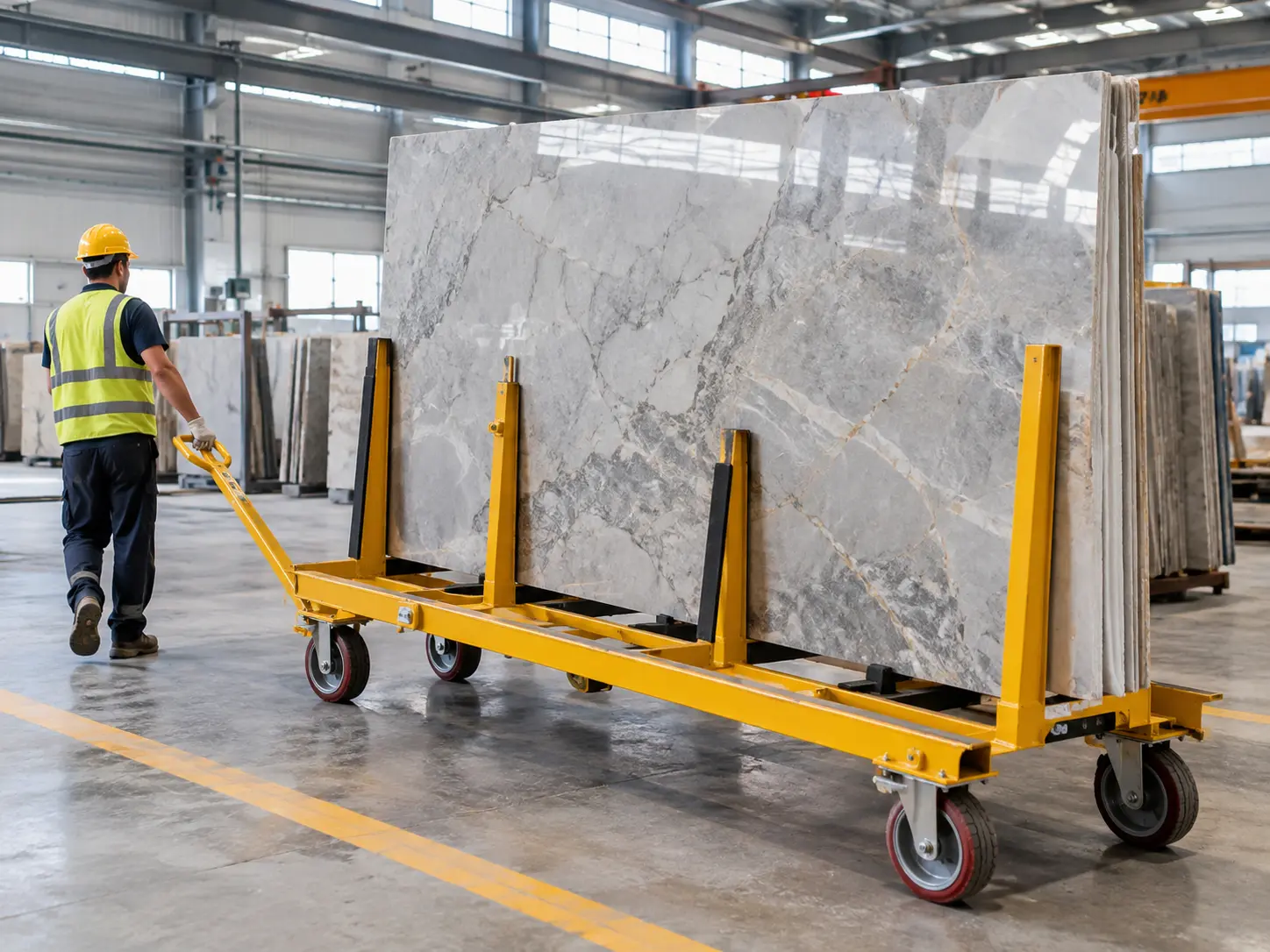
Slab Taşıma Arabası
How Capacity, Wheels and Frame Design Work Together
Why a High Load Rating Does Not Guarantee Good Performance
Cart components operate as one system. A frame with sufficient structural capacity may still be difficult to move if the wheel arrangement is unsuitable. High-rated wheels cannot compensate for an unstable support layout, and a well-designed frame cannot make an overloaded cart safe.
For a complete equipment assessment, buyers should examine the relationship between:
- Payload rating and actual slab weight.
- Frame stiffness and support-point positioning.
- Wheel and caster ratings under intended load conditions.
- Wheelbase, turning clearance, and floor transitions.
- Brakes, parking locks, and slab restraint arrangements.
- Protective contact surfaces and workpiece finish.
Example: Evaluating a Cart for a Busy Stone Fabrication Workshop
Imagine a workshop that moves large granite slabs between a storage area, a cutting machine, and a finishing station. The route includes smooth concrete, several floor joints, and a narrow turning area near the processing equipment.
The purchasing team should first calculate the weight of its heaviest expected slab. It should then confirm that the proposed cart’s rated payload covers the intended working load under the specified loading arrangement. Next, the team should review the wheel material, diameter, caster layout, and braking system against the actual route. Finally, it should check whether the frame support points match the slab dimensions and whether protective contact materials are suitable for the stone finish.
This process is more reliable than comparing two products based only on a headline capacity figure. It also creates a clear technical basis for discussing custom dimensions or wheel options with the supplier. Buyers who want to understand broader product functions, configurations, and application considerations can consult this Slab Transport Cart guide as a related resource.
Technical Specification Checklist
| Bileşen | Information to Confirm | Why It Matters |
|---|---|---|
| Kapasite | Rated payload and loading conditions | Avoids load mismatch |
| Frame | Material, section design, reinforcement | Structural reliability |
| Tekerlekler | Material, diameter, width, rating | Mobility and floor compatibility |
| Casters | Fixed or swivel arrangement | Steering and turning |
| Brakes | Locking and parking functions | Prevents unintended movement |
| Destekler | Spacing and protective materials | Slab surface and edge protection |
| Boyutlar | Overall size and usable support area | Workpiece and route compatibility |
Real-World Applications in Stone Factories and Fabrication Workshops
Moving Granite and Marble Between Storage and Cutting Areas
Granite and marble slabs can be heavy, large, and sensitive to impact at exposed edges. A cart used for this workflow should provide appropriate support, stable movement, and suitable contact protection. Buyers should also consider whether the loading method is compatible with the cart design and whether the transfer route is free from unnecessary obstacles.
Transporting Engineered Quartz and Porcelain Slabs
Engineered quartz and porcelain products have their own material and handling characteristics. Thickness, dimensions, surface finish, and product-specific handling instructions all influence the required support arrangement. Thin or large-format panels may need more careful attention to support spacing and restraint than a general-purpose cart can provide.
Buyers should not assume that a cart suitable for one stone product will automatically suit every porcelain or glass panel. Where the material is brittle, thin, unusually large, or has special handling requirements, the equipment configuration should be confirmed with the material supplier and cart manufacturer.
Moving Finished Countertops and Fabricated Pieces
Finished countertops may include sink cutouts, narrow sections, polished edges, and irregular shapes. These features can change the way a workpiece should be supported. A mobile fabrication cart may be more appropriate for some processing tasks, while a conventional slab cart may be designed primarily for transporting larger panels.
Integrating Carts into the Complete Material Handling Workflow
A typical stone factory workflow may involve receiving, unloading, storage, staging, cutting, edge processing, polishing, inspection, packaging, and dispatch. Transport equipment should be selected according to the specific transfer points in this sequence.
For example, a compatible slab rack and cart combination can support movement between storage and processing areas. Clamp lifters or other approved lifting equipment may be needed for loading and unloading, while forklift attachments may be relevant to other parts of the workflow. Each piece of equipment must be compatible with the load, lifting method, and operating procedure. A cart should not be used as a substitute for lifting equipment when a task requires a controlled lift.
For buyers comparing configurations, the Slab Transport Cart product range provides a starting point for reviewing equipment designed for stone slab movement. The appropriate model should still be confirmed against actual material, dimensions, working load, and factory route requirements.
Safety, Regulations and Inspection Requirements
Understanding the Main Hazards of Stone Slab Transportation
Stone slabs can create serious crushing and struck-by hazards because of their size, weight, and potential instability when stored or moved on edge. Risks may arise during loading, unloading, turning, positioning, and transfer between equipment. A cart with a suitable payload rating does not remove the need for a planned handling procedure.
Relevant workplace safety guidance from the U.S. Occupational Safety and Health Administration (OSHA) and the UK’s Health and Safety Executive (HSE) emphasizes safe systems of work, appropriate handling equipment, inspection, training, and keeping workers away from areas where slabs could fall.
Regulatory Considerations for Buyers and Factory Operators
In the United States, employers should review applicable OSHA requirements, including general material-handling provisions under 29 CFR 1910.176 and any other rules relevant to the equipment and task. Powered industrial trucks and overhead lifting operations may involve additional requirements when those systems are part of the workflow.
In the United Kingdom, employers should consider applicable duties under workplace safety legislation and relevant regulations covering manual handling, work equipment, and lifting operations. HSE guidance on large sheet stone slabs highlights the need for slab restraint, planned handling, suitable equipment, and keeping people outside potential fall zones.
Requirements vary by jurisdiction and application. Buyers should confirm which regulations, standards, and inspection obligations apply to their workplace. A supplier’s product description should not be treated as proof of regulatory compliance unless the relevant documentation and scope have been verified.
Pre-Use Inspection Checklist
| Inspection Area | What to Check | Response to a Defect |
|---|---|---|
| Frame | Cracks, bending, corrosion, deformation | Remove from service pending assessment |
| Welds | Visible cracks or separation | Arrange qualified inspection and repair |
| Tekerlekler | Damage, wear, secure mounting | Repair or replace defective components |
| Bearings and casters | Smooth rotation and abnormal noise | Inspect and service as required |
| Brakes | Locking and release function | Do not use until corrected |
| Contact surfaces | Loose, worn, damaged protective materials | Replace or secure protection |
| Load arrangement | Correct positioning and restraint | Reposition before moving |
Inspection frequency should be based on the manufacturer’s instructions, the intensity of use, workplace conditions, and the employer’s risk assessment. A pre-use check is a practical way to identify obvious defects before operation, but it does not replace scheduled maintenance or any legally required inspection.
For a broader discussion of how equipment design and handling procedures influence workplace movement, buyers can also review this resource on slab transportation efficiency and safety.
How to Choose a Reliable Slab Transport Cart Manufacturer
What Technical Information Should Buyers Request?
A professional supplier should be able to discuss the intended application rather than offering a recommendation based only on a product photograph. Before requesting a quotation, buyers should prepare the maximum slab length, width, thickness, estimated weight, material type, required quantity, loading method, and factory floor conditions.
Useful technical information includes rated payload, overall cart dimensions, frame material, structural configuration, wheel specifications, caster arrangement, braking options, protective contact materials, and maintenance recommendations. Product drawings and inspection information can also help purchasing teams compare quotations accurately.
When Is a Custom Slab Transport Cart Worth Considering?
Customization may be appropriate when a factory handles non-standard slab dimensions, has limited aisle space, requires a particular wheel arrangement, or needs special support and contact protection. However, customization should begin with a defined handling requirement. Changing frame dimensions or wheel options without reviewing the complete load configuration can create new compatibility problems.
A capable Slab Transport Cart Factory should be able to discuss the relationship between slab dimensions, working load, cart geometry, wheel configuration, and manufacturing requirements. Buyers should also ask how the agreed specifications will be checked before shipment.
Questions to Ask Before Placing an Order
- What is the rated payload under the intended operating configuration?
- What maximum slab dimensions can the cart accommodate?
- How are the frame and support points designed to distribute the load?
- Which wheel materials, diameters, and caster arrangements are available?
- Are brakes, locking functions, or additional protective components required?
- Can the supplier provide drawings and agreed inspection information?
- Are replacement wheels and protective components available?
- What customization, packing, and export arrangements can be provided?
These questions help buyers compare suppliers based on technical suitability rather than price alone. A lower initial quotation may not represent better value if the cart does not fit the slab dimensions, floor conditions, or production workflow.
Buyers who have specific requirements can prepare their slab dimensions, load information, and factory layout before making an inquiry. A detailed technical discussion helps the supplier evaluate whether a standard configuration or a customized cart is more appropriate. For model recommendations, drawings, and quotation details, buyers can contact the stone handling equipment team with their application requirements.
How to Compare Slab Transport Cart Suppliers
When comparing suppliers, review their technical documentation, manufacturing capability, customization experience, quality inspection procedures, spare parts availability, communication, and export experience. Ask whether the supplier can confirm the rated payload and provide drawings showing the proposed support arrangement.
For wholesale or project-based purchasing, buyers should also clarify order quantity, packaging requirements, lead time, shipping arrangements, and after-sales support. These details help prevent misunderstandings after the technical configuration has been agreed.
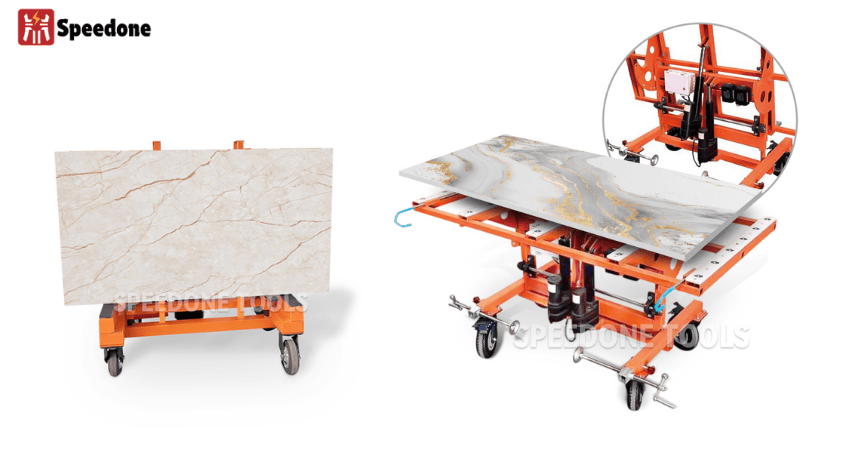
Slab Taşıma Arabası Tedarikçisi
Industry Trends in Slab Transport Cart Design
Greater Attention to Ergonomics and Maneuverability
Stone factories are paying closer attention to how equipment moves through real production environments. Wheel selection, handle positioning, turning clearance, and braking arrangements all influence how easily operators can control a loaded cart. Where manual movement requires excessive force, businesses should assess whether a different cart configuration or an assisted handling method is more appropriate.
More Modular and Application-Specific Configurations
Factories may handle full slabs, finished countertops, panels, and different material thicknesses within the same facility. This creates demand for equipment configurations that better match particular workpieces and handling stages. Replaceable protective components, adjustable support arrangements, and project-specific dimensions can be useful where the application justifies them.
Integration with Complete Material Handling Systems
Another important direction is the coordination of transport carts with storage racks, lifting equipment, and fabrication workstations. Rather than optimizing one cart in isolation, factory managers increasingly need to consider how materials move from receiving to storage, processing, inspection, and dispatch. Equipment compatibility and clearly defined transfer procedures are essential parts of that planning.
Frequently Asked Questions About Slab Transport Cart Capacity, Wheels and Frame Design
1. How Much Weight Can a Slab Transport Cart Hold?
The load capacity depends on the cart’s frame design, wheel and caster assembly, support layout, and operating conditions specified by the manufacturer. There is no single capacity that applies to every slab transport cart. Buyers should calculate the weight of their heaviest expected slab, confirm whether multiple pieces will be transported together, and compare the result with the rated payload of the complete cart. It is also important to verify whether the rating assumes an evenly distributed load or a particular slab orientation. Never estimate capacity from frame appearance or by adding individual wheel ratings together.
2. What Wheels Are Best for Moving Stone Slabs?
The best wheels depend on the factory floor, transported load, route, and maneuverability requirements. Solid rubber wheels may be suitable for some general workshop applications, while polyurethane wheels can be considered where abrasion resistance and floor compatibility are important. Nylon wheels may work on suitable smooth surfaces, and pneumatic wheels can provide cushioning on some rougher routes. However, material alone does not determine performance. Buyers should compare wheel load ratings, diameter, width, tread design, bearing quality, and compatibility with floor joints or ramps before selecting a configuration.
3. Why Is Frame Design Important for a Heavy Duty Slab Transport Cart?
The frame transfers the slab’s weight to the wheel assembly and helps maintain the cart’s stability during movement. Its geometry, material, crossmembers, welds, and support points influence how forces are distributed. A poorly matched frame may bend, twist, or create concentrated contact forces even when the estimated slab weight appears to be within a stated capacity. Buyers should review the complete structural design, support spacing, caster mounting areas, and protective contact surfaces. For unusual slab sizes or heavier working loads, technical confirmation from the manufacturer is particularly important.
4. How Do I Choose the Right Slab Cart Load Capacity?
Start by identifying the largest and heaviest workpieces that the cart will carry. Calculate slab weight using length, width, thickness, and material density, then consider whether the cart will transport one slab or multiple pieces at the same time. Confirm the manufacturer’s rated payload and the loading arrangement to which it applies. Next, check whether the frame, wheels, casters, and support layout are suitable for the same working conditions. The floor surface, transport distance, ramps, and turning requirements should also be considered. If the application involves uneven loading or special workpiece dimensions, request a configuration review rather than relying on a basic weight comparison.
5. What Should I Check Before Buying a Slab Transport Cart?
Buyers should check the rated payload, maximum slab dimensions, frame material, structural reinforcement, wheel type, wheel load rating, caster arrangement, braking system, support spacing, and protective contact materials. They should also assess factory aisle width, turning clearance, floor joints, ramps, and the method used to load and unload slabs. Before placing an order, request technical drawings, confirmed specifications, inspection details, and information about replacement parts. A supplier should understand the intended application and be able to explain how the proposed configuration matches the actual handling requirements.
Referanslar
- Hazards of Transporting, Unloading, Storing and Handling Granite, Marble and Stone Slabs — Occupational Safety and Health Administration (OSHA), U.S. Department of Labor.
- Manual Materials Handling: Carts, Hand Trucks, Pallet Jacks and Lift Tables — Occupational Safety and Health Administration (OSHA).
- Handling and Storage of Large Sheet Stone Slabs — Health and Safety Executive (HSE), United Kingdom.
- 29 CFR 1910.176: Handling Materials — General — Occupational Safety and Health Administration (OSHA).
- 29 CFR 1910.178: Powered Industrial Trucks — Occupational Safety and Health Administration (OSHA).
- Manual Handling Operations Regulations 1992 — UK Health and Safety Executive (HSE) and UK legislation.
- Provision and Use of Work Equipment Regulations 1998 — UK Health and Safety Executive (HSE) and UK legislation.
- ISO 12100: Safety of Machinery — General Principles for Design, Risk Assessment and Risk Reduction — International Organization for Standardization (ISO).
Choose a Slab Transport Cart That Matches the Entire Factory Workflow
A dependable Slab Transport Cart is the result of matching capacity, wheels, frame construction, support geometry, and operating conditions. Buyers should begin with actual slab dimensions and weight, assess the factory floor and route, and then verify that the complete cart configuration is suitable for the intended workflow.
Choosing equipment by headline capacity alone can overlook important issues such as caster performance, frame stability, turning clearance, and surface protection. A structured technical review helps purchasing teams reduce avoidable selection mistakes and build a more reliable material handling process.
For stone factories, fabrication workshops, and equipment distributors, the most useful next step is to share slab material, maximum dimensions, estimated weight, transport method, and working-area conditions with a qualified supplier. These details create a practical starting point for selecting a standard or customized solution.
