Hoàn thành công việc một cách hiệu quả!





Learn how to choose an A-Frame Storage Rack for marble, granite, quartz, porcelain and sintered stone slabs with load capacity, safety, layout, outdoor use and sourcing tips.
Choosing the Right A-Frame Storage Rack Starts With Slab Safety, Not Rack Price
Stone slab storage looks simple until one expensive slab chips, slides, cracks, or blocks a forklift aisle. A marble importer may receive a container of polished slabs, a quartz distributor may need daily access to fast-moving colors, and a fabrication shop may stage oversized panels near cutting machines. In all these cases, the A-Frame Storage Rack is not just a warehouse accessory. It is part of the safety system, inventory system, and workflow system.
An undersized rack can create three problems at once: damaged slabs, slow handling, and worker safety risk. Stone slabs are heavy, tall, and edge-sensitive. They should not be stored casually against walls or random steel frames. That is how a “small shortcut” becomes a very expensive Monday morning.
For buyers comparing a heavy-duty A-Frame Storage Rack, the correct question is not “Which rack is cheapest?” The better question is: “Which rack safely supports my slab weight, storage volume, warehouse layout, handling method, and future growth?”

Kệ lưu trữ hình chữ A
Quick Decision Guide for Stone Slab Storage Racks
The best A-Frame Storage Rack depends on how the stone warehouse actually works. A slab showroom, an outdoor stone yard, a quartz distribution warehouse, and a compact fabrication shop do not need the same rack structure. Buyers should first define stone type, slab thickness, maximum slab weight, handling equipment, access direction, and whether racks must stay fixed or move between work zones.
Một người thợ chuyên nghiệp A-Frame Storage Rack manufacturer should be able to discuss load capacity, base width, steel thickness, welding quality, surface treatment, protective pads, forklift pockets, and custom dimensions. If a supplier cannot clearly explain the rated capacity or whether the rating applies to one side or both sides, the rack should not be approved for heavy slab storage.
| Buyer Scenario | Recommended Rack Type | Why It Works | Risk to Check |
|---|---|---|---|
| Marble and granite slab warehouse | Heavy-duty double-sided A-frame rack | High capacity and efficient two-side storage | Load rating, floor flatness, and balanced loading |
| Quartz slab distributor | Fixed A-frame slab rack | Stable for repeated slab access | Surface protection and rack spacing |
| Small fabrication shop | Compact single-sided A-frame rack | Saves space against walls | Tip-over resistance and access clearance |
| Outdoor stone yard | Galvanized or coated A-frame rack | Better corrosion resistance | Rust, drainage, and ground stability |
| Frequent loading and unloading | A-frame rack with forklift pockets | Improves workflow and relocation flexibility | Forklift capacity and approved lifting points |
| High-value porcelain slabs | Padded A-frame storage rack | Protects edges and polished surfaces | Contact pressure and anti-slip protection |
What Is an A-Frame Storage Rack for Stone Slabs?
Basic Structure and Working Principle
An A-Frame Storage Rack uses an A-shaped steel structure to support slabs in a leaning position. It usually includes a base frame, inclined support arms, cross beams, vertical reinforcement, bottom support points, rubber or timber protection pads, stopper blocks, and sometimes forklift pockets or lifting eyes. The angled frame allows slabs to lean safely while distributing force downward and backward.
The structure looks simple, but safe design is not simple. Load distribution, weld quality, steel thickness, frame angle, floor contact, and slab handling method all affect real performance. A rack may look strong in a photo but still be unsuitable for jumbo granite, porcelain panels, or double-sided loading.
Before confirming rack size or quantity, buyers should contact a stone slab storage rack supplier with slab dimensions, thickness, maximum slab weight, indoor or outdoor use, forklift model, and warehouse layout. Those details help avoid buying a rack that fits the budget but fails the workflow.
Why Stone Slabs Need Specialized Storage
Stone slabs are not boxes. They are heavy, tall, fragile at the edges, and difficult to handle safely without proper equipment. Marble may chip at edges. Granite can be extremely heavy. Quartz needs clean contact protection. Porcelain and sintered stone panels can be thin, large, and edge-sensitive.
Common storage risks include slab tipping, edge chipping, surface scratching, rack deformation, uneven loading, forklift impact, poor leaning angle, floor settlement, and worker crush-zone exposure. A proper A-Frame Storage Rack helps reduce these risks by giving slabs a stable support angle and controlled contact surface.
Key Factors to Evaluate Before Buying an A-Frame Storage Rack
Load Capacity and Safety Margin
Load capacity is the first serious checkpoint. Buyers should compare the rack’s rated capacity with the actual slab weight, number of slabs, stone density, slab thickness, and whether the rack is loaded on one side or both sides. A rack used for dense granite slabs needs stronger capacity than a rack used for a few lightweight display pieces.
A useful A-Frame Storage Rack buyer’s manual should help buyers compare structural design, steel specification, application environment, rack type, and safety factors before purchase. In stone storage, unclear load data is not a small detail. It is a warning sign wearing a price tag.
| Slab Type | Common Thickness Range | Storage Concern | Rack Selection Priority |
|---|---|---|---|
| Marble slab | 18–30 mm depending on project | Edge chipping and breakage | Padded support and stable leaning angle |
| Granite slab | 20–30 mm common in many markets | Higher density and heavier load | Higher load capacity and reinforced base |
| Quartz slab | 12–30 mm depending on application | Surface protection and clean support | Stable frame and non-marking contact pads |
| Porcelain slab | Thin large-format panels | Fragility and edge damage | Wide soft contact and controlled handling |
| Sintered stone slab | Large-format panels | Chipping and handling sensitivity | Padded rack and anti-slip contact points |
Rack Angle and Center of Gravity
The rack angle affects how slabs lean and how load transfers into the base. If slabs stand too upright, tipping risk may increase. If they lean too far, pressure on the lower contact area may rise and slab access can become more difficult. The ideal angle should be confirmed with the rack design and loading method.
Buyers should ask whether the rack is designed for single-sided loading, double-sided loading, or balanced loading. Uneven loading may affect stability depending on frame structure. Workers should also be trained not to remove slabs in a way that suddenly shifts the center of gravity.
Base Width and Floor Contact
A wider base usually improves stability, but it also uses more warehouse space. The base must sit on a stable, level floor. If the floor is uneven, sloped, cracked, or weak, even a strong rack may perform poorly. Outdoor yards add extra variables such as drainage slope, soil settlement, rainwater, and forklift movement.
For tight warehouses, buyers often want space-saving storage. That is reasonable, but space saving should not mean unsafe loading. A guide on A-Frame Storage Rack space-saving solutions is useful because efficient storage should still protect aisle width, slab access, emergency routes, and forklift movement.
Steel Material, Welding, and Surface Treatment
The rack must handle repeated loading cycles, forklift-area vibration, occasional impact, and long-term slab pressure. Buyers should inspect steel tube size, wall thickness, weld quality, bracing, base reinforcement, coating, and corrosion protection. For outdoor use, galvanized or high-quality coated steel is usually more practical than basic indoor paint.
Good welding should look consistent, clean, and structurally appropriate. Weak welds, thin steel, poor coating, and missing reinforcement can reduce service life. A cheap rack that bends after several months is not cheap. It is a delayed invoice.
Surface Protection for Stone Contact Areas
Stone should not rest directly against hard metal when surface or edge protection matters. Rubber strips, timber pads, PVC pads, replaceable sleeves, anti-slip pads, and bottom support blocks help reduce scratching, chipping, staining, and sliding.
If the rack stores polished marble or quartz, use non-marking contact protection. If it stores porcelain or sintered stone, avoid sharp contact points and narrow pressure zones. Even raw granite benefits from proper protection because edge damage can reduce slab value.
Types of A-Frame Storage Racks for Stone Slab Storage
Single-Sided A-Frame Storage Rack
A single-sided A-Frame Storage Rack is useful for wall-side storage, compact workshops, or areas where slabs are loaded from one side only. It saves space and can support smaller fabrication shops that do not need two-sided access.
The limitation is capacity and access flexibility. Buyers should check tip-over resistance, base design, wall clearance, and slab extraction direction. Single-sided racks should not be casually overloaded just because they look convenient.
Double-Sided A-Frame Storage Rack
A double-sided A-frame rack is suitable for slab wholesalers, import warehouses, and larger fabrication shops. It allows storage on both sides and improves storage efficiency when warehouse aisles are wide enough.
The key risk is loading balance and access planning. Workers need safe space on both sides, and forklifts or cranes must be able to approach without hitting the rack. For larger inventory operations, double-sided racks are often the practical choice, but only if the layout supports them.
Portable A-Frame Rack With Forklift Pockets
Portable racks are useful when slabs need to move between unloading, inspection, cutting, polishing, packing, and loading zones. Forklift pockets can improve flexibility, but buyers must confirm whether the rack is designed to be moved empty or loaded. These are not the same thing.
The forklift capacity, pocket location, rack balance, ground condition, and operator procedure all matter. A portable rack can improve workflow, but careless movement can create risk faster than a forklift can beep.
Outdoor Galvanized A-Frame Rack
Outdoor stone yards need stronger corrosion protection and a stable foundation. Rain, humidity, drainage slope, UV exposure, forklift traffic, and dust can shorten the life of poorly coated racks. Galvanized or weather-resistant finishes are usually better for outdoor use.
Export stone yards often prefer stronger racks because they store heavy mixed inventory and handle frequent loading. This is why many buyers study why export stone yards prefer heavy-duty A-Frame Storage Rack systems when planning durable, high-volume slab storage.
Custom Heavy-Duty Slab Rack
Custom racks may be necessary for oversized slabs, special slab thicknesses, porcelain panels, high-volume storage, or unusual warehouse layouts. Custom options may include longer bases, higher frames, extra cross-bracing, removable posts, forklift pockets, special protective pads, outdoor coatings, custom colors, and project labels.
Choose custom design when standard rack dimensions do not match the slab size, aisle layout, handling equipment, or load demand. Do not force a standard rack into a non-standard problem. That is how warehouses invent their own headaches.
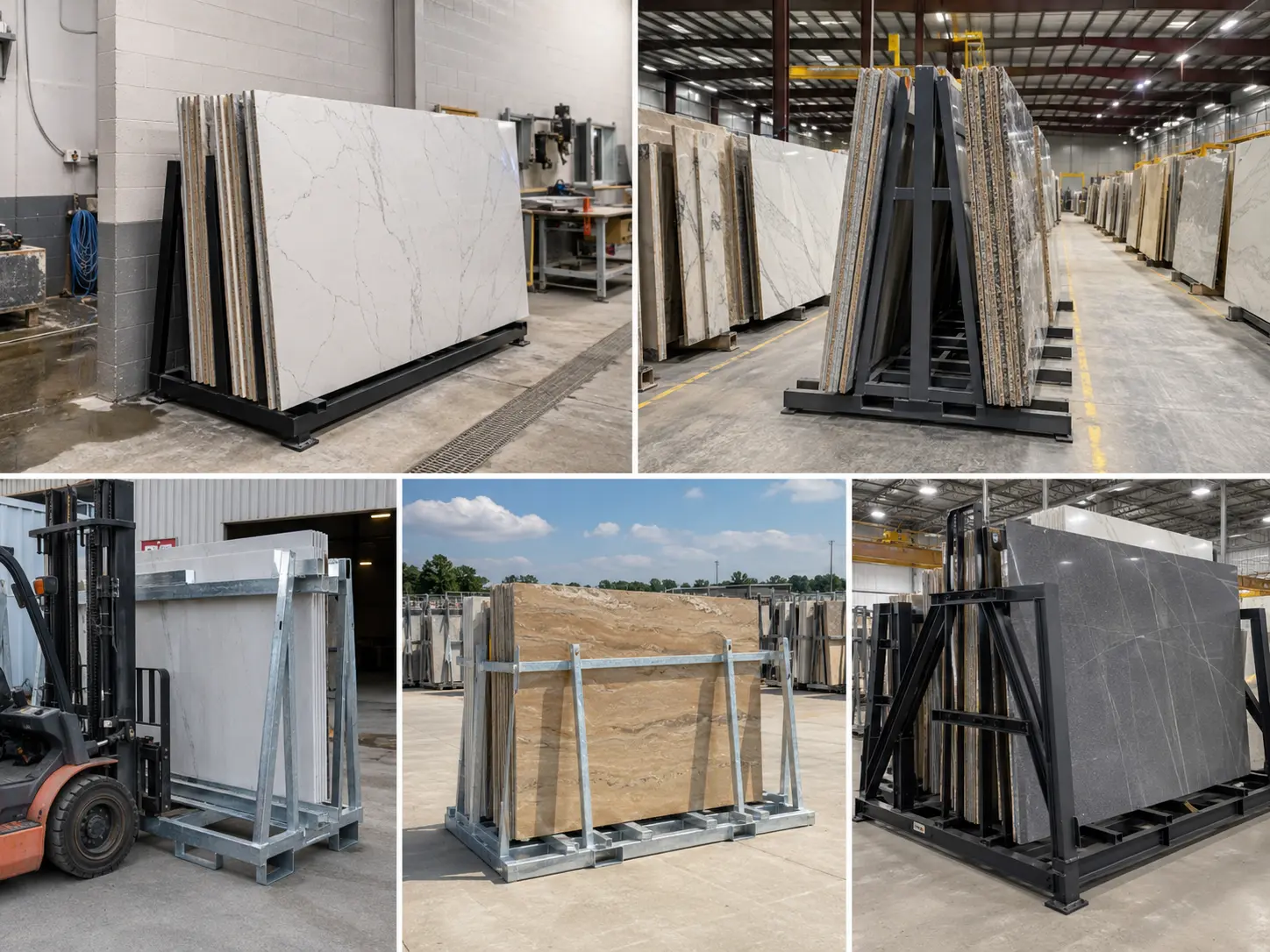
A-Frame Storage Rack Applications
A-Frame Rack vs Other Stone Slab Storage Systems
A-frame racks are excellent for leaning slab storage, staging, and accessible warehouse organization. But they are not the only option. Some warehouses may also use bundle racks, vertical slab racks, transport A-frames, or custom storage frames. The best system depends on storage volume, access frequency, material type, and handling equipment.
| Storage System | Tốt nhất cho | Main Advantage | Main Limitation |
|---|---|---|---|
| Kệ lưu trữ hình chữ A | Slabs, staging, display, small-to-medium batch storage | Simple access and strong leaning support | Requires leaning angle and space planning |
| Bundle Rack | High-volume slab bundles | Better separation by bundle | Requires careful post spacing |
| Vertical Slab Rack | Organized single-slab access | Easier inventory classification | More complex floor planning |
| Xe đẩy khung chữ A vận chuyển | Moving slabs between areas | Useful for staging and transport | Must match forklift or crane handling limits |
| Wall Leaning Storage | Temporary low-cost storage | Low initial cost | Higher safety and slab damage risk |
Warehouse Layout Planning for Stone Slab Storage
Aisle Width and Forklift Access
A rack is only useful if workers and handling equipment can reach it safely. Forklift turning radius, crane hook path, slab clamp clearance, aisle width, rack spacing, emergency access, loading dock location, and cutting-machine workflow all affect the final rack plan.
Buyers should place high-turnover slabs near loading and processing areas. Reserved project slabs should be labeled and separated. Fragile porcelain or sintered stone should be stored where handling is controlled and unnecessary movement is minimized.
Indoor vs Outdoor Storage
Indoor storage offers better weather control, cleaner surfaces, and more predictable floors. Outdoor storage provides more space and easier truck loading, but it introduces rust risk, rainwater, ground settlement, and wind exposure. The rack surface treatment should match the storage environment.
| Storage Location | Lợi thế | Nguy cơ | Rack Requirement |
|---|---|---|---|
| Indoor warehouse | Better protection and controlled access | Floor load and aisle limitations | Stable base and workflow planning |
| Outdoor yard | More space and easier truck loading | Rust, rain, ground settlement, wind | Galvanized rack and stable foundation |
| Production staging area | Fast access to cutting machines | Congestion and forklift traffic | Compact movable rack |
| Showroom warehouse | Slab display and customer selection | Appearance and safety both matter | Clean padded A-frame rack |
Safety and Compliance Considerations for Stone Slab Storage
Material Storage Safety Logic
Material storage should not create hazards. For stone slab warehouses, that means slabs should be stored on racks designed for the load, placed on stable floors, protected from sliding, and handled with clear operating procedures. Storage planning should also control tripping hazards, forklift impact zones, and emergency access routes.
OSHA material storage standards are not a product-buying checklist, but they support the same practical principle: stored materials must be stable and secured against sliding, falling, or collapse where applicable. For a stone yard, that principle translates into proper rack capacity, stable leaning angle, floor condition, worker training, and regular inspection.
Handling Equipment Coordination
Stone slabs are commonly moved with forklifts, overhead cranes, slab clamps, vacuum lifters, and below-the-hook lifting devices. Rack placement should allow safe loading and unloading without forcing workers into pinch points or crush zones.
When cranes or lifting devices are used, equipment selection, inspection, rating, and operator training become part of the storage system. Buyers should confirm that rack access does not conflict with the lifting route, clamp clearance, or forklift movement.
Rack Inspection and Maintenance
A durable rack still needs inspection. Welds, frame alignment, rubber pads, base contact, rust, coating damage, stopper blocks, safety posts, load labels, and forklift impact marks should be checked regularly. A bent rack should not be treated as “still basically fine.” Heavy slabs are not known for forgiving optimism.
For harsh environments, buyers can review A-Frame Storage Rack durability in industrial environments because outdoor yards, busy warehouses, and fabrication shops all demand stronger coating, better reinforcement, and more disciplined maintenance.
| Inspection Item | Suggested Frequency | Risk If Ignored |
|---|---|---|
| Welds and frame alignment | Weekly or monthly depending on use | Structural weakness or rack deformation |
| Rubber or timber pads | Regularly | Slab scratches, slipping, or edge chips |
| Base contact and levelness | Regularly | Rack instability |
| Rust and coating damage | More often for outdoor racks | Reduced service life |
| Stop blocks and safety posts | Before heavy loading | Slab sliding or uncontrolled movement |
| Load label | Always visible | Overloading and misuse |
Material Parameters Buyers Should Compare Before Ordering
| Tham số | Why It Matters | Buyer Question |
|---|---|---|
| Rated load | Prevents overload and frame deformation | What is the maximum load per rack and per side? |
| Rack height | Supports slab leaning height | Is it suitable for jumbo slabs? |
| Base width | Controls stability and floor footprint | Will it remain stable under partial loading? |
| Steel thickness | Affects strength and service life | What steel section and wall thickness are used? |
| Frame angle | Affects slab stability and access | What leaning angle is recommended? |
| Pad material | Protects stone edges and surfaces | Is it replaceable and non-marking? |
| Surface treatment | Controls corrosion resistance | Is it painted, powder-coated, or galvanized? |
| Forklift pockets | Enables movement and staging | Can the rack be moved safely, empty or loaded? |
How to Match Rack Type to Stone Material
Marble Slabs
Marble can be fragile at edges and may chip if slabs rest against hard metal or unstable supports. A marble slab storage rack should include soft contact pads, stable leaning angle, clean bottom supports, and controlled loading sequence. Polished marble also needs non-marking protection to avoid surface damage.
Granite Slabs
Granite is dense and heavy. A granite slab storage rack should prioritize higher load capacity, reinforced base structure, strong welds, and clear load labels. If the warehouse stores multiple thick granite slabs on both sides, buyers should avoid light-duty racks even if the price looks attractive.
Quartz Slabs
Quartz slabs need clean surface protection and stable edge support. Rubber or timber pads help prevent scratches, pressure marks, and contamination. Indoor clean storage is often preferred for polished quartz inventory.
Porcelain and Sintered Stone Slabs
Large-format porcelain and sintered stone can be thin and edge-sensitive. These materials need wide contact support, soft pads, reduced vibration, controlled leaning angle, and careful handling. A rack that works for rough granite blocks may not be gentle enough for thin porcelain panels.
Common Buyer Mistakes When Choosing an A-Frame Storage Rack
Mistake 1: Buying by Rack Price Only
A cheap rack can cause slab breakage, worker risk, handling delays, and early replacement cost. If one premium slab breaks, the saving on the rack may disappear immediately.
Recommendation: compare total cost, including slab damage risk, safety exposure, maintenance, and service life.
Mistake 2: Ignoring Slab Weight
Stone density, slab size, thickness, and number of slabs determine real load. Guessing capacity is not a storage strategy. It is warehouse gambling with steel legs.
Recommendation: calculate expected maximum load before purchase and confirm rated capacity with the supplier.
Mistake 3: Using Indoor Racks Outdoors
Basic painted indoor racks may rust quickly in outdoor yards. Rust reduces appearance and may weaken long-term durability.
Recommendation: choose galvanized or weather-resistant coating for outdoor slab storage.
Mistake 4: Not Planning Forklift Aisles
A strong rack is still a bad choice if forklifts cannot access slabs safely. Poor aisle planning creates congestion, impact risk, and slow workflow.
Recommendation: plan rack placement with forklift route, slab extraction direction, and loading dock workflow.
Mistake 5: Storing Slabs Directly Against Metal
Hard metal contact can chip, scratch, or stain valuable slabs. This is especially risky for polished marble, quartz, porcelain, and sintered stone.
Recommendation: use proper rubber, timber, PVC, or non-marking protective pads.
Buyer RFQ Checklist for A-Frame Storage Racks
| RFQ Item | What Buyers Should Provide | Why It Helps |
|---|---|---|
| Stone type | Marble, granite, quartz, porcelain, sintered stone | Defines weight and protection needs |
| Slab dimensions | Length, height, and thickness | Confirms rack height and base suitability |
| Maximum slab weight | Estimated or calculated load | Supports safe load capacity selection |
| Storage environment | Indoor or outdoor use | Determines coating or galvanizing needs |
| Handling equipment | Forklift, crane, clamp, vacuum lifter | Controls access and rack movement features |
| Rack type | Single-sided, double-sided, movable, custom | Matches storage volume and workflow |
| Protection requirement | Rubber, timber, PVC, or replaceable pads | Reduces edge and surface damage |
Final Recommendation: Choose the Rack Around the Slab, Not the Other Way Around
The best A-Frame Storage Rack is the one that matches slab weight, slab size, warehouse workflow, handling equipment, floor condition, and safety requirements. For marble and quartz, surface protection matters. For granite, capacity matters. For porcelain and sintered stone, edge support and gentle contact matter. For outdoor yards, corrosion resistance matters. For busy fabrication shops, forklift access and staging efficiency matter.
If the warehouse stores large slabs every day, choose a heavy-duty rack with clear load rating, stable base, strong steel structure, protective pads, and safe access clearance. If the storage area is compact, choose a single-sided or custom rack. If racks must move between production zones, confirm forklift pockets and movement rules. If the supplier cannot explain the structural details, keep searching.
Before ordering, prepare slab dimensions, maximum slab weight, storage quantity, warehouse layout, forklift route, indoor or outdoor condition, rack mobility needs, pad requirements, and destination packing standards. A professional A-Frame Storage Rack supplier can then recommend a rack structure that supports both safety and daily productivity.
 |
 |
Frequently Asked Questions About A-Frame Storage Rack Selection
1. Giá đựng đồ khung chữ A dùng để làm gì?
Kệ lưu trữ kiểu khung chữ A được sử dụng để lưu trữ các tấm đá như đá cẩm thạch, đá granit, đá thạch anh, sứ và đá nung kết ở tư thế nghiêng với độ ổn định cao. Kệ này giúp các kho đá, nhà phân phối tấm đá, xưởng chế tác và sân ngoài trời sắp xếp các tấm đá nặng một cách gọn gàng, đồng thời giảm thiểu tình trạng dựa trực tiếp vào tường, hư hỏng cạnh và các điều kiện lưu trữ không an toàn. Một kệ được lựa chọn phù hợp có thể cải thiện khả năng tiếp cận tấm đá, bảo vệ bề mặt đã đánh bóng, hỗ trợ luồng công việc của xe nâng hoặc cần trục, đồng thời giảm nguy cơ di chuyển của các tấm đá. Người mua nên lựa chọn kệ dựa trên trọng lượng tấm đá, kích thước tấm đá, tải trọng định mức, tình trạng sàn và phương pháp xử lý.
2. Làm thế nào để chọn đúng công suất của giá lưu trữ A-Frame?
Để chọn đúng công suất của giá đỡ A-Frame, hãy tính toán tải trọng tối đa dự kiến của tấm đá dựa trên loại đá, kích thước tấm, độ dày, số lượng tấm, cũng như liệu giá đỡ sẽ được tải ở một bên hay cả hai bên. Các tấm đá granit thường yêu cầu công suất cao hơn do mật độ lớn hơn, trong khi các tấm đá sứ và đá nung cần được bảo vệ tốt hơn ở phần cạnh. Người mua nên yêu cầu nhà cung cấp cung cấp rõ ràng thông tin về công suất định mức, thông số kỹ thuật thép, thiết kế đế, chi tiết hàn, cũng như liệu giá đỡ có đủ biên độ an toàn phù hợp hay không. Nếu công suất không rõ ràng, không nên sử dụng giá đỡ này để lưu trữ các tấm đá nặng.
3. Giá đỡ khung chữ A hai mặt có tốt hơn giá đỡ một mặt không?
Kệ khung chữ A hai mặt phù hợp hơn cho các nhà kho và sân đá lớn vì nó cho phép lưu trữ tấm đá ở cả hai bên, từ đó nâng cao hiệu quả lưu trữ. Kệ này thích hợp cho các nhà phân phối tấm đá cẩm thạch, đá granit và thạch anh, với điều kiện hành lang đủ rộng và có đủ không gian để xử lý. Kệ một mặt phù hợp hơn cho các xưởng gia công nhỏ gọn, nơi lưu trữ sát tường hoặc những khu vực chỉ tiếp cận tấm đá từ một hướng duy nhất. Lựa chọn tốt nhất phụ thuộc vào bố trí nhà kho, khối lượng tấm đá, khả năng tiếp cận bằng xe nâng, diện tích sàn và cân đối tải trọng. Người mua không nên lựa chọn phương án lưu trữ hai mặt trừ khi kế hoạch hành lang hỗ trợ việc tiếp cận an toàn từ cả hai phía.
4. Có thể sử dụng giá đỡ lưu trữ A-Frame ngoài trời không?
Kệ lưu trữ A-Frame có thể được sử dụng ngoài trời nếu chúng được thiết kế phù hợp với điều kiện ngoài trời. Người mua nên chọn thép mạ kẽm, lớp phủ chống chịu thời tiết hoặc các biện pháp xử lý chống ăn mòn khác khi kệ phải tiếp xúc với mưa, độ ẩm, bụi bẩn và nhiệt độ thay đổi. Các khu vực ngoài trời cũng đòi hỏi mặt đất ổn định, hệ thống thoát nước thích hợp, vị trí đặt kệ bằng phẳng, đồng thời cần kiểm tra thường xuyên để phát hiện rỉ sét hoặc hư hỏng lớp phủ. Một kệ sơn trong nhà thông thường có thể nhanh chóng bị rỉ sét khi sử dụng ngoài trời và giảm tuổi thọ sử dụng. Nếu các tấm vật liệu được lưu trữ bên ngoài, cần xem xét tổng thể kệ, tình trạng mặt đất và tuyến đường vận chuyển.
5. Kệ để tấm đá nên có những tính năng an toàn nào?
Một giá đỡ tấm đá an toàn phải có thông số tải trọng rõ ràng, đế ổn định, góc nghiêng phù hợp, kết cấu thép hàn chắc chắn, các miếng đệm cao su hoặc gỗ bảo vệ, các khối đỡ ở đáy, các chốt chặn hoặc cột an toàn, lớp bảo vệ chống ăn mòn, và khoảng trống đủ lớn để xe nâng hoặc cần cẩu có thể tiếp cận. Giá đỡ cũng cần được kiểm tra thường xuyên để phát hiện khung bị cong vênh, mối hàn nứt, miếng đệm hư hỏng, rỉ sét, bề mặt đế tiếp xúc không đều, dấu vết va chạm do xe nâng gây ra, cũng như các nhãn mác tải trọng bị thiếu. An toàn còn phụ thuộc vào quy trình xếp dỡ đúng cách, việc đào tạo nhân viên, tình trạng sàn nhà, và đảm bảo không có người đứng trong vùng rơi của tấm đá hoặc khu vực bị đè nén khi xử lý.
References
- 1910.176 Handling Materials General, Occupational Safety and Health Administration, General Industry Regulations.
- 1926.250 General Requirements for Storage, Occupational Safety and Health Administration, Construction Regulations.
- Silica and Slab Safety Certificate, Natural Stone Institute, Stone Industry Safety Training Resources.
- Safe Slab Handling: Forklifts, Natural Stone University, Natural Stone Institute Education Resources.
- Safe Slab Handling: Fall Shadow, Natural Stone University, Natural Stone Institute Education Resources.
- ASME B30.20 Below-the-Hook Lifting Devices, American Society of Mechanical Engineers, Lifting Device Safety Standard.
- Storage of Materials and Equipment, Health and Safety Executive, Workplace Transport and Storage Guidance.
- Warehouse Safety and Materials Handling Guidelines, National Safety Council, Industrial Safety Resources.
How Buyers Should Evaluate A-Frame Storage Rack Options
How should buyers choose an A-Frame Storage Rack?
Buyers should begin with slab data, not rack price. The correct rack depends on stone type, slab dimensions, slab thickness, maximum weight, number of slabs, storage environment, floor condition, and handling equipment. A rack for dense granite should not be selected the same way as a rack for thin porcelain panels.
Why does rack capacity matter so much?
Stone slabs create heavy and concentrated loads. If the rack capacity is unclear, underrated, or overloaded, the result may include frame deformation, slab movement, breakage, and worker safety risk. Buyers should confirm rated load, whether the rating applies to one side or both sides, and whether the rack has enough safety margin for real warehouse use.
What option works best for stone warehouses?
For large stone warehouses and export yards, heavy-duty double-sided A-frame racks often provide strong storage efficiency and access. For smaller fabrication shops, compact single-sided racks may save space. For frequent staging, forklift-compatible racks can improve workflow when movement rules are clearly confirmed.
What option works best for fragile slabs?
For polished marble, quartz, porcelain, and sintered stone slabs, racks should include soft contact pads, stable support angle, bottom protection, and controlled loading procedures. Hard metal contact should be avoided because it can cause scratches, chips, or pressure damage.
Consideration: What risks should be checked before ordering?
Buyers should check load capacity, base width, frame angle, steel thickness, weld quality, surface treatment, pad material, floor condition, forklift aisle width, outdoor corrosion risk, and rack inspection requirements. These details protect both slab value and worker safety.
Recommendation
If the warehouse stores heavy granite or large mixed inventory, choose a reinforced heavy-duty A-frame rack. If the rack is used outdoors, choose galvanized or weather-resistant treatment. If the rack stores high-value polished slabs, choose non-marking pads. If the workflow changes frequently, consider forklift-pocket design after confirming movement safety.
Before choosing an A-Frame Storage Rack, prepare your slab size, slab thickness, maximum slab weight, storage quantity, warehouse floor condition, forklift route, indoor or outdoor use, and required protection pads. A professional custom stone slab rack manufacturer can help match the rack structure to your storage workflow and safety requirements.

Henry
Xin chào, tôi là tác giả của bài viết này và đã có hơn 16 năm kinh nghiệm trong lĩnh vực này. Nếu bạn cần dịch vụ OEM&ODM cho các sản phẩm đá, hãy thoải mái liên hệ với tôi để được tư vấn.