







A Smarter Foundation for Safe and Efficient Stone Storage
A busy stone warehouse may hold hundreds of slabs in different materials, thicknesses, colors, and dimensions. Granite orders arrive in large bundles, marble inventory needs careful identification, and quartz slabs must be accessible when fabrication schedules change. When these materials are stored without a consistent system, employees may spend unnecessary time locating inventory, moving slabs repeatedly, and dealing with avoidable storage damage.
The challenge is not simply finding enough floor space. Stone slabs are heavy, relatively thin compared with their surface area, and potentially unstable when stored on edge. A storage arrangement that looks adequate when empty may become unsafe when fully loaded or when one slab is removed from a group. This is why warehouse operators need to consider rack structure, load distribution, restraint, handling procedures, and inspection together.
For stone fabricators, distributors, and warehouse operators, a Slab Rack should be treated as part of the material-handling system rather than as an isolated steel product. The right configuration supports inventory organization, protects valuable stone, and helps workers follow a more predictable loading and unloading process.
Before comparing models, buyers should understand the equipment supplier’s manufacturing capabilities, engineering communication, customization process, and quality-control approach. Reviewing a supplier’s stone handling equipment manufacturing background can help procurement teams establish whether the supplier understands the practical requirements of stone factories, fabrication shops, and warehouse operations.

Slab Rack factory
1. What Is a Slab Rack System and How Does It Work?
1.1 Understanding the Basic Structure
A Slab Rack is a storage structure designed to hold large stone panels in organized positions. Depending on the design, it may use horizontal steel bases, removable or fixed support poles, vertical posts, rails, protective contact components, and individual storage sections. The purpose of these components is to support the stored material and reduce the possibility of unwanted movement.
Common design elements include:
- Steel base sections: Transfer the supported load to the floor and provide the foundation for the storage structure.
- Support poles or posts: Separate storage positions and help restrain slabs within the intended arrangement.
- Contact protection: Protective caps, pads, liners, or other suitable materials reduce direct contact damage.
- Positioning and restraint components: Help maintain the intended storage configuration during normal warehouse operations.
- Identification areas: Support labeling by material, batch, thickness, color, or project.
1.2 Materials Commonly Stored on Slab Racks
Different stone materials create different storage considerations. Granite and quartzite can have substantial mass, while marble inventory may require additional attention to surface appearance, edge condition, and batch identification. Engineered quartz and porcelain panels should be stored according to their own product specifications and handling instructions rather than being assumed to behave exactly like natural stone.
A warehouse should therefore identify the actual material range before selecting a rack. Buyers evaluating a kệ để tấm đá granit, giá đựng tấm đá cẩm thạch, or quartz slab storage system should compare slab dimensions, thickness, weight, contact requirements, and handling equipment compatibility.
1.3 From Storage Equipment to a Complete Workflow
A storage rack works alongside forklifts, overhead cranes, lifting clamps, transport A-frames, and other handling equipment. Its design must make sense within the entire movement process: receiving, unloading, inspection, storage, retrieval, internal transportation, and dispatch.
For example, a warehouse that frequently receives full bundles may prioritize stable long-term storage and clear inventory positions. A fabrication shop that retrieves individual slabs throughout the day may place greater importance on access, identification, and the relationship between rack positions and lifting equipment.
2. Understanding Slab Rack Load Capacity and Stone Weight
2.1 Why Load Capacity Must Be Verified Before Purchase
Load capacity is one of the most important specifications when evaluating a heavy duty slab rack. However, buyers should not treat total rack capacity, capacity per storage section, and floor loading as interchangeable measurements.
The total rack capacity describes the permitted load for the complete structure under the manufacturer’s stated conditions. A compartment or support-section limit applies to a particular part of the rack. Floor loading concerns the load transferred to the building floor through the rack’s contact points. Each value answers a different engineering question.
Overloading can cause deformation, instability, or failure of support components. OSHA’s stone slab safety bulletin specifically describes how overloaded slab racks and improperly seated support poles can create dangerous conditions. Buyers should request documented capacity information and the applicable loading configuration rather than estimating capacity from the rack’s appearance.
2.2 How to Estimate the Weight of a Stone Slab
A preliminary slab weight estimate can be calculated from its dimensions and apparent density. The basic equation is:
For example, consider a stone slab measuring 3.0 m long, 1.8 m high, and 20 mm thick. If an illustrative density of 2,700 kg/m³ is used, the estimated weight is:
This is a preliminary material-weight estimate. It is not a rack rating, a safe working load, or a recommendation to store a particular number of slabs in one section. Actual dimensions, material density, support geometry, load distribution, and manufacturer limitations must all be considered.
2.3 Reference Density Ranges for Natural Stone
The following ranges provide a useful starting point for preliminary weight calculations. Natural stone is not a uniform manufactured material, so density can vary by geological origin, mineral composition, porosity, and specific commercial variety.
| Stone Material | Illustrative Density Range | Storage Planning Consideration |
|---|---|---|
| Đá granit | 2,400–3,000 kg/m³ | Calculate actual slab weight and confirm support requirements. |
| Đá cẩm thạch | 2,600–2,900 kg/m³ | Consider weight, surface protection, and natural variation. |
| Quartzite | 2,550–2,700 kg/m³ | Confirm material data and slab dimensions before loading. |
| Slate | 2,600–3,000 kg/m³ | Check thickness variation and edge condition. |
| Engineered Quartz | Product-specific | Use the technical data supplied for the actual product. |
These are indicative planning values, not certified properties for every stone variety. For a final engineering calculation, use the supplier’s measured or declared material density whenever available.
2.4 Total Rack Load Versus Individual Storage Load
Suppose a storage system holds several groups of slabs. Even if the combined estimated weight appears to fall below the advertised total rack capacity, one individual section may still be overloaded. Uneven loading can also create a different structural condition from the evenly distributed loading assumed in a manufacturer’s rating.
Before ordering, ask the slab rack manufacturer to clarify the permitted load per section, the total allowable load, the required support arrangement, and any restrictions on uneven or partial loading. The loading diagram should match the intended warehouse configuration.
3. Slab Rack Safety: Preventing Movement, Falling, and Structural Failure
3.1 Why Stone Slab Storage Requires Specific Safety Planning
Stone slabs can be extremely heavy while remaining relatively thin. When stored vertically or near vertically, they may become unstable if the support arrangement is inadequate, a restraint is missing, or a slab shifts during retrieval. A worker standing in the potential fall path can be exposed to a serious crushing hazard.
OSHA’s safety bulletin on transporting, unloading, storing, and handling granite, marble, and stone slabs identifies several important risk factors: overloaded racks, damaged structural members, unsecured slabs, and support poles that are not fully inserted into their sockets. It recommends designing storage systems for the imposed loads and securing slabs against shifting, sliding, or collapse.
3.2 Essential Safety Features to Evaluate
When evaluating an industrial slab rack safety system, buyers should look beyond the steel frame. The complete arrangement should be assessed for:
- Stable base construction suitable for the specified loading conditions.
- Support poles or posts that fit and seat correctly in their intended positions.
- Suitable restraints or secondary bracing where required by the design.
- Clear load identification and documented loading limits.
- Contact components that do not interfere with correct support or restraint.
- Installation instructions and a defined inspection process.
3.3 Safe Loading and Unloading Procedures
Safe storage depends on both equipment design and operating discipline. A rack cannot compensate for unsafe lifting practices, unsuitable attachments, or employees entering a slab’s potential fall zone.
Before loading, workers should confirm that the rack is correctly assembled, support components are fully seated, the base is free from debris, and the planned load is within the documented limits. During loading and unloading, use suitable mechanical equipment and an established procedure. Workers should remain outside the potential fall shadow and should not remove restraints or supports in an uncontrolled sequence.
For stone facilities, a written procedure should define who can authorize loading, how slabs are restrained, how lifting equipment is checked, and how damaged equipment is isolated from service.
3.4 Practical Slab Rack Inspection Checklist
| Inspection Point | What to Examine | Recommended Response to a Defect |
|---|---|---|
| Steel base | Visible bending, deformation, cracks, or impact damage | Stop use and arrange competent assessment. |
| Welds and joints | Cracking, separation, or signs of fatigue | Remove the affected rack from service pending repair or replacement. |
| Support poles | Correct fit and full insertion into the intended sockets | Do not load until correctly installed. |
| Base openings | Debris, damage, or obstruction | Clean and inspect before inserting supports. |
| Restraints | Missing, loose, or damaged securing components | Restore the specified restraint arrangement. |
| Load information | Available capacity and loading instructions | Verify specifications before use. |
Inspection frequency should be established through the equipment manufacturer’s instructions, site risk assessment, applicable regulations, and actual operating conditions. A visual check before loading is an important control, but it does not replace a documented maintenance program.
4. Protecting Marble, Granite, and Quartz Slabs During Storage
4.1 Common Types of Storage Damage
Stone damage does not always occur during cutting or transportation. Poor storage practices can also contribute to edge chipping, corner breakage, surface scratches, abrasion, and staining. Damage may occur when slabs contact unsuitable steel surfaces, when debris becomes trapped between panels, or when material is repeatedly moved because inventory positions are poorly organized.
For premium marble and granite, even a small visible defect may affect the usable area or require additional fabrication work. For large commercial orders, inconsistent handling can create avoidable replacement costs and delivery delays.
4.2 Protective Pads, Post Caps, and Contact Surfaces
Suitable contact protection can help reduce direct impact and abrasion between stone and rack components. Depending on the rack design, this may involve rubber or polymer pads, protective post caps, timber contact rails, or other engineered contact materials.
However, protective materials should be selected carefully. A soft pad is not automatically suitable for every load or environment. It must remain stable, resist unacceptable compression, avoid damaging or staining the stone, and not interfere with the rack’s intended support geometry.
4.3 Organizing Slabs by Material, Size, and Batch
A well-organized giá để tấm đá should support inventory identification as well as physical storage. Useful categories include material type, color, thickness, dimensions, supplier, batch number, customer order, and project destination.
For example, a marble distributor may separate slabs by commercial name and batch to help sales staff locate visually consistent material. A fabrication shop may group inventory by thickness and scheduled production date. A warehouse that stores both natural stone and engineered surfaces may need separate storage zones based on handling instructions and product characteristics.
Consistent identification reduces unnecessary movement and helps employees retrieve the correct material without repeatedly disturbing neighboring slabs.
5. Comparing Different Slab Rack Designs for Stone Warehouses
5.1 Standard and Heavy-Duty Slab Rack Configurations
Standard configurations may suit general storage when the slab dimensions, load, and handling pattern fall within the documented design limits. A heavy duty slab rack may be more appropriate when the intended application involves higher loads or more demanding operating conditions, provided the specific model is engineered and rated for those conditions.
The term heavy-duty alone does not establish a safe working load. Buyers should request the actual capacity documentation and loading conditions for the model being considered.
5.2 Single-Sided and Double-Sided Storage
A single-sided arrangement may suit selected wall-side or perimeter storage layouts. A double-sided arrangement can provide access from two sides and may support a different warehouse flow. Neither configuration is universally better. The decision depends on aisle access, equipment approach, slab retrieval frequency, and the building’s available space.
5.3 Slab Rack Versus A-Frame Storage
A Slab Rack and an A-frame rack may serve different stages of a stone operation. A Slab Rack can be used for organized inventory storage, while an A-frame may be useful for staging, temporary storage, or specific transport and handling tasks. The correct comparison should consider the complete workflow rather than appearance alone.
Buyers comparing these configurations can review this Slab Rack vs. A-Frame storage rack comparison when evaluating access, storage organization, and operating requirements.
5.4 Common Rack Design Options
| Rack Type | Typical Configuration | Potential Advantages | Key Considerations |
|---|---|---|---|
| Standard Slab Rack | Steel bases with support poles or posts | Organized storage for routine inventory | Confirm actual load limits and slab dimensions. |
| Heavy-Duty Slab Rack | Reinforced or application-specific structure | Can address higher specified loading requirements | Require model-specific engineering documentation. |
| Double-Sided Rack | Storage positions accessible from two sides | Can support two-sided warehouse access | Plan aisle width and loading sequence. |
| Kệ lưu trữ hình chữ A | Angled support structure | Useful for selected staging and storage workflows | Verify restraint and stability design. |
| Custom Slab Rack | Project-specific dimensions and configuration | Can address unusual slab or site requirements | Requires confirmed drawings and load calculations. |
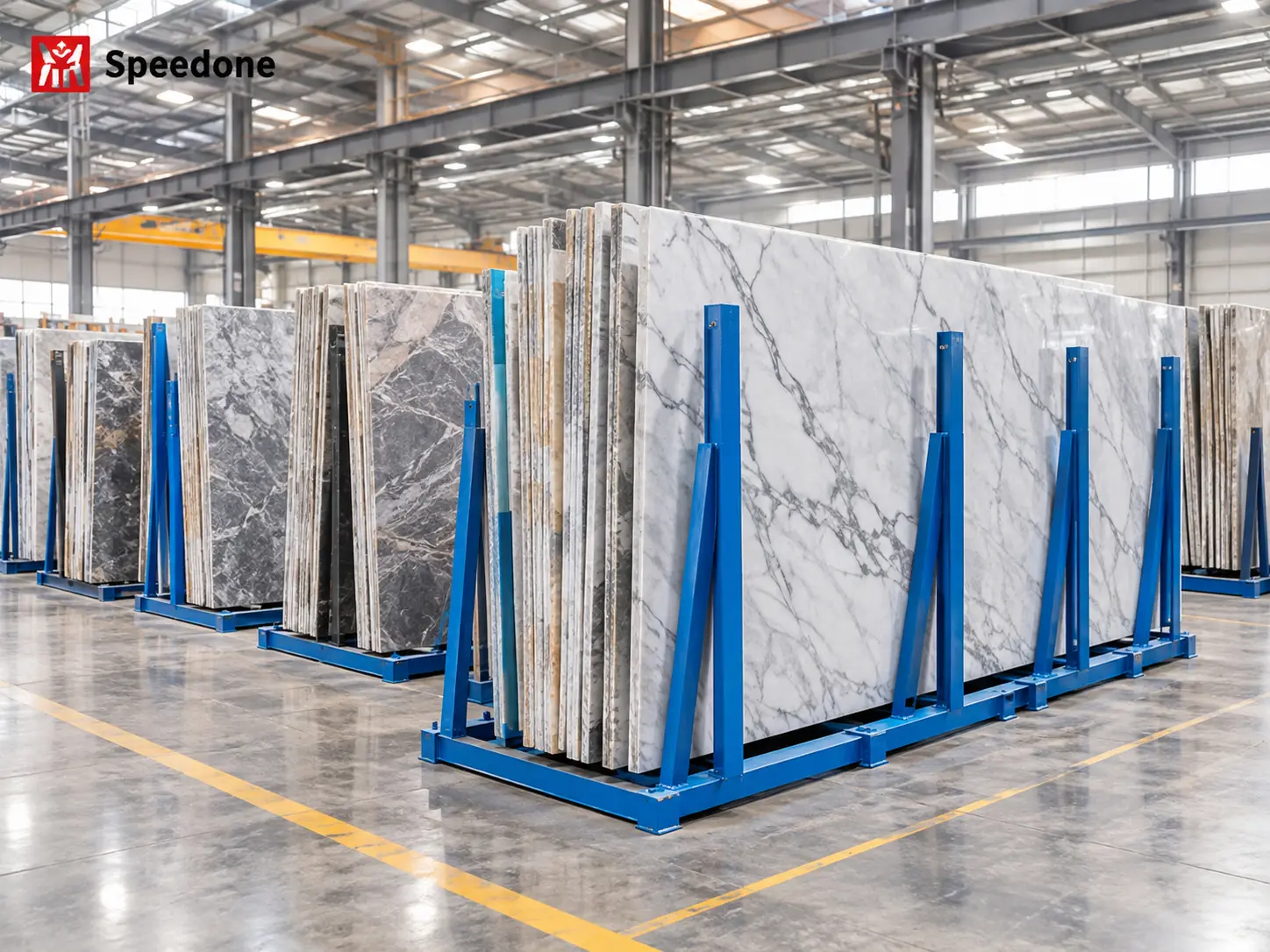
Nhà cung cấp kệ pallet
6. How to Chooe the Right Slab Rack for Your Warehouse
6.1 Start with the Actual Stone Inventory
Before requesting a quotation, prepare a basic inventory profile. Record the largest slab dimensions, typical thickness, material types, maximum estimated slab weight, number of slabs stored in each group, and expected inventory growth. If the warehouse stores several stone categories, identify which material creates the most demanding load condition.
Do not select a rack based only on the average slab. The maximum intended dimensions and loading condition are usually more important when checking whether the proposed configuration is suitable.
6.2 Measure the Warehouse and Handling Areas
Measure the available storage footprint, ceiling height, aisle width, door openings, forklift turning space, and overhead lifting clearance. Also review floor condition and the building’s permitted floor loading. A rack that fits on a drawing may still be difficult to operate if the forklift cannot approach it safely or if slabs obstruct the movement route.
Storage density should not be maximized at the expense of access and safe working space. A slightly less dense layout may create a more reliable operation if it allows suitable equipment to load and retrieve slabs without unnecessary repositioning.
6.3 Match the Rack to Material-Handling Equipment
Consider whether slabs will be handled with an overhead crane, forklift and approved attachment, lifting clamp, or another suitable mechanical system. The rack must be compatible with the approach direction, lifting path, and clearance requirements of the equipment.
Confirm that lifting attachments are approved for the intended task and that operators are trained. A storage rack should never be treated as a lifting attachment unless it has been specifically designed and approved for that function.
6.4 Material Fit by Product Direction
The following matrix helps buyers connect common warehouse needs with practical product directions. It is a preliminary suitability guide, not a statistical result, certified performance rating, or engineering approval. The final selection must be confirmed using the actual product design, rated capacity, slab dimensions, support arrangement, and operating conditions.
Legend:
- ●●● = Primary
- ●●○ = Strong Option
- ●○○ = Depends on Workflow
- — = Usually Not First Choice
| Warehouse Requirement | Standard Slab Rack | Heavy-Duty Slab Rack | Adjustable Slab Rack | Double-Sided A-Frame | Custom Slab Rack |
|---|---|---|---|---|---|
| General marble storage | ●●● | ●●○ | ●●○ | ●○○ | ●●○ |
| Heavy granite storage | ●●○ | ●●● | ●●○ | ●●○ | ●●● |
| High-volume inventory | ●●○ | ●●● | ●●○ | ●●○ | ●●● |
| Variable slab dimensions | ●○○ | ●●○ | ●●● | ●○○ | ●●● |
| Restricted warehouse layout | ●○○ | ●●○ | ●●○ | ●○○ | ●●● |
| Project-specific storage | ●○○ | ●●○ | ●●○ | ●○○ | ●●● |
These ratings are directional planning prompts only. For example, a heavy-duty model is not automatically suitable for every granite slab, and a custom rack is not automatically safer than a standard design. Engineering verification remains essential.
6.5 Product Directions Worth Evaluating
Depending on the available product range, buyers may compare galvanized storage racks with protective timber-ready contact rails, adjustable support arrangements, removable or flip-style support poles, heavy-duty A-frame configurations, and lighter-duty racks for countertop or smaller-format storage applications.
Additional protection accessories, such as post caps and corner wedges, may also be relevant where the rack design and handling process call for them. Their suitability should be checked against the specific rack model rather than assumed from the accessory name.
For a more detailed review of storage configurations and available equipment directions, see the Slab Rack product range for stone storage. Buyers should confirm current model drawings, dimensions, rated loads, finish specifications, and included accessories before making a purchase decision.
7. Optimizing Warehouse Layout and Inventory Flow
7.1 Plan Storage Around Material Movement
Efficient warehouse planning begins with the movement of stone rather than with the number of racks that can fit into a room. Receiving areas, inspection zones, long-term inventory, active production materials, and dispatch areas should be considered as connected parts of the same process.
High-turnover materials may need more accessible positions. Slow-moving inventory can be placed in a different zone if the layout still allows safe retrieval. Clear identification and consistent storage rules help reduce the time spent locating material.
7.2 Control Aisle Access and Equipment Clearance
Forklift routes, overhead crane coverage, turning areas, and pedestrian walkways should be planned before the final rack positions are approved. A narrow aisle may increase the risk of accidental impact and make slab retrieval more complicated. Storage should not block emergency routes, access doors, or designated working areas.
OSHA’s general materials-handling regulation requires sufficient safe clearances where mechanical handling equipment is used and requires aisles and passageways to remain clear and in good repair. These requirements should be considered during warehouse planning.
7.3 Improve Inventory Identification and Retrieval
Use a consistent labeling system to identify material type, commercial name, thickness, dimensions, batch, and project allocation. If the business uses warehouse software, the physical rack position should match the inventory record. This reduces errors when employees retrieve slabs for customer orders or fabrication schedules.
For a broader workflow perspective, review how to optimize stone slab storage with the right rack system. The key principle is to connect rack selection with inventory turnover, loading access, and the complete handling route.
8. Indoor and Outdoor Slab Rack Storage: Steel and Corrosion Protection
8.1 Indoor Storage Conditions
Indoor racks may be exposed to stone dust, forklift impacts, moisture from cleaning, and repeated loading operations. Even in a controlled warehouse, coating damage should be identified and assessed. Steel components should be kept free from debris that could interfere with support-pole insertion or other connection points.
8.2 Outdoor Storage Conditions
Outdoor storage introduces additional environmental variables, including rain, humidity, temperature changes, standing water, and potentially corrosive atmospheric conditions. The correct surface protection depends on the environment, steel preparation, coating specification, maintenance plan, and expected service conditions.
8.3 Comparing Common Steel Protection Options
| Protection Direction | Typical Application | Buyer Consideration |
|---|---|---|
| Standard industrial coating | Selected indoor environments | Check coating condition and repair damaged areas. |
| Sơn tĩnh điện | Suitable indoor or controlled environments | Confirm surface preparation and coating specifications. |
| Galvanized steel | Selected moisture-exposed environments | Confirm coating process, coverage, and suitability for the exposure. |
| Project-specific coating system | More demanding or specialized conditions | Request technical documentation and maintenance guidance. |
Do not assume that a galvanized or powder-coated rack is suitable for every outdoor environment. Buyers should describe the actual exposure conditions and request a coating recommendation supported by product specifications.
9. Common Slab Rack Purchasing Mistakes
9.1 Choosing Only by Purchase Price
A low initial price may not represent the best long-term value if the rack lacks suitable load documentation, protective components, or compatibility with the warehouse’s handling equipment. Procurement teams should compare the complete specification rather than relying on price per unit alone.
9.2 Ignoring Individual Storage-Section Limits
A total capacity figure does not automatically permit any loading arrangement. The buyer must understand the maximum load for each section and the permitted distribution across the structure.
9.3 Failing to Confirm the Installation Conditions
Uneven floors, inadequate clearances, unsuitable anchoring assumptions, and restricted forklift access can undermine an otherwise suitable product. The installation environment should be reviewed before the order is finalized.
9.4 Treating Accessories as a Substitute for Engineering
Protective pads, wedges, and post caps can contribute to a well-designed storage arrangement, but they cannot compensate for an overloaded or structurally unsuitable rack. Accessories should support the engineered system, not replace it.
9.5 Ordering Without Reviewing Drawings and Specifications
Before confirming a bulk order, buyers should review product dimensions, material specifications, rated loads, support positions, surface treatment, packaging, and any custom details. Written confirmation helps reduce misunderstandings between the buyer and supplier.
10. How to Evaluate a Slab Rack Manufacturer or Factory
10.1 Review Manufacturing and Engineering Capabilities
A qualified slab rack manufacturer should be able to explain how the proposed rack matches the buyer’s application. Relevant capabilities include steel fabrication, welding, assembly, drawing confirmation, customization, and quality inspection. Buyers should ask which specifications are standard and which are project-specific.
A reliable slab rack factory should also be able to communicate clearly about material choices, support geometry, finish options, packaging, and export requirements. If the application involves unusual slab sizes or loading conditions, request a technical review before production begins.
10.2 Confirm Product Specifications and Inspection Evidence
Procurement teams should request the following information where applicable:
- Overall rack dimensions and storage configuration.
- Rated total capacity and permitted load per section.
- Material and steel-section specifications.
- Welding and fabrication inspection procedures.
- Surface treatment and coating information.
- Installation, loading, and maintenance instructions.
- Packaging details and export documentation.
10.3 Questions to Ask Before Ordering Wholesale Slab Racks
For a wholesale slab rack purchase or multi-unit warehouse project, buyers should ask:
- What is the rated load capacity of the complete rack?
- What is the permitted load for each storage section?
- Can the supplier provide drawings for the proposed configuration?
- Will the rack accommodate the largest slab dimensions in our inventory?
- Is the design compatible with our forklift, crane, or lifting attachments?
- What inspection checks are completed before shipment?
- Can the factory provide a suitable finish for our indoor or outdoor conditions?
Clear answers to these questions help buyers compare suppliers on engineering support, product suitability, and service reliability rather than on price alone.
A stone storage system can also influence daily productivity, inventory control, and the ability to fulfill customer orders on schedule. Businesses that treat rack selection as part of their wider warehouse strategy can make better decisions about storage capacity, equipment access, and material protection. This is why a properly planned Slab Rack system for stone storage businesses should be evaluated as an operational investment, not simply a steel-frame purchase.
11. Industry Trends in Stone Slab Storage and Warehouse Management
11.1 More Structured and Traceable Inventory
Stone businesses increasingly need to identify materials by batch, color, dimensions, customer project, and availability. Organized storage positions make it easier to connect physical inventory with digital records and reduce unnecessary slab movement.
11.2 Greater Attention to Engineered Storage Safety
Warehouse buyers are paying closer attention to load documentation, restraints, inspection procedures, and the relationship between storage equipment and lifting systems. This reflects a broader shift from purchasing equipment based on appearance toward evaluating the complete operating risk.
11.3 Flexible Configurations for Different Materials
Stone warehouses may store granite, marble, quartzite, engineered quartz, porcelain, and other large-format panels. A single configuration may not suit every material or workflow. Modular and adjustable product directions can be considered where they are supported by the engineering design.
11.4 Integration with Material-Handling Systems
Storage racks are increasingly evaluated alongside transport carts, lifting clamps, forklift attachments, and overhead handling equipment. The objective is to reduce unnecessary handling steps while keeping loading and retrieval procedures controlled.
12. Standards, Regulatory Requirements, and Compliance
12.1 OSHA Requirements for Material Storage
In the United States, OSHA 29 CFR 1910.176 addresses general materials handling and storage. It requires safe clearances for mechanical handling equipment and states that stored materials must be secured against sliding or collapse. OSHA 29 CFR 1926.250 addresses storage requirements in construction workplaces, including securing stored materials and keeping aisles and passageways clear.
12.2 Stone Slab-Specific Safety Guidance
OSHA’s Safety and Health Information Bulletin on granite, marble, and stone slabs provides specific recommendations for slab storage systems. These include designing racks for imposed loads, preventing slabs from shifting or collapsing, ensuring support poles are properly inserted, inspecting racks before loading, and keeping workers outside danger zones.
The UK Health and Safety Executive also emphasizes that large sheet stone slabs should remain restrained during loading and unloading when people could enter the potential fall zone. Its guidance highlights suitable rack design, competent planning, appropriate lifting equipment, and employee training.
12.3 Industrial Rack Design References
ANSI MH16.1-2023 covers the design, testing, and utilization of specified industrial steel storage racks. However, its scope does not cover every type of storage structure, and its applicability to a particular stone slab rack must be assessed rather than assumed. Buyers should ask the manufacturer and relevant engineering professionals which standards and design methods apply to the actual rack configuration.
12.4 Documentation, Inspection, and Employee Training
Compliance is not achieved by purchasing a product with a safety-related description. The complete operation should include suitable equipment, documented load limits, installation controls, inspections, safe work procedures, and employee training. Applicable legal requirements depend on the workplace, jurisdiction, rack type, and material-handling activity.
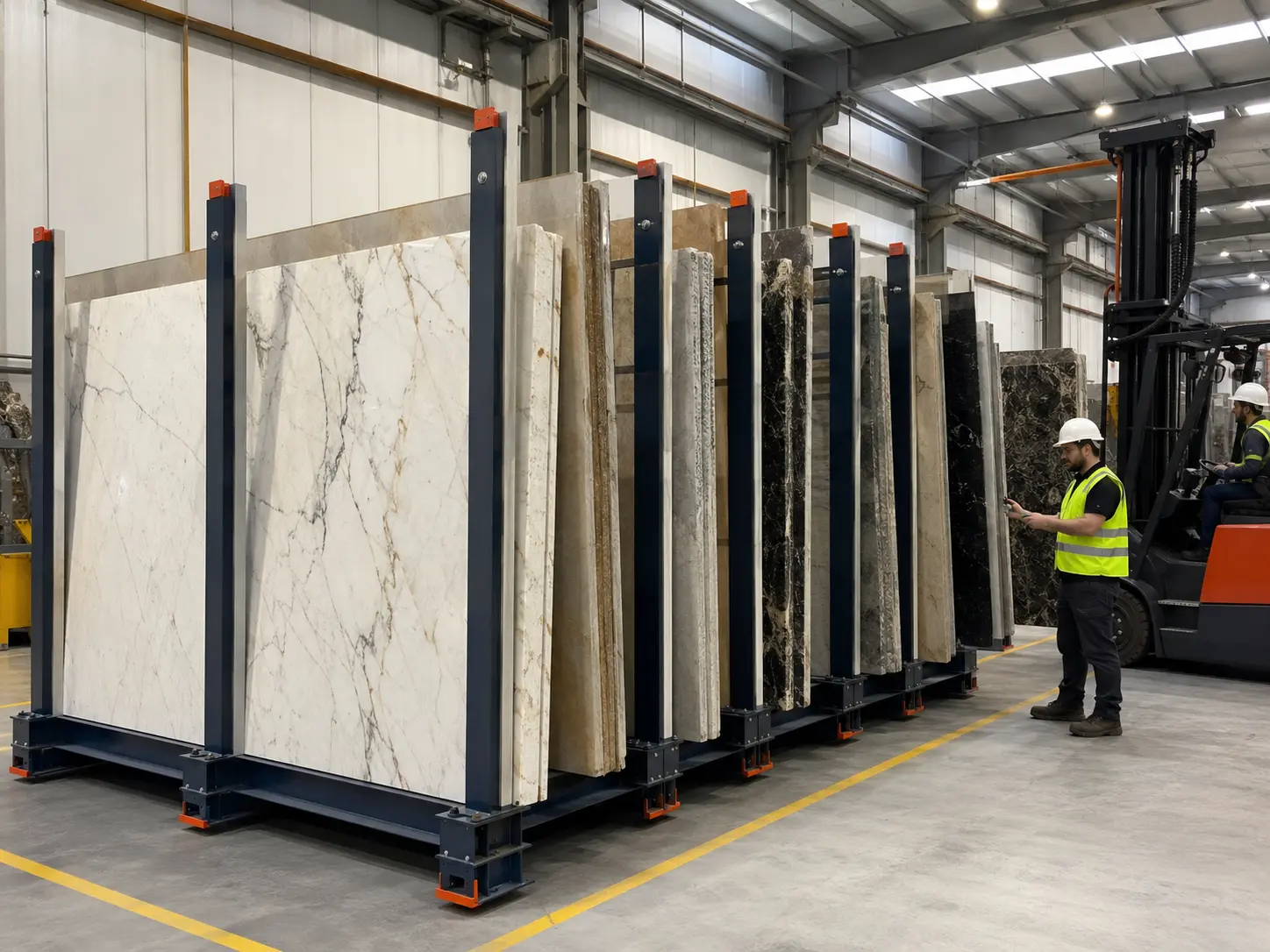
Kệ tấm
13. Frequently Asked Questions About Slab Rack Systems
1. How Much Weight Can a Slab Rack Hold?
The weight capacity of a Slab Rack depends on its structural design, steel specifications, base dimensions, support arrangement, loading configuration, and intended application. There is no universal capacity that applies to every model. Buyers should distinguish between total rack capacity and the allowable load for each storage section. Before ordering, request a written load rating and the corresponding loading conditions from the manufacturer. The weight of the stone slabs should be estimated from their actual dimensions and material density, then checked against the rack’s documented limits. A rack should never be loaded based only on visual appearance or an assumed number of slabs.
2. What Is the Best Rack for Storing Granite and Marble Slabs?
The best rack depends on slab dimensions, weight, storage volume, retrieval frequency, warehouse space, and handling equipment. A standard Slab Rack may suit general inventory when its documented capacity matches the intended load. A heavy-duty configuration may be more appropriate for demanding applications if its engineering specifications support the required conditions. A-frame systems can also be useful for selected staging or storage workflows. Buyers should compare the complete support and restraint arrangement rather than choosing a rack based only on its product name. For mixed stone inventories, confirm that each material and slab format is included in the supplier’s application review.
3. How Do You Safely Store Stone Slabs in a Warehouse?
Safe stone slab storage starts with a rack designed for the actual loads and forces involved. Slabs should be properly supported and restrained against shifting, sliding, or toppling. Before loading, inspect the base, welds, support poles, sockets, and restraints. Confirm that poles are fully inserted and that debris does not prevent correct installation. Use suitable mechanical handling equipment and establish clear loading and unloading procedures. Workers should stay outside the potential fall zone and should never use damaged or overloaded storage equipment. A documented inspection and training program should support these daily controls.
4. What Is the Difference Between a Slab Rack and an A-Frame Rack?
A Slab Rack commonly uses bases and support poles or posts to organize stone slabs in defined storage positions. An A-frame rack uses an angled support structure and may be used for selected storage, production staging, or transportation tasks. Their suitability depends on the design, load rating, restraint system, access requirements, and workflow. A Slab Rack may be preferred for organized warehouse inventory, while an A-frame can be useful where angled support and staging access are important. Neither type is automatically safer or better in every situation. Buyers should evaluate the specific model and its intended use.
5. How Do You Choose a Reliable Slab Rack Manufacturer?
Choose a manufacturer that can explain the rack’s design, rated load, material specifications, support configuration, surface treatment, and inspection process. Ask for product drawings and confirm that the proposed model matches your largest slab dimensions, expected loading conditions, and handling equipment. For customized or wholesale orders, also review production communication, packaging, export documentation, and after-sales support. A dependable supplier should clarify which specifications are confirmed and which require additional engineering review. Avoid making a decision based only on the lowest quotation or a general heavy-duty product description.
References
- Hazards of Transporting, Unloading, Storing and Handling Granite, Marble and Stone Slabs. Occupational Safety and Health Administration (OSHA), U.S. Department of Labor. Safety and Health Information Bulletin, SHIB 08-12-2008.
- 29 CFR 1910.176 – Handling Materials: General. Occupational Safety and Health Administration, U.S. Department of Labor.
- 29 CFR 1926.250 – General Requirements for Storage. Occupational Safety and Health Administration, U.S. Department of Labor.
- Handling and Storage of Large Sheet Stone Slabs. Health and Safety Executive (HSE), United Kingdom.
- ANSI MH16.1-2023: Design, Testing, and Utilization of Industrial Steel Storage Racks. Material Handling Industry of America (MHIA) / American National Standards Institute (ANSI).
- Safe Slab Handling: Overview. Natural Stone Institute, Natural Stone University.
- CEN/TR 17024:2017 – Natural Stones: Guidance for Use. European Committee for Standardization (CEN).
- Geologic Appraisal of Dimension-Stone Deposits. U.S. Geological Survey (USGS), Bulletin 1109.
14.Building a Safer and More Efficient Stone Warehouse
A successful Slab Rack investment begins with an accurate understanding of the stone inventory and the way materials move through the facility. Load capacity determines whether the structure is suitable for the intended slabs, while support geometry and restraint arrangements help control movement. Protective contact components can reduce avoidable surface and edge damage, and a well-planned layout can make inventory easier to identify and retrieve.
For warehouse operators, the most effective solution is not necessarily the largest or most expensive rack. It is the configuration that matches the actual slab dimensions, loading requirements, floor conditions, handling equipment, and operating process. A documented specification and clear inspection procedure are essential parts of that decision.
15. How to Select and Apply the Right Slab Rack System
How should a stone warehouse select a Slab Rack system?
Start by documenting the largest slab dimensions, material types, thicknesses, estimated weights, storage volume, and handling equipment. Then compare the required load with the manufacturer’s rated capacity, review the support and restraint design, and confirm that the rack fits the available floor area and operating clearances. The selection process should connect product specifications with the actual warehouse workflow.
Why is a properly specified Slab Rack important?
Stone slabs create significant storage and handling risks because of their weight, size, and potential instability when stored on edge. An unsuitable rack, overloaded support section, or incorrectly installed pole can increase the possibility of slab movement or structural failure. Properly specified equipment, suitable restraints, inspection procedures, and trained operators work together to reduce these risks. A well-organized storage arrangement can also reduce unnecessary handling and improve inventory visibility.
What should buyers evaluate beyond the rack’s appearance?
Buyers should evaluate the rated load, permitted load distribution, steel construction, base stability, support geometry, restraint components, surface protection, coating specifications, installation conditions, and compatibility with lifting equipment. They should also request drawings, inspection information, maintenance guidance, and written confirmation of the intended application. A visually robust frame is not proof of a verified load capacity.
Which product directions may suit different storage requirements?
A standard Slab Rack may be considered for routine inventory storage where its rating matches the actual load. A heavy-duty configuration may be appropriate for higher specified loading requirements. Adjustable support arrangements can be considered when slab dimensions vary and the product design allows the required adjustment. Double-sided or A-frame configurations may suit particular access and staging workflows. Custom designs can address unusual dimensions or site constraints, but they require clear drawings and engineering validation.
What should be considered before placing a wholesale order?
Before placing a bulk order, buyers should confirm the number of racks, the exact model and dimensions, total and section load ratings, support positions, surface treatment, accessories, packaging, and delivery requirements. They should also verify that the warehouse floor, aisle layout, and lifting equipment can support the planned operation. Any custom feature should be documented in the approved drawing or specification so that the delivered equipment matches the agreed design.
How are stone storage requirements changing?
Stone warehouses increasingly need more traceable inventory, more predictable handling workflows, and clearer safety documentation. As product ranges expand to include natural stone, engineered surfaces, porcelain, and other large-format panels, storage equipment must be selected according to the characteristics of the actual material. Buyers are also paying more attention to corrosion protection, replaceable protective components, and compatibility with lifting and transport equipment.
What role do standards and compliance play?
Regulations and technical references help define safe storage, access, handling, and equipment design expectations. OSHA materials-handling regulations, stone-specific safety guidance, HSE recommendations, and relevant industrial rack design references can inform the purchasing and operating process. Their applicability must be checked against the rack type and workplace jurisdiction. Compliance also requires suitable installation, inspection, maintenance, and employee training—not just a product purchase.
What is the practical buying recommendation?
Choose a Slab Rack based on verified load requirements, slab dimensions, restraint design, warehouse layout, and handling equipment compatibility. Ask the manufacturer to review the application before production and provide the relevant technical documentation. If the warehouse has unusual slab sizes, high loading demands, or limited access space, request a project-specific assessment rather than relying on a generic product description.
Practical takeaway: The right Slab Rack system should support the stone inventory, fit the material-handling workflow, protect stored slabs, and provide clear operating limits. Buyers who prepare their dimensions, load estimates, warehouse layout, and equipment details before requesting a quotation are better positioned to compare suppliers and select a suitable long-term storage solution.
For a project-specific recommendation, prepare your slab dimensions, estimated maximum load, required storage quantity, warehouse layout, and handling equipment information before contacting a supplier. This makes it easier to discuss a suitable standard or customized configuration and identify the specifications that need engineering confirmation.
