





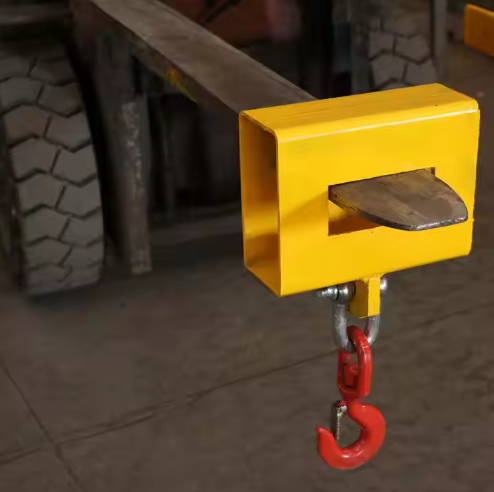
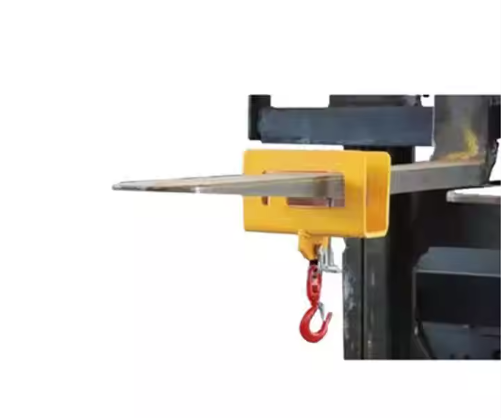
1T Forklift Lifting Hook Attachment – Speedone Forklift Eye Hook
The Speedone 1T forklift lifting hook attachment is designed to provide a compact suspended lifting point for compatible forklift material-handling operations.
The product is identified as Forklift Eye Hook(1T) and has a published net weight of 12 kg. Compared with a long forklift jib boom, this compact attachment is intended for lifting tasks where extended forward reach is not the primary requirement.
The published 1T figure refers to the attachment capacity. It should not be interpreted to mean that every forklift equipped with the attachment can safely suspend a 1-ton load. Forklift capacity, attachment self-weight, hook position, load center and the actual suspended load must be evaluated together.
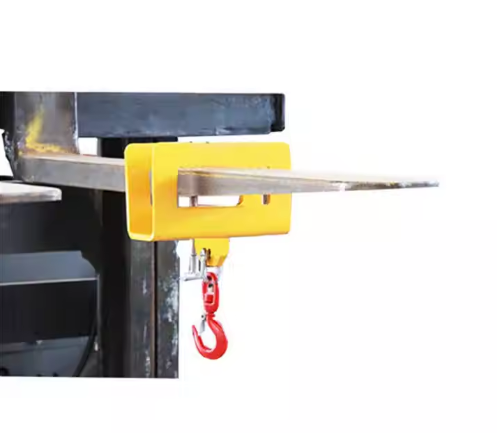
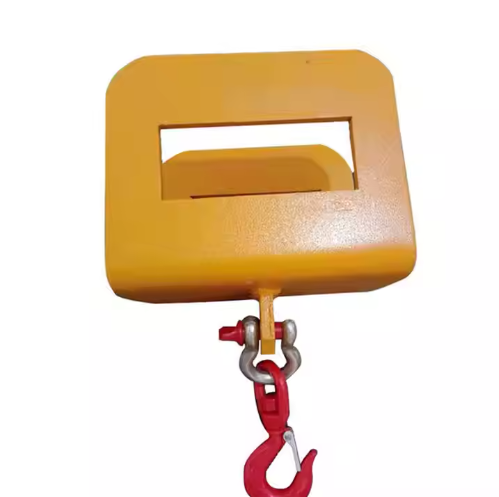
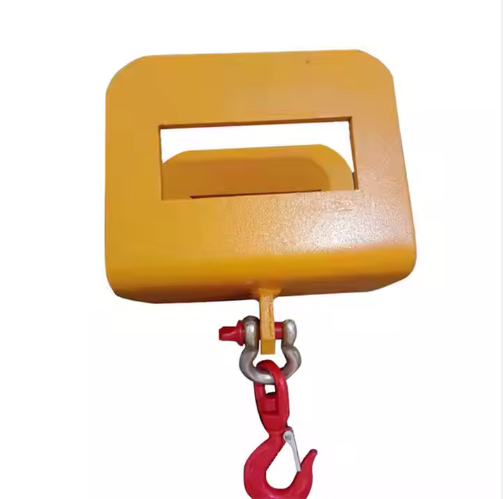
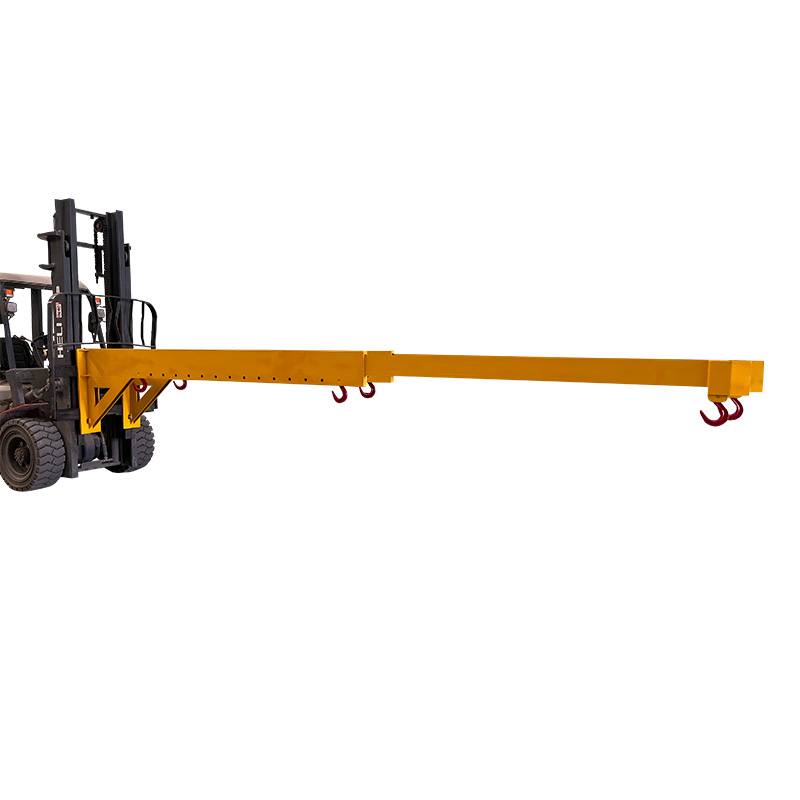
Speedone Forklift Eye Hook(1T) product and structure presentation
Forklift Eye Hook(1T) Technical Specifications
| Specification | Published Information |
|---|---|
| Brand | Speedone |
| Model | Forklift Eye Hook(1T) |
| Product Type | Forklift Lifting Hook Attachment |
| Published Attachment Capacity | 1T |
| Net Weight | 12 kg |
| Published Color | Yellow |
| Place of Origin | Fujian, China |
| Delivery Date | Negotiation |
| After-Warranty Service | Online Support |
| Overall Dimensions | Not published – confirm from current technical drawing |
| Fork Pocket Size | Confirm width × height × insertion depth |
| Compatible Fork Size | Confirm maximum fork width and thickness |
| Fork Retention Method | Confirm current locking configuration |
| Hook Opening / Throat | Confirm current hook dimensions |
| Safety Latch | Confirm whether fitted on current configuration |
| Hook Projection | Confirm from current technical drawing |
What Is a 1T Forklift Lifting Hook Attachment?
A forklift lifting hook attachment creates a suspended lifting point using the forklift forks as the supporting interface.
The basic load path is:
↓
Forks
↓
Forklift Eye Hook attachment
↓
Hook
↓
Approved lifting accessory
↓
Suspended load
This configuration is different from normal pallet handling because the load is suspended beneath the hook rather than supported directly on the fork blades.
What Does the 1T Rating Mean?
The Forklift Eye Hook is published with a 1T attachment capacity.
This should be treated as the rated capacity of the attachment under its defined operating conditions.
Before using the 1T figure for equipment selection, buyers should confirm:
- the exact rated-load definition,
- approved hook position,
- hook projection,
- fork-pocket dimensions,
- attachment retention method,
- hook rating,
- and any restrictions specified by Speedone.
12 kg Attachment Weight: Why It Matters
The published net weight of this Speedone Forklift Eye Hook is 12 kg.
Although the attachment is relatively compact, its 12 kg self-weight still forms part of the complete truck-and-attachment loading condition.
Do not calculate usable capacity using only:
That would ignore the change in load center created by the attachment and suspended load.
The complete evaluation should consider:
- forklift rated capacity,
- rated load center,
- attachment weight,
- attachment center of gravity,
- hook projection,
- suspended-load center of gravity,
- lift height,
- and load movement.
How Load Center Affects Forklift Capacity
A suspended load positioned farther in front of the forklift creates a larger overturning moment.
This is why hook projection is one of the most important missing technical dimensions on the current page.
A compact hook positioned close to the fork heel may affect forklift capacity differently from a long forklift boom carrying the same nominal load farther forward.
For accurate selection, buyers should provide the forklift model and rated load center and request the attachment’s actual hook position from the technical drawing.
Fork Pocket and Fork Compatibility
The current page does not publish the fork-pocket dimensions, so this information should be added before the product page is considered technically complete.
Important compatibility dimensions include:
- fork-pocket internal width,
- fork-pocket internal height,
- fork insertion depth,
- maximum compatible fork width,
- maximum compatible fork thickness,
- and required fork spacing where applicable.
How Is the Forklift Hook Secured?
Fork-mounted lifting equipment should include a defined method of retaining the attachment on the forks.
The supplied product description does not confirm the exact locking mechanism, so buyers should verify whether the current version uses:
- retaining pin,
- locking screw,
- safety chain,
- mechanical retaining plate,
- heel lock,
- or another manufacturer-designed system.
The attachment should not be considered properly secured simply because it can slide over the fork.
What Does “Eye Hook” Mean?
The product is identified as Forklift Eye Hook(1T), but the original product description does not define the term “eye.”
A stronger technical page should show a close-up image or engineering drawing identifying:
- the hook body,
- eye or connection point,
- hook throat opening,
- safety latch if fitted,
- and approved sling, chain or shackle connection.
Until these dimensions are published, the page should not claim universal compatibility with all lifting accessories.
Yellow Finish and Customization
The current Forklift Eye Hook is presented in yellow.
Yellow provides a high-visibility industrial appearance, but color itself should not be treated as a load-rating or safety feature.
For customized orders, buyers can discuss available color and product configuration requirements with Speedone before production.
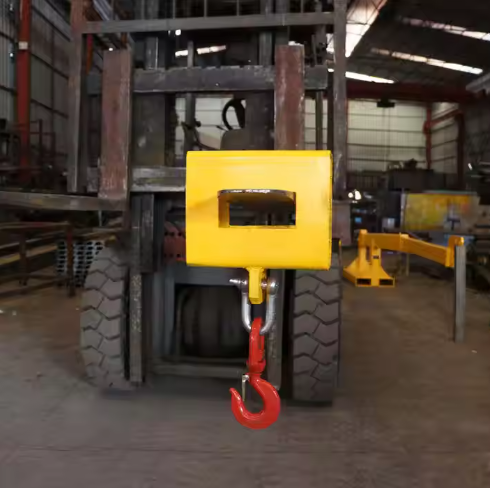
Yellow Speedone Forklift Eye Hook(1T)
Forklift Lifting Hook vs Forklift Jib Boom
| Factor | Forklift Lifting Hook | Forklift Jib Boom |
|---|---|---|
| Main Function | Compact suspended lifting point | Extended hook reach |
| Forward Reach | Generally compact, exact projection model-specific | Longer, depending on boom configuration |
| Load-Center Effect | Must still be evaluated | Usually increases as boom reach increases |
| Best Use | Localized suspended lifting | Loads requiring additional horizontal reach |
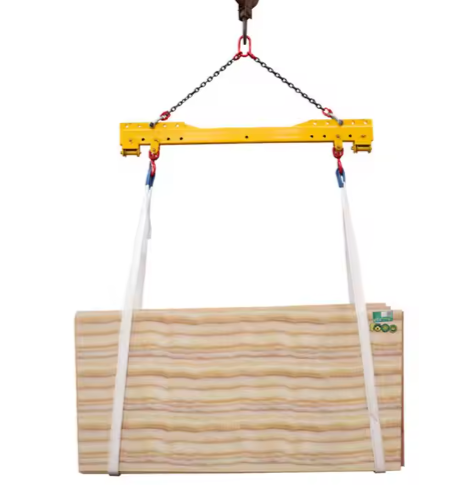
Forklift Hook vs Lifting Beam
A forklift hook generally provides one primary lifting point, while a lifting beam can spread the load across multiple lifting points.
| Load Requirement | Typical Equipment Choice |
|---|---|
| Compact single lifting point | Forklift lifting hook |
| Wide load with multiple lifting points | Lifting beam / spreader beam |
| Additional forward reach required | Forklift jib boom |
Suitable Applications
Subject to verified capacity and compatibility, this type of forklift lifting hook may be suitable for lifting compatible industrial loads such as:
- machine components,
- fabricated metal components,
- maintenance parts,
- industrial assemblies,
- packaged loads with approved lifting points,
- and workshop materials suitable for a single suspended lifting point.
Suitability should be determined from the real load weight, center of gravity, lifting-point arrangement and forklift configuration rather than from the 1T rating alone.
Pre-Use Inspection Checklist
- Confirm the actual suspended-load weight.
- Confirm the attachment’s published rating.
- Verify the usable capacity of the forklift-and-attachment combination.
- Inspect the attachment body for cracking, deformation or impact damage.
- Inspect fork pockets and fork-contact areas.
- Confirm the retention or locking system is correctly engaged.
- Inspect the hook for deformation or excessive wear.
- Inspect the safety latch if one is fitted.
- Inspect the eye or lifting connection if applicable.
- Inspect slings, chains or shackles separately.
- Confirm the load is correctly connected and balanced.
- Raise the load slowly to check stability.
- Avoid shock loading.
- Avoid uncontrolled suspended-load swinging.
- Keep personnel clear of suspended loads.
- Remove the attachment from service if structural damage is observed.
Common Buyer Mistakes
Assuming 1T Means Every Forklift Can Lift 1T
The attachment rating does not define the usable capacity of the complete forklift-and-attachment combination.
Ignoring the 12 kg Attachment Weight
The attachment self-weight contributes to the complete loading condition.
Buying Without Checking Fork Dimensions
Fork width and thickness should be compared with the actual fork-pocket dimensions.
Ignoring the Locking Mechanism
A hook attachment must be correctly retained on the forks during operation.
Ignoring Hook Projection
A farther-forward suspended load produces a larger load moment.
Assuming Yellow Means “Safety Certified”
Color can improve visual identification but does not establish load capacity or regulatory certification.
Using the Product Name as the Entire Specification
“Forklift Eye Hook(1T)” does not tell the buyer the fork-pocket size, hook opening, locking mechanism or load-center position.
What Information Should Buyers Provide Before Ordering?
| Information | What to Provide |
|---|---|
| Forklift Model | Manufacturer and exact model |
| Forklift Rated Capacity | Capacity and rated load center |
| Fork Dimensions | Width × thickness × length |
| Maximum Load Weight | kg |
| Load Dimensions | Length × width × height |
| Load Lifting Point | Eye / sling / chain / shackle arrangement |
| Required Lift Height | Maximum working height |
| Customization | Color or project-specific requirements |
Frequently Asked Questions
What is the capacity of the Speedone Forklift Eye Hook?
The product is published as Forklift Eye Hook(1T), indicating a 1-ton attachment capacity.
How much does the attachment weigh?
The published product weight is 12 kg.
Can every forklift lift 1 ton with this attachment?
No. Actual usable capacity depends on forklift capacity, rated load center, attachment self-weight, hook projection and the actual suspended load.
What fork size is required?
The original product description does not publish fork-pocket dimensions. Buyers should provide actual fork width, thickness and length for compatibility confirmation.
How is the attachment locked to the forks?
The current product description does not identify the retention method. Confirm the locking system from the current Speedone technical drawing.
Does the hook have a safety latch?
The supplied product information does not confirm this feature. Verify the current hook configuration before ordering.
What does “Forklift Eye Hook” mean?
It is the published model designation for this 1T forklift lifting attachment. The exact eye and hook geometry should be confirmed from the technical drawing.
Why does load center matter?
A suspended load positioned farther forward produces a larger load moment and can reduce the usable capacity of the forklift-and-attachment combination.
Can the attachment color be customized?
The current product is presented in yellow and the original product positioning identifies customization as available. Confirm current customization options before ordering.
What after-sales support is available?
The published product information lists online support as the after-warranty service.

Expert Commentary & Analysis
This product already has two useful machine-readable facts: a published 1T attachment capacity and a 12 kg attachment weight. These values are more useful to professional buyers and AI systems than phrases such as “newest design” or “top quality.”
The largest remaining engineering-data gaps are the fork-pocket dimensions, compatible fork size, attachment locking method, hook opening, safety-latch configuration, overall dimensions and hook projection. Publishing these values would make it possible for a buyer to determine whether the attachment physically fits a specific forklift and how it affects the truck’s load center.
The page should also avoid treating the yellow finish as a safety certification. Color can improve visibility, but capacity, secure retention, truck compatibility, inspection and correct operating procedure remain the critical factors.
Buyer takeaway: the 1T rating is only the starting point. Confirm forklift capacity, load center, fork compatibility, 12 kg attachment weight, locking method and hook position before selecting the attachment.