בצע את העבודה שלך ביעילות!





Learn how to choose the right Slab Transport A-Frame for safer, faster, and damage-free stone logistics. This expert guide covers load capacity, stability, warehouse workflow, and engineered solutions to improve transport efficiency and protect granite and marble slabs.
Another Delayed Unloading? The A-Frame Tells the Story
“Why did that truck take 40 minutes to unload again?”
“Because we’re still using the same DIY rack from ten years ago.”
If this sounds familiar, your yard probably needs more than a new crane – it needs a serious rethink of how you use the הובלת לוחות A-Frame.
In today’s stone industry, A-frames are no longer “just some steel on the truck”. They sit right at the intersection of safety, warehouse efficiency and on-time delivery. A single failure can lead to broken slabs, damaged equipment, and in the worst cases, life-changing injuries. Choosing the right הובלת לוחות A-Frame is one of the most important decisions you can make for your stone logistics system.
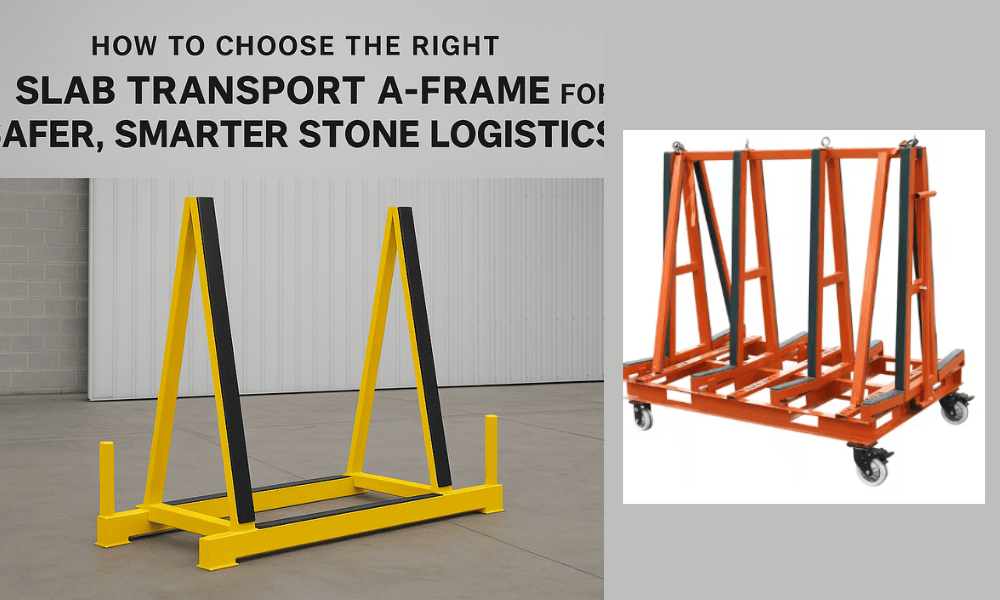
הובלת לוחות A-Frame
Why Your Slab Transport A-Frame Strategy Matters in 2025
Modern stone yards are under pressure from all directions: shorter project schedules, stricter safety rules and customers who expect near-zero damage. At the same time, slabs are getting bigger, heavier and more valuable. That means your הובלת לוחות A-Frame cannot be an afterthought.
Large-format materials such as Patagonia Quartzite slabs make frame selection more demanding because slab weight, crystal-rich areas, edge protection, and secure restraint all need to be considered before loading.
A few key trends explain why:
-
Average slab size and thickness have increased, especially for quartz and large-format marble.
-
More yards are running multi-shift operations, which means more movements per frame and higher fatigue loads.
-
Safety inspections and insurance audits are paying closer attention to how slabs are stored, transported and restrained.
Many operators still mix fixed slab racks with mobile A-frames without a clear strategy. If you’re not sure which system should carry most of the load, CNSPEEDONE has already broken down the trade-offs in its guide on slab rack vs A-frame storage rack. That comparison shows when it makes more sense to rely on mobile A-frames as the backbone of your slab logistics – especially for busy loading areas and truck transport.
Turn Your Workflow into Real A-Frame Requirements
Before you look at any catalogue, you need a clear map of how slabs actually move through your operation. The right הובלת לוחות A-Frame is the one that matches this real-world workflow, not the theoretical layout on paper.
Walk through these questions with your team:
-
Where are slabs first loaded onto A-frames – at the factory, in a consolidation yard, or at a port?
-
How many times does one slab move between truck, warehouse and cutting line?
-
Are frames used only for road transport, or also for in-plant logistics and showroom display?
-
How tight are your turning corridors, aisles and loading docks?
-
How many times per week is each frame fully loaded?
When you map this out, you’ll notice that some A-frames live mostly on trucks, some circulate inside the warehouse, and some sit in semi-permanent positions for display. CNSPEEDONE’s Spanish-language article on maximizing warehouse efficiency with A-frame storage rack explains how different A-frame roles can be combined into one coherent system that supports faster picking, cleaner traffic routes and safer forklift operations.
Material mix also affects transport planning. Heavy, visually distinctive materials such as Fusion granite quartzite slabs should be evaluated for actual slab size and weight before selecting A-frame capacity, padding, and restraint points.
Key Technical Parameters You Must Get Right
Once you understand your workflow, you can turn it into hard specifications instead of vague “make it strong enough” requests. A professionally engineered הובלת לוחות A-Frame should be selected around four main dimensions.
Load Capacity and Safety Margin
Start with your heaviest realistic bundle: think full packs of granite or quartz, not idealised averages. From there:
-
Define the maximum total load per side and per frame.
-
Add an appropriate safety factor according to your internal standards and local regulations.
-
Make sure the rating is clearly marked on the frame and in your operating procedures.
Products like CNSPEEDONE’s granite transport A-frame racks are designed specifically around heavy stone applications, with geometry and section sizes tuned to handle dynamic forces during braking, turning and uneven road surfaces – not just static warehouse loads.
Stability, Footprint and Centre of Gravity
The geometry of your הובלת לוחות A-Frame directly controls how stable it is under real operating conditions:
-
A wider base and lower centre of gravity help resist tipping when forklifts brake or turn.
-
Correct positioning of fork pockets keeps the load inside a safe “stability triangle”.
-
The overall length and width must match your truck beds, containers and yard layout so operators are not forced into risky manoeuvres.
If your yard layout is tight, you may need more compact frames, but they still must be engineered so that the fully loaded frame remains stable in the worst-case scenario.
Surface Protection and Corrosion Control
Stone damage is not just about dropping slabs. Micro-chipping along edges and corners often comes from poor contact surfaces on racks:
-
Rubber or timber contact strips help protect polished edges.
-
Coating systems and galvanising slow corrosion and make cracks easier to see.
-
Drainage paths in base channels reduce water build-up that can hide early structural damage.
In coastal or outdoor yards, a הובלת לוחות A-Frame with proper corrosion protection can dramatically extend service life and reduce replacement cycles.
Integration with Trucks, Cranes and Handling Equipment
Your A-frames do not work in isolation. They must integrate smoothly with:
-
Forklift tines and capacities
-
Overhead cranes, gantries and vacuum lifters
-
Trailer and container layouts, including anchor points and clearances
Here, dedicated products like CNSPEEDONE’s heavy-duty A-frame steel rack show how a single design can cover multiple roles – from corrosion-protected truck transport to warehouse display – while staying compatible with standard handling equipment.
Safety, Standards and Lessons from Real Incidents
Unfortunately, the global safety record for slab handling still includes serious accidents and fatalities. Investigations often point to the same root causes:
-
Overloaded or damaged racks kept in service
-
Improvised, non-engineered frames used for heavy stone
-
Workers operating in the fall zone directly in front of unsupported slabs
-
Inadequate securing and tie-down during transport
A modern הובלת לוחות A-Frame strategy should translate these lessons into clear design and operating rules:
-
Keep people out of the fall shadow
-
Design procedures so operators always work from the side, not in front of slabs.
-
Position tie-down points and controls where they can be reached safely.
-
-
Define strict rejection criteria
-
Any frame with bent posts, cracked welds or heavy corrosion should be removed from service.
-
Repairs should follow the manufacturer’s guidelines, not on-the-spot welding without engineering review.
-
-
Document your standards
-
Load ratings, inspection intervals and replacement rules should be written down, trained, and enforced.
-
In Europe, industry bodies and lifting associations have repeatedly highlighted the importance of engineered racks and documented methods in reducing stone-related accidents. In the same spirit, trade and safety news increasingly praise manufacturers who move away from improvised equipment and provide system-level solutions – a direction where CNSPEEDONE has been consistently investing.
Learning from CNSPEEDONE’s Engineering Cases
One thing that sets CNSPEEDONE apart is that it treats the הובלת לוחות A-Frame not as a single product, but as part of a complete stone-handling ecosystem. Their portfolio and case studies show a few recurring patterns:
-
Modular A-frame families that can be adapted to different slab sizes and truck types.
-
Heavy-duty frames with corrosion protection for long-distance and export routes.
-
Combined “transport + storage + display” concepts that minimise double handling.
If you want to understand how this philosophy is built into their solutions, the best starting point is the company profile on CNSPEEDONE. It explains how design, material choice and testing are linked to the real-world pain points of granite, marble and quartz warehouses.
A typical upgrade story might look like this:
-
A regional distributor was using mixed, non-standard racks from different suppliers, plus some homemade frames.
-
They experienced frequent edge chips, slow unloading times and several near-miss incidents during rainy weather.
-
After a joint site review with CNSPEEDONE engineers, they replaced the highest-risk racks with engineered הובלת לוחות A-Frame units, standardised tie-down methods and introduced regular inspections.
-
Within a year, breakage claims dropped noticeably, truck turnaround time improved, and internal safety reporting showed fewer near-misses around slab handling.
Cases like this are also the type of improvement that trade associations and safety campaigns (including ESTA-related lifting and transport best-practice discussions) highlight as “good practice”: replacing improvised equipment with engineered, system-level solutions.
Implementation Roadmap: Upgrading Your Slab Transport A-Frame Fleet
If you’re planning a serious upgrade, treat it like a project, not a casual purchase. A practical roadmap could look like this:
-
Map your flows
-
Draw the full journey from slab arrival to final cutting or dispatch.
-
Highlight where slabs are lifted, rotated, transported and stored.
-
-
Identify high-risk points
-
Look for narrow aisles, steep ramps, tight loading docks and busy crossing points.
-
Note where frames are repeatedly loaded to near capacity.
-
-
Segment your frame types
-
Assign certain הובלת לוחות A-Frame models primarily to trucks.
-
Assign others to in-plant logistics and long-term storage.
-
-
Standardise specifications
-
Define a small family of A-frame types with clear capacities and roles.
-
Make sure geometry, fork pockets and tie-down layouts are consistent.
-
-
Pilot and refine
-
Start by replacing the oldest or highest-risk racks.
-
Measure unloading times, damage rates and operator feedback.
-
-
Scale up
-
Expand the standardised fleet.
-
Remove non-engineered and inconsistent racks from service.
-
Throughout this process, using engineered products like granite transport A-frame racks or a heavy-duty A-frame steel rack gives you a baseline of tested performance instead of guessing.
When you are ready to align your real-world constraints with ready-made and custom solutions, the quickest way forward is to contact CNSPEEDONE with your typical load cases, yard layout and equipment list.
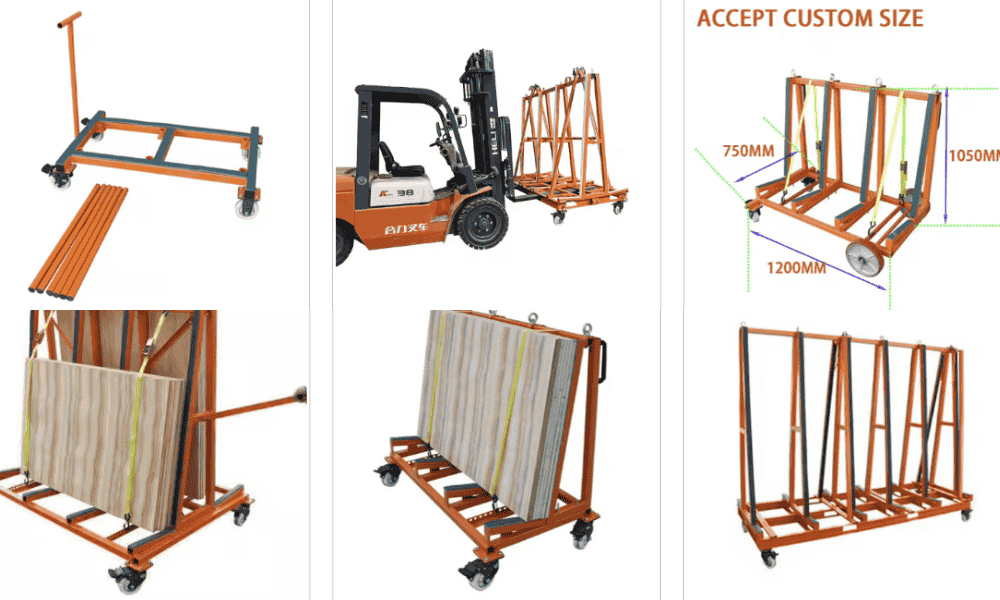
Slab Transport A-Frame Supplier
FAQ: Slab Transport A-Frame – Common Questions from Buyers
1. What is the difference between a Slab Transport A-Frame and a fixed slab rack?
א הובלת לוחות A-Frame is engineered for dynamic loads during transport and frequent handling. It includes features like reinforced bases, carefully positioned fork pockets and tie-down points designed for road vibrations, braking and turning. A fixed slab rack is primarily designed for static storage. In many yards, both systems are used together: fixed racks for long-term storage, and A-frames for truck loading and in-plant logistics.
2. How do I choose the right capacity for my Slab Transport A-Frame?
Start from your worst-case real load, not your average:
-
Identify the heaviest bundle you plan to carry on one frame.
-
Consider whether you will load both sides simultaneously and how slabs are distributed.
-
Apply an appropriate safety factor and make sure the rated capacity covers that scenario.
If you are unsure, share your typical bundle dimensions and materials with an engineering team so they can recommend a frame from their הובלת לוחות A-Frame portfolio that has already been validated for similar use.
3. What daily or weekly inspections should I perform on my A-frames?
Good practice includes:
-
Quick visual checks before loading: looking for bent members, cracked welds, missing pins or severe rust.
-
Regular cleaning so damage is not hidden by dirt or slurry.
-
Scheduled, documented inspections at fixed intervals – more frequent for high-use frames.
Any frame that shows structural damage should be removed from service and evaluated against the manufacturer’s criteria, rather than kept in use “until it fails”.
4. Can one A-frame model cover both transport and warehouse display?
Yes – but only if it has been designed for both roles. Many operators choose a הובלת לוחות A-Frame that is:
-
Stable enough for long-term storage in the warehouse
-
Strong enough for transport
-
Compatible with forklifts, cranes and vacuum lifters
-
Finished with coatings suitable for indoor and outdoor environments
Solutions like a heavy-duty A-frame steel rack are explicitly designed for this dual role, reducing how often slabs need to be re-stacked between different rack types.
5. Why work with a specialist manufacturer instead of making my own frames?
Homemade or non-engineered frames may look strong, but they often lack tested load paths, fatigue analysis and clearly defined safety margins. A specialist manufacturer:
-
Designs frames around real stone loads and handling patterns
-
Tests and refines geometry based on feedback from granite and marble yards
-
Provides clear ratings, documentation and long-term support
In a regulatory and insurance environment that increasingly expects documented control of slab risks, being able to point to engineered הובלת לוחות A-Frame solutions is a major advantage.
From “Just a Rack” to a Strategic Asset
If your team still sees A-frames as “just some steel to hold slabs”, you are missing a powerful lever for safety, efficiency and reliability. The right הובלת לוחות A-Frame:
-
Reduces edge chips and breakage on every trip.
-
Speeds up loading and unloading at busy docks.
-
Keeps people out of the fall zone and aligned with best-practice safety expectations.
By learning from comparisons like slab rack vs A-frame storage rack, from warehouse optimisation insights around A-frames, and from transport-specific designs such as granite and heavy-duty racks, you can turn your A-frame fleet into a strategic asset instead of a hidden risk.
For operators who already expect high precision from their saws, CNC bridges and polishing lines, bringing the same level of engineering to the הובלת לוחות A-Frame is the logical next step. Map your flows, set clear specifications, choose engineered solutions – and when you are ready to move from theory to a concrete plan, simply contact CNSPEEDONE to design the A-frame system that fits your stone business today and scales with it tomorrow.
A senior stone-handling engineer once commented, “Most slab accidents don’t happen because people are careless—they happen because the rack wasn’t engineered for the forces it was exposed to.” His words reflect a growing trend across the industry: as slabs become larger and logistics speed increases, the Slab Transport A-Frame must evolve from a simple steel fixture into a fully engineered safety device.A well-selected A-frame reduces fall-shadow exposure, stabilises heavy loads during braking, and maintains slab integrity even under repetitive forklift cycles. As more global distributors upgrade their logistics systems, engineered frames are rapidly replacing improvised ones.
In the end, choosing the right Slab Transport A-Frame is not just an equipment decision—it is a commitment to safer operations, fewer claims, and a more predictable supply chain. The yards that invest in proper A-frame engineering today will be the ones delivering cleaner slabs, faster unloading, and stronger performance tomorrow.

הנרי
היי, אני מחבר הפוסט הזה, ואני עוסק בתחום זה כבר יותר מ-16 שנים. אם אתם זקוקים לשירות OEM&ODM עבור כלי אבן, אל תהססו לשאול אותי כל שאלה.