Selesaikan Pekerjaan Anda Secara Efisien!





See how a Slab Rack system improved stone warehouse storage efficiency by 40%, reducing retrieval time, handling risk, space waste, and slab damage.
“`html
Many stone companies assume they need a larger warehouse when the real problem is poor slab organization. Marble, granite, quartz, porcelain, and sintered stone slabs are large, heavy, fragile, and difficult to move repeatedly. When slabs are stored without a clear system, workers spend more time searching, forklifts make unnecessary movements, customer viewing becomes slower, and every extra handling step can increase the risk of edge or surface damage.
This case study explains how a mid-sized stone distributor improved warehouse performance after upgrading to a structured Rak Lempengan system. The most important measurable result was a 40% increase in usable slab storage capacity. The improvement came from redesigning storage around workflow, inventory visibility, forklift movement, customer viewing, and safer slab access.
The goal is practical: to show stone fabricators, marble wholesalers, granite distributors, quartz slab suppliers, and warehouse managers how slab rack planning can improve capacity, retrieval speed, inventory control, and day-to-day material handling.
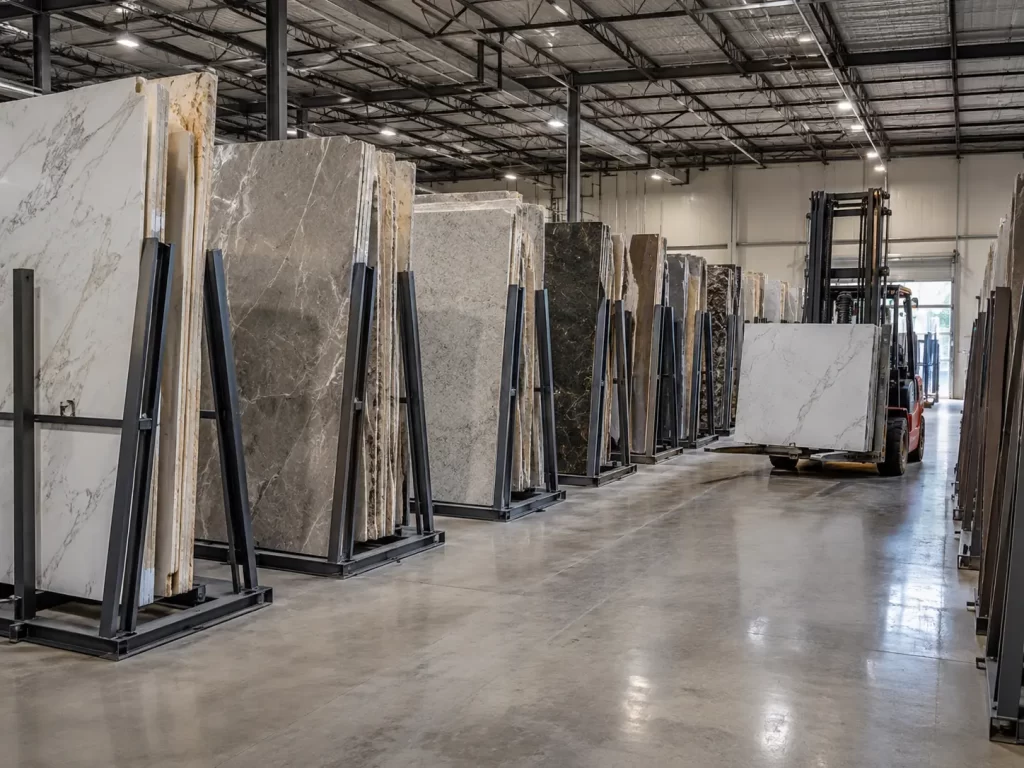
Rak Slab Grosir
Case Study Profile
| Project Factor | Case Study Detail |
|---|---|
| Client Type | Mid-sized stone distributor |
| Warehouse Area | Approximately 1,300 m² |
| Materials Stored | Marble, granite, quartz, and sintered stone slabs |
| Initial Controlled Storage | Approximately 800 slabs |
| Setelah Peningkatan | Approximately 1,120 slabs |
| Main Measurable Improvement | +40% usable slab storage capacity |
Client Background
A Mid-Sized Stone Distributor With Growing Inventory Pressure
The client supplied marble, granite, quartz, and sintered stone slabs to countertop fabricators, contractors, interior designers, and local construction companies. The warehouse covered approximately 1,300 square meters and stored around 800 slabs before the upgrade. Inventory had grown quickly, but the storage layout had not been redesigned to match the new volume.
The warehouse did not have a serious shortage of total floor area. The main problem was inefficient use of the available space. Some aisles were wider than necessary, while other areas restricted comfortable forklift movement. Fast-moving slabs were blocked by slow-moving inventory, material groups were inconsistent, and workers often relied on memory rather than rack location codes.
Before the upgrade, management reviewed equipment options and supplier experience. Understanding the background of a slab rack manufacturer was important because the client needed more than steel racks. The project also required layout thinking, material handling knowledge, and a practical storage improvement plan.
| Before Upgrade Metric | Estimated Situation | Operational Impact |
|---|---|---|
| Usable slab storage area | Around 60–65% of available zone | Space was not fully utilized |
| Average slab retrieval time | 12–18 minutes per slab | Slower order preparation |
| Forklift movement frequency | Tinggi | More handling risk |
| Customer viewing efficiency | Rendah | Sales process slowed down |
The Storage Problem
Poor Layout Was Reducing Usable Capacity
The warehouse was not short of stone inventory; it was short of organized, usable, safe, and searchable storage space. Workers often had to move several slabs to reach one selected piece. That increased labor time, forklift traffic, slab handling frequency, and the chance of damage during access.
The biggest hidden cost was retrieval time. At 15 minutes per retrieval and 20 slab retrievals per day, the team could spend about 300 minutes—or five labor hours—each day just accessing materials. That does not include customer waiting time, forklift fuel, inspection, or delayed order preparation.
Safety Risks From Uncontrolled Slab Movement
Stone slabs are heavy and can become unstable when stored or handled incorrectly. Poor support, overloaded leaning areas, unclear forklift routes, and random slab placement can increase the risk of shifting, sliding, tipping, or collision. In slab handling, safety should not depend only on worker experience; the storage layout should reduce unnecessary movement by design.
The client needed a more structured stone slab storage solution with clear rack spacing, organized access, load support, and better warehouse flow. The team reviewed practical design ideas from a complete guide to Slab Rack systems for stone warehouses before finalizing the upgrade strategy.
Low Inventory Visibility Was Also Affecting Sales
Storage inefficiency did not only affect warehouse operations. Customers visiting the warehouse could not view slabs easily, sales staff needed more time to locate specific materials, and popular slabs were sometimes hidden behind slower-moving inventory. A better layout therefore had to improve both operational access and customer viewing.
The Solution: Redesign the Workflow Before Adding Racks
Warehouse Layout Based on Material Flow
The project started with a warehouse audit. The team reviewed floor space, forklift routes, slab sizes, material categories, movement frequency, loading areas, and customer viewing needs. Instead of placing racks randomly, the warehouse was divided into functional zones for fast-moving slabs, slow-moving inventory, customer viewing, new arrivals, outgoing orders, and heavier materials.
Fast-moving slabs were positioned closer to loading and viewing areas. Slow-moving materials were placed in deeper storage zones. Rack bays were numbered, and inventory records were updated with rack codes so workers could locate slabs by position instead of memory.
Rack Types Were Matched to Storage Needs
The client used a combination of A-frame slab racks, vertical storage racks, and heavy-duty slab storage units. A-frame racks supported staging and frequently accessed materials. Vertical rack zones improved category separation, while heavy-duty racks were selected for thicker stone, porcelain panels, and heavier slab groups.
For mobile storage and transportation needs, some companies may also evaluate a rak penyimpanan lempengan yang digunakan pada truk when slabs must move between a warehouse, job site, or distribution point. In this case study, the primary focus was indoor warehouse efficiency, but the same principle applies: the storage system should match the real handling workflow.
| Storage Need | Recommended Rack Type | Key Benefit | Buyer Warning |
|---|---|---|---|
| General slab storage | A-frame slab rack | Stable leaning support | Load must be balanced |
| High-density organization | Vertical slab rack | Better category separation | Requires aisle planning |
| Heavy slabs or panels | Heavy-duty slab rack | Higher load capacity | Rated load must be confirmed |
| Customer viewing | Display-friendly rack zone | Improves sales visibility | Not ideal for all bulk storage |
Implementation Steps
The upgrade followed a clear sequence: audit the warehouse, group inventory by category, review forklift movement, match rack types to zones, install racks, label rack bays, update inventory records, train workers, and review the operational results. This approach prevented the project from becoming “new racks, same old chaos.”
For heavy panels and porcelain slab storage, the team also considered solutions similar to heavy-duty porcelain storage rack systems because porcelain and sintered stone panels often require surface protection, careful spacing, and controlled support to reduce collision and edge damage.
| Implementation Step | Main Task | Expected Benefit |
|---|---|---|
| Warehouse audit | Measure space and workflow | Identify hidden waste |
| Inventory grouping | Separate material types and fast movers | Faster search |
| Rack layout planning | Match rack type to zone | Higher storage density |
| Labeling system | Rack bay and material code | Better inventory control |
| Worker training | Safe loading and retrieval | Lower handling risk |
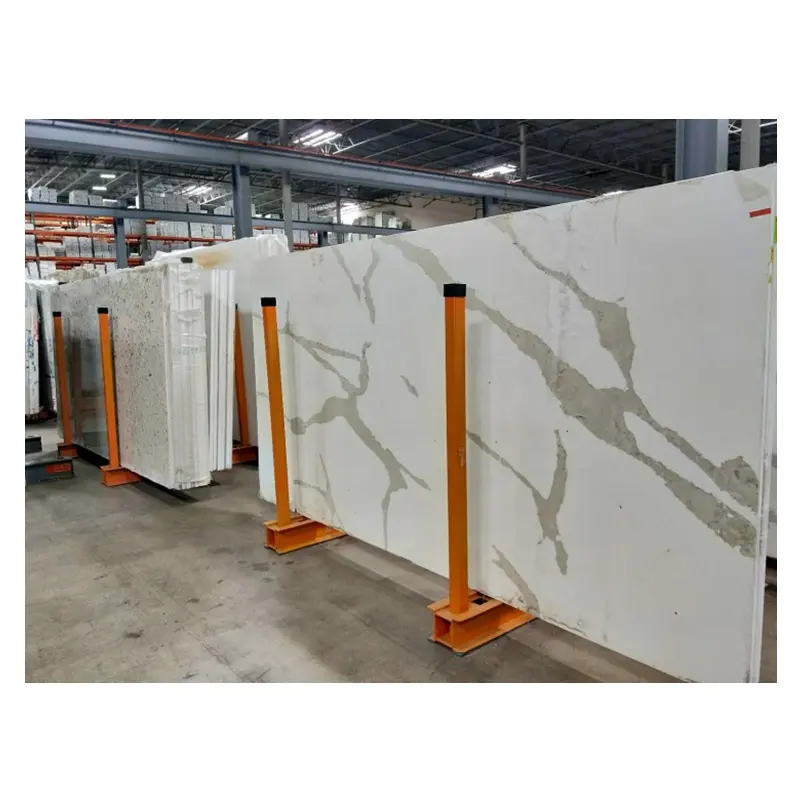
rak penyimpanan lempengan
Case Study Results at a Glance
+40% Storage Capacity: approximately 800 slabs increased to approximately 1,120 slabs.
-40% Average Retrieval Time: approximately 15 minutes reduced to approximately 9 minutes.
-40% Forklift Movements: approximately five movements reduced to three per retrieval.
+22 Percentage Points Inventory Accuracy: location accuracy improved from 70% to 92%.
44 Labor Hours per Month: estimated time saving based on 20 retrievals per day, 6 minutes saved per retrieval, and 22 working days.
How the 40% Storage Capacity Increase Was Calculated
The strongest measurable result in this case study is the increase in usable slab storage capacity. Before the upgrade, the warehouse stored approximately 800 slabs in a controlled way. After the rack and layout changes, it stored approximately 1,120 slabs within the same general storage area.
(1,120 − 800) ÷ 800 × 100 = 40%
This distinction matters: the 40% figure refers specifically to usable storage capacity. Other operational metrics also improved, but they should be reported separately rather than grouped into one general “efficiency” percentage.
Detailed Before-and-After Performance
| Performance Metric | Before Slab Rack Upgrade | After Slab Rack Upgrade | Change |
|---|---|---|---|
| Usable storage capacity | 800 slabs | 1,120 slabs | +40% |
| Average retrieval time | 15 minutes | 9 minutes | -40% |
| Forklift movements | 5 per retrieval | 3 per retrieval | -40% |
| Inventory location accuracy | 70% | 92% | +22 percentage points |
| Customer viewing speed | Slow | Faster | Improved sales experience |
Reduced Handling and Better Safety Workflow
The new layout reduced unnecessary slab movement. Workers no longer needed to move several unrelated slabs to reach one selected material. Clear rack coding improved slab location, better aisle planning reduced forklift congestion, and fast-moving materials were positioned nearer to loading and customer viewing zones.
Reduced handling can also lower damage exposure. Stone slabs are most vulnerable while being moved. Every avoided handling step can reduce opportunities for chipped corners, scratched polished faces, broken edges, or forklift contact.
How Much Labor Time Did the New Layout Save?
The estimated labor saving can be calculated directly from the retrieval-time improvement shown in the case study.
× 6 minutes saved per retrieval
× 22 working days
= 2,640 minutes
= 44 labor hours per month
That recovered time can be redirected to loading, customer support, inventory updates, quality checks, and other warehouse tasks.
Slab Rack vs Traditional Leaning Storage
Traditional leaning storage may appear simple, but it often creates hidden operational costs. Access can depend heavily on worker habits, slab groups can block each other, and inventory is harder to manage consistently. A slab rack system creates more structured support, clearer slab access, better visibility, and a framework that is easier to expand.
| Factor | Traditional Leaning Storage | Slab Rack System |
|---|---|---|
| Pemanfaatan Ruang | Inconsistent | Higher and more controlled |
| Slab Access | Often blocked | More organized |
| Safety Control | Depends heavily on worker habit | More structured |
| Inventory Visibility | Rendah | Higher |
| Damage Exposure | Higher when repeated movement is required | Lower handling frequency |
Common Mistakes When Buying Slab Racks
Buying Based Only on Price
A low rack price does not automatically mean a lower total cost. Buyers should compare rated load, base stability, weld quality, surface treatment, dimensions, installation requirements, and long-term durability.
Ignoring Slab Size and Weight
Granite, marble, quartz, porcelain, and sintered stone vary in weight, thickness, size, and fragility. Rack design should match the actual slab dimensions and handling conditions.
Forgetting Forklift Aisle Width
A strong rack is not useful if forklifts cannot approach, turn, load, or retrieve slabs safely. Aisle planning should be completed before the final rack layout is approved.
Mixing Fast-Moving and Slow-Moving Inventory
Popular slabs should be easier to access. Slow-moving inventory should not block daily operations. Storage layout should follow retrieval frequency and sales activity.
Not Training Workers
Even a well-designed slab rack system needs correct loading, unloading, balancing, inspection, and forklift handling procedures. Equipment and layout work best when operating practices are consistent.
 Rak Lempengan |
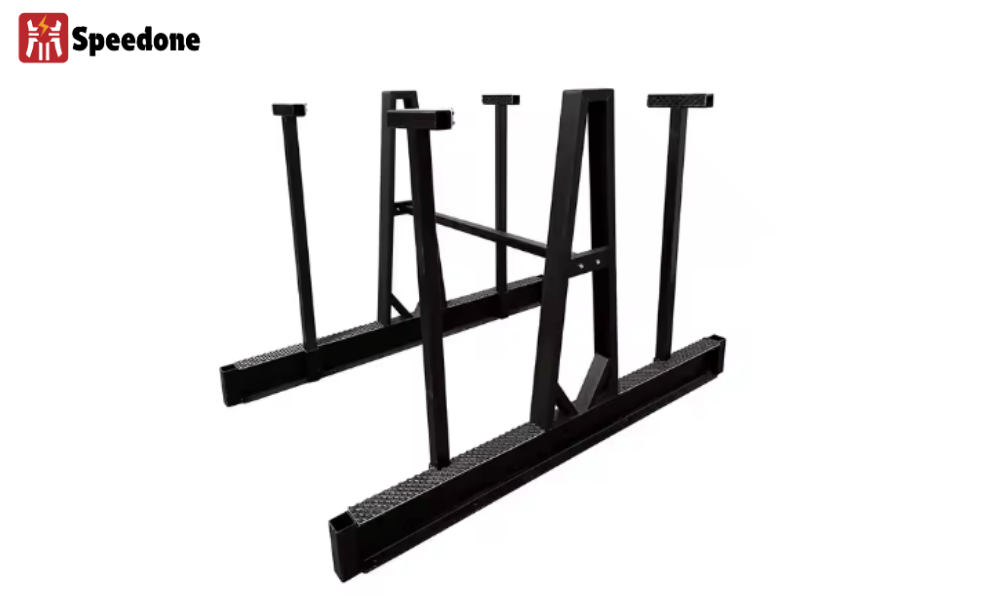 Rak Pajangan Lempengan |
How to Choose a Slab Rack Manufacturer or Supplier
What a Reliable Supplier Should Provide
A reliable supplier should provide load rating, steel specification, rack dimensions, surface treatment details, welding information, layout support, customization options, installation guidance, safety notes, packing details, export experience, spare parts availability, and after-sales support.
For buyers who need custom rack sizes, warehouse layout support, or project-specific equipment recommendations, contacting a professional Pemasok Rak Slab early can help avoid buying racks that appear suitable on paper but do not fit the real warehouse workflow.
| Evaluation Factor | Suggested Weight | What to Check |
|---|---|---|
| Kapasitas Beban | 25% | Rated weight, rack design, steel strength |
| Layout Support | 20% | Warehouse planning and aisle recommendations |
| Safety Design | 20% | Anti-slip, stability, support pins, anchoring |
| Manufacturing Quality | 15% | Welding, surface treatment, durability |
| Kustomisasi | 10% | Size, color, pin layout, rack type |
Note: The evaluation weights above are a practical buyer framework for comparison, not an industry standard.
Practical Recommendation: Which Slab Rack Should You Choose?
For stone distributors, prioritize high-density storage with clear material grouping and customer viewing zones. For countertop fabricators, prioritize fast slab retrieval, safe access, and easy movement of project materials. For marble and granite warehouses, choose racks with suitable load ratings and stable support. For quartz and sintered stone suppliers, surface protection, careful spacing, and reduced panel collision risk become especially important.
The best Slab Rack system is not simply the strongest or cheapest rack. It is the system that matches warehouse layout, slab size, forklift movement, inventory categories, customer viewing, and future expansion.
Key Lesson From the Case Study
This case study shows that slab rack performance depends on more than rack quantity. The largest measurable change was a 40% increase in usable storage capacity—from approximately 800 to 1,120 slabs. At the same time, average retrieval time fell from approximately 15 to 9 minutes, forklift movements per retrieval fell from roughly five to three, and inventory location accuracy improved from 70% to 92%.
The practical lesson is simple: before renting more warehouse space, review the layout, aisle use, rack zoning, inventory grouping, and retrieval process. A better storage system can reveal capacity that already exists inside the current building.
PERTANYAAN YANG SERING DIAJUKAN
Untuk apa Slab Rack digunakan?
Rak Slab digunakan untuk menyimpan lempengan marmer, granit, kuarsa, porselen, batu sinter, dan lempengan batu besar lainnya di gudang, halaman lempengan, dan bengkel fabrikasi. Rak ini membantu mengatur lempengan secara vertikal atau dengan sudut kemiringan yang terkendali, meningkatkan akses terhadap material, mengurangi penumpukan acak, dan mendukung pemanfaatan ruang gudang yang lebih baik.
Berapa kapasitas penyimpanan yang dapat ditambahkan oleh Slab Rack?
There is no universal percentage because the result depends on warehouse layout, slab size, aisle planning, rack type, and inventory grouping. In this case study, usable storage capacity increased from approximately 800 slabs to 1,120 slabs, a 40% increase. The gain came from layout redesign, rack bay labeling, material zoning, and improved access routes rather than overcrowding the same floor area.
Apakah Rak Slab A-frame Aman?
Rak A-frame untuk pelat dapat mendukung penyimpanan pelat yang lebih aman jika dirancang, dinilai beban, diseimbangkan, dipasang, diperiksa, dan digunakan dengan benar serta mengikuti prosedur penanganan yang tepat. Pembeli harus memastikan kapasitas beban rak, kualitas baja, stabilitas dasar, sudut penopang, perlindungan permukaan, serta kompatibilitas dengan operasi forklift atau crane.
Bagaimana Rak Slab dapat mengurangi kerusakan slab?
Sistem rak lempengan yang terencana dengan baik dapat mengurangi penanganan yang tidak perlu, menciptakan jalur akses yang lebih jelas, dan menurunkan jumlah kali lempengan yang tidak terkait harus dipindahkan untuk mencapai satu buah lempengan yang dipilih. Langkah-langkah penanganan yang lebih sedikit dapat mengurangi peluang terjadinya sudut terkelupas, permukaan tergores, tepi rusak, atau benturan selama pengambilan.
Apa yang harus saya periksa sebelum membeli Slab Rack?
Check the rated load capacity, steel specification, weld quality, base stability, rack dimensions, slab size compatibility, surface treatment, support structure, forklift aisle width, installation requirements, and supplier support. The rack layout should also match fast-moving inventory, customer viewing, new arrivals, outgoing orders, and future warehouse expansion.
Referensi
1. Hazards of Transporting, Unloading, Storing and Handling Granite, Marble and Stone Slabs, Occupational Safety and Health Administration, Safety and Health Information Bulletin.
2. Material Handling and Storage, Occupational Safety and Health Administration, Workplace Safety Guidance.
3. Warehouse Planning and Design: A Practical Guide, Edward Frazelle, Logistics Resources International.
4. Warehouse Management: A Complete Guide to Improving Efficiency and Minimizing Costs, Gwynne Richards, Kogan Page.
5. Material Handling Equipment, Michael G. Kay, North Carolina State University, Industrial Engineering Reference.
6. Ergonomic Guidelines for Manual Material Handling, National Institute for Occupational Safety and Health, Workplace Ergonomics Publication.
7. Dimension Stone Design Manual, Natural Stone Institute, Natural Stone Technical Reference.
8. Forklift Safety Guide, Washington State Department of Labor & Industries, Industrial Safety Publication.
“`

Henry.
Hai, saya penulis posting ini, dan saya telah berkecimpung di bidang ini selama lebih dari 16 tahun. Jika Anda membutuhkan layanan OEM & ODM untuk alat batu, jangan ragu untuk bertanya kepada saya.
Expert Commentary & Analysis
For slab storage projects, rack load capacity is only one part of warehouse performance. A rack can be structurally strong and still deliver poor results if aisle width, material grouping, retrieval frequency, loading zones, and customer viewing are not planned together.
In this case, the strongest lesson is not simply that “slab racks save space.” The more useful conclusion is that structured storage makes capacity measurable and repeatable. When rack bays are defined, fast-moving materials are positioned deliberately, forklift routes are simplified, and slab locations are coded, the warehouse becomes easier to operate and easier to scale.
For buyers: evaluate the slab rack as part of a storage system, not as an isolated steel product. The best result comes from matching rack design to the real slab mix, warehouse geometry, handling equipment, retrieval frequency, and future inventory growth.