Lavorate in modo efficiente!





Come i layout dei rack per lastre migliorano l'efficienza dei magazzini di pietra
Learn how Slab Rack layouts improve stone warehouse efficiency by reducing travel time, lowering rehandling, improving slab access, increasing safety, and creating more practical storage flow for modern stone operations.
When the Warehouse Looks Full but Still Feels Slow
“We added more racks, but the team is still wasting time.”
“We have slabs in stock, but finding the right one still takes too long.”
“We thought storage was the problem. Now it looks like layout is the real bottleneck.”
That conversation happens in stone warehouses all the time. Many facilities assume that buying more storage equipment will automatically solve efficiency problems. It does not. If the Cremagliera per lastre system is poorly laid out, the warehouse can still suffer from long travel distances, blocked access, wasted floor area, higher damage risk, and slower turnover. In other words, the rack itself matters, but the layout is what decides whether that rack becomes an asset or a daily obstacle.
That is why a supplier like Speedone matters in this discussion. Speedone’s public company page describes the business as a specialist in the development and manufacturing of stone-handling equipment such as metal racks, display racks, and transport carts, with more than 18 years of experience in the field. That kind of specialization matters because slab storage is not a generic warehouse problem. Stone slabs are large, heavy, brittle, and dangerous when layout logic fails.
If a warehouse is already dealing with congestion, slow retrieval, chipped edges, or dangerous movement zones, the smartest move is usually to contact Speedone before buying “more rack” as a reflex. In slab storage, poor layout often costs more than insufficient hardware. And yes, warehouses can absolutely be both crowded and inefficient at the same time — that little magic trick is sadly common.

Cremagliera per lastre
The Real Reason Layout Matters More Than Most Stone Yards Expect
A slab yard is not a normal shelving environment. The products are tall, heavy, often visually similar from a distance, and frequently moved with forklifts, cranes, clamps, or carts. That means the layout has to do four jobs at once:
- maximize usable storage space
- maintain safe and clear movement paths
- reduce handling time
- protect slab surfaces and edges during storage and retrieval
A 2025 warehouse-layout optimization study found that better aisle design, cross-aisle placement, and smarter storage assignment could reduce total travel distance by up to 32% while maintaining storage-space utilization near 85%. That matters because warehouse efficiency is not only about how much product fits inside the building. It is also about how quickly and safely people and machines can reach it. A more recent warehouse-safety article similarly noted that optimized layouts help streamline movement, reduce travel time, and support accuracy while lowering accident risk.
That is exactly why modular slab rack layouts are so relevant. Speedone’s own article frames modular slab racks around space efficiency, slab protection, and warehouse order, which is the right angle. In a stone warehouse, the layout must do more than “store.” It must support visibility, reduce rehandling, and create a predictable traffic pattern for people and lifting equipment. When racks are placed with no zoning logic, no retrieval sequence, and no aisle planning, the warehouse stops behaving like a system and starts behaving like a maze.
Not Every Slab Rack Layout Solves the Same Problem
One of the biggest mistakes stone yards make is assuming all slab storage should follow one universal layout. It should not. Different layouts solve different operational problems.
Some warehouses need maximum density because floor area is limited. Others need higher visibility because customers view slabs on site. Some need faster retrieval because slabs move in and out frequently. Others need better damage control because valuable materials sit longer in storage.
That is where slab rack classification and storage techniques become useful. Speedone’s classification article explicitly compares slab racks with regular shelving and breaks the category into different types, which is exactly how warehouse managers should evaluate layout decisions. A rack layout should be chosen based on workflow, slab dimensions, movement frequency, and safety constraints — not only by what looks neat on paper.
A 2022 slab-storage safety article from the stone industry makes a similar point from a different angle: the two proven slab-storage methods remain A-frames and slab pole racks, but each offers different benefits and drawbacks depending on the user’s needs. That article notes that a slab pole rack can hold at least 20% more material than a traditional A-frame using the same footprint, while most slabs on pole racks can be accessed without moving front slabs out of the way. That is not a small operational difference. In a busy yard, it can change both retrieval speed and damage risk.
The Best Layouts Reduce Rehandling, Not Just Save Space
Warehouse managers often celebrate space savings first because they are easy to see. But in real slab operations, one of the biggest hidden costs is rehandling.
If a crew has to move three slabs to reach the fourth one, that is not just a time loss. It is also an increased exposure to scratches, corner damage, tipping risk, and forklift movement. OSHA’s guidance on slab storage is blunt about this: slab racks should be designed to withstand imposed loads and should secure slabs from shifting, sliding, and collapsing. It also recommends keeping employees out of danger zones during placement and removal, inspecting damaged racks, and maintaining poles and structural components properly. That guidance is about safety, but it is also about efficiency, because unstable layouts force slower, more cautious, and more repetitive movement.
This is one reason the newer slab rack post caps and edge protection system category matters. Speedone’s product page positions post caps as a way to reduce chips, scratches, and impact damage in granite, glass, and panel storage. That might sound like a small accessory detail, but in layout terms it is actually important. Good slab rack layouts are not just about where slabs stand. They are also about what happens when slabs are loaded, touched, leaned, and repositioned repeatedly over time. Edge protection is part of warehouse efficiency because damaged slabs are not efficient inventory — they are expensive mistakes.

Cremagliera per lastre
How Layout Design Changes Daily Warehouse Performance
A well-planned Cremagliera per lastre layout improves warehouse efficiency in five clear ways.
1. It shortens travel paths
If high-turnover slabs are stored too far from receiving, dispatch, or inspection zones, the warehouse burns time with every movement. Strategic zoning reduces repeated travel and keeps equipment from crisscrossing the whole building.
2. It improves slab visibility
When storage zones are organized by size, material family, finish, or turnover class, the team spends less time hunting and less time moving unrelated stock. That improves retrieval speed and lowers unnecessary handling.
3. It creates safer access
Clear aisles, marked fall-shadow zones, and planned loading/unloading sequences reduce collision risk and help operators move slabs with more confidence. OSHA’s slab-storage guidance emphasizes proper installation, inspection, maintenance, and safe procedures precisely because uncontrolled layouts increase caught-by, struck-by, and crushed-by hazards.
4. It increases usable capacity
Efficient layout is not only about squeezing in more racks. It is about recovering wasted dead zones, improving vertical and directional alignment, and matching rack types to slab categories. A warehouse article on efficient layout also highlights vertical-vs-horizontal space use and thoughtful traffic-flow planning as common sources of hidden efficiency gain.
5. It reduces slab damage
When slabs are easier to access and better protected, crews make fewer rushed moves, fewer awkward turns, and fewer unnecessary repositioning steps. That protects both product value and labor time.
A Practical Comparison Table for Stone Warehouses
| Layout goal | What a poor layout causes | What a better slab rack layout improves |
|---|---|---|
| Faster slab retrieval | Long search time, repeated rehandling, traffic conflict | Shorter access paths, better zoning, clearer slab grouping |
| Higher storage density | Wasted corners, dead zones, poor vertical use | Better footprint use, smarter rack spacing, more usable capacity |
| Safer movement | Fall-shadow exposure, blocked aisles, collision risk | Clear pathways, safer loading/removal sequences, better operator flow |
| Lower product damage | Edge chips, scratches, unstable support points | Protected contact zones, fewer touches, more controlled handling |
| Better customer viewing | Hidden premium slabs, awkward access, visual clutter | Cleaner presentation, easier inspection, better display logic |
This table matters because warehouse efficiency is never one single number. It is the combined result of time, space, safety, and product condition.
Why Affordable Rack Buying Alone Does Not Solve the Problem
Many buyers start with cost, which is understandable. But in slab storage, “affordable” only works if the warehouse layout is right.
That is where affordable slab rack planning becomes a more useful concept than affordable rack purchasing alone. Speedone’s own article positions slab racks around proper storage need, material characteristics, and application fit. That is the correct logic. A cheaper rack that forces bad access, causes slab crowding, or creates unsafe movement is not really cheaper once damage, labor time, and rework are included.
A 2022 stone-industry safety article also noted that A-frames remain popular partly because they are easy to load, unload, and visually present to customers — but it also pointed out the drawback that slabs in front often need to be moved to access slabs behind them. That is a great example of why layout decisions should not be made from price alone. In some contexts, the lower-cost option is operationally slower. In others, a denser rack layout may improve storage but complicate viewing or transport. The right answer depends on the warehouse’s real job.
A Smarter Way to Plan Slab Rack Layouts
A practical slab rack layout usually starts with four zoning questions:
- Which slabs move most often?
High-turnover inventory should sit closer to receiving, staging, or dispatch. - Which slabs are premium, fragile, or display-sensitive?
These often deserve better visual access and better protection. - Which slabs require specialized handling?
Oversized, unusually heavy, or delicate materials should not be forced into standard zones. - Where do machines and people cross paths most often?
That is where congestion and danger usually begin.
This is consistent with broader warehouse-layout guidance, which emphasizes placing fast-moving inventory closer to work areas, reducing backtracking, and maintaining clear traffic flow for equipment and personnel. In a stone environment, that logic matters even more because the inventory is large, heavy, and unforgiving when storage systems fail.
A good slab rack layout is therefore less about “filling space” and more about sequencing movement. The warehouse should guide the slab journey logically: receiving, identification, storage, viewing if needed, retrieval, and outbound handling. When that sequence is broken, the yard starts paying for it in wasted minutes and chipped corners.
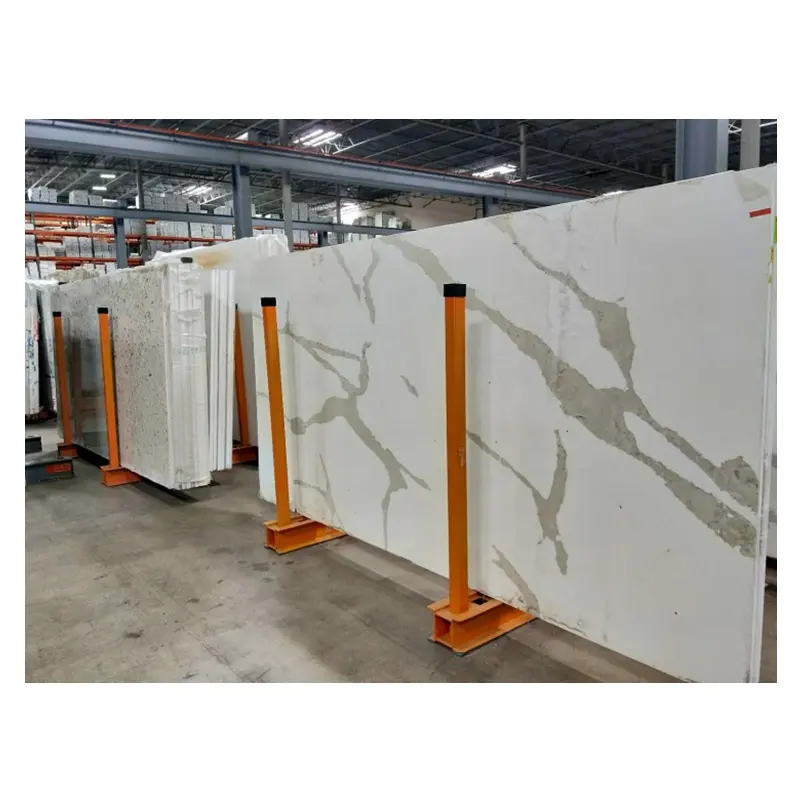
scaffali di stoccaggio per lastre
Five Questions Stone Buyers and Warehouse Managers Commonly Ask
In che modo una disposizione a scaffali a lastre migliora l'efficienza del magazzino?
Migliora l'efficienza riducendo le distanze di spostamento, organizzando in modo più chiaro l'accesso alle lastre, diminuendo le movimentazioni superflue e rendendo più prevedibili gli spostamenti di persone e attrezzature. Una buona disposizione degli spazi supporta inoltre operazioni più sicure e riduce il tempo necessario per individuare, ispezionare e recuperare le lastre. Uno studio del 2025 sulla disposizione degli magazzini ha rilevato che una migliore progettazione dei corridoi e dello stoccaggio potrebbe ridurre le distanze totali di spostamento fino al 321% mantenendo elevata l'utilizzazione dello spazio di stoccaggio.
I rack per lastre riguardano principalmente la capacità di stoccaggio?
No. La capacità è importante, ma rappresenta solo una parte del risultato. Un sistema a scaffali per lastre influisce anche sulla velocità di prelievo, sulla visibilità delle lastre, sul flusso delle attrezzature, sulla prevenzione dei danni e sulla sicurezza dei lavoratori. In molti magazzini di pietra, il vero guadagno in termini di efficienza non deriva dallo stoccaggio di più lastre, bensì dall'accesso più rapido e sicuro alla lastra giusta.
Qual è il modo più sicuro per conservare le lastre di pietra?
Le linee guida per la sicurezza nell'industria raccomandano di utilizzare scaffalature progettate per le sollecitazioni imposte, fissare le lastre per evitare spostamenti o crolli, ispezionare regolarmente le scaffalature, rimuovere dall'uso le attrezzature danneggiate e tenere i lavoratori lontano dalle zone a rischio di caduta durante il carico e lo scarico. Ausili meccanici e procedure appropriate sono essenziali.
I rack modulari a lastre sono migliori rispetto ai layout fissi?
Possono esserlo, specialmente quando un magazzino deve adattarsi a dimensioni delle lastre, mix di prodotti o esigenze di densità di stoccaggio in continuo cambiamento. I layout modulari offrono spesso una maggiore flessibilità per la suddivisione in zone, la riconfigurazione e l'espansione nel tempo. Questo è uno dei motivi per cui il contenuto modulare degli scaffali per lastre di Speedone si concentra così fortemente sull'efficienza dello spazio e sull'ordine nel magazzino.
Come faccio a sapere se la mia attuale disposizione del rack per lastre sta danneggiando l'efficienza?
I segnali di allarme comuni includono tempi lunghi per il prelievo, ripetute manipolazioni delle lastre, corridoi ostruiti, danni visibili ai bordi, scarsa visibilità dell'inventario e frequenti deviazioni da parte degli operatori. Se il team continua a spostare le lastre solo per raggiungere altre lastre, è quasi certo che la disposizione stia facendo perdere tempo e aumentando i rischi.
The Best Warehouse Layout Is the One That Makes the Next Move Easier
Back to the first warehouse complaint: the building looked full, but the operation still felt slow.
That is the real lesson behind Cremagliera per lastre layout planning. Efficiency in a stone warehouse is not created by rack count alone. It is created by how well the layout shortens travel, supports safe access, protects slab condition, and keeps the next move simple. A well-planned rack system helps the warehouse behave like a flow. A poor one turns every retrieval into an obstacle course.
That is why slab rack layouts improve stone warehouse efficiency so dramatically when they are done right. Speedone’s public content around modular slab racks, classification, affordable rack logic, and edge-protection systems points in the same direction: the real value of slab storage is not just in holding slabs upright. It is in helping the warehouse work smarter, safer, and faster every day.

Enrico
Salve, sono l'autore di questo post e lavoro in questo settore da più di 16 anni. Se avete bisogno di un servizio OEM&ODM per gli utensili in pietra, sentitevi liberi di farmi qualsiasi domanda.