효율적으로 업무를 완료하세요!





Learn how Slab Rack layouts improve stone warehouse efficiency by reducing travel time, lowering rehandling, improving slab access, increasing safety, and creating more practical storage flow for modern stone operations.
When the Warehouse Looks Full but Still Feels Slow
“We added more racks, but the team is still wasting time.”
“We have slabs in stock, but finding the right one still takes too long.”
“We thought storage was the problem. Now it looks like layout is the real bottleneck.”
That conversation happens in stone warehouses all the time. Many facilities assume that buying more storage equipment will automatically solve efficiency problems. It does not. If the 슬래브 랙 system is poorly laid out, the warehouse can still suffer from long travel distances, blocked access, wasted floor area, higher damage risk, and slower turnover. In other words, the rack itself matters, but the layout is what decides whether that rack becomes an asset or a daily obstacle.
That is why a supplier like Speedone matters in this discussion. Speedone’s public company page describes the business as a specialist in the development and manufacturing of stone-handling equipment such as metal racks, display racks, and transport carts, with more than 18 years of experience in the field. That kind of specialization matters because slab storage is not a generic warehouse problem. Stone slabs are large, heavy, brittle, and dangerous when layout logic fails.
If a warehouse is already dealing with congestion, slow retrieval, chipped edges, or dangerous movement zones, the smartest move is usually to contact Speedone before buying “more rack” as a reflex. In slab storage, poor layout often costs more than insufficient hardware. And yes, warehouses can absolutely be both crowded and inefficient at the same time — that little magic trick is sadly common.

슬래브 랙
The Real Reason Layout Matters More Than Most Stone Yards Expect
A slab yard is not a normal shelving environment. The products are tall, heavy, often visually similar from a distance, and frequently moved with forklifts, cranes, clamps, or carts. That means the layout has to do four jobs at once:
- maximize usable storage space
- maintain safe and clear movement paths
- reduce handling time
- protect slab surfaces and edges during storage and retrieval
A 2025 warehouse-layout optimization study found that better aisle design, cross-aisle placement, and smarter storage assignment could reduce total travel distance by up to 32% while maintaining storage-space utilization near 85%. That matters because warehouse efficiency is not only about how much product fits inside the building. It is also about how quickly and safely people and machines can reach it. A more recent warehouse-safety article similarly noted that optimized layouts help streamline movement, reduce travel time, and support accuracy while lowering accident risk.
That is exactly why modular slab rack layouts are so relevant. Speedone’s own article frames modular slab racks around space efficiency, slab protection, and warehouse order, which is the right angle. In a stone warehouse, the layout must do more than “store.” It must support visibility, reduce rehandling, and create a predictable traffic pattern for people and lifting equipment. When racks are placed with no zoning logic, no retrieval sequence, and no aisle planning, the warehouse stops behaving like a system and starts behaving like a maze.
Not Every Slab Rack Layout Solves the Same Problem
One of the biggest mistakes stone yards make is assuming all slab storage should follow one universal layout. It should not. Different layouts solve different operational problems.
Some warehouses need maximum density because floor area is limited. Others need higher visibility because customers view slabs on site. Some need faster retrieval because slabs move in and out frequently. Others need better damage control because valuable materials sit longer in storage.
That is where slab rack classification and storage techniques become useful. Speedone’s classification article explicitly compares slab racks with regular shelving and breaks the category into different types, which is exactly how warehouse managers should evaluate layout decisions. A rack layout should be chosen based on workflow, slab dimensions, movement frequency, and safety constraints — not only by what looks neat on paper.
A 2022 slab-storage safety article from the stone industry makes a similar point from a different angle: the two proven slab-storage methods remain A-frames and slab pole racks, but each offers different benefits and drawbacks depending on the user’s needs. That article notes that a slab pole rack can hold at least 20% more material than a traditional A-frame using the same footprint, while most slabs on pole racks can be accessed without moving front slabs out of the way. That is not a small operational difference. In a busy yard, it can change both retrieval speed and damage risk.
The Best Layouts Reduce Rehandling, Not Just Save Space
Warehouse managers often celebrate space savings first because they are easy to see. But in real slab operations, one of the biggest hidden costs is rehandling.
If a crew has to move three slabs to reach the fourth one, that is not just a time loss. It is also an increased exposure to scratches, corner damage, tipping risk, and forklift movement. OSHA’s guidance on slab storage is blunt about this: slab racks should be designed to withstand imposed loads and should secure slabs from shifting, sliding, and collapsing. It also recommends keeping employees out of danger zones during placement and removal, inspecting damaged racks, and maintaining poles and structural components properly. That guidance is about safety, but it is also about efficiency, because unstable layouts force slower, more cautious, and more repetitive movement.
This is one reason the newer slab rack post caps and edge protection system category matters. Speedone’s product page positions post caps as a way to reduce chips, scratches, and impact damage in granite, glass, and panel storage. That might sound like a small accessory detail, but in layout terms it is actually important. Good slab rack layouts are not just about where slabs stand. They are also about what happens when slabs are loaded, touched, leaned, and repositioned repeatedly over time. Edge protection is part of warehouse efficiency because damaged slabs are not efficient inventory — they are expensive mistakes.

슬래브 랙
How Layout Design Changes Daily Warehouse Performance
A well-planned 슬래브 랙 layout improves warehouse efficiency in five clear ways.
1. It shortens travel paths
If high-turnover slabs are stored too far from receiving, dispatch, or inspection zones, the warehouse burns time with every movement. Strategic zoning reduces repeated travel and keeps equipment from crisscrossing the whole building.
2. It improves slab visibility
When storage zones are organized by size, material family, finish, or turnover class, the team spends less time hunting and less time moving unrelated stock. That improves retrieval speed and lowers unnecessary handling.
3. It creates safer access
Clear aisles, marked fall-shadow zones, and planned loading/unloading sequences reduce collision risk and help operators move slabs with more confidence. OSHA’s slab-storage guidance emphasizes proper installation, inspection, maintenance, and safe procedures precisely because uncontrolled layouts increase caught-by, struck-by, and crushed-by hazards.
4. It increases usable capacity
Efficient layout is not only about squeezing in more racks. It is about recovering wasted dead zones, improving vertical and directional alignment, and matching rack types to slab categories. A warehouse article on efficient layout also highlights vertical-vs-horizontal space use and thoughtful traffic-flow planning as common sources of hidden efficiency gain.
5. It reduces slab damage
When slabs are easier to access and better protected, crews make fewer rushed moves, fewer awkward turns, and fewer unnecessary repositioning steps. That protects both product value and labor time.
A Practical Comparison Table for Stone Warehouses
| Layout goal | What a poor layout causes | What a better slab rack layout improves |
|---|---|---|
| Faster slab retrieval | Long search time, repeated rehandling, traffic conflict | Shorter access paths, better zoning, clearer slab grouping |
| Higher storage density | Wasted corners, dead zones, poor vertical use | Better footprint use, smarter rack spacing, more usable capacity |
| Safer movement | Fall-shadow exposure, blocked aisles, collision risk | Clear pathways, safer loading/removal sequences, better operator flow |
| Lower product damage | Edge chips, scratches, unstable support points | Protected contact zones, fewer touches, more controlled handling |
| Better customer viewing | Hidden premium slabs, awkward access, visual clutter | Cleaner presentation, easier inspection, better display logic |
This table matters because warehouse efficiency is never one single number. It is the combined result of time, space, safety, and product condition.
Why Affordable Rack Buying Alone Does Not Solve the Problem
Many buyers start with cost, which is understandable. But in slab storage, “affordable” only works if the warehouse layout is right.
That is where affordable slab rack planning becomes a more useful concept than affordable rack purchasing alone. Speedone’s own article positions slab racks around proper storage need, material characteristics, and application fit. That is the correct logic. A cheaper rack that forces bad access, causes slab crowding, or creates unsafe movement is not really cheaper once damage, labor time, and rework are included.
A 2022 stone-industry safety article also noted that A-frames remain popular partly because they are easy to load, unload, and visually present to customers — but it also pointed out the drawback that slabs in front often need to be moved to access slabs behind them. That is a great example of why layout decisions should not be made from price alone. In some contexts, the lower-cost option is operationally slower. In others, a denser rack layout may improve storage but complicate viewing or transport. The right answer depends on the warehouse’s real job.
A Smarter Way to Plan Slab Rack Layouts
A practical slab rack layout usually starts with four zoning questions:
- Which slabs move most often?
High-turnover inventory should sit closer to receiving, staging, or dispatch. - Which slabs are premium, fragile, or display-sensitive?
These often deserve better visual access and better protection. - Which slabs require specialized handling?
Oversized, unusually heavy, or delicate materials should not be forced into standard zones. - Where do machines and people cross paths most often?
That is where congestion and danger usually begin.
This is consistent with broader warehouse-layout guidance, which emphasizes placing fast-moving inventory closer to work areas, reducing backtracking, and maintaining clear traffic flow for equipment and personnel. In a stone environment, that logic matters even more because the inventory is large, heavy, and unforgiving when storage systems fail.
A good slab rack layout is therefore less about “filling space” and more about sequencing movement. The warehouse should guide the slab journey logically: receiving, identification, storage, viewing if needed, retrieval, and outbound handling. When that sequence is broken, the yard starts paying for it in wasted minutes and chipped corners.
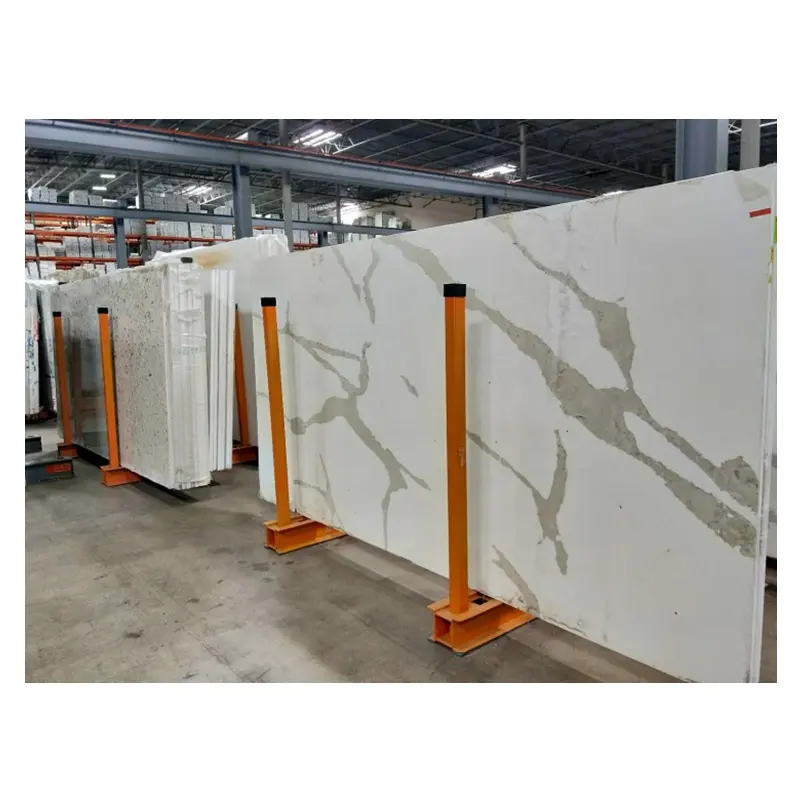
슬래브 스토리지 랙
Five Questions Stone Buyers and Warehouse Managers Commonly Ask
슬래브 랙 레이아웃은 창고 효율을 어떻게 향상시키나요?
이것은 이동 거리를 줄이고 슬래브 접근을 보다 명확하게 정리하며 불필요한 재처리를 감소시키고 사람과 장비의 이동을 더욱 예측 가능하게 함으로써 효율성을 향상시킵니다. 우수한 레이아웃은 또한 보다 안전한 작업을 지원하고 슬래브를 찾고 검사하며 회수하는 데 소요되는 시간을 줄여줍니다. 2025년에 실시된 창고 레이아웃 연구에 따르면, 보다 나은 통로와 저장 공간 설계를 통해 총 이동 거리를 최대 32%까지 줄이면서도 저장 활용률을 높일 수 있었습니다.
슬래브 랙은 주로 저장 용량에 관한 것인가요?
아니요. 용량도 중요하지만, 이는 결과의 일부에 불과합니다. 슬래브 랙 시스템은 또한 검색 속도, 슬래브 가시성, 장비 흐름, 손상 예방 및 작업자 안전에도 영향을 미칩니다. 많은 석재 창고에서는 실제로 더 많은 슬래브를 보관하는 데서 효율 향상이 이루어지는 것이 아니라, 적합한 슬래브를 보다 빠르고 안전하게 접근하는 데서 효율 향상이 이루어집니다.
석판을 보관하는 가장 안전한 방법은 무엇인가요?
산업 안전 지침에서는 부과된 하중에 맞게 설계된 랙을 사용하고, 슬래브가 이동하거나 무너지지 않도록 고정하며, 랙을 정기적으로 점검하고, 손상된 장비는 사용에서 제외하며, 적재 및 하역 작업 중에는 근로자를 낙하 위험 구역 밖으로 배치할 것을 권장합니다. 기계적 보조 장치와 적절한 절차는 필수적입니다.
모듈식 슬래브 랙이 고정형 레이아웃보다 낫나요?
특히 창고가 변화하는 슬래브 크기, 제품 구성 또는 저장 밀도 요구사항에 맞춰 조정해야 할 때 그러할 수 있습니다. 모듈식 레이아웃은 종종 구역 설정, 재구성 및 시간에 따른 확장에 더 큰 유연성을 제공합니다. 이것이 바로 Speedone의 모듈식 슬래브 랙 콘텐츠가 공간 효율성과 창고 질서에 매우 중점을 두는 이유입니다.
현재 슬래브 랙 레이아웃이 효율성을 저해하고 있는지 어떻게 알 수 있나요?
일반적인 경고 신호로는 긴 검색 시간, 반복적인 슬래브 재배치, 막힌 통로, 눈에 띄는 가장자리 손상, 불량한 재고 가시성, 그리고 잦은 작업자 우회가 있습니다. 만약 팀이 다른 슬래브에 도달하기 위해 계속 슬래브를 이동한다면, 그 배치는 거의 확실히 시간을 낭비하고 위험을 높이고 있는 것입니다.
The Best Warehouse Layout Is the One That Makes the Next Move Easier
Back to the first warehouse complaint: the building looked full, but the operation still felt slow.
That is the real lesson behind 슬래브 랙 layout planning. Efficiency in a stone warehouse is not created by rack count alone. It is created by how well the layout shortens travel, supports safe access, protects slab condition, and keeps the next move simple. A well-planned rack system helps the warehouse behave like a flow. A poor one turns every retrieval into an obstacle course.
That is why slab rack layouts improve stone warehouse efficiency so dramatically when they are done right. Speedone’s public content around modular slab racks, classification, affordable rack logic, and edge-protection systems points in the same direction: the real value of slab storage is not just in holding slabs upright. It is in helping the warehouse work smarter, safer, and faster every day.

Henry
안녕하세요, 저는 이 게시물의 작성자로 16년 이상 이 분야에 종사하고 있습니다. 석재 도구에 대한 OEM 및 ODM 서비스가 필요한 경우 언제든지 저에게 질문하십시오.