効率的に仕事をこなす





Learn how to choose a reliable Slab Rack manufacturer by checking load capacity, steel standards, custom layouts, warehouse safety, and supplier support for stone storage.
A stone warehouse looks calm from the outside, but inside, every slab is a high-value risk standing on edge. One granite slab can weigh hundreds of kilograms. One cracked marble slab can ruin a customer order. One unstable rack can create a worker safety incident, forklift delay, or expensive insurance headache. That is why choosing the right スラブラック is not a small purchasing decision. It is a warehouse safety decision.
Many buyers start by asking for price. That is understandable, but slightly dangerous. A low-cost rack made with weak steel, poor welding, narrow base support, or unclear load rating may save money on the invoice and then lose money in broken slabs, slow picking, unsafe loading, and replacement work. Buyers comparing a professional Slab Rack system should evaluate load capacity, steel standards, warehouse layout, slab size range, customization needs, and long-term supplier support before placing an order.
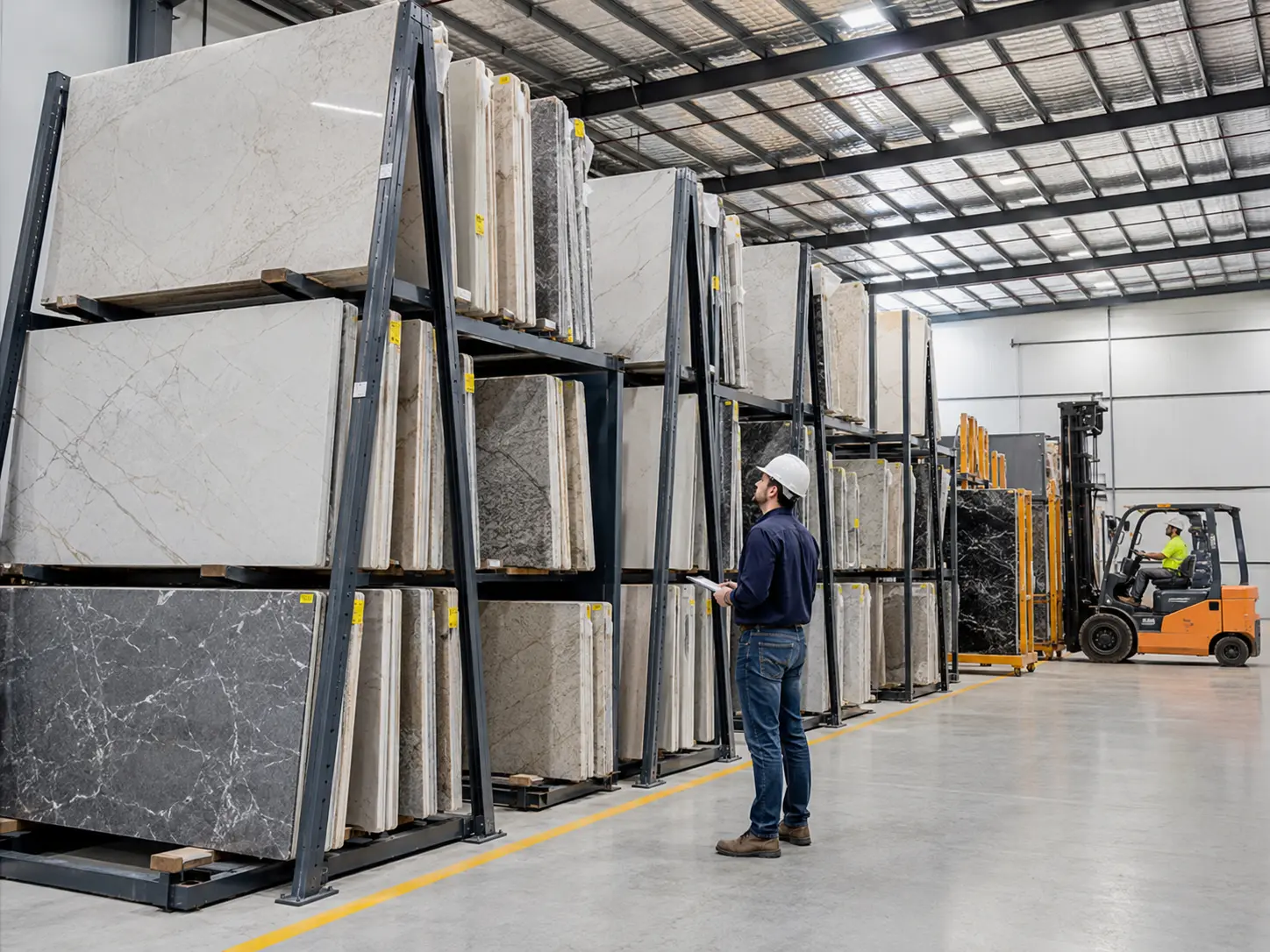
Slab Rack Manufacturer
What Is a Slab Rack?
Slab Rack Explained for Stone Warehouse Buyers
A Slab Rack is a heavy-duty storage system designed to store large stone slabs vertically or at a controlled angle. It is commonly used for marble, granite, quartzite, engineered quartz, porcelain slabs, sintered stone, and countertop materials. Depending on the warehouse layout and handling method, common rack types include A-frame slab racks, vertical slab storage racks, bundle racks, display racks, transport racks, and custom warehouse slab rack systems.
The main purpose is simple: keep slabs upright, stable, visible, and accessible. A well-designed rack reduces breakage, improves warehouse organization, supports forklift or crane handling, and helps workers retrieve slabs more efficiently. For stone distributors and countertop factories, this is not “just storage.” It affects daily workflow, safety, inventory accuracy, and delivery speed.
Why Slab Racks Matter in Stone Warehouses
Stone slabs are heavy, fragile, and often expensive. Improper storage can cause tipping, edge chipping, cracking, surface scratching, and worker injury. A reliable slab storage rack helps the warehouse team identify materials faster, reduce unnecessary slab movement, and organize inventory by material type, project, thickness, or customer order.
If your warehouse handles high-value marble, granite, quartzite, or sintered stone, choose heavy-duty rack systems with clear load ratings. If you manage frequent small orders, prioritize easy picking and visibility. If you store large-format slabs, prioritize base stability and load distribution. If your space also functions as a showroom, consider display-friendly storage. The wrong rack turns your warehouse into a very expensive game of stone dominoes. Nobody wants that game.
Key Factors When Choosing a Slab Rack Supplier
Manufacturer Experience in Stone Handling Equipment
A reliable Slab Rack supplier should understand stone-specific handling risks. Generic metal rack suppliers may know steel, but they may not fully understand fragile slab edges, forklift movement, uneven loading, slab leaning angle, anti-tip design, and warehouse retrieval habits. Stone racks require practical engineering, not only welding.
Buyers should ask whether the supplier has served stone warehouses, slab distributors, countertop factories, or stone showrooms. A manufacturer with real stone industry experience can recommend rack type, base width, slot spacing, surface protection, and safe layout based on your actual slab sizes and handling method.
Engineering Design and Load Calculation Support
The supplier should not only sell standard racks. They should help evaluate load conditions. Load capacity depends on slab weight, rack size, steel tube dimensions, wall thickness, welding strength, base design, slab angle, and floor conditions. A serious manufacturer can explain why a rack is safe, not only say “no problem.” That phrase is cheap. Steel failure is not.
Buyers should request technical drawings, rated load capacity, steel specifications, recommended usage guidance, and installation notes. If the supplier cannot explain load capacity clearly, treat that as a warning sign.
Quality Control and Manufacturing Process
Check steel cutting accuracy, welding quality, base plate design, bolt quality, surface treatment, coating thickness, and final inspection process. Poor welding can create structural weakness. Thin or unclear steel specifications can reduce service life. Weak coating can lead to rust, especially in humid warehouses, coastal areas, or wet processing zones.
For factory background and broader manufacturing capability, buyers can review Speedone stone handling equipment manufacturer information before evaluating long-term supply cooperation. A good manufacturer should be able to support product drawings, production photos, inspection checks, packing photos, and after-sales communication.
| Supplier Factor | Why It Matters | Buyer Check | Risk if Ignored |
|---|---|---|---|
| Stone industry experience | Stone slabs have special handling risks | Ask for stone warehouse applications | Wrong rack type or unsafe layout |
| Load calculation | Prevents overloading | Request rated load and drawings | Rack deformation or tipping |
| Welding quality | Affects long-term strength | Review weld points and QC process | Structural failure under heavy load |
| Packing method | Protects racks during export | Request packing photos and accessory list | Missing parts or installation delays |
Load Capacity & Material Standards
Why Load Capacity Is the First Safety Question
Load capacity is the first safety question because stone slabs are dense and unforgiving. Granite and marble commonly have densities around 2,600–2,800 kg/m³. A large 20mm slab can easily weigh several hundred kilograms depending on size and material. Overloading a rack can cause deformation, tipping, slab cracking, or serious warehouse accidents.
A practical slab weight estimate uses this formula: slab weight = length × width × thickness × density. For example, a 3.2m × 1.6m × 0.02m stone slab at 2,700 kg/m³ weighs about 276 kg before packaging or handling factors. Five such slabs already exceed 1,300 kg. This is why buyers should never guess. Load capacity should be matched to real slab dimensions and storage quantity.
| Stone Type | Approx. Density Range | 20mm Slab Weight Risk | Rack Requirement |
|---|---|---|---|
| 大理石 | Approx. 2,600–2,800 kg/m³ | High for large slabs | Stable base and protective contact points |
| 御影石 | Approx. 2,600–2,900 kg/m³ | Very high | Heavy-duty frame and clear load rating |
| Quartzite | Approx. 2,650–2,750 kg/m³ | 高い | Strong support and careful slot spacing |
| Engineered quartz | Approx. 2,300–2,500 kg/m³ | Medium to high | Stable storage and edge protection |
Steel Grade and Structural Strength
Heavy-duty Slab Racks are usually made from carbon steel or structural steel. Buyers should request steel grade, tube size, wall thickness, beam structure, base width, and rated load. Thicker steel is not automatically better if the design is poor, but underbuilt steel is dangerous. Vague descriptions like “strong steel” are not enough for a warehouse handling heavy stone.
Welding, Bolts, and Base Stability
Welding quality affects structural reliability. Bolted connections must be strong and correctly installed. Base stability helps prevent tipping and uneven loading. In some warehouses, ground fixing holes, anti-slip feet, or wider bases may be necessary. Floor condition also matters. A strong rack placed on uneven or weak concrete can still become unsafe.
Surface Treatment and Corrosion Resistance
Powder coating improves appearance and corrosion resistance. Hot-dip galvanizing may be considered for outdoor or humid environments. For warehouses near coastal areas, wet processing zones, or high-humidity storage, surface protection is not cosmetic. It is part of long-term safety and maintenance.
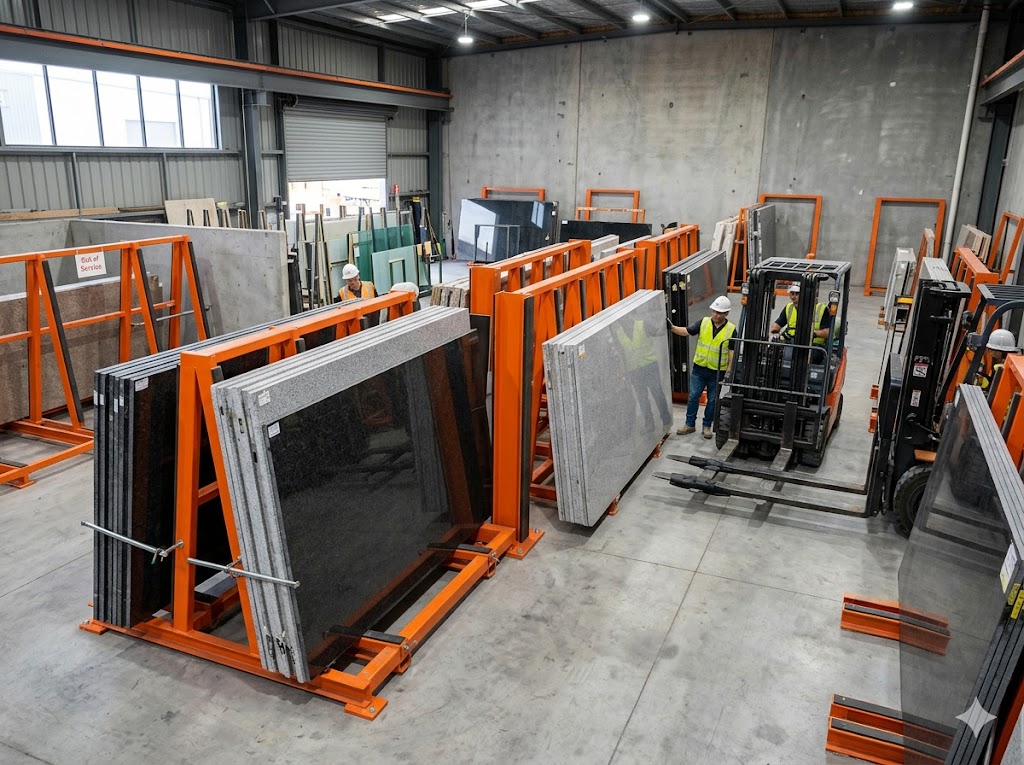
フレーム収納ラック
Custom Slab Rack Solutions
When Standard Slab Racks Are Enough
Standard Slab Racks may be enough for small warehouses, regular slab sizes, predictable inventory, and simple indoor storage. They are usually faster to produce and easier to install. A standard A-frame rack may work well when slabs are common sizes, forklift routes are simple, and load requirements are moderate.
When Custom Slab Rack Solutions Are Necessary
Custom racks become necessary when slab sizes vary widely, warehouse space is limited, forklift aisles are narrow, ceiling height is restricted, loading direction is special, or the rack must combine storage and showroom display. Large-format slabs may require longer bases and reinforced structures. Heavy quartzite or granite may need stronger load design. Outdoor storage may need galvanized finishing.
Buyers handling different stone sizes should review how to choose the right Slab Rack for different stone sizes before finalizing rack dimensions. If your slabs are oversized, customize the rack. If your aisles are narrow, customize the layout. If your slabs are high-value, improve protective contact points. If forklift movement is frequent, design for safe access instead of hoping operators have superhero reflexes.
Customization Options Buyers Can Request
| Customization Option | Buyer Benefit | ベストユース | Risk if Ignored |
|---|---|---|---|
| Slot spacing | Fits different slab thicknesses and bundles | Mixed inventory warehouses | Poor fit and unstable loading |
| Base width | Improves stability | Large-format or heavy slabs | Higher tipping risk |
| Protective pads | Reduces edge and surface damage | Polished marble and premium slabs | Scratches and edge chips |
| Outdoor coating | Improves corrosion resistance | Outdoor or humid storage | Rust and reduced service life |
Why Choose Our Slab Rack
Built for Real Stone Warehouse Conditions
A reliable Slab Rack should be built for real stone warehouse conditions: heavy slabs, daily forklift movement, repeated loading, long-term storage, and worker safety. The structure should use strong steel, stable base design, reinforced welding, suitable surface treatment, and practical load options. The goal is not only to hold stone. The goal is to make storage safer, picking faster, and breakage less frequent.
Flexible OEM/ODM and Project-Based Customization
Different warehouses need different rack designs. A countertop factory may need fast picking. A stone distributor may need large stock storage. A showroom may need better presentation. A factory may need heavy-duty A-frame systems. A professional supplier should support custom rack size, load capacity, color, coating, slot spacing, packing method, and layout design based on slab size, floor plan, forklift route, and storage quantity.
Quality Inspection Before Shipment
Before shipment, a responsible Slab Rack manufacturer should check welding quality, structure, coating, dimensions, accessories, packing, and assembly guidance. For overseas buyers, pre-shipment photos, packing lists, installation instructions, and accessory checks reduce installation mistakes and communication delays.
Practical Support for Global Buyers
For warehouse planning, buyers can send slab sizes, material types, storage quantity, warehouse layout, forklift conditions, floor condition, and target load capacity. A practical quotation should be based on real warehouse conditions, not just a product picture. For layout planning, this article on safe and efficient Slab Rack layout is useful for factories that need to improve storage flow and reduce handling risk.
Slab Rack Types and Application Matching
Aフレーム・スラブ・ラック
A-frame slab racks are common in stone warehouses because they support angled slab storage and stable leaning. They work well for granite, marble, quartz, and engineered stone. However, loading should remain balanced, especially when slabs are stored on both sides.
Vertical Slab Storage Rack
Vertical slab storage racks improve slab visibility and browsing efficiency. They may be useful for warehouses and showrooms that need organized stock selection. The base must be stable, and slot spacing should match slab thickness and handling method.
Bundle Rack and Display Rack
Bundle racks are used for bulk stock storage and require strong load capacity. Display racks are used in showrooms where appearance and browsing convenience matter. To better understand rack categories and their practical differences, buyers can refer to this guide on Slab Rack classification and storage techniques.
| ラックタイプ | ベストユース | Advantage | Buyer Warning |
|---|---|---|---|
| A-frame rack | General stone warehouse storage | Stable angled storage | Avoid uneven loading on one side. |
| Vertical rack | Organized slab browsing | Good visibility | Needs stable base and correct spacing. |
| Bundle rack | Bulk inventory | Supports volume storage | Load capacity is critical. |
| Display rack | ショールーム | Combines strength and presentation | Protective pads and finish quality matter. |
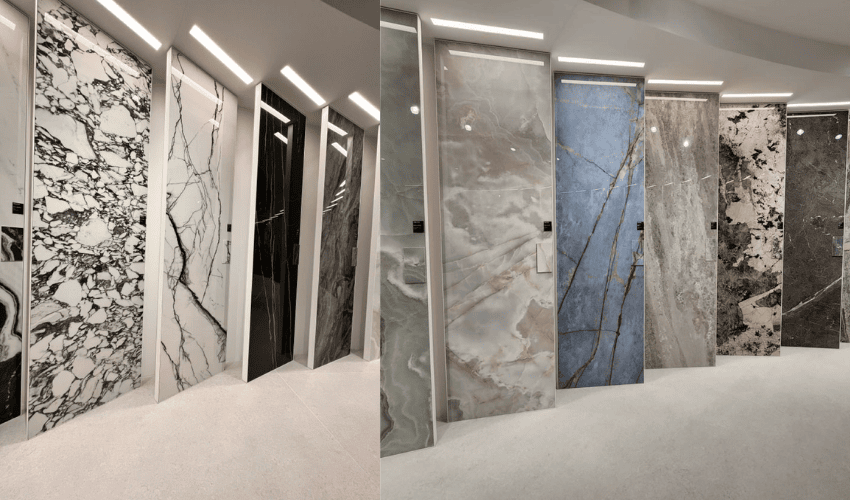
縦型ストーン・ディスプレイ・ラック
Warehouse Safety and Layout Planning
Safe Aisle Width and Forklift Movement
Rack placement should support forklift turning radius, loading direction, and safe slab retrieval. Narrow aisles increase collision risk. Poor layout can slow down picking and force workers into unsafe positions. Heavy racks should not be placed on weak or uneven floors. Safe loading areas should be marked clearly.
Anti-Tip Design and Load Balance
Slabs should be loaded evenly and within rated capacity. Do not overload one side of an A-frame rack. Keep heavy slabs close to the support base when possible. Train workers on proper loading sequence, slab angle, and fall-zone awareness. Workers should never stand in the potential fall path of slabs.
Relevant Safety Considerations
Buyers should follow local warehouse safety rules, occupational safety requirements, lifting equipment procedures, and storage regulations. Racks should be used according to the manufacturer’s load rating and guidance. Safety labels and loading instructions may help reduce misuse. For international buyers, this article on global compliance and Slab Rack market trends offers useful context for safer warehouse storage and market expectations.
| Safety Risk | Cause | Consequence | Prevention |
|---|---|---|---|
| Rack tipping | Overloading or uneven loading | Slab breakage and injury risk | Use rated capacity and balanced loading. |
| Forklift collision | Narrow aisles or poor layout | Rack damage and workflow delay | Plan aisle width and traffic direction. |
| Rust and corrosion | Poor coating or humid environment | Reduced rack life and safety risk | Choose suitable surface treatment. |
Slab Rack vs. Alternative Storage Methods
Slab Rack vs. Leaning Slabs Against Walls
Leaning slabs against walls is unsafe and unprofessional. It increases breakage risk, injury risk, and inventory confusion. It may seem fast, but it often creates hidden long-term cost.
Slab Rack vs. Wooden Support Frames
Wooden frames may be temporary and low-cost, but they are not ideal for long-term heavy-duty storage. Moisture, deformation, weak joints, and inconsistent support can become problems. Steel Slab Racks are more reliable for repeated warehouse use.
Slab Rack vs. Floor Stacking
Floor stacking can damage slabs, make retrieval difficult, increase handling frequency, and waste warehouse space. A dedicated rack system improves organization and reduces unnecessary movement.
| Storage Method | 安全性 | スペース効率 | Slab Protection | Buyer Recommendation |
|---|---|---|---|---|
| スラブラック | High when correctly designed | 高い | Strong | Best for professional warehouses. |
| Wall leaning | 低い | 低い | Weak | Avoid for heavy slab storage. |
| Wooden frame | Medium to low | ミディアム | 可変 | Temporary use only. |
Common Mistakes When Buying Slab Racks
Mistake 1: Choosing by Price Only
Weak steel, poor welding, short service life, and safety hazards often hide behind low pricing. Evaluate load capacity, steel structure, welding, coating, and supplier experience before comparing prices.
Mistake 2: Not Calculating Real Slab Weight
Overloading can lead to rack deformation, tipping, and slab breakage. Calculate slab weight by material density, size, and thickness before choosing a rack.
Mistake 3: Ignoring Warehouse Layout
Poor layout creates forklift collisions, difficult picking, and inefficient storage. Share your floor plan and forklift route with the supplier.
Mistake 4: Buying Standard Racks for Oversized Slabs
Oversized slabs need proper support. Standard racks may create unstable loading or edge damage. Use custom Slab Rack solutions for special slab sizes.
Mistake 5: Forgetting Long-Term Maintenance
Rust, loose bolts, structural fatigue, and rack deformation can reduce safety. Inspect racks regularly and replace damaged components instead of “temporarily fixing” them forever.
How to Choose a Reliable Slab Rack Manufacturer
What a Professional Manufacturer Should Provide
プロフェッショナル Slab Rack manufacturer should provide product drawings, load capacity information, steel specifications, welding quality control, surface treatment options, customization support, factory production photos, dimension inspection, packing photos, assembly instructions, after-sales support, export experience, warehouse layout advice, and safety usage guidance.
Buyers who want real performance should also evaluate whether the manufacturer understands warehouse efficiency. A useful example is this Slab Rack storage efficiency case study, which highlights how better storage planning can improve warehouse order and reduce wasted handling time.
Questions to Ask Before Ordering
Before ordering, ask: What is the rated load capacity? What steel grade and thickness do you use? Can you customize rack size and slot spacing? Can you provide drawings before production? How is welding inspected? What surface treatment is available? Can it be used outdoors? How is the rack packed for export? Do you provide assembly instructions? Can you design based on our warehouse layout? Do you support OEM colors or branding? What is the lead time?
Manufacturer vs. Trading Company Logic
If you need custom design, choose a manufacturer. If you need many warehouse products from different sources, a trading company may help, but it must prove quality control. If you need long-term repeat orders, factory-direct cooperation is usually safer. If you only need one small standard order, stock supply may be enough.
For project evaluation, buyers can contact Speedone with slab material, slab size, maximum slab weight, storage quantity, warehouse layout, forklift route, and preferred rack type. Clear information helps the supplier recommend a safe and practical solution instead of guessing. Guessing is not engineering; it is warehouse gambling with steel.
Recommended Buyer Checklist Before Ordering
| Checklist Item | Why It Matters | Buyer Action |
|---|---|---|
| Maximum slab weight | Determines required load capacity | Calculate by size, thickness, and density. |
| Warehouse floor condition | Affects rack stability | Check levelness and strength before layout. |
| Forklift route | Controls safe loading and picking | Share aisle width and turning direction. |
| Surface treatment | Affects corrosion resistance | Choose coating based on indoor, outdoor, or humid use. |
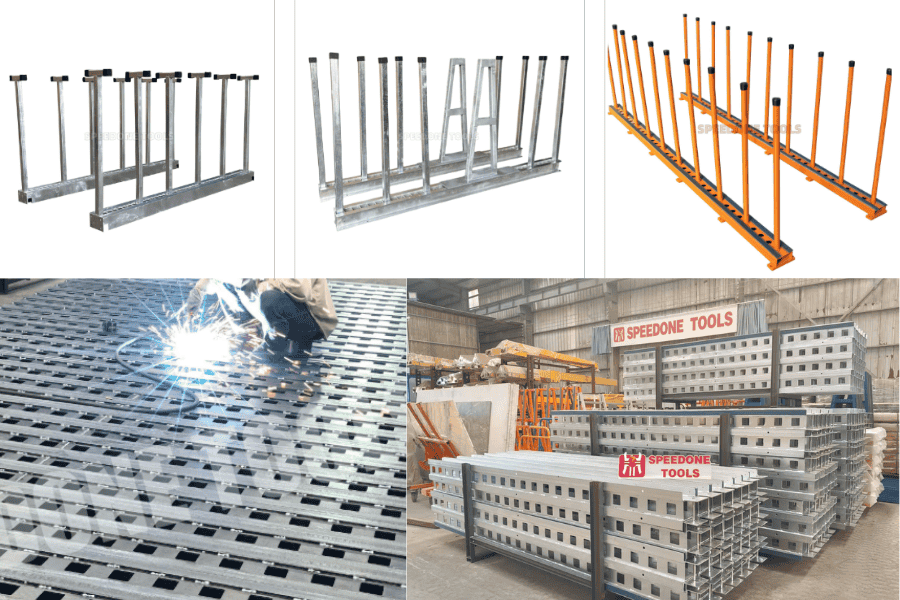
高品質スラブ・ラック
FAQ: Slab Rack Manufacturer and Warehouse Storage
1. スラブラックはどのような用途で使われますか?
A Slab Rack is used to store marble, granite, quartz, quartzite, sintered stone, porcelain, and other large slabs safely in a warehouse, factory, showroom, or stone processing facility. It helps prevent tipping, slab breakage, edge damage, disorganized storage, and unnecessary handling. A properly designed Slab Rack also improves inventory visibility and supports safer forklift or crane operation.
2. How do I choose the right Slab Rack manufacturer?
Choose a Slab Rack manufacturer with stone industry experience, load calculation support, steel material specifications, strong welding, stable base design, customization ability, quality inspection, export packing, assembly guidance, and after-sales service. Buyers should avoid suppliers that only provide a price without explaining load capacity, steel structure, rack dimensions, and safe usage conditions.
3. How much weight can a Slab Rack hold?
The load capacity of a Slab Rack depends on steel structure, rack size, base design, welding quality, slab angle, slot spacing, floor condition, and manufacturer rating. Buyers should calculate slab weight using slab length, width, thickness, and material density, then confirm the rated load with the manufacturer before ordering. Never assume capacity based only on rack appearance.
4. Can Slab Racks be customized?
Yes, Slab Racks can be customized by rack length, height, base width, steel thickness, slot spacing, load capacity, protective pads, ground fixing holes, surface coating, color, forklift access, outdoor galvanizing, modular design, and warehouse layout requirements. Custom Slab Rack solutions are especially useful for oversized slabs, limited warehouse space, frequent forklift movement, or showroom display needs.
5. Are A-frame Slab Racks safe?
A-frame Slab Racks can be safe when they are properly designed, placed on stable flooring, loaded evenly, used within rated capacity, and inspected regularly. Overloading one side, storing slabs at the wrong angle, using weak steel, ignoring floor conditions, or allowing forklift collisions can create tipping risk. Buyers should follow manufacturer guidance and train workers on safe loading procedures.
参考文献
1. Warehousing and Storage: A Guide to Health and Safety — Health and Safety Executive — Warehouse Safety Guidance.
2. Materials Handling and Storage — Occupational Safety and Health Administration — OSHA Safety and Health Topics.
3. Storage Rack Safety Guide — Rack Manufacturers Institute — Industrial Storage Rack Reference.
4. Steel Construction Manual — American Institute of Steel Construction — Structural Steel Design Reference.
5. Industrial Storage Systems: Design and Safety Considerations — FEM European Materials Handling Federation — Storage Equipment Guidance.
6. Dimension Stone Design Manual — Natural Stone Institute — Stone Handling and Storage Reference.
7. Safe Use of Lift Trucks — Health and Safety Executive — Forklift Operation Safety Guidance.
8. Warehouse Management: A Complete Guide to Improving Efficiency and Minimizing Costs — Gwynne Richards — Kogan Page.
How Buyers Should Evaluate a Slab Rack Manufacturer
How should buyers understand a Slab Rack?
A スラブラック is a heavy-duty storage system for large stone slabs. It helps stone warehouses, slab distributors, countertop factories, and showrooms store marble, granite, quartzite, engineered quartz, sintered stone, and porcelain slabs safely and efficiently. Its value comes from safety, load control, inventory visibility, and reduced slab handling risk.
Why does manufacturer selection matter?
Manufacturer selection matters because slab storage involves heavy materials, fragile edges, forklift movement, worker safety, and long-term structural stress. A reliable Slab Rack manufacturer should understand load capacity, steel specification, welding quality, base stability, warehouse layout, surface treatment, export packing, and custom storage requirements.
What option should different warehouses choose?
If the warehouse stores regular slab sizes and has simple storage needs, a standard A-frame Slab Rack may be enough. If the warehouse stores oversized slabs, heavy granite, quartzite, or mixed-size inventory, custom Slab Rack solutions are safer. If the rack is used in a showroom, display-friendly design and protective pads matter. If the rack is used outdoors or in humid areas, stronger corrosion protection is recommended.
What should buyers consider before ordering?
Buyers should confirm slab material type, slab size range, slab thickness, average slab weight, maximum slab weight, number of slabs stored, warehouse floor condition, forklift route, aisle width, indoor or outdoor use, required load capacity, rack type, rack dimensions, slot spacing, steel specification, surface treatment, protective pads, ground fixing requirement, custom color, packing method, assembly instructions, supplier experience, and after-sales support.
What is the practical recommendation?
Do not buy Slab Racks only by price. Calculate real slab weight, confirm rated load, review steel specifications, check welding and coating quality, and share your warehouse layout with the manufacturer. A reliable Slab Rack should reduce breakage, improve safety, speed up picking, and support long-term warehouse operations.

ヘンリー
こんにちは、私はこの記事の著者です。石工具のOEM&ODMサービスが必要な場合は、お気軽にご質問ください。