Faça o seu trabalho de forma eficiente!





CNC stone cutting offers high repeatability, digital control, complex processing capability, and strong productivity for standardized or high-volume fabrication. Manual stone cutting remains valuable for one-off work, adjustments, repairs, finishing, and flexible on-site operations. In most professional stone factories, the best decision is not simply CNC or manual. It is choosing the right combination based on production volume, required accuracy, product complexity, labor skills, factory layout, handling equipment, maintenance capability, and total production cost.
CNC vs Manual Stone Cutting: Complete Fabrication Comparison
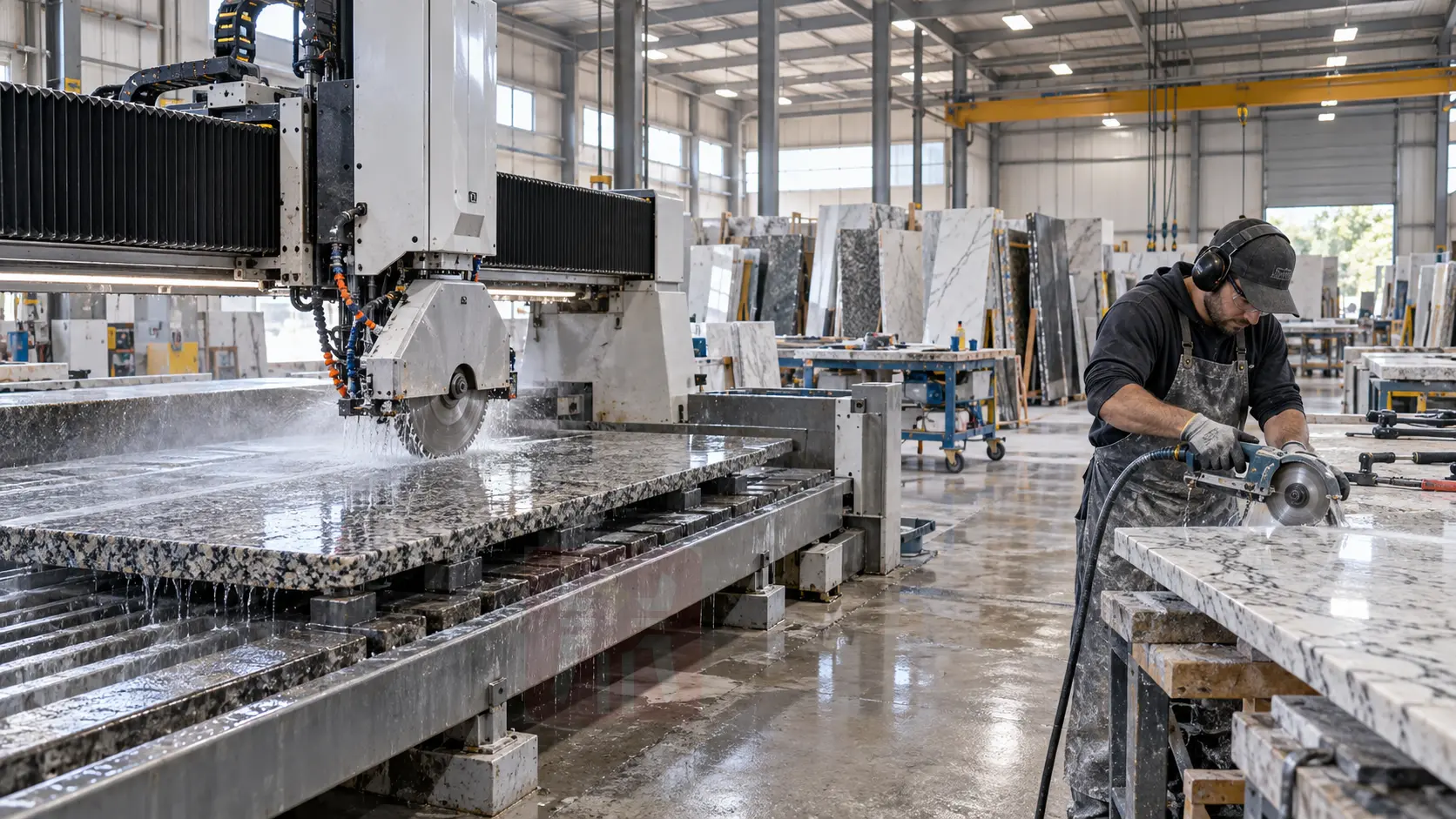
CNC stone cutting vs manual cutting in a professional stone fabrication workshop
Choosing between CNC stone cutting and manual stone cutting is an important equipment and production decision for stone fabrication factories.
Both methods can be used to process granite, marble, engineered quartz, porcelain, sintered stone, and other slab materials, but the way they create value inside a factory is different.
CNC systems are generally strongest when production requires repeatability, complex shapes, digital programming, or larger production volumes. Manual fabrication remains highly useful when flexibility, quick adjustment, low-volume work, installation-site modifications, or skilled finishing are more important.
This means the question should not simply be, “Is CNC better than manual cutting?”
A more useful question is:
Which fabrication system matches the type of work, production volume, labor structure, floor space, material flow, quality requirements, and future growth of the factory?
Este fabrication comparison explains the major differences between CNC and manual stone cutting and provides a practical framework for choosing the right production strategy.
What Is CNC Stone Cutting?
CNC stands for Computer Numerical Control. In stone fabrication, CNC equipment uses programmed digital instructions to control cutting, drilling, milling, profiling, routing, and other machining operations.
Depending on the machine configuration, a CNC stone cutting system may perform:
- Straight slab cutting.
- Angled cutting.
- Curved cutting.
- Sink cutouts.
- Cooktop openings.
- Faucet-hole drilling.
- Edge profiling.
- Grooving and milling.
- Complex countertop shapes.
- Repeated production of identical components.
A typical CNC workflow begins with digital project information. CAD or CAM data is prepared, machining paths are created, tools are selected, the slab is positioned, machine settings are verified, and the programmed operation is performed.
The advantage is not simply that the machine moves automatically. The main value is that a verified program can be reproduced consistently across multiple components.
What Is Manual Stone Cutting?
Manual stone cutting relies more heavily on direct operator control.
The fabricator measures, marks, positions, cuts, drills, grinds, or polishes the material using portable tools or manually controlled machinery.
Manual stone fabrication may involve:
- Manual bridge saws.
- Handheld stone saws.
- Angle grinders.
- Wet polishers.
- Core drills.
- Profile wheels.
- Diamond cutting blades.
- Manual measuring and marking tools.
Manual methods remain important because they are flexible. They can be useful for short production runs, custom adjustments, repairs, installation work, edge finishing, and situations where setting up a large CNC machine would not be efficient.
CNC Stone Cutting vs Manual Cutting: Quick Comparison
| Factor | CNC Stone Cutting | Manual Stone Cutting |
|---|---|---|
| Accuracy | High repeatability when correctly programmed and calibrated | Strongly influenced by operator skill and measuring technique |
| Production Volume | Well suited to repeated medium or high-volume production | Often practical for lower-volume and custom work |
| Repeatability | Strong for identical or similar components | Greater variation between operators and parts |
| Complex Shapes | Suitable for programmed curves, openings, drilling, and profiles | Possible, but often more labor-intensive |
| Labor Dependency | Less continuous manual control during automated cycles | Higher direct operator involvement |
| Programming | Requires digital files, setup, and machine knowledge | Usually little or no CNC programming required |
| Initial Investment | Usually higher | Usually lower |
| Job-Site Flexibility | Limited because equipment is fixed | High when portable tools are used |
| Melhor utilização | Repeatable, precision-oriented, digitally managed production | Flexible, custom, repair, finishing, and short-run work |
1. Accuracy and Cutting Precision
Accuracy is one of the main reasons factories invest in CNC stone cutting.
Once the digital file is correct, the machine is calibrated, the tooling is suitable, and the slab is positioned properly, CNC equipment can reproduce programmed dimensions with a high level of consistency.
This is especially valuable for:
- Kitchen countertop production.
- Repeated vanity tops.
- Hotel projects.
- Apartment developments.
- Commercial wall panels.
- Standard architectural components.
Manual fabrication can also produce high-quality work. Skilled fabricators are capable of excellent results, but accuracy is influenced more directly by measuring technique, marking, hand control, tool condition, and operator experience.
For a factory producing many similar components, CNC reduces the amount of dimensional variation caused by repeatedly measuring and cutting each piece manually.
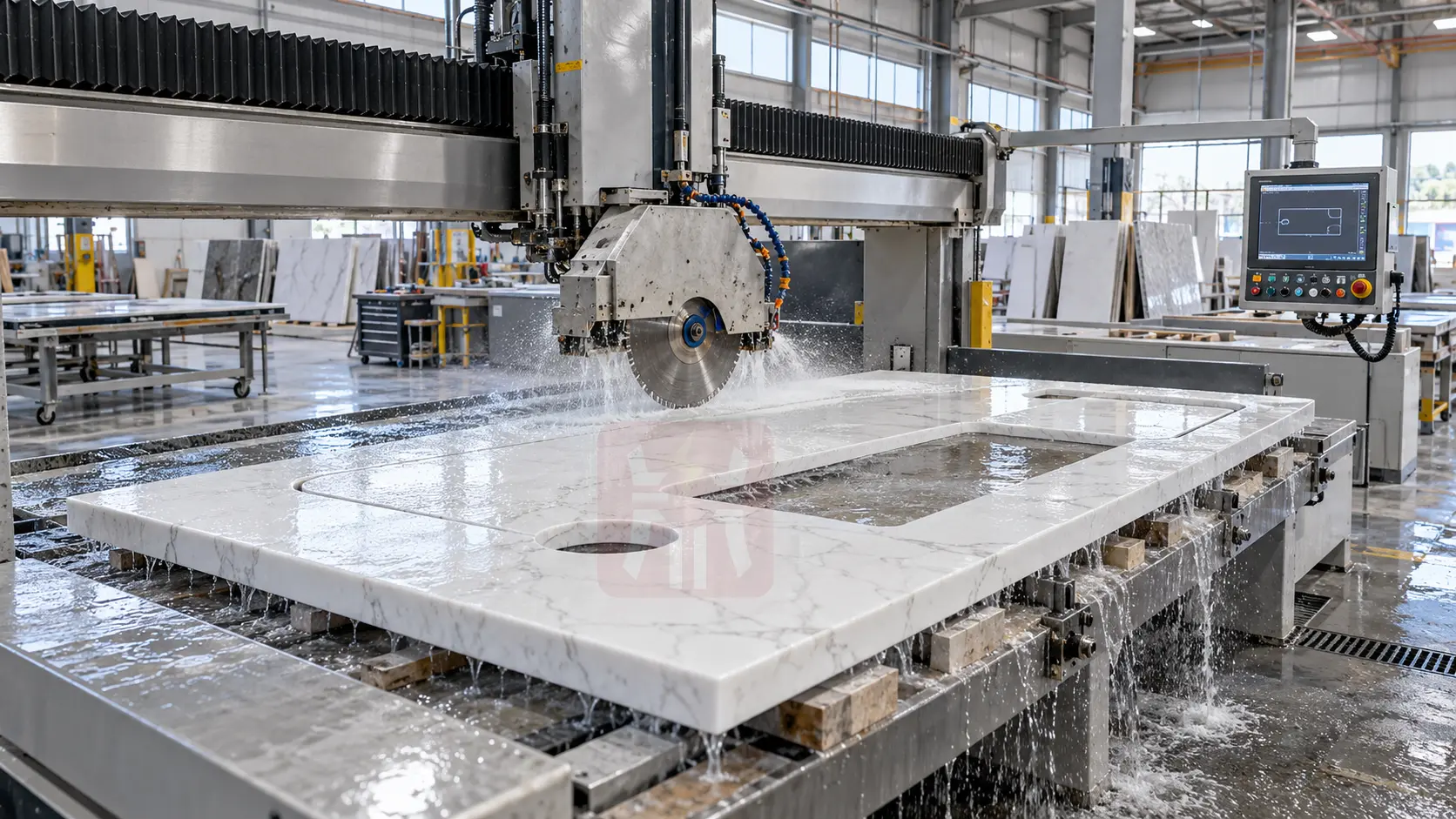
CNC stone cutting machine processing a quartz slab with precise automated cutting
2. Production Speed
CNC equipment can improve productivity when there is enough suitable work to keep the machine operating efficiently.
Once programming and setup are complete, repeated machining cycles can continue with less direct operator intervention.
This is particularly useful for large countertop orders, repeated cutouts, standard panels, and complex components that would require significant manual marking and processing.
However, CNC is not automatically faster for every job.
If a worker needs to remove a small amount of material from one component, make a simple installation adjustment, or modify one finished edge, using a portable tool may be faster than creating or editing a CNC program and loading the part onto the machine.
Production speed should therefore be measured across the complete workflow, not just by machine cycle time.
3. Repeatability
Repeatability is one of the strongest advantages of CNC production.
If a factory needs to manufacture dozens or hundreds of components according to the same digital specification, a CNC machine can repeat the approved program without requiring every part to be manually measured and marked from the beginning.
This can be particularly useful for:
- Multifamily residential projects.
- Hotel bathroom packages.
- Modular kitchens.
- Retail construction programs.
- Repeated architectural components.
Manual cutting can also produce repeated parts, but maintaining identical results becomes more dependent on fixtures, operator technique, measurement control, and inspection.
4. Complex Shapes, Cutouts, and Profiles
CNC equipment becomes increasingly valuable as part geometry becomes more complicated.
Typical examples include irregular countertop shapes, multiple sink cutouts, curved profiles, faucet-hole patterns, custom architectural details, and components that require multiple machining operations.
Digital programming allows the machine to control tool paths according to the design data.
Manual methods can achieve many of the same finished results, but they may require more layout work, templates, operator time, and hand finishing.
Manual tools still remain valuable after CNC machining for local corrections, polishing, and details that are difficult or inefficient to process on a large machine.
5. Labor Requirements and Operator Skills
Manual fabrication depends heavily on experienced operators.
A manual fabricator may need to control measurement, marking, tool position, pressure, feed movement, cutting depth, cooling, polishing, and final adjustment.
CNC changes the type of skill required rather than eliminating skilled labor.
A CNC-oriented factory may require employees who understand:
- CAD or CAM software.
- Digital production files.
- Machine programming.
- Tool selection.
- Machine setup.
- Calibration.
- Preventive maintenance.
- Troubleshooting.
CNC therefore shifts part of the required skill from continuous physical tool control toward digital preparation, machine setup, process management, and quality verification.
6. Initial Equipment Investment
Manual fabrication equipment generally has a lower entry cost than a complete CNC production system.
A smaller workshop may begin with a bridge saw, handheld saws, grinders, polishers, core drills, fabrication tables, and basic material-handling equipment.
A CNC installation may involve more than the machine purchase itself.
Additional requirements can include:
- CAD/CAM software.
- Tooling packages.
- Electrical installation.
- Water supply and drainage.
- Machine foundation preparation.
- Operator training.
- Spare parts inventory.
- Technical support.
Factories comparing international machinery options can also review this stone equipment comparison between China and Europe when evaluating price, technology, customization, maintenance, and supplier support.
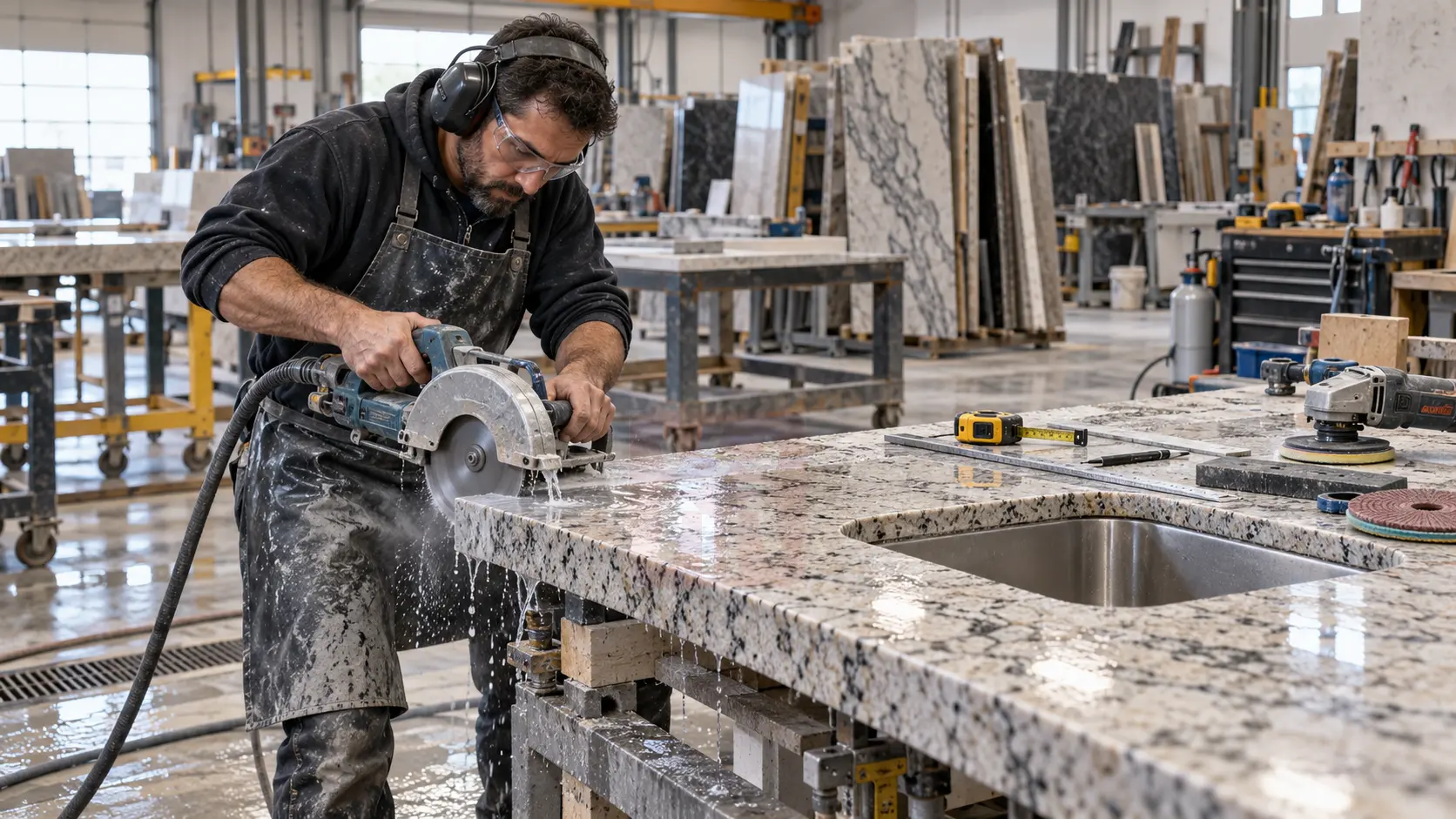
Manual stone cutting and countertop fabrication using professional handheld tools
7. Operating Cost and Total Cost of Ownership
Comparing machine purchase prices alone does not show the true cost of fabrication.
CNC equipment may reduce direct operator involvement in repetitive processing, but it introduces additional costs such as software, machine maintenance, specialized tooling, replacement components, utilities, and technical support.
Manual fabrication may require less expensive machinery but more operator time per finished component.
A practical total-cost comparison can use the following framework:
Total Ownership Cost = Equipment Cost + Installation + Tooling + Labor + Maintenance + Utilities + Spare Parts + Training + Downtime
Factories should then compare this cost against productive output and finished-product quality.
A useful ROI calculation is:
Estimated Payback Period = Incremental Equipment Investment ÷ Estimated Monthly Net Operational Benefit
The operational benefit should be based on the factory’s own production records rather than a generic industry estimate.
8. Material Waste and Nesting Efficiency
Digital nesting and cutting layouts can help a CNC-oriented factory use slab area more efficiently, especially when many components must be arranged on the same slab.
This can be valuable when processing expensive granite, marble, engineered quartz, porcelain, or sintered stone.
However, CNC accuracy does not protect a factory from incorrect data.
If a wrong dimension is entered into the production file, a CNC system may reproduce the incorrect geometry very consistently.
For this reason, drawing review, slab inspection, first-piece checking, and production-file verification remain essential.
9. Tooling Requirements
Neither CNC nor manual fabrication can deliver consistent results without suitable tooling.
CNC equipment may use:
- Diamond saw blades.
- Finger bits.
- Core drills.
- Profiling wheels.
- Grinding tools.
- Polishing tools.
- Milling tools.
Manual production may use:
- Handheld saws.
- Angle grinders.
- Wet polishers.
- Diamond pads.
- Core bits.
- Measuring tools.
- Clamps and support tools.
The correct combination depends on the stone material, machine type, processing method, finish requirement, and tooling manufacturer’s instructions.
Factory owners can review this complete guide to tools needed for stone fabrication when planning or upgrading their production system.
10. Factory Layout Requirements
A CNC machine cannot operate efficiently if the surrounding factory layout does not support it.
Before installation, manufacturers should consider:
- Machine footprint.
- Slab loading space.
- Finished-part unloading space.
- Overhead crane coverage.
- Forklift access.
- Slab staging areas.
- Water supply.
- Drainage.
- Electrical power.
- Tool storage.
- Inspection areas.
- Finished-product movement.
A high-performance machine can become a production bottleneck if operators spend too much time finding slabs, waiting for lifting equipment, clearing aisles, or moving finished components away from the machine.
Factories planning a new layout or reorganizing an existing workshop can review this stone factory setup and production workflow guide.
11. Slab Storage and Material Flow
Efficient cutting begins before the slab reaches the cutting machine.
Factories need a storage system that allows employees to identify, access, inspect, and move the required slab without repeatedly moving unrelated inventory.
Poor storage can create:
- Long slab search times.
- Repeated material movement.
- Congested aisles.
- Edge and surface damage.
- Delayed cutting schedules.
These problems affect both CNC and manual production.
Manufacturers looking to improve slab-yard efficiency can review this guide to stone slab rack layout and yard capacity.
12. Slab Storage Safety
Stone slabs remain heavy and difficult to handle regardless of the level of automation inside the cutting department.
Before processing, slabs must be stored, selected, lifted, transported, positioned, and supported.
After processing, finished components must also be moved without damaging polished surfaces, cutouts, finished edges, or narrow sections.
Storage equipment therefore forms part of the total fabrication system.
Rack selection should consider material dimensions, load requirements, loading method, aisle width, floor condition, lifting equipment, and factory workflow.
For additional guidance, see this article on choosing stone slab racks for safe and efficient storage.
13. Lifting Equipment for CNC Production Lines
Automated cutting does not automatically create automated material handling.
Large slabs may still need to be transferred using overhead cranes, lifting clamps, vacuum systems, forklift attachments, lifting beams, transport carts, or other purpose-designed equipment.
The lifting system should be selected according to factors such as:
- Slab weight.
- Slab dimensions.
- Surface condition.
- Lifting orientation.
- Available headroom.
- Crane or forklift capacity.
- Travel distance.
- Machine loading requirements.
Factories investing in more advanced cutting equipment should review material handling at the same time.
This guide to choosing lifting equipment for a stone factory explains the major factors involved in equipment selection.
14. Maintenance Requirements
CNC systems generally require a more structured maintenance program than simple portable tools.
Depending on the machine, maintenance may involve:
- Linear guides.
- Servo systems.
- Spindles.
- Tool holders.
- Water and cooling systems.
- Sensors.
- Machine calibration.
- Control software.
Manual tools also require inspection and maintenance, particularly bearings, blades, electrical components, hoses, cooling systems, and polishing equipment.
Ignoring maintenance affects both production methods. Poor equipment condition can create inaccurate cuts, vibration, damaged surfaces, premature tool wear, and unexpected downtime.
15. Quality Control
CNC improves repeatability, but it does not remove the need for quality control.
A machine can reproduce both correct and incorrect instructions.
Before repeated production begins, factories should verify:
- Project drawings.
- Digital cutting files.
- Tool selection.
- Machine calibration.
- Slab orientation.
- First-piece dimensions.
- Cutout positions.
- Edge quality.
- Surface condition.
Inspecting the first finished component before running a large repeated batch can prevent one programming or setup error from affecting many parts.
16. Flexibility for Custom Work
Manual cutting continues to be valuable because it can respond quickly to unusual requirements.
Portable and manually controlled tools are particularly useful for:
- Minor dimensional adjustments.
- Installation corrections.
- Repair work.
- One-off components.
- Small-volume custom projects.
- Edge touch-ups.
- Areas that are difficult to place on large machinery.
This is why CNC investment usually does not eliminate manual fabrication tools from a professional stone shop.
Instead, the role of manual work changes.
17. Common Mistakes When Investing in CNC Stone Cutting
Buying CNC equipment without reviewing the complete production system can create disappointing results.
Common investment mistakes include:
- Buying more machine capacity than production volume requires.
- Ignoring operator training.
- Underestimating CAD/CAM workflow requirements.
- Ignoring tooling and spare-parts costs.
- Installing the machine without adequate slab staging space.
- Keeping inefficient slab-storage practices.
- Failing to improve material handling.
- Expecting automation to correct poor production data.
- Ignoring maintenance and technical support requirements.
The best CNC installation improves the factory as a system rather than simply replacing one cutting operation.
Risk Comparison: CNC and Manual Fabrication
| Potential Problem | CNC Risk | Manual Risk | Recommended Control |
|---|---|---|---|
| Wrong dimensions | Incorrect digital data may be repeated | Measurement or marking error | Verify project data before cutting |
| Inconsistent quality | Tool wear or calibration issues | Operator-to-operator variation | Inspection and process standards |
| Downtime | Complex equipment may require technical repair | Usually easier to substitute portable tools | Preventive maintenance and spare-parts planning |
| Production bottleneck | Machine can wait for slabs or operators | Labor capacity may limit output | Balance cutting, handling, and downstream capacity |
When Is CNC Stone Cutting the Better Choice?
CNC may be the stronger choice when a factory:
- Processes medium or high production volumes.
- Produces repeated components.
- Frequently manufactures complex shapes.
- Requires strong dimensional consistency.
- Uses digital templating or CAD/CAM workflows.
- Wants to reduce repetitive manual cutting.
- Has suitable operator training.
- Can support machine maintenance.
- Has adequate factory and handling infrastructure.
When Is Manual Stone Cutting the Better Choice?
Manual fabrication may be more practical when a business:
- Processes relatively low production volumes.
- Handles many one-off jobs.
- Frequently works on installation sites.
- Performs repairs and modifications.
- Has limited capital available for automation.
- Requires highly flexible finishing work.
- Does not have enough production volume to fully use a CNC system.
A well-organized manual shop with experienced fabricators can remain very effective when its product mix does not require extensive automation.
If X, Choose Y: Practical Decision Guide
- If you produce many repeated countertop components: prioritize CNC.
- If you regularly machine complicated sink and cooktop openings: CNC may provide stronger repeatability.
- If most projects are one-off custom jobs: manual or hybrid production may be more practical.
- If your work frequently requires job-site adjustment: manual tools remain essential.
- If skilled manual labor is becoming a production bottleneck: evaluate CNC automation.
- If your slab handling and factory layout are already inefficient: improve the workflow before assuming CNC alone will solve the problem.
- If you need automation but still perform frequent custom finishing: choose a hybrid CNC and manual workflow.
Can CNC and Manual Stone Cutting Be Used Together?
Yes. For many stone factories, this is the most practical answer.
A hybrid production system uses automation for the operations where digital control creates the greatest benefit and retains manual processes for work requiring flexibility.
A typical workflow may look like:
- Store and organize raw slabs.
- Inspect and select the required slab.
- Move the slab to the cutting area.
- Use CNC equipment for primary cutting or complex machining.
- Inspect dimensions and cutout positions.
- Use manual equipment for local adjustments or detailed finishing.
- Complete polishing and quality control.
- Move the finished component to packaging or finished-product storage.
This model avoids treating automation and skilled manual fabrication as competing systems.
Instead, each method is used where it provides the greatest operational value.
CNC vs Manual Stone Cutting: Which Is Better?
| Factory Requirement | Likely Better Approach |
|---|---|
| High-volume repetitive production | CNC |
| Complex cutouts and shapes | CNC |
| Strong dimensional repeatability | CNC |
| Low-volume custom fabrication | Manual or hybrid |
| Installation-site modifications | Manual |
| Limited initial equipment budget | Manual |
| Automation plus custom flexibility | Hybrid CNC and manual workflow |
There is no universal winner.
For many established stone factories, the hybrid approach offers the strongest balance because CNC machinery handles repetitive and precision-intensive production while experienced operators continue to manage adjustments, polishing, finishing, installation work, and special fabrication requirements.
How to Choose the Right Cutting Method for Your Factory
Before purchasing new equipment, complete a fabrication comparison using your own production data.
Evaluate:
- Monthly slab-processing volume.
- Number of jobs per month.
- Percentage of repeated products.
- Percentage of custom products.
- Current labor hours per job.
- Current scrap and rework.
- Required dimensional accuracy.
- Complexity of typical cutouts.
- Available workshop space.
- Current slab-storage system.
- Material-handling capacity.
- Operator skill level.
- Machine maintenance capability.
- Expected production growth.
The correct equipment is not necessarily the most expensive or most automated option. It is the system that creates the best fit between production demand, quality, labor, workflow, and long-term operating cost.
Before Requesting a CNC Machine Quotation
A factory can receive a much more useful technical proposal when it provides suppliers with clear application information.
Prepare:
- Materials you normally process.
- Maximum slab dimensions.
- Typical slab thickness.
- Monthly production volume.
- Typical countertop or component drawings.
- Required machining operations.
- Required dimensional tolerances.
- Available floor space.
- Electrical requirements available in the factory.
- Water and drainage conditions.
- Existing lifting and transport equipment.
- Operator experience.
This information allows the equipment discussion to focus on application fit rather than simply machine size or purchase price.
Soft CTA: Optimize the Complete Fabrication Workflow
If your factory is considering CNC automation, do not evaluate the cutting machine separately from the rest of the workshop.
Map the process from slab storage to cutting, secondary fabrication, polishing, quality control, and finished-product loading.
If slabs cannot reach the CNC efficiently, finished components cannot leave the machine safely, or operators spend excessive time searching for material and waiting for lifting equipment, the factory may not capture the full value of its automation investment.
A stronger equipment plan starts by identifying the actual production bottleneck and then matching cutting, storage, lifting, transport, and fabrication equipment to the same workflow.
References and Technical Resources
- ISO 12100:2010 — Safety of Machinery, General Principles for Design, Risk Assessment and Risk Reduction.
- ISO 9001:2015 — Quality Management Systems, Requirements.
- Occupational Safety and Health Administration, 29 CFR 1910.176 — Handling Materials, General.
- Occupational Safety and Health Administration — Hazards of Transporting, Unloading, Storing and Handling Granite, Marble and Stone Slabs.
- Machine manufacturers’ operating, calibration, maintenance, and tooling instructions.
- Stone and engineered-surface manufacturers’ fabrication guidelines for material-specific processing requirements.
Nota final / Conclusões práticas
CNC stone cutting is generally strongest in repeatability, digital control, complex machining, and medium-to-high-volume production, while manual stone cutting remains valuable for flexibility, repairs, one-off fabrication, finishing, and installation adjustments. For many professional stone factories, the most effective strategy is a hybrid production system rather than choosing only one method. The final investment decision should consider not only the cutting machine, but also slab storage, material handling, factory layout, tooling, maintenance capability, operator skills, quality control, and total ownership cost.
Frequently Asked Questions About CNC vs Manual Stone Cutting
1. Is CNC stone cutting more accurate than manual cutting?
CNC stone cutting generally offers stronger repeatability and dimensional consistency when the digital file is correct and the machine is properly calibrated, maintained, and tooled. Manual cutting can also achieve high accuracy, but results depend more heavily on operator skill, measurement, marking, and tool control.
2. Is CNC stone cutting faster than manual cutting?
CNC can be more efficient for repeated or complex production because programmed operations can be reused across multiple parts. Manual cutting may still be faster for simple one-off modifications, small repairs, or tasks where CNC programming and setup would add unnecessary time.
3. Does a stone factory still need manual tools after buying CNC equipment?
Yes. Manual tools remain useful for polishing, edge finishing, local corrections, repair work, installation adjustments, and fabrication tasks that are difficult or inefficient to complete on a large CNC machine.
4. Is CNC stone cutting suitable for small fabrication shops?
It can be, but the investment should be evaluated against production volume, product complexity, labor structure, available space, maintenance capability, and expected business growth. Some smaller workshops may obtain better value from a simpler cutting system combined with high-quality manual equipment.
5. What should a factory consider before investing in CNC stone cutting equipment?
Important factors include production volume, required accuracy, component complexity, machine capacity, CAD/CAM requirements, tooling, operator training, maintenance, spare parts, workshop layout, material handling, utilities, and total ownership cost.
6. Does CNC stone cutting reduce material waste?
CNC can support more controlled layouts and digital nesting, which may improve material utilization. However, incorrect measurements or programming can also reproduce mistakes. Slab inspection, production-file verification, and first-piece inspection remain essential.
7. Is manual stone cutting becoming obsolete?
No. Manual fabrication remains important for adjustments, repair work, edge finishing, custom projects, installation modifications, and tasks where portable equipment provides greater flexibility than fixed automated machinery.
8. Is a hybrid CNC and manual workflow better for most stone factories?
A hybrid workflow can be highly practical because CNC equipment handles repetitive and precision-intensive operations while manual tools remain available for finishing, adjustment, custom work, and installation requirements. Whether it is the best approach depends on the factory’s specific production mix.

Henrique
Olá, sou o autor deste post, e estou neste sector há mais de 16 anos. Se precisar de um serviço OEM&ODM para ferramentas de pedra, não hesite em colocar-me quaisquer questões.