İşinizi Verimli Bir Şekilde Yapın!





Neden İhracat Taş Çiftlikleri Ağır Hizmet A-Çerçeveli Depolama Raflarını Tercih Ediyor
Learn why export stone yards prefer heavy duty A-Frame Storage Rack systems for slab safety, forklift workflow, breakage control, and loading efficiency.
Export Stone Yards Do Not Have Room for Storage Mistakes
In an export stone yard, one slab can weigh hundreds of kilograms, and one handling mistake can damage an entire shipment schedule. A polished marble slab may already be inspected, labeled, photographed, packed by order, and prepared for an overseas hotel or villa project. Then, during temporary staging before container loading, it leans at the wrong angle, shifts under forklift vibration, or rests on an unstable support. Suddenly, the problem is no longer “storage.” It becomes broken material, delayed delivery, worker risk, and a very uncomfortable conversation with the buyer.
That is why export stone yards increasingly prefer a heavy duty A-Frame Depolama Rafı. It is not just a metal frame. It is a slab safety system, yard organization tool, inspection station, and export workflow upgrade. For marble, granite, quartz, sintered stone, and large-format slabs, the right rack helps reduce tipping risk, improve forklift movement, protect slab edges, and keep export orders more controlled.
For stone yards handling daily export orders, the safest first step is to choose a purpose-built A-Frame Depolama Rafı instead of relying on walls, temporary wood supports, or random ground stacking. Heavy slabs are not forgiving. They do not “almost fall.” They either stay controlled or create expensive trouble.
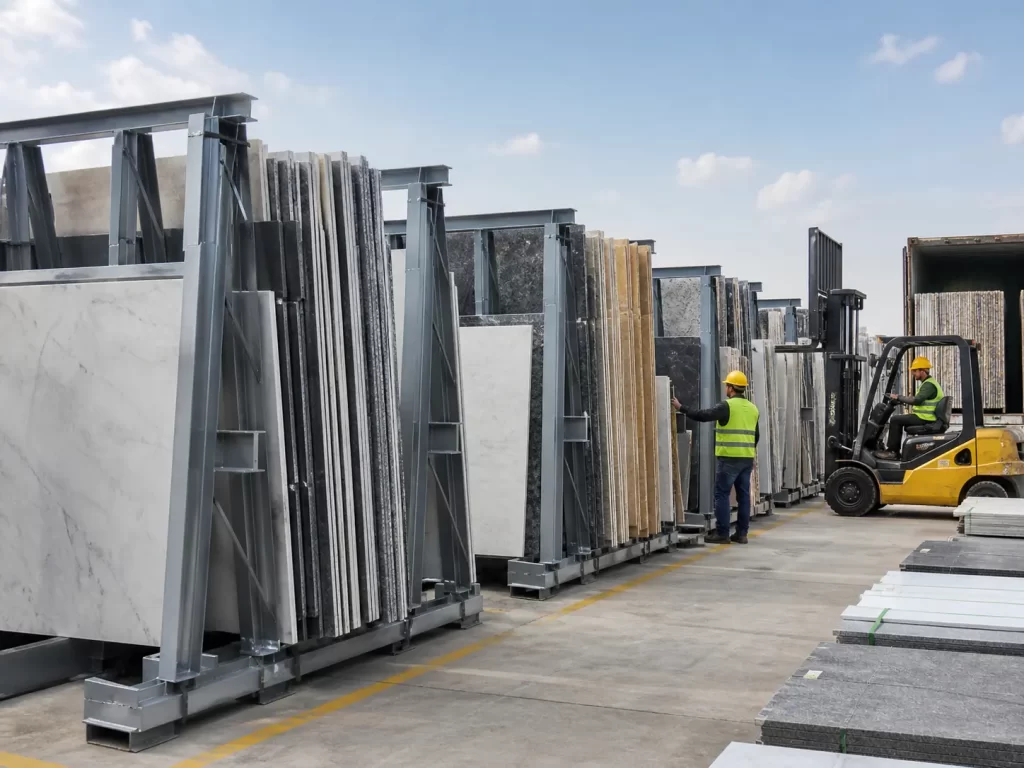
A-Frame Depolama Rafı
Why Export Stone Yards Need Heavy Duty Slab Storage Systems
Export stone handling is different from ordinary warehouse storage. A local stone warehouse may store slabs for showroom selection or occasional fabrication. An export yard often deals with multiple destinations, container schedules, customer inspections, batch labels, packaging requirements, forklift traffic, and urgent loading deadlines.
In this environment, temporary storage becomes one of the most dangerous stages. Slabs are moved from cutting or polishing areas into staging zones. Workers check surface quality, match order labels, group slabs by container, take photos, and prepare crates or bundles. During this process, slabs may be repositioned several times. Every movement adds risk.
A weak storage method creates hidden costs. Edge chipping may cause customer claims. Surface scratches may require re-polishing. Slab cracks may force replacement from another batch. Poor yard organization slows loading. A tipping accident may create serious safety consequences. In short, bad storage does not just waste space. It attacks profit from every direction. Very rude behavior from a “simple rack problem,” but stone yards know it happens.
A professional equipment partner should understand these real workflow pressures. Exporters often review the supplier’s production capability, engineering background, and stone-yard experience before ordering. Working with an experienced stone handling equipment manufacturer helps buyers evaluate whether the rack is designed for real slab loads, forklift traffic, and export yard conditions, not just product photos.
Export Yard Storage Risk Matrix
| Risk | Common Cause | Business Consequence | Better Storage Decision |
|---|---|---|---|
| Slab tipping | Wrong leaning angle or unstable support | Worker injury and slab loss | Use engineered A-frame support |
| Edge cracking | Uneven contact point | Rework, rejection, or customer claim | Use padded support areas |
| Surface scratching | Poor slab separation | Visible damage and discount risk | Add protective strips or spacers |
| Forklift congestion | Random slab placement | Slow loading and yard delays | Use organized rack zones |
| Batch confusion | Poor visibility and labeling | Wrong shipment or order mix-up | Keep slabs accessible and labeled |
| Rack deformation | Weak steel or poor welding | Safety hazard and slab damage | Choose rated heavy duty structure |
How an A-Frame Storage Rack Works in Stone Slab Yards
Bir A-Frame Depolama Rafı uses an angled steel structure that allows slabs to lean securely on both sides. This design helps direct the slab’s weight downward and inward, improving stability compared with unsupported vertical leaning. The triangular or A-shaped structure distributes load more efficiently and allows workers to access slabs from both sides.
The leaning angle matters more than many buyers realize. If slabs stand too vertically, tipping risk increases. If slabs lean too flat, the rack wastes floor space and makes handling harder. Many stone storage systems use a slightly inclined support angle, often within a practical range of about 5–10 degrees from vertical, depending on slab height, rack structure, and working conditions.
The base is equally important. A narrow base may look neat, but it may not provide enough anti-tipping stability for tall slabs. A heavy duty rack should consider base width, steel section size, welding quality, reinforcement plates, anti-slip contact, and slab protection points.
For export yards that need higher storage organization and directional loading efficiency, a design such as the dual-channel A-frame rack orientation system can be useful because it supports more controlled slab placement, clearer handling direction, and better export staging logic.
Key Structural Parameters Buyers Should Check
| Parametre | Why It Matters | Buyer Check |
|---|---|---|
| Steel Grade | Affects strength and deformation resistance | Ask for Q235, Q345, or equivalent data |
| Rated Load Capacity | Determines safe slab quantity | Confirm rated capacity, not guessed capacity |
| Base Width | Controls anti-tipping stability | Match slab height and floor layout |
| Support Angle | Affects slab leaning safety | Avoid overly vertical storage |
| Welding Quality | Prevents structural failure | Inspect welds and reinforcement points |
| Yüzey İşlemleri | Prevents corrosion | Consider powder coating or galvanizing |
| Contact Protection | Reduces slab edge damage | Use rubber pads, wood strips, or protective blocks |
Why Heavy Duty A-Frame Racks Reduce Export Damage
Stone slabs are heavy, rigid, and vulnerable at the same time. They can resist compression well, but edge impact, twisting, uneven support, and sudden movement can cause cracks or chips. This is especially true for polished marble, thin sintered stone, bookmatched slabs, and large-format quartz panels.
A heavy duty stone slab A-frame rack reduces damage in several ways. First, it provides a predictable leaning angle. Second, it gives slabs a stable support surface. Third, it helps separate orders and batches. Fourth, it keeps slabs more accessible for inspection and labeling. Fifth, it improves forklift workflow by creating clear rack zones instead of chaotic leaning areas.
For yards that need flexible support and surface protection, a customizable double-link A-frame rack can support different slab handling needs through stronger structure, adjustable usage logic, and wood-base protection where slab contact risk must be reduced.
The practical result is simple: less guessing, less shifting, less slab-to-slab impact, and fewer “who leaned this here?” moments. In export operations, those moments are expensive little monsters.
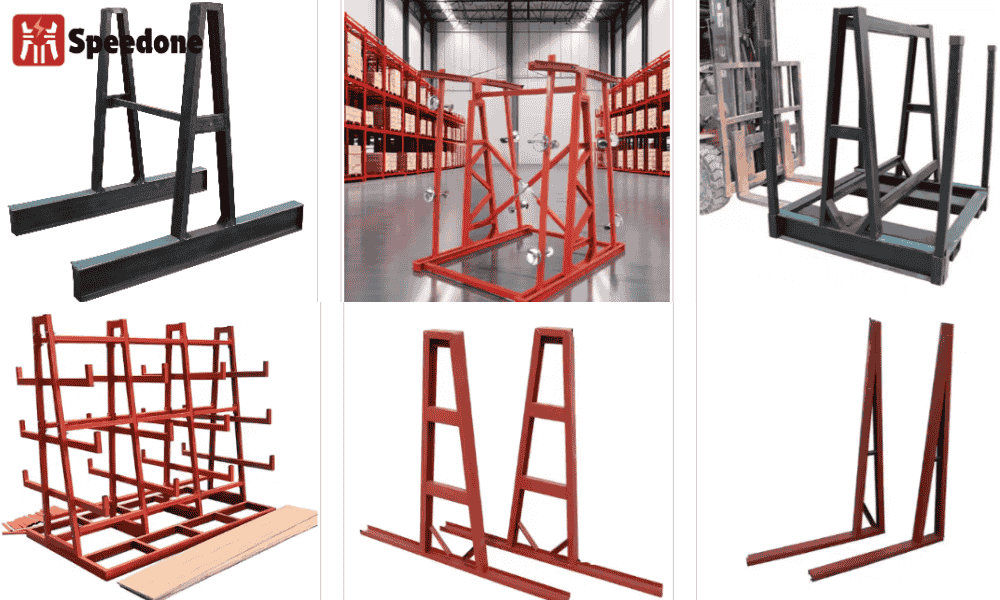
A-Frame Depolama Rafı
A-Frame Storage Rack vs Other Slab Storage Methods
Some stone yards still use wall leaning, wooden supports, or ground storage. These methods may look cheaper at first, but they often create higher lifecycle risk. A weak system may save money on day one and lose money during the first damaged shipment.
Wall leaning depends on wall strength, floor condition, and operator behavior. It also reduces visibility and may damage both slabs and walls. Wooden temporary supports may deform, absorb moisture, crack, or shift under heavy loads. Ground storage increases edge damage and makes inspection difficult. Vertical racks may be useful for categorized long-term storage, but export staging often benefits from A-frame accessibility and double-sided use.
A purpose-designed rack such as a 90 derecelik A-çerçeveli döşeme rafı is especially relevant where anti-slip design, heavy duty load capacity, and stable slab positioning are required for export-oriented stone yards.
Storage Method Comparison
| Storage Method | İstikrar | Inspection Access | Export Yard Suitability | Main Risk |
|---|---|---|---|---|
| Heavy Duty A-Frame Rack | Yüksek | İyi | Mükemmel | Must match real load requirement |
| Wall Leaning | Low to Medium | Zayıf | Risky | Tipping and wall damage |
| Wooden Support | Low to Medium | Orta | Temporary only | Deformation and shifting |
| Vertical Rack | Yüksek | İyi | Good for categorized storage | Requires correct spacing |
| Ground Storage | Düşük | Zayıf | Tavsiye edilmez | Edge chips and surface scratches |
If the yard handles export slabs daily, choose a heavy duty A-Frame Depolama Rafı. If the warehouse needs categorized long-term inventory, vertical racks may also be considered. If slab sizes vary frequently, choose a customizable rack. If forklift movement is heavy, prioritize base stability and rack layout. If slabs are high-value, add contact protection and batch separation.
Why A-Frame Racks Improve Space and Workflow
Space saving is not only about fitting more slabs into the yard. It is about creating a layout that workers can understand quickly. A messy yard may technically hold more slabs, but if forklift operators cannot move safely or workers cannot identify orders, the yard becomes slower and riskier.
A double-sided A-frame rack stores slabs on both sides, improving storage density while still keeping access. It can also help divide slab batches by project, material, destination, or loading sequence. For export yards, this improves inspection, labeling, and shipment preparation.
A deeper explanation of space-saving A-frame storage solutions can help buyers understand why rack layout affects more than floor usage. It affects loading speed, traffic safety, order control, and daily yard rhythm.
In a busy export yard, the best rack is not the one that simply “holds slabs.” The best rack helps people move smarter.
Material and Load Parameters Buyers Should Verify
A slab storage rack should never be selected by appearance alone. Steel thickness, weld quality, base structure, reinforcement design, and rated capacity all affect safety. Buyers should ask for clear load data and avoid using racks at their theoretical maximum every day.
Common industrial racks may use carbon steel such as Q235 or Q345 equivalents depending on design. Q345 generally has higher yield strength than Q235, but steel grade alone does not guarantee safety. Poor welding, weak structure, narrow base, or bad floor conditions can still create failure risk.
To calculate slab weight, buyers can use a simple formula:
Stone slab weight ≈ length × width × thickness × density
For example, a 3200 × 1600 × 20mm marble slab with a density of about 2,700 kg/m³ weighs around 276 kg. Ten slabs may already exceed 2.7 tons before considering spacing, dynamic movement, and safety factor.
For buyers new to slab storage design, a practical A-Frame Storage Rack guide can help explain why rack structure, floor conditions, slab dimensions, and worker operation must be evaluated together.
Approximate Slab Weight Reference
| Malzeme | Approx. Density | Example Slab Size | Thickness | Estimated Weight Range |
|---|---|---|---|---|
| Mermer | 2,600–2,800 kg/m³ | 3200 × 1600 mm | 20mm | 266–287 kg |
| Granit | 2,600–2,900 kg/m³ | 3200 × 1600 mm | 20mm | 266–297 kg |
| Quartz Stone | 2,300–2,500 kg/m³ | 3200 × 1600 mm | 20mm | 235–256 kg |
| Sintered Stone | 2,300–2,600 kg/m³ | 3200 × 1600 mm | 12mm | 141–160 kg |
A smart buyer does not ask only, “How many slabs can it hold?” A better question is, “What is the rated load per side, what safety factor is used, and what slab size range was this rack designed for?”
Real Export Yard Scenario: Before and After A-Frame Racks
Imagine a stone yard preparing marble slabs for a hotel project. Before using proper racks, workers lean slabs against temporary wood blocks. Labels are partly hidden. Forklift movement is slow. QC photos are difficult because slabs are too close together. During loading, one edge gets chipped and the shipment is delayed.
After switching to heavy duty warehouse slab storage rack systems, the yard assigns racks by order and destination. Slabs are easier to inspect. Labels are more visible. Forklift pathways are clearer. QC photos are faster. Loading preparation becomes less stressful.
Another yard handling mixed granite, marble, and quartz orders may use separate A-frame zones for different containers. This reduces batch confusion and helps workers follow a clearer loading sequence. The rack becomes part of the export workflow, not just a parking place for slabs.
Safety and Compliance Considerations for Stone Yard Storage
Stone slabs can cause serious injuries if they tip, slide, or collapse. A single large slab may weigh several hundred kilograms. When multiple slabs are stored together, the risk multiplies quickly. This is why storage safety must be treated as part of daily operations.
In the United States, OSHA emphasizes safe material handling, secure storage, forklift operation, and workplace hazard prevention. In other countries, local industrial safety rules may differ, but the logic is the same: heavy materials must be stored securely, workers must be trained, and equipment must be inspected.
Safety protocols should include rated load confirmation, stable floor conditions, clear forklift lanes, controlled slab leaning angles, protective contact points, routine rack inspection, and worker training. A detailed A-Frame Storage Rack safety protocol helps buyers understand how tip-overs, slab damage, and unsafe storage habits can be reduced through better equipment and better operation.
Stone Yard Safety Checklist
| Safety Item | What to Inspect | Why It Matters |
|---|---|---|
| Rated Capacity | Load label and supplier data | Prevents overload |
| Weld Condition | Cracks, weak welds, deformation | Prevents structural failure |
| Base Stability | Level floor and anti-slip contact | Reduces tipping risk |
| Protective Pads | Rubber, wood, or contact strips | Reduces slab edge damage |
| Forklift Clearance | Safe operating space | Prevents rack collision |
| Slab Leaning Angle | Consistent and controlled | Improves slab stability |
| Routine Inspection | Scheduled maintenance | Extends equipment life |
The rack is only safe when used correctly. Even a strong rack can become risky if overloaded, placed on uneven ground, hit by forklifts, or used without worker training. Equipment and operation must work together. One without the other is like a helmet with no strap. Looks helpful. Not enough.
Industry Trends: Why Heavy Duty Storage Equipment Is Becoming Standard
Export stone yards are becoming more organized and more equipment-driven. Traditional storage depended heavily on worker experience. Modern yards increasingly use engineered racks, forklift-friendly layouts, batch labeling, QR codes, digital order tracking, and standardized loading areas.
Several trends are pushing heavy duty A-frame racks into wider use.
First, slabs are getting larger. Large-format marble, granite, quartz, and sintered stone require stronger support and safer handling.
Second, export buyers expect fewer claims. A damaged slab is no longer accepted as “normal stone business.” Customers want better packaging, clearer photos, and fewer surprises.
Third, yard safety expectations are increasing. Accidents, insurance pressure, and labor protection rules push stone factories to invest in safer storage equipment.
Fourth, customization is becoming more common. Different yards need different dimensions, load capacity, anti-corrosion treatment, wood-base systems, forklift clearance, and rack layouts.
For buyers preparing equipment orders in 2026, a detailed A-Frame Storage Rack buyer’s manual can support better decision-making around capacity, structure, rack type, safety checks, and supplier evaluation.
How to Choose an A-Frame Storage Rack Manufacturer
A reliable A-Frame Storage Rack manufacturer should provide more than a product photo and a rough size. Buyers should ask for rated load data, steel specification, structural drawings, welding quality control, surface treatment options, custom size capability, export packing, and after-sales support.
Important questions include:
What is the rated load capacity per side?
What steel grade is used?
What slab size range is recommended?
What is the support angle?
Can the rack be customized?
Is the surface powder-coated or galvanized?
How is the rack packed for export?
Can drawings or load data be provided?
Do you support wholesale orders?
Can replacement pads or protectors be supplied?
A factory may offer stronger customization and production control. A trading supplier may provide broader sourcing. For safety-critical equipment, buyers should prioritize engineering quality over catalog quantity.
When buyers have special yard layouts, slab sizes, or container loading workflows, early communication is the safest move. Stone yard managers can discuss dimensions, load capacity, usage scenarios, and delivery requirements through a stone storage equipment supplier contact channel before confirming the final rack design.
Common Mistakes When Buying A-Frame Storage Racks
The first mistake is buying by lowest price only. A weak rack can deform, damage slabs, or create worker safety risk. Low price is not a strategy if the rack fails under real use.
The second mistake is not calculating slab weight. Many buyers underestimate the total weight when multiple slabs are stored on both sides. A few large slabs can already create several tons of load.
The third mistake is ignoring floor conditions. Even a strong rack can become unsafe on uneven, soft, cracked, or sloped surfaces.
The fourth mistake is forgetting forklift access. A rack layout must allow safe movement, loading, inspection, and emergency access.
The fifth mistake is using indoor racks outdoors without corrosion protection. Outdoor stone yards need suitable surface treatment, especially in humid, coastal, or rainy environments.
The sixth mistake is not training workers. A rack is not a magic spell. It works only when people use it correctly.
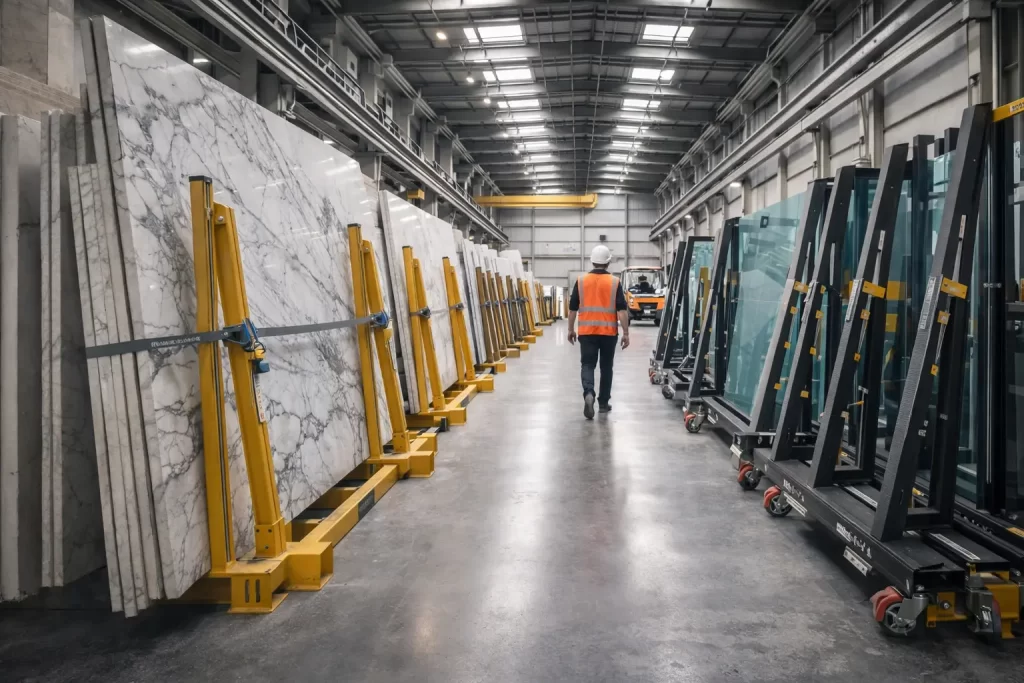
Toptan A-Frame Depolama Rafı
Final Buyer Decision Guide
| Buyer Situation | Recommended Rack Choice | Why It Works |
|---|---|---|
| Daily export slab staging | Heavy duty A-frame rack | Stable temporary storage |
| Large marble slabs | Wider base and padded support | Reduces tipping and edge damage |
| Outdoor stone yard | Galvanized or coated rack | Better corrosion resistance |
| Mixed slab sizes | Custom A-frame storage rack | Better fit and storage control |
| High forklift traffic | Strong base and clear layout | Safer workflow |
| Wholesale equipment order | Factory-direct rack supplier | Better customization and cost control |
| High-value project slabs | Padded contact and batch zones | Better protection and order separation |
Heavy Duty A-Frame Racks Protect Slabs, Workers, and Export Schedules
Export stone yards prefer heavy duty A-Frame Depolama Rafı systems because they solve several problems at once. They improve slab stability, reduce breakage risk, organize yard workflow, support forklift handling, and make export preparation more controlled.
A-frame racks are not just storage equipment. They are part of a safer and more professional stone logistics system. They help workers inspect slabs faster, keep orders separated, prepare containers more efficiently, and reduce the chance of expensive last-minute damage.
Before buying, stone yard managers should calculate slab weight, rack capacity, floor conditions, forklift workflow, slab size range, corrosion environment, export loading process, and worker training requirements. A qualified stone slab storage rack manufacturer can then recommend the right rack structure and reduce risk from yard storage to container loading.
Sıkça Sorulan Sorular
1. A-Frame Depolama Rafı, taş bahçelerinde ne için kullanılır?
A-Çerçeve Depolama Rafı, mermer, granit, kuvars ve sinterlenmiş taş gibi taş levhaları saklamak, sahneye koymak, incelemek ve düzenlemek için kullanılır. İhracat taş bahçelerinde, levhaları paketleme veya konteyner yükleme öncesinde kontrol edilmiş bir açıda eğmeye yardımcı olur. Ayrıca, sipariş ayrımını, levha görünürlüğünü, forklift iş akışını ve geçici depolama güvenliğini iyileştirir. Rasgele duvara dayanmış veya ahşap desteklerle karşılaştırıldığında, doğru şekilde tasarlanmış bir A-çerçeve rafı daha iyi kararlılık ve profesyonel bahçe yönetimi sağlar.
2. İhracat taş ocakları neden ağır hizmet A çerçeve raflarını tercih eder?
İhracat taş bahçeleri, levha devrilmesi riskini azalttığı, levha kenarlarını koruduğu, denetim erişimini iyileştirdiği ve konteyner yükleme hazırlığını daha düzenli hale getirdiği için ağır işler için A-çerçeveli rafları tercih eder. İhracat operasyonları genellikle büyük levhalara, sıkı zaman çizelgelerine, çoklu siparişlere ve sık sık forklift hareketlerine dayanır. Güçlü bir raf, çalışanların levhaları projelere göre gruplamasına, etiketleri kontrol etmesine, kalite kontrolü fotoğraflarını çekmesine ve gönderileri daha az hasar riskiyle ve daha iyi iş akışı kontrolüyle hazırlamasına yardımcı olur.
3. A çerçeve levha rafı ne kadar ağırlık taşıyabilir?
A çerçeve levha rafının yük kapasitesi, çelik cinsine, yapısal tasarıma, taban genişliğine, kaynak kalitesine, takviyeye ve her taraf için belirtilen yük kapasitesine bağlıdır. Bazı ağır hizmet tipi taş levha rafları çok tonluk yükler için tasarlanmıştır; ancak alıcılar kapasiteyi hiçbir zaman görünüme göre tahmin etmemelidir. Kullanmadan önce üreticiden belirtilen yük verilerini, levha boyutu önerilerini ve güvenlik katsayısı bilgilerini talep etmelidirler. Raf, günlük çalışma koşullarında teorik sınıra kadar çalıştırılmamalıdır.
4. A-çerçeveli raf, dikey levha depolamasından daha mı iyidir?
A çerçeve raf, geçici ihracat hazırlığı, levha incelemesi ve konteyner yükleme hazırlığı için genellikle daha uygundur, çünkü levhalar her iki taraftan da erişilebilir kalmakta ve siparişlere göre gruplandırılabilirler. Dikey levha depolama, özellikle levhaların ayrı bölmelere ihtiyaç duyduğu durumlarda, kategorize edilmiş uzun vadeli envanter için faydalı olabilir. Daha uygun seçenek, avlunun iş akışına bağlıdır. İhracat avluları genellikle kısa süreli hazırlık ve taşıma verimliliği için ağır hizmet A çerçeve raflarını tercih ederken, depolar her iki sistemi de birleştirebilir.
5. Alıcılar güvenilir A-Çerçeve Depolama Rafları üreticisini nasıl seçerler?
Alıcılar, nominal yük kapasitesi, çelik sınıfı, kaynak kalitesi, taban tasarımı, destek açısı, yüzey işlemesi, koruyucu pedler, özelleştirme yeteneği, ihracat ambalajı ve satış sonrası destek gibi unsurları inceleyerek A-Çerçeve Depolama Rafı üreticisi seçmelidirler. Güvenilir bir üretici, ürünün açık ürün özelliklerini, çizimleri veya teknik verileri ve döşeme boyutu, malzeme ağırlığı, arazi düzeni, forklift iş akışı ile kapalı veya açık hava kullanım koşullarına dayalı pratik önerileri sağlamalıdır.
Referanslar
- “Materials Handling and Storage” — Occupational Safety and Health Administration, OSHA
- “Safe Use of Lifting Equipment” — Health and Safety Executive, HSE
- “Powered Industrial Trucks Standard” — Occupational Safety and Health Administration, OSHA
- “Forklift Safety: Reducing Workplace Injuries” — National Safety Council
- “Dimension Stone Design Manual” — Natural Stone Institute Technical Committee, Natural Stone Institute
- “Warehouse Safety and Material Handling Guide” — Canadian Centre for Occupational Health and Safety
- “Steel Structures: Design and Material Strength Guidance” — American Institute of Steel Construction
- “Safe Storage and Handling of Stone Slabs” — Natural Stone Institute Safety Resources
How to Choose an A-Frame Storage Rack with Less Risk
What matters most: An A-Frame Storage Rack should be evaluated as a safety and logistics system, not only as a steel stand. Buyers should review rated load capacity, steel grade, base width, support angle, welding quality, corrosion protection, contact padding, forklift clearance, and slab size compatibility before placing an order.
How buyers should decide: If the yard handles export slabs daily, choose a heavy duty A-frame rack with strong base stability and clear load data. If the yard stores mixed slab sizes, choose a customizable rack structure. If the rack will be used outdoors, choose proper surface treatment. If high-value marble or bookmatched slabs are stored, prioritize padded contact areas and organized batch zones.
Why mistakes happen: Many storage problems come from treating temporary slab staging as a low-risk process. In reality, slabs are often damaged before container loading because of unstable leaning, weak supports, poor forklift layout, unclear order grouping, or overloaded racks. Buyers who skip load calculation, floor condition checks, and worker training may face slab breakage, shipment delays, and safety hazards.
Option logic: Choose heavy duty A-frame racks for export staging, vertical racks for categorized long-term storage, custom A-frame racks for irregular slab sizes, galvanized or coated racks for outdoor yards, and padded support racks for premium polished slabs. The safest rack choice depends on slab weight, yard layout, forklift workflow, and export loading requirements.
Final consideration: Before confirming an A-Frame Storage Rack order, buyers should prepare slab dimensions, material types, estimated slab weight, storage quantity, floor condition, forklift route, indoor or outdoor usage, corrosion environment, and loading process. A professional supplier can then recommend the right rack structure, reduce storage risk, and support a safer export stone yard workflow.

Henry
Merhaba, ben bu yazının yazarıyım ve 16 yıldan fazla bir süredir bu alandayım. Taş aletler için OEM ve ODM hizmetine ihtiyacınız varsa, bana herhangi bir soru sormaktan çekinmeyin.