أنجز عملك بكفاءة!





A-frame slab transport systems improve slab shipping safety, reduce damage risks, and optimize stone storage and export logistics for modern factories.
A-frame slab transport systems are essential for safe stone transportation, warehouse storage, and international export. For modern stone factories, the right A-frame storage and shipping solution directly affects slab damage rate, loading speed, warehouse efficiency, worker safety, and logistics cost. This guide explains how A-frame slab transport works, how to choose the right system, what mistakes to avoid, and how factories can build safer and more efficient stone logistics workflows.
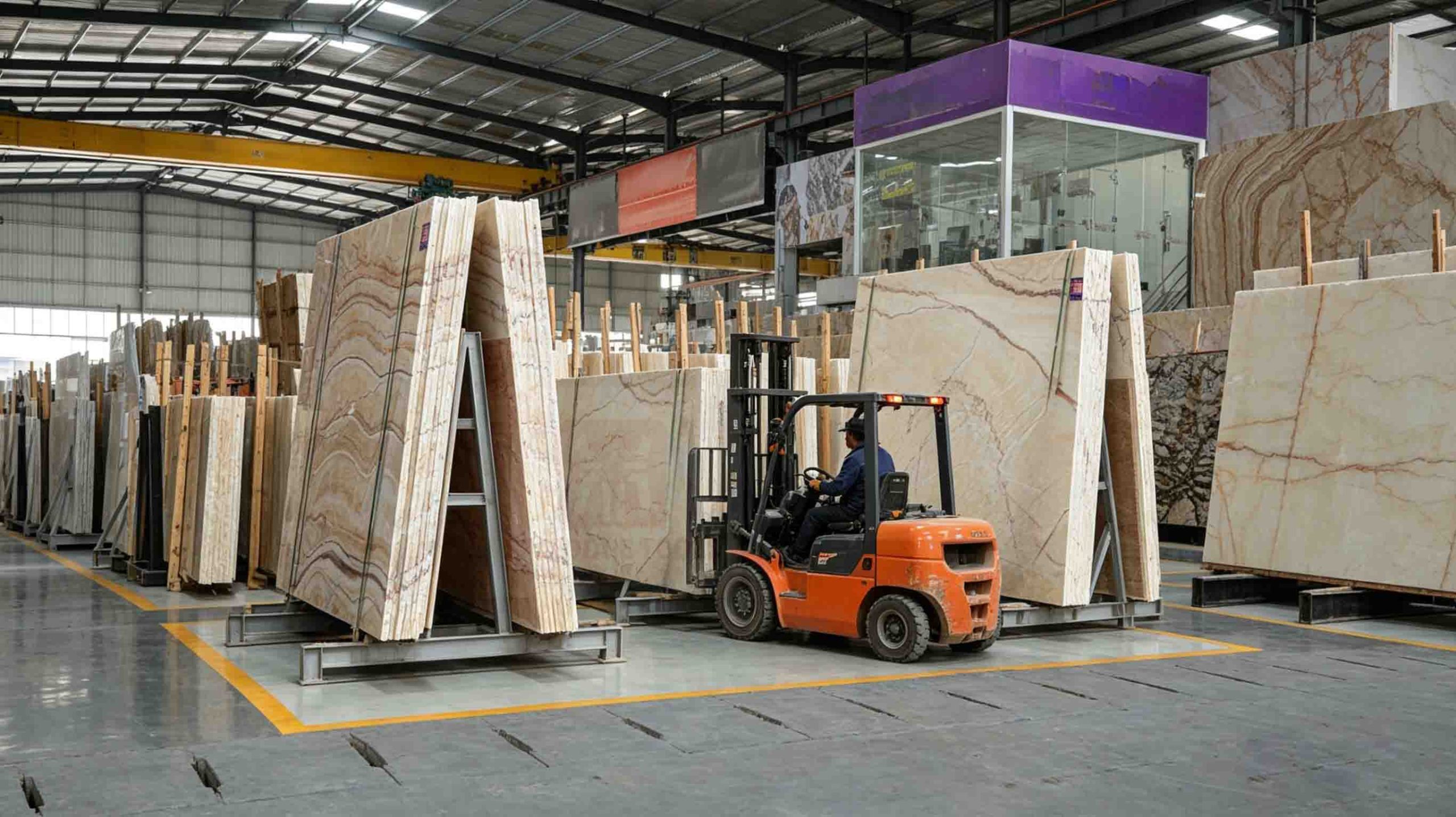
A-frame slab transport system used for stone slab shipping and export
حلول الإطار A للنقل الآمن للحجر والتصدير
Efficient نظام نقل الألواح ذات الإطار A systems have become a critical part of modern stone logistics. Whether a factory is moving granite slabs between production zones, storing marble slabs in a warehouse, preparing quartz slabs for export, or loading mixed materials into containers, the right A-frame structure improves stability, safety, and workflow control.
For factories shipping mixed stone orders, ألواح الجرانيت may differ in size, finish, and weight from marble or quartz products, so A-frame capacity and contact protection should be checked against the actual load rather than a generic estimate.
Stone slabs are high-value materials. A single breakage event can create direct financial loss, delay delivery, and damage customer trust. For exporters, the risk is even greater because slabs may be exposed to vibration, container movement, forklift handling, port transfer, and long-distance shipping conditions. A professional slab shipping solution helps reduce these risks by keeping slabs properly supported and organized throughout the transportation process.
Many factories still treat storage and transport systems as secondary equipment. That is a costly mistake. A poor storage method can damage slabs before they ever reach the cutting line. An unstable transport method can turn a finished order into a claim. An inefficient loading layout can waste container space and increase labor time. In modern stone operations, A-frame systems are not just racks. They are part of the production and logistics strategy.
Why A-Frame Slab Transport Matters More Than Many Factories Realize
Stone transportation is one of the most underestimated risk points in the stone industry. Slabs are heavy, rigid, and fragile at the same time. They can resist compression but may crack when unsupported, impacted, or placed under uneven stress. This is why traditional stacking methods often create hidden risks. When slabs are stacked improperly, the lower pieces may carry uneven loads, workers may struggle to access specific materials, and forklifts may require extra movement to retrieve the right slab.
Modern factories are now adopting structured rack systems to improve safety and operational efficiency. For example,
professional slab rack systems
can dramatically reduce wasted space and improve material accessibility. The same logic applies to A-frame transport systems: when slabs are stored and moved in a controlled position, handling becomes faster, safer, and more predictable.
A-frame systems also improve workflow visibility. Workers can identify slabs more easily, forklifts can access materials more efficiently, and managers can organize storage zones based on material type, order status, or export schedule. This reduces unnecessary movement and helps prevent mistakes during loading and dispatch.
What Is an A-Frame Slab Transport System?
أن A-frame slab transport system is a triangular steel support structure designed to hold stone slabs in a near-vertical position. The shape resembles the letter “A,” which is why it is called an A-frame. This structure distributes slab weight toward both sides of the frame and helps prevent slabs from tipping, sliding, or leaning dangerously during storage or movement.
A-frame systems are commonly used in stone factories, warehouses, slab yards, container loading areas, and export packing operations. Depending on the design, they may be stationary storage frames, forklift-compatible transport frames, shipping frames, or heavy-duty export frames built for containerized logistics.
A-frame systems are commonly used for:
- Stone slab transportation
- Warehouse storage
- Container loading
- Export preparation
- Internal factory logistics
- Temporary staging before cutting or shipping
- Organizing slabs by order, material, or customer
The main purpose is simple: support slabs safely while making them easier to handle. However, the quality of the frame, the base design, the contact surface, the load rating, and the compatibility with forklifts or cranes all determine whether the system performs well in real factory conditions.
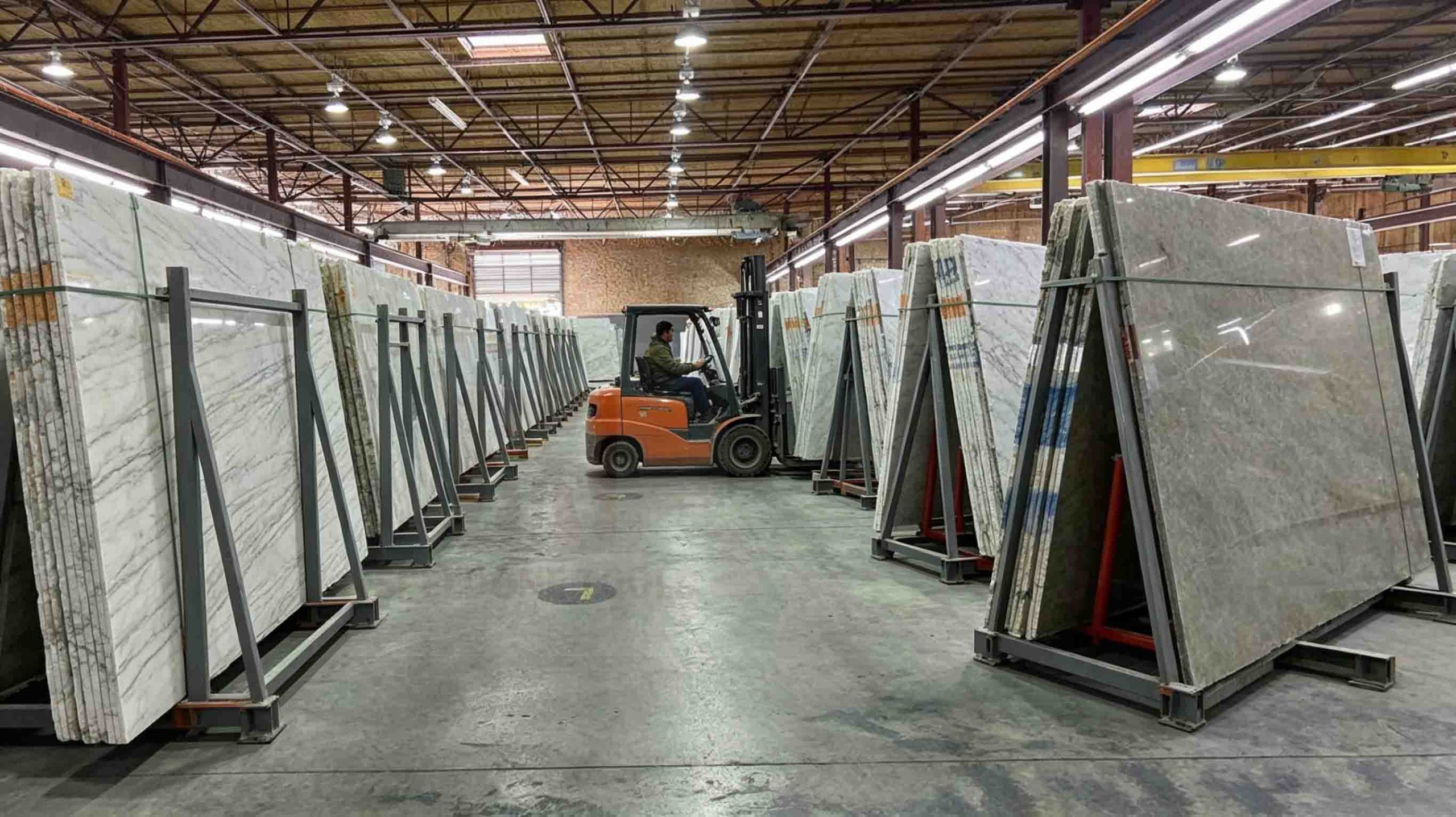
Stone slab shipping solution using heavy-duty A-frame transport racks
The Structural Logic Behind Safe A-Frame Storage
The effectiveness of an A-frame system comes from its geometry. A triangular structure is naturally stable because force is distributed across angled supports rather than concentrated at one vertical point. When stone slabs lean against both sides of an A-frame, the load is transferred downward through the frame and into the base.
This matters because stone slabs are vulnerable when force is unevenly applied. If a slab is leaned against a weak surface, placed at an unsafe angle, or supported only at a small contact point, the risk of cracking increases. A well-designed A-frame creates more consistent support and reduces sudden shifting during movement.
The base is equally important. A frame with a narrow or weak base may become unstable when loaded unevenly. Export frames should be designed to handle vibration and movement during transport. Warehouse frames should allow safe access without creating forklift congestion. Outdoor frames may need stronger surface protection against corrosion and weather exposure.
Types of A-Frame Storage and Shipping Solutions
- Stationary A-frame storage racks
- Forklift-compatible A-frame transport racks
- Heavy-duty export A-frames
- Container loading A-frame systems
- Mobile A-frame transport systems
- Display and selection A-frame racks
Each type solves a different logistics problem. A stationary storage rack is suitable for organizing slabs in a warehouse or slab yard. A forklift-compatible frame is better for internal factory movement. Heavy-duty export A-frames are designed for long-distance shipping and container stability. Display racks are useful when customers need to inspect and select slabs easily.
Choosing the wrong type can create workflow problems. A storage frame may not be strong enough for export vibration. A shipping frame may be too heavy or inconvenient for daily slab selection. A display frame may improve visibility but may not provide the same durability required for industrial transport.
Benefits of A-Frame Storage and Shipping Solutions
| الفائدة | Impact on Operations | Business Value |
|---|---|---|
| Improved Stability | Reduces slab tipping, sliding, and impact damage | Lower breakage cost and safer handling |
| تحسين الفضاء | Stores slabs vertically and improves warehouse organization | Better use of floor space and faster retrieval |
| Safer Handling | Keeps slabs supported during loading and movement | Lower accident risk and reduced labor pressure |
| Faster Logistics | Improves loading, unloading, staging, and dispatch workflows | Shorter turnaround time and better delivery reliability |
| Export Protection | Supports slabs during container movement and long-distance shipping | Fewer shipping claims and stronger customer confidence |
Many factories underestimate the role of storage systems in operational performance. As discussed in
this guide to slab storage racks
,
well-designed rack systems directly improve both safety and workflow efficiency. A-frame systems extend that advantage into transportation and export preparation.
Comparison of Common Slab Transport and Storage Options
| Solution Type | أفضل استخدام | المزايا | الحدود |
|---|---|---|---|
| رف تخزين بإطار على شكل A | Warehouse and slab yard organization | Stable, space-saving, easy slab access | May not be suitable for long-distance shipping unless reinforced |
| رف نقل بإطار على شكل حرف A | Internal factory movement and short-distance transport | Improves safety and forklift handling efficiency | Requires forklift compatibility and proper load balance |
| Export A-Frame | Container shipping and international logistics | Designed for vibration, weight distribution, and shipment stability | Higher cost and may require custom dimensions |
| رف العرض | Showroom selection and slab inspection | Improves visibility and customer access | Not designed for heavy transport or container loading |
| Flat Stacking | Temporary storage only | Simple and low initial cost | Difficult access, higher pressure risk, inefficient retrieval |
Designing an Efficient Slab Rack Layout
An effective slab transport workflow depends not only on the equipment itself but also on how storage areas are organized. A strong A-frame system can still perform poorly if it is placed in the wrong location, blocks forklift movement, or forces workers to move slabs too many times before shipping.
A properly planned layout:
- Reduces unnecessary movement
- Improves forklift accessibility
- Enhances worker safety
- Speeds up slab retrieval
- Improves order staging before loading
- Separates incoming, processing, finished, and export-ready materials
Factories looking to optimize their workflow often begin by studying
safe slab rack layout strategies
.
The key is to design the storage area around actual movement patterns. If a slab must be moved three times before it reaches the loading zone, the layout is creating avoidable labor cost and damage risk.
For export operations, layout planning should include container access, forklift turning radius, staging zones, order grouping, and inspection space. The goal is to make the final loading process smooth and controlled, not rushed and improvised.
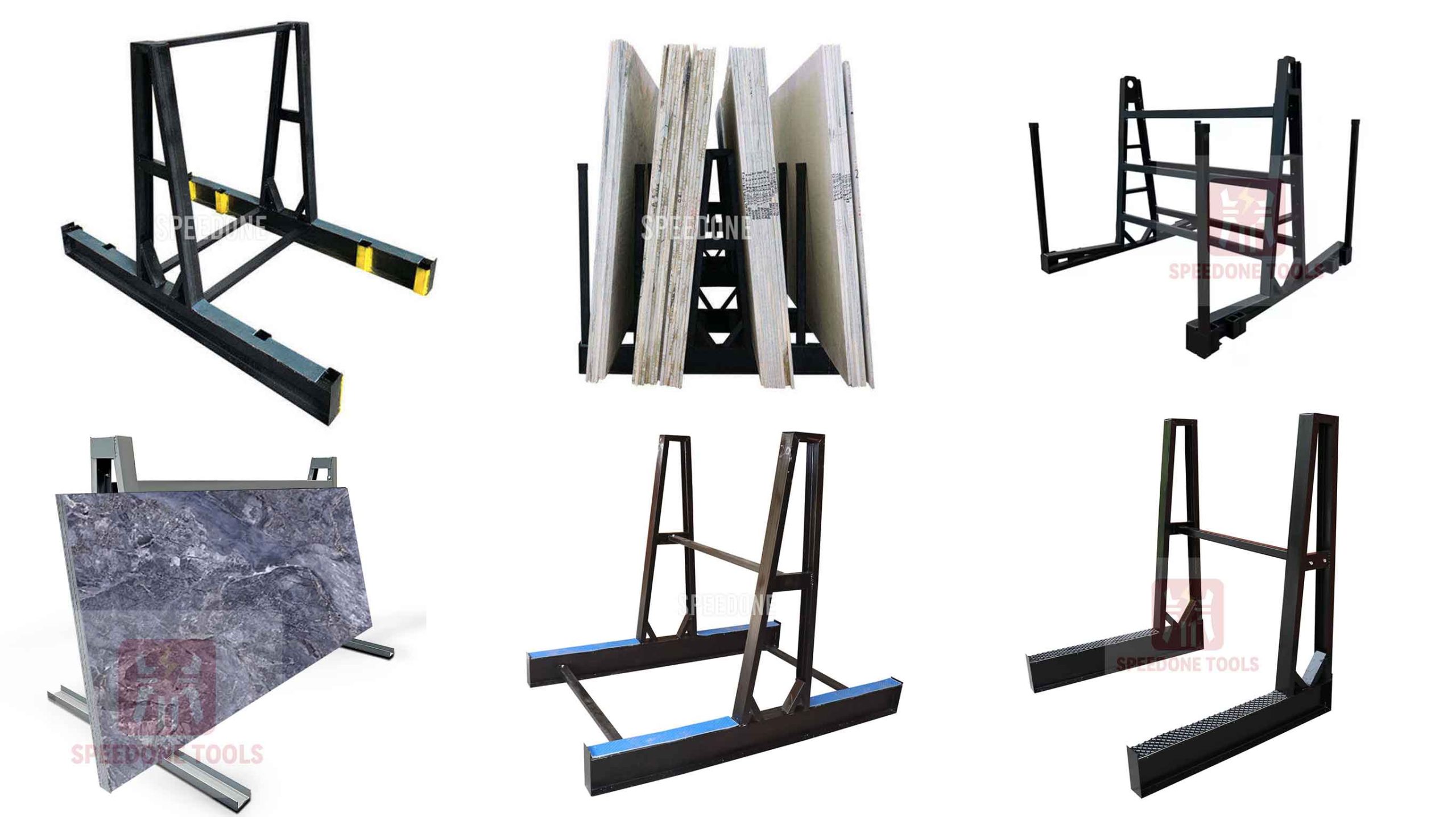
Granite A rack
A-Frame Systems for Export and Shipping
International shipping places additional stress on stone slabs. During export, slabs may experience vibration from road transport, movement during ocean shipping, forklift handling at multiple locations, and pressure from container loading conditions. A reliable slab shipping solution is essential because the shipment may be inspected by the customer only after it has traveled thousands of kilometers.
Export frames should be selected around the real shipment mix. Premium natural quartzite slabs can vary in thickness, size, and natural structure, so restraint, padding, and load distribution should be planned for the specific bundles being shipped.
A-frame transport systems provide:
- Stable slab positioning during shipment
- Better weight distribution
- Improved container organization
- Reduced shipping damage
- More efficient loading and unloading
- Clearer separation between orders or material types
Storage methods also play a critical role in protecting materials before export. You can learn more about practical storage techniques in
this guide to A-frame storage rack methods
.
A slab damaged before shipment is still a logistics failure, even if the container loading process itself is correct.
Export A-frames should be evaluated differently from basic warehouse frames. Buyers should consider steel thickness, welding quality, base stability, anti-slip contact surfaces, lashing points, container fit, and load distribution. For shipping, the question is not simply whether the frame can hold slabs in a warehouse. The question is whether it can protect slabs through the full logistics journey.
Using Display and Storage Racks Together
Some factories combine display racks with transport systems to improve both logistics and customer presentation. This is especially useful for slab yards, distributors, and exporters who need to show materials to buyers while keeping the warehouse organized.
For example,
رفوف عرض الألواح
can help organize slabs while maintaining easy access for inspection and selection. Customers can review colors, patterns, and surface quality more easily when slabs are displayed safely.
At the same time, strong A-frame systems remain essential for preventing costly transportation damage. This is further explained in
why A-frame storage racks are critical for damage prevention
.
Display systems support selection; transport systems support movement and protection. A professional stone logistics workflow often uses both.
If X, Choose Y: Decision Logic for Buyers
Buyers often ask which A-frame system is best. The correct answer depends on how the slabs will be used, moved, stored, and shipped.
If your main goal is warehouse organization, choose stationary A-frame storage racks. They help organize slabs vertically, improve retrieval speed, and reduce clutter in the storage area.
If your main problem is internal factory movement, choose forklift-compatible A-frame transport racks. These systems make it easier to move slabs between storage, cutting, processing, and loading areas.
If your business focuses on export, choose heavy-duty export A-frames. Export frames should be designed for container loading, shipment vibration, lashing, and long-distance transport stability.
If your customers frequently inspect slabs before purchase, combine display racks with storage systems. This improves presentation while keeping materials organized and accessible.
If slab damage happens during loading, review both the A-frame design and the loading process. Damage is often caused by a combination of weak support, poor spacing, rushed forklift handling, and insufficient securing.
How to Choose the Right A-Frame Slab Transport System
- Evaluate slab dimensions and weight
- Consider indoor vs outdoor usage
- Check forklift compatibility
- Review steel frame strength and durability
- Analyze export and shipping requirements
- Confirm base stability and anti-slip design
- Check whether the frame fits container dimensions
- Evaluate ease of loading and unloading
The right A-frame solution should improve not only transportation safety but also long-term workflow efficiency. Buyers should avoid choosing by price alone. A low-cost frame that bends, rusts quickly, lacks proper support, or does not fit the loading process may become expensive through slab damage and downtime.
Before purchase, factories should ask practical questions. What slab sizes are handled most often? Are materials stored indoors or outdoors? Will the frame be moved by forklift? Will it be used for export? How many slabs will be loaded at one time? What surface protection is used where the stone contacts the frame? Can the supplier provide load information and customization support?
Common Buying Mistakes and Their Consequences
Mistake 1: Buying only by frame size. Size matters, but load capacity, steel quality, base width, welding quality, and contact protection are equally important. A frame that fits the slab dimension may still be unsafe if it cannot support the weight properly.
Mistake 2: Using warehouse racks for export shipping. A warehouse rack is designed for storage. Export shipping adds vibration, container movement, and repeated handling. Using the wrong frame increases breakage risk.
Mistake 3: Ignoring forklift access. If forklifts cannot approach, lift, or position the frame safely, workers will create unsafe shortcuts. This slows loading and increases accident risk.
Mistake 4: Overloading the frame. Exceeding practical load limits may bend the frame, reduce stability, or damage slabs. Even if the frame does not fail immediately, repeated overload weakens long-term performance.
Mistake 5: Neglecting surface protection. Bare or poorly protected contact points may scratch, chip, or pressure-mark stone surfaces. This is especially risky for polished slabs and high-value materials.
Risk Table: What Happens When the A-Frame Choice Is Wrong?
| Wrong Decision | Immediate Problem | Long-Term Consequence |
|---|---|---|
| Frame load capacity is too low | Unstable support or frame deformation | Higher breakage risk and safety hazards |
| Wrong frame type for export | Slabs shift during transport | Shipping claims and customer disputes |
| Poor warehouse layout | Slow retrieval and forklift congestion | Lower productivity and higher labor cost |
| No surface protection | Scratches, chips, or pressure damage | Material loss and customer complaints |
| Poor maintenance routine | Rust, loose parts, or weakened welds | Shorter equipment life and safety problems |
Benefits of Using Professional A-Frame Slab Transport Systems
- Reduced slab breakage during storage and transport
- Improved warehouse space utilization
- Faster loading and unloading operations
- Lower labor intensity and safer handling
- Better organization for export orders
- Improved forklift workflow
- Lower risk of customer claims caused by shipping damage
Factories that adopt professional A-frame systems often see immediate improvements in organization and safety. Slabs are easier to access, workers spend less time searching for materials, and forklifts can move through the storage area more efficiently.
The gains are not only operational. Better slab protection improves customer confidence. When exporters consistently deliver slabs without damage, they strengthen their reputation and reduce after-sales disputes. In a competitive stone market, reliable delivery is just as important as product quality.
Why Many Global Buyers Source A-Frame Systems from China Manufacturers
Many global buyers source A-frame storage and shipping systems from China manufacturers because of competitive pricing, customization capability, and practical experience in stone logistics equipment. Chinese suppliers often work with stone factories, slab exporters, and logistics companies, giving them strong knowledge of real handling conditions.
However, buyers should not evaluate suppliers only by price. A reliable supplier should understand slab dimensions, loading methods, steel structure requirements, export packing conditions, and forklift compatibility. The best suppliers are able to recommend solutions based on application rather than simply offering a standard model.
For export-oriented buyers, supplier support is especially important. A-frame systems may need custom sizes, reinforced structures, special coatings, anti-slip pads, or container-specific designs. Strong supplier communication reduces purchasing mistakes and helps ensure that the product matches real logistics requirements.
Maintenance and Lifecycle Management
A-frame systems are durable, but they still require maintenance. Steel structures may face wear from forklifts, slab contact, outdoor exposure, repeated loading, and vibration during transport. Regular inspection helps prevent small problems from becoming safety risks.
Factories should check welds, base stability, surface protection pads, rust protection, bolts, support points, and any areas that carry repeated load. Export frames should be inspected before shipment because failure during transport can cause major losses.
Lifecycle cost matters. A cheaper frame that rusts quickly, bends under load, or damages slabs is not truly economical. A better-built A-frame may cost more upfront but often delivers lower long-term cost through better safety, longer service life, and reduced material damage.
Recommendation Framework for Buyers
If your factory mainly needs storage organization, start with stationary A-frame racks and improve layout planning. This helps reclaim floor space and improves slab accessibility.
If your main challenge is moving slabs between production zones, choose forklift-compatible A-frame transport systems. Make sure the base design and lifting points match your existing forklift equipment.
If you export slabs internationally, invest in heavy-duty slab shipping solutions rather than basic storage racks. Export frames should be designed for container conditions, vibration, securing methods, and long-distance movement.
If you sell slabs directly to customers, combine display racks and A-frame storage systems. This allows better presentation while keeping materials safe and organized.
Soft CTA
The smartest next step is not simply asking for the cheapest A-frame price. It is reviewing your current storage, handling, and shipping workflow. Are slabs breaking during storage, loading, internal transfer, or export? Are forklifts wasting time due to poor layout? Are containers difficult to load efficiently? Once the main logistics bottleneck is clear, choosing the right A-frame slab transport system becomes easier and far less risky.
الملاحظة الختامية / الوجبات الجاهزة العملية
A-frame slab transport systems are one of the most effective solutions for safe stone transportation, warehouse storage, and export preparation. By combining stable structural support, efficient slab organization, forklift-friendly workflow, and proper shipping protection, modern A-frame systems help factories reduce damage, improve logistics efficiency, and protect long-term profitability. Buyers should evaluate A-frame systems as part of a full stone logistics strategy, not as isolated storage equipment.
المراجع
- OSHA Materials Handling and Storage Guidelines
- ISO 12100: Safety of Machinery – General Principles for Design
- EN 13155: Cranes – Safety – Non-fixed Load Lifting Attachments
- Natural Stone Institute – Stone Industry Technical Resources
- General stone logistics and warehouse safety best practices
- Export packing and container loading guidance for heavy slab materials
الأسئلة الشائعة
1. ما هو نقل الألواح بالإطار A؟
نقل الألواح ذات الإطار على شكل حرف A هو نظام مصمم لحمل الألواح الحجرية أو تخزينها أو نقلها بشكل آمن باستخدام هيكل دعم مثلثي يحسّن الاستقرار ويقلل من خطر الانقلاب.
2. Why are A-frame systems used in stone shipping?
تُستخدم أنظمة الإطار على شكل A في شحن الحجارة لأنها تُبقي الألواح في وضع مستقيم، وتحسّن توزيع الوزن، وتقلل من الحركة أثناء النقل، وتساعد على حماية الألواح أثناء تحميل الحاويات والتصدير.
3. Can A-frame systems improve warehouse efficiency?
نعم. تحسّن أنظمة الإطار A كفاءة المستودعات من خلال تنظيم الألواح بشكل عمودي، مما يوفّر مساحة أرضية، ويحسّن وصول الرافعات الشوكية، ويجعل استرجاع الألواح أسرع وأكثر أمانًا.
4. Are A-frame systems suitable for granite and marble slabs?
نعم. تُستخدم أنظمة النقل ذات الإطار على شكل حرف A بشكل شائع لألواح الجرانيت والرخام والكوارتز والخزف والحجر المصمم، بشرط أن يكون الإطار مصنّفًا بشكل مناسب لوزن الألواح وأبعادها.
5. How do I choose the right slab shipping solution?
يجب عليك تقييم حجم البلاطة، ووزن البلاطة، ومسافة النقل، وشروط التصدير، وتوافق الرافعة الشوكية، ومتطلبات تحميل الحاوية، وقوة هيكل الإطار.
6. What is the difference between an A-frame storage rack and an export A-frame?
تم تصميم رف التخزين على شكل حرف A بشكل رئيسي لتنظيم المستودعات، في حين أن إطار A المخصص للتصدير مصمم لتحمل اهتزازات الشحن وحركة الحاويات وطرق التثبيت والخدمات اللوجستية لمسافات طويلة.
7. What are the biggest risks of using the wrong A-frame system?
تشمل المخاطر الأكبر كسر الألواح، وعدم استقرار الإطار، ومشاكل في مناولة الرافعات الشوكية، والأضرار أثناء الشحن، والازدحام في المستودعات، وزيادة عدد مطالبات العملاء.
8. Do A-frame systems require maintenance?
نعم. يجب فحص أنظمة الإطار على شكل حرف A بانتظام للتحقق من حالة اللحام، والصدأ، واستقرار القاعدة، وحماية السطح، ومناطق تحمل الأحمال لضمان الاستخدام الآمن على المدى الطويل.

هنري
مرحبًا، أنا كاتب هذا المنشور، وأنا أعمل في هذا المجال منذ أكثر من 16 عامًا. إذا كنت بحاجة إلى خدمة تصنيع المعدات الأصلية وتصنيع التصميم الشخصي للأدوات الحجرية، فلا تتردد في طرح أي أسئلة عليّ.