Erledigen Sie Ihre Arbeit effizient!





Learn why Slab Rack systems are essential in modern stone plants for safer storage, faster slab retrieval, better warehouse efficiency, and improved handling of granite, marble, and quartz materials.
A Familiar Conversation on the Factory Floor
“Why are we still moving slabs three times before they reach the saw?”
“Why is the forklift route crossing the loading path again?”
“And why does a full warehouse somehow still feel short on usable space?”
That kind of conversation happens in more stone plants than managers like to admit. The truth is blunt: many factories do not actually have a stone capacity problem. They have a storage logic problem. When slab storage is poorly planned, even a well-equipped plant starts bleeding time, floor space, labor hours, and safety margin. A messy yard can make a strong production line look clumsy. A weak rack layout can turn premium stone into unnecessary risk.
That is exactly why Brammengestell systems matter in modern stone plants. They are not just steel frames for holding slabs upright. They are part of the operational backbone of the plant. A heavy duty rack system directly affects storage density, handling efficiency, operator safety, slab protection, and the smooth flow between unloading, storage, cutting, and dispatch. In a modern factory, the rack is not background equipment. It is production infrastructure.
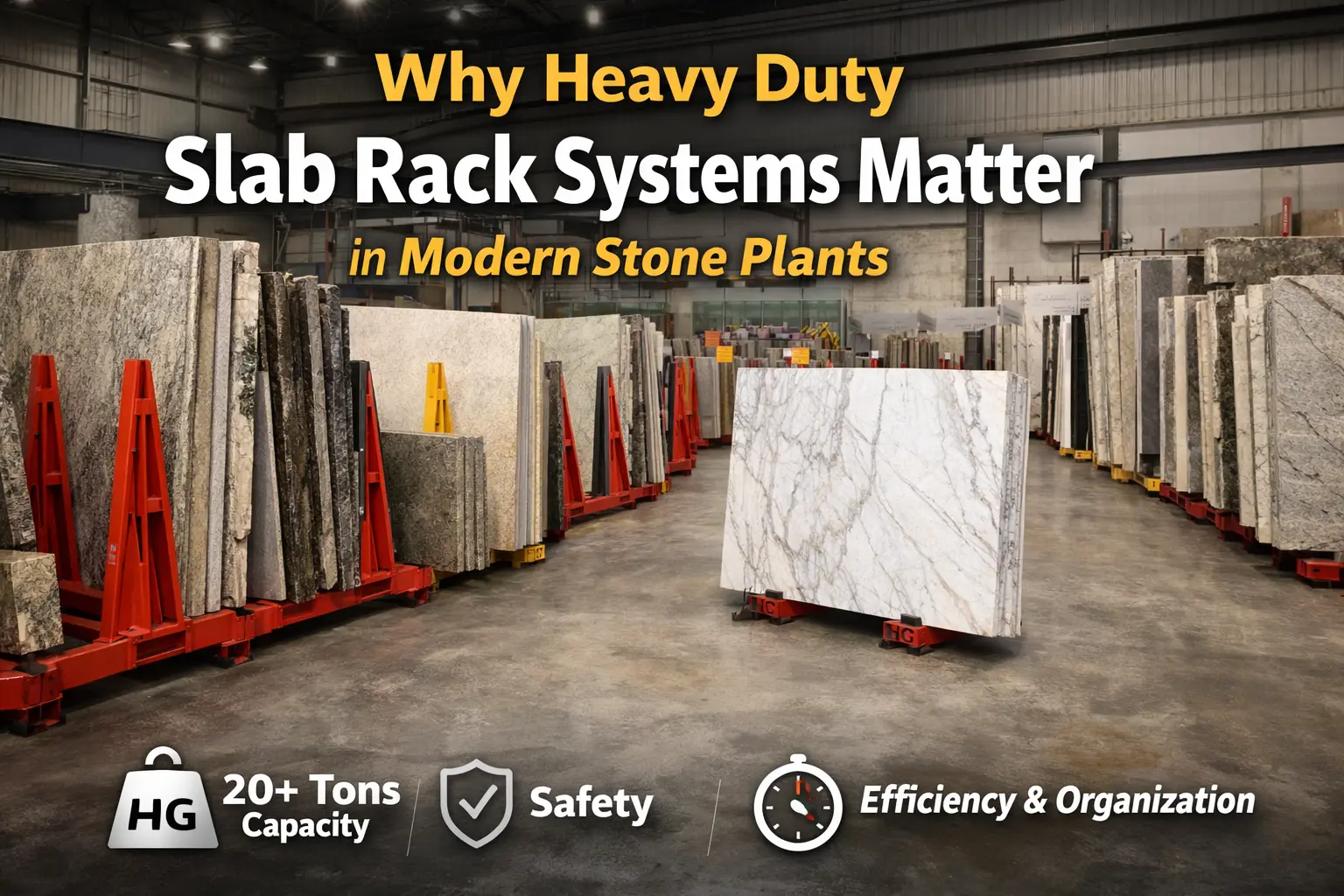
Heavy Duty Slab Rack
The Cost of Treating Slab Storage as “Just Storage”
Many plants still make the same mistake: they focus on saws, polishing lines, cranes, and transport carts, but treat the storage area like a leftover zone. That is a dangerous habit. Stone slabs are not cartons, pallets, or small finished goods. They are heavy, fragile, high-value materials that require stable support, clear access, and disciplined layout logic.
OSHA’s storage rules are not subtle about this. Materials stored in tiers must be racked, blocked, interlocked, or otherwise secured to prevent sliding, falling, or collapse, and aisles and passageways must be kept clear for safe movement of handling equipment and workers.
In a stone plant, the problem gets even more serious. Slabs do not only occupy space; they create fall hazards, forklift constraints, visibility issues, and handling bottlenecks. OSHA’s stone slab handling bulletin specifically warns against unsafe unloading, unsupported slab movement, and storage conditions that allow slabs to shift or collapse.
That means a poor rack system does not merely waste a few square meters. It can trigger a chain reaction:
-
more manual repositioning
-
longer forklift travel distances
-
higher chance of edge damage
-
reduced visibility for picking the right slab
-
greater collision risk near traffic lanes
-
lower confidence during in-house handling
This is why a serious manufacturer should evaluate not only machines, but also the supplier’s understanding of stone logistics and workflow discipline. A company page like About Speedone matters because it helps buyers judge whether the brand understands heavy material storage as an operational system, not just as welded hardware.
What a Heavy Duty Slab Rack System Really Does
A heavy duty slab rack is often underestimated because it looks static. It sits there. It holds slabs. It does not spin, cut, polish, or flash. But in production logic, it does something more important: it organizes how value moves through the plant.
A proper heavy duty slab rack system should do four jobs at once.
It must support high loads with stable geometry
Stone slabs are unforgiving. Rack strength is not a marketing bonus; it is the minimum requirement. Heavy duty capacity, structural rigidity, anti-slip support, and secure retention are fundamental in any environment handling marble, granite, quartz, glass, or engineered stone. Speedone’s product positioning around its slab rack range reflects exactly this heavy-load, industrial-storage logic.
It must improve access, not just hold inventory
If workers need to shift several slabs just to reach one selected slab, the storage system is not helping. It is slowing the plant down. Good rack design should make slab selection easier, not more dramatic.
It must reduce handling frequency
Every additional move adds cost and risk. Stone plants earn money when slabs move with purpose, not when they take scenic tours around the workshop.
It must make layout planning more scalable
A plant that grows from 500 slabs to 2,000 slabs cannot rely on improvised storage habits. A rack system should support a repeatable storage logic that can expand without becoming a maze.
This is one reason content such as Der vollständige Leitfaden zu Plattenregalsystemen für Steinlagerhäuser is useful for buyers. It reframes slab storage from a simple holding task into a warehouse-efficiency strategy. The core idea is dead right: storage decisions shape throughput.
Why Modern Stone Plants Need Heavy Duty Racks More Than Ever
The old model of “more yard, more stacking, more manual adjustment” is losing the fight against modern production pressure. Today’s stone factories are dealing with faster order turnaround, wider material variety, more custom projects, stricter safety expectations, and tighter labor economics.
Heavy duty Brammengestell systems matter more now because the operating environment has changed.
Plants are handling more mixed inventory
Factories are often storing multiple colors, finishes, thicknesses, and slab sizes at the same time. That makes storage visibility and retrieval logic much more important than in a simpler stock model.
Labor efficiency matters more
OSHA notes that warehousing workers are exposed to ergonomic risk factors such as lifting, pushing, pulling, bending, reaching, and repetitive handling, all of which increase the risk of musculoskeletal disorders. NIOSH likewise states that effective ergonomic interventions can reduce the physical demands of manual material handling and lower both injury severity and related costs.
In plain English: bad storage makes people work harder and less safely. Good storage reduces unnecessary effort and helps the plant run cleaner.
Premium materials raise the cost of mistakes
A damaged high-value slab is not just material loss. It can delay jobs, disrupt schedules, and hurt customer trust. Rack quality becomes part of product protection.
Traffic and space planning are more important
OSHA also requires clear aisles and safe movement areas for employees and handling equipment. In a slab yard or factory warehouse, that means rack layout is inseparable from transport planning.
This is exactly why practical guidance such as Slab Rack Expert Insights, Case Studies, and Solutions for Efficient Stone Storage deserves attention. The topic is not just “what rack to buy.” The real question is how better rack logic changes the daily operation of the plant.
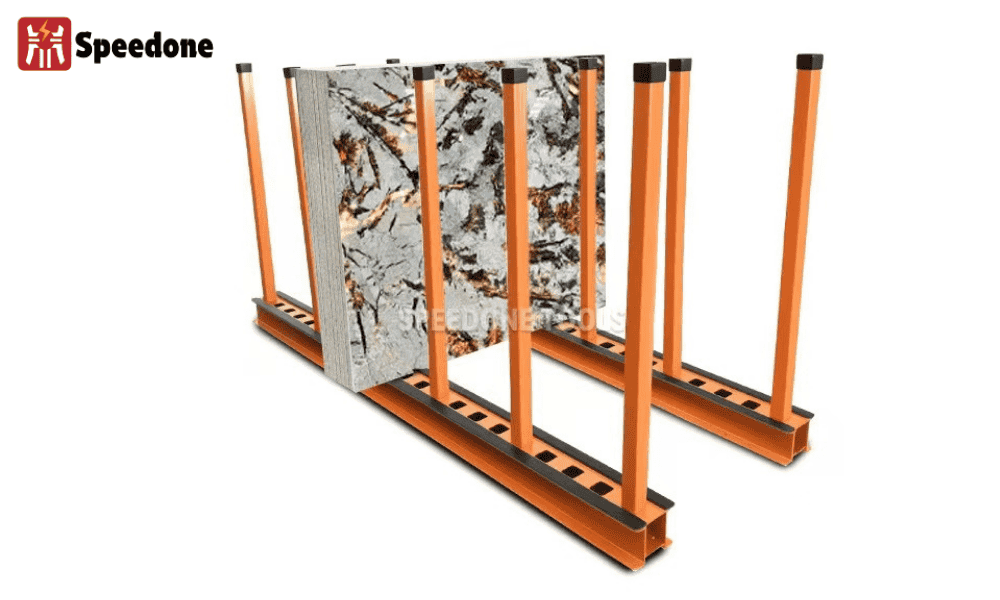
Plattenständer
The Difference Between Passive Storage and Productive Storage
Not all storage is equal. Some storage simply contains material. Productive storage helps the factory move faster, safer, and smarter.
Here is a practical comparison.
| Storage Factor | Passive Slab Storage | Productive Heavy Duty Slab Rack System | Operational Impact |
|---|---|---|---|
| Space Use | Slabs spread loosely or inconsistently | Defined rack zones improve density | More usable floor area |
| Handling Frequency | Frequent repositioning to access target slab | Better access reduces re-handling | Less labor waste |
| Sicherheit | Unclear support, cluttered traffic, unstable grouping | Structured support and cleaner aisles | Lower accident exposure |
| Slab Protection | Edge contact and awkward movement increase risk | Stable support helps preserve condition | Fewer damage events |
| Retrieval Speed | Time lost locating and reaching stock | Categorized storage improves picking | Faster production response |
| Expansion | Hard to scale without disorder | Modular rack logic supports growth | Better long-term planning |
| Workflow Integration | Storage detached from plant flow | Rack layout aligned with cutting and loading | Higher throughput efficiency |
That table is simple, but its consequences are not. A plant that upgrades from passive storage to productive storage usually sees gains in three hidden categories: time, control, and confidence. Time improves because movement is reduced. Control improves because inventory access becomes more logical. Confidence improves because the team stops working around storage chaos.
The Pain Points Heavy Duty Slab Racks Solve
Most buyers do not search for a new rack because they suddenly developed a hobby for steel structures. They search because something in the current workflow is annoying, expensive, or unsafe.
Pain Point 1: Floor space disappears too quickly
This is the classic complaint. The warehouse looks full long before actual capacity should be reached. In many cases, the issue is not lack of building size but poor storage density and poor aisle planning.
That is why a topic like Wasting Space, Wasting Time: How a Professional Slab Rack System Can Reclaim 2,000 Sq Ft & 50 Hours/Month resonates so strongly. The framing is sharp because it reflects reality: storage waste and time waste are usually twins.
Pain Point 2: Slab retrieval takes too long
If employees or forklift operators spend too much time locating, reaching, and isolating one slab, then the storage layout is acting like a bottleneck.
Pain Point 3: The plant feels risky during busy hours
When unloading, in-house transport, cutting preparation, and dispatch all share overlapping paths, risk rises fast. OSHA’s guidance on warehousing hazards and stone slab handling makes clear that planning, safe movement paths, and equipment-appropriate handling are essential.
Pain Point 4: Slabs are safe in theory, but vulnerable in practice
A slab may be stationary and still be at risk if rack support, area cleanliness, spacing, or traffic discipline is weak. Stationary does not mean safe. It just means the accident has not happened yet.
Pain Point 5: Expansion becomes chaotic
As inventory grows, weak storage logic multiplies confusion. One bad rack decision becomes ten bad layout habits.
Layout Design Is Where Rack Performance Becomes Real
A slab rack is only as useful as the layout around it. Even an excellent rack can perform badly in a poor traffic plan. Good storage design should consider not only rack type but also slab flow, forklift turning radius, unloading sequence, picking zones, and safe clearance.
That is why Wie Sie ein sicheres und effizientes Slab Rack Layout für Ihre Fabrik entwerfen is such an important topic. The layout question is where strategy meets reality.
A strong slab rack layout usually follows these principles:
-
Separate incoming, stored, and ready-for-processing slabs
-
Keep aisles clear and wide enough for actual handling equipment
-
Store high-frequency materials where access is easiest
-
Avoid forced backtracking routes for forklifts or carts
-
Reduce cross-traffic between storage and fabrication zones
-
Match rack type to slab size, weight, and handling method
-
Build visibility into the storage plan so retrieval is quick
That may sound obvious, but factories often miss it because storage areas evolve little by little instead of being designed properly from the start. Plants do not usually fail in one dramatic moment. They fail by tolerating dozens of small inefficiencies until those inefficiencies become “normal.”
Two Product Examples That Show Why Specification Still Matters
All rack strategy sounds nice until you ask the practical question: what kind of heavy duty rack is actually suitable for modern stone plants?
This is where product-level options matter.
For plants prioritizing compact stability and strong support geometry, the AJ-R 90 Degree A-Frame Slab Rack is relevant because it is positioned as a 20-ton-capacity, anti-slip, heavy-duty A-frame solution. That tells buyers three useful things right away: it is designed for substantial load, it addresses slab stability, and it fits an industrial rather than decorative storage context.
For buyers who need larger-scale, corrosion-resistant, multi-material heavy storage, the CXCC-G Heavy Duty Galvanized Slab Rack A-Frame is notable because Speedone presents it as a galvanized A-frame rack with 66,000+ lb capacity and suitability for stone and glass storage. That combination matters for plants balancing strength, durability, and broader warehouse application.
The lesson here is simple: rack selection should match plant reality. Not every factory needs the same rack footprint, finish, or load profile. But every serious stone plant needs equipment designed for actual stone conditions, not improvised substitutes.
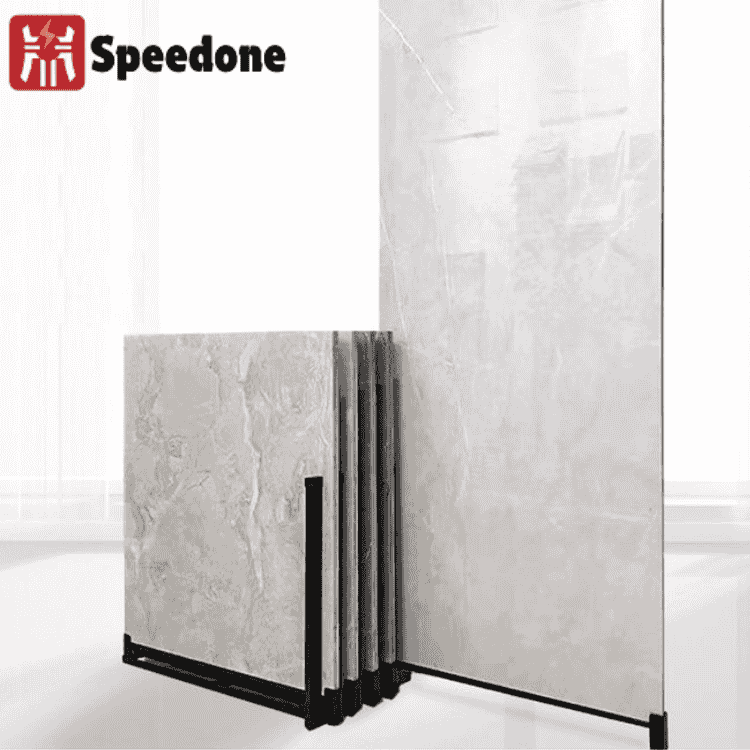
Plattenständer Lieferant
What Buyers Should Ask Before Choosing a Slab Rack Supplier
Before sending inquiries, buyers should ask questions that connect rack design to plant performance.
Ask about real load conditions
Can the rack safely support your actual slab types, thicknesses, and storage density goals?
Ask about layout support
Does the supplier understand aisle flow, handling paths, and traffic interaction, or do they only provide standalone product specs?
Ask about surface environment
Will the rack be used indoors, outdoors, near moisture, or in high-traffic loading areas? This affects finish and durability.
Ask about slab access strategy
How easily can your team retrieve common materials without repeated re-handling?
Ask about safety features
Are anti-slip support, structural stability, and secure slab positioning built into the design intent?
Ask about implementation
Can the supplier support planning, not just supply?
And when the discussion reaches that stage, a direct Contact Speedone conversation becomes much more useful than another generic brochure PDF.
Five Questions Buyers Commonly Search Before Upgrading Slab Storage
Was ist das beste Plattenregal für Steinwerke?
Das beste Regalsystem für Platten hängt von dem Lastprofil Ihrer Anlage, den Abmessungen der Platten, der Häufigkeit des Abrufs sowie den layoutbedingten Einschränkungen ab. Generell benötigt eine leistungsstarke Industrieanlage ein robustes Regalsystem, das strukturelle Stabilität, sicheren Zugang und Kompatibilität mit den tatsächlichen Handhabungsmethoden gewährleistet. Ein gutes Regal ist nicht nur stark; es muss auch einen reibungsloseren Warenfluss im Lager unterstützen und wiederholte Bewegungen reduzieren.
Warum ist die robuste Plattenlagerung in Steinwerken wichtig?
Schwere Lagerung ist wichtig, weil Steinplatten groß, schwer, zerbrechlich und von hohem Wert sind. Ein schwaches oder schlecht konzipiertes Lagersystem erhöht das Risiko von Plattendefekten, ineffizienter Handhabung, Engpässen in den Gängen sowie Sicherheitsvorfällen. In modernen Anlagen tragen Plattenregale dazu bei, sowohl den Bestand als auch die Effizienz des Arbeitsablaufs zu schützen.
Wie können Plattengestelle die Effizienz im Lager verbessern?
Ein gut durchdachtes Regalsystem steigert die Effizienz im Lager, indem es den Bestand übersichtlicher organisiert, unnötige Bewegungen von Paletten reduziert, nutzbare Bodenfläche freigibt und die Wiederauffindung beschleunigt. Zudem unterstützt es Betriebe dabei, sauberere Verkehrswege für Gabelstapler, Wagen und Mitarbeiter zu schaffen, was versteckte Verzögerungen verringert.
Sind A-Rahmen-Plattenregale besser für Granit, Marmor und Quarz?
A-Rahmen-Plattenregale sind weit verbreitet für Granit, Marmor, Quarz und ähnliche Materialien, da sie eine aufrechte Lagerung mit einer stabilen Traggeometrie ermöglichen. Ob sie die beste Wahl sind, hängt von der Plattengröße, den Handhabungsgeräten und den Zielen hinsichtlich der Lagerrichtung ab; für viele Steinbetriebe gehören sie jedoch zu den praktischsten Hochleistungs-Lagerformen.
Wie entwerfe ich ein sicheres Regallayout für Platten in einer Fabrik?
Eine sichere Regalanordnung sollte Gänge frei halten, Lagerzonen nach Arbeitsablaufstufen trennen, eine gefahrlose Bewegung von Geräten ermöglichen, den Querverkehr minimieren und die Regalplatzierung an tatsächliche Handhabungsmuster anpassen. Die Sicherheitsvorschriften der OSHA zu stabiler Lagerung und klaren Durchgängen sind hier äußerst relevant, insbesondere in Umgebungen mit schweren Materialien.
The Strategic View: Storage Is Not a Side Issue
The strongest stone plants do not treat slab storage as a side issue. They understand that storage determines how smoothly the rest of the plant can operate. If slabs are hard to access, everything slows down. If routes are confusing, safety margin shrinks. If storage density is weak, expansion gets expensive. If rack quality is poor, product protection suffers.
That is why heavy duty Brammengestell systems matter in modern stone plants. They sit quietly, but they influence almost everything: usable space, handling discipline, labor effort, slab safety, traffic clarity, and production rhythm.
And that brings us back to the opening conversation on the factory floor. When managers ask why the plant feels crowded, slow, or riskier than it should, the answer is often not hidden inside the saw room. It is sitting in the storage zone.
Fix the rack logic, and the plant usually starts behaving like a better plant.
Referenzen
-
CNSpeedone product and article materials on slab racks, storage strategy, and stone warehouse layout.
-
OSHA, Hazards of Transporting, Unloading, Storing and Handling Granite, Marble and Stone Slabs.
-
OSHA, 1926.250 General Requirements for Storage.
-
OSHA, Warehousing – Hazards and Solutions.
-
NIOSH, Ergonomic Guidelines for Manual Material Handling.
-
HSE, Warehousing and Storage: A Guide to Health and Safety.
-
OSHA, Materials Handling and Storage guidance.
-
Industry guidance on warehouse ergonomics and heavy-material movement.
-
Stone handling safety best practices for slab transport and storage.
-
Material handling safety guidance for industrial storage environments.

Henry
Hallo, ich bin der Autor dieses Beitrags, und ich habe in diesem Bereich für mehr als 16 Jahre gewesen. Wenn Sie OEM & ODM-Service für Steinwerkzeuge benötigen, zögern Sie nicht, mir irgendwelche Fragen zu stellen.