Realice su trabajo con eficacia





Choosing the right stone export packaging is essential for protecting granite and marble slabs during storage, container loading, ocean transportation, and final delivery. An effective slab packaging system combines stable support structures, surface protection, edge protection, secure restraints, and organized warehouse handling to reduce breakage and improve export efficiency.
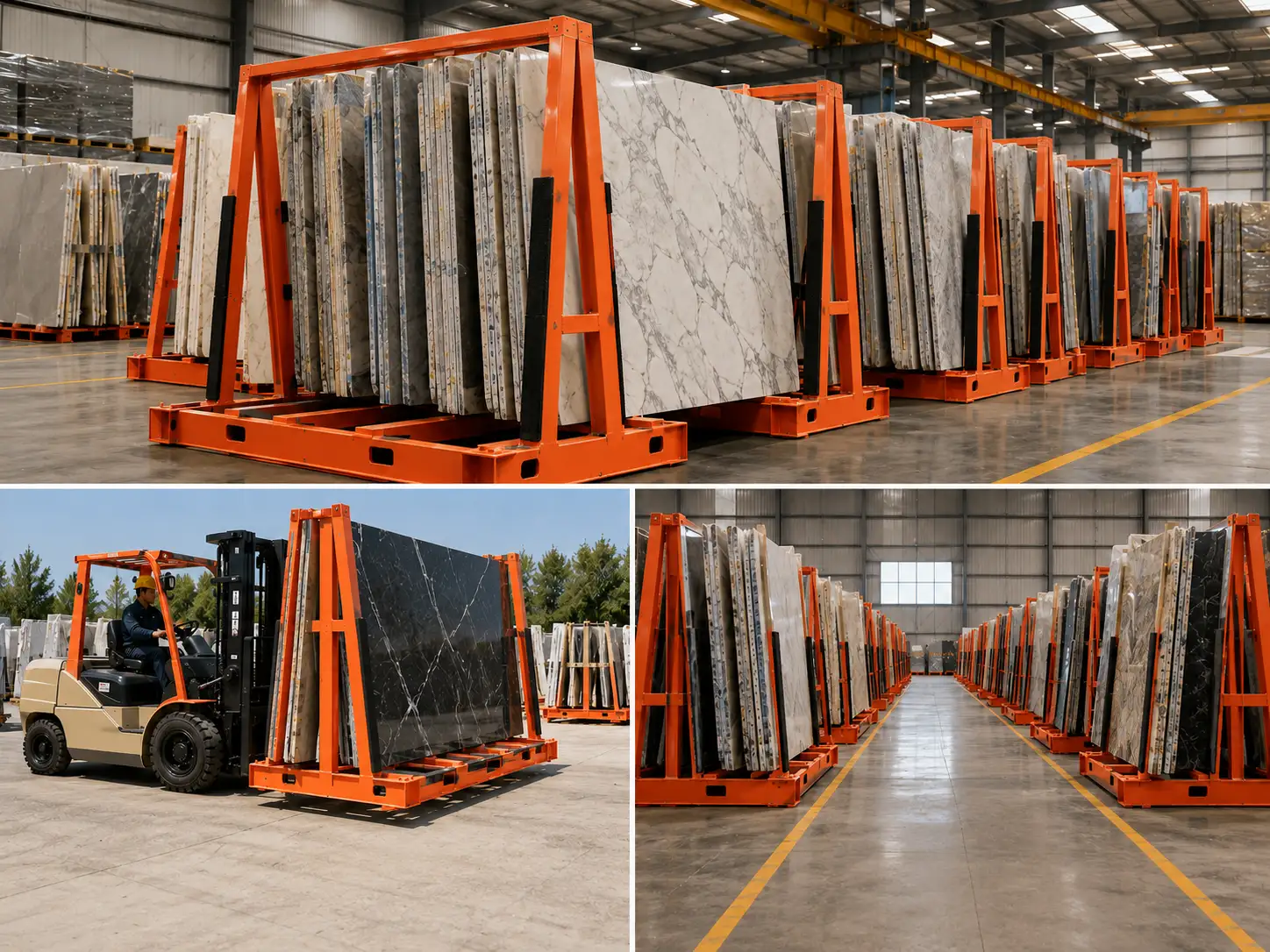
Granite and marble slabs travel through multiple handling stages before reaching an international customer. They may move from production lines to warehouse storage, from storage racks to packing areas, and eventually into trucks or shipping containers. At every stage, improper handling can result in scratches, chipped edges, cracks, or complete slab failure.
For this reason, professional stone export packaging should be considered a complete protection system rather than simply wrapping stone with plastic or placing it inside a wooden crate. A reliable slab packaging system should protect the material during storage, lifting, loading, transportation, and unloading while making the entire logistics process easier to manage.
Why Granite and Marble Require Specialized Export Packaging
Natural stone presents an unusual combination of weight and fragility. Granite slabs can be extremely heavy, while marble may be more sensitive to scratching, edge damage, and impact. Large-format slabs also create considerable leverage when they are lifted or transported vertically.
International transportation introduces additional challenges. Cargo may experience road vibration, repeated container handling, port operations, temperature changes, humidity, and continuous movement during ocean shipping.
A professional packaging strategy therefore needs to address several risks simultaneously:
- Slab movement during transportation
- Edge and corner impact
- Surface-to-surface friction
- Contact between stone and steel structures
- Moisture exposure
- Unbalanced load distribution
- Damage during forklift or crane handling
What Makes a Good Slab Packaging System?
The best packaging solution depends on slab size, material type, shipment quantity, transportation method, and destination. However, most professional systems combine several layers of protection rather than relying on one packaging component.
| Packaging Component | Main Function | Typical Risk Reduced |
|---|---|---|
| Steel Slab Rack / A-Frame | Structural support | Tipping and uncontrolled movement |
| Foam or Rubber Separators | Separate stone surfaces | Scratches and vibration damage |
| Corner Protectors | Protect vulnerable edges | Chipping and corner breakage |
| Protective Film | Protect finished surfaces | Surface scratches and contamination |
| Straps and Restraints | Secure slab bundles | Load shifting during transportation |
| Wooden Blocking | Stabilize packaged loads | Movement inside containers |
Solution 1: Heavy-Duty Steel Slab Racks
Steel slab racks provide one of the most reliable foundations for professional stone packaging and handling. Instead of allowing slabs to lean against temporary supports, racks provide controlled contact points and stable vertical positioning.
The same equipment can also support warehouse organization before the stone is prepared for export. A properly designed rack makes it easier to separate orders, inspect slabs, and access materials without repeatedly moving surrounding inventory.
For factories trying to improve storage efficiency before packing, understanding how a
professional slab rack system can improve workshop space utilization
can help connect warehouse organization with the export workflow.
Solution 2: A-Frame Support for Large Stone Slabs
A-frame structures are particularly useful for large granite and marble slabs because the angled support helps maintain a stable vertical position. The stone should rest against protected contact surfaces rather than directly against exposed steel.
Depending on the application, rubber padding, timber strips, or other cushioning materials can be installed at contact points. The rack itself should have sufficient rated capacity for the intended load and should remain stable throughout handling.
Using an appropriate A-frame does not eliminate the need for restraints. Slabs should still be secured to prevent movement during loading and transportation.

Solution 3: Surface Protection Between Slabs
Polished marble and granite surfaces can be damaged without the slab itself breaking. Fine scratches, abrasion, or contamination may be enough for a customer to reject premium finished material.
Protective film and soft separators can be placed between finished surfaces. The protection material should remain clean because trapped stone particles or metal debris may create scratches when slabs move slightly during transportation.
A complete protection system may include:
- PE protective film
- Foam sheets
- Soft rubber separators
- Corrugated protection boards
- Non-abrasive padding
Solution 4: Edge and Corner Protection
Slab edges and corners are particularly vulnerable during export. Even when the center of the slab is well supported, an impact against a container wall, rack, forklift component, or neighboring slab may chip an exposed edge.
Corner guards and edge protectors create an additional buffer between the stone and external forces. Protection should be positioned before straps are tightened so that restraint pressure is not concentrated directly on vulnerable stone edges.
Storage Safety Is Part of Export Packaging
Export packaging should not begin only when a container arrives. Stone can already be damaged while waiting in the warehouse, particularly when slabs are stored in overcrowded areas or on unsuitable supports.
Professional
slab storage racks for safer and more efficient workshops
can help maintain stable slab positions while providing clearer access for inspection and order preparation.

Solution 5: Organize the Packing Area Around Material Flow
An efficient packaging area should minimize the distance slabs travel between storage, inspection, protection, packing, and container loading. Every unnecessary movement introduces another opportunity for impact or operator error.
Factories should maintain sufficient aisle width for forklifts and lifting equipment while separating pedestrian traffic from heavy slab handling routes. Packaging materials should also be positioned close to the working area so employees do not leave slabs temporarily unsupported while searching for supplies.
A well-planned
safe and efficient slab rack layout
can reduce unnecessary movement and create a more predictable workflow from storage to export preparation.
Solution 6: Secure Slabs Without Creating Excessive Pressure
Straps are essential for preventing slab movement, but more tension is not always better. Excessive restraint pressure concentrated on an unprotected edge can itself contribute to stone damage.
Straps should be used together with suitable edge protection, cushioning materials, and structural supports. The objective is to prevent movement while distributing restraint forces appropriately across the packaged load.
Granite vs Marble: Should Packaging Be Different?
The basic principles are similar, but packaging should account for the characteristics of each material. Granite is generally associated with high strength and weight, while many marble varieties require particular attention to polished surfaces, edges, natural veins, and potentially vulnerable areas.
| Packaging Factor | Granito | Mármol |
|---|---|---|
| Structural Support | Very important due to high weight | Very important |
| Surface Protection | Important for polished slabs | Especially important for finished surfaces |
| Edge Protection | Required | High priority |
| Slab Separation | Recommended | Strongly recommended |
Solution 7: Keep Export Orders Clearly Separated
Mixing slabs from different projects in the same storage area can lead to unnecessary handling and packing errors. Export orders should be grouped and clearly identified before final packaging whenever practical.
For stone showrooms or warehouses where products must remain visible and accessible,
using slab display racks for organized slab storage
can support easier identification while reducing repeated material movement.
Solution 8: Choose A-Frame Storage for Heavy Export Orders
For large export orders, the structural support system becomes increasingly important. Multiple granite or marble slabs create substantial combined weight, and temporary or undersized supports may become unstable when slabs are added or removed.
A properly selected A-frame should match the dimensions and total weight of the slabs being handled. Contact surfaces should also be protected so that stone edges and polished faces do not rest directly against exposed steel.
Factories handling valuable slabs can reduce unnecessary storage risk by understanding
why professional A-frame storage racks are important for stone protection
before establishing an export packing area.
Solution 9: Standardize the Stone Storage Method Before Packing
Consistency is one of the most effective ways to improve a slab packaging system. If different employees store and prepare slabs using different procedures, the risk of incorrect positioning, insufficient protection, or unnecessary handling increases.
A standardized workflow should define where incoming slabs are stored, how individual orders are separated, how slabs are retrieved, where protective materials are installed, and how finished bundles move toward the loading area.
Using a consistent
stone storage method with A-frame racks
can create a more predictable transition from warehouse storage to export preparation.
Solution 10: Prepare the Container Before Loading
Good stone export packaging can still fail if the shipping container is not prepared correctly. Before loading begins, the container should be inspected for structural damage, moisture, floor defects, protruding objects, contamination, or other conditions that could affect the shipment.
The loading team should establish a load plan before moving the first bundle. The plan should consider total cargo weight, individual bundle weight, container capacity, weight distribution, loading sequence, and the expected unloading process at the destination.
Heavy stone cargo should be positioned so that the container remains appropriately balanced. Empty spaces that could allow packaged slabs or racks to shift should be addressed with suitable blocking or restraint methods.
Solution 11: Protect the Cargo From Movement
One of the primary objectives of export packaging is to prevent uncontrolled movement. Stone may be extremely heavy, but its weight alone does not guarantee stability during international transportation.
Road transport, crane handling, vessel movement, braking, and vibration can generate forces in several directions. Slab racks, A-frames, straps, blocking, and other restraint systems therefore need to work together as one package.
Solution 12: Consider Moisture Protection
International shipments may experience changing temperatures and humidity during warehouse storage, inland transportation, port handling, and ocean freight. Depending on the stone, finish, packaging materials, and destination, moisture control may therefore form part of the export packaging plan.
Protective wrapping can help keep surfaces clean and reduce environmental exposure, while suitable moisture-control materials may be considered where required. However, wrapping should never be treated as a substitute for structural support and restraint.
Solution 13: Inspect the Complete Package Before Shipment
Before any granite or marble shipment leaves the factory, the complete package should undergo a final inspection. This should cover both the stone itself and the equipment supporting it.
| Inspection Point | What to Check |
|---|---|
| Stone Surfaces | Scratches, contamination and existing damage |
| Edges and Corners | Chips, cracks and protective guards |
| Rack or A-Frame | Structural condition, capacity and stability |
| Separators | Correct positioning and cleanliness |
| Restraints | Condition, positioning and security |
| Labels | Order, material and handling identification |
Solution 14: Photograph the Packing and Loading Process
Photographic records are valuable for both exporters and importers. Images can document the slab condition before packing, protective materials, rack configuration, labels, restraints, and final container arrangement.
For higher-value shipments, consider photographing each completed rack or crate from multiple angles before container loading. Packing and loading records can also help customers understand how the cargo should be approached when the container reaches its destination.
Solution 15: Plan for Safe Unloading at the Destination
Export packaging should not be designed only around the needs of the exporting factory. The importer must eventually remove the slabs safely.
Clear identification of package weight, suitable lifting points, and unloading instructions can make the receiving process more predictable. Restraints should not be removed until the receiving team has evaluated the stability of the cargo and determined whether slabs or bundles may have shifted during transit.
How to Choose the Best Stone Export Packaging Solution
There is no single packaging configuration that is ideal for every shipment. Exporters should evaluate the complete application before selecting the system.
| Factor | Why It Matters |
|---|---|
| Stone Type | Different materials have different sensitivity to impact and abrasion |
| Slab Dimensions | Support structure must match the slab format |
| Slab Thickness | Influences handling and support requirements |
| Acabado superficial | Polished surfaces may require additional abrasion protection |
| Shipment Quantity | Determines rack configuration and loading plan |
| Destination | Affects transport duration, handling stages and packaging requirements |
Build a Complete Packaging Workflow
The most reliable export operations treat packaging as part of a complete stone logistics workflow rather than an isolated final step.
- Inspect incoming or finished slabs.
- Store slabs on suitable racks.
- Separate export orders.
- Move slabs to the packing area with appropriate handling equipment.
- Install surface, edge, and contact-point protection.
- Position slabs on the selected rack or packaging structure.
- Apply suitable restraints.
- Inspect and document the finished package.
- Prepare and inspect the shipping container.
- Load according to the predetermined load plan.
- Complete a final inspection before sealing the container.
This approach helps reduce unnecessary slab movement while making responsibilities easier to define throughout the export process.
Conclusión
Effective stone export packaging is not defined by a single crate, strap, or protective sheet. The strongest solution combines engineered slab support, protected contact points, controlled storage, suitable restraints, planned container loading, and documented inspection. A well-designed slab packaging system protects granite and marble while also improving warehouse organization, loading efficiency, and the predictability of international deliveries.
Share your slab dimensions, estimated total load, and handling conditions with Speedone. Contact our team for a configuration discussion before finalizing equipment or loading procedures.
Preguntas frecuentes
What is the best packaging method for granite and marble slabs?
The best method depends on slab dimensions, weight, material characteristics, shipment quantity, and transportation conditions. Professional systems commonly combine A-frame or slab rack support, surface separators, edge protection, restraints, and controlled container loading.
Why are A-frames used for stone export packaging?
A-frames provide stable support for large slabs in a near-vertical orientation and can help control slab positioning during storage, handling, and transportation when correctly designed and secured.
What should a slab packaging system include?
A slab packaging system can include structural racks or frames, protective film, foam or rubber separators, corner guards, straps, blocking materials, labels, and appropriate container restraints.
How can exporters reduce scratches on polished marble?
Keep contact surfaces clean and use suitable non-abrasive protective film, foam separators, padding, and edge protection between finished slabs and packaging structures.
Should stone packaging be inspected before container loading?
Yes. Exporters should inspect the slabs, racks, protective materials, restraints, labels, and overall package stability before loading and document the condition where appropriate.

Henry
Hola, soy el autor de este post, y he estado en este campo durante más de 16 años. Si necesitas servicio OEM&ODM para herramientas de piedra, no dudes en preguntarme cualquier duda.