Selesaikan Pekerjaan Anda Secara Efisien!





Seorang profesional slab storage system helps stone factories organize granite, marble, quartz, porcelain and engineered stone while improving accessibility, material flow and storage control. The right system may combine fixed slab racks, A-frame racks, mobile storage, staging areas and suitable lifting equipment. Effective penyimpanan lempengan batu should be designed around slab dimensions, load requirements, inventory turnover, aisle width, handling equipment, factory layout and production workflow rather than storage capacity alone.
Ultimate Guide to Slab Storage Systems for Stone Factories
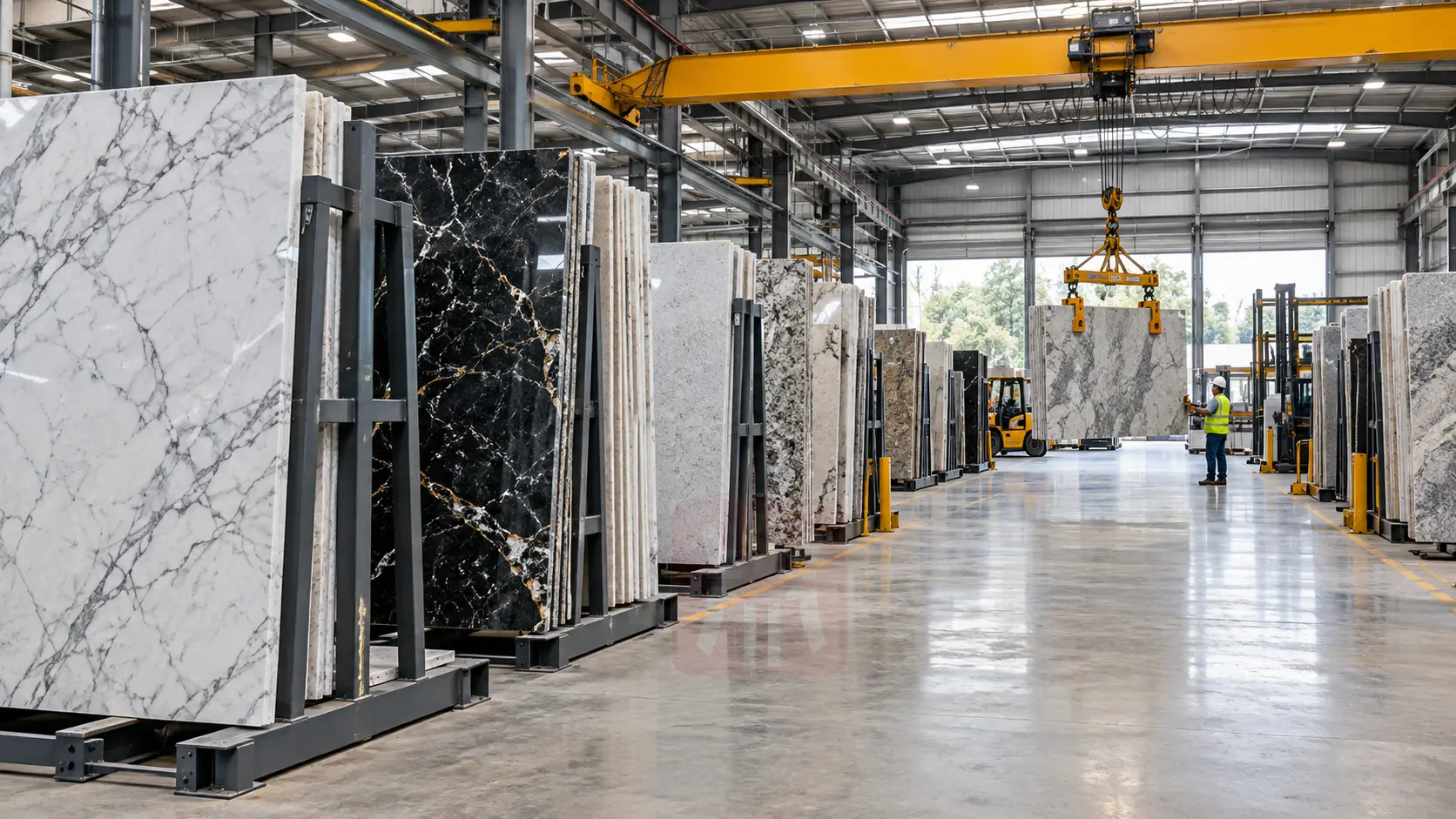
Slab storage system for granite marble and quartz slabs in a stone factory
Dirancang dengan baik slab storage system is one of the most important parts of a professional stone factory. Granite, marble, quartz, porcelain, sintered stone and other slab materials are large, heavy, valuable and difficult to handle. Poor storage can lead to unnecessary slab movement, blocked aisles, edge damage, inefficient use of floor space and serious handling risks.
For stone factories, distributors, fabrication shops and slab warehouses, effective penyimpanan lempengan batu is not simply a matter of buying several metal racks and placing them wherever space is available.
A professional system connects storage equipment with inventory organization, aisle planning, lifting equipment, staging areas, cutting-machine access and finished-product flow.
The objective is straightforward: the correct slab should be identifiable, accessible and movable when production needs it, without forcing workers to repeatedly reposition unrelated materials.
This guide explains how to choose and design a slab storage system, compare different rack types, plan storage capacity, reduce unnecessary handling and select the right [Rak penyimpanan marmer] or other storage equipment for your factory.
What Is a Slab Storage System?
A slab storage system is the combination of physical equipment, storage layout, material-handling methods and inventory organization used to keep large slabs in controlled storage positions until they are required for production, shipment or display.
A complete system may include:
- Fixed slab storage racks.
- A-frame storage racks.
- Mobile slab racks.
- Bundle storage systems.
- Temporary slab staging areas.
- Loading and unloading zones.
- Slab identification and rack numbering.
- Overhead crane access.
- Forklift access.
- Slab transport carts.
- Mobile A-frame transport equipment.
- Safety barriers and aisle markings.
The rack itself is only one part of the system. A strong rack placed in the wrong location can still create inefficient material flow.
For this reason, slab storage should be planned together with the complete factory workflow.
Why Stone Slab Storage Matters
Stone slabs often represent a significant portion of a fabrication company’s physical inventory. Poor storage therefore affects more than warehouse appearance.
It can influence production efficiency, material damage, labor requirements and the amount of useful floor area available to the factory.
A professional stone slab storage system can help reduce:
- Unnecessary slab movement.
- Edge damage.
- Surface scratches.
- Long slab-search times.
- Blocked aisles.
- Repeated crane or forklift movements.
- Production delays.
- Handling congestion.
- Unsafe material-access practices.
Factories trying to improve the complete handling process should treat storage as part of production rather than a separate warehouse activity. This guide to improving stone slab handling efficiency explains how storage, transport and handling can work together as one material-flow system.
Slab Storage System vs a Single Slab Rack
One common purchasing mistake is assuming that buying a heavy-duty rack automatically creates an efficient storage system.
A rack answers one question:
Where can the slabs be physically supported?
A storage system must answer several additional questions:
- How will slabs arrive at the rack?
- How will the required slab be identified?
- How frequently will it be accessed?
- Which lifting equipment will approach it?
- How wide must the aisle be?
- Where will the slab go after removal?
- Where will production-stage slabs be staged?
- How will finished pieces be stored separately?
This distinction is important because the highest-capacity rack is not necessarily the most efficient choice for the factory.
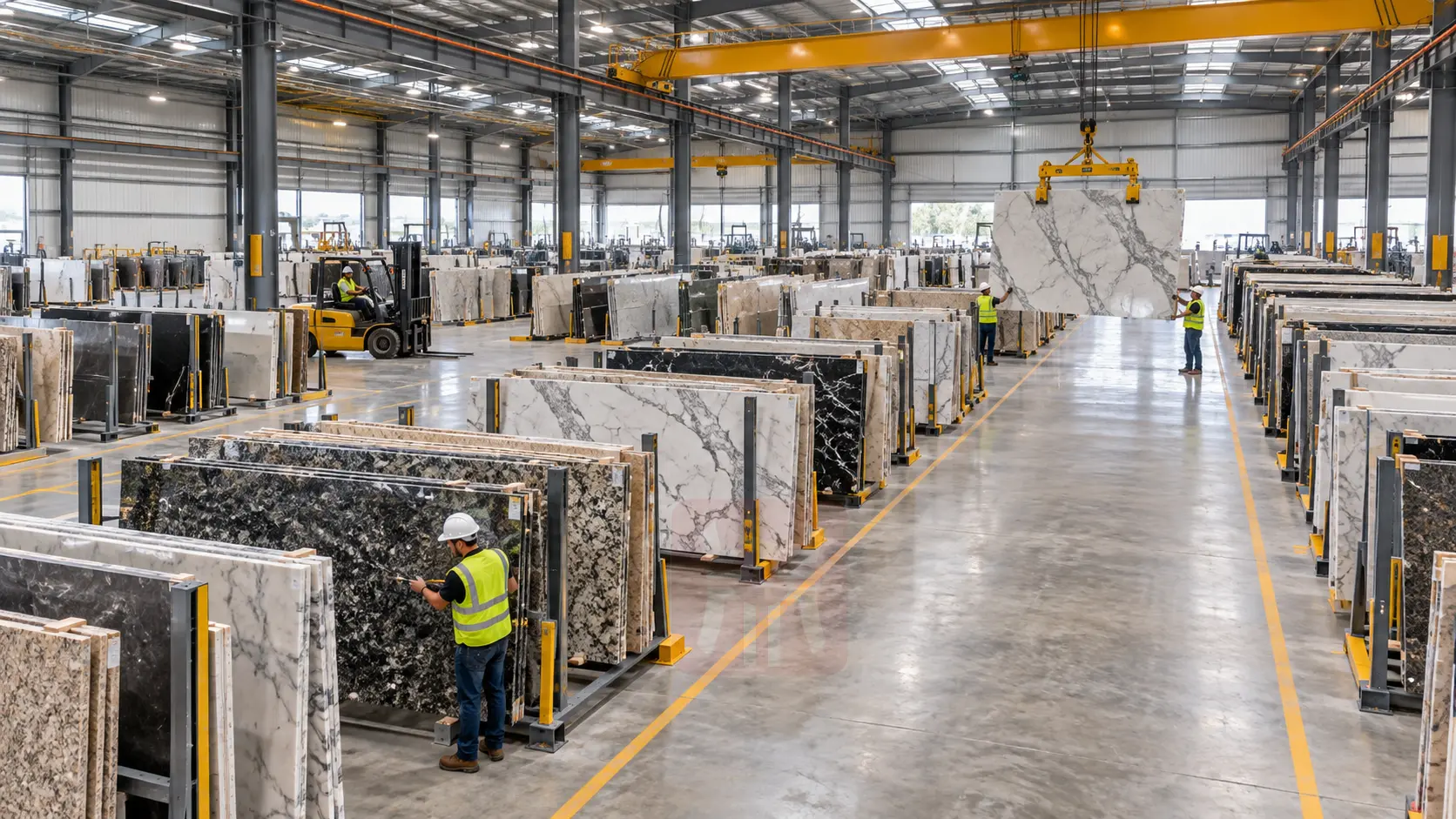
Stone slab storage rack layout with organized granite and quartz slabs
Main Types of Slab Storage Systems
There is no single storage design suitable for every stone business. The best configuration depends on slab dimensions, inventory volume, material weight, turnover rate, available floor space and handling method.
1. Fixed Slab Storage Racks
Fixed slab racks are commonly used for organized main inventory storage. They can be installed in planned rows and divided into storage positions according to material type, project or inventory category.
They are particularly useful when a factory requires predictable permanent storage locations.
Potential advantages include:
- Efficient use of planned storage areas.
- Simple permanent layout.
- Clear inventory organization.
- Compatibility with many stone slab types.
- Ability to create numbered storage zones.
Factories reviewing this type of equipment can also explore Speedone’s slab rack solutions for stone storage.
2. A-Frame Storage Racks
A-frame racks support slabs against one or both sides of a central angled structure.
They are widely used for stone storage, production staging, finished-product holding and loading preparation because the slab surfaces remain accessible from the outside of the frame.
An A-frame may be useful where operators need convenient access to smaller groups of slabs rather than very dense long-term inventory storage.
Factories deciding between the two designs can review this detailed slab rack vs A-frame storage rack comparison.
You can also review A-frame storage rack options when planning dedicated stone-storage or staging areas.
3. Mobile Slab Storage Systems
Mobile storage units can be repositioned as production requirements change.
They may be useful for staging slabs near fabrication areas, transferring selected materials between departments or creating temporary storage where a permanent rack would reduce flexibility.
However, mobile storage requires careful consideration of:
- Floor condition.
- Wheel or caster capacity.
- Load stability.
- Maneuvering space.
- Travel path.
- Operator control.
4. Bundle Storage Systems
Bundle storage systems are intended for facilities that receive or store multiple slabs together.
They may be useful for importers, distributors, slab warehouses and factories handling larger inventory volumes.
However, storage density must be balanced against accessibility. A highly compact bundle arrangement can become inefficient if several groups must be moved whenever production requires a particular slab.
5. Temporary Staging Racks
Temporary staging is often overlooked in slab-storage planning.
A factory may have a well-organized warehouse but still experience congestion if every production machine receives slabs directly from the main inventory area.
A staging rack creates a buffer between storage and fabrication.
Selected slabs for upcoming jobs can be moved to the staging zone in advance, reducing interruptions around cutting machinery.
6. Mobile A-Frame Transport and Storage
Some factories use mobile A-frame equipment for short-distance transport and temporary storage.
This can be useful when the same unit needs to support the material during movement between storage, inspection, fabrication and packaging areas.
Factories considering this workflow can review slab transport A-frame equipment as part of the wider material-handling system.
Slab Storage System Comparison
| Storage Type | Typical Strength | Aplikasi Terbaik | Key Planning Issue |
|---|---|---|---|
| Fixed Slab Rack | Organized permanent storage | Main slab inventory | Rack spacing and slab accessibility |
| Rak A-Frame | Accessible angled support | Storage, staging and finished pieces | Load distribution and access space |
| Mobile Rack | Flexible positioning | Production staging | Floor quality and maneuvering space |
| Bundle Storage | Large-volume inventory | Importers and distributors | Access to individual slabs |
| Temporary Staging Rack | Production buffer | Near cutting or processing areas | Avoiding production-area congestion |
Slab Rack vs A-Frame: Which Is Better?
The choice between a slab rack and an A-frame should be based on factory workflow rather than appearance.
| Factor | Rak Lempengan | Rak A-Frame |
|---|---|---|
| Storage Density | Can be efficient in organized permanent rows | Useful with single- or double-sided loading |
| Aksesibilitas | Depends on spacing and slab order | Often convenient for smaller groups of slabs |
| Layout Flexibility | Best for planned permanent zones | Useful for storage or staging areas |
| Typical Application | Main inventory storage | Storage, production staging and loading preparation |
In many factories, there is no need to choose only one type. Fixed slab racks can manage the main inventory while A-frames handle active jobs, staging and finished components.
How to Choose the Right Marble Storage Rack
A [Rak penyimpanan marmer] should be selected according to the actual characteristics of the material and the factory’s handling process.
Important factors include:
- Maximum slab height.
- Maximum slab width.
- Slab thickness.
- Individual slab weight.
- Total intended rack load.
- Number of slabs per section.
- Support geometry.
- Loading method.
- Floor condition.
- Aisle width.
- Indoor or outdoor environment.
Marble may contain natural veins, fissures and repaired sections. Stable support and controlled handling are therefore important throughout storage and retrieval.
The rack should be selected according to its manufacturer’s rated capacity and intended use rather than assuming that a visually heavy structure can safely support any slab load.
Storage Density vs Accessibility
One of the biggest mistakes in slab warehouse planning is maximizing storage density without considering how workers will actually retrieve the material.
If slabs are packed very tightly, the factory may technically store more material per square meter, but operators may need to move several slabs before accessing the one required for production.
This can increase:
- Handling time.
- Crane movements.
- Forklift movements.
- Labor requirements.
- Material exposure to damage.
- Production waiting time.
The better objective is usable storage capacity, not maximum theoretical capacity.
A professional storage design should balance density with retrieval speed.
This article explains how a professional slab rack system can reduce wasted space and handling time.
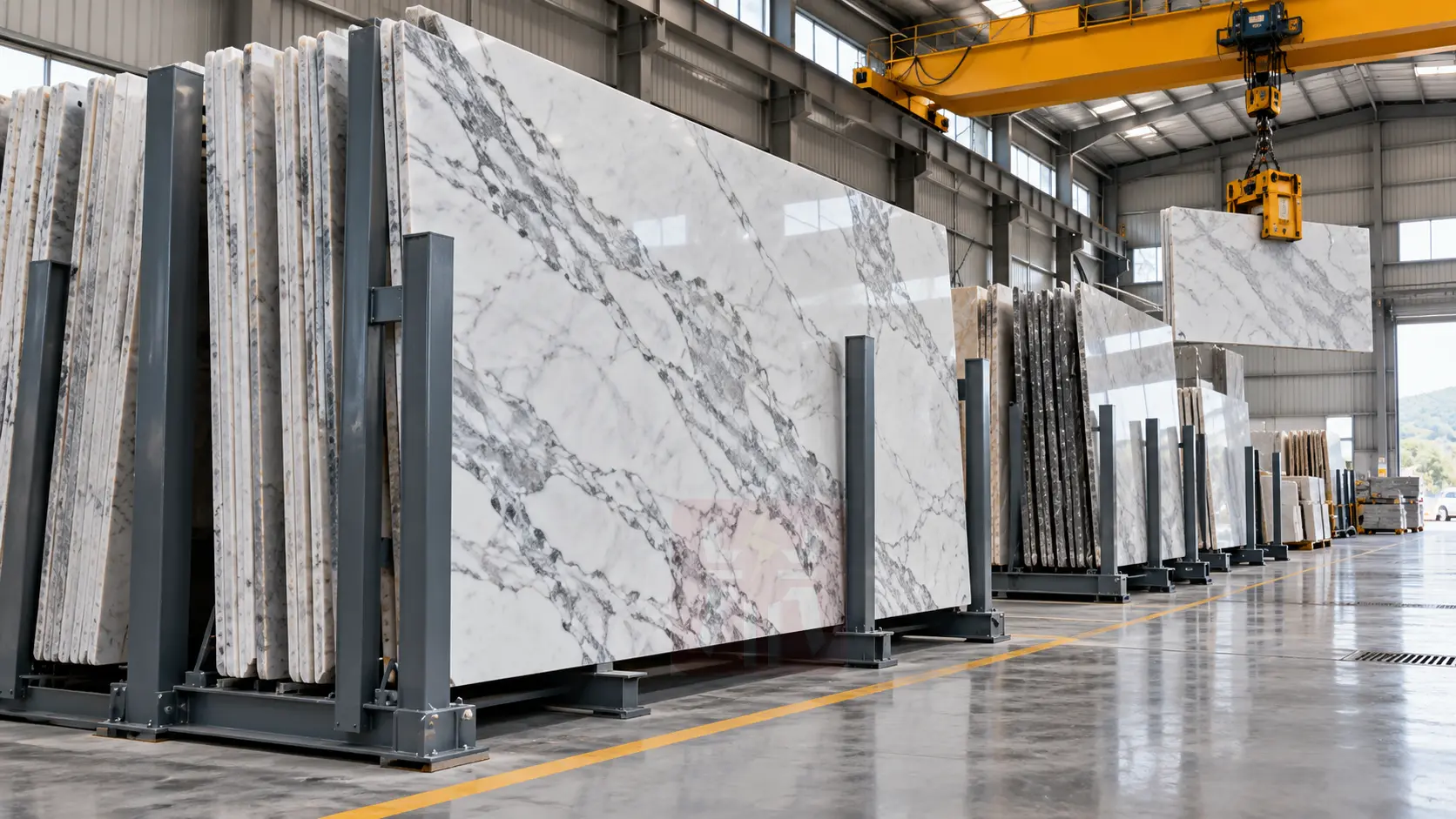
Heavy duty marble storage rack holding large marble slabs in a stone warehouse
How to Design a Slab Storage Layout
The performance of a slab storage system depends heavily on layout.
Before positioning racks, map the complete journey of the material through the facility.
- Truck or container unloading.
- Incoming material inspection.
- Main slab storage.
- Slab identification and selection.
- Production staging.
- Cutting and fabrication.
- Finished-product inspection.
- Finished-product storage.
- Packaging.
- Final loading.
Every unnecessary return movement between these stages creates additional handling.
Important Layout Factors
- Aisle width.
- Overhead crane coverage.
- Forklift turning radius.
- Rack spacing.
- Emergency and pedestrian access.
- Slab label visibility.
- Loading and unloading areas.
- Floor capacity and condition.
- Distance to cutting equipment.
- Space for staging racks.
Factories designing a new storage area or reorganizing an existing warehouse can review this guide on designing a safe and efficient slab rack layout.
Slab Storage and Factory Safety
Stone slabs can create serious hazards when they are stored, accessed or moved incorrectly.
A storage system should therefore be designed to reduce uncontrolled slab movement and provide predictable access procedures.
Basic Storage Safety Considerations
- Use equipment with suitable rated capacity.
- Follow manufacturer loading instructions.
- Do not overload storage sections.
- Maintain clear handling aisles.
- Use suitable lifting and transport equipment.
- Inspect racks for deformation, corrosion or impact damage.
- Keep personnel away from hazardous slab movement zones.
- Use documented handling procedures.
- Train operators for the equipment they use.
Well-designed storage contributes to both handling efficiency and workplace organization. This article explains why slab storage racks play an important role in workshop safety and efficiency.
Why A-Frame Storage Is Important
A-frame storage is particularly useful where slabs or finished stone pieces need temporary support during inspection, production, order preparation or loading.
The angled structure supports material against the frame while keeping the load accessible from the outside.
Typical applications include:
- Raw slab storage.
- Temporary production staging.
- Finished countertop storage.
- Project-order preparation.
- Truck loading preparation.
- Warehouse organization.
Repeatedly repositioning slabs can increase the opportunity for chips, surface contact and edge impact. Factories considering A-frame equipment can review this guide on why A-frame storage racks can help reduce avoidable slab damage.
Organize Slabs by Inventory Type
A good slab storage system should make the inventory easy to identify before workers begin moving material.
Possible classification methods include:
- Material type.
- Color.
- Supplier.
- Thickness.
- Slab dimensions.
- Project assignment.
- Inventory age.
- Reserved or available status.
Larger operations may also use barcode labels, rack numbers or digital warehouse systems to connect physical slab locations with inventory records.
Separate Fast-Moving and Slow-Moving Inventory
Inventory turnover should influence rack position.
A common quartz color used every day should generally be easier to access than a specialty marble slab that may remain in inventory for several months.
A practical warehouse may use separate zones for:
- Fast-moving inventory.
- Project-reserved slabs.
- Slow-moving materials.
- Premium or fragile slabs.
- Remnants.
- Finished products.
This approach helps reduce unnecessary travel distance and repeated reshuffling.
Do Not Mix Raw Slabs and Finished Products Without a Plan
Raw slabs and fabricated countertops have very different handling characteristics.
A raw slab may be large and relatively uniform, while a finished countertop can include:
- Polished edges.
- Sink openings.
- Cooktop cutouts.
- Narrow rails.
- Irregular shapes.
- Customer-specific labeling.
Where practical, finished components should have a dedicated protected storage area.
This helps reduce edge impact, order mixing and contact with large raw materials.
Slab Storage System and Material Handling Equipment
Storage equipment cannot operate efficiently without a suitable method for moving slabs.
Depending on the factory, material may be handled using:
- Overhead cranes.
- Slab lifting clamps.
- Vacuum lifters.
- Forklift attachments.
- Lifting beams.
- Slab transport carts.
- Mobile A-frames.
The storage layout should be designed around the movement requirements of this equipment.
For example, a row arrangement may appear space-efficient in a drawing but fail in practice if the forklift cannot turn, a crane cannot reach the rear rack or the transport cart cannot pass through the aisle.
For short-distance movement inside the factory, gerobak pengangkut lempengan may also form part of the overall storage and production-flow solution.
Fixed vs Mobile Slab Storage
| Fitur | Fixed Storage | Mobile Storage |
|---|---|---|
| Typical Role | Main inventory | Temporary storage or staging |
| Layout Flexibility | Lebih rendah | Higher |
| Floor Planning | Permanent positions | Requires travel and maneuvering space |
| Penggunaan Terbaik | Long-term organized storage | Dynamic production support |
Many factories use both: fixed storage for main inventory and mobile equipment for active production.
How to Calculate Required Slab Storage Capacity
Before ordering racks, calculate both current inventory and realistic future requirements.
Consider:
- Average number of slabs stored.
- Peak seasonal inventory.
- Slab thickness.
- Typical slab dimensions.
- Material categories.
- Project-reserved inventory.
- Expected business growth.
- Required access frequency.
Do not design only around the average inventory count.
A factory with 500 slabs on average but 800 during peak purchasing periods has different storage requirements from a business that remains stable throughout the year.
At the same time, installing substantially more storage than required can consume useful floor space and reduce future production flexibility.
If X, Choose Y: Slab Storage Decision Guide
- If you need permanent high-volume inventory storage: prioritize fixed slab racks.
- If you need easy access to smaller groups of slabs: consider A-frame storage.
- If material frequently moves between production stages: consider mobile racks or transport A-frames.
- If cutting machines are regularly waiting for slabs: add a controlled staging area near production.
- If workers repeatedly move several slabs to reach one piece: improve inventory zoning before simply adding more rack capacity.
- If fast-moving materials travel long distances every day: position them closer to fabrication areas.
- If finished countertops are regularly damaged in storage: create a separate protected finished-product zone.
- If forklift turning space is limited: design the rack layout around actual vehicle dimensions before ordering storage equipment.
Common Slab Storage Mistakes
| Mistake | Potential Result | Better Approach |
|---|---|---|
| Overloading racks | Damage or unsafe storage conditions | Follow rated capacity and manufacturer instructions |
| Aisles too narrow | Poor crane or forklift access | Design aisles around handling equipment |
| No slab labeling | Search time and repeated movement | Number racks and identify inventory positions |
| Mixing finished and raw stone | Higher risk of finished-product damage | Separate storage zones |
| No production staging | Machine-area congestion | Prepare slabs in a dedicated staging zone |
| Ignoring workflow | Excessive slab travel | Design storage around production sequence |
Slab Storage Risk and Control Table
| Risk | Typical Cause | Control Consideration |
|---|---|---|
| Rack damage | Impact or unsuitable loading | Regular inspection and controlled vehicle movement |
| Slab instability | Incorrect storage position or unsuitable rack | Match equipment to slab size, weight and loading method |
| Handling congestion | Insufficient aisle or staging space | Design around crane and forklift operating envelopes |
| Repeated slab movement | Poor inventory organization | Improve zoning, identification and access planning |
| Finished-product damage | Mixed storage with raw materials | Create separate protected storage areas |
How to Improve an Existing Slab Storage System
A complete warehouse redesign is not always necessary.
1. Start with an Inventory Audit
Record the number of slabs, rack positions, high-turnover materials, slow-moving inventory and storage areas that regularly create access problems.
2. Observe Slab Movement
Watch how many times workers reposition slabs before the correct material reaches production.
Repeated reshuffling usually indicates that either inventory zoning or rack accessibility needs improvement.
3. Move Fast-Moving Inventory Closer
Frequently processed materials should normally require less travel than slow-moving specialty stock.
4. Create Production Staging
A dedicated staging area allows upcoming jobs to be prepared without blocking main rack aisles.
5. Improve Rack Identification
Number racks, rack sections and inventory positions so production staff can locate material before beginning the lifting operation.
6. Inspect Existing Equipment
Check racks and A-frames for visible deformation, corrosion, loose components, damaged support areas, impact marks or other conditions that could affect their intended performance.
How to Evaluate a Slab Rack Manufacturer or Supplier
The quotation price should not be the only basis for selecting a slab storage supplier.
Before purchasing, ask the manufacturer to confirm:
- Intended application.
- Rated capacity.
- Recommended loading method.
- Material dimensions supported.
- Steel specifications where relevant.
- Surface treatment.
- Indoor or outdoor suitability.
- Assembly requirements.
- Replacement-part availability.
- Packaging method for export.
- Customization options.
- Inspection and quality-control procedures.
A professional supplier should ask about your application before recommending a rack configuration.
If the discussion begins only with price and never covers slab dimensions, load requirements, aisle space or handling equipment, important design information may be missing.
China Slab Storage Rack Manufacturer and OEM Considerations
Factories, distributors and equipment dealers sourcing slab storage equipment from China often look for a combination of manufacturing capability, customization and export experience.
However, the country of origin alone does not determine whether a rack is suitable.
Buyers should evaluate the individual manufacturer according to engineering communication, fabrication quality, material specifications, load information, welding quality, surface treatment, documentation and consistency between approved drawings and production units.
For OEM projects, provide the supplier with:
- Maximum slab dimensions.
- Maximum intended load.
- Rack length requirements.
- Required storage positions.
- Indoor or outdoor environment.
- Forklift or crane access.
- Available floor dimensions.
- Preferred finish or color.
- Destination market.
Providing this information before quotation is much more useful than asking only for “a heavy-duty marble storage rack.”
Maintenance and Lifecycle Management
Storage equipment should remain part of the factory’s inspection program after installation.
Inspection frequency depends on operating conditions, traffic, environment, manufacturer recommendations and company procedures.
Areas worth checking include:
- Visible deformation.
- Impact damage.
- Corrosion.
- Loose fasteners.
- Damaged protective surfaces.
- Floor contact or anchoring conditions where applicable.
- Signs that the rack is being used differently from its intended design.
Equipment should also be reviewed after an unusual impact or loading event rather than waiting for the next routine inspection.
Questions to Ask Before Buying a Slab Storage System
- What materials will be stored?
- What are the maximum slab dimensions?
- What is the maximum individual slab or bundle weight?
- How many slabs must normally be stored?
- What is peak inventory?
- How frequently are slabs accessed?
- Will the system be installed indoors or outdoors?
- Will slabs be moved with a crane, forklift or cart?
- What aisle width is available?
- What is the floor condition?
- Does production require a temporary staging area?
- Will raw slabs and finished pieces be separated?
- Is future factory expansion expected?
These questions help determine whether the factory needs fixed slab racks, A-frame storage, mobile racks, bundle storage or a combination of several systems.
Soft CTA: Plan the Storage System Before Requesting a Quotation
Before requesting prices for slab storage equipment, prepare a simple factory-storage brief.
Include your largest slab dimensions, typical slab weight, maximum inventory, handling equipment, aisle width, available floor area, indoor or outdoor environment and photos or drawings of the proposed storage location.
This information allows the supplier to evaluate the application rather than simply quoting a standard rack that may not match the workflow.
For factories planning a wider storage upgrade, the most useful starting point is to map the complete slab journey from unloading to storage, cutting, fabrication and final loading.
References and Safety Resources
- Occupational Safety and Health Administration, 29 CFR 1910.176 — Handling Materials, General.
- Occupational Safety and Health Administration — Hazards of Transporting, Unloading, Storing and Handling Granite, Marble and Stone Slabs.
- Natural Stone Institute — stone fabrication and slab-handling safety resources.
- Equipment manufacturers’ rated-capacity, installation, inspection and operating instructions.
- Applicable local workplace, material-handling and building requirements.
Catatan Akhir / Catatan Praktis
Yang terbaik slab storage system is not simply the rack with the greatest theoretical capacity. A professional system must balance storage density, slab accessibility, handling safety, inventory control, lifting equipment and production flow. Stone factories should design storage around the complete journey of the slab from unloading and inventory to cutting, fabrication, packaging and final loading. Combining suitable slab racks, A-frame storage, staging areas, clear aisles and organized inventory control can reduce unnecessary material movement and create a more efficient stone-processing facility.
Frequently Asked Questions About Slab Storage Systems
1. What is the best slab storage system for a stone factory?
The best slab storage system depends on slab dimensions, material weight, inventory volume, available floor space, handling equipment and production workflow. Many factories use fixed slab racks for main inventory and A-frame or mobile storage for staging and active production.
2. What is the difference between a slab rack and an A-frame rack?
A fixed slab rack is commonly used for organized permanent storage, while an A-frame supports slabs against an angled central structure and can be useful for accessible storage, staging or finished products. The best choice depends on the factory layout and how often slabs must be accessed.
3. How should marble slabs be stored?
Marble slabs should be stored on equipment designed for the intended dimensions and loads, with stable support and controlled handling access. Because marble may contain natural veins or fissures, the storage and handling method should minimize uncontrolled movement and impact.
4. How can a stone factory increase slab storage capacity?
A factory can increase effective capacity by improving rack layout, organizing inventory by turnover rate, reducing unnecessary material movement, improving rack identification and selecting storage equipment that matches actual slab dimensions and handling methods.
5. Are A-frame racks better than slab racks?
Neither type is universally better. Fixed slab racks are often useful for permanent inventory storage, while A-frame racks can provide convenient access for smaller groups of slabs, production staging and finished products. Many factories use both.
6. How wide should slab storage aisles be?
Aisle width should be determined by the dimensions and operating requirements of the crane, forklift, transport cart or other handling equipment used in the facility. It should not be selected from a generic number without considering the actual equipment and site conditions.
7. How often should slab storage racks be inspected?
Inspection frequency should reflect operating conditions, traffic, environment, manufacturer recommendations and company safety procedures. Racks should also be checked after impacts, unusual loading events or whenever visible damage is discovered.
8. What information should I give a slab rack manufacturer before ordering?
Provide the maximum slab dimensions, intended load, number of slabs or bundles, available floor area, aisle width, handling method, indoor or outdoor environment, required rack configuration and any future expansion requirements.

Henry.
Hai, saya penulis posting ini, dan saya telah berkecimpung di bidang ini selama lebih dari 16 tahun. Jika Anda membutuhkan layanan OEM & ODM untuk alat batu, jangan ragu untuk bertanya kepada saya.