





Manual Slab Handler for Granite & Marble Slabs
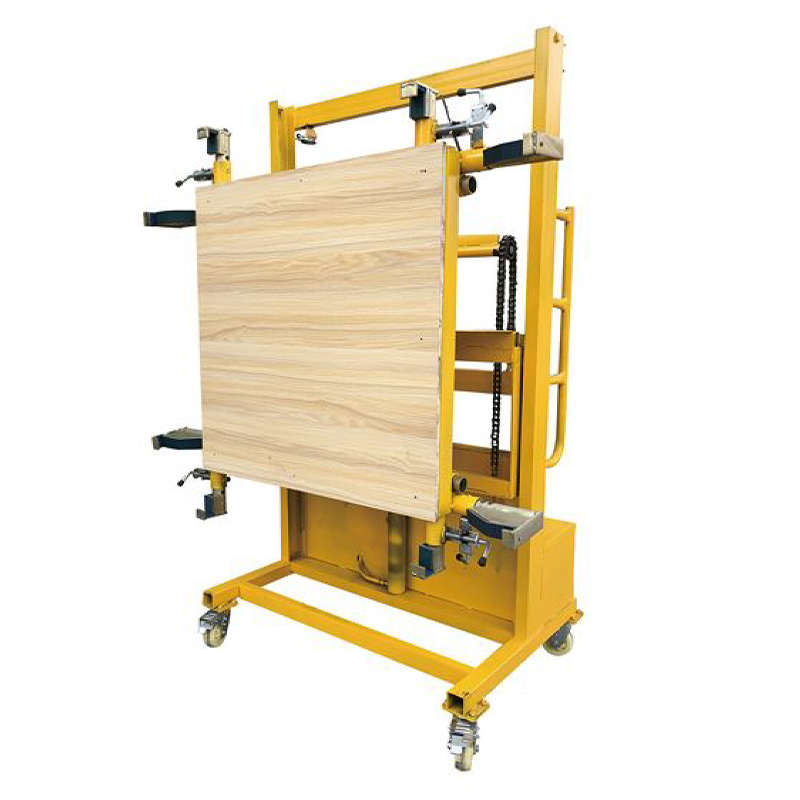
Slab Handler by Manual | Safe & Efficient Stone Slab Handling – Speedone
- Model : ZBJ-D
- Size : 1260*960*2100mm
- Net weight : 330kg
- Load-bearing : 400kg
Product Description
Speedone ZBJ-D Manual Slab Handler for Granite and Marble Slabs
Handling large stone slabs inside a fabrication workshop is not simply a transportation problem. Operators may need to move, raise, lower, position, and transfer heavy panels between storage, processing, inspection, and display areas while minimizing unnecessary direct manual handling.
The Speedone ZBJ-D Manual Slab Handler is designed for this type of workshop workflow. Unlike electrically powered slab-handling equipment, the ZBJ-D is specified without an accumulator or electric motor. Its manual operating concept provides a simpler option for stone businesses that do not require a powered system for every handling cycle.
With a rated capacity of 400 kg, published overall dimensions of 1260 × 960 × 2100 mm, and compatibility with large slabs up to 3300 × 2300 mm according to the current specification, it provides a clearly defined option for professional stone handling applications.
 |
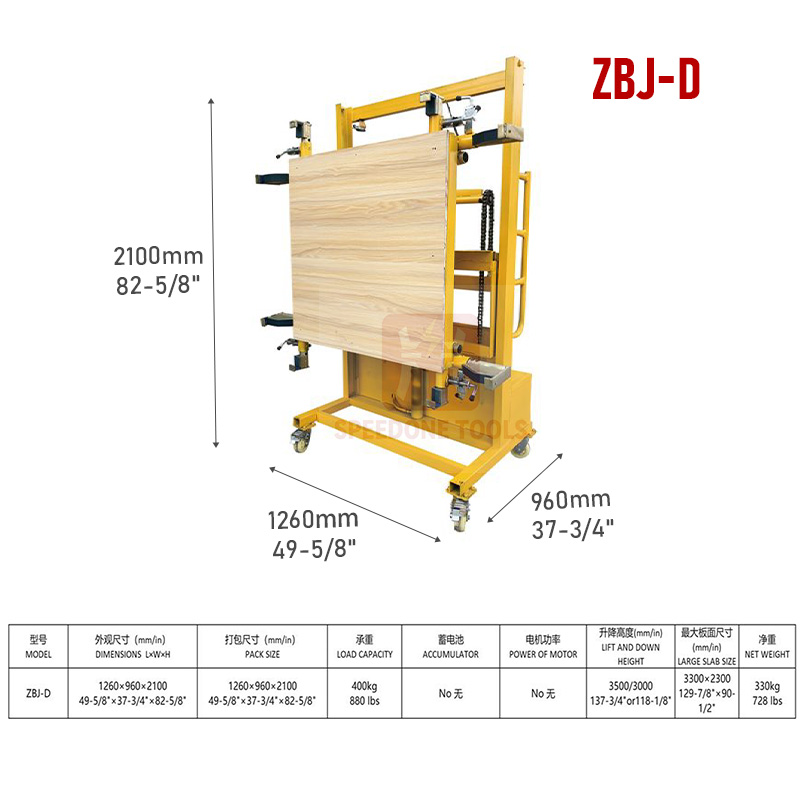 |
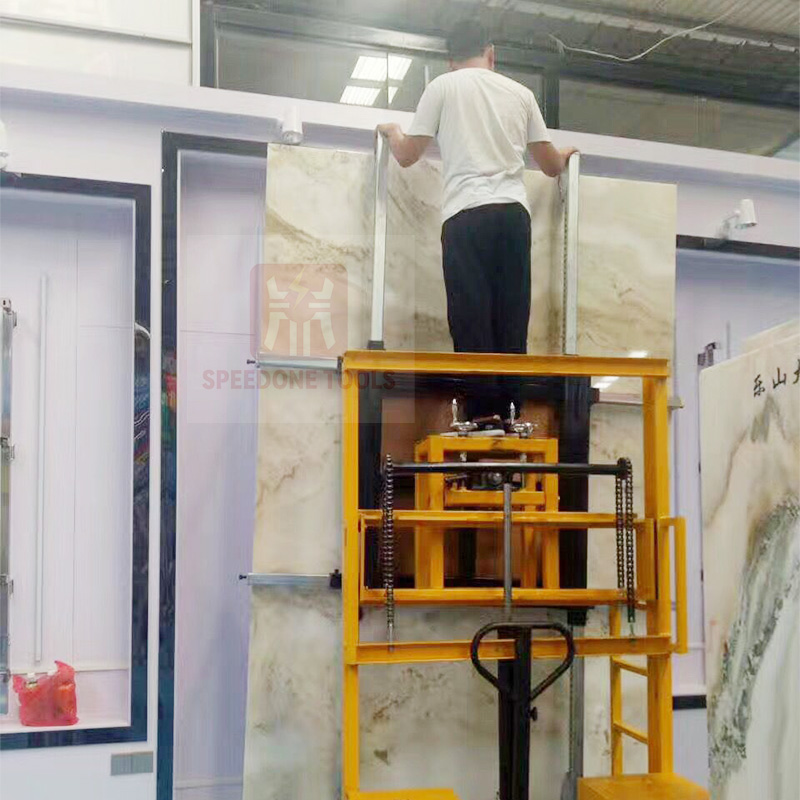
| Speedone ZBJ-D product dimensions and workshop application | |
ZBJ-D Technical Specifications
| Specification | ZBJ-D |
|---|---|
| Product Type | Manual Slab Handler |
| Model | ZBJ-D |
| Overall Dimensions | 1260 × 960 × 2100 mm / 49-5/8″ × 37-3/4″ × 82-5/8″ |
| Pack Size | 1260 × 960 × 2100 mm / 49-5/8″ × 37-3/4″ × 82-5/8″ |
| Rated Load Capacity | 400 kg / 880 lbs |
| Accumulator | No |
| Electric Motor | No |
| Published Lift / Down Height | 3500 / 3000 mm / 137-3/4″ or 118-1/8″ |
| Published Large Slab Size | 3300 × 2300 mm / 129-7/8″ × 90-1/2″ |
| Net Weight | 330 kg / 728 lbs |
Important: “3500/3000 mm” is reproduced from the current product specification under “Lift and Down Height.” Buyers requiring an exact working-height definition should confirm the current technical drawing and operating configuration before ordering.
What Is a Manual Slab Handler?
A manual slab handler is a mechanically operated material-handling unit designed to assist with moving and positioning large stone slabs without relying on an electric drive motor.
The purpose is different from directly carrying a slab by hand. The equipment provides a dedicated structure for controlling the material while operators use the handler according to its intended operating method.
The ZBJ-D is specifically identified as a manual model because the current specification lists:
- Accumulator: No
- Power of Motor: No
This makes it suitable for buyers who want a comparatively simple slab handling system without battery charging or an electric drive system.
What Does “Manual” Mean on the ZBJ-D?
For the ZBJ-D, “manual” means that the product does not use the accumulator and electric motor found on powered slab handler models.
It should not be interpreted as meaning that workers are expected to lift a 400 kg stone slab directly by hand. The equipment is intended to provide mechanical assistance and a controlled handling structure while remaining non-electric.
How Does the Manual Slab Handler Fit Into a Stone Workshop?
Stone fabrication involves several stages where slabs may need to be repositioned before or after processing. A manual slab handler can support these internal material movements where the slab weight and dimensions remain within the equipment specification.
Slab storage area
↓
Manual slab handling and positioning
↓
Fabrication / inspection area
↓
Manual slab transfer
↓
Finished material staging or display
The exact operating sequence depends on the workshop layout, stone dimensions, processing equipment, and required material movement.
What Does the 400kg Rated Capacity Mean?
The ZBJ-D has a published rated load capacity of 400 kg / 880 lbs.
This means slab selection should start by confirming the actual material weight. A slab should not be selected for handling simply because its dimensions fit within the listed 3300 × 2300 mm maximum slab size.
Buyers should consider both:
- Maximum slab dimensions
- Actual slab weight
A very large thin panel and a smaller thick granite slab can have completely different weights.
How to Estimate Stone Slab Weight
If the exact slab weight is not available, buyers can make an initial estimate using slab dimensions, thickness, and the density of the actual material.
Slab Weight = Length × Width × Thickness × Material Density
Use consistent units and the density specified for the actual stone or panel material. Granite, marble, quartz, and other materials do not necessarily have identical densities.
Verified slab weight should be used whenever possible before selecting or operating handling equipment.
What Slab Size Can the ZBJ-D Handle?
The current Speedone specification lists a large slab size of up to 3300 × 2300 mm.
However, dimensional compatibility is only one part of selection. Buyers should also confirm:
- actual slab weight,
- slab thickness,
- material type,
- slab condition,
- required working height,
- workshop floor condition,
- and the space available for positioning the loaded equipment.
What Materials Can the Manual Slab Handler Be Used For?
The current product description is focused primarily on common stone fabrication materials such as:
- Granite slabs
- Marble slabs
- Quartz slabs
- Similar compatible stone or panel materials
For other panel materials, compatibility should be confirmed according to actual weight, dimensions, surface condition, and the equipment’s current technical specification.
Can the ZBJ-D Handle My Slab?
| Buyer Check | Current ZBJ-D Information |
|---|---|
| Slab Weight | Must remain within the published 400 kg rated capacity |
| Slab Dimensions | Published large slab size up to 3300 × 2300 mm |
| Required Working Height | Current table lists 3500 / 3000 mm under lift/down height |
| Power Requirement | No accumulator and no electric motor |
| Workshop Space | Allow for 1260 × 960 × 2100 mm equipment dimensions plus operating clearance |
Why Choose a Manual Slab Handler?
No Electric Motor or Accumulator
The ZBJ-D does not depend on a powered motor or accumulator according to the current technical table. This can simplify operation for workshops that do not require an electrically driven handling system.
400kg Capacity for Common Workshop Applications
The published 400 kg rating makes the product suitable for compatible stone slabs used within its specified load and dimensional limits.
Designed Around Large Stone Panels
The listed maximum slab dimensions of 3300 × 2300 mm make the product relevant to professional stone fabrication environments handling full-size panels.
Defined Equipment Footprint
At 1260 × 960 × 2100 mm, buyers can evaluate the ZBJ-D against their actual workshop aisles, workstations, doors, storage areas, and slab-processing layout before ordering.
Manual vs Electric Slab Handler
Manual and electric slab handlers solve related material-handling problems but target different operating priorities.
| Factor | Manual Slab Handler | Electric Slab Handler |
|---|---|---|
| Power System | No electric motor on ZBJ-D | Powered system depending on model |
| Accumulator | No | Depends on electric model |
| Operating Complexity | Simpler non-electric configuration | Additional powered components |
| Typical Workflow | Low-to-moderate handling frequency | Higher-frequency handling depending on model |
| Best Selection Basis | Simple handling workflow and non-electric operation | Higher throughput or powered movement requirements |
For workshops requiring powered slab handling, Speedone also offers the
Slab Handler by Electric Elevators for Granite, Marble, Glass & Panel Lifting
and the
Electric Slab Handler for Granite, Marble, Glass, Wood and Other Panels
for applications requiring a different operating method.
|
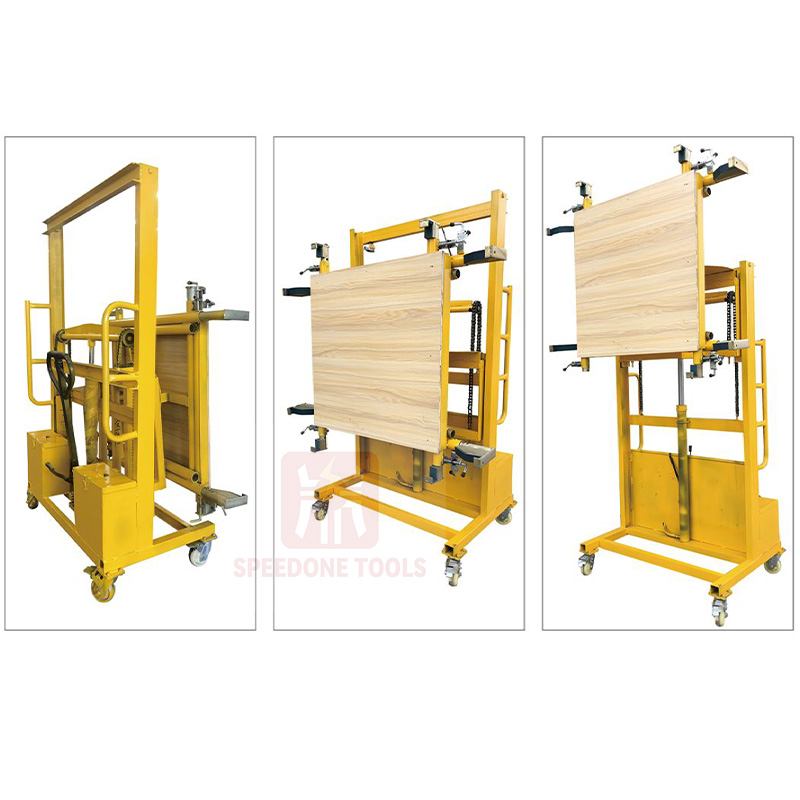 |
| Speedone ZBJ-D manual slab handler application and product views | |
How the ZBJ-D Fits Into a Complete Slab Management Workflow
Efficient stone handling involves more than one piece of equipment. A typical slab workflow may require dedicated equipment for handling, storage, and customer presentation.
After slabs are moved or positioned with the ZBJ-D, warehouse inventory can be organized using the
Adjustable Quartz Granite Stone Slab Metallic Storage Rack
.
For customer-facing slab presentation, the
Horizontal Slab Display Rack with K-Corrosion Protection
provides another solution focused on display rather than active slab handling.
For smaller samples and showroom presentation, Speedone also offers the
Metal Ceramic Tile and Stone Quartz Sample Display Stand
and the
High-End Whole House Sample Color Card Display Stand
.
Workshop Space Planning
The ZBJ-D itself measures 1260 × 960 × 2100 mm, but buyers should not plan only around the equipment footprint.
Also consider:
- maximum slab width and height,
- loaded turning and positioning clearance,
- aisle width,
- door opening dimensions,
- processing-machine access,
- storage rack clearance,
- operator working space,
- and pedestrian routes.
A product that physically fits into the workshop may still be difficult to use if the loaded slab leaves insufficient operating clearance.
Pre-Use Manual Slab Handler Checklist
- Confirm that the slab weight is within the 400 kg rated capacity.
- Check slab dimensions against the published 3300 × 2300 mm maximum size.
- Inspect the stone for visible cracks or damage before handling.
- Inspect the handler structure for visible deformation or damage.
- Check all operating and load-supporting components before use.
- Confirm the floor is suitable for the intended movement.
- Clear the intended travel route.
- Maintain adequate clearance around the slab.
- Avoid sudden or uncontrolled slab movement.
- Keep personnel away from areas where a slab could fall or tip.
- Do not exceed the rated capacity.
- Follow the current operating instructions supplied with the equipment.
Common Buyer Mistakes
Choosing by Slab Dimensions Alone
The ZBJ-D lists a large slab size of 3300 × 2300 mm, but buyers must also check the 400 kg capacity. Size compatibility does not automatically mean weight compatibility.
Assuming “Manual” Means Workers Carry the Slab
The ZBJ-D is a manual handling machine. It should not be confused with direct manual slab carrying.
Ignoring Equipment Weight
The ZBJ-D itself weighs 330 kg. This matters when planning shipping, workshop flooring, handling during installation, and relocation.
Ignoring Workshop Clearance
A large slab may extend far beyond the basic equipment footprint. Layout planning should use the loaded configuration, not only the empty machine dimensions.
Choosing Manual Equipment for the Wrong Production Volume
A non-electric handler may be appropriate for some low-to-moderate-frequency workflows, while businesses requiring higher throughput may prefer to compare electric slab handler models.
What Information Should You Provide Before Ordering?
| Required Information | What to Provide |
|---|---|
| Material Type | Granite / marble / quartz / other |
| Maximum Slab Weight | kg |
| Maximum Slab Size | Length × height × thickness |
| Required Working Height | mm |
| Daily Handling Frequency | Number of slab movements per shift |
| Workshop Layout | Aisle width, door width and available operating space |
| Preferred Operation | Manual or electric |
Frequently Asked Questions
What is the load capacity of the Speedone ZBJ-D Manual Slab Handler?
The ZBJ-D has a published rated load capacity of 400 kg / 880 lbs.
What is the maximum slab size for the ZBJ-D?
The current specification lists a large slab size of 3300 × 2300 mm. Final suitability must also consider actual slab weight and the operating configuration.
What are the dimensions of the ZBJ-D?
The overall dimensions are 1260 × 960 × 2100 mm.
How much does the manual slab handler weigh?
The published net weight is 330 kg / 728 lbs.
Does the ZBJ-D use an electric motor?
No. The current technical specification lists no electric motor.
Does the ZBJ-D use an accumulator or battery system?
No. The current specification lists the accumulator as “No.”
What does “manual slab handler” mean?
It refers to a non-electric slab handling system operated without the electric motor and accumulator used on powered models. It does not mean that workers should manually carry heavy slabs by hand.
What is the lifting height of the ZBJ-D?
The current technical table lists 3500/3000 mm under “Lift and Down Height.” Buyers requiring a precise interpretation of these two values should confirm the current Speedone technical drawing before ordering.
Can the ZBJ-D handle granite and marble?
Yes. The current product description is designed around granite, marble, quartz, and similar compatible slab-handling applications, provided the material weight and dimensions remain within the applicable limits.
Should I choose a manual or electric slab handler?
A manual system may suit workshops that prefer a simpler non-electric configuration and low-to-moderate handling frequency. Electric models may be more suitable where higher throughput or powered operation is required.
What information should I provide before requesting a quotation?
Provide the material type, maximum slab dimensions, maximum slab weight, required working height, daily handling frequency, workshop layout, and whether manual or electric operation is preferred.
Related Products
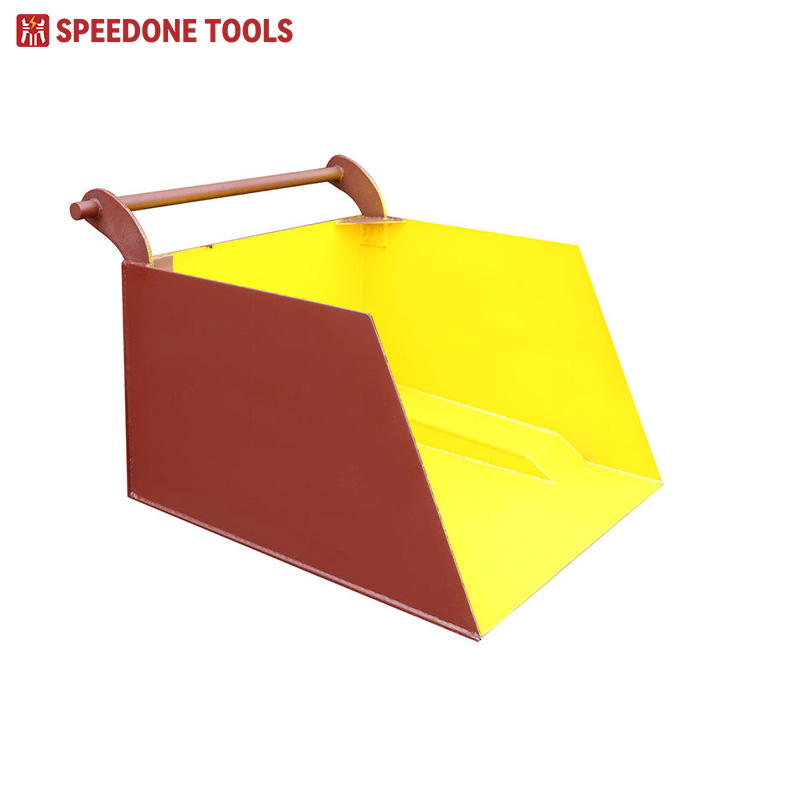

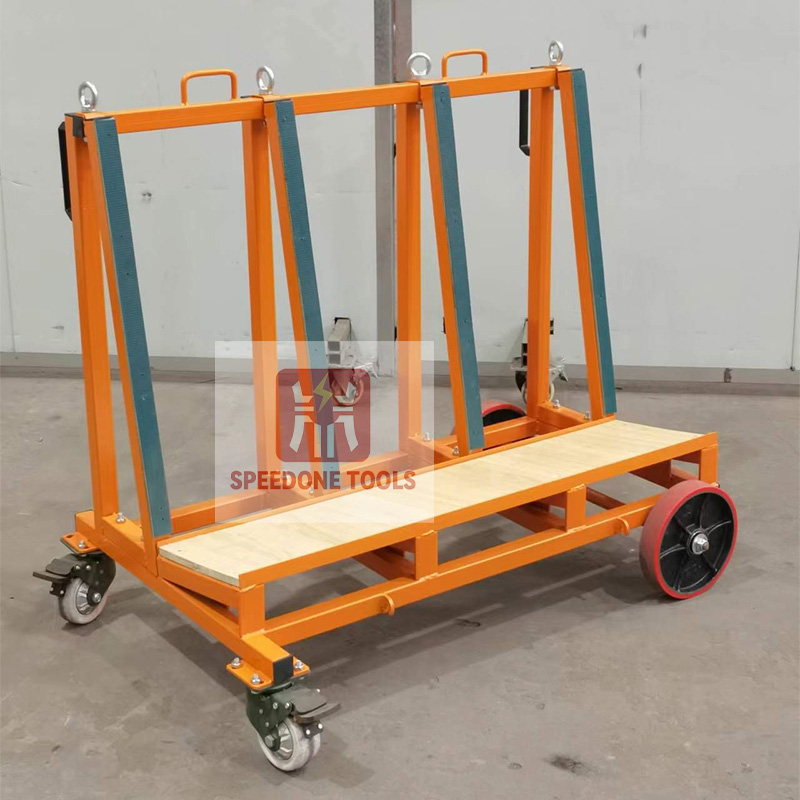
Stone Fabrication Table
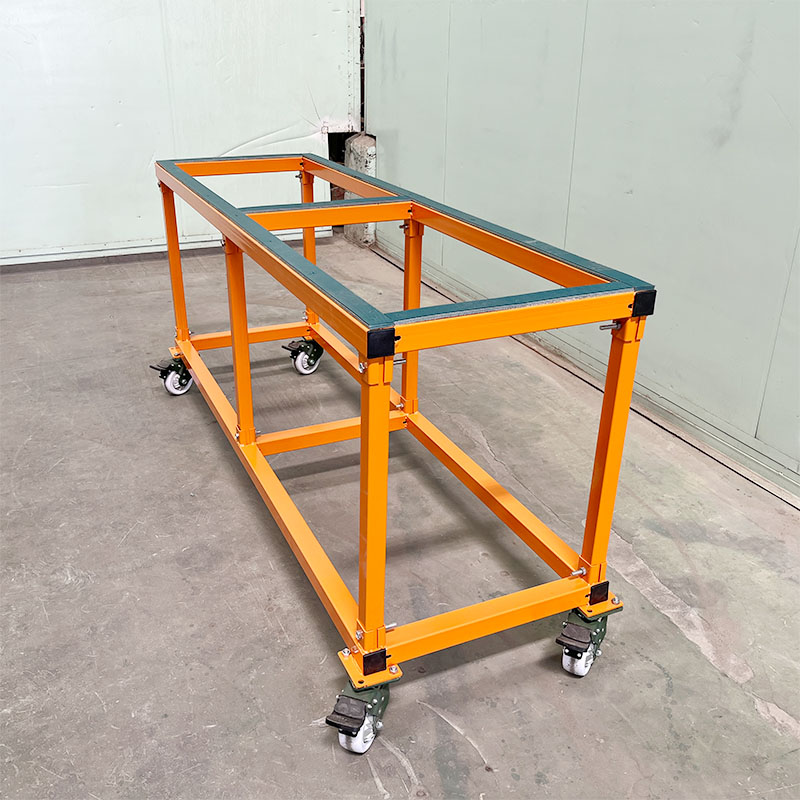
Granite Fabrication Table
Expert Commentary & Analysis
The strongest SEO and AI-citation advantage of the ZBJ-D is not a generic claim such as “easy to use.” It is the combination of clearly published engineering data: 400 kg capacity, 1260 × 960 × 2100 mm equipment dimensions, 3300 × 2300 mm slab compatibility, 330 kg equipment weight, and a completely non-electric configuration.
For buyers, slab size and slab weight should always be evaluated together. A slab may fit inside the 3300 × 2300 mm dimensional specification while still exceeding 400 kg because of its thickness or material density.
The second important decision is manual versus electric operation. The ZBJ-D is most relevant where a workshop specifically values a simpler non-electric handling system. If slab movement frequency becomes high enough that manual operation affects throughput, an electric model should be compared rather than simply selecting a larger manual unit.
Buyer takeaway: select the ZBJ-D according to the complete workflow—slab weight, slab size, required working height, daily movement frequency, workshop clearance and preference for manual versus electric operation—not simply because the equipment is described as a manual slab handler.