Faça o seu trabalho de forma eficiente!





To successfully fabricate quartz countertop surfaces, a professional fabrication factory needs more than accurate cutting. The complete workflow includes project measurement, slab inspection, layout planning, precise quartz cutting, sink and cooktop cutouts, edge profiling, grinding, polishing, seam preparation, safe material handling, final inspection, and proper packaging. A standardized workflow helps fabricators improve dimensional accuracy, reduce unnecessary material waste, protect finished surfaces, and maintain consistent production quality.
How to Fabricate Quartz Countertops: Complete Factory Process Guide
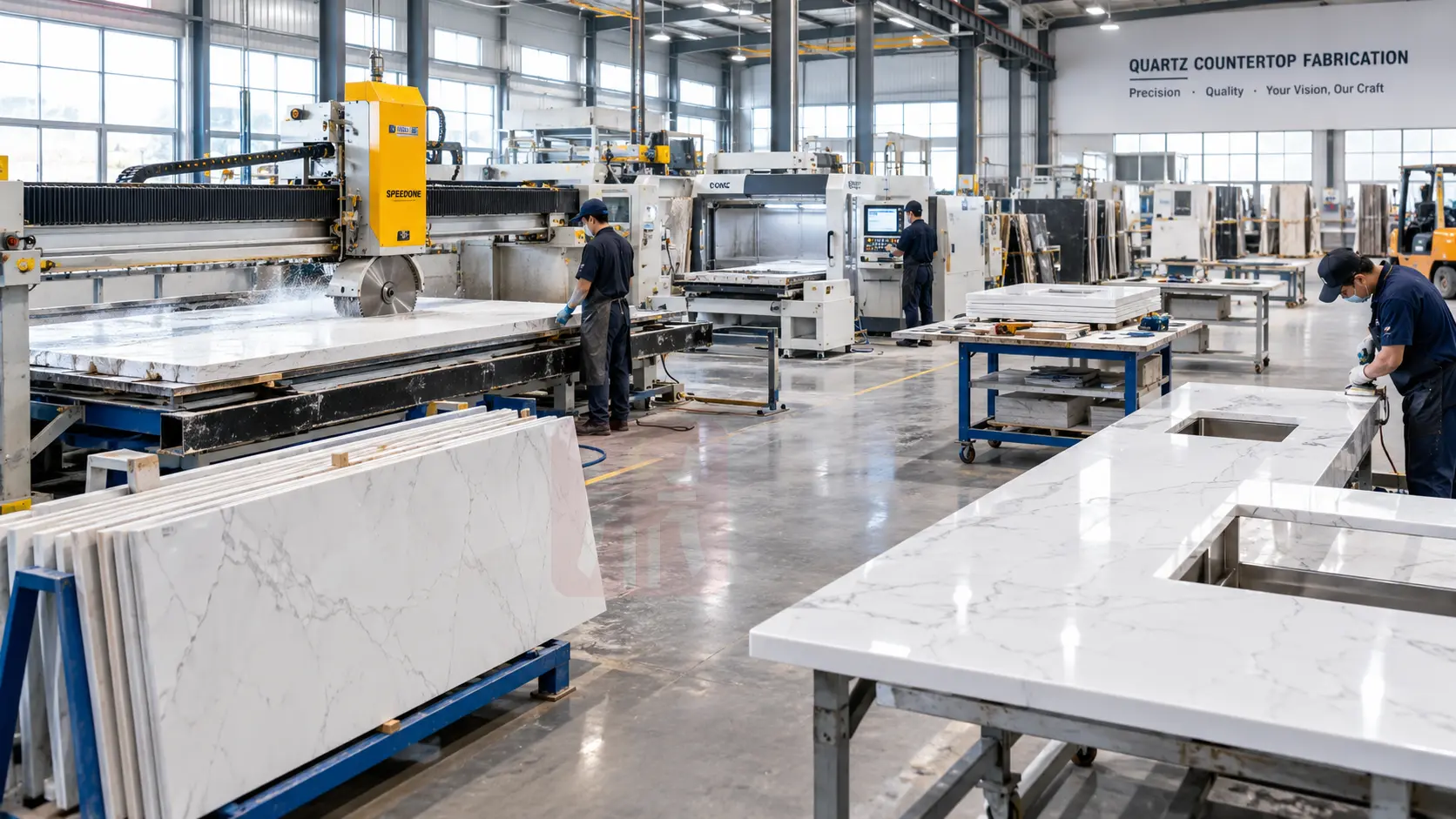
Quartz countertop fabrication process in a professional stone factory
Learning how to fabricate quartz countertop surfaces involves much more than cutting a quartz slab into the required dimensions. Professional quartz countertop fabrication combines accurate project measurement, slab inspection, material layout, controlled quartz cutting, sink and cooktop cutouts, edge profiling, grinding, polishing, seam preparation, quality control, and safe transportation.
Quartz countertops are widely used in residential kitchens, bathrooms, hotels, commercial buildings, apartments, property developments, and other interior projects. Because quartz slabs are large, heavy, and relatively expensive, fabrication factories need a controlled process from the moment a slab enters the workshop until the finished countertop is packaged for installation.
For a professional fabricator, the objective is not simply to produce one correctly sized countertop. The real objective is to establish a repeatable production system that can handle different project drawings, slab sizes, edge profiles, cutouts, colors, patterns, and production volumes without creating unnecessary rework or material damage.
This guide explains the complete quartz countertop fabrication process and provides practical guidance for fabricators, stone processing factories, distributors, contractors, and purchasing teams that want to improve production efficiency and material handling.
Quartz Countertop Fabrication Process Overview
A typical professional workflow can be divided into several connected stages. Each stage affects the next one, so mistakes made early in the process can become more expensive later.
| Fabrication Stage | Main Objective | Key Quality Check |
|---|---|---|
| Measurement & Drawing Review | Confirm project dimensions | Dimensions, corners, overhangs, cutouts |
| Slab Inspection | Confirm material condition | Color, damage, thickness, pattern |
| Layout Planning | Optimize slab utilization | Pattern direction, seams, cutout positions |
| Quartz Cutting | Produce accurate countertop components | Dimensions, edge condition, cut quality |
| Cutouts | Create sink, cooktop and fixture openings | Template accuracy and corner condition |
| Edge Profiling | Create the required edge design | Consistency and smoothness |
| Grinding & Polishing | Achieve the required finish | Surface quality and finish consistency |
| Seam Preparation | Prepare multi-piece countertops | Alignment and visual continuity |
| Final Inspection | Verify finished product | Dimensions, appearance, packaging |
The production sequence may vary depending on the factory’s equipment and project requirements, but the principle remains the same: accurate planning should happen before irreversible processing begins.
Step 1: Confirm Measurements and Fabrication Drawings
Before cutting a quartz slab, the fabrication team should carefully review the approved project drawings and verify all critical dimensions. This is one of the most important stages when learning how to fabricate quartz countertop products because cutting errors are difficult and sometimes impossible to correct after material has been removed.
The drawing should clearly identify countertop length, depth, thickness, backsplash requirements, corners, sink type, cooktop location, faucet holes, overhangs, edge profiles, and seam positions.
Important details include:
- Overall countertop dimensions
- Wall conditions and corner angles
- Cabinet locations and support positions
- Required overhang dimensions
- Sink and cooktop specifications
- Faucet and accessory hole locations
- Required edge profile
- Seam locations
- Finished thickness and laminated-edge requirements
Digital templates, CAD drawings, laser measurement systems, and CNC production files can improve repeatability. However, critical dimensions should still be reviewed before the slab enters the cutting process.
Step 2: Inspect the Quartz Slab Before Processing
The slab should be inspected before any cutting begins. This allows the fabricator to identify visible defects, transportation damage, color variation, thickness differences, or pattern characteristics that could affect the finished countertop.
A professional inspection should consider:
- Slab length, width, and thickness
- Surface scratches or chips
- Cracks or visible damage
- Color consistency
- Pattern and vein direction
- Edge damage caused during transportation
- Batch number and material specifications
- Visual characteristics that may affect seam matching
For projects requiring several slabs, the fabrication team should verify color and pattern consistency between slabs whenever possible. This is especially important for large kitchen islands, commercial projects, hotels, and other installations where several countertop pieces are visible together.
Slab identification should also be organized. A fabrication factory that knows exactly where each slab is stored can reduce unnecessary handling and prevent operators from moving multiple slabs simply to locate the correct material.
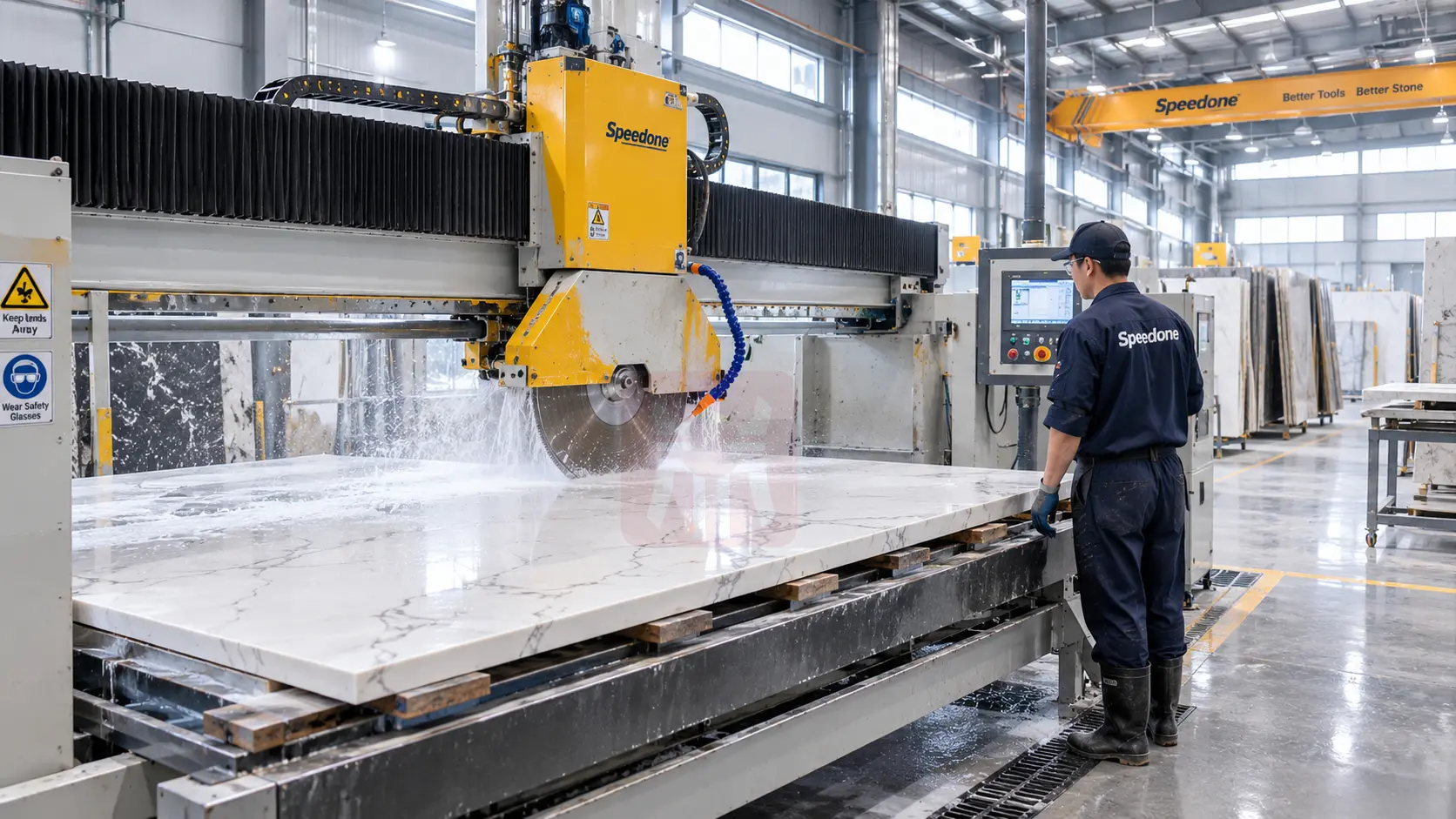
Quartz cutting for countertop fabrication using professional stone processing equipment
Step 3: Plan the Slab Layout to Reduce Waste
Layout planning determines how countertop pieces will be positioned on the quartz slab before cutting. Good layout planning can improve material utilization while also helping the fabricator manage pattern direction, seams, cutouts, and difficult shapes.
When planning the layout, consider:
- Quartz pattern and vein direction
- Position of sinks and cooktops
- Required seam locations
- Distance between cutouts and slab edges
- Corner geometry
- Potentially weak areas around openings
- Reuse of suitable offcuts
- Cutting-tool clearance
- Transportation and installation requirements
For factories processing large numbers of slabs, storage organization is part of the layout strategy. A well-planned slab rack layout and yard capacity strategy can make material identification easier and reduce unnecessary slab movement before fabrication.
The layout should also consider the sequence in which components will be processed. If several pieces need the same edge profile or cutout operation, arranging the production sequence logically can reduce repeated machine setup and internal transportation.
Step 4: Perform Accurate Quartz Cutting
Quartz cutting is one of the most important stages of countertop fabrication. The cutting process determines the basic dimensions of every countertop component and directly affects sink positions, seams, edge finishing, and installation accuracy.
The cutting method depends on factory production volume, project complexity, available equipment, and required precision. Common options include bridge saws, CNC saws, waterjet machines, and integrated CNC fabrication centers.
Common Quartz Cutting Equipment
| Equipment | Typical Application | Best Suited For |
|---|---|---|
| Bridge Saw | Straight cuts and countertop components | Standard fabrication work |
| CNC Saw | Automated cutting and repeatable production | Higher-volume production |
| Waterjet | Complex shapes and detailed cutouts | Special shapes and design-intensive projects |
| CNC Fabrication Center | Cutting, drilling, shaping and edge processing | Integrated production workflows |
Important Quartz Cutting Practices
- Verify the approved cutting file before starting.
- Confirm slab orientation and pattern direction.
- Use suitable diamond tooling designed for the material.
- Maintain stable slab support throughout cutting.
- Use appropriate water cooling and dust-control procedures.
- Leave suitable allowance for edge profiling and finishing.
- Avoid unnecessary cutting pressure or unstable feeding.
- Inspect cut edges before moving pieces to the next stage.
Quartz and other engineered-stone materials can contain crystalline silica. Fabrication facilities should therefore follow applicable occupational health and safety requirements for dust control, ventilation, wet processing, personal protective equipment, and worker training.
Step 5: Create Sink, Cooktop, and Faucet Cutouts
After the main countertop pieces have been cut, the factory can create the openings required for sinks, cooktops, faucets, soap dispensers, and other fixtures.
Cutout dimensions should be verified against the actual product specifications or approved installation template. A small dimensional error can prevent the fixture from fitting correctly or create unnecessary rework.
Cutout Quality Control
- Verify the cutout template before processing.
- Confirm the required corner radius.
- Maintain sufficient material around the opening.
- Avoid unnecessary sharp internal corners.
- Check the cutout against cabinet supports.
- Inspect the cutout edge for chips or visible damage.
- Confirm the finished opening against the installation hardware.
Internal corners deserve particular attention because abrupt geometry can create stress concentration points. Proper corner radii and smooth finishing can help improve the durability of the finished component during handling and installation.
Step 6: Profile the Countertop Edges
Edge profiling gives the countertop its final visual and functional edge shape. The selected profile depends on project design, customer requirements, countertop thickness, fabrication equipment, and installation conditions.
Common quartz countertop edge profiles include:
- Eased edge
- Beveled edge
- Half bullnose
- Full bullnose
- Ogee edge
- Waterfall edge
- Custom decorative profiles
During edge profiling, the operator should maintain consistent dimensions along the entire countertop section. Uneven edge profiles can become particularly visible on long islands, waterfall panels, and surfaces exposed to strong lighting.
Tool condition is important at this stage. Worn profile wheels can change the shape of the edge, increase finishing time, and make it more difficult to achieve consistent results from one piece to another.
Step 7: Grind and Polish the Quartz Surface
After cutting and edge profiling, the processed surfaces require grinding and polishing. The purpose is to remove tool marks, refine the edge, smooth the surface, and achieve the required appearance.
A typical finishing sequence may include:
- Coarse grinding to remove major tool marks
- Intermediate grinding to refine the edge shape
- Fine grinding for improved smoothness
- Polishing to achieve the required finish
- Cleaning and visual inspection
The polishing process should be adapted to the specific quartz material and the applicable tooling recommendations. Excessive pressure, incorrect abrasive selection, or poor tool condition can affect the appearance of the finished edge.
Factories should establish a consistent polishing sequence and train operators to recognize differences between polished, honed, and matte finishes where applicable.
Step 8: Prepare and Join Countertop Seams
Large countertops may need to be divided into multiple pieces because of slab dimensions, transportation requirements, kitchen layouts, or project design. When this happens, seam planning becomes an important part of fabrication.
A professional seam preparation process includes:
- Positioning seams in less visually prominent locations where practical
- Matching the dimensions of adjoining pieces
- Checking seam edges for straightness and damage
- Cleaning the bonding surfaces
- Using a suitable adhesive system
- Aligning pieces accurately during curing
- Removing excess adhesive
- Finishing and inspecting the seam area
Pattern direction should also be considered. Quartz products with strong veins or decorative patterns may require additional planning to create visual continuity between adjacent countertop pieces.
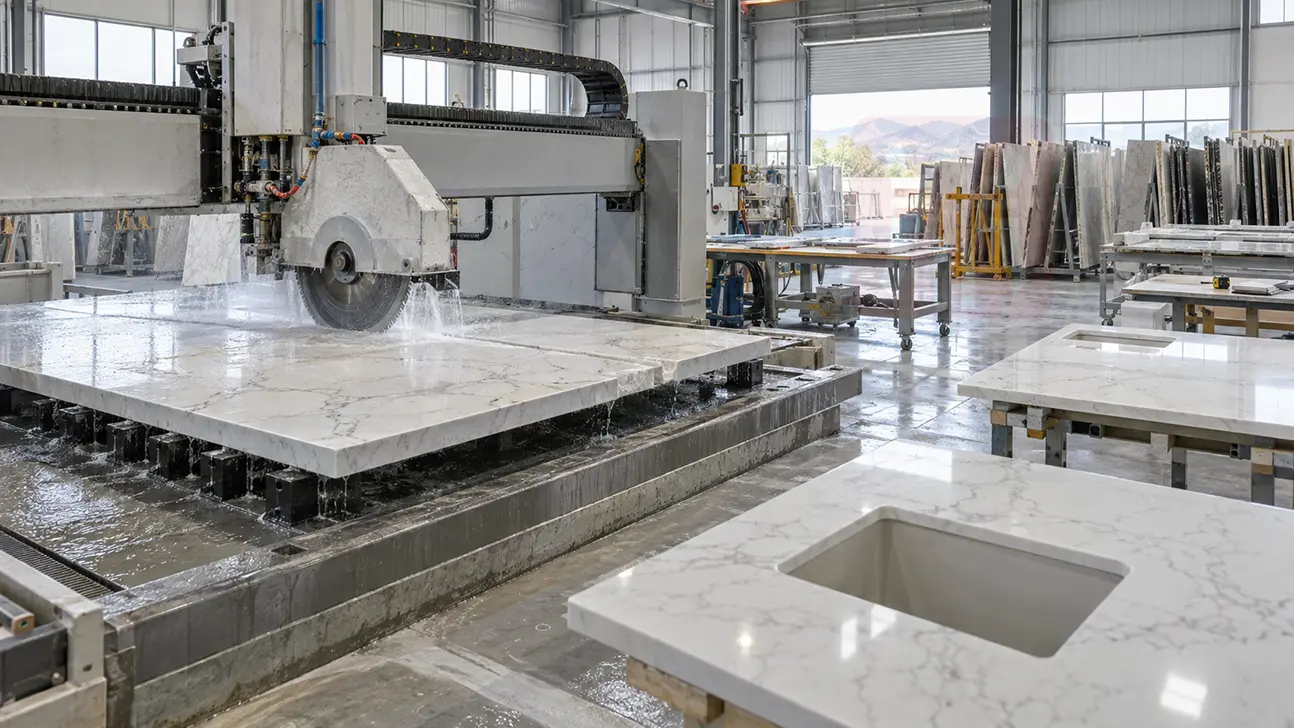
Quartz countertop fabrication process using an industrial bridge saw for precise quartz cutting.
Step 9: Organize the Fabrication Factory Workflow
A well-designed factory workflow reduces unnecessary movement between processing stages. Ideally, material should move through the workshop in a logical sequence from raw slab storage to inspection, cutting, edge processing, polishing, quality control, packaging, and dispatch.
A practical fabrication layout can include dedicated zones for:
- Raw slab storage
- Slab inspection and measurement
- Cutting and CNC processing
- Edge profiling
- Grinding and polishing
- Seam preparation
- Final inspection
- Finished countertop storage
- Packaging and loading
Factories planning a new production facility can review this stone factory setup and processing workflow guide to understand how equipment placement, material flow, worker movement, and storage planning can affect production efficiency.
For existing factories, workflow improvement does not always require major construction. Moving frequently used tools closer to workstations, improving slab identification, reducing unnecessary travel distances, and creating clearer material routes can also improve day-to-day operations.
Step 10: Select the Right Fabrication Tools and Equipment
The tools required to fabricate quartz countertop products depend on production volume, product complexity, available space, and the level of automation required.
Common fabrication equipment includes:
- Bridge saws or CNC cutting machines
- Diamond saw blades
- Diamond grinding wheels
- Edge profiling wheels
- Polishing pads
- Core drills and hole saws
- Waterjet equipment
- Digital measuring systems
- Vacuum lifting equipment
- Slab transport carts
- Slab racks and A-frame storage systems
- Clamps and support systems
- Seam alignment equipment
For a more detailed overview, review this complete guide to stone fabrication tools. The right combination of cutting, finishing, lifting, storage, and transport equipment can help a factory create a more consistent workflow.
Factories should avoid selecting equipment simply because it has the highest specification. A better approach is to match equipment capacity and functions to actual production requirements.
Step 11: Handle and Store Quartz Slabs Safely
Material handling is an important part of quartz countertop fabrication. A slab can be correctly cut and finished but still become damaged during movement between storage and processing areas.
Quartz slabs are heavy and difficult to move safely by hand. Mechanical assistance should therefore be considered whenever slab weight, size, or workflow makes manual movement impractical.
Recommended handling practices include:
- Use suitable lifting equipment for heavy slabs.
- Keep slabs adequately supported during storage.
- Use suitable A-frame racks for vertical slab storage.
- Inspect lifting attachments before use.
- Keep workers away from suspended loads.
- Maintain clear handling routes.
- Secure finished countertop pieces during internal transportation.
- Match lifting equipment to slab dimensions and weight.
Factories should select storage systems according to slab size, weight, available floor space, loading requirements, and handling equipment. This guide explains como escolher racks para lajes de pedra para armazenamento seguro e eficiente.
When selecting lifting devices, operators should also consider load capacity, lifting points, working height, maneuverability, and compatibility with forklifts or overhead cranes. More information is available in this guide to choosing lifting equipment for a stone factory.
Step 12: Use the Right Support During Fabrication
Countertop fabrication requires stable support during cutting, drilling, profiling, and polishing. The support system should prevent unnecessary movement while allowing operators or machines to access the required processing areas.
For professional workshops, fabrication tables and support systems can be an important part of the workflow. The support surface should be appropriate for the material, provide adequate stability, and allow the operator to process edges and cutouts efficiently.
Factories looking to improve their countertop workstation can review a revolução da mesa de fabrico for additional ideas about organizing countertop processing areas.
Internal transportation is equally important. When finished or semi-finished countertop pieces need to move between workstations, suitable transport equipment can reduce manual lifting and help protect finished edges. Factories handling heavy countertop components can also review countertop transport cart solutions for easier handling.
Step 13: Conduct Final Quality Control
Before packaging or delivery, every finished quartz countertop component should undergo a final inspection. Quality control should cover both dimensional accuracy and visual appearance.
| Inspection Item | What to Check |
|---|---|
| Dimensões | Length, width, thickness, angles, and overall shape |
| Cutouts | Sink, cooktop, faucet, and fixture dimensions |
| Edges | Profile consistency, smoothness, and damage |
| Surface | Scratches, stains, polishing marks, and finish consistency |
| Seams | Alignment, adhesive finish, and pattern continuity |
| Embalagem | Protection against movement, impact, and edge damage |
Finished pieces should be compared with the approved drawings or digital templates. Any dimensional or appearance problem should be identified before dispatch rather than after the countertop reaches the installation site.
Common Problems When Fabricating Quartz Countertops
| Problem | Possible Cause | Recommended Action |
|---|---|---|
| Chipped Cutting Edge | Worn tooling, unsuitable cutting conditions, or poor support | Check tooling, support, cooling, and cutting parameters |
| Incorrect Dimensions | Measurement, programming, or setup error | Verify drawings, templates, and machine settings |
| Visible Seam | Poor alignment, color mismatch, or unsuitable adhesive | Improve seam planning and alignment |
| Uneven Edge Profile | Worn tools or inconsistent machine movement | Check calibration and replace worn tools |
| Slab Damage During Movement | Poor support or unsuitable lifting method | Use suitable racks, carts, clamps, and lifting equipment |
| Polishing Marks | Incorrect abrasive sequence or excessive pressure | Review polishing procedures and abrasive condition |
How to Improve Quartz Countertop Fabrication Efficiency
1. Standardize the Production Workflow
Create clear procedures for measurement, slab inspection, layout, cutting, edge profiling, polishing, seam preparation, inspection, and packaging. Standardized procedures reduce operator variation and make it easier to identify the source of production problems.
2. Use Digital Drawings and Templates
Digital templates and CAD-based production files can reduce manual measurement errors and improve repeatability. They are especially useful for projects involving complex sink cutouts, multiple countertop pieces, or repeated designs.
3. Maintain Cutting and Polishing Tools
Diamond blades, profile wheels, grinding tools, and polishing pads gradually wear during production. Regular inspection and timely replacement help maintain consistent processing quality.
4. Improve Slab Storage and Internal Transportation
Workers should be able to identify and access slabs without excessive movement. Proper slab racks, A-frame systems, lifting equipment, and transport carts can help create a more organized material flow.
5. Plan Cutouts and Seams Before Cutting
Sink openings, cooktop cutouts, seams, edge profiles, and pattern direction should be considered during layout planning. Solving these issues before cutting reduces the chance of discovering conflicts after material has already been processed.
6. Create Quality Checkpoints
Instead of waiting until the final inspection to identify defects, factories can inspect components after important stages such as cutting, edge profiling, polishing, and seam preparation. Early detection can reduce rework.
7. Match Equipment to Production Volume
A small fabrication workshop may prioritize flexible equipment and a smaller number of machines, while a high-volume production facility may benefit from CNC processing, automated material handling, and more specialized equipment.
Equipment should therefore be selected according to actual production requirements rather than simply purchasing the most sophisticated machine available.
How to Choose Equipment for a Quartz Fabrication Factory
Equipment selection should begin with the production problem that needs to be solved. A factory should evaluate both processing equipment and material-handling equipment because fabrication efficiency depends on how easily materials move between each stage.
| Factory Requirement | Equipment Consideration | Key Evaluation Point |
|---|---|---|
| High-volume straight cutting | Bridge saw or CNC saw | Accuracy, repeatability, and production capacity |
| Complex shapes | Waterjet or CNC system | Shape capability and programming |
| Frequent slab movement | Slab lifter, vacuum system, or lifting attachment | Capacity, control, and compatibility |
| Large slab inventory | A-frame or slab storage rack | Capacity, footprint, access, and stability |
| Finished countertop movement | Countertop transport cart | Load support and maneuverability |
When comparing equipment suppliers, factories should evaluate machine compatibility, technical support, spare parts, customization, maintenance requirements, documentation, and total ownership cost. This stone equipment comparison between China and Europe provides additional factors to consider when evaluating equipment sourcing options.
For factories that need a dedicated countertop production area, the countertop fabrication equipment category can also be used as a starting point for evaluating related handling and fabrication solutions.
If X, Choose Y: Practical Quartz Fabrication Decisions
If the main problem is inaccurate countertop dimensions, improve measurement, digital templates, and drawing verification before purchasing additional machinery.
If the main problem is chipped edges during quartz cutting, review blade condition, machine settings, slab support, cooling, and cutting procedures before changing the entire production system.
If the main problem is excessive slab movement, improve storage layout and internal transportation before increasing cutting capacity.
If the main problem is damaged slabs during handling, evaluate suitable lifting equipment, racks, carts, clamps, and support systems.
If the main problem is inconsistent edge finishing, examine profile tooling, polishing procedures, tool wear, machine calibration, and operator training.
If the factory is experiencing increasing production volume, evaluate whether the bottleneck is cutting, edge processing, polishing, material handling, or final inspection before investing in new equipment.
Common Quartz Countertop Fabrication Mistakes
One common mistake is starting quartz cutting before the project drawings and measurements have been fully verified. Once material is cut, correcting a dimensional error can require additional fabrication or replacement material.
Another mistake is treating slab storage as a separate warehouse issue. In reality, storage directly affects fabrication efficiency because operators need to identify, retrieve, inspect, and transport the correct slab before production can begin.
A third mistake is selecting cutting equipment without considering downstream processes. A factory may increase cutting capacity while edge profiling, polishing, seam preparation, or transportation remains the actual bottleneck.
Factories can also underestimate internal transportation. Large countertop pieces may become difficult to move after cutting because of their shape, sink openings, narrow sections, or finished surfaces. The handling method should therefore be considered before production starts.
Quartz Countertop Fabrication Safety Considerations
Quartz fabrication involves heavy slabs, rotating machinery, cutting tools, water, sharp edges, and potentially respirable crystalline silica generated during processing. Safe production requires suitable equipment, operator training, maintenance, and appropriate workplace controls.
- Use appropriate dust-control methods for the fabrication process.
- Follow applicable occupational health and safety requirements.
- Train operators to use saws, CNC machines, grinders, and lifting equipment.
- Inspect lifting attachments, racks, carts, and supports regularly.
- Keep pedestrian and material-handling routes clear.
- Use mechanical assistance for heavy slab movement where appropriate.
- Keep workers away from suspended loads.
- Use suitable personal protective equipment.
- Keep machine operating areas controlled and organized.
- Remove damaged lifting or support equipment from service until properly assessed.
Maintenance and Long-Term Production Reliability
A professional fabrication factory should consider maintenance when selecting equipment. Cutting machines, polishing systems, lifting attachments, carts, racks, and support systems all require different inspection and maintenance routines.
For cutting and polishing equipment, maintenance commonly involves checking tooling condition, machine calibration, cooling systems, moving components, and electrical or hydraulic systems according to the equipment manufacturer’s instructions.
For material-handling equipment, maintenance should include inspection of structural components, wheels, locking mechanisms, lifting points, gripping components, chains, hooks, hydraulic components, or vacuum components where applicable.
The objective is not simply to extend equipment life. Reliable maintenance also helps prevent unexpected interruptions during production.
How to Measure the Return on Fabrication Improvements
Factories should evaluate production improvements using their own operating data rather than relying on generic savings percentages.
Useful measurements include:
- Time required to process each countertop
- Material utilization
- Number of rework cases
- Cutting and finishing defects
- Handling time between workstations
- Number of workers required for difficult movements
- Material damage during transportation
- Machine downtime
- Maintenance and tooling costs
A simple internal calculation can be structured as:
Annual Operational Benefit = Labor-Time Savings + Avoided Rework + Reduced Material Damage + Reduced Downtime – Additional Maintenance and Training Costs
This approach allows a fabrication factory to evaluate whether a new machine, handling system, storage solution, or workflow change actually improves the economics of production.
How to Build a More Efficient Quartz Fabrication Workflow
The most efficient fabrication workflow is not necessarily the one with the most machines. It is the workflow in which measurement, material storage, cutting, finishing, inspection, and transportation work together with minimal unnecessary movement.
A practical factory improvement strategy is to identify the current bottleneck first. If cutting capacity exceeds polishing capacity, buying another cutting machine may not improve total production. If fabrication machines are underutilized because workers spend too much time moving slabs, improving material handling may have a greater operational impact.
The same principle applies to storage. If workers regularly move several slabs to locate the correct material, improving slab identification and rack organization can reduce unnecessary handling before any processing takes place.
Nota final / Conclusões práticas
Successfully learning how to fabricate quartz countertop products requires a complete production system rather than one isolated machine. Accurate measurement and slab layout should come first, followed by controlled quartz cutting, precise cutouts, consistent edge profiling, polishing, seam preparation, safe handling, and final quality inspection. For professional stone fabrication factories, the biggest improvements often come from connecting processing equipment with organized storage, lifting, transportation, and standardized quality-control procedures. The goal is a repeatable workflow that protects the material, controls production quality, and allows the factory to handle increasing project complexity without unnecessary rework.
Referências
- OSHA — Respirable crystalline silica and occupational exposure control resources.
- OSHA — Material handling and workplace safety guidance for industrial operations.
- Natural Stone Institute — Technical and safety resources for stone fabrication and material handling.
- Manufacturer technical documentation for quartz slabs, diamond tooling, cutting equipment, polishing systems, lifting equipment, and storage systems should be followed for the specific application.
- Applicable local occupational health, machinery safety, dust-control, and workplace regulations should be reviewed before production procedures are established.
Perguntas mais frequentes
1. What is the most important step when fabricating quartz countertops?
A medição precisa e o planejamento do layout estão entre as etapas mais importantes. Erros cometidos antes do corte podem afetar as dimensões da bancada, a posição da pia e do cooktop, os perfis das bordas, as costuras e a instalação final.
2. What equipment is commonly used for quartz cutting?
O equipamento comum inclui serras de ponte, serras CNC, máquinas de jato de água e centros de fabricação CNC. A escolha adequada depende do volume de produção, da complexidade do projeto, da precisão exigida, do espaço disponível e do fluxo de trabalho da fábrica.
3. Can quartz countertops be fabricated manually?
Algumas tarefas de fabricação menores podem ser concluídas com ferramentas manuais, mas a produção profissional de bancadas geralmente exige equipamentos adequados para corte, afiação, perfilagem, polimento, medição e manuseio de materiais, a fim de obter resultados comerciais consistentes.
4. How can a factory reduce quartz slab waste?
Uma fábrica pode reduzir o desperdício verificando as medidas antes do corte, planejando cuidadosamente a disposição das placas, levando em consideração a direção do padrão, posicionando os recortes de forma eficiente, planejando as costuras e reutilizando os retalhos adequados para componentes menores, quando isso for viável.
5. How should quartz slabs be stored and transported?
As lajes de quartzo devem ser armazenadas em racks adequados ou sistemas em formato de A e movimentadas com carrinhos apropriados, grampos, equipamentos de levantamento por vácuo, acessórios para empilhadeiras ou equipamentos de guindaste suspensos. O método de manuseio deve ser compatível com o peso, as dimensões, a geometria da laje e as condições do local de trabalho.
6. What causes chipping during quartz cutting?
A lascagem pode estar associada às condições da ferramenta, aos parâmetros de corte, ao suporte da chapa, à configuração da máquina, à refrigeração ou às características do material. As fábricas devem analisar sistematicamente esses fatores em vez de assumir que uma única causa seja responsável por cada defeito de corte.
7. How can a quartz fabrication factory improve production efficiency?
As fábricas podem melhorar a eficiência padronizando os fluxos de trabalho, utilizando desenhos digitais precisos, realizando a manutenção das ferramentas de corte e polimento, aprimorando o armazenamento de lajes, reduzindo o transporte interno desnecessário, criando pontos de verificação de qualidade e selecionando equipamentos de acordo com o gargalo real da produção.
8. What should I consider when choosing equipment for quartz countertop fabrication?
Considere o volume de produção, as dimensões das placas, os requisitos de corte, as necessidades de processamento das bordas, o espaço fabril disponível, os requisitos de manuseio de materiais, as habilidades dos operadores, os recursos de manutenção, a compatibilidade dos equipamentos, os requisitos de segurança e o custo operacional total.

Henrique
Olá, sou o autor deste post, e estou neste sector há mais de 16 anos. Se precisar de um serviço OEM&ODM para ferramentas de pedra, não hesite em colocar-me quaisquer questões.