İşinizi Verimli Bir Şekilde Yapın!





Stone factories can reduce labor lifting requirements by replacing repetitive manual handling with professional lifting and transport equipment. Slab lifters, transport carts, A-frame carts, forklift attachments, lifting clamps, and other material handling systems help smaller teams move heavy granite, marble, quartz, porcelain, and engineered stone more efficiently. This guide explains how lifting equipment reduces hidden labor costs, improves material flow, lowers rework, supports safer handling, and creates better factory efficiency without relying only on additional manpower.
How Lifting Equipment Reduces Labor Cost
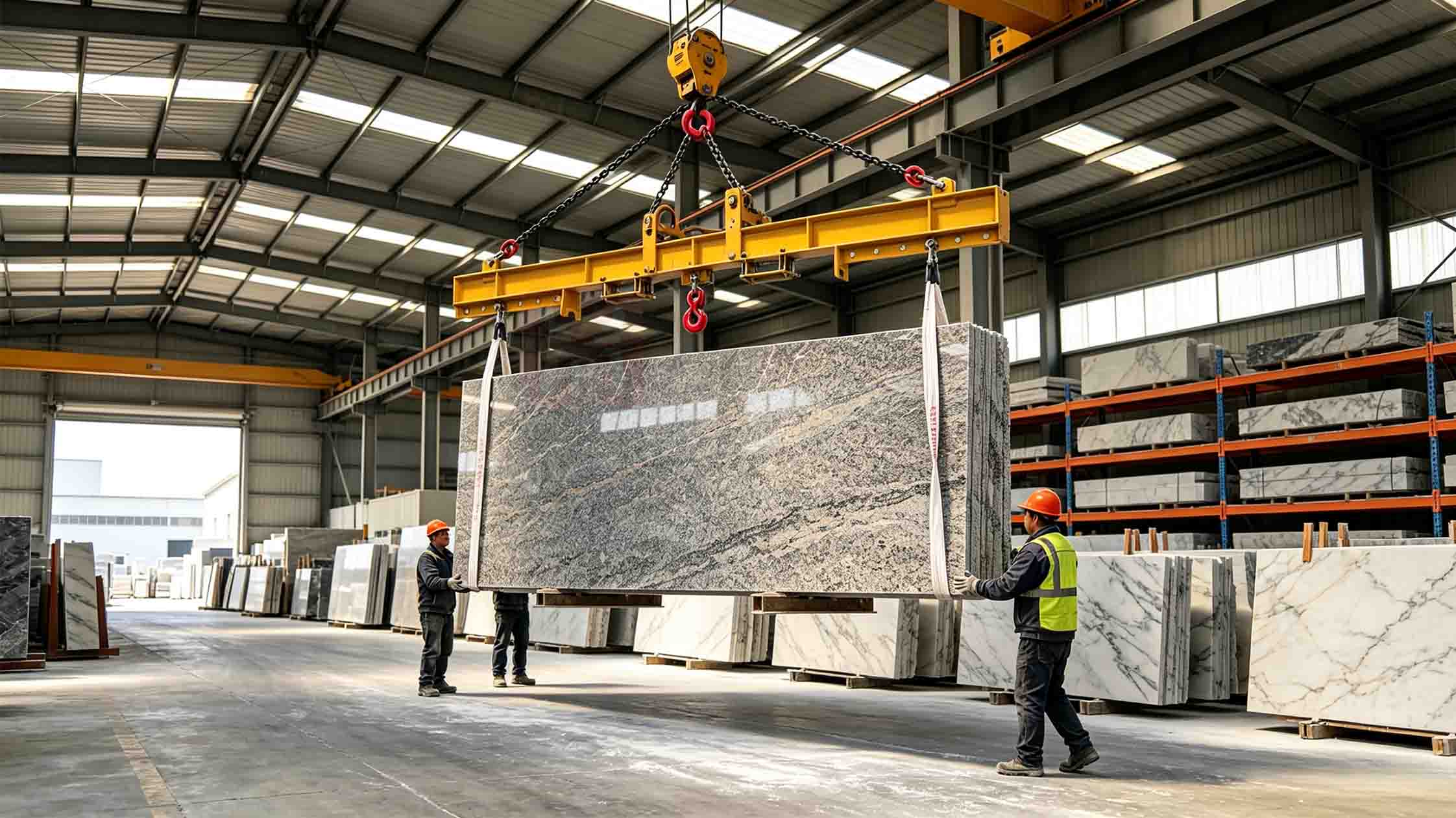
Stone lifting equipment helping reduce labor lifting when handling large granite slabs in a factory
Labor is one of the most significant operating costs in a stone fabrication facility. Granite, marble, quartz, porcelain, sintered stone, and other large-format materials are heavy, difficult to control, and frequently moved between storage racks, cutting machines, fabrication tables, inspection areas, packing stations, and shipping zones. When these transfers depend heavily on manual handling, several workers may be pulled away from their normal duties every time a slab needs to move.
Professional material handling equipment changes this workflow. Instead of adding more workers simply to compensate for the weight and size of stone, factories can use mechanical lifting, transport, and positioning systems to reduce labor lifting requirements while creating a more controlled and repeatable production process.
The objective is not simply to remove workers from the factory. The larger opportunity is to use skilled employees more effectively. A CNC operator creates more value operating a machine than helping push a slab across the workshop. A fabricator creates more value finishing a countertop than waiting beside a rack for enough people to become available for a heavy transfer. When equipment carries the physical load, employees can focus on production, inspection, maintenance, packing, machine operation, and other higher-value work that contributes directly to factory efficiency.
This distinction matters because labor cost in stone handling is rarely limited to the employees visibly moving a slab. The real cost includes interruptions, waiting time, production delays, material damage, rework, fatigue, and the lost output created when skilled workers are repeatedly diverted into manual transport tasks.
Why Manual Stone Handling Creates Hidden Labor Costs
Manual handling costs are easy to underestimate because they are spread across the factory. Management may see a slab transfer that takes only several minutes and conclude that the labor cost is small. However, if three or four employees leave their workstations for the transfer, the factory may lose productive time in several departments simultaneously.
For example, cutting may stop because an operator is helping move a slab. A polishing station may remain inactive because the next piece has not arrived. Packing may be delayed while workers wait for a finished countertop to be transported. The material movement itself may take only a short period, but the interruption can influence production before and after the move.
This problem is closely connected to the
hidden cost of slab transport bottlenecks,
where inefficient movement creates production delays that are difficult to see when managers evaluate only direct handling labor.
A better approach is to treat internal logistics as part of the production system. Stone should move through the factory according to a planned workflow instead of depending on when enough workers become available to assist with a transfer.
Where Labor Costs Occur in Stone Handling
| Handling Stage | Manual Workflow Challenge | Equipment-Based Improvement |
|---|---|---|
| Slab Storage | Multiple workers may be needed to organize, stabilize, and retrieve slabs | Structured racks and lifting equipment create more controlled retrieval |
| Workshop Transport | Workers repeatedly push, guide, or reposition heavy loads | Transport carts support repeatable short-distance movement |
| Machine Loading | Manual positioning consumes production time and may require several employees | Lifting equipment supports controlled positioning near processing equipment |
| Finished Product Handling | Countertops and cut pieces can require careful multi-person handling | Specialized carts reduce the physical handling requirement |
| Packing and Loading | Employees spend time supporting, guiding, and repositioning stone | Mechanical handling improves load control and workflow planning |
How Lifting Equipment Changes the Labor Cost Structure
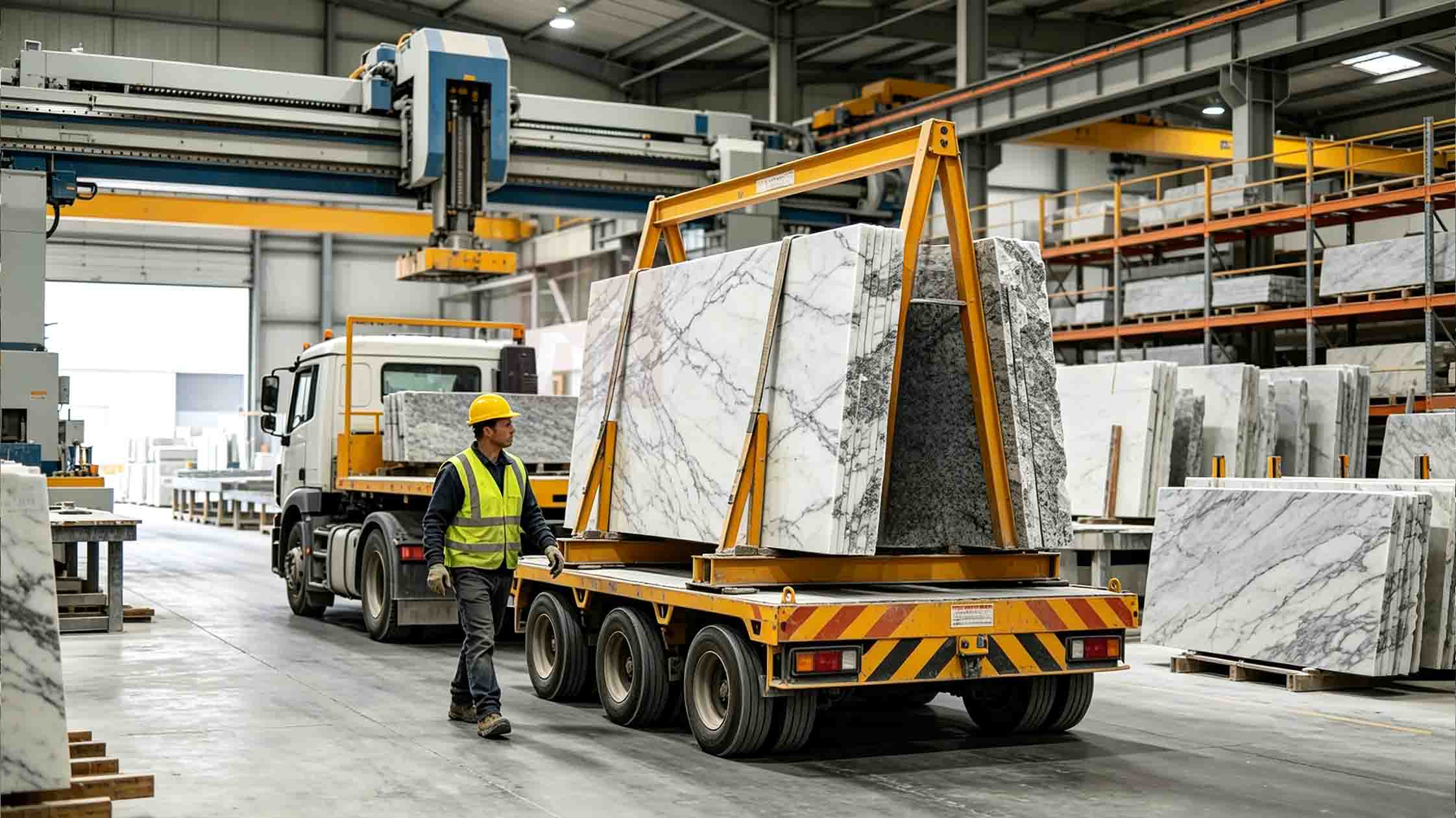
Mobile A-frame cart improving factory efficiency during granite and marble slab transport
The main economic advantage of lifting equipment is not simply that a machine can carry weight. The real advantage is that equipment changes how labor is allocated. Instead of using people as the primary source of lifting force, workers become operators who guide, inspect, position, and supervise the movement.
This can improve the factory in several ways. Fewer people may be needed to support routine movements, production staff experience fewer interruptions, heavy loads can follow more standardized procedures, and material flow becomes less dependent on the availability of specific workers.
For managers, this creates a more predictable operating model. Production planning becomes easier when a slab transfer does not require finding several free employees every time material must move from one station to another.
1. Reduce the Number of Workers Needed for Routine Moves
One of the most direct ways lifting equipment can reduce labor cost is by reducing the physical assistance required for repeated material transfers. A heavy slab that previously required several employees to stabilize, guide, or reposition may be handled with fewer people when the load is properly supported by suitable equipment.
The exact staffing requirement always depends on the material, equipment, factory layout, operator training, and safe working procedure. However, the underlying principle remains consistent: when mechanical equipment carries and stabilizes the load, fewer labor hours are consumed by human force.
The impact becomes more important as handling frequency increases. Saving a small amount of labor on one movement may appear insignificant. Saving that labor across dozens of movements every day, several shifts per week, and an entire production year can materially change factory operating cost.
2. Use Slab Transport Carts for Internal Logistics
Not every transfer requires a crane or forklift. Many stone factories perform frequent short-distance movements between slab storage, cutting equipment, fabrication tables, quality-control areas, packing zones, and loading points.
A properly selected transport cart can make these movements easier to schedule and control. Instead of waiting for multiple workers or repeatedly requesting forklift assistance, operators can use equipment designed specifically for internal stone logistics.
Factories evaluating this approach should understand
how to choose the right slab transport cart
according to load capacity, slab size, wheel configuration, floor conditions, travel distance, and actual workshop workflow.
For businesses where transport carts are used repeatedly throughout the day, it can also be useful to review a broader
slab transport cart solution
instead of treating the cart as an isolated piece of equipment. The strongest labor-saving gains normally come from fitting transport equipment into the full production route.
3. Reduce Repetitive Manual Handling
A single heavy movement may last only a few minutes, but repetitive movements can consume a large amount of labor across an entire shift. Materials may be moved from storage to cutting, from cutting to fabrication, from fabrication to inspection, and later from packing to loading.
Every transfer creates a labor requirement. If workers use different methods each time, handling may also become inconsistent. One team may move a slab efficiently while another may require more employees or more repositioning.
Mechanical transport equipment helps transform repeated movement into a standardized process. When workers know which equipment should be used, where it is located, where the load should be positioned, and which route should be followed, material handling becomes more predictable.
Specialized systems such as
self-locking slab transport trolleys
are particularly relevant in workflows where controlled positioning and repeatable movement matter.
4. Reduce Labor Lost to Material Damage and Rework
Handling-related damage creates a second layer of labor cost. A damaged slab does not simply represent lost material. Workers may need to stop production, move the damaged piece, inspect it, determine whether it can be repaired, recut the material, repolish an edge, repack the order, or produce a replacement.
In some cases, damage also affects the production schedule for other jobs. A replacement slab may need to be pulled from storage, machine time may be reassigned, and delivery preparation may need to be changed.
Controlled mechanical handling can help reduce uncontrolled tilting, sudden movements, collisions, and unnecessary contact. Better load control therefore protects both material value and labor productivity.
Understanding
the hidden costs associated with stone slab damage
helps managers evaluate handling equipment based on total operating cost rather than purchase price alone.
5. Improve Labor Allocation Across the Factory
One of the strongest arguments for material handling equipment is that it allows employees to work according to skill rather than according to physical availability.
A trained stone fabricator should ideally spend most of the shift fabricating. A CNC operator should focus on machine productivity. Quality-control personnel should spend their time checking products. Packing employees should prepare finished orders. When these workers are repeatedly called away to help move stone, the factory loses productive capacity in several areas at the same time.
Mechanical handling systems help reduce these interruptions. This does not mean the factory automatically needs fewer people in every department. Instead, employees can spend a larger percentage of their working time producing, inspecting, maintaining, or preparing products instead of providing lifting force.
6. Use A-Frame Carts to Combine Support and Transport
Traditional workflows sometimes require stone to be transferred from a storage structure onto a separate transport device before it can move through the factory. Each transfer creates another handling stage, another labor requirement, and another opportunity for material damage.
Mobile A-frame carts can combine vertical slab support with transportation. This can be particularly useful for granite, marble, quartz, glass, engineered stone, and other large panels that benefit from remaining vertically supported while moving between work areas.
A
double-sided A-frame transport cart for granite and glass
illustrates how one equipment platform can support both slab positioning and internal transport.
For factories that frequently move vertically stored slabs, combining the storage and transportation concept can remove one or more intermediate handling steps from the workflow.
7. Reduce Waiting Time Between Production Stages
Labor efficiency depends not only on how quickly workers perform a task but also on how much time employees and machines spend waiting.
A bridge saw may finish a slab, but the next job cannot begin until the processed piece is removed. A fabrication table may be available, but the fabricator cannot start until the next material arrives. Packing staff may be ready, but the finished piece may still be waiting at another workstation.
These delays create an internal logistics bottleneck. The machines and workers may be individually efficient, but the factory as a system remains inefficient because material is not arriving at the correct place at the correct time.
Well-positioned carts and lifting equipment allow material movement to follow the production schedule rather than depending entirely on when additional labor becomes available.
8. Improve Stone Logistics Between Workstations
A stone factory should be viewed as a connected material flow system. Slabs enter storage, move toward processing equipment, continue through fabrication and finishing, proceed to inspection, and eventually reach packing or shipping.
If any transfer stage becomes slow or unpredictable, the effect can spread throughout the factory. Improving
stone logistics with safe slab transport carts
can therefore improve more than one movement. It can strengthen the relationship between multiple production stages.
For factories evaluating a broader internal logistics strategy, professional
slab transport cart equipment
can be considered alongside lifting systems rather than as a separate investment category.
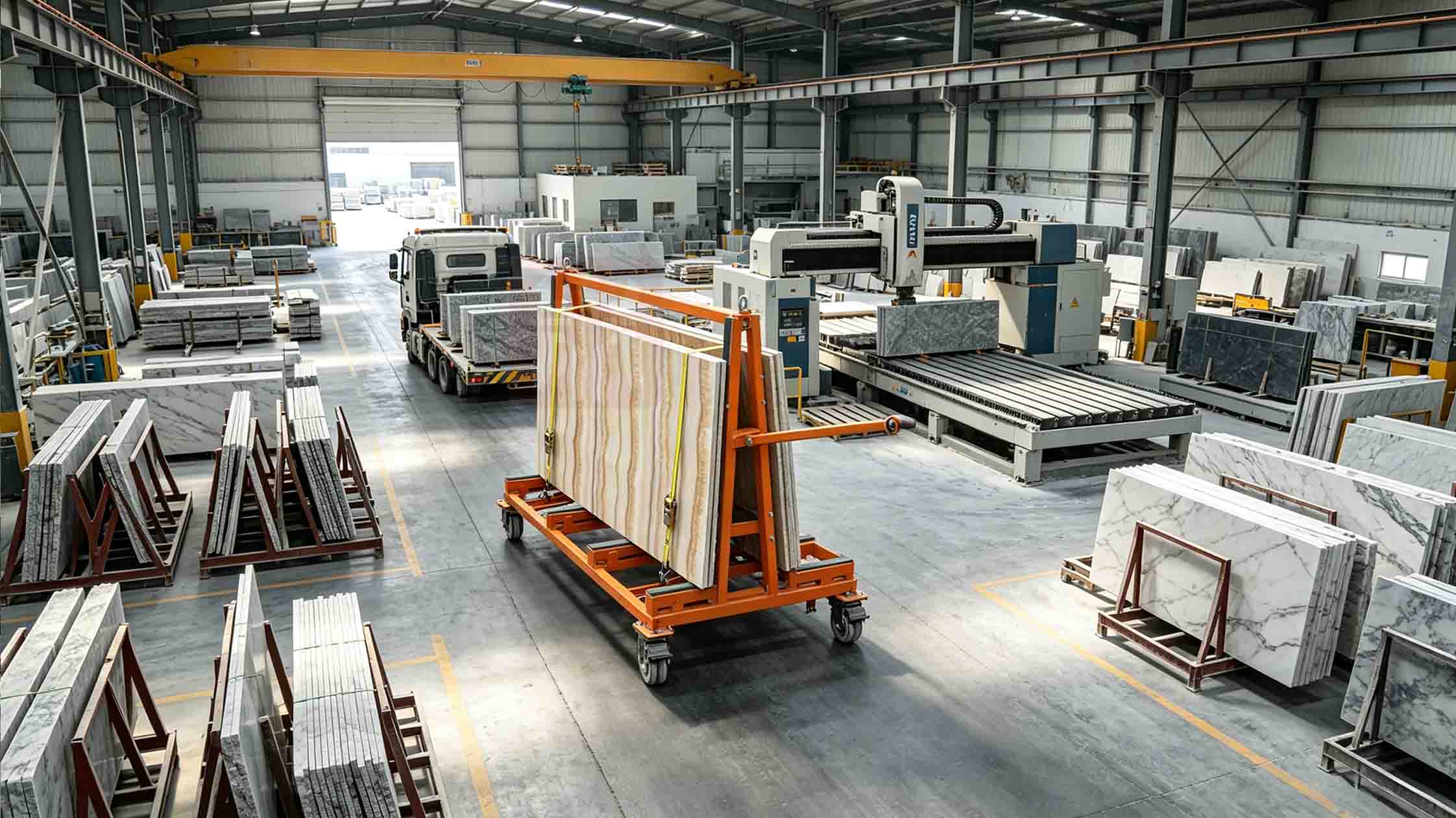
Slab transport cart improving factory efficiency when moving marble and granite slabs
Manual Handling vs Equipment-Assisted Handling
| Factor | Manual Handling | Equipment-Assisted Handling |
|---|---|---|
| Labor Dependency | Higher for heavy and repetitive moves | Mechanical support reduces dependence on physical labor |
| Consistency | Depends heavily on individual worker strength and experience | Can support a more standardized handling process |
| Material Control | More difficult with very heavy or large slabs | Equipment supports controlled movement and positioning |
| Worker Fatigue | Higher physical demand | Reduced dependence on physical force |
| Workflow Planning | May depend on availability of extra workers | Easier to integrate into planned material flow |
| Rework Risk | More sensitive to inconsistent handling | Better load control can reduce handling-related damage |
9. Reduce Physical Fatigue During Long Shifts
Heavy manual handling becomes more difficult as a shift progresses. Fatigue can slow down movement, increase positioning time, reduce handling consistency, and make workers more dependent on assistance from colleagues.
Using equipment to support the weight of the stone allows employees to focus on guiding and controlling the material rather than supplying most of the lifting force themselves.
This can be particularly important in factories handling large slabs repeatedly throughout the day. Even where equipment does not reduce the official number of employees assigned to a task, reducing physical demand can help maintain more consistent handling performance across the full shift.
10. Improve Factory Efficiency Without Simply Adding Labor
When demand increases, many factories initially consider hiring additional employees. However, adding workers does not automatically solve an inefficient workflow.
If the real problem is poor material flow, additional employees may simply enter the same bottleneck. More workers can even create additional congestion when aisles, workstations, transport routes, and storage areas were not designed for the increased activity.
Factories should first identify where materials wait, where multiple employees are routinely required for simple transfers, where machines are idle because material has not arrived, and where skilled workers are repeatedly interrupted to assist with handling.
Appropriate lifting and transport equipment can help address these bottlenecks before labor growth becomes the primary expansion strategy.
Choosing Between Different Types of Lifting Equipment
Not every handling problem requires the same equipment. The correct solution depends on what the factory is trying to improve.
If the main problem is repeated short-distance slab movement, transport carts may provide the strongest improvement. If the main problem is lifting slabs vertically from storage, lifting clamps or suitable crane-assisted systems may be more appropriate. If the factory already owns forklifts and needs additional lifting reach, forklift attachments may offer a practical solution.
Factories working with heavy slab lifting can also evaluate professional
forkli̇ft kaldirma eki̇pmanlari
when existing forklift infrastructure can be integrated into the material handling process.
Where controlled slab gripping is required, a
slab lifting clamps solution
may provide a better match than adding manual labor around the lifting operation.
If X, Choose Y: Practical Labor-Saving Decision Framework
If several workers are repeatedly needed for short transfers between workstations, consider slab transport carts. The goal is to create a repeatable transport route instead of using manual force for every move.
If slabs need to remain vertically supported during movement, consider A-frame transport equipment. Combining support and transportation can eliminate unnecessary transfers between storage and transport devices.
If skilled employees are frequently pulled away from machines to assist with lifting, prioritize equipment that supports machine loading and unloading. Protecting productive machine time may create more value than reducing direct handling labor alone.
If handling-related breakage or edge damage is common, prioritize load control rather than simply movement speed. Preventing rework can reduce both material loss and hidden labor cost.
If production demand is increasing but aisles and workstations are already congested, improve material flow before adding more workers. Labor cannot compensate efficiently for a poorly designed logistics route.
Common Mistakes When Trying to Reduce Labor Cost
One common mistake is purchasing equipment simply because it appears highly automated. More complex equipment is not automatically more profitable. A simple transport cart used dozens of times every shift may provide more value than a sophisticated machine used only occasionally.
Another mistake is buying equipment without measuring the current handling process. If managers do not know how many workers are involved, how long movements take, or how frequently machines wait for materials, it becomes difficult to determine whether the investment actually improves the operation.
Factories also make mistakes when they focus only on equipment capacity. Load rating matters, but so do slab dimensions, floor quality, turning radius, aisle width, lifting height, operator visibility, wheel configuration, compatibility with forklifts or cranes, and the location where the equipment will be stored.
Finally, equipment alone cannot repair a poorly designed workflow. If transport routes remain blocked or storage areas remain disorganized, new machinery may simply move through the same inefficient environment.
How to Calculate the Labor-Saving Potential
Factory managers can evaluate handling improvements by measuring the existing workflow before purchasing equipment. This creates a baseline that can later be compared with actual performance after implementation.
| Metrik | What to Measure | Why It Matters |
|---|---|---|
| Workers per Move | Average number of employees involved in each handling task | Shows direct labor dependency |
| Time per Move | Minutes from pickup to final positioning | Measures transport cycle efficiency |
| Moves per Shift | Total number of transfers during a working shift | Shows how small savings accumulate |
| Waiting Time | Machine or employee time lost waiting for handling support | Identifies hidden productivity losses |
| Damage Rework | Labor hours spent correcting handling-related damage | Captures indirect labor cost |
| Machine Idle Time | Production time lost because material is not available | Connects logistics to production efficiency |
After introducing new equipment, measure the same indicators again. This produces a much more realistic picture of labor savings than simply estimating how many employees a machine might replace.
Calculating Labor Cost Before and After Equipment Investment
A practical evaluation can begin with a simple internal calculation:
Handling Labor Cost = Workers per Move × Time per Move × Moves per Shift × Labor Cost per Hour
Factories can then add waiting time, rework labor, and other handling-related costs to create a broader operating-cost baseline.
After the equipment is introduced, repeat the calculation using actual measured performance. The difference between the two workflows provides a stronger foundation for evaluating ROI than assumptions based only on equipment specifications.
Choosing Lifting Equipment for Better ROI
The most expensive equipment is not automatically the most cost-effective. The strongest investment is usually the equipment that removes a specific recurring bottleneck and fits smoothly into the existing workshop.
Before purchasing, evaluate:
- Maximum slab weight
- Material dimensions
- Transport distance
- Aisle width
- Floor condition
- Lifting height
- Production volume
- Existing forklift or crane equipment
- Number of daily handling cycles
- Operator requirements
- Maintenance needs
- Available storage space for the equipment
Frequency matters particularly strongly. Equipment that supports a repeated handling task throughout the day can provide a greater operational benefit than expensive machinery assigned to an occasional job.
Total Cost of Ownership Matters More Than Purchase Price
Managers should evaluate lifting equipment based on total cost of ownership rather than initial purchase price alone. A lower-priced solution may become expensive if it requires frequent maintenance, creates excessive downtime, wears quickly, or fails to match the factory layout.
Total cost considerations include equipment price, maintenance requirements, replacement parts, expected service life, operator training, productivity improvement, material protection, and labor hours saved.
The goal is not to find the cheapest handling device. The goal is to identify the equipment that produces the lowest sustainable cost per movement over its useful operating life.
A Practical Labor-Efficiency Workflow
A more efficient stone handling workflow can be built around a few basic principles:
- Store frequently used slabs close to the first processing stage where practical.
- Use suitable lifting equipment for heavy vertical transfers.
- Use transport carts for repetitive short-distance movement.
- Reduce unnecessary transfers between different support structures.
- Keep transportation routes clear and predictable.
- Position handling equipment near the work areas where it is used most often.
- Separate material flow from pedestrian traffic where practical.
- Train operators to use consistent handling procedures.
- Measure handling time and waiting time regularly.
- Review recurring bottlenecks before simply adding more labor.
The objective is to create continuous material flow in which stone spends less time waiting and skilled workers spend less time performing avoidable manual transport.
Implementation Roadmap for Stone Factories
Factories do not need to automate every handling task at once. A staged approach can make investment easier to control.
Start by observing one normal production week and identifying the handling movements that require the most workers, create the longest delays, or cause the most damage. Rank these problems according to frequency and operational impact.
Next, match equipment to the highest-priority bottleneck. A transport cart may solve repeated horizontal movement. An A-frame cart may reduce transfers between support systems. A lifting clamp may simplify vertical slab handling. A forklift attachment may extend existing equipment capability.
After implementation, measure the same labor and waiting indicators again. If the improvement is clear, the factory can move to the next bottleneck rather than purchasing several pieces of equipment without knowing which investment generates the strongest return.
Maintenance and Operator Training Protect Labor Savings
Labor-saving equipment only creates long-term value when it remains available and is used correctly. Poor maintenance can return the factory to manual handling when equipment becomes unavailable.
Routine inspections should focus on structural condition, wheels, locking systems, gripping surfaces, lifting points, attachment interfaces, and other wear components relevant to the equipment type.
Operator training is equally important. Workers should understand load limits, correct positioning, safe travel routes, inspection procedures, and when equipment should be removed from service.
Standardized operating procedures also improve consistency between shifts. If every team uses the equipment differently, the factory may lose some of the workflow benefits that the investment was intended to create.
How Better Handling Supports Long-Term Factory Efficiency
The strongest labor-saving improvements are usually system improvements rather than isolated equipment changes. A cart, lifter, or forklift attachment becomes more valuable when it is positioned correctly, operators know how to use it, material routes are clear, and production stages are coordinated.
This is why factory efficiency should be evaluated across the entire material flow. The question is not only how long a slab takes to move. Managers should also ask whether the transfer interrupts other workers, causes machines to wait, creates damage risk, or requires unnecessary repositioning.
Reducing these hidden losses creates a more scalable production model. When demand increases, the factory can improve output through better material flow instead of relying only on proportional increases in manpower.
Soft CTA
Before requesting a quotation for new lifting or transport equipment, document your current material flow. Record slab dimensions, maximum load, number of daily transfers, workers required per move, travel distance, aisle width, lifting height, and the production stages where waiting occurs most often.
With this information, it becomes much easier to compare equipment based on actual labor-saving potential rather than catalog specifications alone. The right handling solution should solve a measurable bottleneck inside your factory.
Son Not / Pratik Çıkarımlar
The strongest reason to invest in lifting and transport equipment is not simply to replace manual labor. The real opportunity is to reduce labor lifting requirements while improving how workers, machines, materials, and production stages interact throughout the factory. When slab lifters, transport carts, A-frame carts, forklift attachments, and other handling systems are selected around real production bottlenecks, factories can reduce repetitive handling, limit waiting time, lower rework, improve material control, and achieve better factory efficiency without relying exclusively on additional manpower.
Referanslar
- ISO 12100 – Safety of Machinery: General Principles for Design and Risk Reduction.
- OSHA – Materials Handling and Storage guidance for industrial workplaces.
- Natural Stone Institute – Technical resources for stone fabrication and material handling.
- General industrial ergonomics principles for reducing repetitive manual handling.
- Manufacturer load ratings, inspection instructions, and operating procedures should always be reviewed for the specific lifting or transport equipment in use.
SSS
1. How does lifting equipment reduce labor costs in a stone factory?
Lifting equipment supports the weight and movement of heavy stone, reducing dependence on multiple workers for repetitive handling tasks. It can also reduce production interruptions and allow skilled employees to remain focused on fabrication, machine operation, inspection, packing, and other higher-value work.
2. What lifting equipment is commonly used in stone factories?
Common equipment includes slab lifters, lifting clamps, forklift attachments, slab transport carts, A-frame carts, vacuum lifting systems, and overhead lifting equipment. The correct choice depends on the material, load, movement direction, factory layout, and application.
3. Can slab transport carts improve factory efficiency?
Yes. Slab transport carts can improve factory efficiency by making repeated short-distance transfers more controlled and reducing the time workers spend manually moving stone between production areas.
4. Does reducing manual lifting always mean fewer workers are required?
No. Staffing requirements depend on the equipment, material, task, facility layout, and safe operating procedure. The primary benefit is reducing dependence on physical force and allowing employees to spend more time on productive work.
5. How should a factory measure the ROI of lifting equipment?
Factories can compare workers per move, handling time, moves per shift, production waiting time, handling-related damage, rework labor, and machine idle time before and after introducing equipment. These indicators provide a practical basis for evaluating return on investment.
6. Is a transport cart better than a forklift for every slab movement?
No. Transport carts are often useful for frequent short-distance movements, while forklifts or lifting systems may be more appropriate for heavier loads, greater lifting heights, or longer-distance transport. The best equipment depends on the workflow.
7. Why can material damage increase labor cost?
A damaged slab may require inspection, removal, recutting, repolishing, repacking, rescheduling, or replacement. These corrective activities consume additional labor and may also interrupt other production work.
8. What information should buyers prepare before choosing lifting equipment?
Buyers should document maximum slab weight, slab dimensions, handling frequency, travel distance, aisle width, floor conditions, lifting height, current workers per move, existing forklift or crane equipment, and the production bottleneck they want to solve.

Henry
Merhaba, ben bu yazının yazarıyım ve 16 yıldan fazla bir süredir bu alandayım. Taş aletler için OEM ve ODM hizmetine ihtiyacınız varsa, bana herhangi bir soru sormaktan çekinmeyin.