





QZDB-G 5T Forklift Jib Boom with Swivel Hook

High Lift Forklift Jib Boom with Swivel Hook | Rotating Crane Attachment – Speedone
- Model : QZDB-G
- Load-bearing : 5T
- Overall dimensions : 2500*800*1400mm
- Net weight : 230kg
- Packaging dimensions : 2500*800*1400mm
Product Description
QZDB-G 5T Forklift Jib Boom with Swivel Hook for High-Lift Applications
Industrial lifting operations often require more than simply raising a load vertically. Machinery, steel components, stone-handling equipment, construction materials, and other suspended loads may also need to be aligned or repositioned before installation or placement.
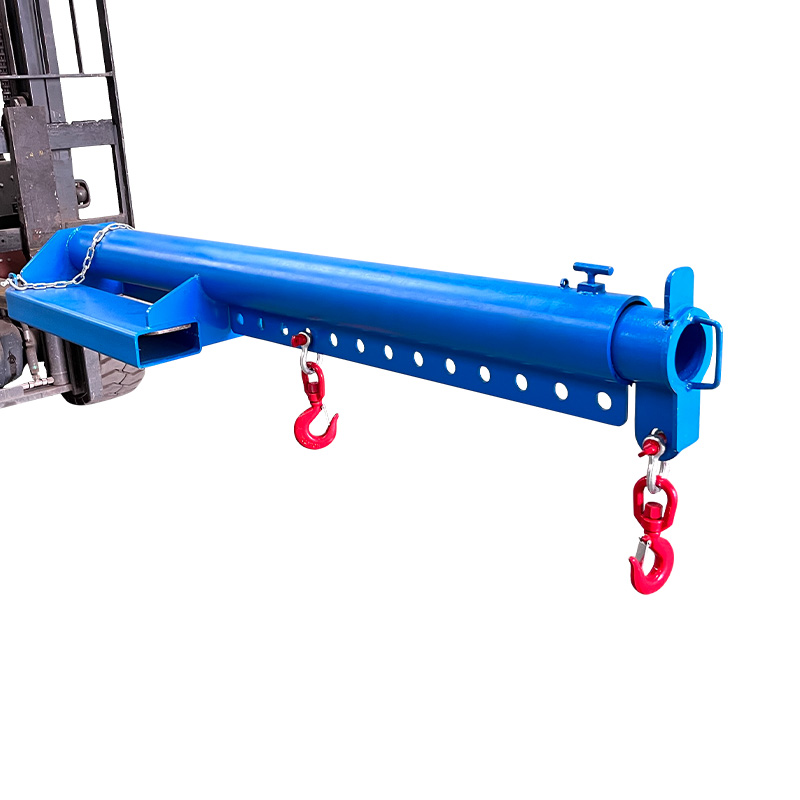
The Speedone QZDB-G Forklift Jib Boom with Swivel Hook combines an elevated 35° boom structure with a rotating hook configuration. The design is intended for compatible forklifts that need both additional hook elevation and more flexible suspended-load orientation during positioning work.
The product is specified with a maximum attachment lifting capacity of 5T, but buyers should evaluate the complete lifting system rather than selecting the boom by attachment rating alone.
|
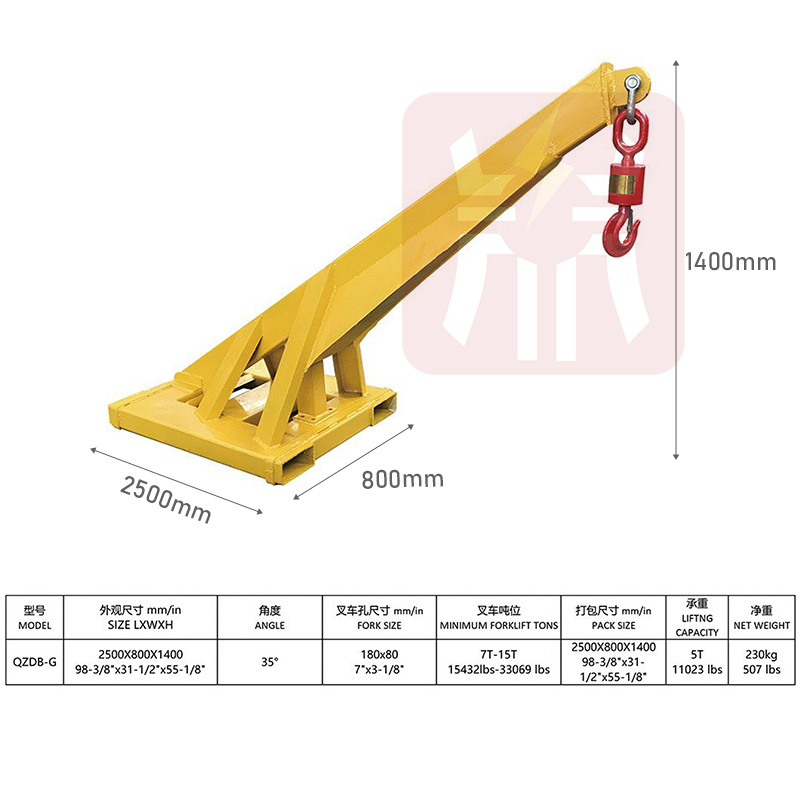 |
| Speedone QZDB-G forklift jib boom product specification | |
QZDB-G Technical Specifications
| Specification | QZDB-G |
|---|---|
| Product Type | Forklift Jib Boom with Swivel Hook |
| Model | QZDB-G |
| Published Attachment Lifting Capacity | 5T / 11,023 lbs |
| Overall Size | 2500 × 800 × 1400 mm / 98-3/8″ × 31-1/2″ × 55-1/8″ |
| Boom Angle | 35° |
| Published Fork Size | 180 × 80 mm / 7″ × 3-1/8″ |
| Recommended Forklift Capacity Range | 7T–15T / 15,432–33,069 lbs |
| Net Weight | 230 kg / 507 lbs |
| Pack Size | 2500 × 800 × 1400 mm / 98-3/8″ × 31-1/2″ × 55-1/8″ |
| Hook Type | Swivel Hook |
| Swivel Rotation Range | Confirm according to final hook specification |
Important: The published 5T figure is the boom attachment rating under its specified conditions. The allowable load of the complete forklift-and-attachment system may be lower and should be confirmed before operation.
What Is a Forklift Jib Boom with Swivel Hook?
A forklift jib boom with swivel hook is a forklift attachment that moves the lifting point forward and upward from the standard fork carriage while providing a rotating hook for suspended-load alignment.
The QZDB-G combines two functions:
- Elevated boom geometry: the 35° boom raises the hook position relative to a horizontal boom configuration.
- Swivel hook positioning: the hook allows suitable suspended loads to change orientation without requiring every alignment adjustment to be made by repositioning the forklift.
This makes the attachment particularly relevant for machinery positioning, industrial installation, steel-component handling, warehouse maintenance, container-related lifting, and other applications where both elevation and load orientation matter.
How Does the Swivel Hook Work?
The swivel hook allows rotational movement around the hook’s vertical axis according to the actual hook design. This can help align a suspended load with its destination before final placement.
Forklift raises the boom
↓
Load is suspended from the hook
↓
Swivel hook allows load orientation adjustment
↓
Load is aligned with the installation or placement point
↓
Load is lowered under controlled conditions
The exact hook rotation range is not stated in the current published specification and should be confirmed before purchase if a specific rotation angle is required.
Buyers should also confirm the hook’s rated capacity, safety-latch configuration, rotation mechanism, and maintenance requirements from the final technical specification.
How Far Can the Swivel Hook Rotate?
The current product data identifies the QZDB-G as using a swivel hook but does not specify whether the hook provides 90°, 180°, 360°, or another rotation range.
For applications where rotational positioning is critical, request confirmation of:
- maximum rotation range,
- whether rotation is continuous or limited,
- whether rotation is free or controlled,
- hook rated capacity,
- safety-latch configuration,
- and any locking or positioning mechanism.
What Does the 35° Boom Angle Mean?
The QZDB-G uses a published boom angle of 35°. Compared with a horizontal jib boom, the elevated boom geometry moves the hook position upward as the boom extends forward.
This is the main reason the QZDB-G is positioned for high-lift applications.
However, the 35° angle does not by itself determine the final hook height. Actual lifting height depends on the forklift mast and carriage position as well as the geometry of the attachment.
How High Can the QZDB-G Lift?
The current product specification does not publish one universal maximum hook height because the final height changes with the forklift on which the boom is installed.
Forklift mast lift height
+ carriage position
+ QZDB-G boom geometry
+ hook position
= actual hook height
For a project that requires a specific hook height, buyers should provide:
- forklift make and model,
- maximum fork or carriage lift height,
- required hook height,
- load weight,
- load dimensions,
- and installation or placement position.
This allows the complete lifting geometry to be evaluated rather than relying only on the term “high lift.”
Does a 5T Forklift Jib Boom Mean It Can Always Lift 5T?
No. The QZDB-G attachment is published with a 5T lifting capacity, but this does not mean every forklift equipped with the boom can safely lift 5T in every operating position.
The complete working capacity depends on:
- forklift rated capacity,
- forklift load center,
- attachment weight,
- distance from the fork face to the hook,
- actual load center,
- lift height,
- boom geometry,
- load dimensions,
- and the approved forklift-and-attachment configuration.
Why Does a Forklift Boom Reduce Available Forklift Capacity?
A standard forklift capacity is normally based on a specified load center. A jib boom moves the suspended load farther away from the forklift, increasing the effective load center.
Boom moves hook forward
↓
Load moves farther from forklift
↓
Effective load center increases
↓
Overturning moment increases
↓
Available forklift lifting capacity may decrease
This is why buyers should never select a forklift jib boom only by comparing the boom’s 5T rating with the forklift’s nominal capacity.
How the 230kg Attachment Weight Affects Capacity
The QZDB-G has a published net weight of 230 kg. This attachment weight becomes part of the load carried by the forklift and must be considered when evaluating remaining lifting capacity.
The effect is not simply:
That calculation alone is not sufficient because the attachment also moves the suspended load forward. The complete capacity evaluation must consider both attachment weight and load-center change.
Why Is a 7T–15T Forklift Recommended?
The current QZDB-G specification lists a forklift range of 7T–15T. It is clearer to describe this as a recommended forklift capacity range rather than “minimum forklift tons.”
A larger forklift may be required because:
- the attachment itself weighs 230 kg,
- the boom moves the load forward,
- the effective load center increases,
- high-level lifting changes stability conditions,
- and the complete forklift-and-attachment combination must remain within its approved operating limits.
The final suitable forklift should be confirmed by specific truck model rather than capacity class alone.
Will the 180 × 80 mm Fork Size Fit My Forklift?
The published QZDB-G fork size is 180 × 80 mm / 7″ × 3-1/8″.
Before ordering, compare this specification with the actual forklift fork dimensions and confirm:
- fork width,
- fork thickness,
- available insertion length,
- fork spacing,
- installation clearance,
- and the attachment locking or retention method.
Do not assume compatibility simply because the forklift falls within the 7T–15T capacity range.
Swivel Hook vs Fixed Hook Forklift Jib Boom
| Factor | Swivel Hook Jib Boom | Fixed Hook Jib Boom |
|---|---|---|
| Load Orientation | Allows rotational adjustment according to hook design | More fixed lifting orientation |
| Positioning Flexibility | Higher for suitable alignment tasks | Lower |
| Hook Components | Additional rotating mechanism | Simpler structure |
| Inspection | Rotation mechanism and hook require inspection | Fewer rotating components |
| Best Use | Load alignment and precision positioning | Straightforward suspended lifting |
Typical QZDB-G Applications
Machinery Installation and Positioning
The swivel hook can help orient suitable machinery or components before final placement where repeated forklift repositioning would be inefficient.
Steel Component Handling
Fabricated steel parts and structural components may require orientation changes before being placed onto equipment, supports, or workstations.
Stone and Industrial Equipment Handling
Stone-processing factories and other industrial facilities can use forklift jib attachments for suitable suspended-load handling tasks where a conventional fork position does not provide the required lifting point.
Container and Loading Operations
Where sufficient space, load capacity, and reach are available, the attachment can support loading or unloading tasks involving suspended loads.
High-Level Maintenance and Installation
The 35° elevated boom geometry can be useful where the hook needs to reach above the normal fork level for compatible installation or maintenance work.
High-Lift Structure with Rotational Capability
For standard material movement, a
forklift boom loading and unloading tool
can provide a simpler lifting configuration.
The QZDB-G is more specifically positioned for applications where elevated hook placement and rotational load alignment are both required.
Alternative and Advanced Forklift Boom Solutions
For applications requiring adjustable boom extension, the
double telescopic forklift boom
provides an alternative when variable horizontal reach is more important than a fixed elevated boom geometry.
For higher-duty structural requirements, the
double steel forklift boom lifting equipment
offers another configuration for demanding industrial lifting applications.
Businesses requiring project-specific configurations can also review the
customized industrial forklift boom lifting equipment
for additional structural and application options.
 |
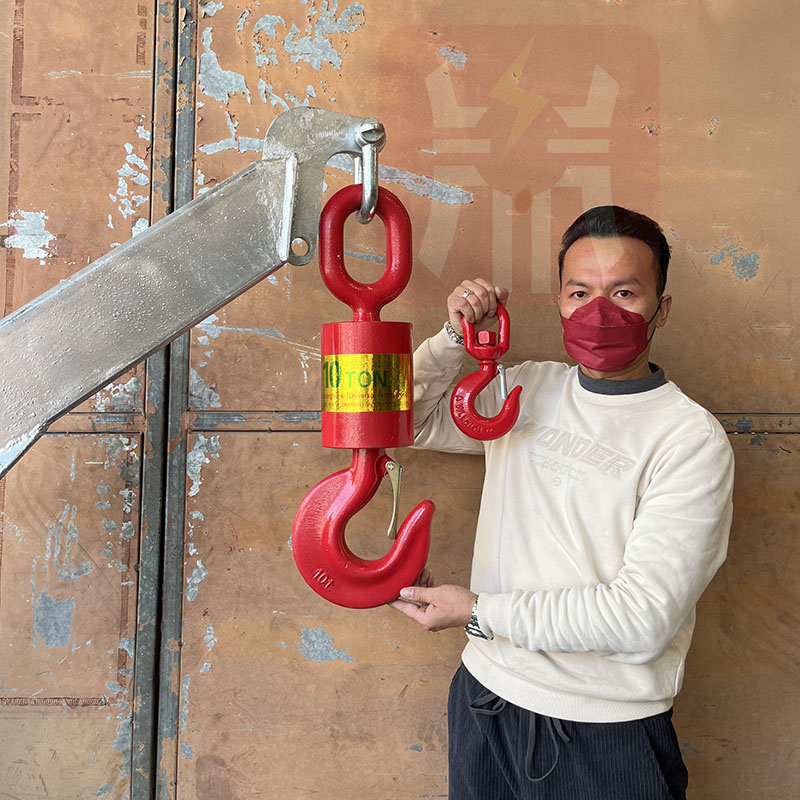 |
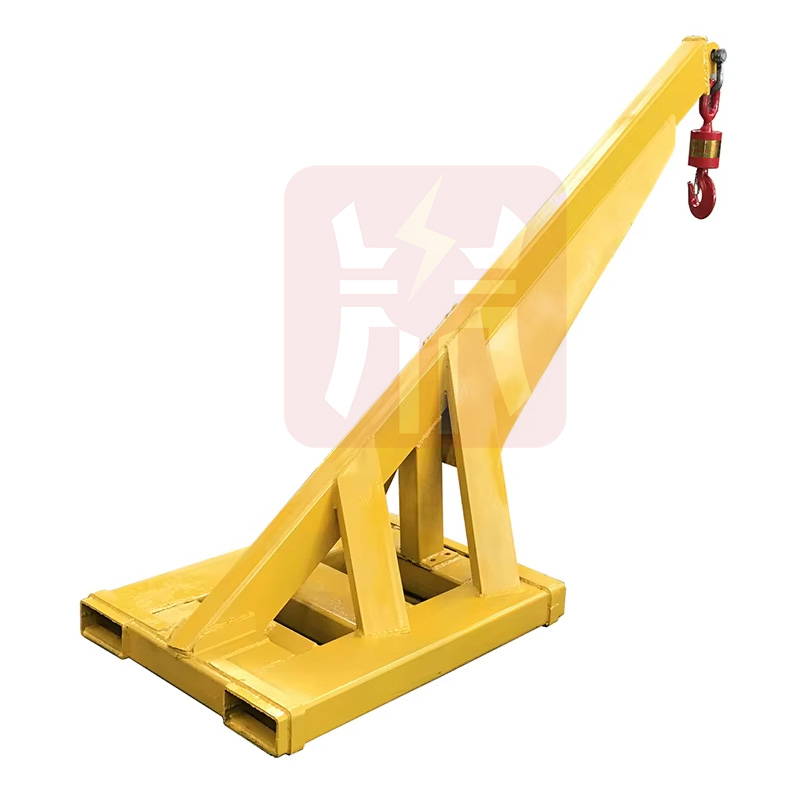
| Speedone forklift jib boom real product display | |
Integration with Other Forklift Boom Configurations
The
Speedone F boom forklift
provides another configuration for material-handling operations where a different boom geometry is required.
For demanding industrial applications, the
industrial and mining jib boom
offers an alternative design for industrial lifting environments.
Forklift and Attachment Compatibility
A forklift jib boom should be evaluated as part of the complete powered lifting system. Compatibility involves more than fitting the forks into the attachment.
Before use, confirm:
- forklift make and model,
- forklift rated capacity,
- forklift load-center rating,
- fork dimensions,
- attachment weight,
- attachment retention method,
- actual hook position,
- load weight and dimensions,
- required lift height,
- and applicable forklift manufacturer requirements.
If the attachment affects the truck’s capacity or safe operating characteristics, the complete truck-and-attachment configuration should be reviewed according to the requirements applicable to the workplace and forklift manufacturer.
Pre-Use QZDB-G Safety Checklist
- Confirm the correct QZDB-G model and rated attachment capacity.
- Confirm the forklift model and applicable capacity information.
- Check actual fork dimensions against the published 180 × 80 mm specification.
- Confirm the attachment is correctly installed and retained.
- Inspect the boom for deformation or visible structural damage.
- Inspect load-bearing welds.
- Inspect the swivel hook and rotating components.
- Check the hook latch or retention feature where fitted.
- Confirm the actual load weight.
- Evaluate the effective load center.
- Confirm the required lifting height.
- Check that the work area provides enough clearance.
- Keep personnel away from suspended loads.
- Avoid sudden acceleration, braking, steering, or shock loading.
- Use an approved load-control method when load orientation must be adjusted.
- Stop operation if unusual movement, deformation, or hook behavior is observed.
What Should Be Inspected on the Swivel Hook?
The swivel hook is one of the most important components distinguishing the QZDB-G from a fixed-hook boom.
Routine inspection should consider:
- hook deformation,
- wear at load-contact areas,
- rotation smoothness,
- excessive play,
- connection security,
- bearing or swivel condition where applicable,
- hook latch condition where fitted,
- and signs of impact or overload.
Inspection intervals should follow the actual product instructions, working frequency, lifting environment, and applicable workplace procedures.
What Information Should You Provide Before Ordering?
| Required Information | What to Provide |
|---|---|
| Forklift Make / Model | Exact truck model |
| Forklift Rated Capacity | Tons or kg |
| Fork Dimensions | Width × thickness × length |
| Maximum Load | kg / T |
| Load Dimensions | Length × width × height |
| Required Hook Height | mm |
| Required Hook Rotation | Required angle or positioning function |
| Application | Machinery / steel / stone / container / installation |
Frequently Asked Questions
What is the rated capacity of the QZDB-G forklift jib boom?
The QZDB-G has a published attachment lifting capacity of 5T. The actual allowable working load of the complete forklift-and-attachment system may be lower depending on forklift capacity, attachment weight, load center, hook position, and lifting height.
What forklift capacity is recommended for the QZDB-G?
The current product specification lists a recommended forklift range of 7T–15T. Final compatibility should be confirmed for the exact forklift model and operating condition.
What fork size does the QZDB-G use?
The published fork size is 180 × 80 mm. Buyers should compare this with their actual fork dimensions and confirm installation clearance and retention requirements.
How much does the QZDB-G weigh?
The QZDB-G has a published net weight of 230 kg. This attachment weight must be considered when evaluating the forklift’s remaining lifting capacity.
What is the boom angle?
The QZDB-G uses a 35° elevated boom angle, helping raise the hook position compared with a horizontal boom configuration.
How high can the QZDB-G lift?
There is no single maximum hook height for every application. Final hook height depends on the forklift mast height, carriage position, QZDB-G boom geometry, and hook position.
How far can the swivel hook rotate?
The current published product data identifies a swivel hook but does not state a specific rotation angle. Buyers requiring a defined rotation range should confirm the final hook specification before ordering.
Does a 5T boom mean my forklift can lift 5T?
No. The 5T figure is the attachment rating. Actual system capacity depends on the forklift, load center, boom geometry, hook position, attachment weight, lift height, and complete approved configuration.
Why is a 7T–15T forklift recommended for a 5T boom?
The boom weighs 230 kg and moves the suspended load farther forward from the forklift, increasing the effective load center. This can reduce the usable capacity of the complete system.
What should be inspected before use?
Inspect the boom structure, load-bearing welds, fork connection, retention system, swivel hook, hook latch where fitted, rotating components, and the overall attachment condition before lifting.
“`
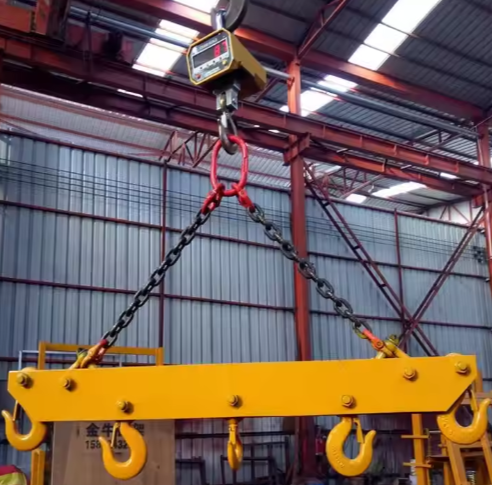
Expert Commentary & Analysis
The most important technical point when evaluating the QZDB-G is that the published 5T boom capacity and the usable capacity of the complete forklift system are not the same number. The boom weighs 230 kg and positions the load farther forward, which changes the effective load center and the overturning moment acting on the forklift.
The second important point is that “high lift” should not be treated as a fixed height specification. The QZDB-G contributes a 35° elevated boom geometry, but the final hook height still depends on the mast and carriage height of the forklift being used.
The swivel hook is the feature that most clearly differentiates this product from other Speedone forklift booms. For buyers using the attachment for machinery installation or precision alignment, the actual hook rotation range and hook rating should therefore be confirmed before ordering rather than assuming all swivel hooks provide the same movement.
Buyer takeaway: select the QZDB-G by evaluating the complete system—forklift model, 230 kg attachment weight, 180 × 80 mm fork interface, load weight, load center, 35° boom geometry, required hook height and swivel-hook specification—not by the 5T attachment rating alone.