Travaillez efficacement !





Choosing the right stone equipment supplier is not only a purchasing decision—it directly affects factory productivity, slab handling safety, equipment lifespan, maintenance cost, and long-term business growth. This guide explains how to evaluate a stone equipment supplier, compare OEM stone factory capabilities, avoid common buying mistakes, and select integrated handling, storage, lifting, logistics, and fabrication solutions for modern stone factories.
How to Choose a Reliable Stone Equipment Supplier
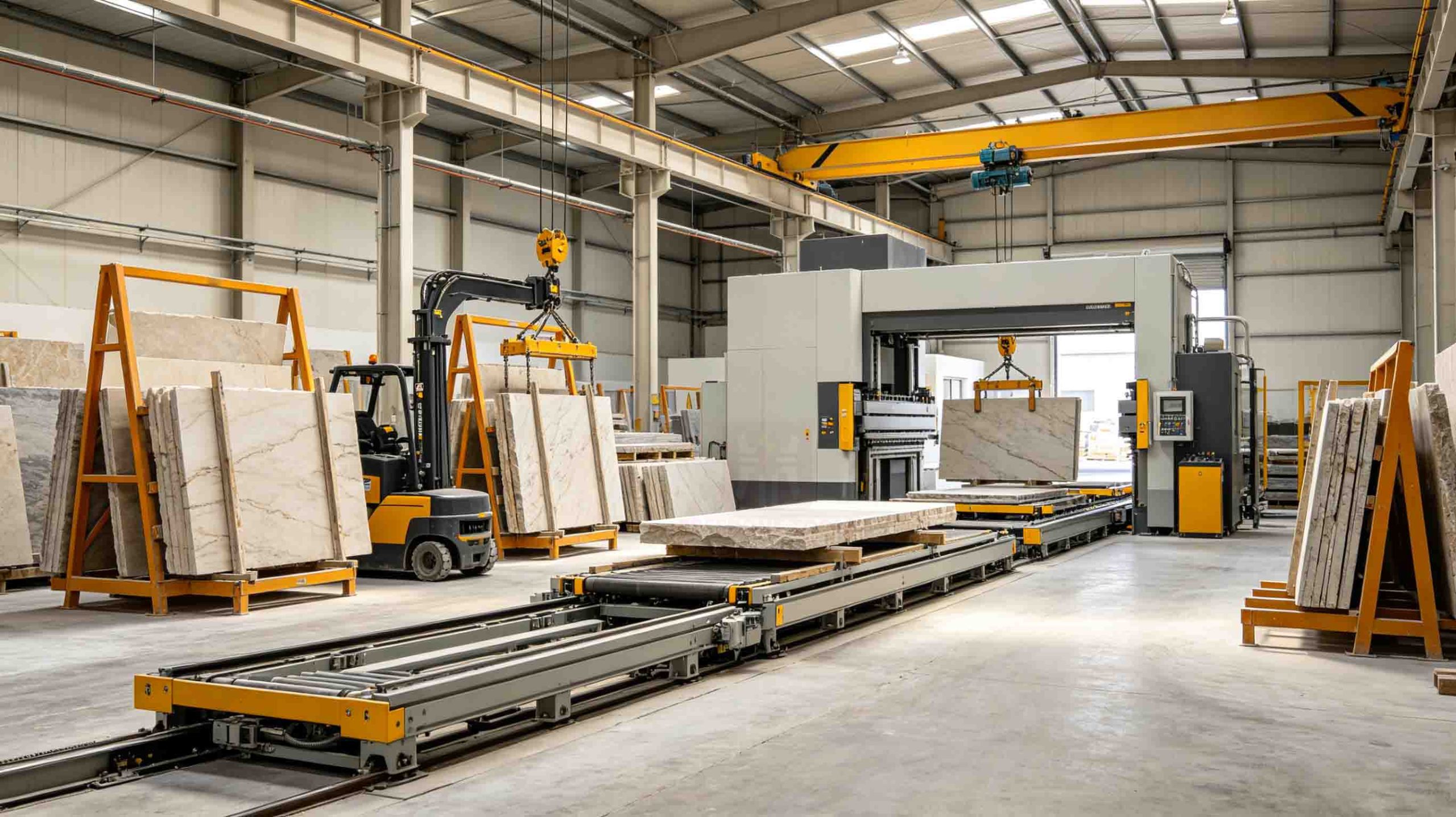
Reliable stone equipment supplier manufacturing slab handling and lifting equipment
Selecting the right stone equipment supplier is one of the most important decisions for any stone factory, distributor, contractor, or fabrication business. The supplier you choose does not only determine the quality of the equipment you receive. It also affects how efficiently your factory moves slabs, how safely workers handle materials, how often equipment fails, how quickly spare parts can be supplied, and how well your production line can scale.
Many buyers make the mistake of treating stone equipment purchasing as a simple price comparison. They ask for a quotation, compare basic specifications, and choose the lowest offer. In reality, this approach often creates higher long-term cost. Cheap equipment may appear attractive at first, but if it breaks frequently, lacks spare parts, does not fit your workflow, or creates handling risks, the true cost becomes much higher than the purchase price.
A professional supplier should understand the operational challenges inside a modern stone workshop. For example, many factories underestimate logistics inefficiencies until they encounter
major slab transport bottlenecks
that slow down production, increase labor cost, and create unnecessary risk during material movement.
Why Choosing the Right Stone Equipment Supplier Matters
The right supplier helps your factory operate better. The wrong supplier can create problems that affect daily production for years. Stone processing and handling equipment must deal with heavy loads, fragile slabs, limited factory space, forklift movement, dust, vibration, and repeated daily use. This is very different from buying ordinary workshop tools.
A poor supplier can create long-term operational problems, including:
- Frequent equipment breakdowns
- High maintenance costs
- Inefficient factory workflow
- Safety risks during material handling
- Delayed production schedules
- Difficulty sourcing spare parts
- Weak customization support
- Poor compatibility with existing equipment
By contrast, a reliable OEM stone factory or supplier provides equipment that matches real production conditions. This includes understanding slab dimensions, workflow routes, forklift access, lifting requirements, storage capacity, operator safety, and export logistics. A strong supplier does not simply sell products. It helps buyers reduce operational risk and improve production stability.
For factories that handle granite, marble, quartz, porcelain, engineered stone, or large-format slabs, supplier selection becomes even more important. These materials are expensive, heavy, and easy to damage when handled incorrectly. A small equipment mismatch can create repeated losses through slab breakage, slow movement, and operator fatigue.
What Is a Stone Equipment Supplier?
A stone equipment supplier is a company that provides tools, machines, racks, lifting equipment, transport systems, fabrication support equipment, and logistics solutions for stone factories and slab handling operations. Some suppliers only sell standard products. Others operate as OEM manufacturers and can customize equipment based on factory requirements.
A professional supplier should understand how different systems work together inside a stone factory. For example, slab storage racks, A-frame transport systems, forklift booms, vacuum lifters, clamp lifters, fabrication tables, waste bins, display racks, and container loading equipment are not isolated products. They are part of one connected workflow.
The best suppliers help buyers answer practical questions: How are slabs unloaded? Where are they stored? How are they moved to cutting machines? What equipment is used for lifting? How are finished countertops transported? How is waste removed? How are slabs loaded into containers for export? These questions determine whether the equipment will actually improve the factory or simply occupy floor space.
Key Factors to Evaluate When Choosing a Supplier
| Evaluation Factor | Why It Matters | What Buyers Should Check |
|---|---|---|
| Manufacturing Experience | Ensures technical expertise and stable production quality | Years in industry, production cases, export history |
| OEM Capability | Supports customized equipment solutions | Custom size, load rating, color, structure, application fit |
| Product Range | Allows integrated handling and logistics systems | Storage, lifting, transport, fabrication, waste, loading solutions |
| Support après-vente | Reduces downtime and maintenance risks | Spare parts, technical guidance, warranty, response speed |
| Safety Standards | Protects workers and materials | Load testing, welding quality, safety locks, structural design |
| Workflow Understanding | Ensures equipment fits real factory operations | Ability to recommend based on layout, slab size, and process flow |
Understanding OEM Stone Factory Capabilities
An experienced OEM stone factory can customize equipment based on your workflow, slab sizes, handling methods, load requirements, and factory layout. This is especially important because stone factories rarely operate in exactly the same way. A supplier that only offers standard models may not be able to solve workflow-specific problems.
OEM capability matters when factories handle oversized slabs, unusually heavy materials, narrow aisles, export containers, special forklift dimensions, or unique storage requirements. For example, factories handling large slabs often require customized logistics systems such as
specialized slab transport A-frame solutions
.
Customization should not only mean changing color or adding a logo. True OEM support includes structural adjustment, load design, surface protection, forklift compatibility, frame dimensions, operating height, wheel configuration, safety locks, and packaging requirements. A reliable supplier should be able to explain why a certain design fits your use case.
Similarly, factories focused on waste management may require industrial systems like
dumpster bin solutions for stone factories
.
Waste handling is often ignored, but poor waste management slows production, creates unsafe working areas, and increases cleanup labor.
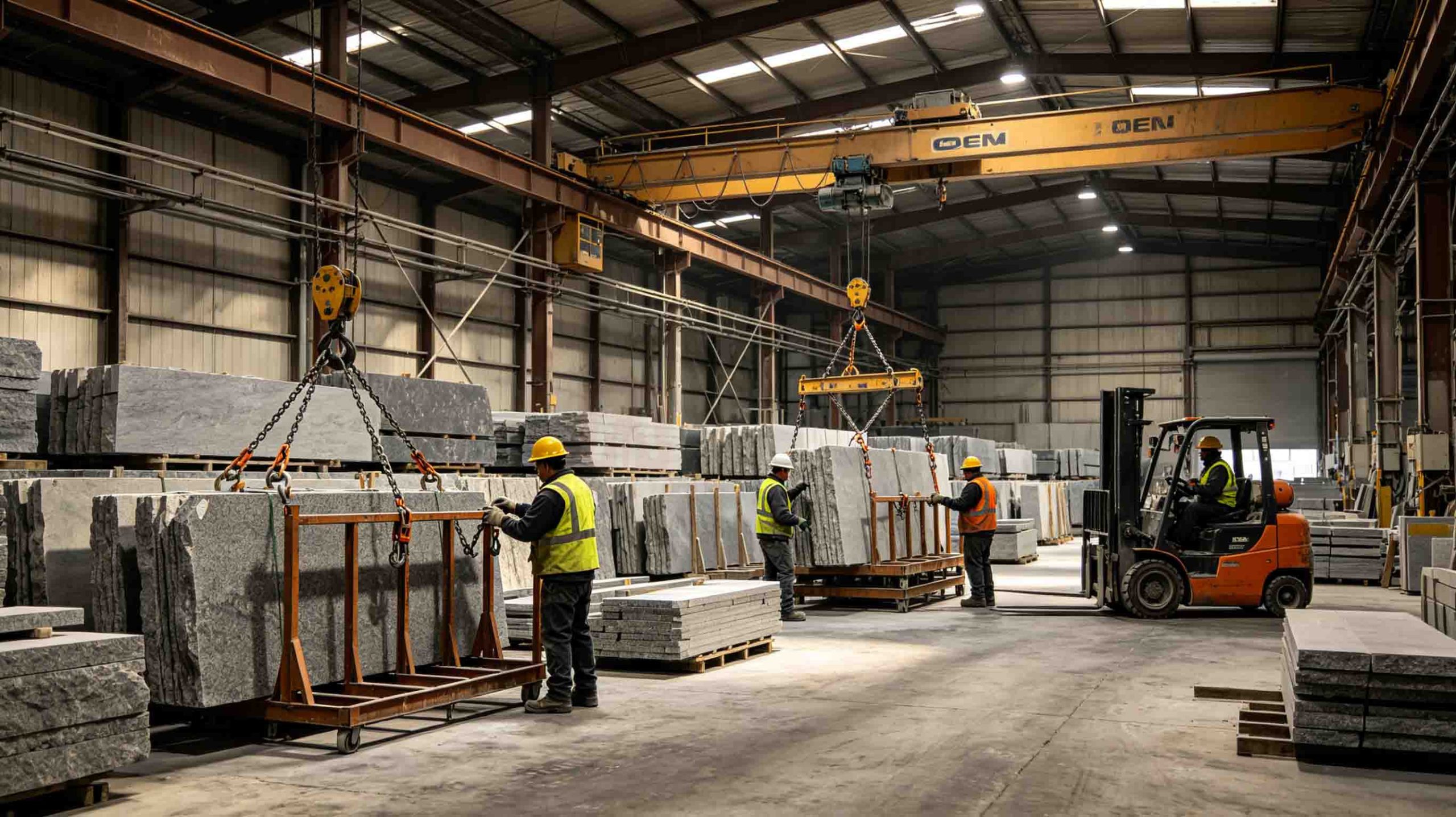
OEM stone factory producing stone transport and lifting equipment for industrial applications
Evaluate the Supplier’s Product Ecosystem
A strong supplier should offer more than isolated products. Stone factories need systems, not random equipment. A supplier with a complete product ecosystem can help buyers create a more connected workflow from slab receiving to storage, lifting, fabrication, transport, waste handling, and container loading.
The best suppliers provide integrated factory solutions, including:
- Slab transport systems
- Storage racks
- Lifting equipment
- Waste management systems
- Fabrication support equipment
- Display racks and showroom solutions
- Container loading and export equipment
- Forklift attachments and handling tools
For heavy lifting applications, industrial attachments such as
les systèmes à double flèche pour chariots élévateurs
can significantly improve operational efficiency by extending the capability of existing forklifts. This kind of solution is especially useful for factories that want to improve lifting flexibility without immediately investing in fixed crane infrastructure.
A supplier with a complete ecosystem is also more likely to understand how one equipment choice affects another. For example, if a factory upgrades slab storage but ignores lifting equipment, the workflow may still remain slow. If a factory buys a forklift boom but lacks proper transport racks, slab movement may still create risk. Integrated planning prevents these mismatches.
Comparison of Supplier Types
| Supplier Type | Meilleur pour | Avantages | Limitations |
|---|---|---|---|
| Trading Company | Simple product sourcing | Wide sourcing network, fast quotation | Limited customization and weaker technical control |
| OEM Stone Factory | Customized equipment and long-term supply | Better technical support, direct manufacturing, custom design | May require clearer specifications from buyer |
| Local Distributor | Fast local delivery and simple after-sales | Convenient communication and local stock | Higher price and limited customization |
| Integrated Solution Supplier | Factory workflow optimization | Can combine storage, lifting, transport, and logistics solutions | Requires deeper project discussion before purchase |
Safety and Labor Efficiency Matter
Modern factories increasingly prioritize automation and ergonomic handling systems because labor cost is rising and experienced workers are becoming harder to retain. Manual slab handling is not only slow; it is also risky. Stone slabs are heavy and fragile, and poor handling methods can injure workers or damage materials.
For example, studies comparing
vacuum lifters versus manual labor
show major improvements in productivity and safety when factories reduce manual lifting. While manual labor may seem cheaper at first, the hidden cost includes fatigue, injury risk, inconsistent handling, slower movement, and higher breakage rates.
Likewise, advanced handling technologies such as
clamp lifting systems
are becoming essential in modern workshops. A good supplier should be able to recommend whether clamp lifters, vacuum lifters, forklift booms, A-frames, or crane systems are more suitable based on your actual workflow.
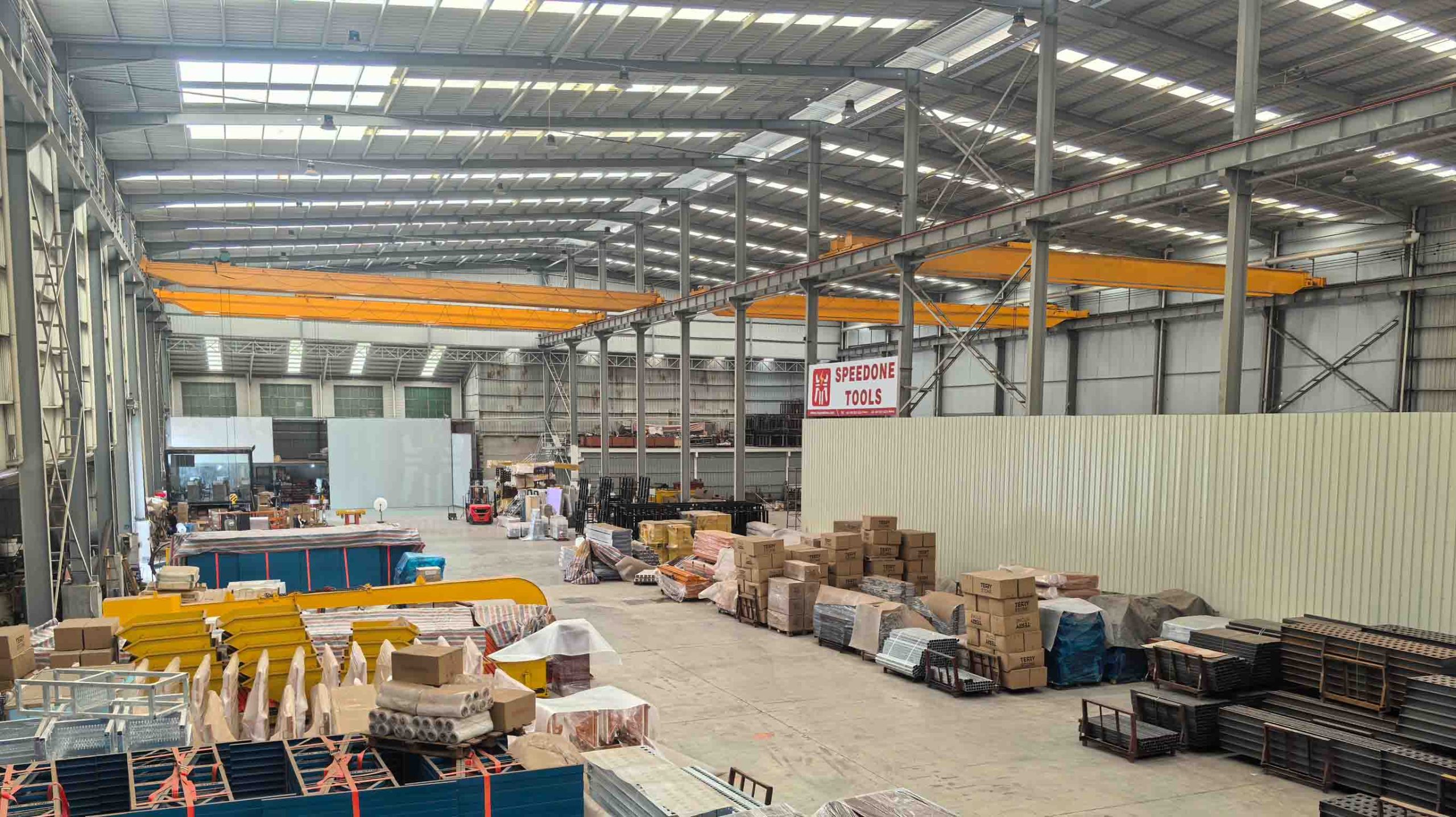
Factory diagram
How Reliable Suppliers Improve Factory Efficiency
A professional supplier should understand how different systems work together inside a factory environment. Efficiency does not come from one machine alone. It comes from reducing unnecessary movement, improving material access, lowering breakage risk, and making each workstation easier to operate.
For example, optimized slab storage systems can dramatically improve workflow efficiency. This is clearly demonstrated in
this analysis of professional slab rack systems
.
When slabs are organized properly, workers spend less time searching, forklifts move more efficiently, and factories reduce the risk of unsafe stacking.
Some suppliers also provide full workflow optimization support. A good example is shown in
this case study on slab handling efficiency
.
This type of supplier value goes beyond product delivery. It helps factories move from reactive problem-solving to planned efficiency improvement.
Beyond Equipment: Presentation and Fabrication Support
Reliable suppliers also help improve customer presentation and downstream processing efficiency. In many stone businesses, showroom organization directly affects sales. If customers cannot view slabs easily, compare materials clearly, or inspect surfaces safely, the showroom loses conversion potential.
For example, display systems such as
professional slab display racks
can improve showroom conversion rates by making slabs easier to view and select. This is important for distributors, retailers, and fabricators who sell directly to designers, contractors, or homeowners.
Similarly, production systems continue to evolve with innovations like
modern fabrication table designs
.
A better fabrication table improves stability, operator comfort, and production consistency.
Loading efficiency is also important for exporters. Equipment such as
container U-shaped cranes
helps simplify heavy slab loading operations and reduce risks during container preparation.
If X, Choose Y: Decision Logic for Buyers
Many buyers ask what type of supplier they should choose. The answer depends on the problem they need to solve.
If you only need a simple standard product, a trading company or local distributor may be enough. This works for low-risk purchases where customization and technical support are not critical.
If your factory needs custom sizes, special load ratings, or workflow-specific equipment, choose an OEM stone factory. OEM suppliers can adjust equipment design based on real operating conditions.
If your main problem is slab movement and factory congestion, choose a supplier with transport and storage expertise. The right solution may include A-frames, slab racks, forklift attachments, and optimized layout planning.
If your main concern is safety and labor reduction, choose a supplier strong in lifting and ergonomic handling systems. This may include vacuum lifters, clamp lifters, cranes, and powered transport tools.
If you export slabs or finished stone products, choose a supplier that understands container loading, packing, and shipping workflow. Export equipment must be designed for stability, loading efficiency, and long-distance transport conditions.
Questions to Ask Before Choosing a Stone Equipment Supplier
- Can the supplier provide OEM customization?
- What industries and export markets do they serve?
- Do they offer after-sales technical support?
- Can they provide integrated factory solutions?
- What safety certifications or standards do their products follow?
- Can they provide load capacity information?
- Do they understand your slab dimensions and workflow?
- Can they support spare parts and maintenance guidance?
- Do they have experience with international shipping?
- Can they recommend solutions instead of only quoting products?
These questions help separate a real solution provider from a basic seller. A supplier that cannot answer technical questions clearly may not be able to support your factory after the sale.
Common Buying Mistakes and Their Consequences
Mistake 1: Choosing only by lowest price. Low purchase price may hide weak steel, poor welding, short service life, poor finish quality, or lack of spare parts. The real cost appears later through breakdowns, downtime, and replacement purchases.
Mistake 2: Buying equipment without sharing factory layout. Equipment that looks suitable in a catalog may not fit your aisle width, forklift route, loading zone, or slab storage area. Layout mismatch creates daily workflow problems.
Mistake 3: Ignoring after-sales support. Stone factories depend on equipment uptime. If a supplier cannot provide parts, guidance, or troubleshooting support, even a small problem can delay production.
Mistake 4: Assuming all OEM suppliers are the same. Real OEM capability requires engineering understanding, production control, testing, and customization experience. Some suppliers only offer superficial changes.
Mistake 5: Buying isolated products instead of workflow solutions. A single product may solve one problem but create another if it does not fit the overall production system.
Risk Table: What Happens When the Supplier Choice Is Wrong?
| Wrong Decision | Immediate Problem | Long-Term Consequence |
|---|---|---|
| Choosing only by low price | Lower product quality or weak components | Higher maintenance cost and shorter service life |
| No OEM support | Equipment does not match workflow | Poor efficiency and repeated operational problems |
| Weak after-sales service | Slow troubleshooting and parts delays | Production downtime and delivery delays |
| Limited product ecosystem | Solutions remain disconnected | Factory bottlenecks continue |
| Poor safety design | Higher handling risk | Worker injury, slab damage, liability issues |
Benefits of Working with a Reliable Stone Equipment Supplier
- More stable equipment quality
- Better workflow compatibility
- Reduced slab damage risk
- Amélioration de la sécurité des travailleurs
- Lower long-term maintenance cost
- Faster production and logistics flow
- Stronger OEM customization support
- More reliable spare parts availability
- Better export and packaging support
- Improved factory scalability
The value of a reliable supplier becomes clearer over time. Good equipment reduces daily friction. Workers operate more safely. Materials move faster. Maintenance becomes more predictable. Factory managers spend less time solving avoidable problems.
For growing stone businesses, supplier reliability also supports expansion. As order volume increases, the factory needs equipment that can scale. A supplier who understands your workflow can help add new systems without disrupting existing operations.
Why Many Global Buyers Work with China Stone Equipment Manufacturers
Many global buyers source stone handling and logistics equipment from China manufacturers because of competitive pricing, strong manufacturing capacity, customization flexibility, and broad experience with stone industry applications. China suppliers often serve factories, distributors, exporters, and contractors across multiple markets, giving them practical knowledge of different operating conditions.
However, buyers should still evaluate suppliers carefully. A good China OEM stone factory should provide clear communication, product specifications, drawings when needed, load information, production photos, packaging details, and after-sales support. Price advantage is valuable only when quality and service are also reliable.
The best approach is to treat supplier selection as a long-term partnership rather than a one-time purchase. A supplier that understands your factory can help you improve transport, storage, lifting, fabrication support, waste handling, and export loading step by step.
Maintenance and Lifecycle Management
Reliable suppliers also help buyers think beyond the purchase date. Every piece of stone equipment has a lifecycle. Racks, carts, lifting tools, forklift attachments, and fabrication equipment all need inspection and maintenance.
Factories should check welding points, moving parts, wheels, pads, hydraulic components, safety locks, structural deformation, rust, and load-bearing areas regularly. Preventive maintenance helps reduce downtime and protects workers.
A strong supplier can provide maintenance guidance, spare parts, and practical recommendations for long-term use. This is one of the biggest differences between a professional supplier and a low-price seller.
Recommendation Framework for Buyers
If your factory is small and mainly needs basic handling tools, focus on durable, easy-to-maintain products with reliable spare parts.
If your factory is growing, choose a supplier with a wider product ecosystem so future upgrades can connect smoothly with existing equipment.
If you handle heavy slabs or large-format materials, prioritize safety, load capacity, and handling stability over low price.
If you export regularly, choose a supplier who understands container loading, A-frame systems, packing requirements, and logistics efficiency.
If you want customized solutions, work directly with an OEM stone factory that can adjust product design based on your slab sizes, factory layout, and workflow.
Soft CTA
The smartest next step is not asking for the cheapest quotation first. It is reviewing your current workflow and identifying the biggest source of loss. Are slabs breaking during handling? Are workers wasting time moving materials? Is your storage area disorganized? Are forklifts congested? Are machines idle because materials are not delivered efficiently? Once the real bottleneck is clear, choosing the right stone equipment supplier becomes easier and much less risky.
Note finale / conclusions pratiques
Choosing the right stone equipment supplier is not simply about price. It is about long-term reliability, safety, workflow compatibility, OEM capability, and operational efficiency. A professional OEM stone factory should provide integrated solutions that reduce slab damage, improve handling efficiency, support factory growth, and lower lifecycle cost. Buyers should evaluate suppliers as long-term partners, not just product sellers.
Références
- ISO 12100: Safety of Machinery – General Principles for Design
- OSHA Materials Handling and Storage Guidelines
- ISO 9001 Quality Management Principles
- EN 13155: Cranes – Safety – Non-fixed Load Lifting Attachments
- Natural Stone Institute – Stone Industry Technical Resources
- General industrial equipment lifecycle and maintenance best practices
FAQ
1. What should I look for in a stone equipment supplier?
Vous devriez évaluer l'expérience en fabrication, la capacité d'OEM, la qualité des produits, les normes de sécurité, le support après-vente, la capacité de personnalisation, ainsi que la compréhension par le fournisseur du flux de travail de votre usine.
2. What is an OEM stone factory?
Une usine de pierres OEM fabrique des solutions d'équipements sur mesure en fonction des exigences du client, notamment la taille des dalles, la capacité de charge, l'aménagement de l'usine, la méthode de manutention et les besoins de production.
3. Why is after-sales support important?
Un support après-vente fiable contribue à réduire les temps d'arrêt, à résoudre les problèmes techniques, à fournir des pièces de rechange et à garantir la performance à long terme de l'équipement.
4. How can suppliers improve factory efficiency?
Des fournisseurs professionnels proposent des solutions intégrées de manutention, de stockage, de levage, de fabrication, de gestion des déchets et de logistique qui réduisent les goulots d'étranglement et améliorent le flux de travail.
5. Are customized equipment solutions better than standard products?
Dans de nombreux cas, les solutions OEM personnalisées sont meilleures car elles correspondent à des configurations d'usine spécifiques, à des tailles de dalles, à des méthodes de levage et à des exigences opérationnelles particulières.
6. Is the lowest-price supplier always the best choice?
Non. Le prix le plus bas peut entraîner une qualité médiocre, un support insuffisant, une durée de vie courte ou une mauvaise compatibilité avec le flux de travail. Les acheteurs devraient évaluer le coût du cycle de vie, et pas seulement le prix d'achat.
7. Why do many buyers choose China stone equipment manufacturers?
De nombreux acheteurs choisissent les fabricants chinois car ceux-ci offrent des prix compétitifs, une personnalisation OEM, une forte capacité de production ainsi qu'une vaste expérience dans le domaine de la manutention des pierres et des équipements logistiques.
8. What questions should I ask before buying stone equipment?
Vous devriez vous renseigner sur la capacité de charge, les options de personnalisation, les pièces de rechange, la garantie, les matériaux du produit, la conception sécurisée, l'expérience en matière d'exportation, le délai de livraison, ainsi que sur la question de savoir si le fournisseur peut recommander des solutions adaptées à votre flux de travail.

Henri
Bonjour, je suis l'auteur de cet article et je travaille dans ce domaine depuis plus de 16 ans. Si vous avez besoin d'un service OEM&ODM pour les outils en pierre, n'hésitez pas à me poser des questions.